

Study in France

Don't know what to do?
Get Free Counseling
Last Updated: 31 August 2026
Study in France: Universities, Visa, Scholarships, Cost and Application Process
France is one of the top countries in the world for international students. It is always ranked among the top 5 study destinations. Every year, more than 400,000 students from different countries choose to study in France. Around 10,000 Indian students are currently studying there, and this number is increasing by about 15% in recent years.
France is popular because it has high-quality universities, globally accepted degrees, and lower education costs compared to other countries. French universities are well-known for courses such as engineering, business, fashion, arts, culinary, and international relations. The country also has special institutions called grandes écoles, which are famous for producing top professionals in engineering and business.
France is also strong in research and innovation. Students can work on modern research projects and use advanced facilities. The education system in France focuses on improving thinking skills, creativity, and practical knowledge, which are very important for jobs today.
For Indian students, France offers a great quality education, cultural experience, and good career opportunities.
*Want to study abroad? Sign-up with Y-Axis for expert guidance
Why Study in France?
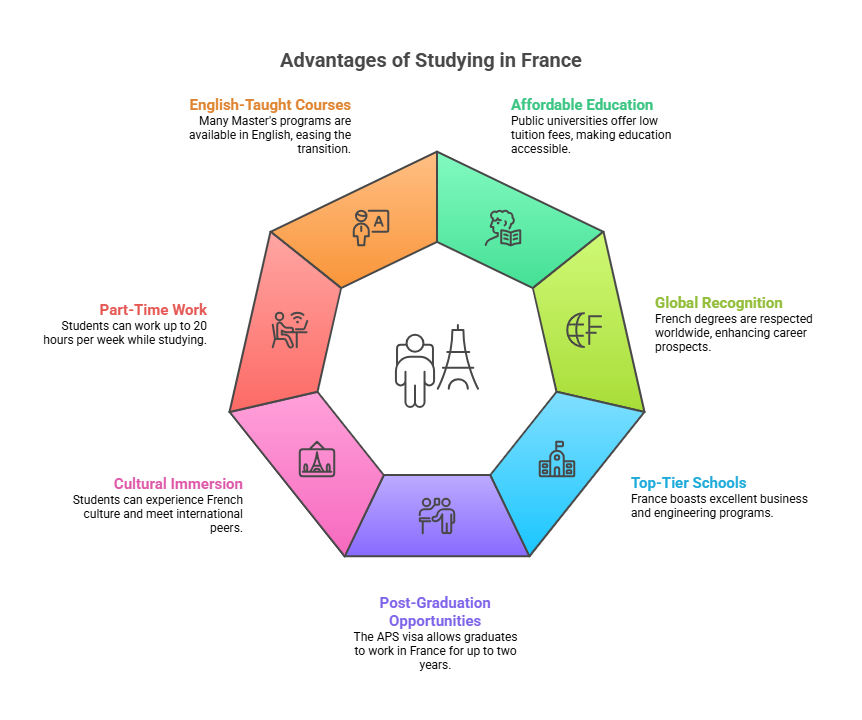
- Public universities have low tuition fees, even for international students
- Degrees from France are accepted and respected all over the world
- France has some of the best business and engineering schools
- Students can stay and work for up to 2 years after graduation (APS visa)
- You can experience a rich culture and meet students from many countries
- Students are allowed to work up to 20 hours per week while studying
- Many courses are available in English, especially for Master’s programs
Top Universities in France for International Students
When you study in France, you have access to some of the most prestigious French universities and Grandes écoles known for their academic excellence and wide range of English-taught programs. Leading institutions like Sorbonne University, Université Paris-Saclay, École Normale Supérieure de Lyon, and HEC Paris consistently rank among the best globally, offering diverse courses in engineering, business, humanities, and more. These universities provide excellent opportunities for international students in France seeking quality education and strong career prospects.
| University | QS Ranking 2024 |
|---|---|
| PSL University Paris | 28 |
| Polytechnic Institute of Paris | 41 |
| Sorbonne University | 72 |
| Paris-Saclay University | 70 |
| Higher Normal School of Lyon | 205 |
| Paris City University | 300 |
| Grenoble Alpes University | 321 |
| Sciences Po Paris | 367 |
| Pantheon-Sorbonne University | 257 |
| University of Montpellier | 430 |
| Aix-Marseille University | 428 |
| National Institute Of Applied Sciences In Lyon | 406 |
| University of Strasbourg | 420 |
| Claude Bernard University Lyon 1 | 587 |
| University of Bordeaux | 494 |
Popular Courses to Study in France
France offers a wide range of courses for international students across different fields. The country is especially known for its strong programs in engineering, business, fashion, arts, and hospitality. Many courses focus on practical learning, industry exposure, and global career opportunities. Students can choose from short-term programs to long-duration degrees based on their interests and career goals.
Here are some of the most popular courses to study in France:
| Name of the Programme | Duration | Popular Courses / Specializations |
|---|---|---|
| Engineering | 3–5 years (Bachelor's/Grande École) | Aerospace Engineering, Mechanical Engineering, Civil Engineering, Electrical Engineering, Mechatronics |
| Business Management / MBA | 1–2 years | International Business, Finance, Marketing, Luxury Brand Management, Supply Chain, MBA |
| Humanities and Arts | 3 years | Philosophy, History, Fine Arts, Literature, Media Studies, Fashion Design |
| Computer Science & IT | 2 years | Computer Science, Artificial Intelligence, Data Science, Cybersecurity, Software Engineering |
| Social Sciences | 2–3 years | Political Science, Sociology, International Relations, Public Policy, European Studies |
| Law | 1–3 years (LLM), 4–5 years (full program) | International Law, European Law, Business Law, Intellectual Property Law |
| Natural Sciences | 2–3 years | Physics, Chemistry, Biology, Environmental Science, Biotechnology |
| Medicine | 6–9 years | General Medicine, Dentistry, Pharmacy, Medical Research |
| Culinary & Hospitality | 1–3 years | Culinary Arts, Hotel Management, Wine & Gastronomy, Event Management |
| Fashion & Design | 2–3 years | Fashion Design, Luxury Management, Interior Design, Graphic Design |
*Want to study masters in France? Contact Y-Axis for complete assistance
Study Programs in France
France offers a wide range of study programs for international students at different levels, including bachelor’s, master’s, and MBA degrees. These programs are designed to provide high-quality education, global exposure, and strong career opportunities across industries.
Bachelor’s programs in France usually take 3 years to complete and are offered by public universities and specialized institutions. Students can choose from fields like engineering, business, arts, humanities, and science. Many programs are available in French, but there are also English-taught options in selected universities.
Master’s programs are one of the most popular choices for international students and typically last 2 years. France offers a wide range of specializations such as data science, artificial intelligence, finance, international business, and engineering. Many master’s programs are taught in English, making it easier for international students to apply.
France is home to some of the world’s top business schools offering globally recognized MBA programs. These programs usually take 1 to 2 years to complete and focus on leadership, management, and global business skills. Popular MBA specializations include finance, marketing, luxury brand management, and entrepreneurship.
Overall, studying in France at any level provides students with strong academic knowledge, international exposure, and excellent career opportunities in global markets.
Cost of Studying in France
The cost of studying in France is one of the main reasons why Indian students choose it. Compared to many other countries, France offers better value with good quality education and affordable living costs.
Tuition Fees at Public and Private Universities
| University Type | Tuition Fee Range | Notes |
|---|---|---|
| Public Universities | €2,770–€3,770 per year | Subsidized by the French government; PhD fees as low as €380/year |
| Grandes Écoles (Engineering/Business) | €3,000–€15,000 per year | Higher fees for top-ranked and English-taught programs |
| Private Universities | €5,000–€20,000 per year | Higher fees for specialized or career-focused programs |
| MBA Programs | Up to €60,000 (total) | Fees vary significantly by institution and program type |
Cost of Living in France
Living costs in France depend on the city. Paris is significantly more expensive than other French cities like Lyon, Toulouse, Bordeaux, or Strasbourg.
Average Monthly Expenses:
- Accommodation: ₹30,000 – ₹60,000
- Food: ₹12,000 – ₹18,000
- Health Insurance: ₹3,000 – ₹6,000
- Transport: ₹3,000 – ₹5,000
- Miscellaneous (mobile, leisure, study materials): ₹8,000 – ₹12,000
- Estimated monthly cost: ₹56,000 – ₹1.01 lakh
- Estimated annual living cost: ₹7 lakh – ₹12.5 lakh
Students must show proof of financial means of at least €615 per month (€7,380 per year) for visa purposes.
*Read more...
Top Scholarships to Study in France for Indians
France offers several scholarship opportunities for international students through the French government, Campus France, universities, and private foundations. Scholarships primarily help students cover tuition fees, living expenses, travel costs, and research expenses.
| Scholarship Name | Scholarship Amount | Eligibility |
|---|---|---|
| Eiffel Excellence Scholarship Programme | €1,181/month (Master's); €1,400/month (PhD) | Open to international students with outstanding academic record; for Master's and PhD applicants |
| BGF – French Embassy Scholarship | Varies by program | Open to Indian students applying for Master's or PhD programs in France |
| Erasmus+ Scholarship | Covers tuition, travel, and living expenses | Open to students enrolled in Erasmus partner programs; selection based on academic merit |
| CNRS International PhD Program | Fully funded PhD | Open to students with a Master's degree in science and technology fields |
| Charpak Scholarship Program | Up to €700/month + other benefits | Open to Indian students for Master's, internship, or exchange programs in France |
| Campus France Grants | Varies by partner country and program | Open to Indian students through bilateral agreements between India and France |
| Sciences Po Scholarship | Up to full tuition + living allowance | Open to talented international students based on financial need and academic merit |
| HEC Paris Scholarships | Up to €30,000 | Open to MBA and Master's students based on merit and financial need |
| Marie Skłodowska-Curie Actions (MSCA) | €3,000/month + €600 transport allowance | Open to researchers of all nationalities for research programs in EU countries including France |
*Want to apply for Scholarships in France? Y-Axis is here to assist you with the process
Eligibility Requirements to Study in France
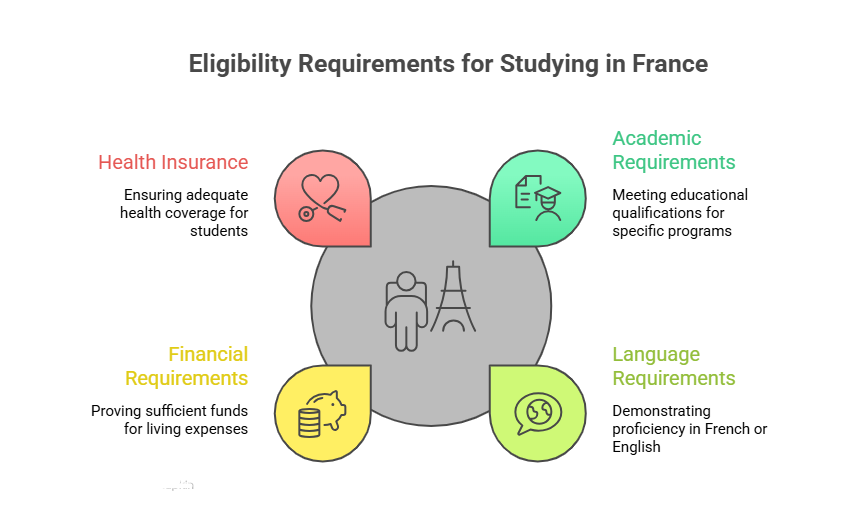
To study in France, students must meet certain academic, language, and financial requirements:
Academic Requirements
- For Bachelor’s programs: A valid 12th-grade certificate is required
- For Master’s programs: A completed bachelor’s degree in a relevant field is required
- Some universities may require minimum academic scores or a foundation year
Language Requirements
- For French-taught programs: DELF B2 or DALF C1/C2 certification
- For English-taught programs: IELTS (minimum 6.0–6.5) or TOEFL scores
Financial Requirements
- Proof of funds: Minimum €615 per month (€7,380 per year)
- Can be shown through bank statements, scholarships, or sponsor documents
Health Insurance Requirement
- Students under 28: Covered under French student health system (CPAM)
- Students above 28: Must take private health insurance (€50–€150/month)
Application Process to Study in France for Indians
Follow these steps to apply for studying in France:
Step 1: Select the right course and university based on factors like course content, specialization, university ranking, location, living costs, language of instruction, and availability of scholarships.
Step 2: Indian students must apply through the Études en France platform, which is mandatory before applying for a student visa.
Step 3: Know the Intakes. France mainly offers two intakes: the Fall intake (September–October), which has the most programs available, and the Spring intake (January–February), which has limited options. It is recommended to apply at least 4–6 months in advance.
Step 4: Non-EU students must apply for a long-stay student visa (VLS-TS), which also acts as a residence permit for one year and must be validated within three months of arrival in France.
Step 5: Arrange accommodation from options such as CROUS housing, shared apartments, private rentals, or homestays. It is important to apply early, especially for affordable student housing.
Step 6: Complete enrollment before the semester begins and will receive their student ID card and login details after enrollment.
Step 7: After reaching France, students must validate their VLS-TS visa online through the ANEF portal within three months.
Step 8: Once all formalities are completed, students should register their address, open a bank account, apply for housing assistance (CAF), explore part-time job opportunities, and join student groups to build their social and professional network.
France Student Visa
A France student visa is required for international students who want to study in France for more than 90 days. This visa is called the long-stay student visa (VLS-TS). It allows students to stay in France for their course duration and also acts as a residence permit for the first year. To apply, students must first receive an admission letter from a recognized French institution and complete their registration through the Campus France process.
Types of France Student Visa
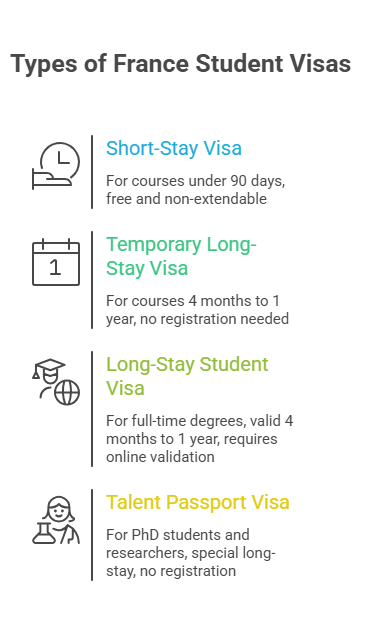
If you are planning to study in France, you should know the different types of student visas based on how long your course is:
Short-Stay Visa (Visa de Court Séjour): This visa is for short courses, language classes, or summer programs that last less than 90 days. There is also a special type called étudiant-concours for students who travel to France to write entrance exams. This visa is free and cannot be extended.
Temporary Long-Stay Visa (VLS-T): This visa is for courses that last between 4 months and up to 1 year, such as exchange programs. You do not need to register this visa after arriving in France, and it cannot be renewed.
Long-Stay Student Visa (VLS-TS): This is the most common visa for students studying full-time programs like bachelor’s or master’s degrees. It is valid for 4 months to 1 year and also works as a residence permit. Students must validate it online within 3 months after arriving in France. After one year, you need to apply for a residence permit to continue your stay.
Talent Passport Visa (Passeport Talent): This visa is for PhD students and researchers. It is a special long-stay visa and does not need to be registered after arriving in France.
Requirements for France Student Visa
- Valid passport (valid for at least 6 months beyond the intended stay, with blank pages)
- Completed and signed visa application form (via TLS Contact portal)
- Recent biometric passport-size photographs
- Proof of enrollment or letter of admission from a French university
- Campus France registration number and clearance
- Proof of financial means (minimum €615/month; bank statements, sponsorship letter, or scholarship letter)
- Proof of accommodation in France (CROUS reservation or private lease agreement)
- Health insurance coverage for the duration of stay
- Academic certificates and transcripts (Class 10, 12, and graduation mark sheets)
- Language proficiency certificates (IELTS/TOEFL for English-taught programs; DELF/DALF for French-taught programs)
- Statement of Purpose (SOP) and Curriculum Vitae (CV)
- Visa application fee payment receipt
Steps to Apply for a France Student Visa from India
Step 1: First, get admission from a recognized university or college in France. You need an offer letter before starting your visa process.
Step 2: Create an account on Campus France and upload your documents like academic records, language scores, resume (CV), and SOP. This step is compulsory.
Step 3: Attend the interview as scheduled. After the interview, you will receive a confirmation certificate.
Step 4: Go to the France-Visas website and fill out the student visa form carefully. Make sure all details match your documents.
Step 5: Collect all important documents such as your admission letter, passport, proof of funds (about €820 per month), accommodation proof, travel insurance, and academic certificates.
Step 6: Book your visa appointment through VFS Global. Centres are available in major cities in India.
Step 7: Visit the VFS centre with all your documents. They will check your application and take your photo and fingerprints.
Step 8: Pay the visa fee (around ₹8,000) along with Campus France service charges.
Step 9: Visa processing usually takes 2 to 4 weeks. It is better to apply at least 2–3 months before your course starts.
Step 10: After reaching France, you must validate your visa online within 3 months to stay legally in the country.
France Student Visa Fee
The standard long-stay student visa fee for France is €50. The amount in Indian rupees may change depending on the exchange rate. Students should pay the visa fee during the application process. In some special cases, the fee may be different.
France Student Visa Processing Time
The student visa process can take several weeks. For Indian students, it is better to apply at least three months before the course starts. Processing can take longer during busy periods. Students should submit their documents correctly and apply as soon as they receive their university admission letter.
Students are advised to:
- Complete the Campus France process early.
- Submit all required documents correctly.
- Apply soon after receiving the university admission letter.
- Allow extra time during busy application periods.
- Check their application status regularly.
- Respond quickly if additional documents are requested.
Part-Time Jobs in France for Indian Students
Part-time work allows Indian students in France to manage living expenses and gain international work experience. International students holding a valid student visa are permitted to work up to 964 hours per year, approximately 20 hours per week during semesters. During academic holidays, students may work full-time within the annual limit.
Students can find part-time jobs through university career boards, job portals like Indeed France, LinkedIn, and JobEtudiant, or directly through hospitality, retail, and logistics companies. Basic French language proficiency significantly increases job opportunities, especially in customer-facing roles.
| Job Type | Average Salary (Approx.) |
|---|---|
| Restaurant / Café Staff | €11.88–€14 per hour |
| Supermarket / Retail Assistant | €11.88–€14 per hour |
| Delivery Jobs | €12–€15 per hour |
| Warehouse / Logistics Assistant | €12–€14 per hour |
| Private Tutor | €15–€25 per hour |
| University Student Assistant | €12–€18 per hour |
| IT Support / Technical Assistant | €15–€22 per hour |
| Hospitality / Hotel Staff | €12–€15 per hour |
The minimum wage in France (SMIC) is approximately €11.88 per hour (as of 2025). Most part-time roles pay at or above this rate. Earnings help students offset living costs and also contribute to social security contributions, which may be beneficial later.
Post-Study Work and Placement Opportunities
France offers excellent career opportunities for international graduates. The country's strong and diversified economy with leading sectors in aerospace, automotive, luxury and fashion, financial services, tourism, and technology, creates sustained demand for skilled professionals, including Indian graduates.
Post-Study Work Visa in France (APS)
After completing a Master's degree or equivalent higher qualification from a French institution, Indian students can apply for the Autorisation Provisoire de Séjour (APS) — a 2-year post-study work authorization. This permit allows graduates to:
- Stay in France and search for a job related to their field of study
- Work in any job during the search period
- Transition to a Talent Passport (Passeport Talent) or EU Blue Card upon finding relevant employment
This 2-year window gives Indian students ample time to explore job opportunities, build their professional network, and establish themselves in the French or broader European job market.
Intakes in France
France offers two main intakes for international students. The Autumn intake is the primary intake with the highest number of courses available, while the Spring intake has limited program options. It is important to understand the timelines and apply early to secure admission and complete the visa process smoothly.
| Intake | Start Month | Programs Available | Admission Deadlines |
|---|---|---|---|
| Autumn (Primary) | September | Undergraduate & Postgraduate (widest selection) | April – July |
| Spring (Secondary) | January / February | Select UG & PG programs only (limited availability, mainly private/business schools) | October – November |
Path to Permanent Residency (PR) in France
After completing their degree and working in France, Indian students can eventually apply for a Long-Stay Residence Permit and, after 5 years of legal and continuous residence, a Carte de Résident (Permanent Residency). Requirements include:
- Minimum 5 years of continuous and legal residence in France
- Proof of stable employment and income
- French language proficiency at B1 level minimum
- Integration into French society (civic and civic knowledge test)
- Clean legal and criminal record
Graduates who hold an EU Blue Card may qualify for permanent residency after just 3 years under certain conditions.
Build Your Career in France
Studying in France is a smart choice for Indian students who want a good quality education at an affordable cost. France has top universities, strong research opportunities, and good career options across Europe. It offers a great mix of education, cultural experience, and career growth. Compared to many other countries, France gives better value for money, especially in public universities, along with an enjoyable student life. With proper planning, applying for scholarships early, and preparing your visa documents correctly, you can easily achieve your dream of studying in France. France is not just a place to study, but also a place to grow and build a successful international career.
How Can Y-Axis Help You?
Y-Axis offers complete support for students planning to study in France, with transparent and personalized guidance.
Our services include:
- Free eligibility assessment for French universities and grandes écoles.
- Expert guidance on course and university selection.
- IELTS/PTE coaching through Y-Axis coaching services.
- SOP, LOR, and application assistance.
- Campus France registration support.
- France student visa documentation and interview preparation.
Looking for inspiration
Explore what Global Indians have to say about Y-Axis in shaping their future