

Study in UK

Don't know what to do?
Get Free Counseling
Last Updated: 14-08-2026
Study in the UK for Indians: Universities, Fees, Scholarships & Visa
The UK is home to some of the world's best universities and offers many courses for international students. Students from different countries choose the UK for its quality education, wide range of study options, and career opportunities after graduation. In 2024/25, more than 685,000 international students studied in UK higher education. In 2025, the UK also granted 426,471 sponsored study visas.
Students can study subjects such as business, engineering, computer science, data science, medicine, and finance at undergraduate, postgraduate, and research levels. The UK also offers scholarships and post-study work options for eligible international students. If you plan to study in the UK, you may need a UK Student visa for an eligible full-time course. The visa application fee is £558, and students may also need to pay the Immigration Health Surcharge (IHS) of £776 per year. If you need to show proof of money, you must have enough funds to cover your tuition fees and living costs of £1,483 per month in London or £1,136 per month outside London, for up to 9 months. From 1 January 2027, the Graduate Route stay period will change from 2 years to 18 months for eligible graduates applying from that date.
*Want to study in UK? Sign-up to Y-Axis for complate guidance and assistance
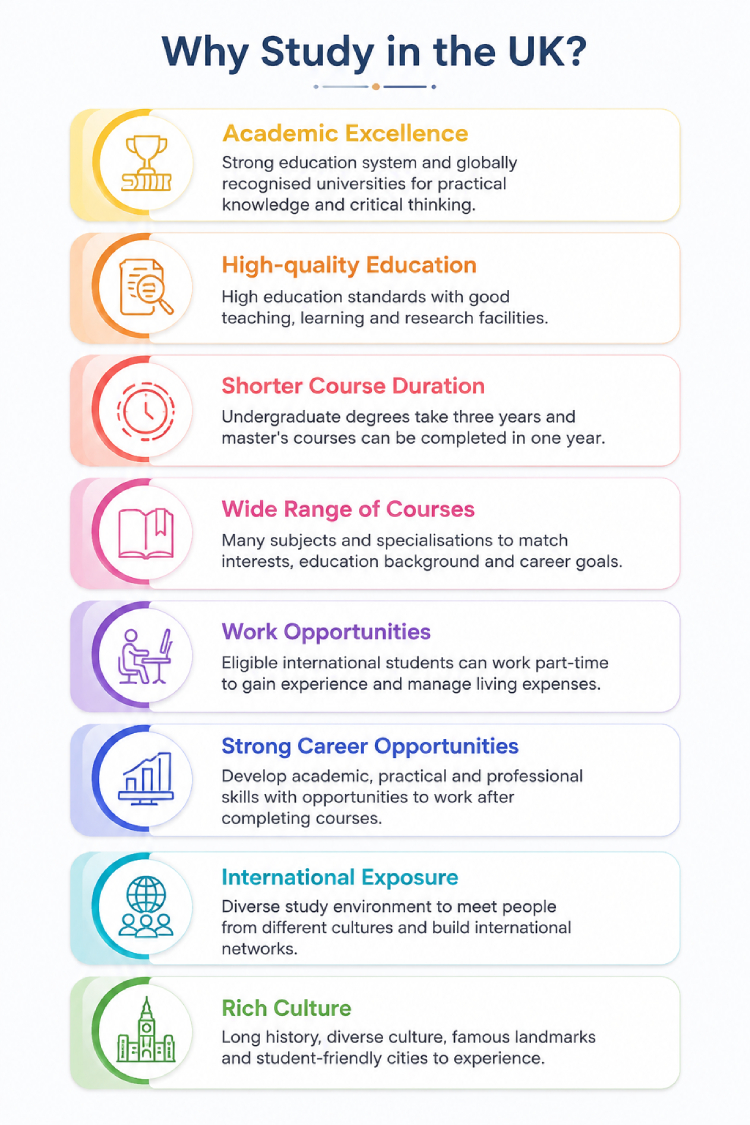
Why Study in the UK?
- Academic excellence: The UK is known for its strong education system and globally recognised universities. Students can develop practical knowledge, critical thinking and skills that are useful for their future careers.
- High-quality education: UK universities follow high education standards and offer good teaching, learning and research facilities. Students can gain quality education across a wide range of subjects.
- Shorter course duration: Many UK degrees take less time to complete than similar courses in other countries. Most undergraduate degrees take three years, while many master's courses can be completed in one year.
- Wide range of courses: UK universities offer courses in many subjects and specialisations. Students can find programmes that match their interests, education background and career goals.
- Work opportunities while studying: Eligible international students can work part-time during their studies, subject to their Student visa conditions. This can help students gain work experience and manage some of their living expenses.
- Strong career opportunities: UK education helps students develop academic, practical and professional skills. The country also offers opportunities to gain work experience after completing an eligible course.
- International exposure: The UK attracts students from many countries, creating a diverse study environment. Students can meet people from different cultures and build an international network.
- Rich culture and lifestyle: The UK has a long history, diverse culture, famous landmarks and many student-friendly cities. International students can experience a different culture while completing their education.
Top Universities in UK for Indian Students
The UK is home to many of the world's leading universities and offers a wide range of courses for international students. UK universities are known for their strong academic standards, research facilities, global reputation and career opportunities.
For Indian students, universities in cities such as London, Oxford, Cambridge, Edinburgh and Manchester are popular choices. They offer a wide range of courses and have diverse international student communities.
Below are some of the top universities in the UK along with their QS World University Rankings:
| University | QS World University Rankings |
|---|---|
| Imperial College London | 2 |
| University of Oxford | 4 |
| University of Cambridge | 6 |
| University College London (UCL) | 9 |
| King's College London | 37 |
| University of Edinburgh | 34 |
| University of Manchester | 40 |
| University of Bristol | 57 |
| London School of Economics and Political Science (LSE) | 62 |
| University of Warwick | 68 |
| University of Birmingham | 68 |
| University of Leeds | 77 |
| University of Glasgow | 80 |
| The University of Sheffield | 82 |
| Durham University | 85 |
| University of Nottingham | 97 |
Top Courses to Study in the UK
The UK offers many courses for international students in areas such as business, technology, engineering, medicine, law and social sciences. Many UK universities are also highly ranked for these subjects.
Below are some of the popular courses in the UK and the universities known for these subjects:
| Popular Course | Top UK Universities |
|---|---|
| Business & Management | University of Oxford, University of Cambridge, LSE, Imperial College London |
| Computer Science & IT | University of Oxford, Imperial College London, University of Cambridge, UCL |
| Engineering | Imperial College London, University of Cambridge, University of Oxford, University of Manchester |
| Medicine | University of Oxford, University of Cambridge, Imperial College London, UCL |
| Law | University of Oxford, University of Cambridge, LSE, King's College London |
| Finance & Accounting | LSE, University of Oxford, University of Cambridge, Imperial College London |
| Social Sciences | LSE, University of Oxford, University of Cambridge, UCL |
| Media & Communication | University of Leeds, King's College London, Goldsmiths, University of London |
Cost of Studying in the UK for Indian Students
The cost of studying in the UK depends on the course, university and city. Tuition fees are usually the biggest expense, while accommodation, food, travel and other daily expenses add to the overall cost.
Tuition Fees in the UK
Tuition fees for international students vary depending on the course and university.
| Study Level | Estimated Tuition Fee per Year |
|---|---|
| Undergraduate | £11,400–£38,000 |
| Postgraduate/Master's | £9,000–£30,000 |
| PhD/Doctoral | £15,000–£24,000 |
UK Student Living Costs
Your living expenses will depend on the city you choose and your lifestyle. London is generally more expensive than other UK cities.
| Expense | Estimated Cost per Month |
|---|---|
| Accommodation | £500–£1,500+ |
| Food and groceries | £150–£300 |
| Transport | £50–£150 |
| Personal expenses | £100–£250 |
Other Costs to Consider
Apart from tuition and living expenses, students should also keep some money aside for:
- Student visa fee: £558
- Immigration Health Surcharge: Depends on the length of your visa
- Books and study materials: Depends on the course
- Travel and personal expenses: Depends on your lifestyle
Calculate Your Study Costs
Not sure how much you will need to study in the UK? The Y-Axis Study Cost Calculator can help you get a better idea of your total first-year expenses. You can estimate tuition fees, living costs and other expenses, and also include scholarships, part-time income and education loans to see how they may affect your overall budget. Use the Y-Axis Study Cost Calculator to plan your study budget and understand how much you may need before moving to the UK.
Scholarships to Study in the UK for Indian Students
Indian students can apply for scholarships offered by the UK Government, British Council, universities and other organisations. These scholarships can help cover tuition fees, living costs and other study expenses.
Some of the top scholarships for Indian students are:
| Scholarship | Study Level | Scholarship Benefit | Estimated Scholarship Amount |
|---|---|---|---|
| Chevening Scholarship | Master's | Covers tuition fees, living costs, travel and other expenses | £30,000–£35,000+ |
| GREAT Scholarships | Master's | Offers at least £10,000 towards tuition fees | £10,000+ |
| Commonwealth Scholarships | Master's & PhD | Provides financial support for eligible postgraduate students | £20,000–£30,000+ |
| Scotland's Saltire Scholarships | Master's | Offers up to £8,000 towards tuition fees | Up to £8,000 |
| Charles Wallace India Trust Scholarships | Master's/Research | Provides funding for eligible students in arts, heritage and humanities | Varies by programme |
| University Scholarships | Undergraduate & Postgraduate | Scholarships vary by university and may cover part of the tuition fees | £1,000–£10,000+ |
Intakes in the UK for Indian Students
UK universities mainly offer three intakes during the year. The September intake is the main intake and usually has the most courses and universities. January is the next major intake, while May has fewer options.
| Intake | Months | Details |
|---|---|---|
| September/Autumn Intake | September–October | The main intake with the largest number of courses and universities. It is the most popular intake for international students. |
| January/Winter Intake | January–February | Offers fewer courses compared with September. It is a good option for students who miss the main intake. |
| May/Summer Intake | May–June | Has limited course options and is available only at some universities. |
Which UK Intake is Best for Indian Students?
The September intake is usually the best choice for students who want more options. It offers a wider choice of courses, universities and scholarships. However, the available intakes can vary depending on the university and course.
Tip: Start preparing your application early. This gives you enough time to choose a course, prepare your documents, apply to universities and complete your Student visa process.
*Want to study BTech in UK? Contact Y-Axis for complete guidance
Eligibility to Study in the UK
Students need to meet the admission requirements set by their chosen university and course. Common requirements include:
- A recognised academic qualification
- Required marks or GPA
- Required subjects for the chosen course
- Proof of English-language skills
- Work experience for some postgraduate or professional courses
Note: University admission requirements are different from UK Student visa requirements.
Requirements to Study in the UK
Students usually need the following documents when applying to a UK university:
- Academic certificates and mark sheets
- Academic transcripts
- Valid passport
- English-language test score
- Statement of Purpose (SOP)
- Letters of Recommendation (LORs), if required
- CV or resume for some courses
- Portfolio for courses such as design and arts
- Work experience documents, if required
Exams Required to Study in the UK
International students may need to prove their English-language skills before admission. Common English tests include:
Some courses or universities may also ask for entrance exams such as GRE, GMAT, SAT or ACT. The required score depends on the university and course. Not all UK universities require the same exams, so students should check the requirements of their chosen university before applying.
Application Process to Study in the UK
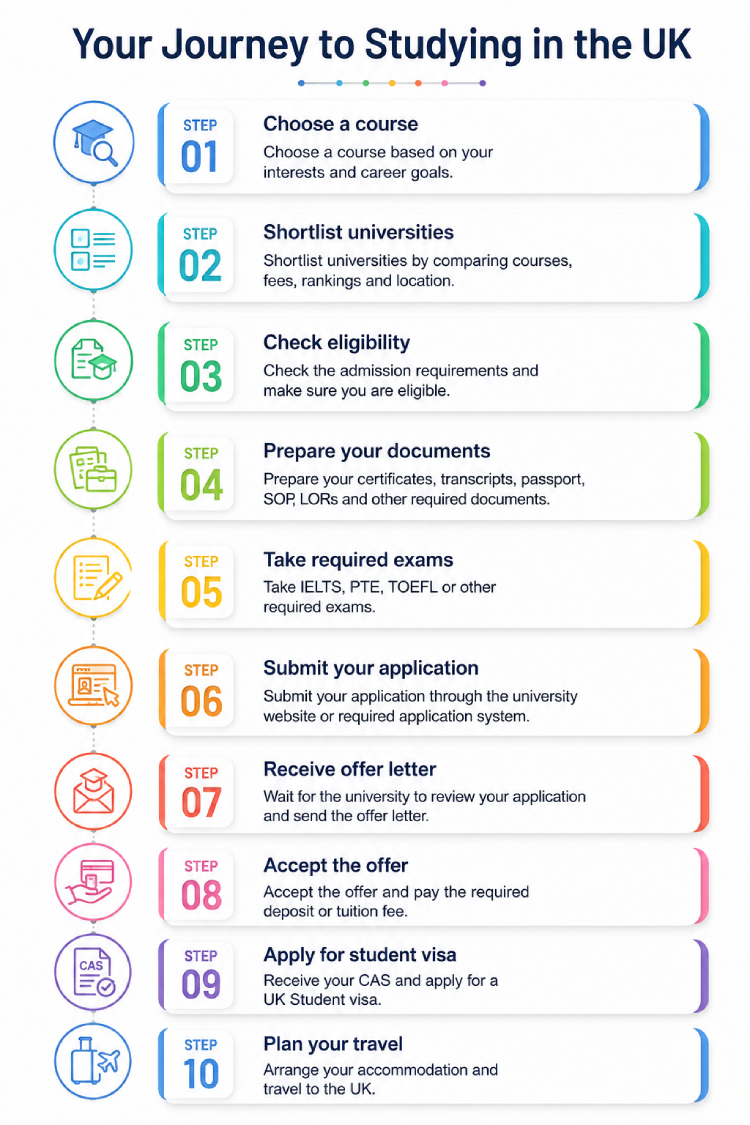
Step 1: Choose a course based on your interests and career goals.
Step 2: Shortlist universities by comparing courses, fees, rankings and location.
Step 3: Check the admission requirements and make sure you are eligible.
Step 4: Prepare your certificates, transcripts, passport, SOP, LORs and other required documents.
Step 5: Take IELTS, PTE, TOEFL or other required exams.
Step 6: Submit your application through the university website or required application system.
Step 7: Wait for the university to review your application and send the offer letter.
Step 8: Accept the offer and pay the required deposit or tuition fee.
Step 9: Receive your CAS and apply for a UK Student visa.
Step 10: Arrange your accommodation and travel to the UK.
UK Student Visa Process for Indians
The UK Student visa is the main visa for international students who want to study an eligible course in the UK. Students must meet the visa rules and have an offer from a licensed UK education provider before applying.
Important: The Student visa replaced the old Tier 4 (General) student visa in October 2020. Tier 4 is no longer the current name of the UK student visa. The term may only be used when talking about the previous visa system.
*Want to apply for Masters in UK? Contact Y-Axis for complete guidance
UK Student Visa – Proof of Funds
UK Student visa applicants must show enough money to cover their remaining tuition fees and living costs. The tuition fee amount is based on the CAS.
| Study Location | Monthly Living Cost | For 9 Months |
|---|---|---|
| London | £1,529 | £13,761 |
| Outside London | £1,171 | £10,539 |
- The required money must usually be held for 28 consecutive days.
- Bank funds, eligible student loans and official sponsorship may be accepted.
- Students bringing eligible dependents need additional funds of £845/month in London or £680/month outside London for each dependent.
- The total amount required is generally outstanding tuition fees + living costs.
UK Study Visa Requirements
To apply for a UK Student visa, you generally need to:
- Have an offer for an eligible course from a licensed student sponsor
- Receive a Confirmation of Acceptance for Studies (CAS) from your education provider
- Meet the English language requirement, if it applies to your course
- Have a valid passport or other accepted travel document
- Show proof of money for your tuition fees and living costs, if you need to meet the financial requirement
- Provide a TB test certificate, if required based on your country of residence
- Provide an ATAS certificate, if your course and circumstances require one
- Submit any other documents required for your individual application
UK Student Visa Fee
The UK Student visa application fee is £558. This fee applies to applications made from outside the UK and to applications to extend or switch to a Student visa from inside the UK. The Student visa fee increased from £524 to £558 on 8 April 2026.
UK Student Visa Cost
| Cost Type | Amount |
|---|---|
| Student visa application fee | £558 |
| Immigration Health Surcharge (IHS) for students | £776 per year |
| Maintenance funds required in London | £1,483 per month |
| Maintenance funds required outside London | £1,136 per month |
The total amount you need to pay will depend on your course, visa length and personal circumstances. You should also plan for other costs such as tuition fees, accommodation, travel and daily living expenses.
UK Student Visa Processing Time
If you apply for a UK Student visa from outside the UK, you will usually get a decision within 3 weeks. However, processing may take longer in some cases. It is best to apply early so that you have enough time to get your visa before your course starts.
Graduate Route: Important 2027 Change
The Graduate Route allows eligible international students to stay in the UK after completing an eligible course. It also allows them to work or look for work without needing a job offer when they apply.
The length of stay will change from 1 January 2027:
| Graduate Route application | Length of stay |
|---|---|
| Application made on or before 31 December 2026 | 2 years |
| Application made on or after 1 January 2027 | 18 months |
| PhD or other doctoral qualification | 3 years |
The new 18-month period is based on the date you apply for the Graduate visa. It is not based on the date you start your course. For example, if you start a bachelor's or master's course in 2026, the Graduate Route period will depend on when you apply for the Graduate visa after completing your course. The Graduate Route cannot be extended. However, if you meet the requirements, you may be able to switch to another visa, such as the Skilled Worker visa, to continue working in the UK.
*Want to apply for MBA in UK? Take help from Y-Axis for complete guidance
Important UK Student Visa Update – New Proof of Funds Requirement
The UK has announced updated maintenance funds (proof of funds) requirements for Student visa applicants. The new amounts will apply to applications made from 30 November 2026.
New Maintenance Fund Requirements
- London: £1,570 per month
- Outside London: £1,203 per month
For the required 9-month period:
- London: £14,130
- Outside London: £10,827
Increase in Required Funds
| Study Location | Current Requirement | New Requirement | Increase |
|---|---|---|---|
| London | £1,529/month | £1,570/month | +£41 |
| Outside London | £1,171/month | £1,203/month | +£32 |
The revised amounts apply to UK Student visa applications submitted from 30 November 2026. Students planning to apply on or after this date should make sure they have enough funds to meet the updated maintenance requirement, in addition to the applicable tuition fees and other visa costs.
Key takeaway: Students planning to study in the UK should review their financial documents and plan for the new proof of funds requirements before submitting their Student visa application.
Jobs After Graduation in UK
International students who complete an eligible course in the UK may be able to stay and work through the Graduate visa. This gives eligible graduates time to look for jobs and gain work experience in the UK.
- The Graduate visa is generally valid for 2 years for applications made by 31 December 2026.
- From 1 January 2027, the stay period will generally be 18 months.
- PhD and other doctoral graduates can stay for 3 years.
- Graduates may later switch to another work visa, such as the Skilled Worker visa, if they meet the requirements.
- The Graduate visa does not guarantee a job or permanent residence.
Popular Fresher Jobs and Average Salaries
Starting salaries depend on the job, location, employer and skills. Recent UK data shows that graduate starting salaries vary widely across sectors, with graduate trainee salaries around £31,000 at the median in one 2026 employer survey.
| Fresher Job | Average Annual Salary |
|---|---|
| Software Engineer | £30,000–£34,000 |
| Data Analyst | £29,000–£32,000 |
| Cybersecurity Analyst | £30,000–£33,000 |
| Business Analyst | £30,000–£34,000 |
| Accountant | £28,000–£32,000 |
| Marketing Executive | £25,000–£30,000 |
| Graduate Engineer | £30,000–£33,000 |
| Financial Analyst | £32,000–£38,000 |
| Consulting Analyst | £35,000–£50,000 |
| Graduate Trainee | £30,000–£33,000 |
*Read more....
Part-Time Jobs in the UK for International Students
International students who are allowed to work under their Student visa can take up part-time jobs while studying. This can help them earn some extra money, gain work experience and improve their communication skills.
- Eligible degree-level students can usually work up to 20 hours per week during term time.
- Students can usually work full-time during official university holidays.
- Common part-time jobs include retail assistant, restaurant staff, cashier, receptionist, tutor and university assistant.
- The pay depends on the type of job, location and the student's age.
- Students must follow the work conditions listed on their visa and should not depend on part-time work to pay their full tuition fees or living costs.
*Read about: UK Student Dependent Visa
Best Cities for International Students in the UK
The UK has many student-friendly cities with good universities, transport and social life. Living costs can vary from one city to another.
| City | Major Universities | General Living Cost |
|---|---|---|
| London | UCL, Imperial College London, King's College London, LSE | High |
| Manchester | University of Manchester, Manchester Metropolitan University | Medium |
| Edinburgh | University of Edinburgh, Heriot-Watt University | Medium–High |
| Birmingham | University of Birmingham, Aston University | Medium |
| Leeds | University of Leeds, Leeds Beckett University | Medium |
| Glasgow | University of Glasgow, University of Strathclyde | Medium |
| Liverpool | University of Liverpool, Liverpool John Moores University | Medium |
| Nottingham | University of Nottingham, Nottingham Trent University | Medium |
London offers many universities and job opportunities but has higher living costs. Cities such as Manchester, Leeds, Birmingham, Liverpool and Nottingham can be more affordable while still offering good universities and student life.
Why choose Y-Axis?
Y-Axis can assist by giving more vital support to aspirants who wish to study in the UK. The support process includes:
- Free Counseling: Free Counseling on university and course selection.
- Campus Ready Program: Fly to the UK with the best and ideal course.
- Course Recommendation: Y-Path gives the best suitable ideas about your study and career options.
- Coaching: Y-Axis offers IELTS live classes to help students clear with high scores.
- UK Student Visa: Our expert team helps you to get a UK student Visa.
Looking for inspiration
Explore what Global Indians have to say about Y-Axis in shaping their future