


Don't know what to do ?
Get Free Counseling
Last Updated 13 October 2026
Why Canada Work Visa?
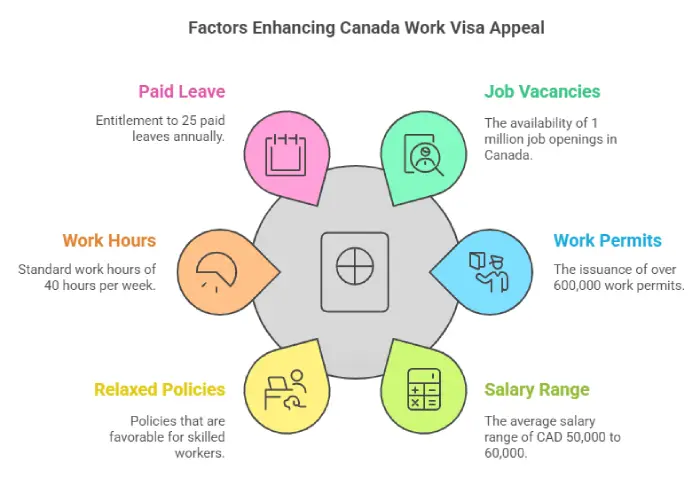
- Approximately 5 lakh job vacancies in Canada
- Issued 600,000+ Canada work permits
- Earn an average salary of CAD 50,000 to 60,000
- Relaxed Work Policies for Skilled Workers
- Work 40 hours per week
- 25 paid leaves every year
- Average salaries per hour increased to 7.5%
LMIA (Labour Market Impact Assessment), which permits them to recruit foreign skilled workers for occupations that cannot be filled in by citizens or permanent residents of Canada.
*Planning to Work in Canada? Start Here! View the Canada Immigration flipbook.
Benefits of Working in Canada
- Stable Jobs & Good Salary: Canada offers stable jobs in fields like healthcare, IT, construction, and skilled trades. The average hourly wage is about CAD $34.80 (as of early 2026).
- Learn New Skills: Working in Canada helps you gain experience in modern industries like AI, cloud computing, and green energy, which are valuable worldwide.
- Good Quality of Life: Canada is one of the best countries to live in, with clean cities, good infrastructure, and people from many cultures.
- Free Healthcare: Canada has a public healthcare system. Most medical services like doctor visits and hospital care are free for residents.
- Pension Benefits: Workers contribute to the Canada Pension Plan (CPP). Indian workers don’t need to pay in both countries due to the India–Canada agreement.
- Paid Leave: Employees get at least 2 weeks of paid vacation after 1 year, and 3 weeks after 5 years.
- Free Education for Children: Children can study for free in public schools from Kindergarten to Grade 12.
- Government Support for Newcomers: The government provides free language classes, job support, and settlement services for new immigrants.
- Tax Benefits: The India-Canada tax agreement helps avoid paying tax twice on the same income.
- Safe Country: Canada is one of the safest countries with low crime rates.
- Company Benefits: Many companies offer extra benefits like health insurance, dental care, retirement savings plans, work-from-home options, and travel support.
- Pathway to PR: Workers can apply for Permanent Residency through programs like Express Entry, PNP, or CEC.
- Easy Travel: A Canadian passport allows travel to 185+ countries without a visa or with visa-on-arrival.
- Child Benefit: Families can get monthly financial support: up to CAD $648.91 for children under 6 and CAD $547.50 for children aged 6–17.
Canada Work Visa for Indians
As one of the world’s leading economies, Canada is a perfect destination for Indians seeking to work abroad. The Canadian Work Permit Visa is the best route for Indians who are willing to migrate to Canada permanently. Typically, applicants need to have a job offer in hand to apply for a Canada work permit. With our end-to-end overseas career solutions, Y-Axis can help you find a job and apply for a Canadian Work Visa.
*Searching for jobs in Canada? Find the right one with the help of Y-Axis resume marketing services.
Canada Work Permit Requirements
List of forms required
The complete checklists of forms that are to be submitted for a Canada work visa are as follows:
- Application for Work Permit made Outside of Canada (IMM 1295)
- Family Information (IMM 5707)
- Statutory Declaration of Common-law Union (IMM 5409)
- Use of a Representative (IMM 5476)
- Authority to Release Personal Information to a Designated Individual (IMM 5475)
- Offer of Employment to a Foreign National Exempt from the Labour Market Impact Assessment (IMM 5802)
List of documents required
The complete checklists of documents that are to be submitted for a Canada work visa are as follows:
- Proof of payment
- A photocopy of the information page of your valid passport or travel document
- Two photos
- Proof of current immigration status
- Photocopy of your Marriage license or Certificate, if applicable
- Labour Market Impact Assessment (LMIA)
- Proof of employer compliance fee payment
- Valid Québec Acceptance Certificate (CAQ) if working in Quebec with an LMIA
- If applying for a post-graduation work permit: Proof of study program requirements
- For provincial nominees: Federal-provincial agreements overview [R204(c) – T13]
- Other additional requirements
Read more...
What are the minimum requirements to get jobs in Canada?
What does LMIA mean?
LMIA refers to Labour Market Impact Assessments. They are issued by ESDC of Canada to help employers bring foreign workers into Canada. A positive LMIA confirms that hiring a foreign worker would not hurt Canada’s labour market. In most cases, a positive LMIA is essential for the employee to obtain a work permit.
LMIA processing times
If you want to get the LMIA, your employer must finish the LMIA process first, which is the first step before the application for a specific work permit can happen. The processing of an LMIA and work permit applications occurs independently as they do not belong to the same process. It is crucial to know that processing times for LMIA applications are different.
Canada Work Permit Eligibility
Irrespective of the work permit you are applying for, you must meet certain eligibility requirements. These include:
- Age: There is no specific age limit for most Canada work permits. However, age criteria may apply to certain immigration programs such as Express Entry or Provincial Nominee Programs (PNPs).
- Valid job offer letter issued by a Canadian employer with a positive LMIA
- Minimum of 2 years of skilled work experience under NOC category of TEER Level 0, 1, 2, or 3
*Read more...
Can I apply for jobs in Canada from India?
What is Canada Work Permit Process?
Identify your occupation's National Occupational Classification (NOC) code. This code helps determine eligibility for specific immigration programs.
Step 1: Choose the Right Canada Immigration Program
Explore Immigration Programs: Research and choose the most suitable immigration program for your profile, such as the Express Entry system, Provincial Nominee Program (PNP), or specific streams like the Atlantic Immigration Program (AIP).
Step 2: Obtain a Canadian Job Offer
Secure a Job Offer: Obtain a valid job offer from a Canadian employer. The employer may need to obtain a Labour Market Impact Assessment (LMIA) from ESDC to prove the need for a foreign worker.
Step 3: Gather Required Documents
Collect Necessary Documents: Gather essential documents, including identification, educational qualifications, proof of work experience, and a valid job offer letter.
Step 4: Apply for the type of work visa
If you are applying for a work permit, you must create an online profile detailing your skills, work experience, education, and other relevant information.
Step 5: Submit the Application
Submit Online Application: Complete the online application form and submit all required documents through the appropriate immigration portal. Pay the necessary fees.
Step 6: Biometrics and Medical Examination
Provide Biometrics: Attend a biometrics appointment at a designated location.
Undergo Medical Examination Complete a medical examination by an approved panel physician. Results are submitted directly to the immigration authorities.
Step 7: Wait for Processing
Await Processing: Be patient while your application is processed. Processing times can vary based on the type of work permit and the immigration program.
Step 8: Receive the Canada Work Permit
Receive Work Permit Approval: Once approved, you'll receive your Canada Work Permit. Review the details, including the type of work, locations, and duration.
Step 9: Settle in Canada
Arrive in Canada: Arrive in Canada before or on the date specified on your work permit. Ensure compliance with the conditions outlined in your permit.
Step 10: Consider Permanent Residency
Explore Permanent Residency: If interested, explore pathways to permanent residency in Canada, such as Express Entry's Canadian Experience Class or Provincial Nominee Programs.
*Read more...
Can I get PR while on a work permit in Canada?
How to Go to Canada for a Job from India — Step by Step
To work in Canada from India, you usually need a job offer and a work permit before you travel. These are the steps.
1. Get a valid job offer from a Canadian employer.
2. Employer approvals. Your employer either gets a positive LMIA from Employment and Social Development Canada (ESDC), or, for LMIA-exempt jobs, submits the offer through the IRCC Employer Portal and pays the CAD 230 compliance fee. You then receive the LMIA or the offer of employment number.
3. Gather your documents. You need your passport, job offer, educational and experience certificates, proof of funds where required, and a Police Clearance Certificate from Passport Seva if IRCC asks for one.
4. Apply online on the IRCC portal and pay the fees: CAD 155 for the work permit and CAD 85 for biometrics.
5. Give biometrics at a VFS Global centre in India and take a medical exam with an IRCC panel physician if required.
6. Receive your port-of-entry letter of introduction. The border officer issues the actual work permit when you land in Canada.
Processing times change often, so check the IRCC processing-time tool for applications made from India. Y-Axis can help you check your eligibility and prepare your work permit file.
Canada Work Permit Processing Time
Processing times for Canada work visa permits can differ from one type of visa to another, depending on factors such as whether a Labor Market Impact Assessment is needed, the applicant’s country of residence, and the completeness of the application submitted. While some applications may be completed in a matter of weeks, others can take a few months or more. Applicants should make sure to confirm the most current processing time from IRCC before submitting an application.
Canada Work Permit Processing Times by Permit Type
| Work Permit Type | Typical Processing Time |
|---|---|
| LMIA-based Work Permit | 9–16 weeks |
| Open Work Permit (Post-Graduation) | 7–19 weeks |
| IEC (International Experience Canada) | 6–12 weeks |
| CUSMA Professionals | 1–3 weeks |
You may be entitled to take your spouse and children to Canada if you obtain a job offer from a Canadian employer and have an open work permit. Your children will be eligible to attend Canadian educational institutions without having to get separate study permits. Your spouse will also be able to apply for an open work permit to work in Canada.
Note: In the case of an employer-specific work permit being requested that necessitates obtaining an LMIA, the employer will need to obtain the LMIA from ESDC before the application goes through. The LMIA process is independent from the work permit application process, and it can take a different length of time depending on the LMIA the employer must follow.
Canada LMIA Processing Times by Stream (2026)
| LMIA Stream | Average Processing Time |
|---|---|
| Global Talent Stream | 9 business days |
| Agricultural Stream | 22 business days |
| Seasonal Agricultural Worker Program | 9 business days |
| High-Wage Stream | 79 business days |
| Low-Wage Stream | 71 business days |
| Permanent Residence Stream | 99 business days |
Canada Work Visa Costs and Fees
| Type of Canada Work Visa | Fees |
|---|---|
| Work permit (including extensions) – per person | $155.00 |
| Work permit (including extensions) – per group (3 or more performing artists) | $465.00 |
| International Experience Canada (IEC) | $184.75 |
| Open work permit holder fee | $100.00 |
| Restore your status as a worker | $401.25 (Restoration $246.25 + Work Permit $155) |
Students
| Type | Fees |
|---|---|
| Study permit (including extensions) – per person | $150.00 |
| Restore your status as a student | $396.25 (Restoration $246.25 + Study Permit $150) |
Inadmissibility
| Type | Fees |
|---|---|
| Temporary Resident Permit (TRP) | $246.25 |
Biometrics
| Type | Fees |
|---|---|
| Biometrics – per person | $85.00 |
| Biometrics – per family (2 or more people) | $170.00 |
| Biometrics – per group (3 or more performing artists) | $255.00 |
Additional Important Fee
| Type | Fees |
|---|---|
| Employer Compliance Fee (paid by employer, if LMIA-exempt) | $230.00 |
Note: The work permit application fee is CAD $155 per person. In most cases, an additional biometrics fee of CAD $85 applies, bringing the total cost to CAD $240 per applicant.
Jobs in Canada for Indians
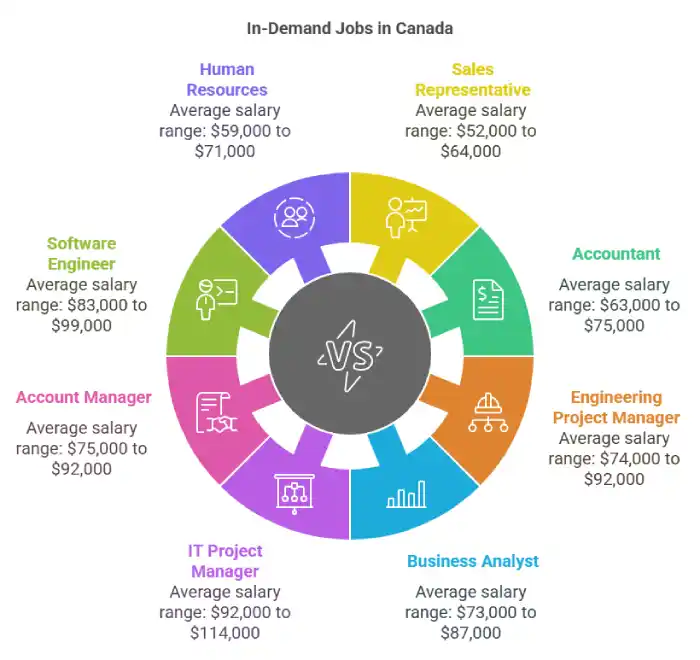
There are Approximately 5 Lakhs jobs in Canada lying vacant for 3 months. The table below gives information about the top in-demand occupations in Canada, along with the average salaries.
| Job Role | Avg. Annual Salary (CAD) |
|---|---|
| Software Developer / Cloud Engineer | $95,000 – $130,000 |
| Registered Nurse (RN) | $80,000 – $110,000 |
| Finance Director | $136,300 – $263,000 |
| Financial Analyst | $82,400 – $127,400 |
| Pharmacist | $102,300 – $142,500 |
| Digital Marketing Manager | $78,000 – $135,000 |
| Human Resources Manager | ~$89,000 |
| Construction Project Manager | $90,000 – $120,000 |
| Electrician (Industrial) | $67,000 – $99,000 |
| Welder | $49,000 – $79,000 |
| Heavy-Duty Equipment Mechanic | ~$82,800 |
| Business Development Manager | ~$84,000 |
| SEO Specialist / Web Developer | $55,000 – $85,000 |
| Dental Hygienist | $69,400 – $103,200 |
| Warehouse / Logistics Supervisor | $52,000 – $75,000 |
*Read more...
Can I apply for jobs in Canada from India?
How to Get a Job in Canada from India
Getting a Canadian job offer from India takes preparation, because most employers who hire from overseas need government approval to do so.
1. Find your NOC code. Look up your occupation in Canada's National Occupational Classification (NOC 2021), and check its TEER level and typical wages on Job Bank.
2. Target employers who can hire from abroad. Most job offers for foreign workers need a Labour Market Impact Assessment (LMIA). Some are LMIA-exempt, for example intra-company transfers or roles under trade agreements.
3. Use the right job boards. Search Job Bank, where many LMIA job ads are posted, as well as LinkedIn, Indeed and employer career pages.
4. Adapt your résumé. Keep it to two pages, focus on results, and leave out your photo, age and marital status.
5. Strengthen your profile. Get an Educational Credential Assessment (ECA) from WES or another designated body, and take IELTS General, CELPIP or PTE Core. These also count for permanent residence later.
6. Watch for fraud. Never pay an employer or recruiter for a job offer or an LMIA. That is illegal in Canada.
Since March 2025, a job offer no longer adds CRS points in Express Entry. You can still apply for PR without one, and a job offer remains useful for a work permit and for some provincial nominee streams. Y-Axis can help you with your résumé and job search, but hiring decisions stay with employers.
Average Salary Levels in Canada
Salaries in Canada vary based on experience, industry, and job role. Entry-level workers usually earn lower salaries, while mid-level and senior professionals with more experience and specialized skills earn higher pay. These salary ranges are common across industries like IT, healthcare, engineering, construction, manufacturing, and hospitality. High-demand roles such as AI engineers, cybersecurity experts, and senior IT professionals may earn even more.
| Experience Level | Average Salary |
|---|---|
| Entry Level | CAD $45,000 – $60,000 per year (₹27–36 LPA) |
| Mid Level | CAD $65,000 – $90,000 per year (₹39–54 LPA) |
| Senior Level | CAD $100,000 – $150,000+ per year (₹60–90 LPA) |
In-Demand White-Collar Occupations in Canada
Canada continues to experience strong demand for skilled professionals in technology, healthcare, finance, marketing, and human resources. These occupations offer competitive salaries, excellent career growth, and opportunities for foreign workers through employer-sponsored work permits and permanent residence pathways. The table below shows the average annual salary ranges for some of Canada's most in-demand white-collar occupations.
| Occupation | Annual Salary Range (CAD) | Approx. Annual Salary Range (INR) |
|---|---|---|
| AI / Machine Learning Engineer | $110,000 – $160,000 | ₹69.3 lakh – ₹1.01 crore |
| AI Product Manager | $120,000 – $170,000 | ₹75.6 lakh – ₹1.07 crore |
| Cloud Architect | $120,000 – $170,000 | ₹75.6 lakh – ₹1.07 crore |
| Cybersecurity Analyst | $85,000 – $125,000 | ₹53.6 lakh – ₹78.8 lakh |
| Data Scientist | $98,000 – $130,000 | ₹61.7 lakh – ₹81.9 lakh |
| Software Engineer | $100,000 – $140,000 | ₹63.0 lakh – ₹88.2 lakh |
| Physician / Medical Specialist | $275,000 – $340,000 | ₹1.73 crore – ₹2.14 crore |
| Nurse Practitioner | $90,000 – $120,000 | ₹56.7 lakh – ₹75.6 lakh |
| Pharmacist | $85,000 – $127,000 | ₹53.6 lakh – ₹80.0 lakh |
| Finance Manager / Controller | $90,000 – $140,000 | ₹56.7 lakh – ₹88.2 lakh |
| Marketing Manager | $62,000 – $125,000 | ₹39.1 lakh – ₹78.8 lakh |
| Sales Manager | $80,000 – $130,000 | ₹50.4 lakh – ₹81.9 lakh |
| HR Business Partner | $75,000 – $110,000 | ₹47.3 lakh – ₹69.3 lakh |
Market Background & Trends in Canada
- Record Foreign Workforce: Canada hosted approximately 3 million non-permanent residents in Q3 2024, with temporary foreign worker numbers continuing to break all previous records into early 2025.
- Immigration Recalibration: Canada's 2025–2027 Immigration Levels Plan set decreasing permanent resident admissions, 395,000 in 2025, 380,000 in 2026, and 365,000 in 2027 as the government aims to return immigration to sustainable levels while easing pressure on housing and infrastructure.
- India–Canada Dominance: 127,320 Indian nationals became permanent residents in 2024, accounting for 26% of all PRs, making India Canada's single largest source country by a significant margin.
- In-Demand Sectors: Healthcare, technology, logistics, and skilled trades continue to be Canada's highest-demand sectors, driven by an aging population, high retirement rates, and structural skill shortages that the domestic workforce cannot fill alone.
- Skilled Visa Categories: Key immigration pathways include Express Entry (Federal Skilled Worker, Canadian Experience Class), Provincial Nominee Programs (PNP), the Temporary Foreign Worker Program (TFWP), and the International Mobility Program (IMP), each targeting specific skill levels and labour market needs.
- Category-Based Selection (CBS): Canada conducted 19 CBS rounds in 2024, focusing on French-language proficiency, healthcare, STEM, skilled trades, transport, agriculture, and education, with Indian candidates topping the STEM category at 75% of invitations.
- Policy Reforms: Canada is transitioning its immigration focus toward temporary residents already living and working in the country, with over 60% of new permanent residents in January 2026 being former temporary residents — well-integrated workers with Canadian education and work experience.
- Growing Labour Shortfall: Despite a slight dip in total job vacancies to around 500,000 in Q1 2026, Canada's overall labour demand continues to rise, driven by demographic shifts, technological innovation, and persistent skill shortages.
- Fast-Track PR Pathways: Candidates in healthcare and STEM occupations invited through Category-Based Selection can receive Invitations to Apply (ITAs) with relatively lower CRS scores, significantly accelerating the path to Permanent Residency compared to standard Express Entry draws.
*Read more....
Types of Canada Work Permits
Canada has seven types of work permits and different types of visas through which candidates can apply to work. These work permits are:
- Temporary Foreign Worker Program
- Intra-Company Transfers
- LMIA Required
- LMIA Exempt
- Business Visitors
- IEC Canada
- Post-Graduation Work Permits
- Open Work Permits
LMIA Canada
Labour Market Impact Assessment (LMIA)is essential for candidates who want to migrate to work in Canada. A positive LMIA report helps to enter the local job market of Canada. Candidate needs to apply through Employment and Social Development Canada and Service Canada.
*Read more...
Can I get a job in Canada without an LMIA?
Canada Open Work Permit
An employer-specific work permit, as the name suggests, is a permit that allows you to work for a specific employer. While the employer-specific work permit pertains to a single employer, the open work permit can come with certain conditions that will be written on it. These include:
- Type of work
- Places where you can work
- Duration of work
Holders of the following visas can apply for an Open Work Permit:
- Spousal Open Work permit
- Temporary Work Permits for spouses
- Post-Graduation Work Permit
- Temporary Resident Permit
- World Youth Program Permit
- Atlantic Immigration Program (AIP) – Spousal Open Work Permit
- Regular Open Work Permit
- Bridging Open Work Permit
Conditions for the open work permit:
- Proof of financial resources that can support your and your family’s stay in Canada during the work permit validity.
- Proof that you have no history of a criminal record.
- Proof that you are in good health.
- Willingness to adhere to the conditions of your work permit even if you are given a restricted work permit.
- Meet eligibility conditions such as language skills, biometric data, and insurance.
IEC Canada
IEC, commonly referred to as International Experience Canada, allows applicants to travel and work in Canada for up to 2 years. There are 3 types of work and travel experiences in Canada, namely:
- Working Holiday
- Young Professionals
- International Co-op (Internship)
Benefits of Canada Work Permit Visa
Canada issued 608,420 work permits in 2022. This number increased significantly, with over 800,000 work permits issued in 2023, reflecting rising demand for foreign workers (IRCC).
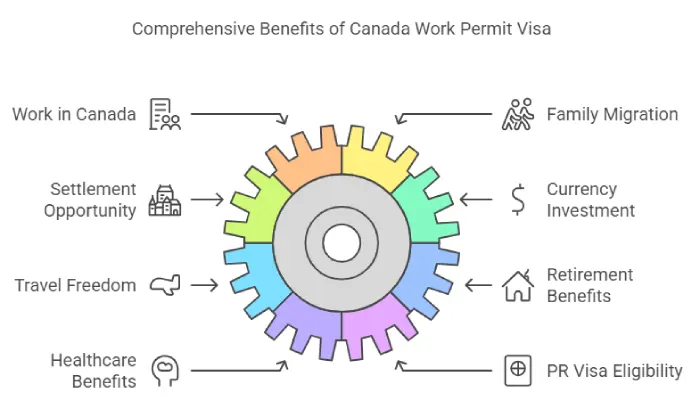
Under the Canada Work Permit Visa, you can:
- Work in Canada under the employer you have mentioned in your work permit application.
- Migrate along with your family.
- The shortest route to settle in Canada.
- Invest in Rupees and earn in CAD
- Travel across Canada.
- Enjoy the retirement benefits.
- Free healthcare benefits.
- Apply for a PR visa based on eligibility.
Pathways from a Canada Work Permit to Permanent Residence
A Canada work permit gives one the possibility of transitioning to permanent residence. Foreign workers who have Canadian work experience can qualify for different immigration programs. Depending on one’s qualifications, work history, skills, and location of employment, one may qualify for one of the following options:
Express Entry
The Canada Express Entry draw is an online application management system regarding skilled immigration in Canada. This system accepts applications via a number of schemes, like the Federal Skilled Worker Program (FSWP), the Canadian Experience Class (CEC), and the Federal Skilled Trades Program (FSTP). Using the Comprehensive Ranking System (CRS), candidates can compare their scores and find out if they are eligible to receive the Invitation to Apply (ITA) for permanent residence.
What CRS Score is Needed for Canada Express Entry?
There is not one specific Comprehensive Ranking System (CRS) score that one should attain to be eligible for Express Entry to Canada. The CRS cutoff does vary at different Express Entry draws depending on things such as immigration class, number of invitations issued, and labor market priorities of Canada. For Indian applicants a better CRS score generally enhances their chance to get an Invitation to Apply (ITA) for permanent residency. The latest Express Entry draws show that the scores required for a successful application are not the same for applying under the Express Entry programs such as Canadian Experience Class (CEC), Provincial Nominee Program (PNP), etc.
| CRS Score Range | General Guidance |
|---|---|
| 500+ | Highly competitive for many general and Canadian Experience Class (CEC) draws. |
| 450–499 | May be competitive for selected category-based draws, depending on IRCC requirements. |
| 400–449 | Candidates can improve their chances through category-based draws or by securing a Provincial Nominee Program (PNP) nomination. |
| Below 400 | Consider increasing your CRS score by improving language test results, gaining additional work experience, pursuing higher education, or obtaining a provincial nomination. |
Important: There is no guaranteed CRS score that results in an Invitation to Apply (ITA). In every Express Entry draw, IRCC publishes new CRS cut-off, which may vary depending on the number of ITAs issued, and the category of Express Entry draw. The people applying for Express Entry must check the latest Express Entry rounds of invitations released by IRCC for the latest CRS cut-off scores.
Provincial Nominee Program (PNP)
Each province and territory in Canada has a Provincial Nominee Program (PNP), through which it can satisfy needs on local labour markets. A skilled foreign worker with work experience in Canada may get nominated by the province, which may significantly increase the chances of getting permanent residence in Canada afterward. A variety of PNP streams are integrated with the Express Entry system.
Significant Announcement: Consultation on the Express Entry System Reform (2026)
From the start of April 23 through May 24, 2026, Immigration, Refugees and Citizenship Canada (IRCC) held a public consultation regarding proposed changes to the Express entry system. The purpose of the consultation was to examine the possibility of consolidating the Federal Skilled Worker Program (FSWP), Canadian Experience Class (CEC), and Federal Skilled Trades Program (FSTP) into a single Federal High Skilled Program. Among the changes discussed was the possible adjustment of the Comprehensive Ranking System (CRS). Only proposals have been issued for consultation and the existing Express entry system continues to remain unchanged. Candidates are advised to keep complying with the current rules and to follow the updates from the IRCC until the amendments are finalized.
Y-Axis snapshot
1M
Successful applicants
1500+
Experienced counselors
25Y+
Expertise
50+
Offices
Don't know what to do ?
Get Free Counseling
Looking for Inspiration
Explore what Global Indians have to say about Y-Axis in shaping their future