


Don't know what to do ?
Get Free Counseling
Last Updated 09 October 2026
France Work Visa for Indians: Talent Passport, EU Blue Card & ICT Complete Guide
France is one of the leading destinations in Europe with multiple job vacancies for skilled professionaWhy should Indians migrate to Francels. The country offers significant opportunities for foreign workers to find jobs across sectors such as technology, healthcare, engineering, and construction. Indian applicants are among the top recipients of the French work visa, reflecting the growing demand for Indians in the country.
- Offers 500,000+ job vacancies across multiple sectors for skilled professionals.
- Secures a stable economy with a GDP of about $4.068 trillion.
- SMIC (France's minimum wage) raised to €12.02/hour gross (€1,823.03/month for a 35-hour full-time week).
- Streamlined pathways to long-term residence and scope stable career growth.
*Want to apply for jobs in France? Contact Y-axis for end-to-end support.
Benefits of France Immigration as a skilled professional?
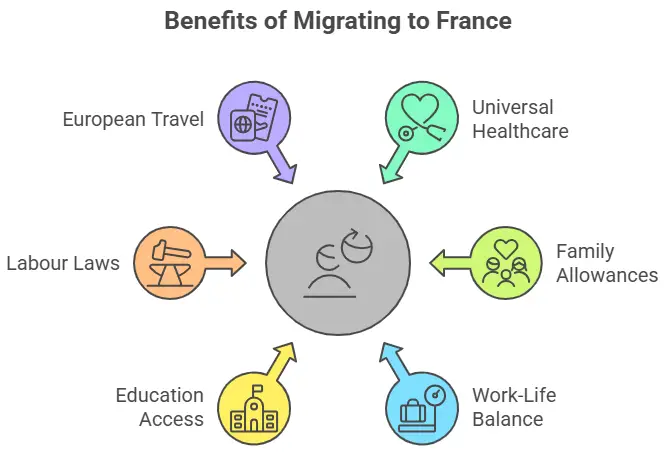
Skilled professionals should migrate to France in the current year due to the following reasons:
- The universal healthcare system (Assurance Maladie) provides highly subsidised medical care for workers.
- Family allowances and child benefits (CAF) are offered to professionals to support households with children while they are away.
- Work–life balance with a 35-hour workweek and 25+ days of paid annual leave.
- Free and affordable public education, along with access to childcare and crèche facilities.
- Strong labour laws have been implemented to protect employee rights and create job security
- Freedom to travel within Europe (Schengen Area) upon securing long-term residency.
Why should Indians migrate to France?
Here is why Indians should migrate to France on a work permit:
- India–EU FTA 2026 (Coming Soon): The India–EU Free Trade Agreement negotiations concluded on January 27, 2026. Once ratified by the EU Council, European Parliament, and India's Parliament — expected early 2027 — it will create significant new professional mobility pathways for Indian IT and ITeS professionals in France. Current pathways remain: Talent Passport, EU Blue Card, and ICT Permit.
- Talent Passport visa offers a 4-year multi-entry work permit with accelerated family reunification policies.
- Paris is known as a major global tech hub, with Station F, the world’s largest startup campus.
- A France work residence permit grants visa-free travel across all 26 Schengen Area countries — enabling Indian professionals to work from France while visiting clients and colleagues across Europe including Germany, Netherlands, Spain, and Italy, without needing additional visas or border permits.
- France has a strong Indian community in cities like Paris and Lyon, with major festivals like Diwali celebrated publicly.
France Work Visa
A France Work Visa is a long-stay visa that allows foreign professionals to live and work legally in France. It is issued based on the type of job and employment contract offered by a French employer. Before travelling to France, non-EU citizens must obtain a valid work visa linked to their employment. This visa permits the holder to stay and work in France for a specific employer and period, in line with the approved work conditions.
*Want to apply for France work visa? Let Y-Axis guide you with the process.
Types of France Work Visa
The types of work visa in France are as follows:
- Talent Passport (Passport Talent): A Talent Passport is granted to highly skilled workers, investors, and researchers. The visa is granted for 4 years and can be extended based on work requirements.
- EU Blue Card: Highly skilled professionals with a minimum annual gross salary of €59,373 qualify for an EU Blue Card in France. Effective August 29, 2025, per Ministerial Order — equivalent to 1.5× the reference salary of €39,582. In INR: approximately ₹52.8 lakh/year at €1 ≈ ₹89.
- ICT (Intra-Corporate Transfer) Permit: For managers, specialists, or graduate trainees being transferred within the same company to the French branch.
Covers:
(1) Managers and specialist employees such as software architects, solution specialists, and technical leads;
(2) Graduate trainees for up to 1 year. Minimum salary for managers and specialists: 1.5× SMIC = approximately €2,734/month gross from January 1, 2026.
Valid for 90 days to 3 years for managers and specialists, or up to 1 year for trainees.
- Saisonnier (Seasonal Worker) Visa: A Seasonal worker visa in France is a long-stay permit granted to foreign workers engaged in fields such as agriculture and tourism. The seasonal worker visa permits temporary work for up to 6 months within 1 year.
- France Salaried Employee Work Visa: This visa is for foreign nationals with a job offer and an employment contract from a French employer. It usually allows individuals to work in France for up to one year and can be renewed based on employment.
- France Work Visa for Business Creation or Company Management: This visa is for individuals who plan to start, invest in, or run a business in France. It applies whether the business is a personal venture or a joint project with a company in France.
- France Work Visa for Professionals and Independent Workers: This visa is meant for self-employed professionals and freelancers. Some professions may require approval or registration with a French professional authority before applying. Applicants must ensure their profession is allowed for non-EU nationals.
- France Long-Stay Visa for Volunteer Work: This visa is for individuals who wish to engage in humanitarian or volunteer work in France. It allows stays of more than three months, usually up to one year or longer, depending on the program.
- France International Organization Work Visa: This visa is for individuals working on an official assignment with an international organization based in France. It is issued for the duration of the assignment.
India–EU FTA 2026 : What Indian Professionals Need to Know
The India–EU Free Trade Agreement negotiations concluded on January 27, 2026 but have NOT yet entered into force. EU Council adoption, European Parliament consent, and India's parliamentary ratification are all still required. Entry into force is expected early 2027. Indian professionals cannot currently use any FTA-specific pathway for France. Current routes remain: Talent Passport, EU Blue Card, ICT Permit, and others listed above.
Also, read...
India–EU Trade Pact Opens New Pathways for Students and Skilled Professionals. Apply now!
Eligibility Criteria to apply for France Work Visa
To apply for a French work visa, candidates must hold a bachelor's/master's degree in high-demand fields such as IT, software engineering, healthcare, or finance, along with relevant work experience. Most employers prefer at least a B2 level of language proficiency, while advanced certifications can further strengthen the applicant's profile.
| Category | Details |
|---|---|
| Ideal Candidate Profile | IT / Software Engineers, Data Scientists, Finance Professionals (CA/CFA), Aerospace Engineers, Healthcare Professionals, and bilingual professionals (English + French preferred). |
| Education Requirements |
Bachelor’s or Master’s degree in a relevant field. Talent Passport (Qualified Employee): Recognised degree + at least 2 years of experience, or salary ≥ €39,582/year gross. Ministerial Order August 29, 2025. In INR: approximately ₹35.2 lakh/year. EU Blue Card: Recognised degree with salary ≥ €59,373/year gross. 1.5× reference salary, same Ministerial Order. In INR: approximately ₹52.8 lakh/year. Good News: The Talent Passport threshold was REDUCED in 2025 to €39,582/year — meaning more Indian professionals qualify in 2026 than before. |
| Work Experience | Typically 2–5 years of experience preferred for most professional roles. Talent Passport applicants usually require 2+ years of post-qualification experience. |
| Language Requirements | French B2 level preferred for most jobs. English-only roles may be available in Paris tech companies and multinational firms. DELF or TCF certification can strengthen applications. |
France work visa salary thresholds in 2026
| Visa Type | Minimum Salary Requirement (2026) | Approx. INR Equivalent | Key Details |
|---|---|---|---|
| France Talent Passport (Qualified Employee) | €39,582/year gross | Approximately ₹35.2 lakh/year | Updated under Ministerial Order dated August 29, 2025. Lower threshold than before, making more Indian professionals eligible. |
| EU Blue Card (France) | €59,373/year gross | Approximately ₹52.8 lakh/year | Set at 1.5× the French reference salary under the same Ministerial Order. |
| ICT Permit (Intra-Company Transfer) | Approximately €2,734/month gross | Approximately ₹2.4 lakh/month | Based on 1.5× SMIC effective January 1, 2026. |
France Work Visa Requirements
Applicants need to submit the following documents to apply for a work visa in France:
- Valid passport
- Passport copies with blank pages
- Completed France work visa application form
- Recent passport-size photographs
- Valid job offer letter
- Signed employment contract
- Proof of academic or professional qualifications
- Work authorization approved by French authorities
- Health insurance coverage
- Proof of payment of the visa fee
Read more...
Have 3 years of work experience? You Could Be Eligible to Work in France
How to Apply for a France Work Permit from India
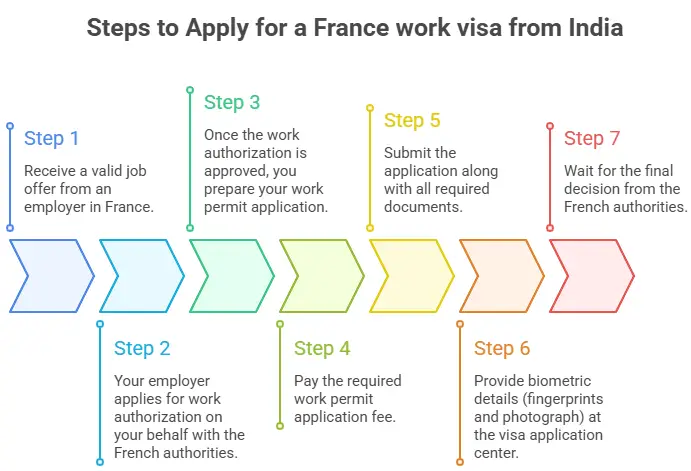
The application process for a France Work Permit begins after you receive a confirmed job offer from a French employer.
The steps to apply for a France work visa for Indians are as follows:
Step 1: Receive a valid job offer from an employer in France.
Step 2: Your employer applies for work authorization on your behalf with the French authorities.
Step 3: Once the work authorization is approved, you prepare your work permit application.
Step 4: Pay the required work permit application fee.
Step 5: Submit the application along with all required documents.
Step 6: Provide biometric details (fingerprints and photograph) at the visa application center.
Step 7: Wait for the final decision from the French authorities.
Also, read...
How to apply for a permit to work in France
France Work Visa Processing Time
The processing time for a France Work Visa usually takes around 4-12 weeks after the application is submitted. In some cases, the processing time may be longer if the visa authorities require additional documents, further verification, or clarification from the employer. The final decision time can also vary based on the type of job, accuracy of the application, and workload at the visa office. Submitting complete and correct documents can help avoid delays.
Note: Applicants should consider additional time of 2-4 weeks for labour authorisation from DREETS.
France Work Visa Fees
The application fee for a France Work Visa depends on the type of visa you apply for. All visa fees must be paid at the time of application and are non-refundable, even if the visa is refused.
| Expense Category | Estimated Cost / Fee | Notes |
|---|---|---|
| Long-stay Visa Fee | € 99 | Standard France long-stay work visa application fee |
| Residence Permit Renewal (OFII) | € 200 | Paid during residence permit renewal process |
| French Language Course (Alliance Française) | ₹30,000 – ₹80,000 | Depends on course level and duration |
| Relocation Costs (Flights, initial settlement, documents) | ₹2 – ₹4 Lakhs | Includes travel, accommodation setup, and documentation |
| Agent / Immigration Lawyer Fees | ₹50,000 – ₹1,20,000 | Optional professional assistance charges |
| DREETS Labour Authorisation | Handled by employer, no fee for employee | May add 2–4 additional weeks to processing time |
Note: All EUR figures are at April 2026 rates. €1 ≈ ₹89 — verify current rates at xe.com before applying. All visa fees are non-refundable even if the visa is refused.
Job Market in France
France offers strong job opportunities for skilled professionals, especially in IT, software development, engineering, healthcare, construction, manufacturing, automotive, and hospitality sectors. The country faces skill shortages in several industries and actively welcomes foreign professionals to meet workforce needs. Paris, the capital city, is a major hub for technology, finance, innovation, and international businesses. Professionals with relevant skills and experience have good chances of finding employment across major cities in France.
*Also, read...
The Top 10 in-demand Occupations in France
France's highly developed economy drives strong employment and steady economic growth. Industries with high workforce demand, including Technology & Digital, Aerospace & Defence, Automotive, Healthcare, Luxury & Retail, Finance & Banking, Renewable Energy, and Tourism & Hospitality, mainly support the French job market.
Given below are the top 10 high-paying occupations in France for Indian professionals:
- Software Developers & IT Architects
- Data Scientists & AI Engineers
- Cybersecurity Experts
- Medical Doctors & General Practitioners
- Nurses & Allied Health Professionals
- Civil & Electrical Engineers
- Financial Analysts & Auditors
- Supply Chain & Logistics Managers
- Renewable Energy Engineers
- Multilingual Sales Executives.
Also, read...
Highest paying jobs in France.
Average Salary in France
The table below highlights the average salary ranges for professionals in entry-level, intermediate, and senior roles in France.
| Experience Level | Average Salary (EUR / Year) | Approx. Salary (INR / Year) |
|---|---|---|
| Entry-Level | €28,000 – €36,000 | ≈ ₹25 – ₹32 LPA |
| Mid-Level | €45,000 – €65,000 | ≈ ₹40 – ₹58 LPA |
| Senior-Level | €80,000 – €130,000+ | ≈ ₹71 – ₹116 LPA |
Note: France is facing a significant labour shortage, with over 330,000 job vacancies reported by Pôle Emploi (France Travail) during 2024–2025, including 80,000+ unfilled positions in the digital sector. Projected Job Demand in France in the next 10 years.
Note on French Taxation for Indian Professionals: France's income tax rate can reach up to 45%+ at higher income bands. However, this is significantly offset by comprehensive social benefits — Sécurité Sociale provides universal subsidised healthcare for all workers; CAF (Caisse d'Allocations Familiales) provides monthly family and child allowances, check your indicative amounts at caf.fr; and the Navigo transport card in Île-de-France has 50% of the monthly cost paid by your employer. For most Indian professionals, the net quality of life benefit of French social infrastructure outweighs the higher marginal tax rate.
Job Market in France
The job market in France is growing significantly. By 2030, this growth is expected to create multiple job vacancies across sectors such as AI, cybersecurity, healthcare, and renewable energy, among others.
The table below shows the projected demand for jobs in France by 2030:
| Sector | Projected Job Demand / Shortage | Timeframe / Target Year |
|---|---|---|
| Digital & Technology | Around 700,000 digital jobs expected to be created due to growing demand for AI, cybersecurity, data, and software professionals. | By 2030 |
| Healthcare | 200,000+ professionals shortage including doctors, nurses, and allied healthcare workers due to ageing population and healthcare demand. | Ongoing demand through 2030 |
| Renewable Energy | 100,000+ new jobs expected in wind, solar, and clean energy sectors as France expands green energy projects. | By 2035 |
Dependent Benefits for France Work Visa holders
The dependents of France work visa holders can benefit in the following ways:
| Category | Details |
|---|---|
| Dependent Benefits | Spouses and children can accompany the main applicant through family reunification programs. |
| Family / Spouse Work Rights | Talent Passport: spouse receives automatic work authorization in France. EU Blue Card: spouse is also allowed to work once family reunification is approved. |
| Children’s Education | Children of migrants can attend free public schools in France. |
| Family Financial Support | Eligible families may receive CAF family allowances starting from the first month of residence in France. |
France permanent residence (PR) pathway
France offers long-term settlement pathways for skilled professionals from abroad, allowing them to transition from temporary workers to permanent residence in the country. Upon completing 5 continuous years of work and residence in France, you can apply for a Carte de Résident (permanent residence permit). EU Blue Card holders may apply for long-term resident status in France after 3 years of combined EU residence — not necessarily exclusively in France — under EU Directive 2021/1883.
Note: the French Carte de Résident (PR) requires 5 years of continuous residence primarily in France. Blue Card holders may benefit from combined EU residence counting toward long-term resident status under Article 23 of the Directive.
| Category | Details |
|---|---|
| Permanent Residency (PR) | Migrants can apply for a Carte de Résident (permanent residence permit) after 5 years of continuous residence in France. |
| Citizenship / Naturalisation | Foreign nationals may apply for French citizenship after 5 years of residence. In exceptional contribution cases, eligibility may reduce to 2 years. |
| Special Pathways | The India–EU FTA (negotiations concluded January 2026; ratification expected 2027) is set to improve professional mobility and long-term settlement prospects for Indian professionals once in force. Current pathways remain Talent Passport, EU Blue Card, and ICT Permit. |
| PR Eligibility Timeline | Standard route: 5 years of residence. EU Blue Card holders may qualify in about 3 years depending on eligibility conditions. |
Also, read...
How can Y-Axis assist you in getting a Work Permit in France?
Y-Axis has over 25 years of work experience in overseas immigration, offering reliable and personalised immigration guidance. The team of specialists provides the following service:
- Professionals' resume-writing assistance aligns with job profiles.
- Expert guidance on the France work visa application steps.
- Document review to ensure accuracy.
- Resume Marketing Services to connect candidates with suitable international job opportunities
- Post-arrival support to settle abroad.
Y-Axis snapshot
1M
Successful applicants
1500+
Experienced counselors
25Y+
Expertise
50+
Offices
Don't know what to do ?
Get Free Counseling
Looking for Inspiration
Explore what Global Indians have to say about Y-Axis in shaping their future