

Norway Job Market
Down Arrow
Down Arrow
Down Arrow

I accept the Terms & Conditions

Don't know what to do
Don't know what to do?

Get free Counselling

Norway Job Market: Trends and Opportunities 

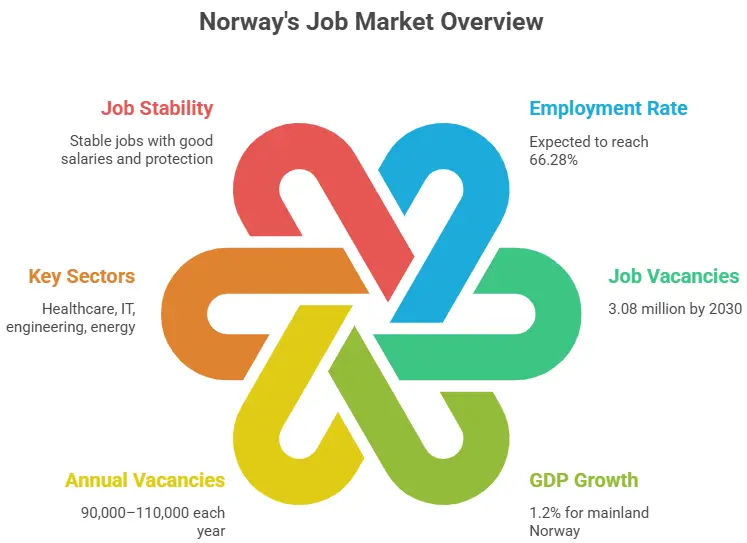
  • Employment rate is expected to reach 66.28%. 
  • 3.08 million jobs vacancies by 2030 
  • Mainland GDP growth is expected at 1.2%. 
  • Around 90,000–110,000 job vacancies are expected each year. 
  • Strong hiring in healthcare, IT, engineering, and energy sectors. 
  • Stable jobs with good salaries and worker protection. 

Norway Job Market

Job Outlook in Norway

Understanding the job outlook for job seekers and employers

If you are willing to work in Norway, you can benefit from researching and learning the job market of Norway. Looking at the work culture, you can set the practical expectations before applying for job. The companies in Norway usually have flat hierarchies and flexible work environments, with a focus on creating an employee-focused culture. They encourage employees to develop critical-thinking skills, provide honest feedback and take accountability and ownership at work. They also offer employee benefits such as sick leave, parental leave, paid holidays, health care and retirement benefits.

Companies always encourage people to focus on their physical and mental well-being and take breaks. The average workweek is about 37.5 hours that is five days in a week. Workdays usually start at 9 a.m. and end by 4 p.m.

General employment trends for the year

Norway has been facing shortage of workers in the technology field. The country has invested more in the IT market and its current population is about 5.3 million, this is simply not enough to meet the demand for new businesses.

The few other in-demand positions in Norway are cloud architects, data scientists, and software engineers into its technology market. According to IT consultancy, the most in-demand technology jobs in Norway are Software Engineers. This is one of the most popular and widely searched job in several European countries such as Austria, Belgium, and the Czech Republic.


In-Demand Industries and Occupations

Analysis of industries experiencing growth and increased demand for skilled workers

In Norway, a large number of jobs are expected to be provided by the forces of automation, digitalization or robotization. Technology helps to create new jobs or even new occupations that are necessary to build new digital infrastructures, others may increase due the broad impacts of digitalization or rising incomes. The creation of new jobs can also depend on how economic policy responds to automation.

*Looking to work in Norway? Get top consultation from experts at Y-Axis.   

Discussion on specific occupations in demand

The most in-demand occupations looking for highly skilled workers their average salaries per year are listed below:

Highest paying jobs/occupations in Norway and their Salaries

Occupation Average Annual Salary
IT and Software NOK 7,60,000
Engineering NOK 6,59,121
Accounting and Finance NOK 635,000
Human Resource Management NOK 954,900
Hospitality NOK 212,500
Sales and Marketing NOK 725,000
Healthcare NOK 913,000
STEM NOK 641,000
Teaching NOK 758,118
Nursing NOK 5,70,601

Source: Talent site

Workforce demands in different States of Norway

Highlighting areas with notable job opportunities or challenges

The future of Norway as an energy producer consumer, investor and exporter depends on the global energy transition. The energy systems is growing rapidly with increase in number of countries around the world. The changes is occurring from a model based on ‘hydrocarbon molecules’ to one based on ‘electrons’ and renewables. The main reason for this global transition was climate change with local environmental impacts, particularly urban air quality and its consequences for public health - accelerating the calls for changes in the way that energy is produced and consumed.

Indians like to settle in Norway because of two main reasons that is low population that supports its growing economy and the work-life balance in Norway. Indian students who wish to join a job in Norway by studying abroad should first know more about the job market.

Also, read...

Top In-Demand Jobs in Norway for the Next 10 Years

Impact of Technology and Automation in Norway

Discussion on how technological advancements and automation are shaping the job market

The terms digitalization, automation and robotization are often used synonymously to describe the technological revolution that is set by many firms. Many studies have completed to know how labour markets have been affected the jobs that are lost. Recent Norwegian study stated that a third of Norwegian jobs are in professions with 70% risk of being automated over the coming twenty years.

Countries have managed digitalization well when they have reacted with more growth and employment reforms. Countries like Germany, Sweden, the Netherlands or Switzerland have seen positive labour market development after reforms.

Potential opportunities and challenges for workers in the evolving landscape

The job market is in a state of continual change in Norway, handled by growth in technology, changes in demographics, and shifts in the economy. It's important for job seekers to stay updated about these developments and actively improve their skills and expertise to align with the demands of employers.

Skills in demand in Norway

Identification of key skills sought by employers

Previously, a university degree was noted as an important factor for career success However, the employment landscape in 2023 makes a greater impact on skills and practical experience. Employers are giving importance to candidates with a diverse set of skills, including critical thinking and adaptability.

This benefits the employees of current generation, encouraging lifelong learning and adapting the skills that is relevant to the fast-paced, technology-driven workplace.

Importance of up skilling or reskilling for job seekers

Employers are more seeking for candidates those who have strong soft skills like communication, teamwork, and problem-solving, apart from technical expertise. These skills are important for success in today's workplace, irrespective of the sector.

Also, read...

Top in demand occupations in Norway

Remote Work and Flexible Arrangements

Exploration of the continuing trend of remote work

One of the most noticeable shifts in the world of work is the adoption all over the world of remote work. The pandemic started this trend, suggesting organizations rethink traditional office-based models.

In 2023, remote work become a standard practice for many industries. This remote work will allow people to balance work and life more effectively.

This change has also given opportunities for global association, with teams spread across different time zones and continents working consistently through digital platforms.

Implications for both employers and employees

The COVID-19 pandemic has quickened the promotion of remote work, and this trend is expected to continue in 2024. Remote work offers many benefits, such as increased flexibility and work-life balance.

Government Policies and Initiatives

Overview of any government programs or policies influencing employment

Norway is recognised as one of the world’s most powerful economies globally, holding a population of more than five million people. The country leads in technology, communication, maritime, energy, and innovation businesses. The country’s economic growth can be attributed in part to government policies that provide benefits to setting up a business in Norway.  

Furthermore, the country has shown remarkable activity in adopting sustainable business practices to reduce its carbon footprint. Thanks to the high rank of the country in the Ease of Doing Business Index, which is 9, according to the World Bank, among 190 other countries, Norway features a business-friendly environment. Around 35,000 new businesses are registered in Norway each year. Setting up a business in the country is straightforward and enterprise friendly.

Challenges and Opportunities for Job Seekers in Norway

Discussion on the challenges faced by job seekers

Norway has low unemployment rate and developing economy, but international workers can sometimes can sometimes to get job. To increase the chances of getting job opportunities, you should learn Norwegian. English is widely spoken in Norway, but the local language is used in many organizations. Norwegian will help you get more opportunities and will help you settle in Norway.

*Want to prepare a professional resume? Choose Y-Axis resume services.

Tips and strategies for navigating the job market successfully

To make yourself comfortable in Norwegian society and to increase your chances of finding jobs, you'll need to learn the Norwegian language. Most jobs are advertised on the internet, and many newspapers, including Aftenposten, Dagbladet, and The Norway Post, also advertise job opportunities.

The procedure for applying for jobs in Norway is similar to that in the UK. You have to submit a two-page CV and cover letter, with which you should attach copies of your references and qualifications, before attending an interview. Each application should be customized based on the roles, and CVs and cover letters should be submitted in Norwegian unless something else has been explicitly mentioned.

Be on time for interviews - Norwegians pride themselves on their punctuality.

Summary of Norway Job Outlook

To find a job in Norway’s job market as a foreigner could be more challenging without proper guidance. However, it can be a little easy with a bit of expert help. By understanding the country’s work culture and its job search tools, you can find many ways to gain an advantage in this competitive market.

*Searching for Jobs abroad? Find the right one with the help of Y-Axis Resume Marketing Services.

Sign up for a free expert consultation
Down Arrow
Down Arrow
Down Arrow

I accept the Terms & Conditions

Don't know what to do
Don't know what to do?

Get free Counselling

Frequently Asked Questions

What are the most in-demand jobs in Norway right now?
plus

Here is the list of in demand roles by sectors in Norway right now

Sector

In-Demand Roles

Healthcare

Doctors, nurses, elderly care specialists, medical technicians

Information Technology

Software developers, data scientists, cloud architects, cybersecurity experts

Engineering

Civil, mechanical, electrical, environmental engineers

Construction

Architects, construction managers, carpenters, electricians, welders

Education

Kindergarten, vocational, and special education teachers

Tourism & Hospitality

Hotel managers, tour guides, travel agents, hospitality managers

Logistics & Warehousing

Warehouse workers, logistics coordinators

Renewable Energy

Wind turbine technicians, solar energy specialists

Finance & Business

Financial analysts, accountants, business consultants

Manufacturing

Industrial engineers, production managers, quality control specialists

Which industries are hiring the most in Norway (energy, tech, maritime, healthcare, construction)?
plus

Several industries in Norway are actively hiring professionals, and the most hiring sectors are listed below:

  • Energy & Renewable Resources: Norway invests in sustainable energy, including hydropower, wind, and solar, creating many jobs for skilled professionals.
  • Technology & Digital Transformation: The tech industry in Norway is rapidly growing, especially in AI, cloud computing, cybersecurity, and data analytics.
  • Maritime & Aquaculture: Norway's maritime sector remains strong, providing jobs in shipping, offshore energy, and aquaculture.
  • Healthcare & Medical Services: There is a high demand for healthcare professionals due to an aging population and increasing medical services.
  • Construction & Infrastructure: The construction sector is growing due to nationwide urban development and infrastructure projects.
How important is learning Norwegian to get a job as an Indian professional?
plus

Learning Norwegian is helpful for Indian professionals, but it is not always mandatory. In sectors like IT, finance, and multinational companies, many roles are available where English is enough, so you can secure a job without knowing Norwegian. However, in healthcare, customer service, or government roles, proficiency in Norwegian is required to interact with patients, clients, or local authorities. Even for English-friendly jobs, knowing basic Norwegian can make daily life easier, from handling paperwork to interacting with colleagues.

Where can I find English-speaking jobs in Norway?
plus

English-speaking jobs in Norway are mostly found in big cities like Oslo, Bergen, Stavanger, and Trondheim, where multinational companies and IT companies are located. Sectors like IT, Engineering, Oil and Gas, Shipping, Research, and Universities hire many English-speaking professionals. You can find these jobs in major online job boards like EnglishJobs.no, The local Norway, LinkedIn, Glassdoor, Indeed, and Finn.no sites.

What engineering roles (civil, mechanical, electrical, petroleum) are most in demand in Norway?
plus

Here are some of the most in-demand job roles in civil, mechanical, electrical, and petroleum industries:

Engineering Field

In-Demand Roles

Civil Engineering

Structural Engineer, Construction Engineer, Infrastructure Engineer

Mechanical Engineering

Mechanical Design Engineer, Maintenance Engineer, Offshore Mechanical Engineer

Electrical Engineering

Power Systems Engineer, Electrical Design Engineer, Grid/High Voltage Engineer

Petroleum Engineering

Drilling Engineer, Reservoir Engineer, Process Engineer

Environmental & Renewable

Renewable Energy Engineer, Environmental Engineer, Sustainability Engineer

What is the average salary in Norway for software engineers, core engineers, nurses, and finance roles?
plus

The average salary in Norway for software engineers, core engineers, nurses, and finance roles is listed below:

Role

Average Salary (NOK/year)

Software Engineer

700,000–750,000

Nurse

459,000–494,000

Finance Analyst /

 Related Roles

720,000–875,000

Accountant

500,000–540,000

Core Engineer

683334-980,584

Which job boards and portals are best for the Norway job market?
plus

Here are some of the best job boards & portals for the Norwegian job market:

  • Finn.no: Norway's biggest job site, with many job listings across many sectors.
  • NAV/Arbeidsplassen: This is the official government job portal, which is very useful for finding many vacancies and support services.
  • EnglishJobs.no: This job site focuses on roles that only need English, not Norwegian.
  • Jobsafari.no: A good job site with plenty of job ads.
  • Life in Norway: Job Vacancies: This is a useful site for foreigners that offers job listings, career tips, and job trends.
  • Work in Norway (Norge.no): Official job guide for foreigners, which includes links to job boards
  • Indeed, and Glassdoor: These international sites are also popular in Norway and provide many job postings from multinational companies.
  • LinkedIn: Many international companies and recruiters in Norway use LinkedIn, particularly for roles in the tech, finance, and corporate sectors.
I’m a software engineer—what opportunities, tech stacks, and companies should I target in Norway?
plus

If you are a software engineer planning to work in Norway, target tech stacks in demand, such as Java, JavaScript (React, Node.js), Python, and cloud platforms like AWS and Azure, DevOps, and CI/CD pipelines. The demand for AI, Machine Learning, and Data Analytics. IoT and sustainability test.

Top companies you can target are Tietoevry, Cognite, Knatega, Varig Technologies, and Enonic. These companies are currently open to hiring international professionals. To improve your chances of getting a job, focus on building a solid portfolio, highlight cloud and full-stack experience, and apply through job portals such as LinkedIn, Glassdoor, and company career pages.

What are the biggest challenges foreign workers face in Norway and how can I overcome them?
plus

Here are some common challenges for foreigners in Norway, along with tips to overcome them:

  • Language Barrier: Many job roles require Norwegian, so start learning the basics while applying for English-speaking roles.
  • High Cost of Living: Norway is expensive, so plan your budget accordingly and try to secure a house.
  • Competition for Jobs: Locals and EU citizens have an advantage in jobs, so highlight your unique skills (IT, engineering, healthcare) to stand out.
  • Work Culture Differences: Work culture in Norway is collaborative and flexible, adapting through openness, reliability, and teamwork.
  • Networking: Many jobs are found through connections, so networks can be built through LinkedIn, local groups, and industry events.
  • Visa & Work Permit Rules: The process for these can be strict. Apply through the correct permit route and make sure the paperwork is complete.
  • Weather and Lifestyle: Winters are long and dark, so stay active and use indoor hobbies to adapt.
How does Norway’s job market compare with other European countries for international hires?
plus

Norway's job market is favorable for international workers, with less unemployment, high demand for skilled workers, and good salaries, mainly in IT, healthcare, engineering, and construction. Compared to other European countries, Norway has more stability and better work-life balance, though some roles require Norwegian language skills. While countries like Germany, the Netherlands, and Sweden have an easier process, Norway's visa rules are strict. Norway provides higher salaries and roles for foreigners compared to some European countries.

Which cities (Oslo, Bergen, Stavanger, Trondheim) offer the most job opportunities and in what sectors?
plus

Oslo offers the most job opportunities in Norway, and most international professionals prefer this city. With many companies in finance, IT, energy, construction, and government, this city has good opportunities for skilled workers. Stavanger is an important city for oil and gas, renewable energy, and engineering jobs. At the same time, Trondheim provides opportunities in technology, research, and green energy projects. Bergen mainly offers marine research, shipping, tourism, and media job roles.

Are remote or hybrid jobs common in Norway, and where can I find them?
plus

Yes, remote and hybrid jobs are typical and increasing in Norway, particularly in the tech, finance, and professional services industries. This increased mainly after the COVID-19 pandemic, which made hybrid working the preferred mode for several companies.

How should I tailor my CV and interview style for Norwegian employers?
plus

Here are some tips to tailor my CV and interview style for Norwegian employers:

CV Tips:          

  • Keep it short and simple; 1 - 2 pages are enough.
  • Use a clear structure: Personal details, work experience, education, skills, and languages.
  • Highlight your achievements and results.
  • Highlight relevant skills, especially for tech, engineering, or healthcare roles.
  • Include languages known, mainly Norwegian and English proficiency.
  • Avoid personal details like age, marital status, or photo unless asked.

Interview Tips:

  • Be punctual, direct, and concise. Norwegians appreciate straightforwardness and honesty.
  • Show initiative and independence, but also your ability to work in a team.
  • Be prepared to discuss specific results and achievements from past roles.
  • Keep a friendly yet professional tone, don't exaggerate or overreact.
  • Research about the company and its culture before attending the interview.
What work permits/visa routes are common for Indians who want to work in Norway?
plus

The most common work permits and visa routes for Indian professionals seeking employment in Norway are the Residence Permit for Skilled Workers and the Job Seeker Permit. The specific route depends on whether you have a job offer before applying.

  • Residence Permit for Skilled Workers: This is the standard path for Indian professionals with a confirmed job offer from a Norwegian employer. Your qualifications must be relevant to the position you are offered.
  • Job Seeker Permit: In rare cases, skilled workers who have specific connections to Norway can get a permit to stay and search for a job, but this route isn’t common for Indians applying from India without prior ties.
What cost of living, taxes, and employee benefits should I consider when evaluating a Norway job offer?
plus

When looking for a job in Norway, remember that the cost of living is high, especially in cities like Oslo and Stavanger, where rent, food, and transport can be much more expensive than in India. Taxes are also high, ranging from 22% to 38% depending on income, but they provide excellent public services. Conversely, employee benefits are significant as workers get 25–30 days of paid leave, parental leave, healthcare, and pension contributions. Many companies also provide flexible timings, remote work options, and opportunities for skill development.

Can my employer apply for the work permit on my behalf?
plus

Yes, your Norwegian employer can apply for the work permit on your behalf. However, you must give them written permission to do so. The employer will submit job-related details, such as your contract and salary. You are still responsible for providing personal documents like your passport and qualifications. This option makes the process easier, especially for first-time applicants.

Which sectors are creating the most jobs in Norway?
plus

Norway is creating more jobs in sectors like IT, engineering, healthcare, renewable energy, and logistics. These industries face skill shortages and need foreign workers to fill open roles. The healthcare sector is growing due to an ageing population. Technology and renewable energy jobs are increasing because of digital growth and green energy projects. Skilled professionals have better job opportunities in these fields.

Is Norway’s job market competitive for foreigners?
plus

Yes, Norway’s job market is competitive, especially for foreign workers. Employers prefer candidates with strong skills and relevant work experience. Having experience in shortage occupations improves your chances. Knowing basic Norwegian can also help, even if the job accepts English. Early job applications, good qualifications, and international experience can make it easier to secure a job in Norway.

Do foreign degrees need recognition to work in Norway?
plus

Yes, many jobs in Norway require foreign degrees to be officially recognised. This is important for skilled professions such as engineering, healthcare, and teaching. Degree recognition confirms that your education meets Norwegian standards. Without recognition, you may not be allowed to work in certain roles. The process helps employers trust your qualifications and ensures you meet job requirements.

Are there job openings for English-speaking professionals in Norway?
plus

Yes, there are many job openings in Norway where English is accepted as the working language. This is common in IT, engineering, research, and international companies. Start-ups and multinational firms often use English at work. However, learning basic Norwegian can improve job options and career growth. English-speaking professionals still have good chances in skilled roles.