


Don't know what to do ?
Get Free Counseling
Last Updated 05 October 2026
Switzerland Work Permit :L/B Permit, Fees & Apply from India
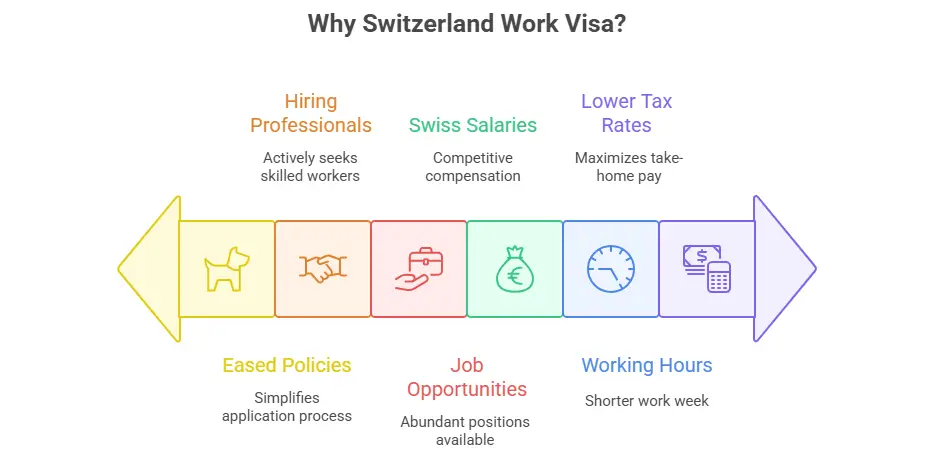
- Switzerland is among the top 3 highest-paying countries in the world — average annual salary CHF 84,288 (Swiss Federal Statistical Office median, 2024)
- 8,500 non-EU work permits available in 2026 — 4,500 B Permits (long-term) and 4,000 L Permits (short-term) — Swiss Federal Council, November 2025
- IT and software roles earn CHF 110,000–180,000+ per year; AI/ML engineers earn CHF 180,000–300,000+ per year
- Full-time contracted hours: 40–42 hours per week (Swiss Federal Statistical Office, 2024)
- Lower taxes compared to many European countries, with excellent healthcare and social benefits
- Clear pathway to permanent residence after 10 years continuous legal residence — C Permit
A Switzerland work visa — officially a national D-visa — allows non-EU/EFTA nationals including Indians to enter Switzerland for the purpose of work. Once in Switzerland, the D-visa is converted into a residence and work permit: an L Permit (short-term, up to one year) or B Permit (long-term, one year renewable). Only highly skilled professionals with a qualified job offer and employer sponsorship can obtain a Swiss work permit. All permits for non-EU/EFTA nationals are subject to an annual quota system — 4,500 B permits and 4,000 L permits are available in 2026 (Swiss Federal Council, November 2025).
Switzerland is one of the best countries in the world for people who want to work and build a better future abroad. It has a very strong economy, high salaries, and low unemployment. Many top companies and industries are based here, especially in finance, IT, healthcare, engineering, and research. This creates many job opportunities for skilled workers. Switzerland also offers a very high quality of life. It has excellent healthcare, top universities, a clean environment, and a very safe society. People usually work around 35 hours per week, and taxes are lower compared to many other European countries. For foreign professionals, getting a work visa has become easier, especially for those with in-demand skills. There is also a clear path to permanent residency, making it a good place to settle long-term.
For Indian nationals, Switzerland offers two main work permit routes — the L Permit for short-term contracts and the B Permit for long-term employment — both subject to annual quotas set by the Swiss Federal Council each November.
Types of Switzerland Work Visa for Indian
Switzerland has a permit-based system to manage foreign workers. The rules depend on your nationality, skills, and how long you plan to stay. EU/EFTA citizens have easier access, while non-EU workers must follow stricter rules and quotas.
The main types of Switzerland work visas are given below:
| Permit Type | Duration | Who It Is For | Quota Applies? |
|---|---|---|---|
| L Permit – Short-Term Work Permit | Up to 1 year (extendable) | Foreign nationals with fixed-term employment contracts of up to 12 months | Yes – 4,000 permits in 2026 |
| B Permit – Long-Term Work Permit | 1 year, renewable annually | Foreign nationals with permanent or long-term employment contracts in Switzerland | Yes – 4,500 permits in 2026 |
| C Permit – Settlement / Permanent Residence | Indefinite (no renewal required) | Individuals who have legally resided in Switzerland continuously for 10 years | No quota |
| G Permit – Cross-Border Commuter Permit | Linked to employment | Residents of neighbouring countries who live outside Switzerland and commute for work | Not applicable for Indians |
| Permit Ci – Family Member Work Permit | Linked to sponsor's permit | Spouses and eligible family members of Swiss residents who wish to work | No quota |
| Type D Visa – National Long-Stay Visa | Entry visa only | Required before travelling to Switzerland to take up employment or long-term residence | N/A |
For Indian nationals: the L Permit and B Permit are the entry routes. The C Permit is the long-term settlement goal after 10 years. The G Permit does not apply to Indian applicants residing in India.
Switzerland Work Permit Quota System — What Indian Applicants Must Know
Switzerland limits the number of work permits issued to non-EU/EFTA nationals each year. This is the most critical planning factor for Indian professionals applying for a Swiss work permit.
2026 Quota Figures (Swiss Federal Council, 19 November 2025):
| Permit Type | Annual Quota for Non-EU/EFTA Nationals | Quarterly Distribution |
|---|---|---|
| B Permit (Long-Term) | 4,500 | Distributed across all 26 cantons each quarter |
| L Permit (Short-Term) | 4,000 | Distributed across all 26 cantons each quarter |
Key points for Indian applicants:
- Quotas are distributed quarterly across Switzerland's 26 cantons — each canton receives a share
- As of September 2025, approximately 52% of the 2026 annual quota had been utilised — quotas are not currently exhausted
- Quotas reset each January — applying early in the year (January–March) maximises your chance of securing a permit before your canton's quota runs out
- Even a fully qualifying candidate may be declined if their canton's quarterly quota is exhausted
- Source: Fragomen, November 2025; Newland Chase, November 2025
Eligibility Requirements for Switzerland Work Visa
- You must hold a university degree or recognised professional qualification, with several years of relevant work experience. The role must be classified as skilled — Switzerland's strict eligibility rules are aimed at highly qualified professionals in IT, pharma, finance, engineering, and healthcare.
- Valid Passport
- Job Offer or a Signed Employment Contract
- Proof of Qualifications
- Financial Proof
- Valid Health Insurance
- Police Clearance Certificate
- Proof of Accommodation
- Work Experience Proof
- Personal Documents which include passport-size photographs, a birth certificate, and a copy of your updated resume or CV.
- Employment Details
- Your salary must meet Swiss market-rate standards for the role and sector — typically CHF 85,000 or more per year in major cities such as Zurich and Geneva. Your employer must demonstrate the offered salary is in line with Swiss collective agreements and market rates. (Source: employsome.com; deel.com, 2026)
- Language skills: German (dominant in Zurich, Bern, and Basel) or French (dominant in Geneva and Lausanne) proficiency is strongly recommended. English is widely used in Zurich and Geneva tech and pharma sectors. B1 German or French level is required for C Permit (permanent settlement) applications.
Also, read…
What are the most in-demand jobs in Switzerland for the next 10 years?
In-demand Jobs in Switzerland
Some high-demand jobs in Switzerland are given below with their average annual salary:
| Occupation | Average Salary (CHF per Year) | Average Salary (INR Approx.) |
|---|---|---|
| Software Engineer / Full-Stack Developer | CHF 95,000–140,000 | ₹91–134 LPA |
| Data Scientist / AI Researcher | CHF 110,000–160,000 | ₹106–154 LPA |
| Machine Learning Engineer | CHF 180,000–350,000 | ₹173–336 LPA |
| Cybersecurity Specialist | CHF 92,000–145,000 | ₹88–139 LPA |
| Quantitative Analyst / Financial Engineer | CHF 107,000–160,000 | ₹103–154 LPA |
| Investment Banker / Wealth Manager | CHF 116,000–220,000 | ₹111–211 LPA |
| Civil / Structural Engineer | CHF 90,000–130,000 | ₹86–125 LPA |
| Medical Doctor (Specialists) | CHF 150,000–350,000+ | ₹144–336 LPA+ |
| Nurses / Healthcare Assistants | CHF 60,000–100,000 | ₹58–96 LPA |
| Pharmaceutical Scientist / Researcher | CHF 80,000–150,000 | ₹77–144 LPA |
1 CHF ≈ ₹96 (April 2026) — exchange rates fluctuate.
Top Swiss Cities for Indian Professionals
| City / Canton | Key Sectors | Why It Matters for Indians |
|---|---|---|
| Zurich | IT, Finance, Banking, Consulting | Switzerland's technology and financial hub, offering some of the highest salaries and a significant share of B Permit allocations. |
| Geneva | International Organisations, Pharmaceuticals, Finance | Bilingual French-English environment and home to major international organizations such as WHO, UN, and CERN. |
| Basel | Pharmaceuticals, Life Sciences | Global pharmaceutical hub and headquarters of leading companies such as Roche and Novartis. |
| Bern | Federal Administration, IT, Engineering | Switzerland's capital city with strong demand across government, engineering, and technology sectors. |
| Lausanne | Education, Technology, Biotechnology | Home to EPFL, one of the world's leading engineering institutions, and a rapidly growing startup and innovation ecosystem. |
*Read more....
Highest paying Jobs in Switzerland
Salaries in Switzerland
Salaries in Switzerland depend on your experience, job role, and industry. Beginners earn less, while experienced and highly skilled workers earn much higher salaries. Jobs in finance, banking, IT, and pharmaceuticals usually offer the highest pay.
Experience is very important. Salaries increase every year, and experienced professionals can earn CHF 100,000 or more. Special roles like AI engineers, cybersecurity experts, and senior finance professionals can earn between CHF 180,000 and CHF 300,000 or more.
| Experience Level | Average Salary (per year CHF) | Equivalent in INR |
|---|---|---|
| Entry Level (0–3 years) | CHF 55,000 – CHF 75,000 | ₹52–71 LPA |
| Mid Level (3–8 years) | CHF 80,000 – CHF 110,000 | ₹76–104 LPA |
| Senior Level (8+ years) | CHF 120,000 – CHF 200,000+ | ₹114–190 LPA+ |
Switzerland Job Market & Trends
Strong Demand for Skilled Workers: Switzerland faces persistent shortages in IT, pharma, engineering, and healthcare. The FSO estimates up to 400,000 unfilled positions by the end of this decade, driven by an ageing population and rapid technology growth.
High Number of Foreign Workers: Around 30% of people living in Switzerland are from other countries. The employment rate is also very high compared to other European countries.
Growing Worker Shortage: Switzerland may face a bigger shortage of workers in the future. By the end of this decade, there could be around 400,000 unfilled jobs.
IT Talent Shortage: There is a big shortage of IT professionals. Around 40,000 IT workers may be needed by 2030 due to fast technology growth.
Cybersecurity Job Growth: Cybersecurity jobs are increasing, with expected growth of over 8% in the coming years. Companies are investing more in security.
Strong Hiring Plans: Switzerland has one of the highest hiring rates in Europe, with companies planning to hire more employees.
Work Permit Limits (2026): For 2026, Switzerland has fixed limits for non-EU workers:
- 4,000 short-term permits (L Permit)
- 4,500 long-term permits (B Permit)
Processing Time: Work permits usually take 4 to 12 weeks, depending on the case and documents.
Salary Growth Trend: The FSO median salary is CHF 7,024 per month (CHF 84,288 per year) as of 2024, with salary growth of approximately 1.8% projected for 2026. High-demand sectors such as IT, pharma, and finance pay well above the median. (Source: Swiss Federal Statistical Office, 2024).
*Also, read…
Switzerland Job Market: Trends & Job Opportunities
How to apply for Switzerland Work Visa?
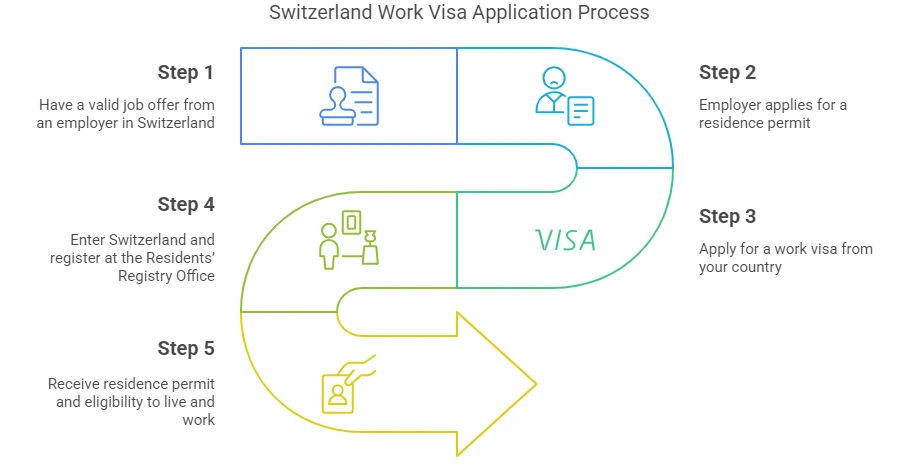
Step 1: Get a Job Offer
You must have a written job offer from a Swiss employer who is willing to sponsor your work permit application. The employer must demonstrate to the cantonal authority that no suitable Swiss or EU/EFTA candidate was available for the role — this is called the labour market test, required under the Swiss Employment Act for non-EU hires. Target employers in Zurich (IT, banking), Geneva (pharma, finance), and Basel (life sciences) who regularly hire international talent.
Step 2: Employer Applies for Work Permit
Your employer submits the work permit application to the relevant cantonal (state) migration authority, along with your employment contract, qualifications, and labour market test evidence. The cantonal authority reviews the application and forwards it to the federal State Secretariat for Migration (SEM) at sem.admin.ch for final approval. The employer must also confirm that quota capacity is available — if the canton's quarterly quota is exhausted, the application cannot proceed until the next quarter.
Step 3: Approval from Authorities
Cantonal approval typically takes 3–8 weeks. Federal SEM approval takes an additional 1–2 weeks. Once both approvals are granted, your employer receives a confirmation letter authorising you to enter Switzerland for work. This confirmation letter is your basis for the next step.
Step 4: Get Approval Letter
With the employer's confirmation letter, apply for a National D (long-stay) Visa at the Swiss Embassy in New Delhi or the Swiss Consulate in Mumbai, or through a VFS Global centre. Submit your passport, employment contract, confirmation letter, qualification certificates, proof of accommodation, and health insurance. Embassy processing takes approximately 4–6 weeks. Book your appointment early as slots fill quickly.
Step 5: Apply for Type D Visa
Attend your appointment at the Swiss Embassy or VFS Global centre to submit fingerprints and photographs. Biometric submission is mandatory for all non-EU work visa applicants.
Step 6: Submit Biometrics
Visit the consulate to give your fingerprints and complete visa formalities.
Step 7: Travel to Switzerland
After visa approval, travel to Switzerland within 90 days.
Step 8: Register Locally
On arrival in Switzerland, you must register with your local cantonal residents' registration office (Einwohnerkontrolle) within 14 days. Do not start work before this registration is complete. Bring your passport, D-visa, employment contract, and proof of accommodation.
Step 9: Get Residence Permit
You will receive your residence permit (L or B permit) to live and work legally.
Step 10: Get Health Insurance
You must take health insurance within 3 months of arriving in Switzerland.
From Work Permit to Permanent Residence in Switzerland
For Indian professionals, Switzerland offers a clear long-term settlement pathway — but it requires patience and planning.
| Stage | Timeline | Requirements |
|---|---|---|
| L Permit | Up to 1 year | Fixed-term employment contract |
| B Permit | 1 year, renewable annually | Permanent employment; continued employment with the same or a new qualifying employer |
| C Permit (Permanent Settlement) | After 10 years continuous legal residence | German or French at B1 level; financial self-sufficiency; clean criminal record; integration requirements met |
Key facts for Indian applicants:
- Indian nationals must complete 10 years of continuous legal residence before applying for the C Permit (settlement)
- Language proficiency at B1 level in German or French is required — begin language study early in your Swiss career
- The C Permit is indefinite and does not require annual renewal — it is the goal of long-term settlement
- Swiss citizenship is possible after 10 years of residence, with stricter language and integration requirements
Switzerland work visa processing time
The processing time for a Switzerland work visa depends on different steps like approval from local and federal authorities and visa issuance. The total time can vary, so it is best to apply at least 3 to 4 months in advance to avoid delays.
| Stage | Time Required |
|---|---|
| Cantonal Review | 3–8 weeks |
| Federal SEM Approval | 1–2 additional weeks |
| National D Visa Issuance | 8–10 weeks (up to 12 weeks during peak periods) |
Total Processing Time: 4–12 weeks for work permit + additional time for D visa issuance
Apply at least 3–4 months before your intended start date to account for all stages.
Switzerland Work Visa Cost
The cost of a Switzerland work visa depends on different parts of the application process, such as permit fees, administrative charges, and visa application fees. The total cost can vary based on the canton and type of permit. It is important to plan your budget in advance. The cost breakdown for Switzerland Work Visa is given below:
| Fee Component | Amount (CHF) | Approx. in INR |
|---|---|---|
| Cantonal Permit Processing Fee (L or B Permit) | CHF 100–300+ (varies by canton; Zurich fees increased in March 2024) | ₹9,600–28,800+ |
| Cantonal Residence Registration on Arrival | CHF 50–65 | ₹4,800–6,200 |
| National D Visa Application Fee (Swiss Embassy) | CHF 60–100 | ₹5,760–9,600 |
| Notarisation, Translation, and Document Preparation | CHF 100–300 | ₹9,600–28,800 |
| VFS Global Service Fee (if applying via VFS) | CHF 30–50 (approx.) | ₹2,880–4,800 |
| Medical Examination (if required) | CHF 50–150 | ₹4,800–14,400 |
| Total Estimated Cost | CHF 400–1,100+ | ₹38,400–1,05,600+ |
Fees are non-refundable and vary by canton and permit type. Verify current cantonal fees at sem.admin.ch before applying. Some employers reimburse permit application costs — confirm with your employer before proceeding.
Total Estimated Cost: CHF 200–800 (≈ ₹19,000–76,000)
How Can Y-Axis Help You?
- Y-Axis can assist you with:
- Immigration documents checklist
- Guidance in application processing
- Forms, documentation & application filing
- Updates & follow up
Y-Axis snapshot
1M
Successful applicants
1500+
Experienced counselors
25Y+
Expertise
50+
Offices
Don't know what to do ?
Get Free Counseling
Looking for Inspiration
Explore what Global Indians have to say about Y-Axis in shaping their future