

Don't know what to do ?
Get Free Counseling
Last Updated 15 October 2026
About South Korea
South Korea is a highly developed and technology-driven country. It has grown very fast and is now one of the world’s top economies. It is strong in industries like electronics, semiconductors, automobiles, and entertainment. The country also has a growing expat community of over 2.5 million foreign residents, supported by government programs like KIIP, which help international professionals settle easily.
There are over 900,000 foreign professionals in South Korea, and the number is increasing every year. The country needs more skilled professionals, especially in IT, engineering, healthcare, and manufacturing.
The government offers different visa options for foreign workers, such as the E-7 visa for skilled jobs and points-based systems for faster residency. There are also programs to help foreigners settle in the country.
South Korea offers good salaries, modern infrastructure, and a high standard of living. In many technical jobs, knowing Korean is not always required.
Capital: Seoul | Population: ~51 million | Language: Korean | Currency: Won (₩) ≈ ₹0.063
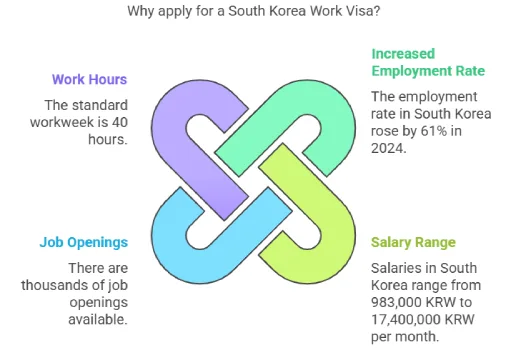
Why apply for a South Korea Work Visa?
- South Korea's employment rate reached 62.9% in 2024 (Source: OECD Labour Statistics), supported by over 1.1 million foreign workers meeting growing sectoral demand.
- South Korean salaries range from about 983,000 KRW to 17,400,000 KRW per month
- Has thousands of job openings
- Work for 40 hours a week
- Access to advanced industries like technology, semiconductors, and automotive with global career exposure
- High standard of living with modern infrastructure, safe environment, and efficient public transport
South Korean Work Visa
Indian nationals can apply for various types of South Korean visas based on their trip purpose. Each visa type has specific criteria. The visa application process requires submitting basic personal, contact, and passport information.
A South Korean work visa is an official stamp in your passport that allows you to visit, work, and stay in a nation for a specified time. Foreign employees require a work permit and visa to enter the Republic of South Korea. Without these legal documents, employment is not accepted in the nation. Work visas guarantee and prove that you can stay in the country.
Additionally, Indians must meet health and safety requirements to be eligible for the South Korean work visa.
Also, read...
South Korea Introduces K-STAR Visa to Attract Global STEM Professionals. Apply now!
Types of South Korea Work Visas
Business & Investment Visas
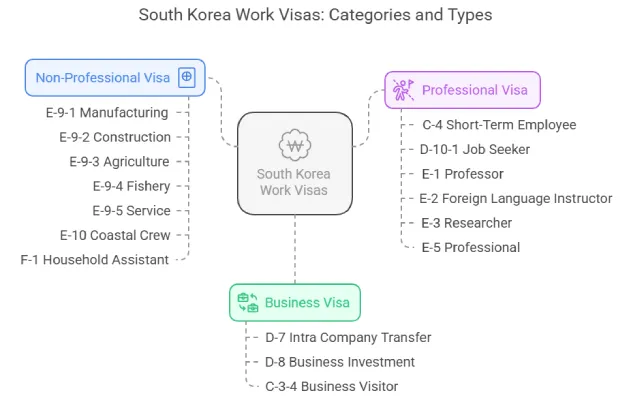
- D-7 (Intra-Company Transfer Visa):
For employees of multinational companies who are transferred to a branch or subsidiary in South Korea. - D-8 (Business Investment Visa):
For foreign investors and entrepreneurs who want to start or manage a business in South Korea. - C-3-4 (Business Visitor Visa):
For short-term business visits such as meetings, market research, or contract discussions.
Professional Work Visas
- E-1 (Professor Visa):
For individuals teaching or conducting research at universities or higher education institutions. - E-2 (Foreign Language Instructor Visa):
For teaching languages like English in schools, academies, or training institutes. - E-3 (Researcher Visa):
For professionals working in research and development in science or technology fields. - E-4 (Technical Instructor / Technician Visa):
For experts providing technical training or specialized skills in industries. - E-5 (Professional Visa):
For licensed professionals such as doctors, lawyers, and accountants. - E-7 (Specially Skilled Worker Visa):
For skilled professionals in fields like IT, engineering, and other in-demand sectors.
K-STAR Visa (launched September 2025, nationwide from 2026):
- For elite global STEM professionals in AI, semiconductors, biotechnology, and advanced engineering. Designed for top-tier talent at Korean universities and high-tech companies.
- Requirements: Master's or doctoral degree from a world top-100 university; minimum 8 years' total experience including 3+ years at a global top-500 company; employment at a designated high-tech Korean company; minimum annual salary of KRW 140,000,000 (~₹88.2 lakh/year).
- Benefits: Up to 50% income tax reduction for 10 years; housing loan eligibility up to KRW 500 million; accelerated F-2 residency status without needing a job offer (for university-recommended STEM graduates); F-5 permanent residency pathway after 3 years on F-2 (instead of the standard 6 years).
- Relevant for: Indian professionals currently at global top-500 companies such as Google, Microsoft, Qualcomm, Infosys, TCS, or leading semiconductor firms.
Non-Professional & Entry-Level Visas
- E-9 (Non-Professional Employment Visa):
For workers in sectors like manufacturing, construction, agriculture, and fisheries under government programs. - E-10 (Maritime Crew Visa):
For individuals working as crew members on ships, fishing vessels, or cruise liners.
Other Important Visas
- D-10-1 (Job Seeker Visa):
Allows individuals to stay in South Korea and search for jobs after completing studies or training. - F-1 (Cohabitee / Dependent Visa):
For family members or assistants of foreign workers, investors, or diplomats living in South Korea.
Top In-Demand Jobs in South Korea
South Korea is facing a shortage of skilled workers due to an ageing population and fast growth in technology. Because of this, there is high demand for professionals in many sectors, especially in IT, engineering, healthcare, and manufacturing. These jobs offer stable careers and good salaries.
Below are some of the most in-demand jobs in South Korea with their average yearly salaries:
| Occupation | Average Salary per Year (₩) | Approx. in INR |
|---|---|---|
| Software Developers & IT Engineers | ₩55,000,000 | ~₹34.65 lakh |
| AI / Machine Learning Engineers | ₩75,000,000 | ~₹47.25 lakh |
| Semiconductor Engineers | ₩70,000,000 | ~₹44.1 lakh |
| Nurses & Care Workers | ₩35,000,000 | ~₹22.05 lakh |
| Civil & Mechanical Engineers | ₩52,000,000 | ~₹32.76 lakh |
| Construction Workers & Supervisors | ₩38,000,000 | ~₹23.94 lakh |
| Manufacturing / Automation Engineers | ₩50,000,000 | ~₹31.5 lakh |
| Data Analysts | ₩55,000,000 | ~₹34.65 lakh |
| English Language Teachers | ₩32,000,000 | ~₹20.16 lakh |
| Hospitality & Food Service Managers | ₩38,000,000 | ~₹23.94 lakh |
(1 KRW ≈ ₹0.063, April 2026 indicative rate — verify current rate at xe.com before making financial decisions.)
*Also, read...
Highest Paying Jobs in South Korea for Indians
Average Salary in South Korea Based on Experience
Salaries in South Korea depend on your experience, job role, and industry. Freshers usually earn lower salaries, while professionals with more experience and special skills can earn much higher pay. This applies to fields like IT, healthcare, engineering, manufacturing, and hospitality. High-demand roles like AI, semiconductors, and senior tech jobs may offer even higher salaries.
| Experience Level | Average Salary per Year |
|---|---|
| Entry Level | ₩30M – ₩40M (₹19–25 LPA) |
| Mid Level | ₩45M – ₩65M (₹28–40 LPA) |
| Senior Level | ₩80M – ₩150M+ (₹50–94 LPA) |
Top Companies in South Korea Hiring Indian Professionals
South Korea is home to many global companies that actively hire skilled international professionals, including Indians. These companies offer good salaries, advanced work environments, and opportunities to work on global projects. Many of them have English-friendly workplaces, strong visa support, and roles in high-demand fields like IT, engineering, AI, and manufacturing.
| Company | Industry | Why It's Good for International Talent |
|---|---|---|
| Samsung Electronics Co., Ltd. | Technology / Semiconductors / Electronics | Global tech giant; hires many Indian IT professionals in R&D and engineering roles; strong visa support |
| LG Electronics Inc. | Electronics / Home Appliances / Tech | Actively hires Indian engineers; international-friendly teams |
| SK Hynix Inc. | Semiconductors / Memory Technology | High demand for engineers; good salary and relocation support |
| Hyundai Motor Company | Automotive / EV / Manufacturing | Offers roles in EV, R&D, and global operations |
| Kia Corporation | Automotive / Global Operations | Hires engineers and specialists in design and manufacturing |
| Coupang Corp. | E-commerce / Tech / Logistics | English-friendly workplace; hires in tech and operations |
| Krafton Inc. | Gaming / Tech / Entertainment | Opportunities in game development and engineering |
| Naver Corporation | Tech / AI / Fintech | Hires for AI, software, and global services |
| Kakao Corp. | Tech / Mobile / Fintech | Growing hiring in digital and tech roles |
| Doosan Robotics | Robotics / Automation | High demand for engineers and automation experts |
| Samsung Biologics | Biotech / Pharma | Roles in biotech R&D and global operations |
| Lotte Group | Retail / Hospitality / Food | Jobs in retail, hospitality, and marketing |
| Tata Consultancy Services Korea | IT Services / Consulting | Good option for Indian professionals in IT |
| Accenture Korea | Consulting / IT | Hires for AI, consulting, and digital roles |
| IBM Korea | IT / Cloud / AI | Opportunities in cloud, AI, and enterprise tech |
Key Tips for Indian Professionals
- Check visa options and requirements through official portals like hikorea.go.kr and visa.go.kr
- Confirm if the company provides visa sponsorship (E-7 or D-7) before applying
- Look for companies with English-friendly work environments
- Focus on high-demand fields like IT, semiconductors, engineering, AI, healthcare, and global business
- Learn basic Korean language (TOPIK Level 2–3) to improve job chances
- Korean language skills also help in better workplace communication and integration
Market Background & Trends in South Korea
South Korea is seeing a steady rise in foreign workers, with over 1.1 million employed, showing strong demand for international talent. Many companies, especially small manufacturing firms, are struggling to find local workers, which is increasing hiring from abroad. Skilled visa demand has grown rapidly, especially for E-7 visas, showing the need for professionals in advanced sectors. The government has also introduced new visa programs to attract top talent in areas like semiconductors, biotechnology, and advanced technology.
India and South Korea have strong bilateral ties through the Comprehensive Economic Partnership Agreement (CEPA), in force since January 1, 2010. For Indian professionals, CEPA may facilitate simplified credential recognition in certain E-7 Specific Activity categories and may reduce labour market testing requirements for eligible applicants in CEPA-designated occupations. Indian IT professionals in particular may benefit from these provisions when applying through qualified Korean employers. Y-Axis can advise on CEPA-specific advantages based on your occupation and visa category. Key sectors with high demand include IT, AI, robotics, healthcare, construction, automotive, and logistics. Due to an ageing population, there is also growing demand in healthcare and caregiving roles. South Korea is expected to face a shortage of over 500,000 skilled professionals in the coming years. Skilled workers can also move from temporary visas to long-term residency and eventually Permanent Residency (PR), making South Korea a strong option for long-term career growth.
Also, read...
South Korea Job Market:Trends & Job Opportunities
South Korean Work Visa Requirements
The requirements for a South Korea visa depend on the type of visa you need; following are the requirements of a South Korean work visa:
- A completed visa application form
- A valid passport with blank pages
- A copy of the passport
- Passport-size photographs taken in the last three months
- Professional and educational certificates
- Employment contract
- Business registration license
- Tax returns and financial payments of the company in the previous financial year
- Sponsor letter from an MNC or a South Korean Business/Government/Organization
- Tuberculosis (TB) test certificate
e-Arrival Card: Mandatory for all foreign nationals entering South Korea from February 24, 2025. Complete the electronic arrival card online at e-arrivalcard.go.kr at least 72 hours (3 days) before travel. Free of charge. This replaces the paper arrival card and is required for all Indian work visa holders.
Steps to apply for a working visa in South Korea
You must apply for a South Korean visa from one of the Republic of Korea's diplomatic missions abroad or have a sponsor in South Korea.
Step 1: Choose the right type of visa.
Step 2: Get started with your visa application
Step 3: Gather all your documents and submit them
Step 4: Book an appointment in the Korea Visa Application Centre near you
Step 5: Pay the required fees
Step 6: Attend the visa interview
Step 7: After receiving your visa, complete the South Korea e-Arrival Card at e-arrivalcard.go.kr at least 72 hours before your departure date.
Also, read…
What are the most in-demand jobs in South Korea for the next 10 years?
South Korea Work Visa Cost
The cost of a South Korea work visa depends on the type of visa and number of entries. In most cases, visa fees range from USD 40 to USD 90. The exact amount may change slightly based on your nationality and when you apply, as fees are updated regularly.
| Visa Type | Fee (INR) |
|---|---|
| Single Entry Visa (up to 90 days) | ₹ 3,400 |
| Single Entry Visa (more than 90 days) | ₹ 5,100 |
| Double Entry Visa | ₹ 5,950 |
| Multiple Entry Visa | ₹ 7,650 |
VFS Global / KVAC service fee: ~₹1,380 per application (additional). ARC (Alien Registration Card) after arrival: KRW 35,000 (~₹2,205). Fees revised June 1, 2025. Source: Korea Visa Application Centre India (kvac.kr). Subject to change — verify before applying.
After arriving in South Korea, you must apply for a Residence Card (previously called ARC). The fee for this is KRW 35,000 (around USD 25–26). This is a fixed government fee and must be paid in Korean Won.
South Korea Work Visa Processing Time
The processing time for a South Korea work visa usually takes 2 weeks to 2 months, depending on the visa type and application details. It is always better to apply early to avoid delays. After entering South Korea, you must apply for a Residence Card within 90 days. The card is usually issued within 3 to 5 weeks, although it may take longer during busy periods.
Processing times by visa type (approximate):
- E-7 (Skilled Worker): 3–8 weeks from CCVI submission
- E-2 (Foreign Language Instructor): 2–4 weeks
- D-7 (Intra-Company Transfer): 3–6 weeks
- E-9 (Employment Permit System / EPS): tied to EPS-TOPIK test schedule — apply well in advance
Apply at least 2–3 months before your intended start date to account for document preparation, CCVI processing in Korea, and consulate processing time.
Alien Registration Card (ARC) — What to Do After Arriving in South Korea
After arriving in South Korea on a work visa, you must apply for your Alien Registration Card (ARC) at a local immigration office within 90 days of entry. The ARC is your official Korean resident ID and is required for banking, mobile SIM registration, healthcare access, and most official transactions. Many employers also require the ARC before processing your payroll.
Fee: KRW 35,000 (~₹2,205). Processing time: 3–5 weeks in most cases, though this can extend during busy periods. Apply early — do not wait until close to the 90-day deadline.
South Korean work visa application online
South Korea allows both online and in-person visa applications. Indian applicants apply through the Korea Visa Application Centre (KVAC India) or the Korean Embassy.
KVAC centres across India: New Delhi, Mumbai, Chennai, Bengaluru, Kolkata, Hyderabad, Ahmedabad.
Official portals:
- Korea Visa Portal (visa.go.kr) — for applications from outside South Korea
- Hi Korea portal (hikorea.go.kr) — for applications, extensions, and services inside South Korea
- KVAC India (kvac.kr) — for Indian applicants applying through KVAC centres
- e-Arrival Card portal (e-arrivalcard.go.kr) — mandatory pre-travel form for all foreign nationals
If your Korean employer has initiated the CCVI (Certificate of Confirmation of Visa Issuance) process from inside Korea, the application may be submitted via visa.go.kr directly by the employer.
How can Y-Axis help you?
Y-Axis, the world's top overseas immigration consultancy, provides unbiased immigration services for every client based on their interests and requirements. Our impeccable services at Y-Axis include the following:
- Expert guidance/counseling for working in South Korea
- Assistance in applying visa
- Coaching Services: IELTS/TOEFL Proficiency Coaching
- Free career counseling; book your slot today!
- Resume Marketing services to find related Jobs in South Korea
Y-Axis snapshot
1M
Successful applicants
1500+
Experienced counselors
25Y+
Expertise
50+
Offices
Don't know what to do ?
Get Free Counseling
Looking for Inspiration
Explore what Global Indians have to say about Y-Axis in shaping their future