


Don't know what to do ?
Get Free Counseling
Last Updated 10 September 2026
Why apply for a US Work Visa?
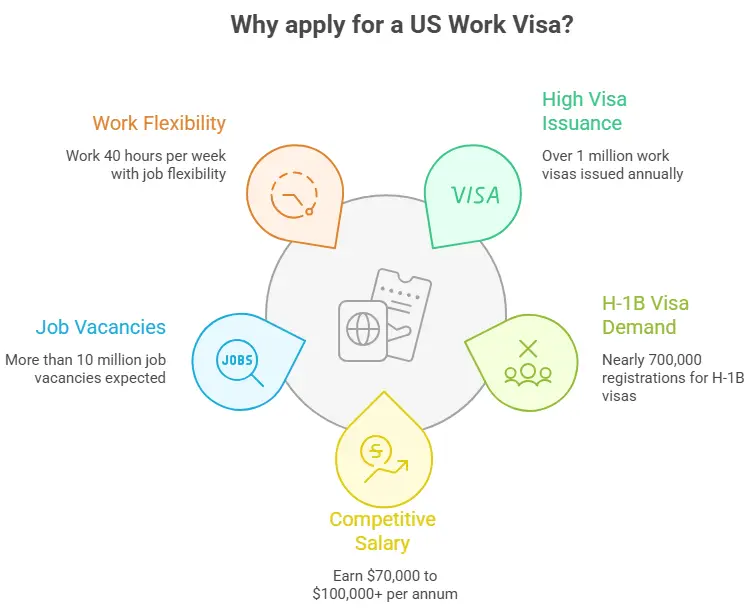
- Issues over 1 million work visas annually (H-1B, L-1, O-1 visas)
- High demand for H-1B visas, with nearly 700,000 registrations every year
- Earn $70,000 to $100,000+ per annum (varies with the job role, location, industry, and experience)
- More than 10 million job vacancies are expected in the coming decade
- Work for 40 hours per week, with job flexibility
Capital: Washington, D.C. | Population: 341 million | Language: English (official since 2025); Spanish is the second most spoken language with approximately 42 million speakers, making the US one of the largest Spanish-speaking countries in the world.
Benefits of working in the USA
Here are the benefits of working in the USA:
- Abundant job opportunities across diverse industries including tech, finance, healthcare, and entertainment
- High earning potential with some of the most competitive salaries in the world
- Career growth with access to world-class companies, startups, and innovation hubs
- High quality of life with access to modern infrastructure, healthcare, and education
- Travel freedom with visa-free or visa-on-arrival access to many countries
- US is one of the best countries in the world to start and scale a business
- Diverse work culture welcoming professionals from all over the globe
- Access to top universities and research institutions for continued learning and development
- Strong legal protections for workers including anti-discrimination laws and labor rights
- Social benefits such as employer-sponsored health insurance, 401(k) retirement plans, and paid leave policies
U.S. Work Visa for Indians
The United States has a strong attraction for job seekers from India, the leading global economy. However, obtaining a US work visa from India can be difficult and time-consuming. It is important to clearly understand the job application process, visa requirements, and necessary documents. First, understand the available visa types, eligibility criteria, application procedures, and important considerations for Indian applicants. By providing the right knowledge, you can increase your chances of obtaining a work visa and pursuing your professional desire in the United States.
*Looking to work in the USA? Get expert assistance with H-1B Visa Flipbook.
Why Should Indians Migrate to USA?
Here are the key reasons why Indians should consider migrating to the USA:
- Over 4.4 million Indians already settled across major cities like New York, San Francisco, Chicago, and Houston.
- The USA is home to global tech giants like Google, Microsoft, Amazon, and Meta.
- Indians are eligible for the H-1B visa, which allows skilled workers in specialty occupations to live and work in the USA, with pathways to permanent residency (Green Card).
- High demand for doctors, nurses, and healthcare professionals, with Indian medical graduates widely recognized and welcomed into the American healthcare system.
- Indian students are among the largest international student communities in the USA, with access to world-renowned universities and the OPT program.
- The USA offers significantly higher salaries compared to most countries, with Indian professionals in tech, medicine, and finance.
- After maintaining lawful permanent residence, Indians can apply for US Citizenship after 5 years.
- The EB-5 Immigrant Investor Program allows Indians with investment capital to obtain a Green Card by investing a minimum of $1,050,000 (or $800,000 in a Targeted Employment Area) in US businesses that create at least 10 full-time jobs.
- High-demand roles in IT, research, academia, and healthcare offer strong job security and long-term career stability.
- Working in the USA provides access to a vast domestic market, making it one of the best countries in the world for Indian entrepreneurs to start and scale businesses.
What are the most in-demand jobs in the USA for the next 10 years?
USA Work Visa
A USA work visa allows foreign nationals to enter and legally work in the country, often requiring a valid job offer from an employer in the US, who will also file a petition with the USCIS on your behalf. Some of the most common work visas in the US include the H-1B visa for specialty occupations, the L-1 visa for intracompany transferees, and the O-1 visa for extraordinary abilities.
United States Work Visa Types
The US offers different work visa options for foreign nationals interested in moving to the country for work. Given below are the most common US work visa types, which are basically divided into Temporary Non-Immigrant visas and Permanent (Immigrant) visas.
Temporary non-immigrant work visas
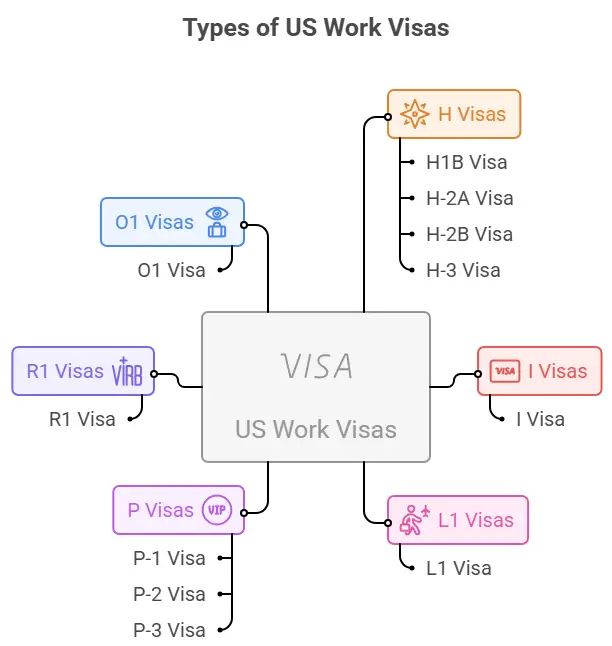
- H Visas: You can apply for H-1B visas for highly qualified and specialized professionals, while H-2A and H-2B visas are for temporary agricultural and non-agricultural workers, respectively.
- I Visas: I visas for individuals from the press, including editors, crews, and reporters, allowing them to work long-term in media-related job roles or professions.
- L Visas: L-1 visas are for intra-company transfers; the L-1A visa is for managers and executives (3-year validity), and the L-1B visa is for individuals with highly specialized knowledge.
- O Visas: O visas are for individuals with extraordinary abilities and skills across top sectors and industries.
- P Visas: The P visas are exclusively for artists and athletes and are generally for event-based durations.
- R Visas: R visas are for religious workers who are members of religious organizations affiliated with the US.
Permanent (Immigrant) work visas
- First Preference EB-1: Individuals with extraordinary abilities in research, arts, athletics, academia, and who do not require a labour market certificate.
- Second Preference EB-2: Individuals with an advanced degree or a foreign equivalent, or those with a minimum of 10 years of prior work experience in a relevant field or occupation, or those whose employment is in the national interest of the US.
- Third Preference EB-3: Individuals with a Bachelor’s degree, skilled and unskilled labourers with a non-temporary job offer from an employer in the US.
- Fourth Preference EB-4: It is a highly specialized visa category that includes religious workers, employees of foreign service posts in the US, non-citizen minors, and retired employees of international organizations.
- Fifth Preference EB-5: The EB-5 Immigrant Investor Program applies to individuals who invest at least $1,050,000 USD in a new enterprise. The enterprise must have employed at least 10 full-time US workers, or invest at least $800,000 USD in a Targeted Employment Area (TEA) or infrastructure project that employs at least 10 full-time US workers.
US Work Visa Types
Here are the types of US Temporary Work Visas:
| Visa Type | Occupation | Work Type |
|---|---|---|
| H-1B Visa | Specialty Occupation Professionals | Work in specialized fields such as IT, engineering, finance, healthcare, and consulting |
| H-1B1 Visa | Free Trade Agreement (FTA) Professionals | Work in specialty occupations under U.S. trade agreements |
| H-2A Visa | Temporary Agricultural Workers | Seasonal agricultural and farming work |
| H-2B Visa | Temporary Non-Agricultural Workers | Seasonal non-agricultural work in hospitality, tourism, landscaping, and related sectors |
| H-3 Visa | Trainees / Special Education Visitors | Training and skill development programs |
| I Visa | Foreign Media Representatives | Journalism, reporting, and media-related work |
| L-1 Visa | Intracompany Transferees | Transfer within multinational companies in managerial or specialized roles |
| P-1 Visa | Athletes / Entertainment Groups | Participation in sports competitions or entertainment events |
| P-2 Visa | Artists / Entertainers | Perform under approved cultural exchange programs |
| P-3 Visa | Artists / Entertainers (Cultural Programs) | Perform or teach culturally unique artistic programs |
| R-1 Visa | Religious Workers | Work for nonprofit religious organizations |
| TN Visa | CUSMA/USMCA Professionals | Temporary work for eligible Canadian and Mexican professionals |
| O-1 Visa | Individuals with Extraordinary Ability | Work in science, arts, education, business, athletics, or entertainment with proven exceptional achievement |
Planning a short business trip to the US without taking up employment? The US B1/B2 Visitor Visa may be the right option for you.
H-1B work visa
The H1B work visa is introduced by an employer in the United States. The employer must have an open job position, and if they cannot find an American employee suitable for that position, they can hire employees from other countries. This position might require higher education degrees or specialized skills. Thousands of people move to the USA every year to work on H1B visas.
H-1B Visa 2025–2026 Policy Updates: What Indian Professionals Must Know
Five major changes to the H-1B visa program took effect between September 2025 and March 2026. All Indian H-1B applicants and holders should review these updates before filing or planning travel.
1. Wage-Based Weighted Selection — Effective February 27, 2026
The random H-1B lottery has been permanently replaced by a wage-based weighted selection system. Job offers at higher DOL OEWS wage levels receive more registration entries and significantly better selection odds:
- Level IV (highest wage tier): ~61% selection odds
- Level III: ~46% selection odds
- Level II: ~31% selection odds
- Level I (entry wage): ~15% selection odds
Strategy: Negotiate a Level III or Level IV job offer with your sponsoring employer to maximise your H-1B selection chances. Source: DHS Final Rule, December 2025.
2. Dropbox (Interview Waiver) Eliminated — Effective September 2, 2025
The H-1B interview waiver (dropbox) programme has been permanently eliminated for all H-1B applicants worldwide. All H-1B visa applicants — including those renewing an existing H-1B — must now attend an in-person visa interview at a US consulate or embassy. In India: Mumbai, New Delhi, Chennai, Hyderabad, and Kolkata consulates. Appointment availability at India consulates is extremely limited. Book as early as possible at ustraveldocs.com.
3. $100,000 Fee for Overseas H-1B Beneficiaries — Effective September 19, 2025
Presidential Proclamation 10973 introduced a $100,000 fee for new H-1B petitions filed for beneficiaries who are outside the United States and do not hold a valid H-1B visa at the time of filing.
Who is EXEMPT from the $100K fee:
- F-1 students on OPT or STEM OPT already inside the United States
- H-1B extensions with the same employer
- H-1B transfers to a new employer
- H-1B amendments
The fee is currently set to expire September 21, 2026 unless renewed by executive action.
4. Mandatory Social Media Vetting for H-1B and H-4 Applicants — Effective December 15, 2025
All H-1B and H-4 visa applicants attending a US consulate interview must now declare their social media handles. A supplemental DS-5540 form may be required. This change caused widespread appointment cancellations at all five India consulates in late 2025 and early 2026. Social media vetting may extend visa processing times beyond standard estimates. Source: Federal Register / US Department of State.
5. Premium Processing Fee Increased to $2,965 — Effective March 1, 2026
The USCIS premium processing fee for H-1B petitions (Form I-907 / I-129) increased to $2,965 effective March 1, 2026. Premium processing guarantees a decision within 15 business days. Source: uscis.gov/forms/filing-fees.
Important Notice for H-1B Holders in India
As of early 2026, all five India US consulates (Mumbai, New Delhi, Chennai, Hyderabad, Kolkata) showed no H-1B visa interview appointments available through 2026. Limited appointment slots resumed on April 4, 2026.
- Book your H-1B visa interview appointment as early as possible at ustraveldocs.com
- All H-1B applicants must attend in-person interviews — the dropbox waiver no longer exists (eliminated September 2, 2025)
- Social media vetting is mandatory since December 15, 2025 — declare all handles at your interview
- Processing times may be extended due to social media vetting requirement
Stay ahead of every H-1B rule change — from the new wage-based lottery to mandatory interviews and the $100K overseas fee.
Complete H-1B Visa Guide for Indians
OPT to H-1B Transition Guide for Indian Students in the USA
Indian students on F-1 visas form the largest segment of H-1B applicants each year. Here is everything you need to know about transitioning from OPT or STEM OPT to H-1B status.
Key Timelines:
- Standard OPT: 12 months of work authorisation after graduation
- STEM OPT Extension: Additional 24 months for STEM degree holders (total 36 months OPT)
- H-1B Registration: Opens in early March each year. You must have a sponsoring employer before registering.
Cap-Gap Rule: If your OPT expires before October 1 (the H-1B start date) and your H-1B petition is selected and approved, the cap-gap rule automatically extends your OPT and work authorisation until September 30 — bridging the gap. Your employer must file the H-1B petition before your OPT expires.
60-Day Grace Period: If you are not selected in the H-1B process, you have a 60-day grace period from the end of your OPT to make alternative arrangements or depart the US.
If You Are Not Selected — Alternative Options:
- O-1 Visa: For individuals with extraordinary ability — no annual cap
- L-1 Visa: If your employer has international offices, transfer abroad for one year and return on L-1
- Employer international transfer: Work for the same employer in Canada, India, or another country and reapply in a future H-1B cycle
- CPT / another degree: Enrol in a new programme to maintain F-1 status
How to apply for the US H-1B Visa?
H-2B work visa
Foreign workers can apply for work visas after being sponsored by a US employer and have the chance to work in the US for a specified period of time. The H-2B visa jobs are designed for certain industries that experience demand surges and illustrate a need for additional temporary workers. Industries that qualify to hire H-2B workers include:
- Hospitality
- Cruise Ships
- Resorts and Theme Parks
- Construction
- Ski resorts
- Golf courses
- Maintenance and Janitorial
- Landscaping
- Water Parks
- Warehouses
- Restaurants and bars
- Retail stores
- Sports and athletics, etc.
TN work visa
The non-immigrant TN work visa allows citizens of Mexico and Canada, as CUSMA/USMCA professionals, to work in the United States in pre-planned business activities for U.S. or foreign employers. Permanent residents of Mexico and Canada cannot apply for TN visas to work as CUSMA/USMCA professionals. Note: NAFTA was replaced by CUSMA (Canada-United States-Mexico Agreement, known as USMCA in the US) effective July 1, 2020.
O1 Work Visa
The O1 visa for the US is a non-immigrant type of visa. It is issued to foreign nationals with extraordinary abilities or achievements in their field. The O1 visa aims at individuals in education, science, or the arts; it is also referred to as an artist’s visa or an extraordinary ability visa.
Eligibility Criteria for USA Work Visa
To apply for a USA work visa, candidates must generally have a confirmed job offer from a US employer, as most work visa categories are employer-sponsored. The USA prioritises skilled professionals, speciality occupation workers, and individuals with extraordinary abilities. A clean immigration history and valid passport are mandatory for all applicant
|
Category |
Details |
|---|---|
|
Ideal Candidate Profile |
IT professionals (developers, data engineers, cybersecurity specialists), healthcare workers (doctors, nurses), engineers, researchers, financial analysts, educators, corporate managers, skilled tradespeople, and investors. |
|
Education Requirements |
A Bachelor’s degree or higher is usually required for visas like H-1B and EB-2. Advanced degrees (Master’s/PhD) help with EB-1 or NIW categories. Vocational or trade certifications are accepted for EB-3 or H-2B. Indian degrees are generally recognised but may require credential evaluation (WES/ECE). |
|
Work Experience |
Relevant experience in the field is required. 2–3 years is common for H-1B roles, while 5+ years may be needed for senior or EB-1 extraordinary ability roles. |
|
Language Requirements |
Strong English proficiency is required. TOEFL or IELTS may be needed for academic roles. Healthcare workers must meet English standards for licensing exams such as USMLE or NCLEX. |
|
Salary Thresholds |
H-1B: Employer must pay the prevailing wage (often $60,000–$110,000+ per year). EB-2 / EB-3: Must meet the prevailing wage for the job. O-1: No fixed minimum salary. EB-5 Investor Visa: Minimum investment $1,050,000 (standard) or $800,000 in a Targeted Employment Area (TEA) or rural/infrastructure project, creating at least 10 full-time US jobs. |
|
Additional Requirements |
Valid passport, clean immigration record, confirmed job offer from a US employer, approved Labor Condition Application (LCA), employer-filed I-129 petition, DS-160 visa form, and visa interview at a US consulate in India. H-1B visas are capped annually. Effective FY2027 (February 27, 2026), selection uses a wage-based weighted system — higher DOL OEWS wage levels receive more entries and significantly better selection odds (Level IV ~61%, Level III ~46%, Level II ~31%, Level I ~15%). |
US Work Visa Requirements
The USA work visa requirements are given below –
- The applicant must have a sponsor.
- Proof of educational qualifications
- Proof of English language proficiency
- An employment offer from a US-based company
- Work experience certificate (If applicable)
- Approval from the USCIS
- DS-160 form
- Copies of I-129 & I-797 forms
Job Market in the USA
The USA offers vast job opportunities across a wide range of industries, with high demand across IT, software development, healthcare, finance, engineering, and advanced manufacturing. The country hosts the headquarters of numerous Fortune 500 companies having a thriving startup ecosystem, in commercial hubs like Silicon Valley, New York, Austin, and Seattle. The USA faces growing shortages of skilled workers in tech and healthcare sectors, making it actively hire qualified foreign professionals. With the right skills and experience, professionals have strong prospects of finding competitive, well-paying roles across the country.
Highest paying Jobs Opportunities in USA for Indians
Top Jobs in the USA for Indians
|
Industry |
In-Demand Job Roles & Insights |
|---|---|
|
IT & Software |
Software Developers, Cloud Architects, DevOps Engineers, AI/ML Engineers, Data Scientists, Cybersecurity Analysts. The US accounts for the largest share of H-1B visa holders, with Indians receiving over 70% of approvals. Major tech hubs include Silicon Valley, Seattle, Austin, and New York. |
|
Healthcare & Medicine |
Physicians, Surgeons, Registered Nurses, Pharmacists, Medical Researchers, Radiologists. The US faces a projected shortage of up to 86,000 doctors by 2036, creating strong demand for internationally trained professionals. |
|
Engineering |
Mechanical, Electrical, Civil, Chemical, and Aerospace Engineers. Demand is driven by infrastructure investment, defence contracts, and advanced manufacturing growth. |
|
Finance & Banking |
Financial Analysts, Investment Bankers, Risk Managers, Accountants, Actuaries. New York, Chicago, and San Francisco are the primary financial hubs. |
|
Research & Academia |
University Professors, Research Scientists, Postdoctoral Researchers. Indians are among the top contributors to US academic and scientific institutions. |
|
Clean Energy & Sustainability |
Renewable Energy Engineers, Environmental Consultants, Sustainability Managers. Demand is growing due to federal investment in green infrastructure and net-zero initiatives. |
|
Construction & Infrastructure |
Civil Engineers, Project Managers, Electricians, Skilled Tradespeople. The US Infrastructure Investment and Jobs Act is generating hundreds of thousands of new roles. |
|
Consulting & Management |
Management Consultants, Business Analysts, Strategy Managers, Operations Leads. Top consulting firms actively recruit Indian professionals for their analytical and technical expertise. |
|
Education & EdTech |
STEM Teachers, University Faculty, Curriculum Designers, EdTech Product Managers. Demand is rising across both traditional education and the rapidly expanding online learning sector. |
|
Pharmaceuticals & Biotech |
Clinical Research Associates, Biomedical Engineers, Drug Safety Specialists, Lab Scientists. The US leads globally in pharma R&D, with major hubs in Boston, San Diego, and New Jersey. |
USA Job Market: Trends & Job Opportunities
Average Salary of Skilled Workers in the USA
The USA offers the highest average salary compared with other major labour market in the world. Wages are governed by federal and state minimum wage laws, with many states setting rates well above the federal floor of $7.25/hour. Skilled professionals benefit from performance bonuses, employer-sponsored health insurance, 401(k) retirement plans, and stock options. Standard working hours are 40 hours/week, with an average of 10–15 days of paid annual leave depending on the employer.
|
Experience Level |
Average Gross Salary (USD / Year) |
Approx. Salary (INR / Year) |
|---|---|---|
|
Entry-Level |
$45,000 – $70,000 |
≈ ₹38 – ₹58 LPA |
|
Mid-Level |
$75,000 – $120,000 |
≈ ₹63 – ₹100 LPA |
|
Senior-Level |
$130,000 – $200,000+ |
≈ ₹108 – ₹167 LPA |
Note: INR equivalents are approximate and based on the USD/INR exchange rate at time of publication (~₹84–₹85/USD as of April 2026). Exchange rates fluctuate.
How can I get a visa sponsorship job in the USA?
How to apply for a US Work Visa for Indian?
The steps to apply for a USA work visa from India are as follows:
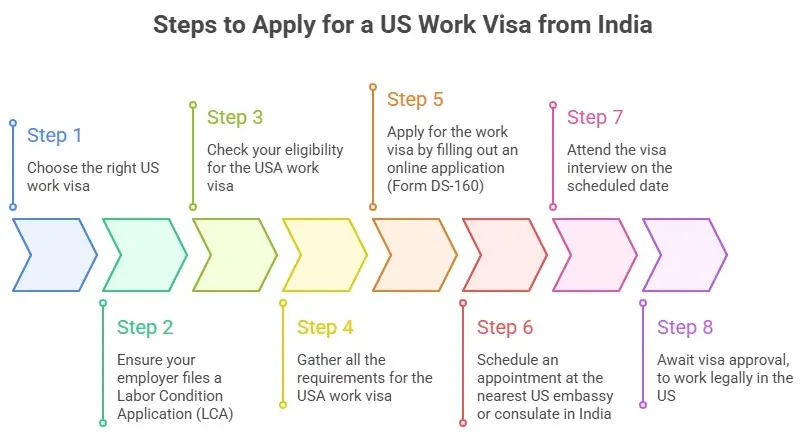
Step 1: Choose the right US work visa that best suits your job category
Step 2: Ensure your employer files a Labor Condition Application (LCA) with the US Department of Labor.
Step 3: Check your eligibility for the USA work visa based on occupation, salary and job roles.
Step 4: Gather all the requirements for the USA work visa such as passport, income proof, job offer letter, proof of accomodation, etc.
Step 5: Apply for the work visa by filling out an online application (Form DS-160)
Step 6: Schedule an appointment at the nearest US embassy or consulate in India for document verification and biometrics (Mumbai, New Delhi, Chennai, Hyderabad, or Kolkata)
Step 7: Attend the visa interview on the scheduled date.
Step 8: Await visa approval, to work legally in the US.
*Want to apply for a US visa? Talk to experts at Y-Axis to help you with the process.
US Work Visa Cost
The USA work visa fee costs around $185 to $205 and differs from the work visa type. The table given below has complete information on the kind of USA work visas and their processing fee:
|
USA Work Visa |
Consulate Application Fee (MRV) |
|---|---|
|
J-1 Visa |
$185 |
|
L-1 Visa |
$205 |
|
H-1B Visa |
$205 |
|
H-2B Visa |
$205 |
|
O-1 Visa |
$205 |
USA Work Visa Processing Time
The processing time for the USA work visa generally takes around three weeks to 8 months from the date of application. The processing time differs with the work visa type applied for and the submission date. The table below has a complete list of U.S. work visas and their processing times.
|
USA Work Visa |
Processing Time |
|---|---|
|
J-1 Visa |
1 to 3 months |
|
L-1 Visa |
2 to 4 months |
|
H-1B Visa |
3 to 6 months (regular); 15 business days (premium processing — $2,965 fee, effective March 1, 2026) |
|
H-2B Visa |
2 to 4 months |
|
O-1 Visa |
2 to 4 months |
Dependent Benefits for USA Work Visa Holders
Spouses and children of USA work visa holders are entitled to certain benefits depending on the visa category. Unlike Finland, the USA does not have a universal welfare system, and dependent benefits vary significantly by visa type, state, and employer.
|
Category |
Details |
|---|---|
|
Dependent Visa |
Spouses and unmarried children under 21 can apply as dependents: H-4 (H-1B), L-2 (L-1), O-3 (O-1), and J-2 (J-1). Their visa validity depends on the main applicant’s visa. |
|
Spouse Work Rights |
Work rights depend on visa type. H-4 spouses with an approved I-140 can get a work permit (EAD). L-2 spouses can work automatically. J-2 and O-3 spouses must apply for work authorization. |
|
Children’s Education |
Children can attend free public schools (K–12) in the USA. |
|
Healthcare Access |
Dependents usually get coverage through the main applicant’s employer health insurance. |
|
Child Benefit |
Eligible taxpayers may receive the Child Tax Credit (up to $2,000 per child). |
|
Childcare Support |
Families may use Dependent Care FSA to set aside up to $5,000 pre-tax for childcare expenses. Some states may also offer subsidies. |
Pathway to Long-Term Residency in the USA
The US residency pathway is primarily employment-based and structured around visa preference categories, and annual green card quotas. For Indian nationals, the process is significantly impacted by per-country caps.
|
Category |
Details |
|---|---|
|
Green Card (Permanent Residency) |
Allows foreign nationals to live and work permanently in the USA. Main employment categories include EB-1, EB-2, and EB-3. Many Indian professionals apply through EB-2 or EB-3 with employer sponsorship. |
|
Priority Date & Waiting Period |
Due to country limits, Indian applicants in EB-2 and EB-3 can face long waiting periods (often decades). EB-1 usually has much shorter wait times. |
|
PERM Labour Certification |
Most employers must prove no qualified US worker is available for the role before sponsoring a green card. This process typically takes about 1–2 years. |
|
EB-1 Fast-Track |
For individuals with extraordinary ability, outstanding researchers, or multinational executives. This category often has faster processing and may allow self-petitioning. |
|
Citizenship / Naturalisation |
Applicants can apply for US citizenship after 5 years of permanent residency (3 years if married to a US citizen) and must pass an English and civics test. |
|
Language Requirements |
No language test is required for a green card. Basic English and a civics test are required only when applying for citizenship. |
|
PR Eligibility Timeline |
Many Indian professionals start on H-1B visas and remain on extensions for years while waiting for their green card due to backlogs. |
|
Dual Citizenship |
The USA allows dual citizenship, but India does not. Indians who become US citizens must give up their Indian passport and can apply for an OCI card. |
India Green Card Wait Times: What Every Indian H-1B Holder Must Know
India-born applicants face the longest EB-2 and EB-3 green card waiting periods in the world. As of 2026, the US Department of State is processing EB-2 India and EB-3 India priority dates from 2012–2013. This translates to an estimated wait of 40–70+ years for most applicants in these categories.
Faster alternatives to consider:
- EB-1A (Extraordinary Ability): No employer sponsorship required; not subject to the same per-country backlog
- EB-2 NIW (National Interest Waiver): Self-petition option; no PERM labour certification required
US Work Visa Apply Online
To apply for a US work visa, first complete the online non-immigrant visa application, Form DS-160. This form takes approximately 90 minutes to complete, and you must also upload a photo of yourself to submit with your application.
After completing your application, take a print of the DS-160 barcode page and keep it with you. Also, print the application form confirmation page; you must carry both copies to your visa interview. You must also pay a non-refundable visa processing fee of $190 (USD).
Once you have submitted your application and paid the fee, you must schedule a visa interview at your nearest US embassy or consulate.
How can Y-Axis help you?
Y-Axis, the world's top overseas immigration consultancy, provides unbiased immigration services for every client based on their interests and requirements. Our impeccable services at Y-Axis include the following:
- Expert guidance/counseling for working in the United States
- Assistance in applying visa
- Coaching Services: IELTS/TOEFL Proficiency Coaching
- Free career counseling; book your slot today!
- Resume Marketing services to find related Jobs in the United States
Other Work Visas
This page provides general information only and does not constitute legal advice. US immigration law is complex and subject to frequent change. Penalties for errors in visa petitions or applications can be severe. Consult a qualified US immigration attorney (AILA member — aila.org) before submitting any US visa petition or application. Y-Axis provides immigration consulting services and is not a law firm.
Y-Axis snapshot
1M
Successful applicants
1500+
Experienced counselors
20Y+
Expertise
50+
Offices
Don't know what to do ?
Get Free Counseling
Looking for Inspiration
Explore what Global Indians have to say about Y-Axis in shaping their future