


Most in Demand Occupations in Italy
Down Arrow
Down Arrow
Down Arrow

I accept the Terms & Conditions

Don't know what to do
Don't know what to do ?

Get Free Counseling

Last Updated 19-May-2026

Highest Paying Job Opportunities in Italy

Being one of the top 10 biggest economies in the world, Italy is expanding into a developing market for jobs and employment. With about 4 lakh new hires expected until January 2026 and one million job openings by 2030. The country is welcoming skilled professionals from around the world. There are numerous jobs in Italy for Indians, especially in sectors like IT, engineering, finance, and healthcare. 

Some of the highest paying jobs in Italy are listed below:

Occupation

Average annual salary

IT and Software

€ 93, 432

Healthcare

€ 85,713

Engineering

€ 77,500

Accounting and Finance

€ 75,210

Nursing

€ 78,000

Sales and Marketing

€ 68,220

STEM

€ 95,500

Human Resource Management

€ 53,000

Tourism

€ 55,000

Teaching

€ 55,225


*Want to work in Italy? Let Y-Axis guide you with the process.

Job Vacancy in Italy by 2030

Italy will have many new job opportunities in the coming years. By 2030, there will be demand for skilled professionals in areas like IT, healthcare, engineering, finance, and tourism. The expected job vacancies in Italy by 2030 by different occupations by 2030 are listed below:
 

Occupation

Job Vacancy in Italy by 2030

IT & Software

70,000

Tourism

100,000+

Hospitality

68,000

Healthcare

65,000

Teaching

45,000

Nursing

39,000

Engineering

35,000

Accounting & Finance

33,000

Human Resources & Management

22,000

Marketing & Sales

10,000


Read more...

Top In-Demand Jobs in Italy for the Next 10 Years

Step-by-Step Guide for Job Search in Italy

Step 1: Look for jobs in your field.

Step 2: Use online job portals, company career websites Consider recruitment agencies.

Step 3: Prepare your CV and cover letter according to Italian job standards and the specific role.

Step 4: Network with professionals, connect with people working in Italy through LinkedIn or professional groups.

Step 5: Keep track of your applications and politely follow up with recruiters.

Step 6: Prepare for online interviews and know about Italian work culture.

Step 7: Make sure you meet the requirements for an Italy work visa before applying.


Also, read...

Italy Job Market: Trends & Job Opportunities

Why apply for Jobs in Italy?

  • Higher salaries compared to India for similar roles
  • One million job vacancies projected by 2030
  • Fourth largest economy in Europe
  • Pathways for long-term residency and career growth
  • Work for 36 hours a week
  • Access to European work culture and benefits
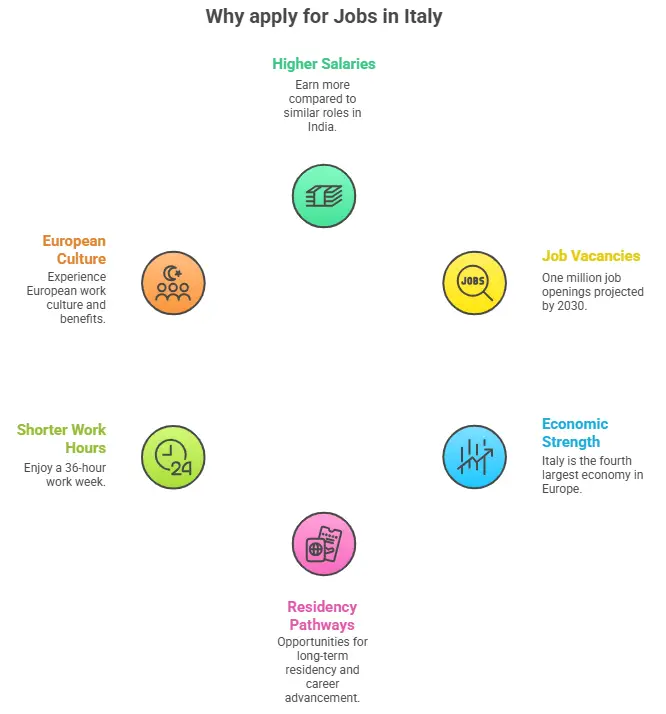
 

hy apply for Jobs in Italy


Migrate with an Italy work visa

An Italian work visa is simply an entry visa, and it is required to own a work permit before entering Italy. It comes under the long-stay visa category, also called D-visa or National visa. After obtaining an Italy work visa, you must apply for a residence permit within eight days of entering the country.


Types of Italy Work Visa

Italy offers different types of work visas depending on your job and nationality. EU citizens (including Iceland, Liechtenstein, and Norway) do not need a work permit but must register with local authorities if staying more than 90 days. Non-EU citizens, including those from the UK, must obtain a work visa before moving to Italy.

The main types of Italy work visas are:

  • Salaried Employment Visa: For people hired by an Italian company. The employer must get permission first.
  • Self-Employment Visa: For freelancers or people starting their own business in Italy.
  • Highly Specialized Worker Visa: For professionals with advanced skills in fields like IT, engineering, or research.
  • Digital Nomad / Remote Worker Visa: For people working for a foreign company while living in Italy.
  • Seasonal Work Visa: For temporary jobs in agriculture, tourism, or hospitality.

*Willing to migrate to Italy? Y-Axis will help you with the step-by-step process.

Requirements for Italy work visa

To obtain a work visa in Italy, the following requirements are needed:

  • You must have a real job offer from an Italian employer
  • You need the original work permit (Nulla Osta) and a copy for your visa. It is valid for six months, so apply within that time
  • A valid passport with at least two blank pages
  • Two recent passport-sized photos
  • Filled Visa Application Form
  • Professional certificates to show your qualifications.
  • Proof of Accommodation
  • Proof of Financial means
  • Health Insurance and police clearance certificate
  • Proof that you have paid the visa application fee
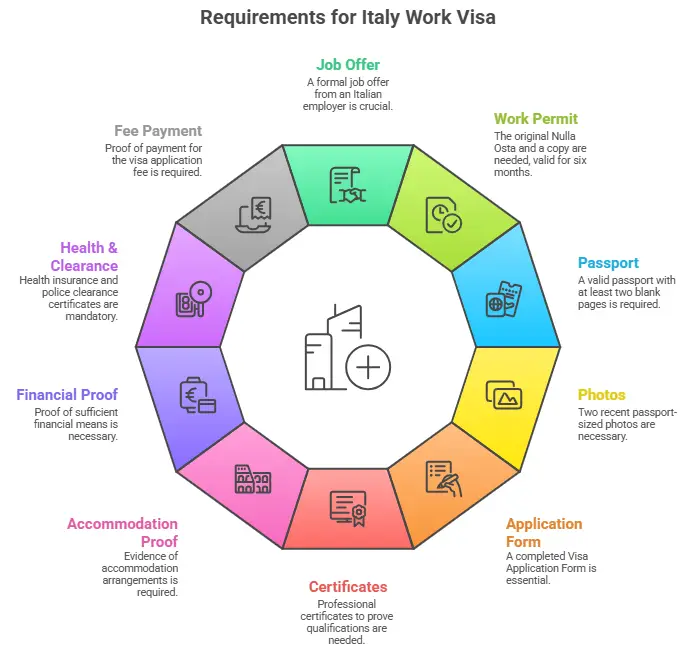
 

Italy work visa requirements


*Looking to work overseas? Contact Y-Axis, the world’s No. 1 overseas consultant for assisted guidance.

Top Careers in Italy

IT Jobs in Italy

The IT sector in Italy is growing rapidly, with high demand for roles like software developers, AI specialists, cybersecurity experts, and cloud engineers. Professionals with skills in Python, Java, and are in-demand. Salaries in top IT jobs can range from €35,000 to €95,000 per year, and senior roles or specialized tech positions can earn even more. Cities like Milan, Rome, and Turin offer the most opportunities for IT professionals.

Healthcare Jobs in Italy

Healthcare professionals such as doctors, surgeons, and nurses are in high demand, particularly in northern Italy where the population is older. Specialists like cardiologists, neurologists, and anesthesiologists earn competitive salaries, often ranging from €50,000 to €120,000 per year. Hospitals and private clinics actively seek skilled professionals, making it a secure career choice.

Engineering Jobs in Italy

Italy offers strong opportunities for engineers, especially in software, aerospace, mechanical, and petroleum engineering. Those with advanced degrees or international experience are highly valued. Salaries typically range from €30,000 to €70,000 per year, with senior or specialized engineers earning more. Engineering roles are concentrated in industrial hubs like Milan, Turin, and Bologna.

Financial Jobs in Italy

Finance professionals, including bank managers, financial analysts, and accountants, are among the top earners. Experienced financial managers can earn up to €156,000 per year, while mid-level roles average around €50,000–€70,000. Financial institutions in Milan and Rome offer the best salaries and career growth opportunities.

Sales & Marketing Jobs in Italy

Sales and marketing directors can earn around €80,000 per year on average. Roles in multinational companies or tech firms offer even higher pay. Skills in digital marketing, sales strategy, and client management are highly valued.

Teaching Jobs in Italy

University professors earn an average of €55,000 per year, with higher pay for senior or specialized positions. Academic careers in Italy provide opportunities for research, teaching, and international collaboration.


Also, Read...

Italy’s Travel & Tourism Sector to Create 500,000 Jobs


Italy Work Permit

An Italy work permit, also known as Nulla Osta, is required for non-EU citizens who want to work in Italy. It is a legal authorization issued by the Italian authorities allowing foreign professionals to take up employment in the country. To obtain a work permit, you must have a confirmed job offer from an Italian employer. The permit is usually valid for the duration of your employment and must be applied for before entering Italy. Once approved, you can apply for a long-stay work visa (D-type) and, after arrival, a residence permit to legally live and work in Italy.

Residence Permit to Long-Term Residence Permit

After living and working in Italy with a residence permit (Permesso di Soggiorno), non-EU citizens can apply for a long-term residence permit. If you continuously live and work in Italy for several years, which provides more stability, easier job changes, and access to social services. It is an important step for anyone planning a long-term career in Italy.

Requirements to Apply for a Long-Term Residence Permit

  • You must have lived in Italy legally for at least 5 years.
  • You need a valid residence permit during this period.
  • Proof of steady income or employment is required.
  • You must have health insurance covering your stay.
  • Proof of suitable housing in Italy is needed.
  • You should have a basic knowledge of the Italian language.
  • No serious criminal record in Italy or your home country.

*Searching for jobs in Italy? Find the right one with the help of Y-Axis Resume Marketing Services.


How to Apply for an Italy Work Visa

Step 1: Find a suitable job from an Italian employer.

Step 2: Make sure you meet the requirements for the type of work visa you need.

Step 3: Complete the online application

Step 4: Gather all required documents

Step 5: Pay the visa fee.

Step 6: Submit your application and documents at the nearest Italian embassy or consulate.

Step 7: Attend the interview (if required)

Step 8: Wait for processing

Step 9:  Once approved, enter Italy with your visa and apply for a residence permit.

Step 10: Start working legally in Italy


How can Y-Axis assist you?

Y-Axis guides you in the path to get work in Italy. Our exemplary services are:

  • Y-Axis has helped and benefited more than trusted clients to obtain work in Italy.
  • The exclusive Y-axis jobs search portal will help you search for your desired Job in Italy.
  • Y-Axis coaching will help improve language proficiency tests.
  • Free counseling services to move on the right path.

WhatsApp Now

Y-Axis snapshot

1M

Successful applicants

1500+

Experienced counselors

25Y+

Expertise

50+

Offices

Sign up for a free expert consultation
Down Arrow
Down Arrow
Down Arrow

I accept the Terms & Conditions

Don't know what to do
Don't know what to do ?

Get Free Counseling

Looking for Inspiration

Explore what Global Indians have to say about Y-Axis in shaping their future

Frequently Asked Questions

What are the highest paying jobs in Italy for Indian professionals?
plus

Some of the highest paying jobs in Italy for Indian professionals are in IT, engineering, finance, and healthcare. Skilled professionals such as software developers, data analysts, engineers, doctors, and financial managers earn high salaries in Italy. For example, IT professionals can earn up to €90,000 per year, while doctors and engineers can earn between €70,000 and €120,000 per year depending on their experience. With many job openings expected by 2030, Italy offers great career growth and a good quality of life for skilled workers.

How much salary can I earn in Italy as an IT professional?
plus

As an IT professional in Italy, you can earn between €35,000 and €95,000 per year, depending on your skills, experience, and the city you work in. Entry-level software developers or IT support staff usually start around €30,000, while experienced professionals in roles like AI specialists, cybersecurity experts, or cloud engineers can earn above €90,000 per year. Cities like Milan, Rome, and Turin offer the highest salaries and the most job opportunities for IT professionals due to their growing tech and industrial sectors.

Are engineering jobs in Italy in high demand?
plus

Yes, engineering jobs are in high demand in Italy, especially in fields like mechanical, civil, electrical, and software engineering. With the country’s focus on industrial development, renewable energy, and technology, skilled engineers are needed across many sectors. Companies in cities such as Milan, Turin, and Bologna often hire foreign engineers with the right skills and experience. The average salary for engineers in Italy ranges from €30,000 to €70,000 per year, and senior professionals can earn even more depending on their specialization and experience.

Which city in Italy provides the best job opportunities for foreigners?
plus

The best cities in Italy for foreigners to find jobs are Milan, Rome, and Turin. Milan is the country’s financial and business hub, offering great opportunities in IT, finance, engineering, and fashion. Rome has many jobs in tourism, education, and public services, while Turin is known for its automotive and industrial engineering roles. Other cities like Bologna and Florence also offer growing job markets. Overall, Milan provides the highest salaries and the most international work opportunities for skilled professionals.

How can I find jobs in Italy from India?
plus

Follow these steps to find jobs in Italy from India:

Step 1: Search for jobs that match your skills and experience.

Step 2: Use online job portals, company career pages, or trusted recruitment agencies to apply.

Step 3: Create a professional CV and cover letter that meet Italian job standards for your role.

Step 4: Connect with professionals in Italy through LinkedIn and online career communities.

Step 5: Track your job applications and send polite follow-up messages to employers.

Step 6: Prepare for online interviews and learn about Italian workplace culture.

Step 7: Check if you meet all the eligibility criteria for an Italy work visa before submitting your application.

What are the best job boards for finding employment in Italy?
plus

Here are some of the best job boards to find work in Italy:

  • EnglishJobs.it: Provides job roles where the Italian language is not required, which is suitable for international and multilingual positions.
  • EuroTech Jobs: Good job board for software, embedded systems, and other tech roles in Italy.
  • InfoJobs.It: One of the biggest general job boards in Italy with different job listings.
  • Indeed Italy: Provides a huge volume of job listings and helps filter by type, location, etc
  • LinkedIn Italy: A professional networking site that serves as a central job board and helps connect with companies directly.
  • Jobrapido: It provides job offers from various sources, making finding many opportunities easier.
  • Neuvoo Italy: Posts many job listings from companies across Italy.
What are the main types of work visas available for Italy?
plus

Italy offers several types of work visas depending on your job type and nationality. The main work visas include:

  • Salaried Employment Visa: For people hired by an Italian company with a confirmed job offer.
  • Self-Employment Visa: For freelancers, entrepreneurs, or business owners.
  • Highly Skilled Worker Visa:  For professionals with advanced qualifications in fields like IT, engineering, or research.
  • Seasonal Work Visa: For temporary jobs in agriculture, tourism, or hospitality.
  • Digital Nomad Visa: For remote workers employed by companies outside Italy.
Do I need a job offer before applying for an Italy work visa?
plus

Yes, you must have a job offer from an Italian employer before applying for an Italy work visa. The employer in Italy must first request a work permit (Nulla Osta) on your behalf from the local immigration office. Once the permit is approved, you can apply for the Italy long-stay work visa (D-visa) at the nearest Italian embassy or consulate. Without a confirmed job offer, your visa application cannot be processed, as the work permit is directly linked to your specific job and employer in Italy.

What is the average salary for healthcare professionals in Italy?
plus

In Italy, healthcare professionals earn good salaries depending on their role and experience. Doctors can earn around €75,000 per year, with senior specialists making over €100,000. Registered nurses earn an average of €54,000, while general nurses earn between €38,000 and €58,000 per year. Salaries also vary by city, with northern cities like Milan and Turin offering higher pay. With the growing demand for healthcare workers, Italy provides stable job opportunities and competitive compensation for skilled medical professionals, making it an attractive country for healthcare careers.

How many job vacancies are expected in Italy by 2030?
plus

Italy is expected to have around 1 million job vacancies by 2030. These openings will include new positions as well as replacements for retiring workers. The highest demand will be in sectors like IT, healthcare, engineering, finance, and tourism. This makes Italy a great opportunity for skilled professionals from around the world. With many companies looking for experienced workers, especially in major cities like Milan, Rome, and Turin, job seekers can find a variety of high-paying roles and long-term career growth in the country.

Is it easy for Indian engineers to get jobs in Italy?
plus

Yes, it is possible for Indian engineers to get jobs in Italy, especially if they have the right skills and qualifications. Sectors like software, mechanical, civil, and electrical engineering have high demand for skilled professionals. Knowing English helps, but learning basic Italian improves job chances and communication. Having a recognized degree or certification and some work experience increases your opportunities. Cities like Milan, Turin, and Bologna offer the most engineering jobs. With proper preparation, networking, and a confirmed job offer, Indian engineers can successfully secure employment in Italy.

Do I need to know Italian to work in Italy?
plus

Knowing Italian is not always mandatory to work in Italy, especially for jobs in IT, multinational companies, or research, where English is often used. However, having basic knowledge of Italian is very helpful for daily life, communication with colleagues, and understanding workplace culture. For jobs in healthcare, teaching, or local businesses, Italian is usually required. Learning the language can also improve your chances of getting a job, building professional networks, and settling comfortably in Italy. Overall, even a basic level of Italian is recommended for a smoother work experience.

What are the benefits of working in Italy as a skilled professional?
plus

The benefits of working in Italy as a skilled professional are listed below:

  • Skilled professionals in Italy earn good salaries compared to many other countries.
  • Many job opportunities are available in sectors like IT, healthcare, engineering, finance, and tourism.
  • Working in Italy gives good chances for career growth and promotions.
  • The work culture allows a better work-life balance with shorter working hours.
  • You can enjoy a European lifestyle with good food, culture, travel, and healthcare.
  • After several years of work, you can apply for a long-term residence permit.
  • You can meet and network with international professionals to gain global experience.
  • Working in Italy gives you a chance to experience its rich history, arts, and traditions.
Which companies in Italy are hiring for technical and IT roles?
plus

Here is the list of companies that are hiring for technical and IT roles:

  • Accenture
  • IBM Italia
  • Capgemini Italy / Capgemini Invent
  • Microsoft Italy
  • Oracle Italy
  • Tata Consultancy Services (TCS),
  • Globant,
  • Sopra Steria,
  • Luxoft
  • Eni Spa
  • Italtel
What kind of tourism and hospitality jobs are available in Italy now?
plus

Here are some of the in-demand jobs for the tourism and hospitality sector in Italy:

  • Hotel Managers and Resort Managers
  • Front Desk/Receptionist
  • Chefs/Sous Chef
  • Event Management/Event Coordinator
  • Concierge/Guest Services
  • Tour Guide/Travel Consultant
  • Housekeeping/Room Attendant
  • Waiter/Waitress
  • Seasonal or Camp Jobs
What is the minimum qualification required to work in Italy?
plus

The minimum qualification required to work in Italy depends on the type of job and industry. For most skilled jobs like IT, engineering, healthcare, and finance, a bachelor’s degree or equivalent professional qualification is usually required. Some positions, such as technical or vocational roles, may accept diplomas or relevant work experience instead of a degree. Additionally, having certifications or specialized training in your field can improve your chances of getting a job. For certain regulated professions, like doctors, nurses, or teachers, your foreign qualifications may need recognition by Italian authorities before you can work legally.

What documents are needed to apply for an Italy work visa?
plus

The documents required to apply for an Italy work visa are listed below:

  • A confirmed job offer or employment contract from an Italian employer.
  • The work permit issued by the Italian authorities.
  • A valid passport
  • Two recent passport-sized photos.
  • Completed long-stay visa (D-type) application form.
  • Educational diplomas and professional certificates.
  • Proof of accommodation in Italy.
  • Proof of financial means.
  • Health insurance covering at least €30,000.
  • Proof of visa application fee payment.
How competitive is the job market for foreign workers in Italy?
plus

The job market for foreign workers in Italy is moderately competitive, depending on the industry and location. Sectors like IT, engineering, healthcare, finance, and tourism have high demand for skilled professionals, making it easier for qualified foreigners to find jobs. However, some roles may require knowledge of the Italian language or recognition of foreign qualifications. Competition is higher for popular cities like Milan, Rome, and Turin, where many international candidates apply. Overall, having the right skills, experience, and a confirmed job offer increases your chances of securing employment in Italy.

Can I change my job while on an Italy work visa?
plus

Yes, you can change your job while on an Italy work visa, but there are some rules. Your current work visa is linked to your employer, so you must first get approval from the Italian authorities before switching jobs. You will need a new work permit (Nulla Osta) from your new employer and may have to update your residence permit. It is important to follow the legal process; otherwise, you could risk losing your visa status. Always ensure your new job meets the requirements of your visa type before making the change.

What is the cost of living in Italy for foreign workers?
plus

The cost of living in Italy varies by city and lifestyle. Cities like Milan and Rome are more expensive than smaller cities. On average, monthly expenses for a single person, including rent, food, transportation, and utilities, can range from €1,000 to €1,800. Housing is the biggest expense, especially in big cities. Smaller cities or towns are more affordable. Skilled professionals with good salaries can enjoy a comfortable lifestyle while covering living costs, travel, and leisure activities in Italy.