

Don't know what to do?
Get Free Counselling
Last Updated 22 September 2026
Why Apply for a Slovenia Tourist Visa?
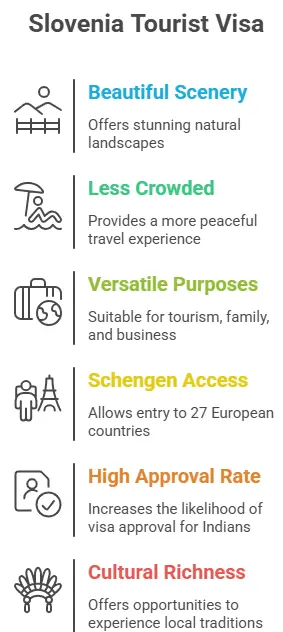
- Slovenia is a beautiful and less crowded destination in Central Europe
- You can visit for tourism, family visits, or business trips
- Schengen visa allows stays up to 90 days in 180 days
- Good visa approval rate for Indians
- Explore lakes, castles, caves, coastlines, and culture
A Slovenia Visit Visa is a short-term visa that allows travellers to visit Slovenia for tourism, meeting family or friends, or attending short business meetings and events. It is suitable for people who plan to stay for a short time and return to their home country after the visit.
Slovenia is known for its clean environment, peaceful cities, and natural beauty. It offers a perfect mix of mountains, lakes, and charming towns, making it a great place for relaxation and sightseeing. Tourists also enjoy the country's friendly atmosphere and well-connected travel routes. Slovenia offers a short-term Schengen visa (Type C), which allows you to stay for up to 90 days within any 180-day period. This visa can be single-entry or multiple-entry, and it also gives you free access to travel across all 29 Schengen member countries — including Romania and Bulgaria, which completed full Schengen accession on 1 January 2025.
Types of Slovenia Visit Visa
Single Entry Schengen Visa (Type C)
This visa allows you to enter Slovenia only once. You can stay for up to 90 days within 180 days. It is best for a single trip, like tourism, visiting family, or attending an event. Once you leave the Schengen Area, you cannot use the visa again.
Multiple Entry Schengen Visa (Type C)
This visa lets you enter and exit Slovenia and other Schengen countries many times during its validity. The validity can be from 6 months to 5 years, depending on your profile. It is useful for people who travel to Europe often.
Short Stay Business Visa (Type C)
This visa is for business purposes like meetings, conferences, or short training programs. You can stay for up to 90 days. It does not allow you to work or earn money in Slovenia.
Family Visit Visa (Type C)
This visa is for visiting family members or friends living in Slovenia. You need an invitation letter and support documents from your host.
Airport Transit Visa (Type A)
This visa is for travellers who are changing flights at a Slovenian airport without entering the country. It is required only for certain nationalities.
National Long-Stay Visa (Type D)
This visa is for people who want to stay in Slovenia for more than 90 days, up to one year. It is used for work, study, or joining family, not for tourism.
Top 10 Places to Visit in Slovenia
Slovenia is a beautiful country in Central Europe. It has lakes, mountains, caves, castles, and coastal towns.
Here are 10 places you should visit:
- Lake Bled: Lake Bled is one of the most famous places in Slovenia. It has a lake with a small island and a church, along with a castle on a hill. The views are very beautiful and attract many tourists.
- Ljubljana: Ljubljana is the capital city of Slovenia. It has a lovely old town, a castle on a hill, and many cafes near the river. It is a clean and peaceful city to explore.
- Postojna Cave: Postojna Cave is a very large and popular cave system. It is known for its unique rock formations and an underground train that takes visitors inside the cave.
- Predjama Castle: Predjama Castle is built inside a cliff and looks very unique. It is located near Postojna Cave and is one of the most interesting castles in the world.
- Triglav National Park: This is the only national park in Slovenia. It has mountains, lakes, rivers, and waterfalls. It is perfect for hiking, cycling, and nature lovers.
- Piran: Piran is a small coastal town by the sea. It has narrow streets, colourful buildings, and a peaceful atmosphere. It is a great place to relax and enjoy sea views.
- Škocjan Caves: Škocjan Caves are very famous and are a UNESCO World Heritage Site. These caves have large underground spaces, rivers, and waterfalls.
- Vintgar Gorge: Vintgar Gorge is a natural canyon near Lake Bled. Visitors can walk on wooden paths and enjoy the clear blue river and scenic views.
- Maribor: Maribor is the second-largest city in Slovenia. It is known for wine and has the oldest grapevine in the world. The city also has a nice old town and river views.
- Logarska Valley: Logarska Valley is a peaceful mountain valley. It has green fields, forests, and waterfalls. It is a perfect place for relaxing and enjoying nature.
Key facts for Indian visitors to Slovenia:
1. Passport stamps are replaced with digital biometric registration: On your first Schengen entry after April 10, 2026, your fingerprints (4 fingers) and facial image are captured and stored in the EES database for 3 years. Subsequent entries verify your existing data.
2. Allow extra time at the border: Expect approximately 5–10 extra minutes at Ljubljana Jože Pučnik Airport or any Slovenian land border for first-time EES registration.
3. The 90/180-day rule is now digitally tracked: Your permitted days across all 29 Schengen countries — including neighbouring members like Italy, Austria, and Hungary — are automatically counted and enforced. Overstays are detected automatically at every subsequent Schengen crossing.
4. Your visa requirement is unchanged: You still need a valid Schengen visa (Type C) to enter Slovenia. EES is a border management system — it does not replace the visa requirement.
5. ETIAS does NOT apply to Indian passport holders: ETIAS (European Travel Information and Authorisation System), expected late 2026, is a pre-travel registration for visa-exempt nationalities only. Indian passport holders require a full Schengen visa and are not affected by ETIAS.
Eligibility for Slovenia Tourist Visa
Indian passport holders can apply for a Slovenia Schengen tourist visa (Type C) through VFS Global in India. Requirements include a valid passport with at least 3 months' validity beyond your return date, travel insurance covering a minimum of €30,000 for the full Schengen Area, a confirmed return ticket, accommodation proof, and proof of sufficient funds for your stay.
To apply for a Slovenia Tourist Visa (Schengen Type C), you must meet the following eligibility criteria:
- A valid passport with at least 3 months validity beyond your intended stay
- Clear purpose of travel such as tourism, visiting family, or business meetings
- Proof of sufficient funds to cover your stay in Slovenia
- Confirmed return flight tickets
- Confirmed accommodation in Slovenia
- Travel medical insurance covering a minimum of €30,000, valid across the Schengen Area for the entire duration of stay
- No criminal record or prior immigration violations
Slovenia Visit Visa Requirements
When applying for a Slovenia Tourist Visa, you need to submit the following documents:
- Completed and signed Schengen visa application form
- Recent passport-size photographs (as per Schengen photo specifications)
- Valid passport issued within the last 10 years
- Copies of previous Schengen or Slovenian visas, if any
- Cover letter explaining the purpose of visit and travel plans
- Confirmed flight reservation
- Proof of accommodation
- Proof of sufficient financial means such as bank statements or income certificates
- Travel medical insurance with minimum €30,000 coverage valid across the Schengen Area
- Address proof in home country
- Biometric data submitted in person at the visa centre
Step-by-Step Slovenia Tourist Visa Application
Step 1: Choose the correct visa type (Single Entry or Multiple Entry, Type C Schengen) based on your travel purpose and plans.
Step 2: Register on the official Slovenian embassy portal or VFS Global website and complete the Slovenia visa application form accurately.
Step 3: Gather all required documents including passport copy, photographs, travel insurance, flight tickets, and accommodation proof.
Step 4: Book an appointment at the nearest Slovenian embassy or VFS Global centre in your city.
Step 5: Attend your appointment in person and submit your application along with biometric data.
Step 6: Pay the applicable Slovenia visa fee at the centre.
Step 7: Wait for visa processing and receive the decision by email or SMS.
Step 8: Collect your passport with the visa from the centre, then travel to Slovenia and present your visa and supporting documents at immigration.
Slovenia Visit Visa Processing Time
The processing time for a Slovenia visa application is usually up to 15 calendar days, counted from the date the consulate receives your application. Processing may take longer, up to 30 or even 60 days, depending on the season or if further review is needed. To avoid delays, it is recommended to apply at least 3 to 4 weeks before your travel date and make sure all documents are complete and accurate.
Slovenia Tourist Visa Cost
The cost of a Slovenia Visit Visa depends on the type and the applicant's age. The visa fee is non-refundable in case of refusal, and the service fee is non-refundable once the appointment is confirmed.
The Slovenia Schengen tourist visa fee for Indian citizens is €90 for adults (effective June 11, 2024 under EU Delegated Regulation 2024/1415, increased from €80); €45 for children aged 6–12; children under 6 are exempt.
| Type | Approximate Cost |
|---|---|
| Schengen Visa – Adult (18+) | €90 (approx. ₹8,200–₹8,815) |
| Schengen Visa – Child (6–12 years) | €45 (approx. ₹4,100–₹4,400) |
| Schengen Visa – Child (Under 6 years) | Free |
| VFS Global Service Charge | ₹1,026 (per application) |
| National Visa (Type D) | €116–€135 (approx. ₹10,800–₹12,400) |
How Can Y-Axis Help You?
The Y-Axis team provides complete support to make your Slovenia visit visa process simple and smooth.
Our services include:
- Guidance on the correct visa type for your travel purpose
- Support with financial requirements and document preparation
- Application form assistance through the official embassy portal or VFS Global
- Document review and submission support
- Appointment booking assistance at VFS Global centres across India
- Regular updates on visa status and follow-up support until approval
Y-Axis snapshot
1M
Successful applicants
1500+
Experienced counselors
25Y+
Expertise
50+
Offices
Don't know what to do?
Get Free Counselling
Looking For Inspiration
Explore What Global Indians have to say about Y-axis