

Study in Switzerland

Don't know what to do?
Get Free Counseling
Last Updated: 02-09 -2026
Study in Switzerland: Top Universities, Fees, Scholarships and Visa
Switzerland is one of Europe's leading study destinations, known for its high-quality education, globally recognized universities, strong research environment, and excellent quality of life. The country attracts 75,000+ international students, including thousands from India, who choose Switzerland for its respected degrees and career opportunities. Switzerland is home to world-class institutions such as ETH Zurich and EPFL, with strong programs in engineering, technology, science, business, and research. There are also hundreds of English-taught programs, particularly at the master's and postgraduate levels.
Tuition fees at many public universities are relatively affordable, generally ranging from around CHF 1,000–4,000 per year, although costs vary by university and student category. Scholarships and fee waivers are also available for eligible students. International students can generally work up to 15 hours per week during the semester, subject to applicable conditions. Switzerland's central European location also makes it convenient to travel to countries such as France, Germany, Italy, and Austria. With its excellent education system, research opportunities, multicultural environment, and strong economy, Switzerland is an attractive option for students planning to study abroad.
*Need assistance to Study Abroad? Y-Axis is here to assist you in all the ways.
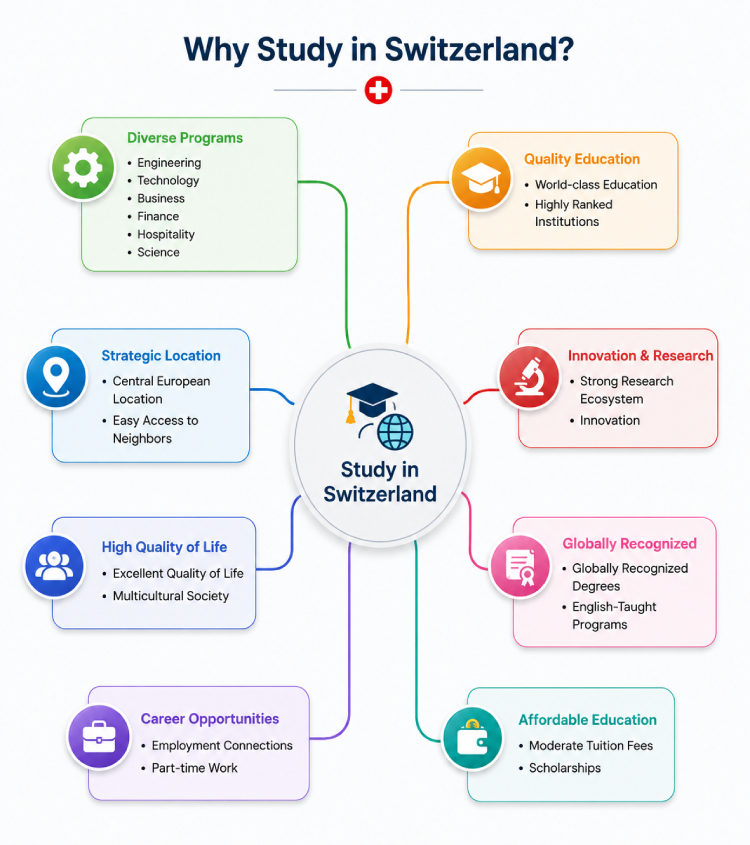
Why Study in Switzerland?
- World-class education from internationally recognized universities
- Highly ranked institutions such as ETH Zurich and EPFL
- Strong research and innovation ecosystem
- Globally recognized degrees
- Many English-taught master's and postgraduate programs
- Relatively moderate tuition fees at public universities
- Scholarships and financial aid opportunities for eligible students
- Strong employment and industry connections
- Opportunities for international students to work part-time, subject to visa and employment rules
- Excellent quality of life and safe environment
- Multicultural and multilingual society
- Central European location with easy access to neighboring countries
- Strong programs in engineering, technology, business, finance, hospitality, and science
- Opportunities to gain international academic and professional experience
Top Universities in Switzerland for Indian Students
Switzerland is home to several highly respected universities known for academic excellence, research, innovation, and strong industry connections. Institutions such as ETH Zurich and EPFL are globally recognized, particularly in engineering, technology, science, and research. Swiss universities offer a variety of undergraduate and postgraduate programs, including many English-taught courses. Students can choose between public universities, universities of applied sciences, and private institutions. Public universities are generally more affordable and are popular among international students. The table below shows some of the top universities in Switzerland:
| University | QS Ranking | Average Tuition Fee |
|---|---|---|
| ETH Zurich – Swiss Federal Institute of Technology | 8 | CHF 1,500–2,500 |
| EPFL – École Polytechnique Fédérale de Lausanne | 22 | CHF 1,500–2,500 |
| University of Zurich | 98 | CHF 1,500–3,000 |
| University of Geneva | 168 | CHF 1,000–2,500 |
| University of Basel | 150 | CHF 1,500–3,000 |
| University of Bern | 191 | CHF 1,500–3,000 |
| University of Lausanne | 233 | CHF 1,000–2,500 |
| Università della Svizzera italiana (USI) | 456 | CHF 2,000–4,000 |
| University of Fribourg | 670 | CHF 3,000–7,000 |
| Zurich University of Applied Sciences (ZHAW) | 851-900 | CHF 1,500–3,000 |
Popular Courses to Study in Switzerland
Switzerland offers a wide range of courses for international students, with particularly strong opportunities in engineering, technology, business, finance, hospitality, science, and management. Many master's programs are taught in English, making Switzerland an attractive destination for Indian students.
Students can choose undergraduate and postgraduate programs based on their academic background and career goals. Switzerland is also well known for specialized programs in hospitality management, banking and finance, engineering, computer science, pharmaceuticals, and research.
| Programme | Duration | Popular Specializations |
|---|---|---|
| Engineering | 3–4 years | Mechanical, Electrical, Civil, Chemical, Biomedical, Robotics |
| Business / MBA | 1–2 years | Finance, Marketing, International Business, Management, Entrepreneurship |
| Computer Science & IT | 3–4 years | Artificial Intelligence, Data Science, Cybersecurity, Software Engineering, Machine Learning |
| Finance & Banking | 1–2 years | Banking, Investment Management, Financial Technology, Risk Management |
| Hospitality & Tourism | 2–4 years | Hotel Management, Tourism Management, Hospitality, Event Management |
| Life Sciences | 3–5 years | Biotechnology, Biochemistry, Molecular Biology, Pharmaceutical Sciences |
| Natural Sciences | 3–5 years | Physics, Chemistry, Mathematics, Environmental Science |
| Architecture & Design | 3–5 years | Architecture, Urban Planning, Sustainable Design, Interior Design |
| Social Sciences | 2–3 years | Economics, Psychology, International Relations, Political Science |
| Medicine & Healthcare | 5–6 years | Medicine, Dentistry, Pharmacy, Biomedical Research |
*Willing to apply for Masters in Switzerland? Contact Y-Axis for end-to-end support.
Cost of Studying at Switzerland
The cost of studying in Switzerland depends on the university, course, and city you choose. While Switzerland has a higher cost of living than many European countries, tuition fees at public universities are generally moderate. Students should budget for tuition, accommodation, food, transport, health insurance, and other personal expenses.
Tuition Fees at Public and Private Universities
Public universities in Switzerland generally charge lower tuition fees than private institutions. For international students, tuition can range from around CHF 1,000 to CHF 4,000 per year, although some universities may charge additional fees for international students. Private universities and business schools are usually more expensive, with tuition fees often ranging from CHF 10,000 to CHF 40,000 or more per year, depending on the institution and program. MBA and specialized management programs can have significantly higher fees.
| University Type | Tuition Fee Range | Notes |
|---|---|---|
| Public Universities | CHF 1,000–4,000 per year | Fees vary by university, program, and student status |
| Private Universities | CHF 10,000–40,000+ per year | Higher fees for specialized and business programs |
| MBA Programs | CHF 20,000–60,000+ (total) | Fees depend on the university and course |
Additional Charges and Fees
Apart from tuition fees, students may need to pay registration fees, semester fees, examination charges, student association fees, and other administrative costs. International students may also need to budget for mandatory health insurance and study-related expenses. These additional costs vary between universities and cantons, so students should check the fee structure of their chosen institution before applying.
Cost of Living in Switzerland
Switzerland has a relatively high cost of living compared with many European study destinations. Expenses vary depending on the city. Zurich and Geneva are generally more expensive, while cities such as Lausanne, Bern, and smaller university towns may offer comparatively lower living costs.
Average Monthly Expenses:
- Accommodation: ₹60,000 – ₹1,20,000
- Food: ₹20,000 – ₹35,000
- Transport: ₹5,000 – ₹10,000
- Health insurance and other expenses: ₹10,000 – ₹20,000
- Estimated monthly cost: ₹1 lakh – ₹1.8 lakh
- Estimated annual cost: ₹12 lakh – ₹22 lakh
Study Cost Calculator
Use the Y-Axis Study Cost Calculator to estimate your first-year cost of studying abroad. Select your destination, city, university type, course, accommodation, lifestyle, and other expenses to get an estimated budget in Indian Rupees and local currency. The calculator also considers part-time earnings, scholarships, loans, and upfront funds required for your visa, helping you plan your study-abroad finances more effectively.
Top Scholarships to Study in Switzerland for Indian Students
Switzerland offers several scholarship opportunities for international students through the Swiss government, universities, and other institutions. These scholarships can help reduce the financial burden of tuition fees and living expenses.
The Swiss Government Excellence Scholarships are among the best-known options for international students and are mainly aimed at postgraduate researchers, doctoral students, and postdoctoral researchers. Individual universities also provide scholarships based on academic performance or other eligibility criteria.
| Scholarship Name | Scholarship Amount | Eligibility |
|---|---|---|
| Swiss Government Excellence Scholarships | Monthly stipend and other benefits, depending on the scholarship category | Mainly international postgraduate researchers, PhD students and postdoctoral researchers |
| ETH Zurich Scholarships | Can include tuition fee waiver and financial support | Outstanding students applying for eligible Master's programs |
| EPFL Master's Excellence Fellowships | Financial support of around CHF 10,000 per semester, subject to program conditions | High-achieving Master's applicants |
| University Scholarships | Varies depending on the university | Eligibility depends on academic performance and university requirements |
| University of Geneva Excellence Master Fellowships | Financial support of up to CHF 10,000 per year | Outstanding international Master's applicants in eligible programs |
Eligibility Requirements to Study in Switzerland
- A recognized academic qualification relevant to the chosen course.
- For Master's programs, a recognized Bachelor's degree in a relevant field, generally of at least three years.
- Minimum academic grades, marks, or GPA as specified by the university and course.
- Language proficiency in the language of instruction. English-taught programs may require IELTS, TOEFL, or another accepted test.
- Entrance examination or selection test for certain universities and programs.
- Academic transcripts, certificates, degree documents, and other required educational records.
- Additional documents such as a CV, statement of purpose, recommendation letters, portfolio, or work experience, depending on the program.
- An official admission or acceptance letter from a recognized Swiss university for the student visa application.
- A valid passport for the visa application and travel.
- Proof of sufficient funds to cover tuition fees and living expenses in Switzerland.
- A National D student visa for courses lasting more than 90 days.
- Health insurance that meets Swiss requirements for international students.
- Specific admission criteria may vary by university, course, and level of study, so applicants should check the requirements of their chosen institution.
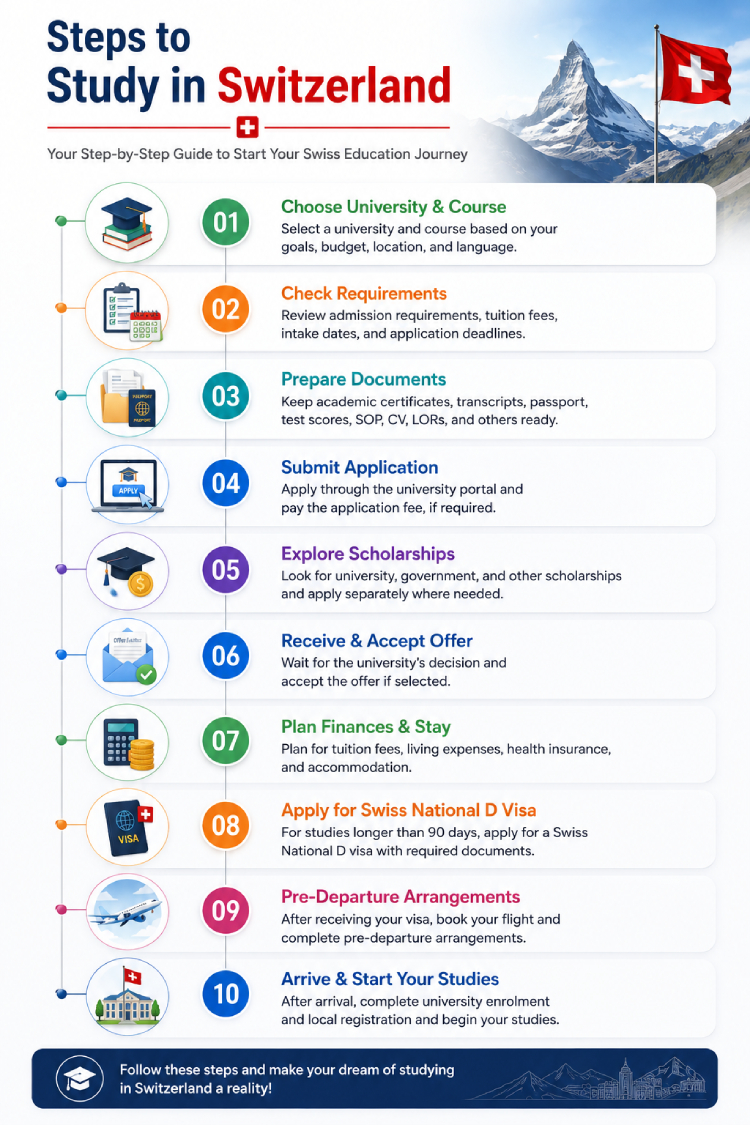
Steps to Study in Switzerland
Step 1: Select a university and course based on your career goals, budget, location, and preferred language.
Step 2: Review the admission requirements, tuition fees, intake dates, and application deadlines.
Step 3: Keep your academic certificates, transcripts, passport, language test scores, CV, SOP, and LORs ready, as applicable.
Step 4: Submit your application through the university's official application portal and pay the application fee, if applicable.
Step 5: Explore available university, government, and other scholarships and submit separate applications where required.
Step 6: Wait for the university's decision and accept the offer if you are selected.
Step 7: Plan for your tuition fees, living expenses, health insurance, and accommodation before travelling.
Step 8: For studies longer than 90 days, apply for a Swiss National D visa with the required supporting documents.
Step 9: After receiving your visa, book your flight and complete your pre-departure arrangements.
Step 10: After arrival, complete university enrolment and local registration and begin your studies.
Switzerland Student Visa for Indians
Indian students planning to study in Switzerland generally need a student visa and residence permit depending on the duration of their course. Students planning to stay for more than 90 days usually apply for a National D visa. They must first receive admission from a recognized Swiss university or educational institution and then submit their visa application with the required academic, financial, and personal documents.
Types of Switzerland Work Visa
Switzerland has different types of work and residence permits. The permit you need depends on your job, length of stay, nationality, and employment situation. For Indian citizens and other non-EU/EFTA nationals, work permits have additional requirements.
- L Permit – Short-Term Work Permit: For people taking up temporary jobs in Switzerland, usually for less than one year.
- B Permit – Residence Permit: For professionals who plan to live and work in Switzerland for a longer period. A job offer and approval from the Swiss authorities are generally required.
- G Permit – Cross-Border Commuter Permit: For people who live in another country and work in Switzerland. Specific conditions apply based on nationality and place of residence.
- C Permit – Settlement Permit: For foreign nationals who have lived in Switzerland for the required period and meet the conditions for long-term settlement. It is generally not issued for a person's first job in Switzerland.
- Ci Permit – Residence and Work Permit: Mainly for certain family members of employees working for foreign diplomatic missions or international organizations in Switzerland.
For Indian Professionals
For Indian citizens, the L Permit and B Permit are the most relevant options for employment in Switzerland. Since India is a non-EU/EFTA country, obtaining a Swiss work permit can be more difficult and is generally focused on highly qualified and skilled professionals. Employers usually apply for the work permit on behalf of the employee. The application may consider the candidate's qualifications, work experience, salary, and availability of workers in Switzerland and the EU/EFTA region. In 2026, Switzerland has 8,500 permits available for qualified workers from non-EU/EFTA countries, including 4,500 B permits and 4,000 L permits.
Switzerland Student Visa Requirements for Indians
- Admission to a recognized Swiss university or educational institution.
- A National D visa for courses lasting more than 90 days.
- A valid passport with sufficient validity.
- Completed visa application form and passport-size photographs.
- University admission or acceptance letter.
- Academic certificates and transcripts.
- Language proficiency test scores, where applicable.
- Proof of sufficient financial resources to cover tuition and living expenses.
- Accommodation details in Switzerland.
- Valid health insurance as required.
- CV and statement of purpose/study plan, where requested.
- Any additional documents requested by the Swiss Embassy, Consulate, or relevant Swiss authorities.
Documents Required for Switzerland Student Visa Application
- Valid passport
- Completed visa application form
- Passport-size photographs
- University admission or acceptance letter
- Academic certificates and transcripts
- Language proficiency test scores, if applicable
- Proof of financial resources
- Accommodation confirmation or details
- Health insurance documents
- CV or resume
- Statement of purpose or study plan
- Visa appointment confirmation, where applicable
- Any additional documents requested by the Swiss authorities
Steps to Apply for Switzerland Student Visa
Step 1: Apply to a recognized Swiss university or educational institution and receive your admission letter.
Step 2: Check the visa requirements and book an appointment with the Swiss representation in India responsible for your application.
Step 3: Complete the required National D visa application form and prepare the supporting documents.
Step 4: Arrange proof of sufficient financial resources to support your studies and living expenses in Switzerland.
Step 5: Prepare your passport, admission letter, academic documents, financial proof, accommodation details, insurance, and other required documents.
Step 6: Attend the visa appointment and submit your application and biometric information, where required.
Step 7: The application may be forwarded to the relevant Swiss cantonal authorities for review and approval.
Step 8: Wait for the visa decision. Additional documents or information may be requested during the process.
Step 9: After visa approval, collect your passport with the Swiss National D visa.
Step 10: Travel to Switzerland and complete the required local registration and residence permit formalities after arrival.
Switzerland Student Visa Fee
Students applying for a Swiss National D student visa need to pay the applicable visa fee.
- Adult visa fee: Around CHF 88 (approximately ₹9,000), subject to the applicable exchange rate.
- Children aged 6–12: Around CHF 44, where applicable.
- The fee is generally paid in the local currency according to the exchange rate used by the Swiss authorities.
- Additional service or appointment-related charges may apply.
- Visa fees are generally non-refundable, including in cases of visa refusal.
Switzerland Student Visa Processing Time
The processing time for a Switzerland student visa can vary depending on the canton, application volume, completeness of documents, and individual circumstances.
- Students should apply well in advance of their intended course start date.
- Long-stay student visa applications may require approval from the relevant cantonal migration authority.
- Processing can take several weeks or longer, particularly during peak admission periods.
- Additional document checks or requests from the authorities can increase processing time.
- Students should avoid making non-refundable travel arrangements until the visa has been approved.
Important: Visa requirements, fees, and processing times can change. Students should check the latest requirements with the Swiss Embassy/Consulate or the official Swiss authorities before submitting their application.
Switzerland Study Intakes: Fall & Spring
Switzerland mainly has two major study intakes: Fall and Spring. The Fall intake, which usually begins in September, is the primary intake and offers the widest choice of courses. The Spring intake generally starts in February and has fewer course options. Indian students should begin preparing several months in advance because university applications, language tests, financial arrangements, and the Swiss student visa process can take time.
Fall Intake (Starts in September)
The Fall intake is the main and most popular intake for international students in Switzerland.
- University Application Deadline: Usually between December and April, depending on the university and course.
- English Language Tests: Complete IELTS, TOEFL, or other required tests by October–January.
- University Applications: Submit applications according to the university's deadline, preferably several months before the course starts.
- Admission Decisions: Usually received between March and June, depending on the institution.
- Scholarships: Apply for scholarships as early as possible because deadlines may be earlier than admission deadlines.
- Financial Planning: Arrange tuition fees, proof of funds, accommodation, and other financial requirements after receiving admission.
- Student Visa: Apply for the Swiss National D visa as soon as possible after receiving admission and preparing the required documents.
- Travel to Switzerland: Plan your travel after receiving the visa and complete university and local registration requirements after arrival.
Spring Intake (Starts in February)
The Spring intake is available at fewer universities and for fewer programs compared with the Fall intake.
- University Application Deadline: Usually between September and November of the previous year, depending on the university.
- English Language Tests: Complete IELTS, TOEFL, or other required tests before submitting the application.
- University Applications: Apply as early as possible because course availability is more limited.
- Admission Decisions: Usually received between November and January.
- Scholarships: Check scholarship deadlines early and submit applications where applicable.
- Financial Planning: Arrange tuition fees, proof of funds, accommodation, and other expenses.
- Student Visa: Start the National D visa process after receiving the admission letter.
- Travel to Switzerland: Plan to travel in January or early February, depending on the university's orientation and course start date.
Month-by-Month Plan for Switzerland
- March–May: Research Swiss universities, courses, tuition fees, scholarships, and admission requirements.
- June–August: Shortlist universities and prepare for IELTS/TOEFL or other required tests.
- August–October: Prepare your SOP, CV, LORs, transcripts, passport, and other documents.
- October–January: Submit applications for the next Fall intake according to university deadlines.
- January–April: Receive admission decisions and compare universities and offers.
- April–June: Accept the offer, arrange finances, accommodation, and prepare the student visa documents.
- May–August: Submit the visa application, complete required formalities, and prepare for travel.
- August–September: Travel to Switzerland, complete registration and university enrolment, and begin your studies.
Part-Time Jobs in Switzerland for Indian Students
International students in Switzerland can work part-time alongside their studies, subject to immigration and university conditions. For students from non-EU/EFTA countries, including India, part-time work can generally begin six months after starting their studies. Students can work up to 15 hours per week outside vacation periods, provided the university confirms that the job will not interfere with their studies.
- International students can work up to 15 hours per week during the semester.
- Part-time work can generally begin after six months of study for non-EU/EFTA students.
- During official university holidays, students may generally work without the 15-hour weekly limit, subject to applicable rules.
- The university must confirm that the employment is compatible with the student's studies and will not delay graduation.
- The employer generally needs to submit the required application to the relevant cantonal authority.
- Students should comply with the applicable salary, working-hour, and employment regulations.
- Common student jobs include restaurants and cafés, retail, hospitality, administrative work, tutoring, research assistance, and university jobs.
- Knowledge of German, French, or Italian can improve access to part-time jobs, depending on the canton and type of work.
- Part-time income can help with living expenses, but students should not rely on it as their primary source of funding, as Switzerland has a relatively high cost of living.
- Students who graduate from a Swiss higher education institution can generally receive six months to look for a job related to their qualifications, subject to the applicable conditions.
Important: Part-time employment rules can vary based on the student's permit, canton, and circumstances. Students should confirm the applicable requirements with the relevant cantonal authorities before starting work.
*Want to pursue an MBA in Switzerland? Contact Y-Axis for complete guidance and support
Post-Study Work and Career Opportunities in Switzerland
Switzerland offers international graduates opportunities to gain professional experience after completing their studies. For Indian students, Switzerland provides a six-month period to look for employment after graduating from a recognized Swiss higher education institution, subject to applicable conditions.
Post-Study Work Options in Switzerland
- International graduates can generally stay for up to six months after completing their studies to look for a suitable job.
- The job should generally match the graduate's qualifications.
- Graduates should apply through the relevant cantonal authorities for the appropriate residence and work status.
- Finding a job does not automatically guarantee a long-term work permit.
- For non-EU/EFTA nationals, including Indians, work permits are subject to qualification, labour-market conditions, quotas, and employer requirements.
- Switzerland offers career opportunities in sectors such as IT, engineering, finance, pharmaceuticals, healthcare, research, hospitality, and business.
- Graduates should begin their job search early to make the most of the available post-study period.
Path to Permanent Residency (PR) in Switzerland
Getting permanent residency in Switzerland after studying is not automatic. Completing a degree or finding employment does not directly provide permanent residence. Graduates need to meet the requirements for a suitable residence status and later satisfy the conditions for permanent residency.
A typical route can involve:
- Complete your degree at a recognized Swiss higher education institution.
- Use the six-month post-study period to search for suitable employment.
- Find an employer willing to employ you under the applicable Swiss work-permit rules.
- Obtain the appropriate residence and work authorization.
- Continue living and working legally in Switzerland while meeting the applicable residence and integration requirements.
- After meeting the required conditions and period of residence, you may become eligible to apply for permanent residence (Permit C).
- The time required to qualify for permanent residence depends on factors such as residence status, length of stay, integration, nationality, and applicable immigration rules.
Important: Switzerland does not have a fixed rule that guarantees permanent residency after working for a specific number of years following graduation. Eligibility depends on the individual's residence status and the requirements applicable to their circumstances.
How Y-Axis can help you?
Y-Axis is the right mentor to advise you on studying in Switzerland. It helps you with
- Choose the best path for you with the help of Y-Path.
- Coaching services assist you in acing your IELTS test results with our live classes. This helps you to score well on the exams required to study in Switzerland. Y-Axis is the only overseas consultancy that provides world-class coaching services.
- Get counseling and advice from proven experts who can advise you on all the steps.
- Course Recommendation: get unbiased advice with Y-Path that puts you on the right path to success.
- Guides and assists you in writing commendable SOPs and Resumes.
Looking for inspiration
Explore what Global Indians have to say about Y-Axis in shaping their future