

Don't know what to do ?
Get Free Counseling
Last Updated 11 July 2026
Ireland Job Market in 2026-30
- Ireland is a popular destination for Indian job-seekers
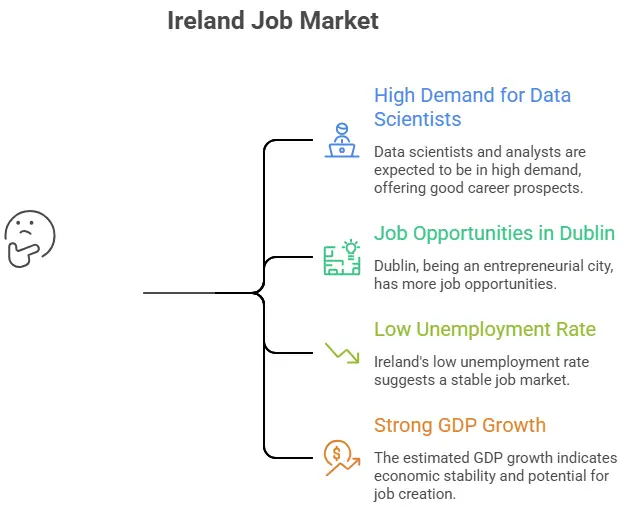
- Data scientists and analysts will continue to be in high demand this year
- Dublin, entrepreneurial city has more job opportunities
- As of July 2026, Ireland's unemployment rate stood at 5.1%, according to the Central Statistics Office (CSO) — its highest level so far this year, though still low by historical standards
- GDP growth is forecast to slow to between 1.8% and 3.2% in 2026, following an exceptional 12%+ surge in 2025 driven by pharmaceutical exports
Ireland's unemployment rate stood at 5.1% in July 2026, with strong ongoing demand for IT, healthcare, engineering, and life sciences professionals. The Critical Skills Employment Permit offers fast-track visas (minimum salary €40,904/year) for shortage occupations, with a path to Stamp 4 residency in 21 months.
Job Outlook in Ireland
Understanding the job outlook for job seekers and employers
Ireland continues to be one of the strongest-performing economies in the Eurozone, with growth in the multinational-dominated sector helping the economy rebound by 3.9% quarter-on-quarter in Q2 2026. At the heart of this strength lies a sustained national commitment to innovation and talent development. The country has constantly supported a vibrant ambitious ecosystem, attracting global companies and promoting a culture of innovation. This has converted into a talent pool of skilled professionals, especially in the technology and financial sectors.
The current labor market is strong, with a decrease in unemployment and an increase in the employment rate. This tight job market adjusts the stage for notable increases in real wages, especially in sectors facing skill shortages like engineering, technology, and financial services.
*Looking to apply for an Ireland work visa? Get in touch with experts at Y-Axis to help you with the process.
General employment trends for the year
The coming year is expected to observe rapid expansion in a number of industries, with the financial services, accountancy, technology, engineering, and life sciences sectors leading the way. In response to economic swings, the salary landscape illustrates a calculated yet strategic response; over half of Irish businesses expect raising salaries, particularly for positions that are difficult to fill. Salary increases are probably going to follow inflation rates in most industries.
Although salary increases are anticipated, 51% of Irish workers cite higher pay as their main motivation for changing jobs, according to 2026 research from Jobs.ie/IrishJobs, underlining how competitive the market remains for employers trying to retain talent. This demonstrates how competitive the labor market is and how important it is for companies to provide attractive benefits and packages in order to draw in and keep top personnel.
Also, read...
What are the most in-demand jobs in Ireland for the next 10 years?
In-Demand Industries and Occupations
Analysis of industries experiencing growth and increased demand for skilled workers
The Republic of Ireland is home to many booming industries, including manufacturing, software engineering, medical devices, aerospace, and renewable energy. These businesses all contribute to the growth and revolution of the Irish economy. It's critical to stay aware of the most recent trends and data that are controlling these industries' futures as we continue to negotiate their shifting terrain.
*Looking to work abroad? Get top consultation from experts at Y-Axis.
Discussion on specific occupations in demand
The most in-demand occupations looking for highly skilled workers their average salaries per year are listed below:
Highest paying jobs/occupations in Ireland and their Salaries
| Occupation | Average annual salary |
|---|---|
| IT and Software | € 56 331 |
| Engineering | € 55 581 |
| Accounting and Finance | € 46 368 |
| Human Resource Management | € 46 424 |
| Hospitality | € 38 437 |
| Sales and Marketing | € 47 780 |
| Healthcare | € 61 977 |
| STEM | € 59 902 |
| Teaching | € 45 407 |
| Nursing | € 27 750 |
Source: Talent site
*Know more details about in demand occupations in Ireland.
Workforce demands in different States of Ireland
Highlighting areas with notable job opportunities or challenges
The service sector dominates the job market. Opportunities can be found in a number of major industries including the growing technology sector, where the demand for IT workers is high, and thanks to Ireland's rising popularity as a holiday destination, the hospitality and tourism industry are in need of both skilled and casual workers.
The job market is mainly led by the service sector, offering diverse opportunities across several key industries. Especially, the technology sector is experiencing significant growth, leading to a high demand for IT professionals. Additionally, Ireland's increasing interest as a holiday spot is driving demand within the hospitality and tourism industry, creating opportunities for both skilled and part-time workers.
Ireland country is also home to several multinational companies, like:
- Apple
- Microsoft
- Ryanair
Impact of Technology and Automation in Ireland
Discussion on how technological advancements and automation are shaping the job market
Technological developments such as artificial intelligence (AI), machine learning, and automation are changing the nature of jobs and the skills needed for them. While previous waves of AI mostly affected physical work, McKinsey predicts that the rise of general artificial intelligence (gen AI) would have a real impact on knowledge work, which includes disciplines like education, law, technology, and the arts.
Additionally, the potential applications of AI in the workplace have expanded with the release of ChatGPT in November 2022, among other recent developments in the field that enable the production of various content types. It is anticipated that in the coming years, as employer and worker confidence in AI increases, the gap between the desire to use AI and its actual deployment will close.
Potential opportunities and challenges for workers in the evolving landscape
The job market in Ireland is constantly changing, driven by technological growth, economic shifts, and demographic changes. It's important for job seekers to stay informed about these developments and actively enhance their skills and expertise to align with employers' demands.
*Willing to migrate to Ireland? Y-Axis will help you in step by step process.
Skills in demand in Ireland
Identification of key skills sought by employers
In Ireland, the technology sector stands out as one of the fastest-growing industries, with projections indicating sustained growth throughout. There exists a strong demand for skilled professionals in specialized fields like software development, cyber security, and data analytics.
Importance of upskilling or reskilling for job seekers
Apart from technical expertise, employers are increasingly looking for candidates with strong soft skills like communication, teamwork, and problem-solving. These skills are necessary for success in today's workplace, irrespective of the sector.
Also, read...
Are Indians eligible to work in Ireland?
Remote Work and Flexible Arrangements
Exploration of the continuing trend of remote work
Remote work has become more common; workers are given permission to live and work from anywhere in the world. Also, technology has made it simple for entrepreneurs to start their own businesses and for workers to do freelance.
Government Policies and Initiatives
Overview of any government programs or policies influencing employment
Entrepreneurs are essential to Ireland's economic growth. The creative ability of a person to see an opportunity and seize it in order to create new value or financial success is the definition of "entrepreneurship" as stated in the 2014 National Policy Statement on Entrepreneurship. The Policy Statement went on to state that "any thriving economy's health and wellbeing are critically dependent on entrepreneurship." "SMEs and entrepreneurship are central to Ireland's challenge of generating a broad-based growth and prosperity," the OECD declares, agreeing with the statement. Our economy's capacity to flourish is largely reliant on entrepreneurs and the SMEs they found, nurture, and expand.
Analysis of how policy changes may impact the job market
Ireland’s job market continues to evolve with recent government initiatives focused on economic growth, infrastructure, and sustainability. Programs such as the Housing Action Plan (which superseded Housing for All in November 2025), the National Skills Council's regional skills strategy, and green economy initiatives under the Climate Action Plan are creating new employment opportunities across sectors.
These policies aim to address skills shortages, improve workforce participation, and support long-term economic development, making Ireland an attractive destination for skilled professionals.
Also, read...
Can I get a job seeker visa in Ireland?
Challenges and Opportunities for Job Seekers in the Ireland
Discussion on the challenges faced by job seekers
In Ireland, hiring has become increasingly competitive, with many businesses facing challenges in finding qualified candidates for open roles. This is driven by factors such as a tight labour market and ongoing skills shortages across key sectors. Industries such as healthcare, IT, and construction continue to experience high demand for skilled professionals.
Because of this, some companies now have to pay more and provide better perks in order to draw and keep employees. Furthermore, a change in the way individuals work has been brought about by the pandemic, with many choosing flexible or remote work schedules. Employers now find it more challenging to draw in applicants seeking for conventional office-based positions as a result.
*Want to prepare a professional resume? Choose Y-Axis writing resume services.
Tips and strategies for navigating the job market successfully
Six key focus areas that will help you make a favourable impression in front of recruiters.
Optimize Your Resume and Cover Letter
Your cover letter and resume can help you make a good first impression. Resumes specifically designed for a given industry have a significantly higher possibility of being chosen for further consideration. Emphasize your accomplishments and pertinent abilities to make your CV unique and tailored to the position you're applying for.
Leverage Your Education & Highlight International Exposure
Making a good first impression is possible with the help of your cover letter and resume. Resumes specifically designed for a given industry have a significantly higher possibility of getting chosen for further consideration. Make your CV unique and tailored to the position you're going for by emphasizing your accomplishments and pertinent abilities.
Showcase Internships and Work Experience
It's also crucial to emphasize internships and work experience. Expertise obtained from internships, cooperative education, or part-time work showcases your practical abilities and comprehension of the field. It demonstrates your readiness to get started right away, which is helpful to employers who are seeking for new hires right away.
Also, read...
Can I get a work visa for Ireland without a job offer?
Summary of Ireland Job Outlook
Candidates who want to explore different career paths, working abroad may be exciting opportunity for them. Ireland, a country in Southern Europe, provides inspiring career opportunities in areas such as tourism, retail, finance, IT and business. If you are thinking to apply for a job in Ireland, you can benefit from learning about the corporate culture, lifestyle and the job application process.
*Searching for Jobs in Ireland? Find the right one with the help of Y-Axis Resume Marketing Services.
| S.NO | Country | URL |
|---|---|---|
| 1 | UK | www.y-axis.com/job-outlook/uk/ |
| 2 | USA | www.y-axis.com/job-outlook/usa/ |
| 3 | Australia | www.y-axis.com/job-outlook/australia/ |
| 4 | Canada | www.y-axis.com/job-outlook/canada/ |
| 5 | UAE | www.y-axis.com/job-outlook/uae/ |
| 6 | Germany | www.y-axis.com/job-outlook/germany/ |
| 7 | Portugal | www.y-axis.com/job-outlook/portugal/ |
| 8 | Sweden | www.y-axis.com/job-outlook/sweden/ |
| 9 | Italy | www.y-axis.com/job-outlook/italy/ |
| 10 | Finland | www.y-axis.com/job-outlook/finland/ |
| 11 | France | www.y-axis.com/job-outlook/france/ |
| 12 | Poland | www.y-axis.com/job-outlook/poland/ |
| 13 | Norway | www.y-axis.com/job-outlook/norway/ |
| 14 | Japan | www.y-axis.com/job-outlook/japan/ |
Y-Axis snapshot
1M
Successful applicants
1500+
Experienced counselors
25Y+
Expertise
50+
Offices
Don't know what to do ?
Get Free Counseling
Looking for Inspiration
Explore what Global Indians have to say about Y-Axis in shaping their future