


Migrate to Portugal
Sign up for a free expert consultation

Don't know what to do?
Get Free Counseling
Last Updated 04 November 2026
Why Portugal Skilled Work-Seeking Visa?
Important update: Portugal suspended its earlier job seeker visa on 23 October 2025. A new Portugal job seeker visa for highly qualified professionals has been announced, but applications will open only once the new rules are published. Until then, skilled professionals can consider the D3 Highly Qualified Activity Visa or a Portugal work visa.
- Stable and growing economy
- High demand for skilled foreign workers in technology, construction, and healthcare
- Excellent work-life balance and relaxed lifestyle
- Competitive salaries with strong social security and healthcare benefits
- Safe, welcoming, and family-friendly country
- Growing job opportunities in tourism, technology, renewable energy, and engineering
- Opportunity to work and live in Portugal with a residence permit
Portugal is one of Europe's fastest-growing destinations for skilled foreign professionals. With a stable economy, expanding tech sector, and one of the lowest crime rates in the world, Portugal has become an attractive option for workers looking to build a career and a life in Western Europe.
Capital: Lisbon | Population: 10.6 million | Language: Portuguese (official); English is widely spoken in cities, tech workplaces, and tourism-related industries, making it a practical destination even before learning the local language.
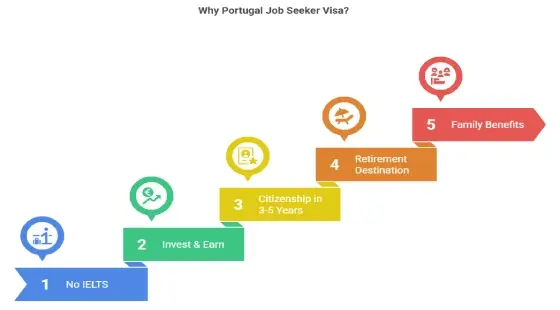
What is the Portugal Skilled Work-Seeking Visa?
The Portugal job seeker visa (officially the Skilled Work-Seeking Visa) is a temporary visa that allows foreign nationals to enter and stay in Portugal to look for employment. This temporary national visa will enable individuals to reside in Portugal for a maximum of 120 days, which can also be extended for an additional 60 days. Once you successfully get a job in Portugal, you can convert it into a temporary residence permit.
Benefits of settling in Portugal
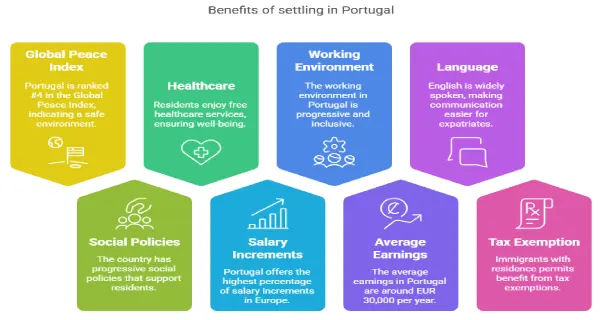
- Ranked #4 in the Global Peace Index
- Progressive social policies
- FREE healthcare
- Highest percentage of salary increments
- Progressive Working Environment
- Average earnings per year EUR 30,000/year
- English is widely spoken
- Tax exemption for immigrants with residence permits
Why Should Indians Migrate to Portugal?
Here are the main reasons why Indians should consider immigrating to Portugal:
- Ranked among the top 10 safest countries in the world by the Global Peace Index.
- Portugal faces a projected shortage of over 120,000 workers by 2030, with critical gaps in information technology, construction, healthcare, tourism, and renewable energy sectors.
- Indian professionals are among the fastest-growing non-EU migrant communities in Portugal.
- Portugal Skilled Work-Seeking Visa allows skilled Indian professionals to enter Portugal for up to 120 days to search for employment.
- Portugal offers a streamlined residence permit for employed workers.
- After 5 years of legal residence, Indian professionals can apply for permanent residency, with a direct pathway to Portuguese citizenship.
- Portugal's D3 Highly Qualified Activity Visa is specifically designed to attract professionals in technology, research, and highly skilled roles, offering a structured and faster entry route.
*Interested to work in Portugal? Let Y-Axis assist you with the steps.
Types of Portugal Work Visa for Indians
Portugal offers several work-based visas and residence permits for foreign professionals, depending on the type of job or business activity. The main types are listed below:
- Business Visa (Schengen Visa Type C): This visa allows individuals to stay in Portugal for up to 90 days within a 180-day period. It is suitable for business meetings, conferences, negotiations, and short-term professional visits. It does not permit paid employment in Portugal.
- Temporary Stay Visa for Employment: This visa is issued to non-EU nationals who have a confirmed job offer from a Portuguese employer. It allows the holder to enter Portugal and begin working while the residence permit application is being processed. It is typically valid for 4 months and is the first step toward obtaining a residence permit.
- Residence Permit for Employed Workers: This is the most common Portugal work visa for Indian professionals who have secured employment with a Portuguese company. It allows the holder to live and work legally in Portugal for a specific employer. It is issued under the following categories:
- Temporary Residence Permit: For fixed-term or short-duration employment contracts, typically valid for one year and renewable.
- Permanent Residence Permit: Granted after 5 years of continuous legal residence in Portugal, subject to meeting income and language requirements.
- D3 Visa: This visa is designed specifically for non-EU professionals working in highly skilled roles, including technology, research, academia, and senior management. It offers a structured and faster route to residence for qualified specialists and is one of the most relevant options for Indian IT and engineering professionals.
- Skilled Work-Seeking Visa: This permit allows non-EU nationals to enter Portugal for up to 120 days to actively search for employment or explore self-employment opportunities, without needing a job offer before arrival. It is a practical first step for Indian professionals who want to explore the Portuguese job market in person.
- Residence Permit for Self-Employment and Independent Professional Activity: This permit is for individuals who wish to work as freelancers, independent contractors, or run their own business in Portugal. Applicants must demonstrate sufficient income or business viability, and the activity must be registered with Portuguese tax authorities. It is suitable for entrepreneurs, consultants, and independent service providers.
How to Get a Work Visa in Portugal
For most Indian professionals, the surest way to work in Portugal is to secure a job offer first and then apply for a national (Type D) visa at the Portuguese Embassy in New Delhi or its visa application centre (VFS Global). The main options are:
1. Work visa for subordinate employment (D1): for anyone with an employment contract or binding job offer from a Portuguese employer.
2. Highly qualified activity visa (D3): for skilled roles that need a degree or specialised expertise, often with faster processing.
3. Tech Visa: for roles with tech companies certified under the Tech Visa programme run by IAPMEI.
4. EU Blue Card: for highly qualified roles that meet Portugal's Blue Card salary threshold.
5. Qualified job-seeking visa: lets skilled applicants enter to look for work, but it is not open for new applications until the qualifying-skills ordinance is published.
The usual steps:
6. Get a signed contract or job offer.
7. Gather your passport, Indian police clearance certificate (from Passport Seva), degree certificates, CV, travel insurance and proof of accommodation.
8. Book an appointment and submit your visa application with biometrics.
9. After arrival, attend your AIMA appointment to get your residence permit.
Check exact fees and documents on vistos.mne.gov.pt before you apply. Y-Axis can help you choose the right visa and prepare a complete application.
*Want to apply for a Portugal visa? Let Y-Axis guide you with the process.
Portugal Skilled Work-Seeking Visa eligibility
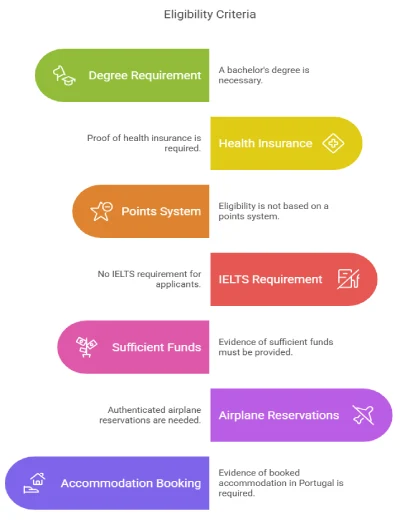
To apply for a Portugal job seeker visa, you must:
- Be a non-EU resident
- Be at least 18 years of age
- Have a Bachelor’s degree
- Have sufficient funds for your stay in Portugal
- Valid medical insurance
- Accommodation in Portugal
- Have flight reservations
Portugal Skilled Work-Seeking Visa Documents Checklist
You need the following documents for a Portugal job seeker visa:
| Document | Requirements |
|---|---|
| Valid passport | Must be issued within the last 10 years and have at least 3 months of validity |
| Photographs | 2 copies of recent passport-sized photographs |
| Visa application | A properly filled and signed national visa application form |
| CV | Updated curriculum vitae (CV) |
| Travel insurance | Valid travel insurance coverage of at least €30,000 |
| PCC | Police Clearance Certificate |
| Proof of funds | Usually about three months of the national minimum wage (around €2,760); the exact amount will be confirmed under the new rules |
| Flight reservations | Confirmed or tentative travel booking documents |
Job Market in Portugal
Portugal offers growing job opportunities for skilled professionals, particularly in technology, engineering, tourism, construction, renewable energy, and healthcare. The country is undergoing rapid economic transformation to welcome foreign professionals across multiple labor shortage industries. Lisbon and Porto are the two main employment hubs, with Lisbon emerging as one of Europe’s most recognised technology and startup cities. Professionals with the right skills and experience have strong prospects of finding employment in Portugal. This makes the Portugal job seeker visa a useful route for skilled Indians.
Also, read...
Highest paying Jobs in Portugal
Top Jobs in Portugal for Indians
Portugal is investing heavily in digital infrastructure, green energy, tourism development, and construction. The country has simplified its immigration framework specifically to attract non-EU skilled talent, and Indian professionals across sectors like IT, engineering, and financial services. The roles in the table below are a good fit for Portugal job seeker visa holders.
| Industry | In-Demand Job Roles |
|---|---|
| IT & Software | Software Developers, Full Stack Engineers, Cloud Architects, DevOps Engineers, Cybersecurity Analysts, Data Scientists |
| Engineering & Construction | Civil Engineers, Structural Engineers, Mechanical Engineers, Electrical Engineers, Project Managers, Site Supervisors |
| Tourism & Hospitality | Hotel Managers, Restaurant Supervisors, Tour Guides, Event Coordinators, Customer Service Professionals |
| Renewable Energy & Environment | Solar Energy Engineers, Wind Energy Technicians, Environmental Consultants, Sustainability Analysts |
| Healthcare & Life Sciences | General Practitioners, Specialist Physicians, Registered Nurses, Pharmacists, Biomedical Researchers |
| Finance & Business Services | Financial Analysts, Accountants, Compliance Officers, Tax Advisors, Business Process Specialists |
| Education & Social Services | English Language Teachers, STEM Educators, Special Needs Support Workers, Early Childhood Educators |
| Logistics & Supply Chain | Warehouse Coordinators, Supply Chain Managers, Freight Logistics Specialists, Port Operations Staff |
Also, read...
Portugal Job Market: Trends and Opportunities
Average Salary of Skilled Workers in Portugal
Portugal has a statutory national minimum wage of €920 per month in 2026, which continues to increase as part of the government’s multi-year wage improvement plan. Salaries vary by sector, experience, and location, with Lisbon and Porto offering higher compensation than other regions.
| Experience Level | Average Gross Salary (EUR / Year) | Approx. Salary (INR / Year) |
|---|---|---|
| Entry-Level | €18,000 – €26,000 | ≈ ₹16 – ₹24 LPA |
| Mid-Level | €26,000 – €45,000 | ≈ ₹24 – ₹41 LPA |
| Senior-Level | €45,000 – €75,000+ | ≈ ₹41 – ₹69 LPA |
Portugal Skilled Work-Seeking Visa Fees
The table below provides a complete breakdown of the Portugal job seeker visa fees:
| Fee Type | Fees (EUR) | Fees (INR approx.) |
|---|---|---|
| Embassy / Consulate Visa Application Fee | €90 | ₹8,000 |
| AIMA Residence Permit Submission Fee | €83 | ₹7,400 |
| AIMA Residence Permit Issuance Fee | €72 | ₹6,400 |
| Total Estimated Cost | €245 | ≈ ₹21,800 |
Processing Time for Portugal Skilled Work-Seeking Visa
The average processing time for a Portugal job seeker visa is 30-90 days, with a standard processing time of 60 days. During peak seasons, the processing time may go up to 3 months.
Note: It is advised to apply for a Portugal Skilled Work-Seeking Visa at least 1-3 months before your intended travel period.
Validity & Extension Rules for the Portugal Skilled Work-Seeking Visa
The Portugal job seeker visa is valid for 120 days, and can be extended for an additional 60 days, giving you the chance to live in Portugal for a maximum of 180 days to look for employment.
- Submit proof of registration with the IEFP as a job seeker.
- Submit a written declaration confirming that your Portugal stay conditions have remained unchanged.
- Provide a valid reason for Portugal's Skilled Work-Seeking Visa extension so the authorities can decide.
- You will be required to leave Portugal if you fail to secure a job offer or a residence permit before the expiration of your visa.
- You can only reapply for a new Skilled Work-Seeking Visa after 12 months.
What Are the Requirements for Extending the Portugal Job Seeker Visa?
Portugal's job seeker visa is granted for 120 days and can be extended once by a further 60 days, a maximum of 180 days in total. Since Law No. 61/2025 came into force on 23 October 2025, the route is limited to people with specialised technical skills (the "qualified job-seeking visa"). The list of qualifying skills depends on a government ordinance (portaria) that, as of our latest check, had not yet been published, so consulates were not accepting new applications. Visas issued under the old rules stay valid on their original terms.
To request the 60-day extension from AIMA, you will typically need:
1. A valid passport and your current job seeker visa.
2. Proof of registration with IEFP, Portugal's public employment service.
3. Proof that you still have enough means of subsistence for the extra period.
4. Valid travel or health insurance covering the extension.
5. Proof of accommodation in Portugal.
Apply before your visa expires. If you do not start a job within the visa's validity, you must leave Portugal and can only apply again one year after the visa expires. Once you sign an employment contract, you can request a temporary residence permit from AIMA without leaving the country.
Y-Axis can help you check whether your profile fits the new qualified route and prepare your documents once applications reopen.
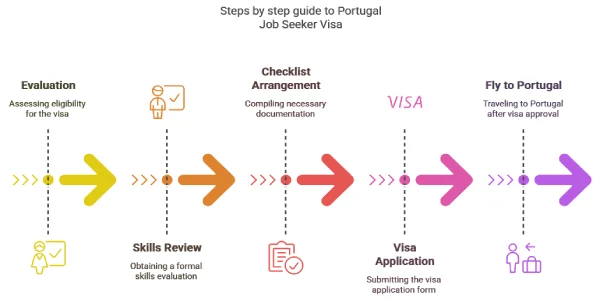
Step-by-Step Process for a Portugal Skilled Work-Seeking Visa
Step 1: Check your eligibility for the Portugal job seeker visa
Step 2: Arrange the documents required for the visa
Step 3: Apply for the visa via the official Portuguese consulate in India
Step 4: Complete the visa fee payment
Step 5: If approved, you can collect your Skilled Work-Seeking Visa
Step 6: Fly to Portugal
Step 7: Upon landing, register with the IEFP employment centre
Step 8: Start your job search process
Step 9: Secure a valid job offer in Portugal
Step 10: Apply for a residence permit at the Portuguese Immigration and Borders Service (SEF)
Pathway to Residency & Citizenship in Portugal
The Portugal job seeker visa allows you to stay in the country for up to 120 days to look for employment. You can extend your visa by another 60 days (180 days in total), but you cannot work until you get a residence permit. Once you secure a valid job offer in Portugal, you can apply for a temporary residence permit, which can lead to permanent residency after 5 years and Portuguese citizenship after 10 years of legal residence.
Also, read...
Portugal Skilled Work-Seeking Visa to Residency
Step 1: Apply for a Portugal job seeker visa
Step 2: Upon approval, fly to Portugal to look for jobs
Step 3: Find employment in Portugal within 120 + 60 days
Step 4: Get a valid job offer in Portugal
Step 5: Apply for a residence permit based on your employment
Residency to Portuguese Citizenship
Step 1: Become a legal resident by obtaining a residence permit that allows you to live and work in Portugal
Step 2: Fulfill the legal residency period in Portugal
Step 3: Meet the citizenship requirements (at least 10 years of residency in Portugal, along with other conditions)
Step 4: Submit evidence of A2 level proficiency in the Portuguese language
Step 5: Apply for citizenship (only upon meeting all the requirements)
Also, read...
Why apply for Portugal Residence Permit for Work?
Dependent Benefits for Portugal Work Visa Holders
Spouses and children of Portugal work visa holders are entitled to a range of benefits through Portugal’s family reunification programme and the country’s public social security system (Segurança Social). The program covers healthcare, education, and family support for legal residents. Family members usually join once the Portugal job seeker visa holder has a residence permit.
| Category | Details |
|---|---|
| Dependent Visa / Family Reunification | Spouses and unmarried children under 18 can join the main applicant through Portugal’s family reunification programme. The main visa holder must demonstrate sufficient income, generally at least the Portuguese national minimum wage for the household, with additional amounts required per dependent. Dependent permits are temporary. |
| Spouse Work Rights | Spouses granted a family reunification residence permit receive full rights to work in Portugal for any employer. They do not need a separate work permit or a prior job offer to begin employment. |
| Children's Education | Children holding a valid residence permit can attend Portugal’s free public schools. Public schooling is free up to secondary education, and children of legal residents can enrol in their local municipal school without additional fees. |
| Healthcare Access | Legal residents registered with AIMA and enrolled in the national health system (SNS — Serviço Nacional de Saúde) can access public healthcare at subsidised rates. |
| Child Benefit (Abono de Família) | Families with children under 16 (or up to 24 if in full-time education) can apply for Portugal’s child benefit through Segurança Social. |
| Childcare Support | Portugal offers subsidised public crèche and pre-school places for children aged 4 months to 6 years through municipal social solidarity institutions (IPSSs). |
Common Reasons for Portugal Skilled Work-Seeking Visa Refusal
Common reasons a Portugal job seeker visa is refused include:
- Incorrect or incomplete visa documentation
- Inaccurate information in the visa application and the provided documents
- Expired or invalid passport
- Not meeting the photo specifications
- Having insufficient funds for the visa
- Not providing your accommodation details in Portugal
- Unclear purpose of travel
- Failing to provide a clear intent to return to your home country
- Failing to register with the IEFP
How can Y-Axis help you?
Y-Axis, the world’s best immigration company, provides unbiased immigration services for every client based on their interests and requirements. Our experts can guide you through every step of your Portugal job seeker visa application. The impeccable services of Y-Axis include:
- Expert guidance for Portugal immigration
- Free eligibility checks
- Expert career consultation through Y-Path
- Free consultation
Y-Axis snapshot
1M
Successful applicants
1500+
Experienced counselors
25Y+
Expertise
50+
Offices
Looking For Inspiration
Explore what Global Indians have to say about Y-Axis in shaping their future