


Don't know what to do ?
Get Free Counseling
Last Updated 17 July 2026
Why Apply for an Italy Work Visa?
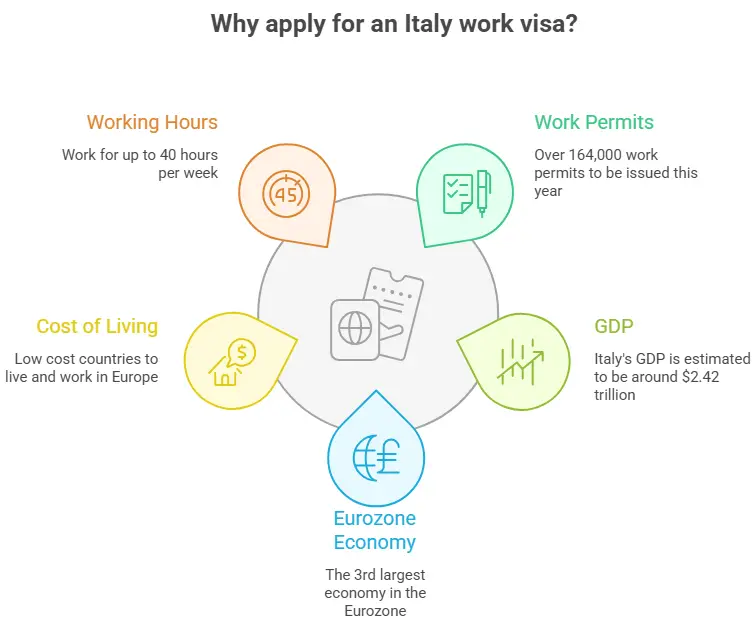
- 164,850 work permits issued in 2026 — Register now to prepare for Italy's 2027 Click Day
- Italy’s GDP is estimated to be around $2.42 trillion
- The 3rd largest economy in the Eurozone
- Low-cost countries to live and work in Europe
- Work for up to 40 hours per week
Note — Italy Decreto Flussi 2026: Quota Fully Allocated
Italy authorised 164,850 work permits for non-EU nationals under the 2026 Decreto Flussi programme. Both Click Day windows (March and May 2026) are now closed and all permits have been allocated. The next opportunity is the 2027 Click Day window. Indian professionals should begin preparing their documents and employer connections now — early preparation significantly improves Click Day success rates. IT, research, and teaching roles are not subject to the annual quota and remain open year-round.
The Italian job market has huge scope for skilled foreign workers, especially from India. Under the 2026–2028 Decreto Flussi framework, Italy has allocated 497,550 work permits — with India designated as a priority country under the bilateral Migration and Mobility Agreement. Italy has also issued an additional 10,000 work visas for foreign caregivers in 2025.
The Italian job market has huge scope for skilled foreign workers, especially from India. According to recent news, Italy plans to grant 500,000 work visas in 2026-28 — 2026 quota closed, 2027 window opens next. The country maintains a cap count on the total number of work permits to be issued each year. Italy has also issued an additional of 10,000 Work Visas for foreign caregivers in 2025.
*Want to apply for Italy work visa? Let Y-Axis guide you with the process.
2026 Decreto Flussi Update: Click Day Windows Are Closed
The 2026 Click Day windows opened and closed in January–February 2026 within minutes due to massive oversubscription. Indian applicants cannot apply under the 2026 Decreto Flussi quota. The 2026–2028 plan allocates 497,550 total permits, including 25,000 priority slots per year for India. Planning must now begin for the 2027 Click Day. Register your interest with Y-Axis now to receive early notification when 2027 registration opens.
What Can Indian Professionals Do Right Now?
The 2026 Click Day is closed — but four pathways remain open today:
| Pathway | Who It's For | Status |
|---|---|---|
| EU Blue Card | IT, healthcare, and engineering professionals earning €30,576+ per year | Open year-round (no quota) |
| Quota-Exempt Roles | Professionals in IT, research, and teaching | Open year-round (no Click Day required) |
| Italy Digital Nomad Visa | Remote workers earning €28,000+ per year from non-Italian employers | Open year-round (launched April 2024) |
| 2027 Decreto Flussi Preparation | Professionals planning to apply under quota-based sectors | Prepare early with required documents, employer sponsorship, and occupation code |
EU Blue Card — Open Now
The Italy EU Blue Card is not subject to the Decreto Flussi quota. Indian professionals with a qualifying job offer earning at least €30,576/year (or €25,479/year for shortage occupations) can apply at any time. IT, healthcare, and engineering professionals are the most common EU Blue Card applicants from India. Processing takes approximately 30 days once all documents are submitted.
Quota-Exempt Roles — Open Now
Roles in IT, scientific research, and university-level teaching do not require a Click Day slot. Indian professionals with confirmed job offers in these sectors can initiate their Nulla Osta application at any time through the Sportello Unico per l'Immigrazione — no quota window required.
Italy Digital Nomad Visa — Open Now
Launched in April 2024, the Italy Digital Nomad Visa allows Indian remote workers employed by non-Italian companies to live and work in Italy for up to 1 year, renewable. Minimum income requirement is approximately €28,000/year. No Italian employer required — your existing foreign employer qualifies. This is one of the most underutilised Italy visa options for Indian IT professionals working remotely for US, UK, or EU companies.
2027 Click Day Preparation — Start Now
The 2027 Decreto Flussi quota is expected to be announced in Q1 2027. Early preparation is the single biggest factor in Click Day success — quota slots fill within minutes of opening. Indian professionals targeting 2027 should:
- Identify their NOC/ISCO occupation code now
- Secure a committed Italian employer before Click Day opens
- Apostille all educational documents through India's Ministry of External Affairs
- Complete Italian language basics if targeting healthcare, caregiving, or construction roles
- Register with Y-Axis for 2027 Click Day monitoring and employer matching
Benefits of Working in Italy
- Tredicesima (13th-Month Bonus): Italian law mandates a 13th-month salary payment every December, effectively giving workers one additional month's pay per year. This applies across all sectors under CCNL collective bargaining agreements.
- 4 Weeks Statutory Paid Annual Leave: All workers in Italy are entitled to a minimum of 4 weeks (20 days) of paid annual leave under Italian Labour Code and CCNL agreements, plus 12 public holidays.
- Free Public Healthcare (SSN): After registering with the Servizio Sanitario Nazionale upon arrival, work permit holders and their dependents receive access to Italy's universal public healthcare system — covering GP visits, specialist care, hospital treatment, and subsidised medicines.
- CCNL Collective Bargaining Protections: Salaries and working conditions are governed by sector-specific collective agreements (Contratti Collettivi Nazionali di Lavoro), providing strong legal protections for working hours, overtime pay, dismissal procedures, and minimum sector wages.
- Parental Leave Rights: Both parents are entitled to up to 14 months of combined parental leave at approximately 80% of salary under Italian Labour Code and EU Directive alignment.
- EU Schengen Zone Access: Working in Italy gives full access to travel across all 27 Schengen countries without border checks.
- Career Growth in High-Demand Sectors: Italy's structural labour shortage across IT, healthcare, engineering, and green energy means strong job security and upward mobility for skilled foreign workers.
- Path to EU Long-Term Residency: After 5 years of continuous legal residence, workers can apply for the EU Long-Term Residence Permit, enabling permanent work and residence rights across the EU.
Also read…
What are the benefits of working in Italy?
Italy vs India: Cost of Living & Financial Comparison for Indian Professionals
Italian salaries appear lower than UK or Germany in nominal terms, but the financial picture improves significantly when cost of living, free healthcare, and mandatory benefits are factored in.
| Factor | Italy (Milan/Rome) | India (Mumbai/Bangalore) |
|---|---|---|
| Average 1BHK rent (city centre) | €900–€1,400/month | ₹35,000–₹80,000/month |
| Public healthcare cost | Free (SSN after registration) | Out-of-pocket or private insurance |
| Income tax rate | ~23–43% (progressive IRPEF) | ~5–30% (progressive) |
| 13th-month salary bonus | Mandatory (Tredicesima) | Not universal |
| Paid annual leave | 4 weeks statutory minimum | 15–30 days (varies by employer) |
Why Should Indians Migrate to Italy?
Here are the key reasons why Indians should consider immigrating to Italy:
- Italy has announced plans to issue nearly 500,000 work permits between 2026 and 2028 under the Decreto Flussi framework.
- Italy faces serious structural labour shortages across multiple sectors, including a shortage of 258,000+ workers in hospitality and services, 45,000+ doctors and 65,000+ nurses in healthcare, and 280,000+ workers in engineering and the green economy.
- India has signed a Migration and Mobility Agreement with Italy, making India one of the priority countries under the Decreto Flussi.
- Over 203,000 Indians are already settled in Italy, with a particularly strong presence in Lombardy, Emilia-Romagna, and major cities like Rome, Milan, and Florence.
- Indian students who complete academic or vocational training in Italy can stay for up to 12 months post-study to gain professional experience and find employment.
- Italy's cost of living remains significantly lower than other EU destinations for Indian.
- Working in Italy gives Indians full access to the EU job market and Schengen Zone.
- After 5 years of continuous legal residence, Indian professionals can apply for an EU Long-Term Residence Permit.
- High-demand roles in IT, research, and teaching are not subject to the annual quota system.
Italy Work Visa Vs. Italy Work Permit
While the terms Italy work visa and Italy work permit is often used interchangeably, there is a subtle difference between the two. Italy’s work visa is considered an entrance visa, and it is necessary to obtain an Italy work permit before entering Italy. Italy’s work visa comes under the category of a long-stay visa, also called a D-visa or National visa. After obtaining an Italy work visa, you must apply for a residence permit within eight days of entering the country. This is because the Italian government will accept work permit applications for a few months every one or two years, depending on the demand of the job market in Italy.
Also read…
How can you get residence in Italy?
Types of Italy Work Visa
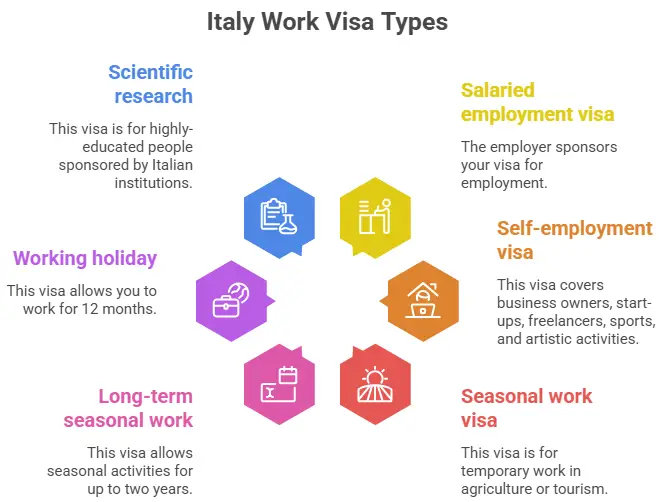
Italy offers several types of National Visas (Visa D) for those who wish to live and work in Italy for more than 90 days. These are distinct from short-stay Schengen visas and are issued based on the nature of employment or professional activity.
| Visa Type | Details |
|---|---|
| Salaried Employment Visa | For professionals with a confirmed job offer from an Italian employer. The employer sponsors the applicant and initiates the process by applying for a Nulla Osta (work authorisation) at the Sportello Unico per l'Immigrazione. Subject to annual Decreto Flussi quota and Click Day. |
| Self-Employment Visa | For individuals who want to start or run their own business or professional activity in Italy. Includes categories such as Business Owner, Start-up Founder, Freelancer, Sports Professional, and Artistic Professional. |
| Seasonal Work Visa | For short-term workers in agriculture or tourism sectors. The visa is valid for one season and is linked to a specific employer and job sector. |
| Long-Term Seasonal Work Visa | For workers who return for seasonal work over two consecutive years. It allows repeated entry for seasonal jobs without applying again every year. |
| Working Holiday Visa | For young applicants from eligible countries who want to work and travel in Italy for up to 12 months. Mainly designed for short-term cultural and work experience. |
| Scientific Research Visa | For highly qualified researchers sponsored by Italian universities or research institutions. Also allows family members to accompany the researcher under a hosting agreement. Quota-exempt. |
| Digital Nomad Visa | For remote workers and freelancers with foreign clients or employers. Launched under Ministerial Decree No. 79. Requires minimum income of €28,000/year, valid health insurance, and proof of 6+ months remote work experience. Offers a 1-year renewable permit and is not subject to Decreto Flussi quota. Ideal for Indian IT professionals working remotely. |
Italy Digital Nomad Visa (Ministerial Decree No. 79 — April 2024)
The Italy Digital Nomad Visa is the most accessible Italy work pathway for Indian IT professionals in 2026. Unlike every other Italy work visa, it does not require an Italian employer, a job offer, or a Decreto Flussi Click Day slot. If you work remotely for a company based outside Italy — whether in India, the US, UK, or anywhere else — and earn at least €28,000/year, you may qualify.
| Feature | Detail |
|---|---|
| Legal Basis | Ministerial Decree No. 79 (April 2024) |
| Who Qualifies | Remote workers employed by non-Italian companies |
| Minimum Income | €28,000 per year |
| Qualification Required | University degree or at least 6 months of remote work experience |
| Health Insurance | Minimum Schengen-wide coverage of €30,000 |
| Italian Employer Required | No |
| Click Day Required | No — applications are accepted year-round |
| Validity | 1 year, renewable |
Note: The Digital Nomad Visa does not grant the right to work for Italian clients or companies. Your employment or client base must remain outside Italy. Indian freelancers with mixed Italian and non-Italian clients should seek legal advice before applying.
For full details, documents, and application process see: Italy Digital Nomad Visa — Complete Guide
EU Blue Card Italy 2026: Faster Route to Italian Residence for Highly Qualified Indians
The EU Blue Card is a fast-track work and residence permit for highly qualified non-EU professionals. It is one of the most attractive long-term options for Indian engineers, IT professionals, doctors, and senior managers relocating to Italy.
2026 Salary Thresholds (Updated per Decree 152/2023):
| Category | Annual Gross Salary Threshold | INR Equivalent (approx.) |
|---|---|---|
| Standard roles | ~€35,000/year | ≈ ₹32.5 LPA |
| Shortage sector roles | ~€28,000–€29,000/year | ≈ ₹26–27 LPA |
Art. 27-ter Quota-Exempt Pathway for Indian IT & Research Professionals
Indian professionals working in IT, research, or university teaching may qualify for quota-exempt work permits that bypass the Decreto Flussi Click Day entirely.
Eligible Categories:
- IT specialists transferring within a multinational company (Intra-Company Transfer — ICT permit under Art. 27-ter)
- Qualified researchers sponsored by Italian universities or research institutions
- University teaching professionals
Key Advantages:
- No Click Day participation required
- No annual quota cap
- Application processed directly by the employer/institution through portaleimmigrazione.it
- Particularly relevant for Indian IT professionals at MNCs with Italian offices (TCS, Infosys, Wipro, HCL employees transferring to Italy)
Eligibility for Italy work visa
To apply for an Italy work visa, candidates must have a confirmed job offer from an Italian employer in most cases, as the process is employer-led under the Decreto Flussi system. Italy prioritises skilled professionals, seasonal workers, and shortage occupations. A clean criminal record and valid health insurance are mandatory for all applicants.
| Category | Details |
|---|---|
| Ideal Candidate Profile | IT professionals (software developers, data engineers, cybersecurity specialists), healthcare workers (doctors, nurses, caregivers, physiotherapists), engineers (civil, mechanical, electrical), construction and skilled tradespeople (electricians, plumbers, welders), agriculture and tourism workers, logistics and transport professionals, researchers, and corporate managers or executives in Italian companies. |
| Education Requirements | A bachelor's degree or higher is required for the EU Blue Card and specialist roles. Vocational or trade certificates are accepted for skilled and seasonal shortage jobs under the Decreto Flussi quota. Degrees must be apostilled by the Indian Ministry of External Affairs. Regulated professions such as medicine, nursing, and architecture require formal recognition (riconoscimento) by the relevant Italian professional body. |
| Work Experience | Relevant work experience is required for the applied role. Healthcare, engineering, and IT roles typically require 2–3 years of experience. Senior and specialist roles require 5+ years. Indian work experience is accepted if qualifications are verifiable and meet Italian sector standards. |
| Language Requirements | Italian language proficiency is not universally mandatory at the visa application stage. However, it is essential for healthcare, caregiving, education, and roles involving public interaction or safety-sensitive environments. English is accepted in multinational companies and tech firms. A basic commitment to learning Italian after arrival is generally expected for non-specialist roles. |
| Salary Thresholds | EU Blue Card: minimum ~€35,000/year gross for standard roles (1.5× ISTAT national average); ~€28,000–€29,000/year for shortage sector occupations (1.2× national average). Thresholds are updated annually by ISTAT per Decree 152/2023. (Previous figures of €30,576/€25,479 were 2023-era estimates and are now outdated.) Non-Seasonal Employed Worker Visa: salary must match the applicable national collective labour agreement (CCNL) for the sector. Seasonal Work Visa: minimum wage as per sector CCNL, typically €9–€14/hour. Self-Employment Visa: proof of investment of at least €500,000 and creation of 3 or more jobs, or demonstrated professional standing for freelancers and artists. Digital Nomad Visa: minimum €28,000/year from remote work. |
| Additional Requirements |
Valid passport with at least 3 months validity beyond the intended stay; Police Clearance Certificate (PCC) from India; valid health insurance until covered by Italy's National Health Service (SSN); a binding employment contract from an Italian employer; and a Nulla Osta (work authorisation) issued by the Sportello Unico per l'Immigrazione. 2026 Update — Nulla Osta Validity Extended: As of 2026, the nulla osta validity period has been extended from 6 months to 12 months, giving applicants more time to complete consular visa steps. Employers now have a 7-day window to confirm the nulla osta once issued. Source: Italian Ministry of Labour circular, 2026. Applications under the Decreto Flussi must be submitted during officially announced Click Day windows, where the employer applies on the applicant's behalf through the portaleimmigrazione.it portal. 2026 Click Days are closed. Plan for 2027. |
Also read…
Italy Work Visa Requirements
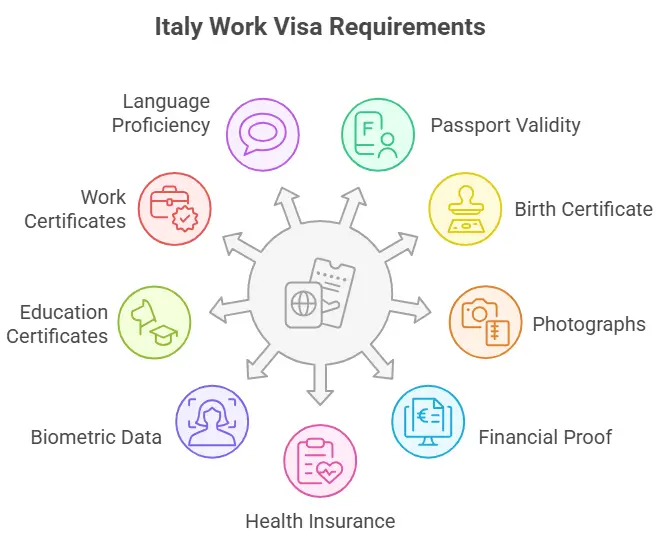
The requirements for the Italy work permit visa are given as follows:
- 6 months valid passport
- Birth certificate
- 2 passport size photographs taken in the last 6 months
- Proof of sufficient funds to stay in Italy
- Proof of health insurance
- Submission of biometric data
- Higher education certificates
- Work certificates and testimonials
- Proof of language proficiency
Also, read...
Top In-Demand Jobs in Italy for the Next 10 Years
Italian Language Requirements for Indian Applicants
Italian language proficiency is not required at the visa application stage for most work permit categories. Here is what you need to know at each stage:
| Stage / Visa Type | Italian Language Requirement |
|---|---|
| Standard Work Visa (Salaried) | Not required at visa stage |
| EU Blue Card | Not required at visa stage |
| Digital Nomad Visa | Not required (work is with foreign clients) |
| Healthcare & caregiving roles | Required — patient interaction and safety-critical |
| Long-Term Residence (Carta di Soggiorno) — after 5 years | Italian A2 level required |
| Citizenship — after 10 years | Italian B1 level required |
Italy Digital Nomad Visa for Indian IT Professionals
Italy launched its Digital Nomad Visa in April 2024 under Ministerial Decree No. 79, making it one of the most relevant new pathways for Indian IT professionals with overseas clients or remote employers.
Key Requirements:
- Minimum income: €28,000/year (≈ ₹26 LPA) from remote work or freelance activity
- Valid health insurance covering the duration of stay
- Proof of at least 6 months of remote work experience
- Active client or employer relationship outside Italy
Key Benefits:
- 1-year permit, renewable
- Not subject to annual Decreto Flussi quota — apply at any time, no Click Day required
- No Italian employer sponsorship needed
- Italian language not required (work is with foreign clients)
- Path to long-term residency after 5 years of legal stay
(EUR 1 = approx. INR 93, April 2026 indicative) Source: vistoperitalia.esteri.it; Ministerial Decree No. 79, April 2024.
Job Market in Italy
Italy is the third-largest Eurozone economy and faces a serious structural labour shortage driven by an ageing population. The government has committed to issuing nearly 500,000 work permits between 2026 and 2028 under the Decreto Flussi framework. High-demand sectors include IT, healthcare, engineering, construction, manufacturing, and hospitality. The most critical shortages are in technicians, welders, IT professionals, nurses, and chefs. Milan, Rome, and Turin are the primary employment hubs, with northern Italy offering the highest salaries. Nearly 40% of companies hiring non-EU workers operate in the high-tech sector.
Top Jobs in Italy for Indians
Italy is investing heavily in manufacturing modernisation, healthcare, green energy, and digital transformation. With 500,000 work permits planned between 2026 and 2028 under the Decreto Flussi framework, and India listed as a priority country under the bilateral Migration and Mobility Agreement, Indian professionals are among the most actively recruited foreign talent in Italy.
| Industry | In-Demand Job Roles |
|---|---|
| IT & Software | Software Developers, AI/ML Engineers, Cybersecurity Specialists, Cloud Engineers, Data Analysts. IT specialists can obtain work permits outside the annual quota system, making this one of the fastest routes for Indian tech professionals. Major tech hubs are in Milan and Turin. |
| Engineering | Mechanical Engineers, Civil Engineers, Electrical Engineers, Process Engineers, Automation & Robotics Engineers, Aerospace Engineers. |
| Healthcare & Life Sciences | Doctors, Specialist Surgeons, Registered Nurses, Caregivers, Elderly Care Workers, Healthcare Assistants, Physiotherapists. |
| Manufacturing & Skilled Trades | Welders, Electricians, Machine Operators, Industrial Maintenance Technicians, Chemical Operators, Production Technicians. |
| Construction | Bricklayers, Carpenters, Electricians, Plumbers, Specialised Maintenance Technicians, Construction Workers. |
| Renewable & Green Energy | Solar & Wind Technicians, Environmental Engineers, Energy Efficiency Specialists, Sustainability Managers. |
| Hospitality & Tourism | Chefs, Hotel Managers, Restaurant Staff, Event Planners, Housekeeping Supervisors. |
| Finance & Business Services | Financial Analysts, Accountants, Procurement Managers, Sales & Marketing Directors. |
| Fashion, Design & Luxury | Product Designers, Fashion Designers, UX/UI Designers, Multimedia Artists. |
| Education & Social Services | STEM Teachers, English Language Teachers (TEFL), Childcare Workers, Social Workers. |
Also, read...
What are the fast-track hiring options in Italy for Skilled Professionals?
Average Salary of Skilled Workers in Italy
Italy's average gross salary is around €33,800/year, making it lower than Germany, Denmark, and Finland but offset by a significantly lower cost of living, especially outside major northern cities. Salaries are governed by sector-specific collective bargaining agreements (CCNL) rather than a statutory minimum wage. Workers benefit from a mandatory 13th-month salary bonus (Tredicesima), 4 weeks of paid annual leave, 12 public holidays, and access to Italy's universal public healthcare system.
| Experience Level | Average Gross Salary (EUR/Year) | Approx. Salary (INR/Year) |
|---|---|---|
| Entry-Level (0–2 years) | €20,000 – €30,000 | ≈ ₹18.6 – ₹27.9 LPA |
| Mid-Level (3–5 years) | €30,000 – €48,000 | ≈ ₹27.9 – ₹44.6 LPA |
| Senior-Level (5+ years) | €48,000 – €90,000+ | ≈ ₹44.6 – ₹83.7 LPA |
How to Apply for an Italy Work Permit: Step-by-Step Guide (2026)
Under the Decreto Flussi system, the employer initiates the work permit process — not the applicant. The applicant only applies for the consular visa after the employer has obtained the Nulla Osta. Here is the correct step-by-step process:
EMPLOYER STEPS
Step 1 — Employer registers on portaleimmigrazione.it The Italian employer (or their legal representative) creates an account on the official immigration portal and prepares the application.
Step 2 — Employer participates in Click Day (or applies via quota-exempt route) For roles subject to the annual quota, the employer submits the Nulla Osta application during the officially announced Click Day window. IT specialists, researchers, and intra-company transferees may apply outside the quota at any time. Note: 2026 Click Days are closed. The next opportunity is the 2027 Click Day. Register with Y-Axis for early notification.
Step 3 — The local immigration desk (Sportello Unico) processes the Nulla Osta application. Processing time: 30 days (statutory deadline introduced under Decreto Flussi 2026–2028 — previously 2–6 months). Delays may still occur in exceptional cases.
Step 4 — Nulla Osta issued to employer Once approved, the Nulla Osta is issued. 2026 Update: Nulla Osta validity has been extended from 6 to 12 months. The employer has a 7-day window to confirm acceptance once issued.
APPLICANT STEPS
Step 5 — Applicant applies for consular visa at Italian Embassy / VFS India With the Nulla Osta in hand, the applicant submits a visa application at the Italian Embassy or VFS Global centre in India. Book your VFS appointment as early as possible — slots fill quickly. Processing time: 15–60 days (varies by consulate — book your VFS appointment as early as possible after Nulla Osta approval).
Step 6 — Applicant travels to Italy Upon visa approval, the applicant enters Italy.
Step 7 — Applicant applies for Permesso di Soggiorno (Residence Permit) within 8 days Within 8 days of arriving in Italy, the applicant must submit a residence permit application (Permesso di Soggiorno) at the local Questura (police headquarters) or via a post office kit (kit postale).
Step 8 — Obtain Codice Fiscale (Italian Tax Code) Apply for the Codice Fiscale at the local Agenzia delle Entrate office. This is required for employment, banking, healthcare registration, and signing a lease. Source: agenziaentrate.gov.it
Step 9 — Register with SSN (National Health Service) Register with the Servizio Sanitario Nazionale (SSN) at the local ASL (health authority) to access Italy's public healthcare system.
Total Timeline: 3–8 months from job offer to legally working in Italy
| Stage | Who Applies | Typical Time |
|---|---|---|
| Sportello Unico Nulla Osta | Employer | 2–6 months |
| Consular visa (after Nulla Osta) | Applicant | 15–60 days |
| Residence permit (after arrival) | Applicant | Within 8 days of arrival |
Also, read...
Highest Paying Job Opportunities in Italy
Italy work visa processing time
The processing time for an Italy work visa depends on the type of visa you have applied for. The documents you have submitted will be reviewed by the immigration officers, and then your visa will be approved within 15-60 days.
| Stage | Applicant | Typical Duration |
|---|---|---|
| Sportello Unico Nulla Osta approval | Employer applies | 2–6 months |
| Consular visa (after Nulla Osta issued) | Applicant applies at Italian Embassy / VFS India | 15–60 days |
| Permesso di Soggiorno (residence permit after arrival) | Applicant applies at local Questura | Must apply within 8 days of arrival |
Also, read…
What is the job outlook for Italy?
Italy work visa cost
The Italy work visa price ranges between € 100 and € 116, depending upon the type of visa you apply for. The table below lists the details of the Italy work visa costs:
| Visa Type | Total Cost |
|---|---|
| Self-Employment Visa | € 116.00 |
| Seasonal Work | € 116.00 |
| Long-term Seasonal Work | € 100.00 |
| Working Holiday | € 116.00 |
| Scientific Research | € 116.00 |
How long is the Italy work visa valid?
The validity of Italy work visa is usually 2 years and can be renewed for up to 5 years, depending upon the employment contract.
Italy Job Seeker Visa for Indians
The Italy Job Seeker Visa is a national long-stay visa that allows non-EU citizens — including Indians — to travel to Italy and stay for up to 12 months to search for employment, without needing a prior job offer.
Key Details:
- Duration: 12-month stay to find employment
- Quota status: Quota-exempt — no Click Day required, apply at any time
- Minimum income requirement: Proof of financial means equivalent to at least the Italian social allowance level (assegno sociale) — approximately €6,400/year — to demonstrate self-sufficiency during the job search period
- Education: Valid Bachelor's or Master's degree required
- Where to apply: Italian Consulate in India.
Is Italy offering a Job Seeker Visa for Indians?
Italy does offer a job seeker entry under the Decreto Flussi framework, allowing Indian professionals to enter Italy for up to 12 months to search for employment without a prior job offer. However, this pathway is subject to the same annual quota system as all other Decreto Flussi permits — and the 2026 Click Day windows are now closed.
Status — July 2026: The Job Seeker pathway under Decreto Flussi 2026 is no longer available. Indian professionals interested in this route should begin preparing for the 2027 Click Day window. In the meantime, the following quota-exempt alternatives remain open:
EU Blue Card — for roles earning €30,576+/year, no Click Day required
Digital Nomad Visa — for remote workers earning €28,000+/year with non-Italian clients
IT, research, and teaching roles — permanently quota-exempt, can be applied for at any time
Prepare for Italy 2027 — Start Here
Dependent Benefits for Italy Work Visa Holders
Spouses and children of Italy work visa holders are entitled to a wide range of benefits through Italy's family reunification programme and national social welfare system (INPS).
| Category | Details |
|---|---|
| Dependent Visa / Family Reunification | Spouses over 18, unmarried children under 18, and dependent adult children with disabilities can join the main applicant. The main applicant must show an annual income of about €8,500–€9,000, provide suitable housing, and hold a valid residence permit. The dependent permit is temporary and renewed with the main applicant’s permit. Processing time is usually 3–6 months. |
| Spouse Work Rights | After receiving the family reunification residence permit, the spouse can work for any employer or start self-employment in Italy without a separate work permit. |
| Children's Education | Children can attend free public schools in Italy. Education is compulsory from ages 6 to 16, with access to language support for non-Italian speakers and options for secondary or vocational education. |
| Healthcare Access | Dependents get access to Italy’s National Health Service (SSN), which covers doctor visits, specialist care, hospital treatment, and medicines at subsidised rates. |
| Child Benefit (Assegno Unico e Universale) | Families receive a monthly child allowance from the 7th month of pregnancy until the child turns 21 (under certain conditions). The amount ranges from €57 to €199.40 per child per month depending on family income. |
| Parental Leave | Both parents can receive up to 14 months of parental leave at about 80% of salary under EU rules. |
| Childcare Support | Subsidised daycare and nurseries are available for children from 3 months to 3 years. Families with lower income may receive full or partial fee exemptions and additional baby bonuses. |
Pathway to Long-Term Residency in Italy
Italy's residency pathway is structured around continuous legal stay, language integration, and employment history. It offers a clear and transparent route from a temporary work permit to permanent residency and eventually EU citizenship.
| Category | Details |
|---|---|
| Permanent Residency (PR) | After 5 years of legal residence, workers can apply for the EU Long-Term Residence Permit. It allows them to live and work in Italy permanently and change employers freely. The permit is renewed every 10 years. |
| PR Requirements | Minimum income of €8,264/year (single) or €11,362/year (married), proof of accommodation, A2 level Italian, and a clean criminal record. |
| Citizenship / Naturalisation | Citizenship can be applied for after 10 years of legal residence. Applicants must show B1 Italian, stable income, and a clean criminal record. Processing takes 2–4 years. |
| Faster Citizenship Pathways | 3 years for people with Italian ancestry, 2 years for spouses of Italian citizens (1 year if they have minor children), and 4 years for EU citizens. |
| Language Requirements | A2 Italian for PR and B1 Italian for citizenship. |
| PR Eligibility Timeline | Temporary residence permit (1–2 years, renewable) → PR after 5 years → citizenship after 10 years. |
| Dual Citizenship | Italy allows dual citizenship. Indians who become Italian citizens lose Indian citizenship but can apply for OCI status. |
How can Y-Axis assist you to get work visa in Italy?
Y-Axis is the best route to get work in Italy. Our impeccable services include:
- Expert guidance for work overseas.
- The exclusive Y-Axis Resume Marketing Services will help you search for your desired jobs in Italy.
- Y-Axis coaching will help you ace the standardized test required for immigration.
Other Work Visas
Y-Axis snapshot
1M
Successful applicants
1500+
Experienced counselors
25Y+
Expertise
50+
Offices
Don't know what to do ?
Get Free Counseling
Looking for Inspiration
Explore what Global Indians have to say about Y-Axis in shaping their future