

Study in Canada

Don't know what to do?
Get Free Counseling
Last Updated: 17-08-2026
Study in Canada: Student Visa, Universities, Costs & Scholarships
Canada is one of the top choices for international students looking for quality education, globally recognised universities and opportunities to gain work experience after graduation. In 2025, Canada had around 691,215 study permit holders, showing the strong demand for Canadian education. For 2026, Canada expects to issue up to 408,000 study permits, including new students and study permit extensions.
Students can choose from a wide range of undergraduate, postgraduate and doctoral programs across Canadian universities, colleges and other designated learning institutions. The average tuition fee for international students in 2025/2026 is CAD 41,746 per year for undergraduate programs and CAD 24,028 for graduate programs.
If you plan to study in Canada in 2026, it is important to understand the study permit requirements, tuition fees, living costs, scholarships, work opportunities and post-graduation options before choosing a course or institution.
Why Study in Canada?
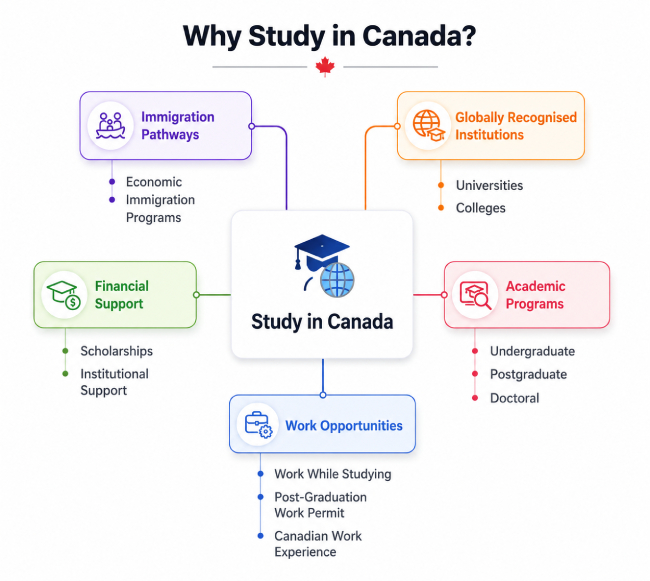
Canada remains a major destination for international students because of its universities, colleges, research opportunities and post-study work options.
- Globally recognised universities and colleges
- Undergraduate, postgraduate and doctoral programs across many disciplines
- Opportunities to work while studying if you meet IRCC requirements
- Eligibility for a Post-Graduation Work Permit (PGWP) for graduates of eligible programs
- Access to scholarships and institutional financial support
- Opportunities to gain Canadian work experience after graduation
- Potential pathways to permanent residence through eligible economic immigration programs
A PGWP does not automatically lead to permanent residence. Graduates must independently meet the requirements of the immigration program they apply under.
Canada is welcoming 408,000 students
Canada has released the study program allocation for 2026 and plans to welcome 408,000 international students.
| Category | Allocated Study Permits |
|---|---|
| PAL/ TAL required applicants | 1,80,000 |
| Master’s and doctoral students (PAL/TAL exempt) | 49,000 |
| Primary and secondary school (kindergarten to grade 12, also PAL/TAL exempt) | 1,15,000 |
| Other PAL/TAL-exempt study permit applicants | 64,000 |
| Total | 4,08,000 |
Top Universities in Canada for International Students
Choosing the right university and study program is important for your education and future career in Canada. Canada has many well-known universities that attract students from around the world. The table below lists some of the top universities in Canada based on the QS World University Rankings 2027.
| QS Global Rank | University |
|---|---|
| #32 | University of Toronto |
| #30 | McGill University |
| #45 | University of British Columbia |
| #162 | Université de Montréal |
| #96 | University of Alberta |
| #174 | McMaster University |
| #113 | University of Waterloo |
| #142 | Western University |
| #228 | University of Ottawa |
| #249 | University of Calgary |
| #179 | Queen's University at Kingston |
| #298 | Dalhousie University |
| #312 | Simon Fraser University |
| #370 | University of Victoria (UVic) |
| #526 | Université Laval |
| #411 | University of Saskatchewan |
| #322 | York University |
| #497 | Concordia University |
| #546 | University of Guelph |
| #591–600 | Université du Québec |
| #801–650 | Carleton University |
| #560 | University of Manitoba |
| #677 | University of New Brunswick |
| #537 | University of Windsor |
| #721 | Memorial University of Newfoundland |
| #951–1000 | Université de Sherbrooke |
*For Admission Assistance to Canadian universities, consult Y-Axis!
Popular Courses to Study in Canada
Popular areas of study among international students include:
| Program area | Typical study level | What to check |
|---|---|---|
| Computer Science | Bachelor's/Master's | Academic prerequisites, mathematics, programming background |
| Data Science/AI | Master's/Graduate | Statistics, mathematics and programming requirements |
| Engineering | Bachelor's/Master's | Subject prerequisites and professional requirements |
| Business/MBA | Master's | Work experience, GMAT/GRE requirements where applicable |
| Nursing | Bachelor's/Master's | Science prerequisites and provincial requirements |
| Public Health | Master's | Relevant bachelor's degree and program prerequisites |
| Finance | Bachelor's/Master's | Mathematics, economics and program-specific requirements |
| Engineering Management | Master's | Engineering/technical background |
| Supply Chain Management | Graduate/Undergraduate | Business or related academic background |
| Biotechnology | Bachelor's/Master's | Biology, chemistry and laboratory prerequisites |
Important: The tuition and eligibility figures for individual programs should be checked on the university's official website because they vary by institution and intake.
Eligibility to Study in Canada
To be eligible to study in Canada, students generally need to:
- Get admission to a Designated Learning Institution (DLI) in Canada.
- Meet the academic requirements of the chosen course and institution.
- Meet the required English or French language proficiency criteria, if applicable.
- Have sufficient funds to cover tuition fees, living expenses and travel costs.
- Have a valid passport or travel document.
- Meet Canada's health and character requirements, including a medical exam or police certificate if required.
- Obtain a study permit if required for the course.
Requirements to Study in Canada
- Valid passport
- Academic certificates and transcripts
- English or French language proficiency, if required
- Letter of Acceptance (LOA) from a Canadian institution
- Proof of sufficient funds for tuition and living expenses
- Statement of Purpose (SOP) or study plan, if required
- Provincial Attestation Letter (PAL/TAL), if required
- Quebec Acceptance Certificate (CAQ), if studying in Quebec
- Medical examination, if required
- Other documents required by the chosen institution
Steps to Study in Canada
Step 1: Choose a suitable course and a recognised Canadian institution that matches your academic and career goals.
Step 2: Check the admission requirements and prepare your academic, language and other supporting documents.
Step 3: Apply to the selected Canadian institution and pay the applicable application fee.
Step 4: Receive the Letter of Acceptance (LOA) after your application is approved.
Step 5: Obtain a PAL/TAL or CAQ, if required for your study program and province.
Step 6: Arrange your finances and prepare for your studies, including tuition fees, accommodation and living expenses.
Step 7: Apply for a study permit, if required, before travelling to Canada.
Step 8: Once your study permit is approved, make your travel arrangements and begin your studies in Canada.
Cost of Studying in Canada
The cost of studying in Canada depends on the course, institution, level of study, and province. International students should check the official tuition fees of their chosen institution before planning their budget.
Average Tuition Fees in Canada
The average annual tuition fees for international students are:
| Study Level | Average Annual Tuition |
|---|---|
| International Undergraduate | CAD 41,746 |
| International Graduate | CAD 24,028 |
These are national average fees for full-time international students. They are not the exact fees charged by every university or college. The actual cost can be higher or lower depending on the program and institution.
Tuition Fees by Province
Tuition fees can vary significantly across Canadian provinces. For 2025/2026, Statistics Canada reported the following average fees for international undergraduate students:
| Province | Average International Undergraduate Tuition |
|---|---|
| Newfoundland and Labrador | CAD 18,867 |
| Ontario | CAD 49,802 |
Tuition Fees by Field of Study
The cost of tuition also depends on the field of study. Professional and specialised programs, such as engineering, business, medicine, and dentistry, may cost more than the national average. Students should always check the official tuition fee schedule of their chosen university or college instead of depending on a general estimate.
Canada Student Visa Process for Indians
For Indian students planning to study in Canada, understanding the Canada student visa process is essential. The process generally involves obtaining a Letter of Acceptance (LOA) from a Designated Learning Institution (DLI), arranging proof of funds, obtaining the required documents, and applying for a Canadian study permit through IRCC. Students should also check the latest eligibility requirements, financial requirements, and visa application procedures before applying.
Canada Student Visa Requirements
To apply for a Canada study permit, you generally need to:
- Obtain a Letter of Acceptance from a Designated Learning Institution (DLI)
- Provide a PAL/TAL unless you qualify for an exemption
- Obtain a CAQ if you plan to study in Quebec, where required
- Show sufficient funds for tuition, living expenses and transportation
- Have a valid passport or travel document
- Complete biometrics if required
- Provide a medical examination if required
- Provide a police certificate if requested
- Provide a letter of explanation describing why you want to study in Canada and your responsibilities as an international student
- Satisfy the immigration officer that you meet Canada's temporary-residence requirements, including leaving Canada at the end of your authorized stay
IRCC may request additional documents depending on the applicant's circumstances and country of application.
Note: There is no single IRCC IELTS score that applies to every Canada study permit applicant. Universities and colleges set their own admission and language requirements. Some institutions accept IELTS, while others may accept TOEFL, PTE, CAEL, Duolingo or other approved evidence depending on the institution and program. Therefore, students should check the language requirements of their chosen DLI and program rather than relying on a single "Canada student visa IELTS score."
Designated Learning Institutions (DLIs)
A Designated Learning Institution (DLI) is a Canadian school approved by a provincial or territorial government to host international students. Students applying for a post-secondary study permit need an LOA from a DLI. Students should also check whether their specific program is eligible for a PGWP if they plan to work in Canada after graduation. Graduating from a DLI does not automatically make a student eligible for a PGWP.
How to choose a DLI?
Before accepting an offer, check:
- Whether the institution is on the official DLI list
- Whether the specific program is PGWP eligible
- Tuition fees
- Program duration
- Admission requirements
- Location and living costs
- Co-op or internship opportunities
- Graduate employment opportunities
- Scholarship availability
Do not select a college only because it is listed as a DLI. PGWP eligibility can depend on the program and other requirements.
Proof of Funds for Canada Study Permit
You must demonstrate that you have enough money to pay for:
- Tuition
- Living expenses
- Transportation to and from Canada
- Living expenses for accompanying family members, where applicable
IRCC's financial requirements are updated annually.
What can be used as proof of funds?
Common forms of financial evidence include:
- Bank statements
- Proof of tuition and housing payments
- A Canadian bank account in your name
- A Guaranteed Investment Certificate (GIC) from a participating Canadian financial institution
- A student or education loan
- A bank draft that can be converted to Canadian dollars
- A scholarship or financial-support letter
- Documents showing financial support from a person or institution
IRCC states that bank statements for the previous 4 months can be used as one form of evidence. The exact documents required can vary according to the applicant's circumstances and visa-office instructions.
Canada Study Permit Fees
The current Canada study permit fees are:
| Fee | Amount |
|---|---|
| Study permit application | CAD 150 |
| Biometrics fee – Individual | CAD 85 |
| Study permit + Biometrics | CAD 235 |
The CAD 85 biometrics fee is required if you need to provide biometrics. For families applying together, the maximum biometrics fee is CAD 170. You may also need to pay extra for services such as a medical examination, police certificate, English language test, and Visa Application Centre (VAC) services. These additional costs are separate from the study permit fee.
Important Canada Study Permit Update – Financial Requirement
Canada has updated the financial requirements for study permit applicants. The new amounts apply from September 1, 2026, for students studying outside Quebec.
Key update:
- Previous annual living expense requirement: CAD 22,895
- New annual living expense requirement: CAD 23,448
- Increase: CAD 553 (approximately 2.42%)
The amount is for living expenses only and does not include tuition fees or transportation costs.
Updated Financial Requirement for Families
| Family Members | Old Requirement | New Requirement from Sept. 1, 2026 |
|---|---|---|
| 1 | CAD 22,895 | CAD 23,448 |
| 2 | CAD 28,502 | CAD 29,192 |
| 3 | CAD 35,040 | CAD 35,888 |
| 4 | CAD 42,543 | CAD 43,572 |
| 5 | CAD 48,252 | CAD 49,419 |
| 6 | CAD 54,420 | CAD 55,736 |
| 7 | CAD 60,589 | CAD 62,054 |
| Each additional family member | CAD 6,150 | CAD 6,318 |
Important: These requirements apply to all provinces and territories except Quebec. Students should ensure they can show sufficient funds for living expenses, in addition to tuition and travel costs, when applying for a Canadian study permit.
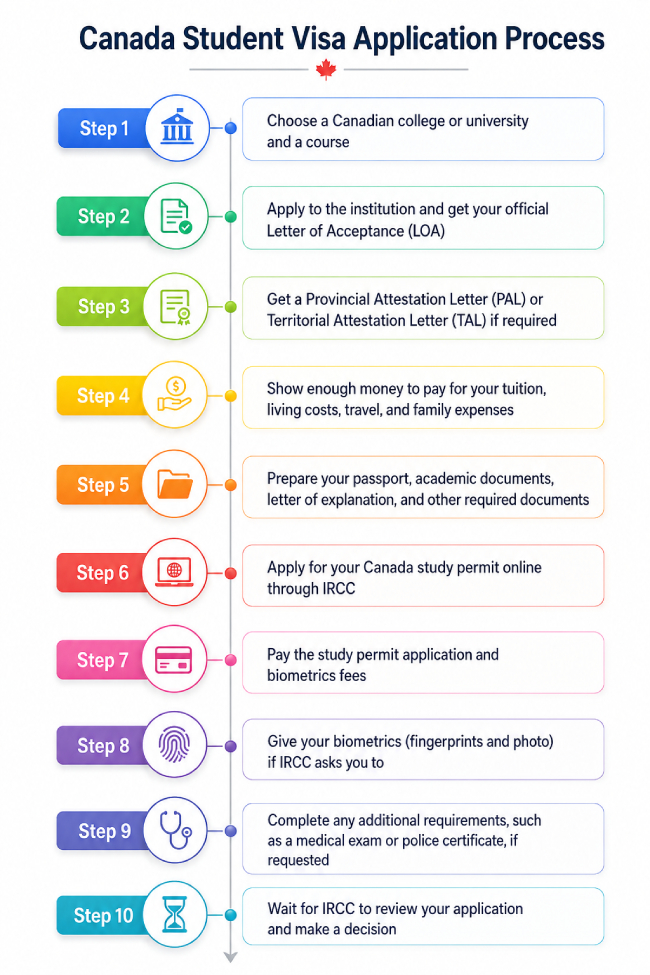
Canada Student Visa Application Process
Step 1: Choose a Canadian college or university and a course that matches your education and career goals.
Step 2: Apply to the institution and get your official Letter of Acceptance (LOA).
Step 3: Get a Provincial Attestation Letter (PAL) or Territorial Attestation Letter (TAL) if required, or check if you are exempt.
Step 4: Show enough money to pay for your tuition, living costs, travel, and family expenses, if applicable.
Step 5: Prepare your passport, academic documents, letter of explanation, and other required documents.
Step 6: Apply for your Canada study permit online through IRCC.
Step 7: Pay the study permit application and biometrics fees.
Step 8: Give your biometrics (fingerprints and photo) if IRCC asks you to.
Step 9: Complete any additional requirements, such as a medical exam or police certificate, if requested.
Step 10: Wait for IRCC to review your application and make a decision.
Step 11: If approved, follow the instructions in your approval letter and travel to Canada with all required documents.
Canada Student Visa Processing Time
There is no fixed processing time for a Canada study permit. The processing time can be different for each applicant based on several factors, such as the country where you apply, type of application, complete documents, biometrics, background checks, additional document requests, and IRCC workload.
Applicants should check the IRCC processing-time tool for the latest estimate before applying. It is better to check the current processing time instead of relying on a fixed time given on other websites.
Cost of Living in Canada
The cost of living in Canada depends mainly on the city, accommodation, and lifestyle of the student. Major expenses usually include:
- Accommodation
- Food and groceries
- Transportation
- Mobile phone and internet
- Health insurance
- Books and study materials
- Personal expenses
- Winter clothing and other initial settlement costs
Cities such as Toronto and Vancouver generally have higher housing costs than many smaller Canadian cities. Students should compare accommodation and other living costs in the city where they plan to study.
Housing Options for International Students
International students in Canada can choose from different types of accommodation, including:
- University or college residence
- Shared rental accommodation
- Private rental accommodation
- Homestay
- Temporary accommodation when they first arrive in Canada
Students should create a realistic monthly budget based on their city, accommodation choice, and personal spending habits.
Important: The IRCC proof-of-funds amount is the minimum amount students must show for their study permit application in applicable cases. It should not be considered a complete estimate of the actual living costs for every student.
Scholarships to Study in Canada
International students can apply for scholarships and financial support from Canadian universities, provincial governments, private organisations, foundations, international organisations, and the Government of Canada. The amount varies based on the scholarship, institution, course, and eligibility.
| Fee | Amount |
|---|---|
| Study permit application | CAD 150 |
| Biometrics fee – Individual | CAD 85 |
| Study permit + Biometrics | CAD 235 |
Note: These are estimated ranges and actual scholarship amounts can vary by institution and program. Students should check the official scholarship provider's website for the latest amount, eligibility requirements, and deadlines.
How to Apply for a Scholarship to Study in Canada?
Getting a scholarship to study in Canada needs good planning and preparation. Follow these simple steps:
Step 1: Search for scholarships: Look for scholarships offered by Canadian universities, the Government of Canada, provincial governments, private organisations, and other providers.
Step 2: Check the requirements: Each scholarship has different rules. Check the required academic marks, language skills, study level, and other conditions before applying.
Step 3: Prepare your documents: Keep your academic transcripts, recommendation letters, CV, personal statement, and other required documents ready.
Step 4: Apply before the deadline: Scholarship deadlines are different for each program. Start your application early so you have enough time to prepare and submit all documents.
Step 5: Show your achievements: Mention your academic results, leadership skills, extracurricular activities, research work, volunteering, and other achievements if they are relevant to the scholarship.
Step 6: Follow the application process: Some scholarships require students to apply directly, while others may require the Canadian university or college to submit the application.
Part-Time Jobs in Canada
Eligible international students can work while studying in Canada without getting a separate work permit, as long as they meet the requirements set by IRCC.
Working Off Campus
Eligible international students can work:
- Up to 24 hours per week during regular study periods.
- Unlimited hours during scheduled breaks, such as summer or winter holidays.
Students must continue to meet the conditions of their study permit to work.
Who Can Work Off Campus?
Students generally need to:
- Have a valid study permit.
- Be studying full-time at a Designated Learning Institution (DLI).
- Be enrolled in an eligible study program.
- Be studying in a program that is at least 6 months long and leads to a degree, diploma, or certificate.
- Continue to meet the conditions of their study permit.
- Students cannot start working before their study program begins.
Working On Campus
Eligible international students can also work on campus without a fixed weekly hour limit during regular study periods and scheduled breaks, as long as they meet the required conditions.
Popular Part-Time Jobs for Students in Canada
International students may find part-time jobs in areas such as:
- Retail
- Hotels and hospitality
- Restaurants and food services
- Customer service
- Administration
- Tutoring
- Campus services
- Research assistance
- Library services
The availability and pay of part-time jobs depend on the location, employer, skills, and work experience. Students should not depend on part-time work as their main source of money for studying in Canada. They must show that they have enough funds to support themselves when applying for a study permit.
Post-Graduation Work Permit (PGWP)
The Post-Graduation Work Permit (PGWP) allows eligible graduates to gain Canadian work experience after completing an eligible program. Graduating from a DLI does not automatically make a student eligible for a PGWP. The institution and program must meet the applicable requirements.
PGWP duration
For programs other than master's programs:
| Program duration | Possible PGWP duration |
|---|---|
| At least 8 months but less than 2 years | Up to the same length as the program |
| 2 years or longer | Up to 3 years |
For eligible master's degree programs, a student may qualify for a 3-year PGWP even when the master's program is less than 2 years, provided the program is at least 8 months and all other eligibility requirements are met. The PGWP duration can also be limited by passport expiry.
PGWP Field-of-Study Requirements
There is no field-of-study requirement for graduates with bachelor's, master's, or doctoral degrees. However, students graduating from certain other university, college, polytechnic, and non-university programs may need to complete an eligible field of study to qualify for a Post-Graduation Work Permit (PGWP) if their study permit application was submitted on or after November 1, 2024. IRCC has stated that the eligible field-of-study list is frozen for 2026, so no fields will be added or removed during 2026 under the current policy. Students should check the exact CIP code and current PGWP eligibility before choosing a study program.
PR After Studying in Canada
International students may apply for Permanent Residency (PR) after completing their studies in Canada, if they meet the eligibility requirements of a PR program. Studying in Canada does not guarantee PR.
A common pathway is to complete your studies, obtain a Post-Graduation Work Permit (PGWP), gain eligible Canadian work experience and then apply for PR.
Popular PR Pathways
- Canadian Experience Class (CEC): For eligible skilled workers with Canadian work experience.
- Express Entry: Eligible graduates can create a profile and may receive an invitation based on their CRS score.
- Provincial Nominee Program (PNP): Provinces and territories offer PR pathways for eligible international graduates and skilled workers.
Canada Study Permit Validity
A Canada study permit is generally valid for the length of your study program and usually becomes invalid 90 days after you complete your studies. It can also become invalid if you stop studying at the Designated Learning Institution (DLI) listed on your permit, unless you have completed your studies. Students should always check the expiry date and conditions shown on their study permit and apply for an extension if needed.
How Y-Axis Makes Studying in Canada Easier and Hassle-Free?
Y-Axis can assist by giving more vital support to aspirants who wish to study in Canada. The support process includes
- Free Counseling: Professional counseling for your selection of appropriate course and university.
- Campus Ready Program: Navigate to study in Canada with the best and ideal course.
- Course Recommendation: Y-Path gives unbiased advice on choosing the right path for successful career growth.
- Coaching: We assist you with IELTS live classes to improve your score.
- Canada Student Visa: Our expert team helps you in all steps to get a Canada student visa.
Read More:
Looking for inspiration
Explore what Global Indians have to say about Y-Axis in shaping their future