

Don't know what to do ?
Get Free Counseling
Last Updated 20 July 2026
South Korea Digital Nomad Visa (F-1-D)
South Korea is a popular travel destination, attracting nearly 20 million international visitors each year. To support remote workers, the South Korean Ministry of Justice introduced the Digital Nomad Visa (F-1-D Workation Visa) on 1 January 2024. On 30 June 2026, the government made the visa a permanent programme, introducing easier eligibility requirements and extending the maximum stay. The visa allows foreign nationals to live in South Korea while working remotely for employers or clients based outside the country.
Why Apply for Digital Nomad Visa
- Stay in South Korea for up to 3 years, the longest Digital Nomad Visa in East Asia (extended from 2 years on 30 June 2026).
- Get your visa processed in 10–15 working days.
- Bring your spouse and minor children, who can receive the same F-1-D visa status.
- Pay no Korean tax on foreign income for the first 5 years as a new tax resident, if the income is not brought into Korea.
- Enjoy high-speed internet with speeds of over 100 Mbps across the country.
- Work remotely for overseas employers or clients while living and travelling anywhere in South Korea.
Eligibility for South Korea Digital Nomad Visa
To apply for the South Korea Digital Nomad Visa (F-1-D Workation Visa), you must meet the following requirements:
- Citizens of all countries, including India, are eligible to apply.
- You must work remotely for a company registered outside South Korea or own a registered business outside Korea. You cannot work for a Korean employer on this visa.
- You must meet the minimum income requirement. For 2026, the standard requirement is an annual income of about KRW 105 million (around USD 74,000 or INR 62–65 lakh). This amount is updated every year, so check the latest requirement before applying.
- Young applicants 18–34 years who plan to live outside the Greater Seoul area (Seoul, Incheon, and Gyeonggi Province) may qualify with a lower income requirement. Even lower thresholds apply in selected population-declining regions.
- You must be at least 18 years old and have at least one year of work experience in your current field.
- If you are a freelancer, having a registered business such as a sole proprietorship, LLP, or private limited company and overseas client contracts can strengthen your application.
- You must have medical insurance covering at least KRW 100 million for hospital treatment and emergency repatriation during your stay in South Korea.
- You must have a clean criminal record with no criminal convictions in your home country or South Korea.
- You must provide a valid address in South Korea. A hotel or guesthouse booking for your initial stay is generally accepted.
- You can apply through the South Korean embassy or consulate in your home country. If you are already in South Korea, you may be able to change your status from a B-1 (Visa Exemption), B-2 (Tourist Visa), or C-3 (Short-Term Visit Visa), if eligible.
Note: The income requirement is revised annually. Always check the latest eligibility criteria with HiKorea or the Embassy of the Republic of Korea before submitting your application.
Benefits of the South Korea Digital Nomad Visa
The South Korea Digital Nomad Visa offers several advantages for remote workers who want to live and work in one of Asia's leading technology hubs.
- Stay in South Korea for up to 3 years under the latest Digital Nomad Visa rules.
- Bring your spouse and children under the same visa category.
- Join free Korean language classes available for foreign residents in many cities.
- Enjoy the freedom to travel across South Korea while experiencing its culture, food, and tourist attractions.
- Build your professional network in a country that is home to global companies such as Samsung, LG, Kakao, and Naver.
- Benefit from a reasonable cost of living, especially outside Seoul.
- Access high-speed internet, which is among the fastest and most reliable in the world.
- Travel easily to other Asian destinations with excellent international flight connections.
- Live in modern cities with excellent public transport, healthcare, and digital services.
- Work remotely for overseas employers or clients while enjoying a safe and high-quality lifestyle in South Korea.
*Want to apply for South Korea Work Visa? Contact Y-Axis for complete guidance
South Korea Digital Nomad Visa Requirements
- Visa request form
- Passport
- Passport copy
- Passport picture
- Proof of employment or work (employment contract, business registration for freelancers)
- Pay slips
- Bank statements (to prove income)
- Other financial proof if available (all taxable income you have in a year)
- Extract of criminal record (no previous convictions, either in your home country or in Korea)
- Proof of private insurance covering at least KRW 100 million for accidents/transport/medical help and repatriation
- An address in Korea is REQUIRED for the application
*Want to apply for a South Korea work visa? Sign up with Y-Axis for end-to-end support with the process.
Alien Registration Card (ARC) – Required for Stays Over 90 Days
If you stay in South Korea for more than 90 days on an F-1-D Digital Nomad Visa, you must apply for an Alien Registration Card (ARC), now officially called the Residence Card, within 90 days of arrival. Not registering within this period is an immigration violation.
The ARC is important for everyday life in South Korea. You will need it to:
- Open a Korean bank account.
- Get a Korean mobile phone plan.
- Rent a house or apartment.
- Access healthcare services.
- Use many Korean apps and online services.
How to Apply for an ARC
- Book an appointment in advance through the HiKorea website and visit your nearest Korea Immigration Service office.
- Submit your passport, visa documents, passport-sized photos, and proof of your address in South Korea.
- Pay an application fee of about KRW 30,000 (around INR 1,750).
- Processing usually takes 2–4 weeks.
- A Mobile ARC (digital Residence Card) has been available since 2025.
- After 6 months of registered residence, you may become eligible to join the Korea National Health Insurance (NHI) system.
Steps to apply for South Korea Digital Nomad Visa
Step 1: Check your eligibility
Step 2: Sort out the checklist of documents
Step 3: Apply for the South Korea Workation Visa at the Korean embassy/consulate
Step 4: Submit all the requirements
Step 5: Await the visa status and fly to South Korea
*Also, read...
Highest Paying Jobs in South Korea for Indians
Validity of South Korea Digital Nomad Visa
| Type of Visa | Validity |
|---|---|
| Digital Nomad Visa (F-1-D) | Up to 3 years (initial 1 year, extendable; increased from 2 years on June 30, 2026) |
| B-2 – Tourist Visa | 90 days |
| C-3 – Short-Term Stay Visa | 90 days (within the valid 180 days) |
Processing Time for South Korea Digital Nomad Visa
| Type of Visa | Processing Time |
|---|---|
| Digital Nomad Visa (F-1-D) | 10–15 working days |
| B-2 – Tourist Visa | 14 working days |
| C-3 – Short-Term Stay Visa | Up to 25 days |
Cost for applying for South Korea Digital Nomad Visa
The visa fee for the South Korea Digital Nomad Visa is approximately USD 60–90 (around INR 5,000–7,500), depending on single or multiple entry and the country you are applying from. Fees vary by embassy, so confirm with the Korean embassy or consulate in your country before applying.
*Read about – South Korea Job Market and Trends
Tax for Digital Nomads in South Korea
If you stay in South Korea for 183 days or more in a calendar year, you are generally considered a Korean tax resident.
- Stay less than 183 days: You are usually taxed only on income earned in South Korea. Income from overseas employers or clients is generally not taxed in Korea.
- Stay 183 days or more: New tax residents may qualify for a 5-year tax exemption on foreign income, provided that income is not transferred to South Korea. This can benefit remote workers who earn from overseas employers or clients.
- India–South Korea Double Taxation Avoidance Agreement (DTAA): India and South Korea have a DTAA to help prevent the same income from being taxed twice. However, your Indian tax obligations will still depend on your residential status and other tax rules.
Note: Tax rules can change and depend on your personal situation. It is advisable to consult a qualified tax professional before making financial or tax decisions.
Best Cities in South Korea for Indians
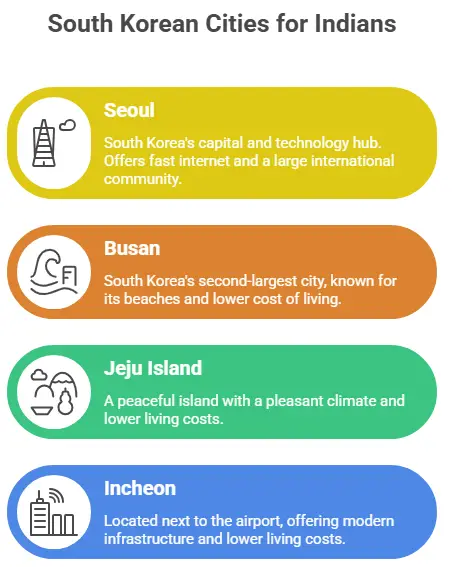
Seoul: South Korea's capital and largest technology hub, Seoul is home to global companies such as Samsung, LG, Kakao, Naver, and Coupang. It offers fast internet, excellent coworking spaces, and a large international community.
- One-bedroom apartment: KRW 700,000–1,500,000/month (approx. INR 40,000–87,000)
- Estimated monthly living cost: KRW 2.0–3.5 million (approx. INR 1.2–2.0 lakh)
Busan: Busan is South Korea's second-largest city and is known for its beaches and lower cost of living. It is becoming increasingly popular with remote workers.
- One-bedroom apartment: KRW 500,000–900,000/month (approx. INR 29,000–52,000)
Jeju Island: Jeju is a peaceful island with a pleasant climate, lower living costs, and a growing workation community.
- One-bedroom apartment: KRW 450,000–800,000/month (approx. INR 26,000–46,000)
Incheon: Located next to Incheon International Airport, Incheon offers modern infrastructure, smart-city facilities, and lower living costs than central Seoul.
- One-bedroom apartment: KRW 550,000–1,000,000/month (approx. INR 32,000–58,000)
South Korea vs Japan Digital Nomad Visa
| Feature | South Korea (F-1-D) | Japan Digital Nomad Visa |
|---|---|---|
| Maximum Stay | Up to 3 years | Up to 6 months |
| Income Requirement | About KRW 105 million/year (lower requirements available for some applicants from 2026) | JPY 10 million/year |
| Indian Citizens Eligible? | Yes | No (India is currently not on the eligible country list) |
| Family Members | Spouse and minor children can accompany | Spouse and children allowed |
| Local Registration | Residence Card (ARC) required for stays over 90 days | No residence card required |
| Tax | Foreign income may qualify for a 5-year exemption if conditions are met | Generally treated as a non-resident for tax purposes |
| Work Permission | Overseas employers and clients only | Overseas employers and clients only |
For many Indian professionals, South Korea offers a more practical option because of its longer stay, family-friendly policy, and access to local services through the Residence Card.
Also, read...
South Korea Introduces K-STAR Visa to Attract Global STEM Professionals. Apply now!
Why South Korea Is a Good Choice for Indian IT Professionals
- Home to leading technology companies such as Samsung, LG, Kakao, Naver, and Coupang.
- Korea Standard Time (KST) is only 3.5 hours ahead of Indian Standard Time (IST), making it convenient to work with clients in Europe, the Middle East, and many parts of Asia.
- South Korea is known for having some of the fastest internet speeds in the world.
- Living costs are generally lower than Tokyo or Singapore, making it a more affordable base in Asia.
- Many cities offer free Korean language classes for foreigners, and South Korea has excellent flight connections across Asia for easy travel.
How can Y-Axis help?
Y-Axis, the world’s number one overseas immigration consultant, creating Global Indians for over 25+ years, assists you through your journey to make a life as a Digital Nomad in South Korea. Our guidance and end-to-end support system ensure that you make the right choice at every step. We assist you with:
- Resume Marketing services to find related jobs in South Korea
- Eligibility check and income documentation review for the F-1-D visa
- Complete visa application and documentation support
Y-Axis snapshot
1M
Successful applicants
1500+
Experienced counselors
25Y+
Expertise
50+
Offices
Don't know what to do ?
Get Free Counseling