

Study in Poland

Don't know what to do?
Get Free Counseling
Last Updated: 1 October 2026
Study in Poland: Top Universities, Fees, Scholarships and Visa
Poland is becoming a popular study destination for international students, including students from India. The country has more than 1.32 million higher education students and 345+ higher education institutions. It also has 108,000+ international students from around 179 countries, showing the growing international appeal of Polish universities. Indian students are also choosing Poland for higher education, with 3,700+ Indian students studying in the country. Poland has produced 300,000+ graduates, offering students a large and diverse academic environment.
Polish universities offer courses in areas such as engineering, information technology, medicine, business, finance, science, humanities, and social sciences. Many universities also offer courses in English, especially at the master's and postgraduate levels. Tuition fees in Poland are generally lower than in many Western European countries, although costs depend on the university, course, and language of study. Scholarships and other financial support may also be available for eligible students. Students can also experience European culture and visit nearby countries during their studies, subject to the applicable visa and residence rules. With its affordable education, wide range of courses, international student community, and opportunities to gain international academic experience, Poland is an option for Indian students planning to study abroad.
*Need assistance to Study Abroad? Y-Axis is here to assist you in all the ways.
Why Study in Poland?
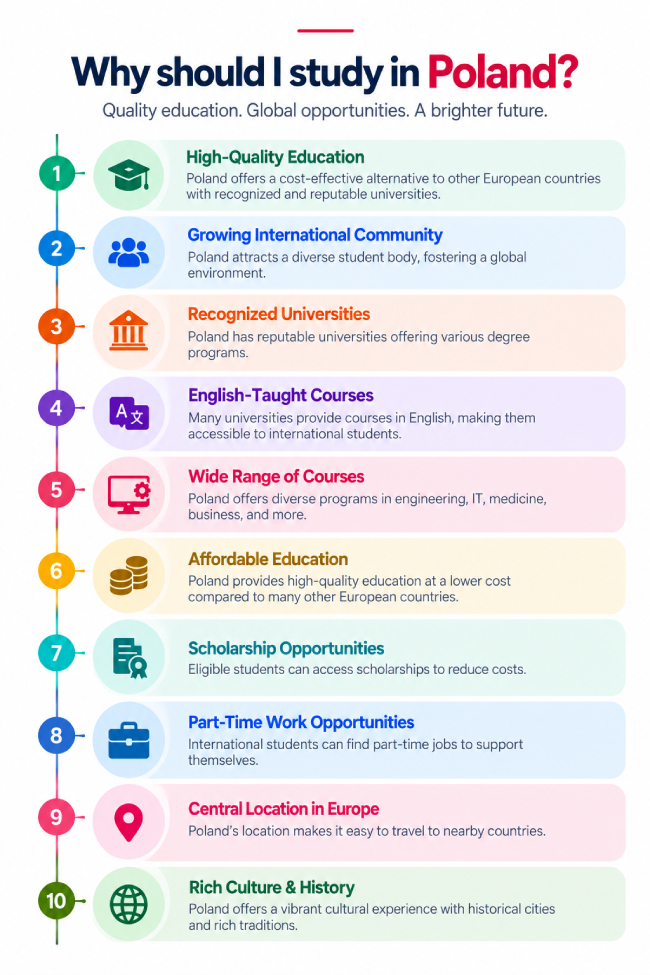
- Affordable education compared with many other European countries
- Growing international student community, with more than 108,000 international students
- Recognized universities offering bachelor's, master's, and doctoral programmes
- English-taught courses available at many universities
- Wide range of courses in engineering, IT, medicine, business, science, humanities, and social sciences
- European-style education system with degrees that are widely recognized
- Strong engineering and technology courses for students interested in technical careers
- Medical and healthcare programmes available at universities across Poland
- Business and management courses covering areas such as finance, economics, and management
- Scholarship opportunities for eligible international students
- Growing interest from Indian students, with more than 3,700 Indian students studying in Poland in 2024
- Part-time work opportunities for eligible international students, subject to Polish visa and employment rules
- Central location in Europe, making it convenient to visit nearby countries such as Germany, Czechia, Slovakia, Austria, and Hungary
- Rich culture and history, with many Polish cities offering a mix of traditional and modern student life
- Popular student cities such as Warsaw, Kraków, Wrocław, Poznań, and Gdańsk
- Opportunities for international experience through internships, research projects, university programmes, and other academic activities
Top Universities in Poland for Indian Students
Poland has a growing higher education system with universities offering courses in engineering, technology, medicine, business, science, humanities, and social sciences. Many universities also offer courses in English, especially at the master's level. Poland has more than 1.32 million higher education students and over 345 higher education institutions. The country also has more than 108,000 international students from around 179 countries. More than 3,700 Indian students were studying in Poland in 2024, showing the country's growing popularity among Indian students.
Some Polish universities are well known for their programmes in technology, engineering, medicine, business, and research. Popular institutions include the University of Warsaw, Jagiellonian University, Warsaw University of Technology, Adam Mickiewicz University, AGH University of Krakow, and Gdańsk University of Technology.
| University | Popular Study Areas |
|---|---|
| University of Warsaw | Business, Economics, Computer Science, Social Sciences, Law, Natural Sciences |
| Jagiellonian University | Medicine, Pharmacy, Law, Humanities, Science, Social Sciences |
| Warsaw University of Technology | Engineering, Computer Science, Architecture, Technology |
| Adam Mickiewicz University | Humanities, Languages, Psychology, Law, Social Sciences |
| AGH University of Krakow | Engineering, Computer Science, Technology, Materials Science |
| Gdańsk University of Technology | Engineering, Technology, Environmental Engineering |
| University of Wrocław | Science, Law, Biology, Chemistry, Social Sciences |
| University of Gdańsk | Economics, Business, Law, Science, Oceanography |
| Wrocław University of Science and Technology | Engineering, Computer Science, Architecture, Mechanical Engineering |
Popular Courses to Study in Poland
Poland offers a wide range of courses for international students. Popular choices include engineering, computer science, business, medicine, finance, life sciences, architecture, and social sciences. Students can choose bachelor's, master's, long-cycle master's, and doctoral programmes depending on their previous education and career plans. Many universities offer courses in English, which can be a useful option for Indian students who do not speak Polish.
| Programme | Typical Duration | Popular Specializations |
|---|---|---|
| Engineering | 3–4 years | Mechanical, Electrical, Civil, Chemical, Industrial, Environmental |
| Computer Science & IT | 3–4 years | Artificial Intelligence, Data Science, Cybersecurity, Software Development |
| Business & Management | 3–4 years | Finance, Marketing, International Business, Management, Entrepreneurship |
| Finance & Economics | 3–4 years | Banking, Accounting, Economics, Financial Management, Risk Management |
| Medicine & Healthcare | 5–6 years | Medicine, Dentistry, Pharmacy, Public Health, Medical Sciences |
| Life Sciences | 3–5 years | Biotechnology, Biochemistry, Molecular Biology, Genetics |
| Natural Sciences | 3–5 years | Physics, Chemistry, Mathematics, Environmental Science |
| Architecture & Design | 3–5 years | Architecture, Urban Planning, Interior Design, Sustainable Design |
| Social Sciences | 3–4 years | Psychology, Sociology, International Relations, Political Science |
| Humanities & Languages | 3–4 years | Languages, History, Literature, Cultural Studies |
Cost of Studying in Poland
The cost of studying in Poland depends on the university, course, study language, and student status. In general, Poland can be a more affordable option compared with several Western European countries. International students should plan for both tuition fees and living expenses. Other costs may include accommodation, food, transport, health insurance, study materials, and personal expenses.
Tuition Fees at Polish Universities
For international students who pay tuition fees, the cost is generally around EUR 2,000 to EUR 6,000 per year. The actual amount depends on the university and course. Some specialised programmes, such as MBA courses, can cost more.
| University Type / Programme | Approx. Tuition Fee | Details |
|---|---|---|
| Public Universities | EUR 2,000–6,000 per year | Depends on the course and university |
| Private Universities | EUR 2,000–6,000+ per year | Fees vary by institution and programme |
| MBA Programmes | EUR 8,000–12,000 per year | Usually more expensive than regular programmes |
| Doctoral Studies | Can be tuition-free | Some full-time doctoral students may also receive scholarships |
Some international students may be able to study at public universities without paying tuition, depending on their nationality, residence status, scholarship, or other conditions.
Other Study Expenses in Poland
Apart from tuition fees, international students should also plan for the following monthly expenses:
| Expense | Estimated Cost per Month |
|---|---|
| Accommodation | EUR 200–500 |
| Food and groceries | EUR 150–250 |
| Public transport | EUR 15–30 |
| Health insurance | EUR 15–30 |
| Books and study materials | EUR 20–50 |
| Mobile and internet | EUR 15–30 |
| Personal expenses | EUR 50–100 |
| Entertainment | EUR 30–80 |
| Travel expenses | EUR 20–100 |
| University administration fees | EUR 10–50 |
Estimated total living expenses: Around EUR 525–1,220 per month, depending on the city, accommodation and lifestyle. Warsaw and other larger cities may have higher living costs, while smaller student cities can be more affordable.
Cost of Living in Poland
The cost of living in Poland is generally lower than in several major Western European countries. However, the amount you spend will depend on your city, accommodation, lifestyle, and personal needs. Warsaw, Kraków, Wrocław, and Gdańsk are popular student cities, but accommodation and daily expenses can differ between them. Students should prepare a monthly budget that covers rent, food, transport, insurance, study materials, and personal expenses before travelling to Poland.
Scholarships to Study in Poland for Indian Students
Indian students can explore scholarships offered by the Polish government, NAWA, universities, and other organisations. Scholarship availability depends on the programme, academic level, nationality, university, and eligibility requirements. Some scholarship options that Indian students may explore include:
| Scholarship | Financial Support | Who Can Apply |
|---|---|---|
| Stefan Banach Scholarship | PLN 2,500 per month, plus tuition exemption at public universities and a travel allowance | Eligible students from selected countries, including India, applying for Master's studies |
| Ignacy Łukasiewicz Scholarship | PLN 2,500 per month, plus tuition exemption and preparatory course support where applicable | Eligible students from selected countries, including India, applying for selected Master's programmes |
| Poland My First Choice | PLN 2,000 per month, plus tuition exemption at selected public universities | Eligible international students applying for selected Master's programmes |
| University Scholarships | Amount varies by university and scholarship | International students who meet the university's requirements |
| Polonista Scholarship | Amount varies depending on the programme and study level | Students and researchers studying Polish language, literature, or culture |
Note: Scholarship amounts and conditions can change depending on the academic year and programme. For university-specific scholarships, there is no single fixed amount.
Eligibility Requirements to Study in Poland
- A recognised academic qualification that meets the entry requirements of your chosen course and university.
- For Master's programmes, a recognised Bachelor's degree in a relevant field is generally required.
- The required academic grades or marks depend on the university and course.
- English language proficiency is required for most English-taught programmes. Universities may accept IELTS, TOEFL, PTE or other approved tests.
- Some courses may require an entrance exam, interview, portfolio or other selection process.
- Academic transcripts, certificates and degree documents may be required during admission.
- Additional documents such as a CV, statement of purpose, recommendation letters or portfolio may be required for some courses.
- An official admission letter from a Polish university is generally required for the student visa application.
- A valid passport is required for admission, visa application and travel.
- Proof of sufficient funds may be required to show that you can support yourself during your stay.
- Health insurance covering your stay in Poland is generally required.
- Students from countries that require a visa generally need to apply for a Polish national D-type student visa for long-term study.
- After arriving in Poland, students staying for longer periods may need to apply for a temporary residence permit, depending on their nationality and circumstances.
- Admission requirements can vary by university, course and level of study, so check the specific requirements of your chosen institution.
Step-by-Step Process to Study in Poland
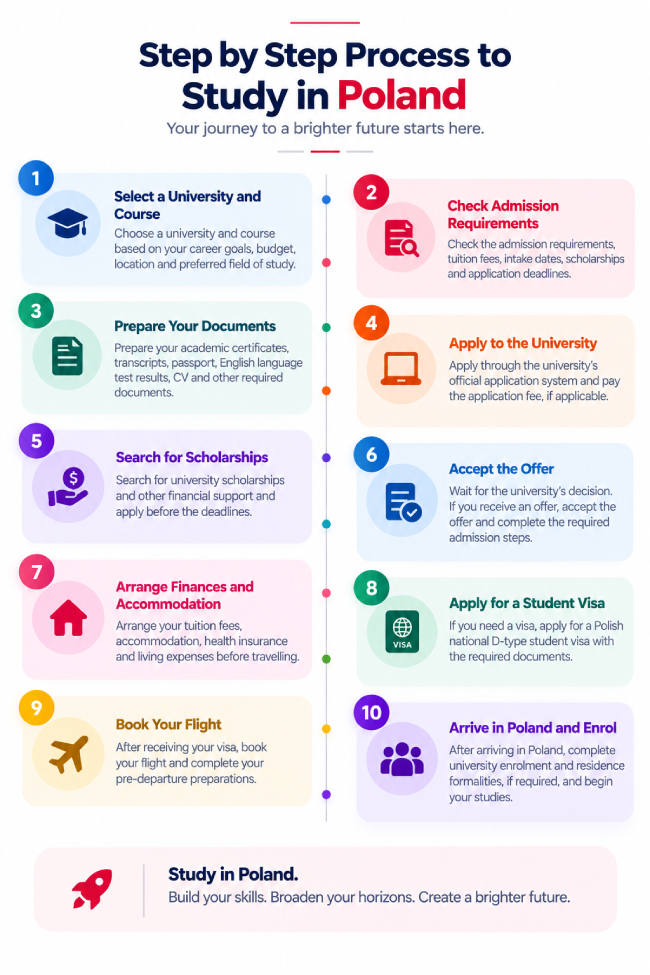
Step 1: Select a university and course based on your career goals, budget, location and preferred field of study.
Step 2: Check the admission requirements, tuition fees, intake dates, scholarships and application deadlines.
Step 3: Prepare your academic certificates, transcripts, passport, English language test results, CV and other required documents.
Step 4: Apply through the university's official application system and pay the application fee, if applicable.
Step 5: Search for university scholarships and other financial support and apply before the deadlines.
Step 6: Wait for the university's decision. If you receive an offer, accept the offer and complete the required admission steps.
Step 7: Arrange your tuition fees, accommodation, health insurance and living expenses before travelling.
Step 8: If you need a visa, apply for a Polish national D-type student visa with the required documents.
Step 9: After receiving your visa, book your flight and complete your pre-departure preparations.
Step 10: After arriving in Poland, complete university enrolment and residence formalities, if required, and begin your studies.
Poland Student Visa for Indians
Indian students planning to study in Poland generally need a student visa depending on the duration of their course. Students planning to stay in Poland for more than 90 days usually apply for a National D visa. Students must first receive admission from a recognized Polish university or educational institution and then submit their visa application with the required academic, financial, and personal documents.
Types of Poland Student Visa
Poland mainly has different visa options depending on the purpose and length of stay.
- Schengen C Visa: For short stays of up to 90 days within a 180-day period. This is generally not the usual route for students taking long-term degree programmes.
- National D Visa: For students planning to stay in Poland for more than 90 days for education. This is the main visa option for Indian students enrolled in longer study programmes.
For Indian Students
For Indian students planning to complete a full-time degree in Poland, the National D student visa is generally the relevant option. Students need an admission letter from a Polish university and must provide documents showing their academic background, financial resources, accommodation, health insurance, and purpose of study. After arriving in Poland, students planning to stay longer may also need to apply for a temporary residence permit according to the applicable immigration rules.
Poland Student Visa Requirements for Indians
- Admission to a recognized Polish university or educational institution.
- A National D visa for studies lasting more than 90 days.
- A valid passport with sufficient validity and available pages.
- A completed visa application form and required photographs.
- University admission or acceptance letter.
- Academic certificates and transcripts.
- Proof of language proficiency, where required by the university or visa authorities.
- Proof of sufficient financial resources to cover tuition fees, living costs, accommodation, and travel.
- Accommodation details or confirmation in Poland.
- Valid health insurance meeting the applicable requirements.
- Flight or travel arrangements, where required.
- CV and study plan or other supporting documents, where requested.
- Any additional documents requested by the Polish Embassy, Consulate, or visa authorities.
Documents Required for Poland Student Visa Application
- Valid passport
- Completed National D visa application form
- Passport-size photographs
- University admission or acceptance letter
- Academic certificates and transcripts
- Language proficiency certificate, if applicable
- Proof of financial resources
- Accommodation confirmation or details
- Health insurance documents
- Proof of tuition fee payment, where required
- Travel or flight details, where applicable
- CV or resume, if requested
- Study plan or statement of purpose, if requested
- Visa appointment confirmation
- Any additional documents requested by the Polish authorities
Steps to Apply for Poland Student Visa
Step 1: Apply to a recognized Polish university or educational institution and receive your admission letter.
Step 2: Check the latest visa requirements and book an appointment with the Polish Embassy, Consulate, or relevant visa application centre in India.
Step 3: Complete the required National D visa application form and prepare the supporting documents.
Step 4: Arrange proof of sufficient financial resources to cover your tuition fees and living expenses in Poland.
Step 5: Prepare your passport, admission letter, academic documents, financial proof, accommodation details, insurance, and other required documents.
Step 6: Attend your visa appointment and submit your application and biometric information, where required.
Step 7: The Polish authorities will review your application and may ask for additional documents or information.
Step 8: Wait for the visa decision. Processing time can vary depending on the application and workload.
Step 9: After visa approval, collect your passport with the Polish National D visa.
Step 10: Travel to Poland and complete university enrolment and residence permit formalities, where required.
Poland Student Visa Fee
Students applying for a Polish National D student visa need to pay the applicable visa fee.
- National D visa fee: The applicable fee is generally around €135, although the amount can change based on current Polish visa rules.
- The fee is normally paid according to the payment method and currency specified by the Polish authorities or visa application centre in India.
- Additional service charges may apply when using a visa application centre.
- Visa fees are generally non-refundable, including when an application is refused.
- Students should check the latest fee before booking their appointment because visa fees can change.
Poland Student Visa Processing Time
The processing time for a Poland student visa can vary depending on the application volume, completeness of documents, appointment availability, and individual circumstances.
- Students should apply well before their planned course start date.
- Long-stay student visa applications may require additional checks by the Polish authorities.
- Processing can take several weeks or longer, especially during busy admission periods.
- Missing or incorrect documents can result in delays or requests for additional information.
- Students should avoid making non-refundable travel arrangements until their visa has been approved.
Important: Polish visa requirements, fees, documents, and processing times can change. Indian students should check the latest information with the Polish Embassy/Consulate or official Polish visa authorities before submitting their application.
Poland Study Intakes: Fall & Spring
Poland mainly has two study intakes: Fall and Spring. The Fall intake, which usually starts in October, is the main intake and offers the widest range of courses and universities. The Spring intake usually begins in February and has fewer programmes available. Indian students should start preparing several months in advance because university applications, language tests, financial planning, accommodation, and the Polish student visa process can take time.
Fall Intake (Starts in October)
The Fall intake is the main and most popular intake for international students in Poland.
- University Application Deadline: Usually between February and July, depending on the university and course.
- English Language Tests: Complete IELTS, TOEFL, PTE, or another accepted test before the university application deadline.
- University Applications: Submit applications according to the university's deadline. Applying early can give you more time for admission and visa processing.
- Admission Decisions: The timing varies by university and programme. Students usually receive decisions after their applications and documents have been reviewed.
- Scholarships: Check scholarship deadlines early because some scholarships have separate deadlines from university applications.
- Financial Planning: Arrange tuition fees, proof of funds, accommodation, health insurance, and other expenses after receiving admission.
- Student Visa: Start the Poland National D visa process after receiving your admission documents and preparing the required paperwork.
- Travel to Poland: Plan your travel after receiving your visa and completing the required university and pre-departure formalities.
Spring Intake (Starts in February)
The Spring intake is available at fewer universities and for fewer programmes compared with the Fall intake.
- University Application Deadline: Usually between September and January, depending on the university and course.
- English Language Tests: Complete IELTS, TOEFL, PTE, or another accepted test before submitting your application.
- University Applications: Apply as early as possible because there may be fewer course options during the Spring intake.
- Admission Decisions: The decision period depends on the university and programme.
- Scholarships: Check scholarship availability and deadlines before applying.
- Financial Planning: Arrange tuition fees, proof of funds, accommodation, health insurance, and other expenses.
- Student Visa: Start the National D visa process after receiving your admission letter.
- Travel to Poland: Plan to travel in January or early February, depending on your university's orientation and course start date.
Month-by-Month Plan for Poland
- March–May: Research Polish universities, courses, tuition fees, scholarships, cities, and admission requirements.
- June–August: Shortlist universities and prepare for IELTS, TOEFL, PTE, or other required language tests.
- August–October: Prepare your SOP, CV, LORs, academic transcripts, passport, language test results, and other documents.
- October–January: Start submitting applications for the next Fall intake according to individual university deadlines.
- January–April: Continue submitting applications and wait for admission decisions.
- April–June: Accept your offer, arrange finances, accommodation, insurance, and prepare your student visa documents.
- May–August: Submit your Poland National D visa application, complete the required formalities, and prepare for travel.
- August–September: Travel to Poland, complete university enrolment and any required residence formalities, and prepare to begin your studies.
Part-Time Jobs in Poland for Indian Students
International students studying in Poland can work part-time while completing their studies, subject to their visa, residence status, and applicable employment rules. Students with a valid student visa or residence permit may have opportunities to work without needing a separate work permit in certain circumstances.
- International students can work while studying, subject to the conditions of their residence status.
- Students should make sure that employment does not interfere with their studies and university requirements.
- Students should follow the applicable working-hour, employment, tax, and labour regulations.
- Common student jobs include restaurants and cafés, retail, hospitality, customer service, administration, tutoring, delivery services, and university-related work.
- Jobs related to your field of study can provide useful work experience and help develop professional skills.
- Knowledge of Polish can improve access to part-time jobs, especially in customer-facing roles.
- English-speaking students can also find opportunities in international companies, IT, business services, hospitality, and other sectors.
- Part-time income can help with daily expenses, but students should not depend on part-time work as their main source of financial support.
- Students should check their employment conditions before starting a job and ensure that their work is legally permitted.
Important: Employment rules can depend on your visa, residence permit, type of study, and individual circumstances. Students should check the latest Polish immigration and employment rules before starting work.
Post-Study Work and Career Opportunities in Poland
Poland provides international graduates with opportunities to look for employment after completing their studies. Indian students who complete their studies in Poland can explore career opportunities in areas such as IT, engineering, business, finance, pharmaceuticals, manufacturing, science, logistics, and other professional fields.
Post-Study Work Options in Poland
- International graduates can explore employment opportunities after completing their studies in Poland.
- Graduates can look for jobs related to their education, qualifications, and professional skills.
- Students who complete full-time studies in Poland may have specific rights related to employment and work authorization, depending on their residence status.
- Finding a job does not automatically guarantee permanent residence in Poland.
- Graduates should ensure they have the correct residence and employment status when continuing to work after their studies.
- Poland has employment opportunities in sectors such as IT, engineering, manufacturing, finance, pharmaceuticals, healthcare, business, logistics, and technology.
- Knowledge of Polish or English can be useful depending on the employer and type of job.
- Graduates should begin their job search before completing their studies to give themselves more time to find suitable employment.
Path to Permanent Residency (PR) in Poland
Getting permanent residency in Poland after studying is not automatic. Completing a degree or finding a job does not directly provide permanent residence. Graduates need to meet the requirements for an appropriate residence status and satisfy the applicable residence, employment, and other conditions.
A possible route can involve:
- Complete your degree at a recognized Polish higher education institution.
- Find suitable employment in Poland after graduation.
- Obtain the appropriate residence and work authorization, where required.
- Continue living and working legally in Poland while meeting the applicable immigration conditions.
- Maintain the required residence history, income, accommodation, and other conditions.
- After meeting the required eligibility conditions and period of legal residence, you may be able to apply for permanent residence.
- The time required to qualify for permanent residence depends on factors such as your residence status, length of stay, employment situation, and individual circumstances.
Important: Studying in Poland does not automatically lead to permanent residency. The conditions depend on the type of residence permit and the individual's circumstaces.
How Y-Axis Can Help You?
Y-Axis can guide students who are planning to study in Poland. It can help with:
- University and course selection: Get guidance on choosing a suitable university and course based on your education, career goals, budget, and preferences.
- Coaching services: Prepare for IELTS, PTE, TOEFL, and other English language tests through coaching and practice.
- Counselling: Get guidance on university selection, admission requirements, tuition fees, scholarships, and the application process.
- Course Recommendation: Get support in finding courses that match your academic background and career plans.
- SOP and Resume: Get assistance with preparing your Statement of Purpose, CV, and other application documents.
- Visa guidance: Get support with preparing your Poland student visa application and required documents.
- Pre-departure guidance: Get information about accommodation, travel, documentation, and other preparations before travelling to Poland.
Looking for inspiration
Explore what Global Indians have to say about Y-Axis in shaping their future