

Study in Ireland

Don't know what to do?
Get Free Counseling
Last Updated: 07-08-2026
Study in Ireland: Student Visa Requirements, Universities, Fees & Scholarships
Ireland is one of the top study destination for Indian students, offering world-class education, internationally recognised qualifications, and strong career opportunities. The country is home to several globally ranked universities that provide programes in engineering, business, medicine, information technology, data science, healthcare, finance, law, and many other fields.
English is the main language of instruction in Irish universities, making it easier for international students to adapt. Ireland is also home to many leading global companies, giving students excellent internship and employment opportunities after graduation. Indian students planning to study in Ireland must meet the admission requirements of their chosen institution and apply for an Irish study visa through Immigration Service Delivery (ISD).
| Feature | Details |
|---|---|
| Capital | Dublin |
| Language | English |
| Currency | Euro (€) |
| Top Universities | Trinity College Dublin, University College Dublin, University of Galway, University College Cork, Dublin City University |
| QS Ranked Universities | 8+ |
| Intakes | September (Primary), January (Limited) |
| Tuition Fees | Approximately €6,000–€25,000 per year (varies by course and university) |
| Proof of Funds (2026) | €10,000 for courses lasting one year or more |
| Work While Studying | Up to 20 hours/week during term and 40 hours/week during holidays |
| Post-study Work | Stamp 1G (12 months or 24 months depending on qualification) |
*Need assistance to Study Abroad? Y-Axis is here to assist you in all the ways.
Why Study in Ireland?
Ireland has become one of Europe's fastest-growing destinations for international education because of its high academic standards, innovative learning environment, and strong job market.
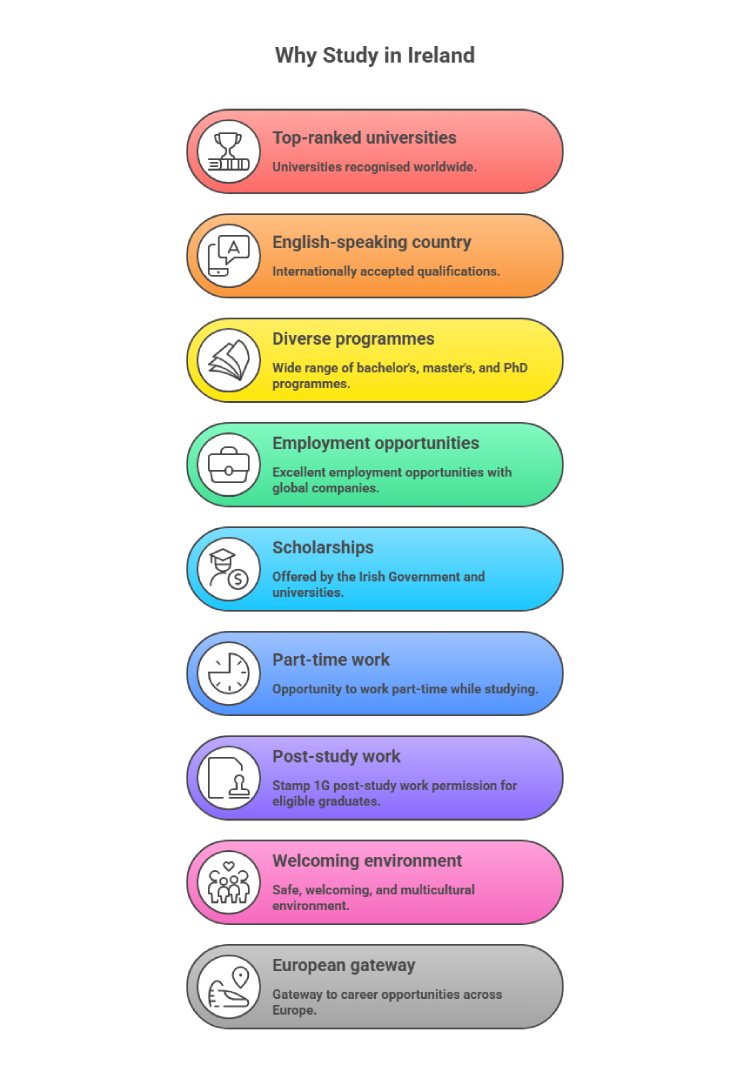
Some of the top reasons to study in Ireland include:
- Top-ranked universities recognised worldwide.
- English-speaking country with internationally accepted qualifications.
- Wide range of bachelor's, master's, and PhD programmes.
- Excellent employment opportunities with global companies.
- Scholarships offered by the Irish Government and universities.
- Opportunity to work part-time while studying.
- Stamp 1G post-study work permission for eligible graduates.
- Safe, welcoming, and multicultural environment.
- Gateway to career opportunities across Europe.
Top Universities to Study in Ireland
Ireland is home to some of the world's leading universities, known for their high-quality education, research, and industry-focused learning. International students can choose from universities offering courses in engineering, business, medicine, computer science, data analytics, law, and many other fields. Many Irish universities are ranked in the QS World University Rankings and provide scholarships for international students.
Top Universities in Ireland
| University | QS World University Ranking | City | Approx. First-Year Tuition Fee | Scholarships | Accepted Exams |
|---|---|---|---|---|---|
| Trinity College Dublin (TCD) | 87 | Dublin | €7,000–€64,000 | Global Excellence Scholarships, E3 Balanced Solutions Scholarship | IELTS, TOEFL, PTE, GMAT, Duolingo |
| University College Dublin (UCD) | 126 | Dublin | €12,000–€68,000 | V.V. Giri Global Excellence Scholarship, Programme-specific scholarships | IELTS, TOEFL, PTE, GMAT, GRE, SAT, Duolingo |
| University College Cork (UCC) | 273 | Cork | €10,000–€55,000 | Postgraduate Scholarships, PhD Scholarships | IELTS, TOEFL, PTE, Duolingo |
| University of Galway | 273 | Galway | €9,000–€58,000 | Government of Ireland Scholarship, University Scholarships | IELTS, TOEFL, PTE, Duolingo |
| Dublin City University (DCU) | 421 | Dublin | €9,000–€29,000 | Merit-based Scholarships | IELTS, TOEFL, PTE, Duolingo |
| University of Limerick | 421 | Limerick | €8,000–€31,000 | University Scholarships, Government Scholarships | IELTS, TOEFL, PTE, Duolingo |
| Maynooth University | 801–850 | Maynooth | €5,000–€21,000 | Maynooth Scholarships, Government of Ireland Postgraduate Scholarship | IELTS, TOEFL, PTE, Duolingo |
| Technological University Dublin | 851–900 | Dublin | €8,000–€20,000 | Merit and Fee Waiver Scholarships | IELTS, TOEFL, PTE, Duolingo |
Popular Courses to Study in Ireland
Ireland is a popular destination for students because of its excellent universities and strong job market. Many global companies have offices in Ireland, creating good career opportunities for graduates. Students can choose from a wide range of courses that are in high demand across different industries.
Popular Courses in Ireland
| Course | Annual Tuition Fee | Top Universities | Popular Career Options | Average Annual Salary |
|---|---|---|---|---|
| Business Analytics | €10,000–€25,000 | University College Dublin, National University of Ireland, University of Limerick | Business Analyst, Data Analyst, Financial Analyst, Statistician | €40,000–€52,000 |
| Data Analytics | €10,000–€25,000 | University College Dublin, Trinity College Dublin, University College Cork | Data Analyst, Data Scientist, Big Data Architect | €36,000+ |
| Software Engineering | €15,000–€30,000 | Dublin City University, National University of Ireland, University of Limerick | Software Developer, Computer Scientist, IT Security Specialist | €46,000–€65,000 |
| Computer Science | €8,000–€20,000 | National University of Ireland, Maynooth University, Technological University Dublin | Software Developer, Web Developer, IT Consultant, UX Designer | €37,095–€55,218 |
| Banking and Finance | €11,000–€26,000 | University College Dublin, Trinity College Dublin, University College Cork | Financial Analyst, Accountant, Financial Consultant, Finance Manager | €45,000–€65,000 |
| Medicine | €10,000–€35,000 | University College Dublin, Trinity College Dublin, Royal College of Surgeons in Ireland | Doctor, Physician, Medical Specialist, Radiologist | €51,000+ |
*Confused to choose which course to pursue? Avail Y-Axis course recommendation services to choose the best.
Intakes in Ireland
Most Irish universities offer two main intakes every year.
| Intake | Programmes | Application Period |
|---|---|---|
| September Intake | Undergraduate & Postgraduate | October – July |
| January Intake | Selected Programmes | June – November |
The September intake offers the largest number of programmes and scholarships.
Tuition Fees in Ireland
Tuition fees vary depending on the university, programme, and level of study.The average annual tuition fees for international students are:
| Study Level | Estimated Tuition Fees |
|---|---|
| Undergraduate | €10,000–€25,000 |
| Postgraduate | €10,000–€30,000 |
| MBA | €20,000–€40,000 |
| Medicine & Health Sciences | €30,000–€55,000 |
In addition to tuition fees, students should budget for accommodation, food, transport, health insurance, and other living expenses.
Many universities also offer:
- Merit scholarships
- Government-funded scholarships
- Tuition fee waivers
- Research scholarships
- International student grants
Ireland Student Visa for Indian Students
Indian students who plan to study in Ireland for more than 90 days must apply for a Long Stay 'D' Study Visa before travelling. After arriving in Ireland, students must also register with Immigration Service Delivery (ISD) and obtain an Irish Residence Permit (IRP) if they are staying for more than 90 days.
To apply for an Ireland student visa, you must have an admission letter from a recognised Irish institution, show €10,000 as proof of financial support for courses lasting one year or more, and meet the academic, financial, and English language requirements.
*Want to apply for Ireland Student Visa? Sign-up to Y-Axis for complete guidance
Why Apply for an Ireland Student Visa?
An Ireland student visa allows international students to study at recognised Irish universities while benefiting from excellent career opportunities and post-study work options.
Benefits include:
- Study at globally recognised universities.
- Earn internationally accepted qualifications.
- Work part-time while studying.
- Access to scholarships and research opportunities.
- Apply for the Stamp 1G post-study work permission after graduation (if eligible).
- Build a career with leading multinational companies based in Ireland.
Ireland Student Visa Requirements
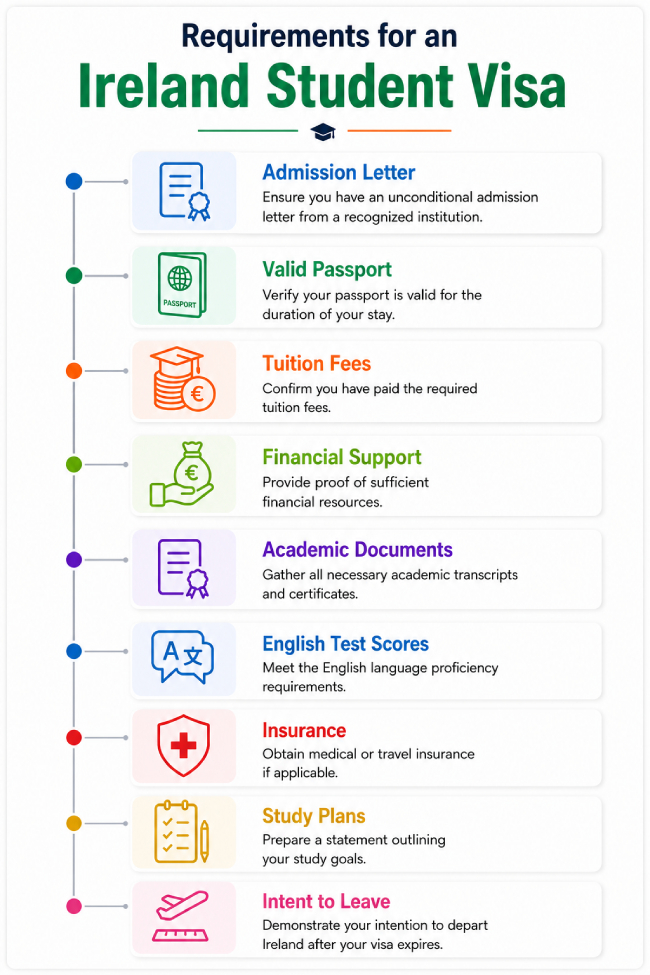
To apply for an Ireland student visa, you must meet the following requirements:
- Admission letter from a recognised Irish university or institution.
- Valid passport.
- Proof of payment of tuition fees (as required by the institution).
- Proof of sufficient financial support.
- Academic transcripts and certificates.
- English language test scores (if required).
- Medical or travel insurance (where applicable).
- Statement explaining your study plans.
- Evidence that you intend to leave Ireland after your permission expires.
English Language Requirements
Most Irish universities accept one or more of the following English language tests:
| Test | Typical Requirement* |
|---|---|
| IELTS Academic | 6.0–6.5 Overall |
| TOEFL iBT | University-specific |
| PTE Academic | University-specific |
| Duolingo English Test | Accepted by selected universities |
*Get expert coaching services from Y-Axis professionals to ace your scores.
Important Information for Students
Before submitting your visa application, make sure you:
- Have received an unconditional admission letter.
- Have paid the required tuition fees.
- Meet the financial requirements.
- Submit genuine supporting documents.
- Apply well before your course begins.
Providing incorrect or incomplete information may delay your application or result in a visa refusal.
Documents Required for an Ireland Student Visa
Prepare the following documents before submitting your application:
- Valid passport.
- Completed visa application.
- Letter of acceptance from an eligible Irish institution.
- Proof of tuition fee payment.
- Proof of financial support.
- Academic certificates and transcripts.
- English language proficiency test results (IELTS, TOEFL, PTE, or other accepted tests).
- Passport-size photographs.
- Medical or travel insurance details (if applicable).
- Any additional documents requested by ISD.
Financial Proof Requirement
International students must show that they have enough money to support themselves during their studies. Students enrolled in a course lasting one year or longer must show €10,000 as proof of available funds to cover living expenses.
The financial documents should:
- Be in the student's own name or supported by an eligible sponsor.
- Clearly show the available balance.
- Be recent and verifiable.
- Match the information provided in the visa application.
Important: Previous references to different financial requirements based on location such as Dublin versus outside Dublin should not be used. Students should follow the current financial requirement published by Immigration Service Delivery (ISD).
Ireland Student Visa Fees
The visa fee depends on the type of entry you require.
| Visa Type | Fee |
|---|---|
| Single Entry Long Stay (D) Visa | €60 |
| Multiple Entry Long Stay (D) Visa | €100 |
| Transit Visa | €25 |
Additional service charges may apply depending on the Visa Application Centre.
Ireland Student Visa Processing Time
Most Ireland student visa applications are processed within 4 to 8 weeks.
Processing times may vary depending on:
- Application volume.
- Nationality.
- Completeness of documents.
- Additional verification required.
Students are advised to apply at least three months before their intended travel date.
Irish Residence Permit (IRP)
International students who plan to stay in Ireland for more than 90 days must register with the Irish immigration authorities after they arrive and obtain an Irish Residence Permit (IRP). The IRP registration fee is €300. The IRP card is proof that you are legally allowed to live in Ireland and should be kept with you during your stay. You will usually complete your registration at your local immigration office after arriving in Ireland.
Dependants Policy
International students should be aware that not all study programmes allow family members to accompany them.
In general:
- Students enrolled in Level 9 postgraduate programmes (Master's and PhD) may be eligible to bring qualifying dependants, subject to Immigration Service Delivery (ISD) rules.
- Students enrolled in undergraduate or most taught programmes are generally not eligible to bring dependants.
Students should always check the latest ISD guidance before making travel arrangements for family members.
Cost of Living in Ireland
The cost of living in Ireland depends on your city, lifestyle, and type of accommodation. Apart from tuition fees, students should budget for accommodation, food, transport, utilities, study materials, and personal expenses. On average, international students should expect to spend between €10,000 and €15,000 per year on living expenses.
Estimated Monthly Living Costs
| Expense | Estimated Monthly Cost |
|---|---|
| Accommodation | €800–€1,500 |
| Food and Groceries | €250–€350 |
| Utilities | €50–€100 |
| Transport | €80–€120 |
| Mobile & Internet | €20–€40 |
| Study Materials | €50–€100 |
| Personal Expenses | €200–€300 |
City-wise Living Costs in Ireland
| City | Estimated Monthly Living Cost |
|---|---|
| Dublin | €1,500–€2,200 |
| Cork | €1,200–€1,800 |
| Galway | €1,200–€1,700 |
| Limerick | €1,100–€1,600 |
| Maynooth | €1,100–€1,600 |
Part-time Jobs in Ireland
International students studying full-time in Ireland can work part-time if they meet the eligibility requirements. Students holding Stamp 2 permission and enrolled in an eligible full-time programme listed on the Interim List of Eligible Programmes (ILEP) can:
- Work up to 20 hours per week during the academic term.
- Work up to 40 hours per week during official holiday periods.
Students with Stamp 2A permission are not permitted to work.
Work Permission
| Immigration Permission | Work Rights |
|---|---|
| Stamp 2 | Up to 20 hours/week during term and 40 hours/week during holidays |
| Stamp 2A | No work rights |
Eligibility for Part-Time Work
To work while studying in Ireland, students must:
- Hold a valid Stamp 2 permission.
- Be enrolled in a full-time course listed on the ILEP.
- Study a programme leading to a recognised qualification.
- Have a valid Personal Public Service (PPS) Number.
- Hold an Irish bank account for salary payments.
Stamp 1G Post-Study Work Permission
After completing an eligible qualification in Ireland, international students may apply for Stamp 1G under the Third Level Graduate Programme. Stamp 1G allows graduates to remain in Ireland and look for employment or apply for a work permit.
Duration of Stamp 1G
| Qualification | Stamp 1G Duration |
|---|---|
| Ordinary Bachelor's Degree (Level 8) | Up to 12 months |
| Honours Bachelor's Degree (Level 8) | Up to 12 months |
| Master's Degree (Level 9) | Up to 24 months |
| Doctoral Degree (Level 10) | Up to 24 months |
During this period, graduates can work full-time and may later qualify for an employment permit if they meet the eligibility requirements.
Ireland PR After Study
Many international graduates choose to continue their careers in Ireland after completing their studies. Students who secure eligible employment and meet the residency requirements may later become eligible to apply for Long-Term Residence or Permanent Residence, subject to Irish immigration rules.
General Eligibility
Applicants generally need to:
- Hold a valid employment permission.
- Meet the required period of lawful residence.
- Maintain continuous legal residence.
- Demonstrate good character.
- Meet all Immigration Service Delivery (ISD) requirements.
Permanent residence is assessed individually and is not granted automatically after graduation.
Common Reasons for Ireland Student Visa Refusal
To improve your chances of approval, avoid the following common mistakes:
- Incomplete application.
- Insufficient financial evidence.
- Missing or incorrect documents.
- Unclear study plans.
- Poor Statement of Purpose (SOP).
- Inconsistent information across documents.
- Failure to demonstrate genuine student intent.
- Unsatisfactory academic progression.
- Incorrect or unverifiable financial documents.
Always ensure that your application is complete and that all supporting documents are genuine and up to date.
Ireland vs Germany vs Netherlands – Study Comparison
| Feature | Ireland | Germany | Netherlands |
|---|---|---|---|
| Language of Instruction | English | English & German | English |
| Average Tuition Fees | €6,000–€25,000 | Low or No Tuition at Public Universities | €8,000–€20,000 |
| Post-study Work | Stamp 1G (12 or 24 months) | 18 months | Up to 12 months (Orientation Year) |
| Part-time Work | 20 hrs/week | 20 hrs/week | 16 hrs/week or full-time in summer |
| Major Industries | Technology, Pharma, Finance | Engineering, Automotive, Manufacturing | Technology, Logistics, Business |
| Popular Among Indian Students | High | High | High |
Scholarships to Study in Ireland
Ireland offers a wide range of scholarships to help international students reduce the cost of studying. Scholarships are provided by the Irish Government, universities, research councils, and private organisations. They may cover tuition fees, living expenses, or both, depending on the scholarship and eligibility criteria. International students are encouraged to apply early, as most scholarships have limited seats and separate application deadlines.
*Want to know more about scholarships to study abroad? Ley Y-Axis helps you in all ways!
Government Scholarships in Ireland
The Irish Government offers several scholarships for outstanding international students pursuing undergraduate, postgraduate, and research programmes.
| Scholarship | Benefits |
|---|---|
| Government of Ireland International Education Scholarship (GOI-IES) | Full tuition fee waiver and €10,000 stipend for one academic year |
| Irish Research Council Scholarships | Funding for eligible postgraduate research programmes |
| Erasmus+ Programme | Financial support for eligible exchange and mobility programmes |
| Higher Education Authority (HEA) Scholarships | Tuition fee and living expense support (where applicable) |
University Scholarships in Ireland
Many Irish universities offer merit-based and programme-specific scholarships for international students.
| University | Scholarship |
|---|---|
| Trinity College Dublin | Global Excellence Scholarships |
| University College Dublin | Global Excellence Scholarship |
| University College Cork | International Student Scholarships |
| University of Galway | International Excellence Scholarships |
| Dublin City University | International Merit Scholarships |
| University of Limerick | International Scholarships |
| Maynooth University | International Scholarships |
| Technological University Dublin | Merit-based Scholarships |
Scholarship values vary by university and may include partial tuition fee waivers, full tuition fee waivers, or living expense support.
Eligibility for Scholarships in Ireland
Scholarship requirements differ by institution, but applicants generally need to:
- Have an excellent academic record.
- Meet the university's admission requirements.
- Hold an offer letter from an eligible Irish institution.
- Demonstrate English language proficiency.
- Submit a strong Statement of Purpose (SOP).
- Provide letters of recommendation.
Some scholarships may also consider leadership qualities, extracurricular achievements, research experience, or community involvement.
How to Apply for Scholarships in Ireland
Follow these steps to apply for scholarships in Ireland:
Step 1: Research scholarships offered by the Irish Government and your chosen university.
Step 2: Check the eligibility criteria and application deadlines.
Step 3: Prepare the required documents, including academic transcripts, SOP, recommendation letters, and English language test scores.
Step 4: Submit your scholarship application before the deadline.
Step 5: Track your application and respond promptly if additional information is requested.
How Y-Axis can Assist You?
Y-Axis can assist by giving more vital support to aspirants who wish to study in Ireland. The support process includes,
- Free Counseling: Free Counseling on university and course selection.
- Campus Ready Program: Fly to Ireland with the best and ideal course.
- Course Recommendation: Y-Path gives the best suitable ideas about your study and career options.
- Coaching: Y-Axis offers IELTS live classes to help students clear with high scores.
- Ireland Student Visa: Our expert team helps you to get an Ireland student Visa.
Looking for inspiration
Explore what Global Indians have to say about Y-Axis in shaping their future