


Migrate to Austria
Sign up for a free expert consultation

Don't know what to do?
Get Free Counseling
Last Updated 12 August 2026
Austria Immigration from India— Red-White-Red Card, EU Blue Card, Shortage Occupations, Points System, PR and Complete Guide
If you intend to stay in Austria for more than six months and are not an EEA citizen or a Swiss national, then you will need to get a residence permit. Austria offers different types of resident permits. However, if your period of stay is less than six months, you do not require a residence permit, but you will need a visa.
The application for a residence permit should be made in person and in your home country before you enter Austria. Residence permits are issued for either employment, study or research. You need to have a fixed and regular source of income to meet your living costs. The best cities to live in Austria include Vienna, Innsbruck and Salzburg.
Austria Immigration Updates 2026:
- Red-White-Red Card (Other Key Workers): EUR 3,465/month — up from EUR 3,225
- EU Blue Card: EUR 55,678/year
- Shortage occupations: 64 nationwide + 66 regional, including IT, engineering, nursing, AI and cybersecurity analysts
- Per-pay-period compliance: each monthly payslip must independently meet the salary threshold — year-end bonuses can no longer be used to average up
Jump to: RWR Card | EU Blue Card | Austria PR | 2026 Updates | Why Austria
Why Migrate to Austria?
- Vienna has been ranked among the world's most liveable cities for multiple consecutive years (EIU).
- Austria's population is approximately 9.1 million (2025), with a GDP per capita among the highest in the EU.
- Salaries are paid across 14 instalments a year (12 monthly payments plus a June holiday bonus and a December Christmas bonus) — meaning total annual income is higher than a 12-payment structure suggests.
- Average gross salary ranges EUR 40,000–45,000/year, with tech and engineering roles at EUR 55,000–80,000+.
- Benefits include universal healthcare, a minimum of 5 weeks' paid annual leave, and Schengen-area access to 26 European countries.
- English is widely used in Vienna's international business community.
Residence permits to migrate to Austria from India
Austria's shortage occupation route — with no salary floor — makes Austria uniquely accessible for a wide range of Indian professionals, including nurses, IT developers, and engineers who might not clear the EUR 3,465/month or EU Blue Card thresholds. Direct flights connect Mumbai and Delhi to Vienna via Austrian Airlines, Lufthansa, Emirates, and Etihad (typically 7–9 hours). The India-Austria Double Taxation Avoidance Agreement (DTAA) offers relief on specific income categories — consult a tax specialist before accepting Austrian employment. RWR Card holders must complete an Integration Course (Integrationskurs) within 24 months of arrival, subsidised by the Austrian Integration Fund (OIF).
Given below is a list of residence permits to migrate to Austria
- Aufenthaltsbewilligung or temporary residence permit (for temporary stay in Austria)
- Betriebsentsandter for employees sent on temporary duty
- Rotationsarbeitskraft for company representatives/managers/executives
- Selbsttändiger for self-employed individuals
- Forscher for researchers in Austrian educational institutions
- Künstler for self-employed artists
- Sonderfälle unselbständiger Erwerbstätigkeit for journalists, guest lecturers
- Student for individuals attending college/university in Austria
- Schüler for students attending school (grade 1-12) in Austria
- Niederlassungsbewilligung – a settlement permit for financially independent non-EU nationals who plan to permanently settle in Austria without taking up employment or study (proof of sufficient independent financial resources required).
The Red-White-Red Card (RWR Card) is Austria's primary combined residence and work permit for skilled non-EU nationals, including Indians — a points-based system with four categories, valid for 24 months and tied to a specific employer
1. Very Highly Qualified Workers — minimum 70 out of 100 points; no salary floor (collective agreement rate applies); includes a Job Seeker Visa option (6 months to find employment in Austria).
2. Skilled Workers in Shortage Occupations — minimum 55 out of 90 points; no salary floor; no labour market test required. Austria's 2026 Skilled Workers Ordinance lists 64 nationwide and 66 regional shortage occupations, including IT, engineering, nursing, AI and cybersecurity analysts, locomotive drivers, high-voltage technicians, and inclusive early-childhood educators.
3. Other Key Workers — minimum 55 out of 90 points; minimum salary EUR 3,465 gross per month (2026, up from EUR 3,225 in 2025 — a 7.4% increase); a labour market test (AMS check) applies.
4. Graduates of Austrian Universities — requires a qualifying academic job offer; salary in line with the applicable collective agreement.
After approximately 21 months of qualifying employment, RWR Card holders can apply for the RWR Card Plus, which removes the employer tie and grants full, unrestricted access to the Austrian labour market.
RWR Card Points System
Points are awarded across four criteria:
- Qualifications — up to 30 points (university degree scores highest; STEM/MINT fields score more)
- Professional experience — up to 18 points (more years of relevant experience = more points, capped)
- Language skills — up to 15 points combined German and English (German weighted more heavily; a German B1 certificate earns significantly more than English alone)
- Age — up to 20 points (younger applicants score higher)
EU Blue Card Austria
The Austria EU Blue Card requires a minimum salary of EUR 55,678 gross per year (2026, across 14 payments — approximately EUR 3,977–4,000/month) and a university degree — or, for IT professionals, 3+ years of relevant professional experience acquired within the last 7 years can substitute for the degree requirement. A labour market test (AMS check) applies.
Its key advantage over the RWR Card: after 12 months of qualifying EU Blue Card employment in Austria, holders can apply for an EU Blue Card in another EU member state with simplified procedures — stronger EU-wide mobility than the RWR Card offers.
RWR Card vs EU Blue Card at a glance:
| Criteria | RWR Card | EU Blue Card |
|---|---|---|
| Salary Threshold | EUR 3,465/month (Other Key Workers); no minimum salary for shortage occupations | EUR 55,678/year |
| Qualification | Points-based (70/100 or 55/90) | Degree, or 3-year IT experience exception |
| Labour Market Test | Required for Other Key Workers only | Required |
| EU Mobility | Limited | Stronger – simplified EU Blue Card transfer after 12 months |
| Validity | 24 months, employer-tied | 24 months, employer-tied |
Eligibility for Daueraufenthalt-EU (Permanent EU Residence)
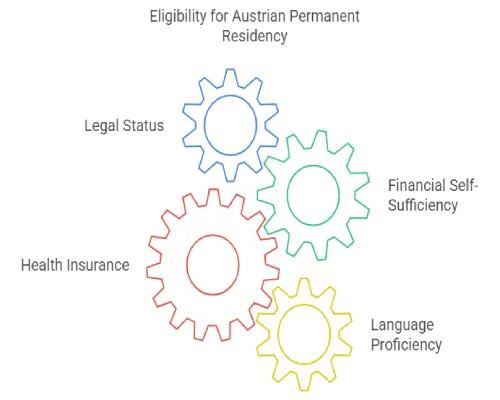
To apply for permanent residency in Austria, you must meet the following requirements:
- For the past five years, you must have had legal status in Austria.
- You must be financially self-sufficient, whether through employment or self-employment (approximately EUR 1,273.99/month net for a single adult, EUR 2,009.85 for a couple, plus EUR 196.57 per child — BS to verify current 2026 figures).
- You must be insured by health insurance for those five years.
- Module 2 of the Integration Agreement must be fulfilled (B1 level German).
Applications can be submitted at any time — you do not need to wait for your current permit to expire, but must apply before it does. Processing typically takes about one month for complete applications.
Austrian citizenship is possible after 10 years of continuous legal residence (or 6 years in exceptional integration cases), and generally requires C1-level German. Note: India does not permit dual citizenship under the Indian Citizenship Act, 1955 — Austrian naturalisation generally requires renouncing Indian citizenship. Consult a specialist before beginning this process.
Application process
- You must submit only complete applications
- They must be submitted in person
- If the applicant is a minor, then the application should be signed by both the parents
- Processing time will require at least one month because all applications must the sent to Austria
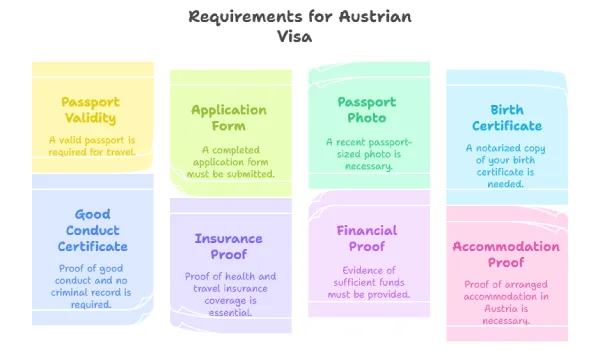
Documents required
- Valid passport with at least three months validity from the date of return
- Completed application form with receipt for payment of consular fees
- Recent passport size photo
- Notarized copy of your birth certificate
- Certificate proving good conduct and absence of any criminal record
- Proof of health, travel and accident insurance coverage
- Proof of having enough funds
- Proof of having arranged accommodation in Austria
Austria vs Germany vs Denmark: Best Place to Migrate Abroad
| Criteria | Austria | Germany | Denmark |
|---|---|---|---|
| Primary Work Visa Route | Red-White-Red (RWR) Card / EU Blue Card | EU Blue Card | Pay Limit Scheme / Certified Employer Scheme |
| Salary Threshold | EUR 3,465/month for Other Key Workers; no salary floor for shortage occupations | EUR 50,700/year (2026) | DKK 552,000/year (Pay Limit); DKK 300,000/year under the Certified Employer Scheme |
| Eligibility Criteria | 55/90 points or 70/100 points under the RWR Card system | Salary threshold and EU Blue Card requirements | Salary threshold and employer sponsorship requirements |
| EU Blue Card Availability | Yes | Yes | No |
| Special Provision | Three years of IT experience can replace a degree for the EU Blue Card | PR possible in 21 months with B1 German | Certified Employer Scheme specifically includes Indian applicants |
| Path to Permanent Residency | Not specified | 21 months with B1 German | 8 years (or 4 years under certain conditions) |
| Path to Citizenship | Not specified | 5 years | Not specified |
| Lifestyle Advantage | Vienna is among the world's most liveable cities | Strong economy and large Indian community | High wages and strong work-life balance |
| Key Differentiator | No salary floor for shortage occupations and a degree-free IT pathway under the EU Blue Card | Fast-track PR and citizenship options | India-specific Certified Employer Scheme despite the absence of the EU Blue Card |
How can Y-Axis help you?
- Advise you on the documentation that will be required for the visa
- Advise you on how the funds needed for the visa need to be shown
- Complete the application process
- Review your documents needed for the visa application
- Help you prepare for a visa interview in case one is required
Y-Axis snapshot
1M
Successful applicants
1500+
Experienced counselors
25Y+
Expertise
50+
Offices