


Don't know what to do ?
Get Free Counseling
Last Update: 29 October 2026
Study in Singapore: Top Universities, Fees, Scholarships and Visa
Singapore is a popular study destination for international students interested in technology, engineering, business, finance, science and research. The country offers undergraduate, postgraduate and doctoral programmes through public and private institutions. Indian students can choose from programmes taught primarily in English across a wide range of academic disciplines. Popular study areas include computer science, artificial intelligence, engineering, business administration, biotechnology, finance and data science. International students accepted into eligible full-time courses generally need a Student’s Pass issued by Singapore’s Immigration & Checkpoints Authority (ICA). Eligible students may work part-time during term time or full-time during scheduled vacations, subject to applicable eligibility requirements and work restrictions. After graduation, students may explore options to remain in Singapore to seek employment, subject to the relevant immigration and work-pass requirements.
*Need assistance to study abroad? Contact Y-Axis for guidance with your study plans.
Why Study in Singapore?
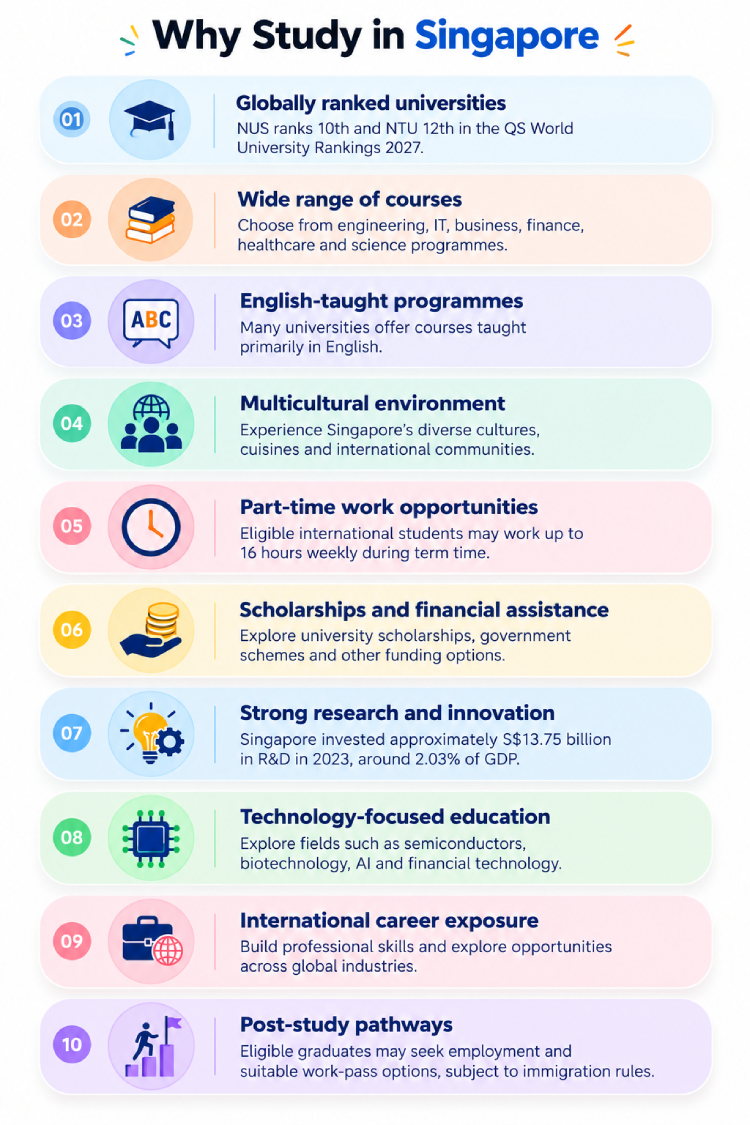
- Globally ranked universities: NUS ranks 10th and NTU 12th in the QS World University Rankings 2027.
- Wide range of courses: Choose from engineering, IT, business, finance, healthcare and science programmes.
- English-taught programmes: Many universities offer courses taught primarily in English.
- Multicultural environment: Experience Singapore’s diverse cultures, cuisines and international communities.
- Part-time work opportunities: Eligible international students may work up to 16 hours weekly during term time.
- Scholarships and financial assistance: Explore university scholarships, government schemes and other funding options.
- Strong research and innovation: Singapore invested approximately S$13.75 billion in R&D in 2023, around 2.03% of GDP.
- Technology-focused education: Explore fields such as semiconductors, biotechnology, AI and financial technology.
- International career exposure: Build professional skills and explore opportunities across global industries.
- Post-study pathways: Eligible graduates may seek employment and suitable work-pass options, subject to immigration rules.
Singapore offers quality education, global industry exposure and international experience. Research admission requirements, tuition fees, scholarships and Student’s Pass rules before applying, and build career skills through networking, internships and industry projects.
Top Universities in Singapore for Indian Students
Singapore has well-known universities that offer courses in technology, business, engineering, science and research. Students can choose a university based on their course, budget, academic results and career goals.
| University / Institution | Popular Study Areas |
|---|---|
| National University of Singapore (NUS) | Computer Science, Engineering, Business, Medicine and Science |
| Nanyang Technological University (NTU) | Engineering, AI, Data Science, Business and Technology |
| Singapore Management University (SMU) | Business, Finance, Economics, Law and Information Systems |
| Singapore University of Technology and Design (SUTD) | Design, Engineering, Architecture and Technology |
| Singapore Institute of Technology (SIT) | Engineering, Computing, Healthcare and Hospitality |
| Singapore University of Social Sciences (SUSS) | Business, Finance, Social Sciences and Human Development |
| INSEAD Singapore | Business, MBA and Management |
| ESSEC Business School Singapore | Business, Marketing, Finance and Management |
| James Cook University Singapore | Business, IT, Psychology and Environmental Science |
| Singapore Institute of Management (SIM) | Business, Computing, Finance and Social Sciences |
Popular Courses to Study in Singapore
Singapore offers bachelor's, master's and doctoral programmes in many subjects. Course length depends on the university and qualification.
| Programme | Typical Duration | Popular Specialisations |
|---|---|---|
| Computer Science and IT | 3–4 years for a bachelor's; 1–2 years for a master's | Software Development, AI, Data Science and Cybersecurity |
| Business and Management | 3–4 years for a bachelor's; 1–2 years for a master's | Management, Marketing, Finance and International Business |
| Engineering | 3–4 years for a bachelor's; 1–2 years for a master's | Mechanical, Electrical, Civil and Robotics Engineering |
| Finance and Accounting | 3–4 years for a bachelor's; 1–2 years for a master's | Banking, Accounting, Investment and Financial Management |
| Healthcare and Health Sciences | Usually 3–4 years or longer | Public Health, Biomedical Science and Nursing |
| Data Science | 3–4 years for a bachelor's; 1–2 years for a master's | Data Analytics, Machine Learning and AI |
| Natural Sciences | 3–4 years for a bachelor's; 1–2 years for a master's | Biology, Chemistry, Physics and Biotechnology |
| Hospitality and Tourism | Usually 3–4 years for a bachelor's | Hotel Management, Tourism and Event Management |
| Architecture and Design | Usually 3–4 years or longer | Architecture, Industrial Design and Urban Planning |
| Logistics and Supply Chain Management | 3–4 years for a bachelor's; 1–2 years for a master's | Logistics, Supply Chain and Operations Management |
Cost of Studying in Singapore
The cost of studying in Singapore depends on the university, course and living arrangements. Students should plan for tuition fees, accommodation, food, transport, insurance, books and personal expenses.
Tuition Fees in Singapore
The following are estimated yearly tuition fees for some types of programmes. Actual fees depend on the university and course.
| University or Programme Type | Estimated Annual Tuition Fee |
|---|---|
| Public university bachelor's programmes with an eligible tuition grant | S$18,000–S$22,000 for many courses |
| Public university bachelor's programmes without a tuition grant | S$36,000–S$46,000 for many courses |
| Business and specialised programmes | Depends on the university and course |
| Master's programmes | Depends on the university and course |
| Medicine and other specialised programmes | May cost considerably more |
Some international students who receive a government tuition grant must agree to work for a Singapore-registered company for three years after graduation. Students should check the conditions before accepting the grant.
Other Study Expenses in Singapore
Living costs depend on the city area, accommodation and lifestyle.
| Expense | Estimated Monthly Cost | Details |
|---|---|---|
| Accommodation | S$500–S$1,500+ | University housing, shared rooms or private rentals |
| Food and groceries | S$250–S$500 | Depends on eating habits and food choices |
| Public transport | S$80–S$200 | Depends on how often you travel |
| Utilities and mobile service | S$45–S$100 | Electricity, internet and phone expenses |
| Personal expenses | S$100–S$300+ | Books, healthcare, leisure and other needs |
Estimated monthly living budget: S$1,000–S$2,800. Students may need more money depending on their accommodation and lifestyle. Check housing costs before travelling.
Scholarships to Study in Singapore
Indian students may be able to get scholarships or financial support to reduce their study costs. Eligibility depends on academic results, the course, the university and the scholarship rules.
| Scholarship or Funding Option | Estimated Amount |
|---|---|
| NUS Scholarships | May cover full tuition fees. Some scholarships also provide around S$6,000 per year for living costs. |
| NTU Scholarships | May cover part or all tuition fees. Some scholarships also provide around S$5,000–S$6,500 per year for living costs. |
| SMU Scholarships | May cover part or all tuition fees, depending on the scholarship. |
| SUTD Scholarships | May cover part or all tuition fees. Some awards may also help with other costs. |
| Singapore International Graduate Award (SINGA) | Covers tuition fees and provides a monthly allowance of around S$2,700–S$3,200 for eligible PhD students. |
| MOE Tuition Grant | Helps reduce tuition fees. The amount depends on the course and student eligibility. Some grants have conditions, such as a work requirement after graduation. |
| University Research Funding | May cover tuition fees and provide a monthly allowance for students doing research. The amount depends on the university and programme. |
Eligibility Requirements to Study in Singapore
Indian students must meet the university's academic and language requirements before applying.
- Complete the required education for your chosen course.
- For a bachelor's degree, usually complete 12 years of schooling or an accepted equivalent.
- For a master's degree, have a relevant bachelor's degree.
- For a doctoral degree, usually have a relevant master's degree.
- Meet the university's minimum marks or grade requirements.
- Meet the English-language requirements if needed.
- Submit IELTS, TOEFL or other accepted test scores if required.
- Take entrance exams or attend interviews if required.
- Submit academic certificates, mark sheets and other required documents.
- Provide a CV, statement of purpose or recommendation letters if requested.
- Have a valid passport.
- Show that you can pay your tuition fees and living expenses if required.
- Get an admission offer from a recognised Singapore institution.
- Meet the requirements for a Singapore Student's Pass.
- Submit bank statements or sponsor documents if required.
- Meet any other requirements set by the university or course.
Requirements vary by university and course. Check the rules before applying.
Step-by-Step Process to Study in Singapore
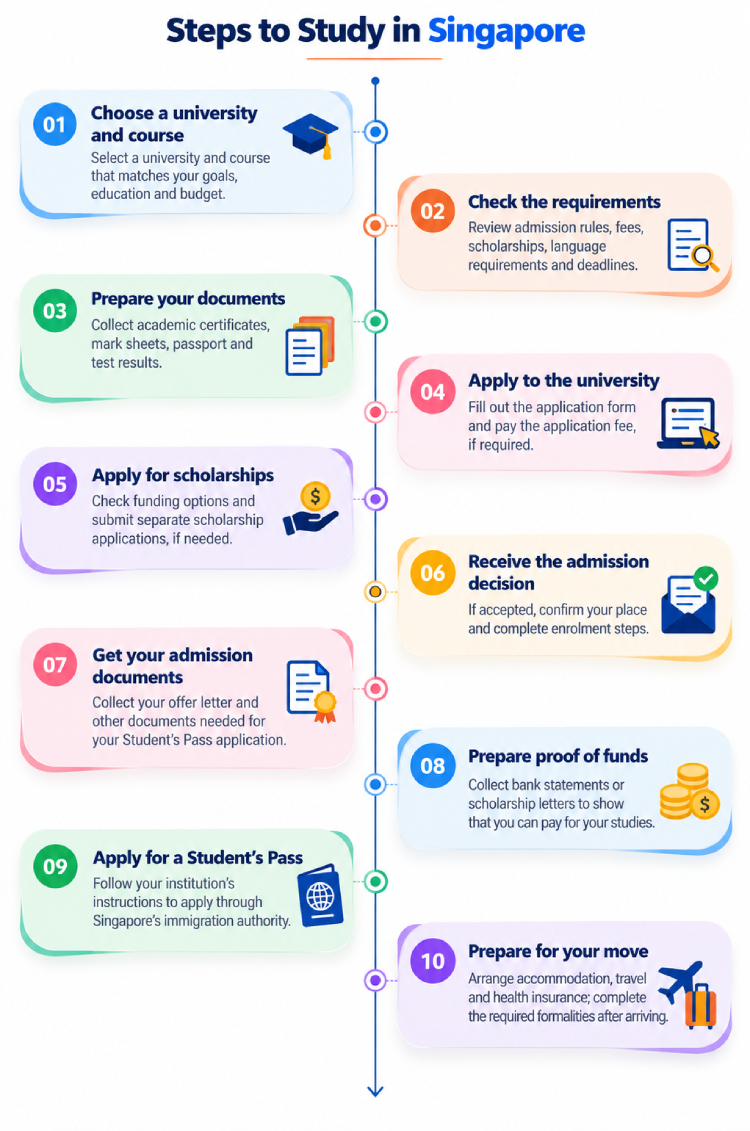
Step 1: Choose a university and course. Select a course that matches your career goals, education and budget.
Step 2: Check the requirements. Review admission rules, fees, scholarships, language requirements and deadlines.
Step 3: Prepare your documents. Collect your academic certificates, mark sheets, passport and test results.
Step 4: Apply to the university. Fill out the application form and pay the application fee, if required.
Step 5: Apply for scholarships. Check university scholarships and other funding options. Submit separate applications if needed.
Step 6: Receive your admission decision. If you are accepted, confirm your place and complete the university's enrolment steps.
Step 7: Get your admission documents. Collect your offer letter and other documents needed for your Student's Pass application.
Step 8: Prepare proof of funds. Collect bank statements, sponsor documents, scholarship letters or education loan papers if required.
Step 9: Apply for a Student's Pass. Follow your university's instructions to apply through Singapore's immigration authority. Apply within the required time before your course starts.
Step 10: Prepare for your move. Once your application is approved, arrange accommodation, travel and health insurance. Follow the instructions to complete the required formalities after arriving in Singapore.
Singapore Student Visa for Indians
Indian students who want to study in Singapore usually need a Student's Pass for full-time study. Students generally need an offer from an approved educational institution before applying. Singapore's Student's Pass is different from South Korea's D-2 and D-4 visas. The type of application and requirements depend on the institution and course. Students should follow their institution's instructions and check Singapore's immigration requirements before applying.
Types of Student Pass and Study Options in Singapore
Singapore mainly uses the Student's Pass system for eligible international students studying full-time.
- Student's Pass for University Courses: For eligible full-time bachelor's, master's and doctoral programmes at approved institutions.
- Student's Pass for Private Education: For eligible full-time courses at approved private educational institutions.
- Student's Pass for Polytechnic Courses: For eligible full-time diploma programmes at Singapore's polytechnics.
- Student's Pass for Other Approved Courses: For eligible full-time courses at other approved educational institutions.
- Short-Term Study: Some short courses lasting up to 30 days may be allowed under a short-term visit arrangement, depending on the course and the student's circumstances. Other courses may require a Student's Pass.
The Student's Pass is generally intended for eligible full-time study. Students should confirm with their institution whether their course qualifies and which application process applies.
Singapore Student's Pass Requirements for Indians
Indian students may need to provide the following documents when applying for a Student's Pass:
- A valid passport.
- A completed Student's Pass application form.
- A recent passport-size photograph.
- An admission or registration letter from the educational institution.
- Academic certificates and mark sheets.
- Details of previous education and employment, if applicable.
- Personal information and contact details.
- A residential address in Singapore, if available.
- Bank statements or proof of financial support, if required.
- Financial sponsor documents, if parents or another person will pay for the studies.
- Scholarship documents, if applicable.
- Education loan documents, if applicable.
- Birth certificate, if required.
- Medical examination report, if required.
- Any additional documents requested by the institution or Singapore's Immigration and Checkpoints Authority (ICA).
Important: Not every student needs to submit every document listed above. Requirements depend on the educational institution and the student's circumstances. Check the latest document checklist before applying.
Proof of Funds to Study in Singapore
Indian students may need to show that they can pay their tuition fees and living expenses while studying in Singapore. The documents required depend on the institution and the student's circumstances.
- Living expenses: Prepare a budget for accommodation, food, transport and personal expenses.
- Tuition fees: Make sure you can pay the course fees and other university charges.
- Bank statements: You may need to provide bank statements or other proof of savings.
- Income documents: Your parents or financial sponsor may need to provide proof of income.
- Education loan: Loan approval documents may help show how you will fund your studies.
- Scholarships: A scholarship letter can show that some or all of your expenses are covered.
- Financial sponsor: If someone else is paying for your studies, you may need to provide their financial documents.
- Source of funds: Additional documents may be requested to explain where the money comes from.
There is no single proof-of-funds amount that applies to every student. Check your institution's requirements before applying.
Steps to Apply for a Singapore Student's Pass
Step 1: Choose a university or college. Select an approved institution and a course that matches your education and career goals.
Step 2: Check the course requirements. Review admission rules, tuition fees, scholarships, language requirements and application deadlines.
Step 3: Apply to the institution. Complete the application form and submit your academic documents.
Step 4: Receive an admission offer. If you are accepted, follow the institution's instructions to confirm your place.
Step 5: Prepare your documents. Collect your passport, academic certificates, photograph and any other required documents.
Step 6: Arrange proof of funds. Prepare bank statements, sponsor documents, scholarship letters or education loan papers if required.
Step 7: Start the Student's Pass application. Your institution will usually register your details and provide the information needed to apply through ICA's online service.
Step 8: Submit the application and pay the fee. Complete the online form, provide the required details and pay the application fee.
Step 9: Wait for the decision. ICA will review your application. It may request more information or documents if needed.
Step 10: Receive your approval letter. If your application is approved, follow the instructions in your In-Principle Approval (IPA) letter.
Step 11: Prepare for your move. Arrange accommodation, travel and any required medical examination.
Step 12: Complete the final formalities. After arriving in Singapore, follow ICA's instructions to complete the required checks and receive your Student's Pass.
Singapore Student's Pass Fee
Students applying to study in Singapore generally need to pay a fee for their Student's Pass application.
- Application fee: S$45.
- Issuance fee: An additional S$60 is generally charged when the Student's Pass is issued.
- Multiple Journey Visa fee: An additional S$30 may apply if a visa is required.
The total cost depends on the student's circumstances and whether a visa is required. Other charges may also apply. Check the latest fee details before applying.
Singapore Student's Pass Processing Time
The processing time for a Singapore Student's Pass depends on the educational institution, application details and whether extra documents are needed.
- Many Singapore Student's Pass applications are processed within 2 to 4 weeks, but some may take longer.
- Some applications may take longer if additional checks or documents are required.
- Students should apply within the timeframe provided by their institution.
- For many higher education institutions, applications can generally be submitted two to three months before the course starts.
Apply early to allow enough time for processing and travel arrangements.
Singapore Study Intakes
Singapore universities commonly offer admission in August and January, but the available intakes depend on the university and course. Many undergraduate programmes start in August, while some courses offer a January intake. Application deadlines vary, so students should check the dates published by their chosen university.
August Intake
The August intake is a common option for students applying to Singapore universities.
- Research universities, courses, fees and scholarships.
- Check admission requirements and application deadlines.
- Prepare for English-language tests, if required.
- Collect academic certificates, mark sheets and other documents.
- Submit university applications according to the deadlines.
- Complete entrance exams or interviews, if required.
- Receive an admission offer and confirm your place.
- Arrange tuition fees and prepare financial documents.
- Apply for scholarships before their deadlines.
- Apply for a Student's Pass within the required period.
- Arrange accommodation and travel after approval.
January Intake
Some Singapore universities and courses offer a January intake.
- Check which universities offer January admission for your chosen course.
- Review application deadlines, course fees and language requirements.
- Prepare academic documents and recommendation letters, if required.
- Complete language tests or entrance exams, if needed.
- Submit your application before the university's deadline.
- Check scholarship options and apply on time.
- Receive your admission decision and confirm your place.
- Arrange tuition fees and prepare proof of funds.
- Apply for a Student's Pass within the required period.
- Arrange accommodation and travel after approval.
Note: Not every university or course offers both intakes. Always check the schedule for your chosen programme.
Month-by-Month Plan for Studying in Singapore
The following is a sample plan for students targeting the August intake. Adjust it according to your university's deadlines.
- September–November: Research universities, courses, fees, scholarships and admission requirements.
- November–January: Shortlist universities, prepare for language tests and collect your academic documents.
- December–March: Submit applications according to each university's deadlines.
- March–May: Attend interviews or entrance exams, if required, and wait for admission decisions.
- April–June: Confirm your admission, check scholarship results and arrange tuition payments.
- May–June: Prepare financial documents and start the Student's Pass application process when eligible.
- June–July: Complete visa formalities, arrange accommodation and book travel after approval.
- July–August: Prepare for departure, complete university registration and get ready to start classes.
For the January intake, shift this schedule to match your university's application deadlines and course start date.
Part-Time Jobs in Singapore for Indian Students
Eligible international students can work part-time while studying in Singapore if they meet the required conditions. Students at approved institutions may work up to 16 hours per week during term time without a separate work pass, subject to Singapore's rules.
Common part-time jobs include:
- Restaurant and café work
- Retail and shop assistance
- General office assistance
- Campus jobs
- Customer service roles
- Event support work
- Other permitted part-time roles
Part-time work can help students gain experience and cover some daily expenses. However, students should not depend on part-time earnings to pay all their tuition fees and living costs. Students must check whether their institution and course qualify them to work. Some students may need permission or may not be allowed to work during their studies. Working without the required approval can lead to penalties.
Post-Study Work in Singapore
Singapore offers career opportunities in information technology, engineering, finance, healthcare, business, research and other professional fields.
- Eligible graduates can look for jobs after completing their studies.
- Graduates may be able to apply for a suitable work pass if they meet the requirements.
- Common work-pass options include the Employment Pass and S Pass, depending on the job and the applicant's qualifications.
- Graduating from a Singapore institution does not automatically give students permission to work.
- Applicants must meet the relevant salary, qualification and other requirements for the work pass.
- Career opportunities depend on qualifications, skills, work experience and employer requirements.
- Internships and relevant work experience can help students prepare for employment.
- Students should prepare their CVs and start exploring job opportunities before graduation.
- Some employers recruit international graduates for specialist, technical, finance and business roles.
A Student's Pass does not automatically allow graduates to work after their studies. Graduates must obtain the appropriate work authorisation before starting a job that requires it.
*Want to work in Singapore? Contact Y-Axis for guidance on study and work visa options.
Path to Permanent Residency in Singapore
Studying in Singapore does not automatically lead to permanent residency (PR). Graduates may first find a job and obtain an eligible work pass before considering a PR application.
The main points to understand are:
- Employment Pass or S Pass: Eligible work-pass holders may apply for Singapore PR.
- Stable employment: Having a job and making an economic contribution may support an application.
- Qualifications: Your education and professional skills may be considered.
- Length of residence: The time you have lived in Singapore may be considered.
- Family ties: Family connections in Singapore may be relevant.
- Personal background: Age, family profile and other factors may be considered.
Singapore's Immigration and Checkpoints Authority assesses applications individually. Meeting the eligibility conditions does not guarantee approval.
Important: Studying at a Singapore university alone does not automatically make an international graduate eligible for PR. Students and graduates should check the specific eligibility rules before planning their long-term stay.
How Can Y-Axis Help You?
Y-Axis can guide students planning to study in Singapore and help them understand their study options and application process.
- Free Counselling: Get guidance on university and course selection.
- Campus Ready Program: Explore support to prepare for studying abroad and your future career.
- Course Recommendation: Explore courses based on your education and career goals.
- Y-Path: Understand your study and career options.
- Coaching: Explore test preparation for your chosen course.
- Singapore Study Guidance: Get help understanding study options, admission requirements and Student's Pass procedures.
Contact Y-Axis to discuss your study plans, university choices and application requirements.
Don't know what to do ?
Get Free Counseling
Looking for Inspiration
Explore what Global Indians have to say about Y-Axis in shaping their future

