

Study in Japan

Don't know what to do?
Get Free Counseling
Last Updated: 12 October 2026
Study in Japan: Top Universities, Fees, Scholarships and Visa
Japan is a popular study destination for international students who want quality education, modern technology and international career opportunities. The country offers undergraduate, postgraduate and doctoral programmes in fields such as engineering, business, computer science, healthcare, finance, science and social sciences. Indian students can choose from national, public and private universities across Japan. Many universities offer programmes taught in English, while other courses require Japanese-language skills. International students generally need a student visa to study in Japan for an extended period. Eligible students may work part-time with the required permission while studying. After graduation, students who secure a suitable job may be able to change their residence status to work in Japan. Eligible graduates who are still looking for work may also qualify for a designated job-hunting residence status, subject to the applicable rules.
*Need assistance to study abroad? Contact Y-Axis for guidance with your study plans.
Why Study in Japan?
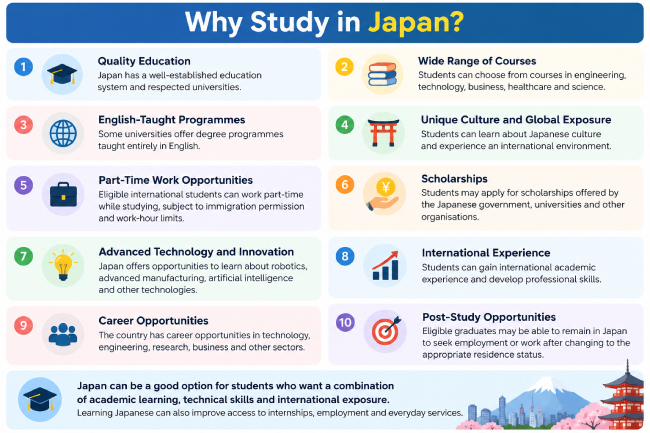
- Japan has a well-established education system and respected universities.
- Students can choose from courses in engineering, technology, business, healthcare and science.
- Some universities offer degree programmes taught entirely in English.
- Students can learn about Japanese culture and experience an international environment.
- Eligible international students can work part-time while studying, subject to immigration permission and work-hour limits.
- Students may apply for scholarships offered by the Japanese government, universities and other organisations.
- Japan offers opportunities to learn about robotics, advanced manufacturing, artificial intelligence and other technologies.
- Students can gain international academic experience and develop professional skills.
- The country has career opportunities in technology, engineering, research, business and other sectors.
- Eligible graduates may be able to remain in Japan to seek employment or work after changing to the appropriate residence status.
Japan can be a good option for students who want a combination of academic learning, technical skills and international exposure. Learning Japanese can also improve access to internships, employment and everyday services.
Top Universities in Japan for Indian Students
Japan has several well-known universities offering undergraduate and postgraduate programmes. The best university for you will depend on your preferred course, tuition budget, language requirements, research interests and career goals.
The rankings below are from the QS World University Rankings 2027 and may change in future editions.
| University / Institution | QS World Ranking 2027 | Popular Study Areas |
|---|---|---|
| The University of Tokyo | 39 | Engineering, Computer Science, Business, Medicine, Science and Law |
| Kyoto University | 64 | Science, Engineering, Medicine, Economics and Research |
| The University of Osaka | 95 | Engineering, Medicine, Science, Business and Computer Science |
| Institute of Science Tokyo | 97 | Engineering, Technology, Science and Medicine |
| Tohoku University | 102 | Engineering, Materials Science, Medicine and Research |
| Nagoya University | 156 | Engineering, Science, Automotive Technology and Research |
| Kyushu University | 171 | Engineering, Medicine, Science, Agriculture and Business |
| Hokkaido University | 179 | Agriculture, Environmental Science, Engineering and Medicine |
| Waseda University | 201 | Business, Economics, Political Science, Social Sciences and Engineering |
| Keio University | 213 | Business, Economics, Medicine, Information Technology and Social Sciences |
Tip for Indian students: Check whether your preferred programme is taught in English or Japanese before applying. Also compare admission requirements, scholarship availability, research opportunities and the total cost of living in the university's city.
Read more...
Top 10 Universities for Master’s (PG) in Japan
Popular Courses to Study in Japan
Japan offers courses at different academic levels, from bachelor's degrees to master's and doctoral programmes. Course duration depends on the university, subject and qualification.
| Programme | Typical Duration | Popular Specialisations |
|---|---|---|
| Computer Science and IT | 4 years for a bachelor's degree; 2 years for a master's | Software Development, AI, Data Science, Cybersecurity |
| Business and Management | 3–4 years for a bachelor's degree; 1–2 years for a master's | Management, Marketing, International Business, Entrepreneurship |
| Engineering | Usually 4 years for a bachelor's degree; 2 years for a master's | Mechanical, Civil, Electrical, Robotics and Electronics Engineering |
| Finance and Accounting | Usually 4 years for a bachelor's degree; 1–2 years for a master's | Banking, Accounting, Investment, Financial Management |
| Healthcare and Health Sciences | Usually 4 years or longer, depending on the qualification | Health Sciences, Nursing, Public Health and Biomedical Science |
| Data Science | 4 years for a bachelor's degree; 1–2 years for a master's | Data Analytics, AI, Machine Learning and Statistics |
| Science | Usually 4 years for a bachelor's degree; 2 years for a master's | Biology, Chemistry, Physics and Environmental Science |
| Japanese Language and Studies | Often 1–2 years for language programmes; degree duration varies | Japanese Language, Culture, Literature and Translation |
| Architecture and Design | Usually 4 years for a bachelor's degree; further study varies | Architecture, Industrial Design, Urban Planning and Digital Design |
| Agriculture and Environmental Studies | Usually 4 years for a bachelor's degree; 2 years for a master's | Agriculture, Food Science, Forestry and Environmental Management |
Also read...
Top 10 Universities for Bachelor’s (UG) in Japan
Cost of Studying in Japan
The cost of studying in Japan depends on the university, course, level of study and location. National universities generally have lower tuition fees than many private universities. Students should budget for tuition, admission fees, accommodation, food, transport, health insurance and personal expenses.
Tuition Fees in Japan
Tuition fees in Japan vary by university, course and level of study. National university bachelor's and master's programmes typically cost around ¥535,800 per year, while public university bachelor's programmes cost approximately ¥536,000 per year. Private university bachelor's programmes generally cost ¥1,000,000–¥1,500,000 annually, and private master's programmes cost around ¥800,000–¥1,200,000. Courses in business, engineering and computer science may cost ¥800,000–¥1,500,000 per year, while medicine and other specialised programmes can be considerably more expensive. Additional admission fees, laboratory charges and other expenses may apply.
Other Study Expenses in Japan
Students should also prepare a monthly budget for living expenses. Costs depend on the city, accommodation type and lifestyle. Tokyo is generally more expensive than many regional areas.
| Expense | Estimated Cost per Month | Details |
|---|---|---|
| Accommodation | ¥30,000–¥70,000 | University dormitories and shared housing may cost less than private apartments |
| Food and groceries | ¥25,000–¥40,000 | Depends on eating habits and how often you eat out |
| Public transport | ¥4,000–¥12,000 | Depends on commuting distance and student discounts |
| Health insurance and medical expenses | ¥2,000–¥5,000 | Actual costs depend on enrolment and healthcare needs |
| Books and study materials | ¥2,000–¥6,000 | Course and laboratory materials may cost more |
| Utilities | ¥5,000–¥10,000 | Electricity, gas and water costs vary by season and accommodation |
| Mobile and internet | ¥2,000–¥5,000 | Depends on the plan and accommodation |
| Personal and entertainment expenses | ¥8,000–¥20,000 | Clothing, leisure and other personal needs |
Estimated total monthly living expenses: Around ¥100,000–¥160,000 for many students, with higher budgets often needed in Tokyo or for private accommodation. This is a planning range, not an official fixed cost. Accommodation, food and transport are the main expenses to consider.
*Read more..
Scholarships to Study in Japan
Indian students may be eligible for scholarships that help cover tuition fees and living expenses. Awards depend on academic performance, nationality, course, age, university and other eligibility conditions.
| Scholarship | Offered By | Possible Benefits |
|---|---|---|
| MEXT Scholarship | Japanese Ministry of Education, Culture, Sports, Science and Technology | Depending on the category, may include tuition exemption, a monthly allowance and round-trip airfare |
| JASSO Scholarship | Japan Student Services Organization | Financial support for eligible privately financed international students and exchange students |
| University Scholarships | Individual Japanese universities | May provide tuition reductions, fee waivers or living-cost support |
| Local Government Scholarships | Japanese local governments and related organisations | Support for eligible students studying or living in a particular area |
| Private Foundation Scholarships | Private foundations and other organisations | Funding based on academic merit, field of study or other selection criteria |
Eligibility Requirements to Study in Japan
- Have a recognised academic qualification that meets the requirements of your chosen course.
- For bachelor's programmes, have completed secondary school education or an equivalent qualification, usually 12 years of schooling.
- For master's programmes, have a relevant bachelor's degree or equivalent qualification.
- Meet the minimum academic marks or grade requirements set by the university.
- Meet the Japanese-language requirements if you choose a Japanese-taught programme.
- For Japanese-taught courses, provide Japanese proficiency proof, such as JLPT results, if required.
- For English-taught programmes, provide English-language proof if required by the university.
- Universities may accept IELTS, TOEFL or other approved English tests, depending on their rules.
- Some universities may require the Examination for Japanese University Admission for International Students (EJU), entrance examinations or interviews.
- Provide academic transcripts, education certificates and other required documents.
- Some courses may require a CV, statement of purpose, research proposal or recommendation letters.
- Have a valid passport.
- Show that you have enough funds to pay tuition fees and living expenses.
- Receive an admission offer from a recognised Japanese educational institution.
- Meet the requirements for a Japanese Certificate of Eligibility (COE) and student visa, where applicable.
- Provide financial documents from yourself or your financial sponsor, if required.
- Meet any additional requirements set by your chosen university or course.
Admission requirements vary by university, course and language of instruction. Check the official admission guidelines before applying.
*Read about...
Top Vocational Colleges for Indian Students
Step-by-Step Process to Study in Japan
Step 1: Choose a university and course based on your career goals, academic background, budget and preferred subject.
Step 2: Check the course requirements, tuition fees, scholarships, language requirements, intake dates and application deadlines.
Step 3: Prepare your academic certificates, transcripts, passport, language test results and other required documents.
Step 4: Apply to your selected Japanese university or educational institution and pay the application fee, if required.
Step 5: Apply for scholarships such as the MEXT Scholarship, JASSO support or university-funded scholarships, according to the relevant deadlines.
Step 6: Wait for the admission decision. If accepted, confirm your place and complete the university's enrolment requirements.
Step 7: Work with your university to prepare the documents needed for the Certificate of Eligibility (COE). The university often applies for the COE on behalf of the student.
Step 8: Prepare your financial evidence, including bank statements, income documents, scholarship letters or education loan documents, as applicable.
Step 9: After the COE is issued, apply for the Japanese student visa through the relevant Japanese embassy, consulate or authorised application centre in India.
Step 10: After visa approval, arrange accommodation, travel and health insurance. Once you arrive in Japan, complete the required immigration, residence registration and university enrolment formalities.
*Read about...
Japan Student Visa for Indians
Indian students who plan to study full-time in Japan generally need a student visa for long-term study. Japan uses the Student status of residence for eligible studies at universities, graduate schools, junior colleges, colleges of technology, specialised training colleges and Japanese-language schools. Students normally obtain admission first, then arrange the Certificate of Eligibility (COE), usually with help from their school. Once the COE is issued, they apply for a visa through the relevant Japanese diplomatic mission or authorised visa application centre in India. Applicants may need to submit a passport, visa application form, photograph, COE and additional supporting documents. The exact requirements depend on the applicant and the instructions in force when applying.
Types of Japanese Student Visa and Study Options
Japan does not use the same separate student visa categories as New Zealand. The appropriate visa and residence arrangements depend on the type and duration of study.
- University Student: For eligible bachelor's, master's and doctoral programmes at Japanese universities.
- Japanese-Language School Student: For eligible long-term Japanese-language courses at recognised institutions.
- Specialised Training College Student: For eligible vocational and professional training programmes.
- Research Student: Students undertaking research at a Japanese institution must confirm the correct enrolment arrangement and residence status with their institution; the visa route depends on their actual study status.
- Short-Term Study: Short courses or exchange programmes may have different entry requirements depending on their duration, activities and the student's nationality.
The official residence status for eligible long-term study is generally called Student. The period of stay is determined individually and may be granted for up to 4 years and 3 months, depending on the circumstances.
Japan Student Visa Requirements for Indians
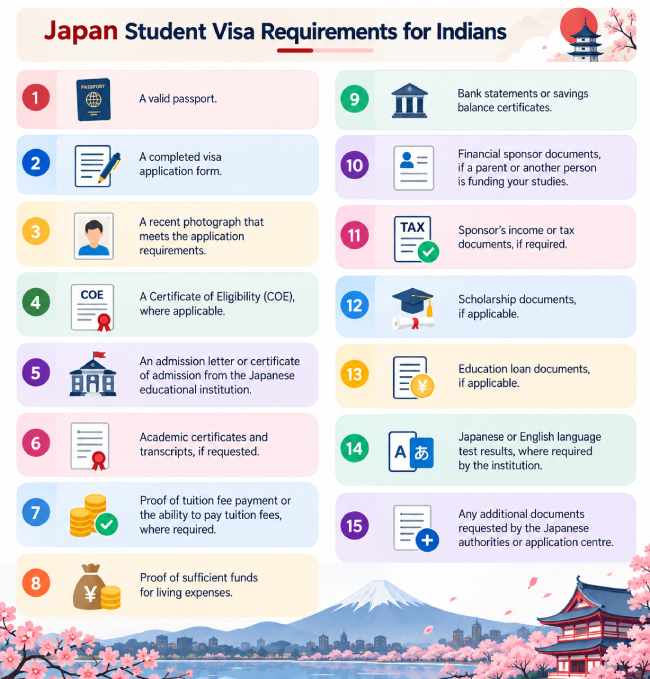
- A valid passport.
- A completed visa application form.
- A recent photograph that meets the application requirements.
- A Certificate of Eligibility (COE), where applicable.
- An admission letter or certificate of admission from the Japanese educational institution.
- Academic certificates and transcripts, if requested.
- Proof of tuition fee payment or the ability to pay tuition fees, where required.
- Proof of sufficient funds for living expenses.
- Bank statements or savings balance certificates.
- Financial sponsor documents, if a parent or another person is funding your studies.
- Sponsor's income or tax documents, if required.
- Scholarship documents, if applicable.
- Education loan documents, if applicable.
- Japanese or English language test results, where required by the institution.
- Any additional documents requested by the Japanese authorities or application centre.
Important: Not every applicant needs to submit every document listed above. Confirm the current checklist with the Embassy of Japan in India or the relevant authorised application centre before submitting your application.
Proof of Funds to Study in Japan
International students may be asked to show that they can cover tuition fees and living expenses during their stay. Japan does not have one universal fixed proof-of-funds amount that applies to every student and course. The required evidence depends on the institution, immigration assessment and individual circumstances.
- Living expenses: Prepare a realistic budget for accommodation, food, transport, utilities and personal expenses.
- Tuition fees: Show that you can pay the tuition and other fees charged by your university.
- Bank statements: A savings balance certificate or bank statements may be requested to show available funds.
- Income documents: You or your financial sponsor may need to provide income or tax certificates.
- Education loan: Loan documents may help demonstrate how your studies will be funded.
- Scholarship: A scholarship award letter can show that some or all of your expenses are covered.
- Financial sponsor: If your parents or another sponsor are paying, you may need to submit their financial documents and a statement explaining their support.
- Source of funds: Authorities may request documents explaining where the money comes from and whether it is available for your education.
The official Study in Japan guidance identifies savings balance certificates, income certificates and other financial evidence as possible supporting documents for a COE or visa application.
Example
Suppose your annual tuition fee is ¥800,000 and you estimate your living expenses at ¥120,000 per month.
- Annual tuition fees: ¥800,000
- Estimated living expenses for 12 months: ¥1,440,000
- Estimated first-year budget: ¥2,240,000
This is an example for financial planning, not an official minimum visa-fund requirement. You should also budget for admission fees, travel, insurance, study materials and other expenses that apply to your course.
Important Points for Indian Students
- The Student visa is generally required for Indian students planning to pursue long-term studies in Japan.
- Students should receive an admission offer from a recognised Japanese educational institution.
- Students generally need a Certificate of Eligibility (COE) before applying for a long-term student visa.
- Students must show that they can pay tuition fees and living expenses.
- There is no single fixed proof-of-funds amount that applies to every student; financial requirements depend on the course and individual circumstances.
- Students may need to provide bank statements, income certificates or financial sponsor documents.
- Eligible students can work part-time for up to 28 hours per week after obtaining the required permission.
- During long school holidays, eligible students may work up to 8 hours per day, subject to the applicable rules.
- Students should demonstrate that they intend to study and meet the requirements for their chosen course.
- Students should apply early because visa processing times can vary depending on application volume and individual circumstances.
- Most Japanese universities have an April intake, while some offer September or October admission.
- After completing an eligible qualification, graduates may be able to change to an appropriate work-related residence status if they meet the requirements.
- Visa fees, application procedures and immigration rules can change, so students should check the latest official information before applying.
International students must obtain permission to work outside their student status before starting a part-time job.
Steps to Apply for a Japan Student Visa
Step 1: Choose a recognised Japanese university, college or language school and select a course that matches your academic background and career goals.
Step 2: Check the course requirements, tuition fees, Japanese or English language requirements, available scholarships and admission deadlines.
Step 3: Apply to your selected educational institution and receive an admission offer.
Step 4: Prepare your academic certificates, transcripts, passport, language test results and other documents required by the institution.
Step 5: Arrange proof of funds for tuition fees and living expenses. This may include bank statements, education loan documents, scholarship letters or financial sponsor documents.
Step 6: Work with your educational institution to arrange the Certificate of Eligibility (COE). In many cases, the institution applies for the COE on the student's behalf.
Step 7: Once the COE is issued, prepare the student visa application, passport, photograph and other documents required by the Japanese authorities.
Step 8: Submit your visa application through the relevant Japanese embassy, consulate or authorised visa application centre in India, following the current instructions.
Step 9: Wait for the visa decision. The authorities may request additional documents or information if necessary.
Step 10: After visa approval, arrange accommodation, travel and insurance. Travel to Japan and complete the required residence registration and university enrolment procedures.
Japan Student Visa Fee
As of the fee schedule effective 1 July 2026, the Japanese Embassy in India lists the visa fee for Indian nationals as ₹500 for a single-entry or multiple-entry visa, plus the applicable VFS service fee. Confirm the applicable fee for your specific student visa application before submitting it.
Students may also have additional costs for:
- University application fees
- Admission fees and tuition deposits
- Certificate of Eligibility-related document preparation, if applicable
- Japanese or English language tests
- Document translation and certification
- Passport-related expenses, if applicable
- Travel and health insurance
- Air tickets and accommodation
- Other application-related expenses
Visa fees and service charges may change. Check the latest fee schedule before applying. Do not assume that every fee paid to a university or application centre is refundable if your visa application is refused.
Japan Student Visa Processing Time
Japan does not have one guaranteed processing time for every student visa application. Processing can vary depending on the completeness of the documents, the need for additional checks and the volume of applications. Students applying for long-term study should generally allow enough time for both the Certificate of Eligibility process and the visa application. The Japanese Embassy in India advises applicants to plan ahead because processing times can vary significantly. Visa applications may generally be submitted up to three months before the intended travel date, subject to the applicable instructions.
To reduce the risk of delays:
- Apply to your chosen institution early.
- Submit complete and accurate academic and financial documents.
- Respond promptly to requests for additional information.
- Confirm the COE and visa application requirements before submitting documents.
- Avoid booking non-refundable flights before your visa is approved.
Recommended approach: Start your university application and immigration preparations around 6–12 months before your intended course start date. This is a planning recommendation, not an official visa processing guarantee.
Japan Study Intakes
Japanese universities generally begin their academic year in April. Some universities and graduate schools also offer admission in September or October. Japanese-language schools may offer additional intakes, including January and July, depending on the institution.
April Intake
- Research universities, courses, tuition fees and scholarships.
- Check admission requirements and application deadlines.
- Complete the required Japanese or English language tests.
- Prepare academic certificates, transcripts and other supporting documents.
- Submit your university applications.
- Complete entrance examinations or interviews, if required.
- Receive an admission offer and confirm your place.
- Arrange tuition fees and proof of funds.
- Work with your institution to arrange the COE.
- Apply for the student visa and prepare for travel after approval.
September/October Intake
- Check which universities offer autumn admission for your preferred course.
- Review application deadlines and language requirements.
- Prepare academic documents, recommendation letters and a statement of purpose, if required.
- Complete the necessary language tests or entrance examinations.
- Submit applications and wait for admission decisions.
- Check scholarship availability and apply before the deadlines.
- Confirm your admission and arrange tuition payments.
- Prepare financial documents and apply for the COE.
- Submit your student visa application.
- Arrange accommodation and travel after visa approval.
Note: Not every university or course offers both April and autumn admission. Always check the specific intake dates published by your chosen institution.
Month-by-Month Plan for Studying in Japan
The following schedule is a planning guide for students targeting the April intake. Adjust it to match your university's application deadlines and the time needed for your COE and visa.
- April–June: Research universities, courses, fees, scholarships and language requirements for the following year's intake.
- June–August: Shortlist universities, prepare for Japanese or English language tests and check entrance examination requirements.
- August–October: Prepare academic transcripts, certificates, recommendation letters and a statement of purpose, if required.
- September–November: Submit applications according to each university's deadlines and complete any required entrance examinations.
- November–January: Receive admission decisions, confirm your place and arrange tuition payments as instructed.
- December–February: Prepare financial documents and work with your institution on the Certificate of Eligibility application.
- January–March: Complete the visa application process, subject to COE issuance and the relevant application arrangements.
- February–March: Arrange accommodation, insurance, travel documents and pre-departure preparations.
- March: Confirm your travel plans after visa approval and prepare for arrival in Japan.
- April: Arrive in Japan, complete university enrolment and residence-related formalities, and begin your studies.
For September or October admission, shift this schedule to match the university's autumn intake and application deadlines. Some institutions require applications many months before the course begins.
Final tip: Begin early, confirm every deadline directly with your university and use official Japanese government guidance for visa and immigration requirements. This will help you prepare your application and financial documents more effectively.
Part-Time Jobs in Japan for Indian Students
Eligible international students can work part-time while studying in Japan after obtaining the required permission. Students are generally allowed to work up to 28 hours per week during their studies and up to 8 hours per day during long school holidays. Common part-time jobs include restaurants, retail, factories, delivery, cleaning, administration and language teaching. Part-time work can help students gain experience and manage some daily expenses. However, students should not rely on part-time earnings to cover all tuition and living costs. Japanese-language skills can also improve access to job opportunities.
Post-Study Work in Japan
Japan offers career opportunities in IT, technology, engineering, manufacturing, healthcare, business, finance, research and education.
- Eligible graduates can search for jobs after completing their studies.
- Graduates who secure an eligible job may apply to change to an appropriate work-related residence status.
- Eligible graduates who have not found a job may be able to stay in Japan for job hunting under a Designated Activities residence status.
- The initial job-hunting period may be six months, with one extension possible for eligible applicants.
- Career opportunities depend on qualifications, skills, language ability and employer requirements.
- Japanese-language proficiency can improve employment opportunities.
- Relevant internships and work experience can strengthen a graduate's profile.
- Students should start preparing for job applications before graduation.
- Some employers recruit international graduates for technical, business and specialist roles.
- Obtaining a job or work visa does not automatically grant permanent residence.
Graduates must meet the applicable immigration requirements to remain in Japan for work or job hunting.
*Want to work in Japan? Contact Y-Axis for guidance on work visa options.
Path to Permanent Residency in Japan
Studying in Japan does not automatically lead to permanent residency. After graduation, eligible students may obtain a suitable work-related residence status and gain professional experience in Japan. They may later apply for permanent residency if they meet the applicable requirements.
In principle, applicants generally need at least 10 years of continuous residence in Japan, including at least 5 years under a qualifying work or residence status. Exceptions may apply to certain applicants, including eligible highly skilled professionals who meet specific requirements. Permanent residency depends on factors such as residence history, conduct, financial stability, tax and social insurance compliance, and the rules in force when applying.
How Can Y-Axis Help You?
Y-Axis can provide support to students planning to study in Japan. Services may include:
- Free Counselling: Get guidance on university and course selection.
- Campus Ready Program: Get support to prepare for your study abroad journey.
- Course Recommendation: Explore suitable study options through Y-Path.
- Coaching: Explore IELTS and other test preparation services where relevant to your chosen programme.
- Japan Student Visa: Get assistance with preparing your student visa application and understanding the required documents.
Contact Y-Axis to discuss your study plans, course options and application requirements.
Looking for inspiration
Explore what Global Indians have to say about Y-Axis in shaping their future

