


Don't know what to do ?
Get Free Counseling
Last Updated 05 August 2026
Canada Express Entry —Category-Based Draws, CRS Calculator, Eligibility and Complete PR Guide
- Best Path to Canada Permanent Residency
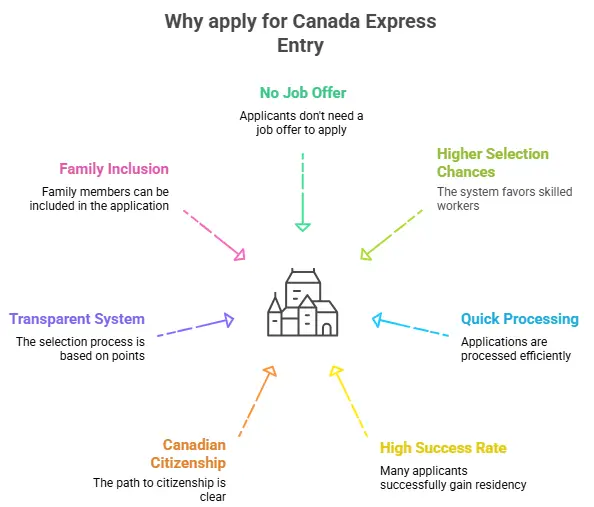
- No job offer is required
- Higher chances of selection
- Quick processing time
- High success rate for applicants
- Opportunity for Canadian citizenship
- Transparent and points-based selection system
- Family members can be included in the application
Canada Express Entry is the most popular route for overseas skilled professionals to settle in Canada permanently. Express Entry draws in 2026 are increasingly category-based and targeted at specific occupations, language skills, or Canadian work experience. The schedule and invitation volume are entirely at the minister's discretion and are not predictable — understanding which category you qualify for matters more than trying to predict draw timing.
Canada Express Entry Draw
Canada Immigration through Express Entry is one of the most popular and trusted pathways for skilled professionals who want to settle in Canada with Permanent Residency (PR). Express Entry is an online application management system used by the Canadian government to manage PR applications for skilled workers.
The system uses a points-based ranking method, called the Comprehensive Ranking System (CRS). Candidates are assessed based on details in their profile, such as age, education, work experience, language skills, job offer (if any), and provincial nomination.
Express Entry draws are usually held every two weeks, but the schedule may change depending on Canada’s immigration needs. During each draw, IRCC selects eligible candidates from the Express Entry pool and issues Invitations to Apply (ITAs) for Canada PR. A higher CRS score increases the chances of receiving an ITA.
Category-Based Express Entry Draws
IRCC continues to conduct category-based Express Entry draws to meet Canada’s labor market requirements. Through these draws, Canada invites skilled professionals who have experience in high-demand occupations or who meet specific criteria such as language skills or work experience in priority sectors.
These category-based draws help Canada address workforce shortages and support the country’s economic growth by inviting candidates who can contribute immediately to the labor market.
Latest Express Entry Draw
- Invitation Round – #431 (Provincial Nominee Program)
- Express Entry Latest Draw Date – August 4, 2026
- Number of Invitations – 507
- CRS score – 768
The latest Express Entry draw was held on August 4, 2026, and 507 ITAs were issued.
The #431 Express Entry draw invited Provincial Nominee Program candidates with a CRS score of 768 to apply for Canada PR.
Canada's Proposed 2026 Express Entry Overhaul (Under Review — Not Yet in Effect)
IRCC ran a major public consultation from April 23 to May 24, 2026 (now closed) proposing the most significant Express Entry changes since 2015. Key proposals:
- Merging the three federal programs (FSWP, CEC, FSTP) into a single unified pathway (tentatively called the Federal High Skilled Class), with one set of minimum eligibility requirements
- A new "high-wage occupation" CRS factor, rewarding candidates whose occupation earns above the national median wage
- Job offer points could return — but only for high-wage occupations
- Sibling and Canadian-education CRS points may be reduced
Current rules remain fully in effect. The full program merger requires regulatory changes and isn't expected to take effect until late 2027 at the earliest. However, the high-wage occupation CRS factor could move faster since it only requires a Ministerial Instruction, not new regulations. Continue preparing your application under the current system. Y-Axis is monitoring developments and can advise on your strategy under both scenarios.
Express Entry Draws
| Draw No. | Date | Immigration Program | Invitations Issued |
|---|---|---|---|
| 431 | August 4, 2026 | Provincial Nominee Program | 507 |
| 430 | July 23, 2026 | Skilled Military Recruits, 2026 – Version 1 | 4 |
| 429 | July 22, 2026 | French Language Proficiency (2026 – Version 2) | 5,000 |
| 428 | July 21, 2026 | Canadian Experience Class | 2,000 |
| 427 | July 20, 2026 | Provincial Nominee Program | 511 |
| 426 | July 10, 2026 | Senior Managers with Canadian Work Experience, 2026 – Version 1 | 500 |
| 425 | July 09, 2026 | French Language Proficiency (2026 – Version 2) | 5,000 |
| 424 | July 07, 2026 | Canadian Experience Class | 2,000 |
| 423 | July 06, 2026 | Provincial Nominee Program | 534 |
| 422 | June 25, 2026 | Healthcare and Social Services Occupations, 2026 – Version 3 | 4,000 |
| 421 | June 24, 2026 | Physicians with Canadian Work Experience, 2026 – Version 1 | 271 |
| 420 | June 23, 2026 | Canadian Experience Class | 4,000 |
| 419 | June 22, 2026 | Provincial Nominee Program | 955 |
| 418 | May 28, 2026 | French Language Proficiency (2026 – Version 2) | 4,500 |
| 417 | May 27, 2026 | Canadian Experience Class | 3,000 |
| 416 | May 25, 2026 | Provincial Nominee Program | 334 |
| 415 | May 11, 2026 | Provincial Nominee Program | 380 |
| 414 | April 29, 2026 | French Language Proficiency (2026 – Version 2) | 4,000 |
| 413 | April 28, 2026 | Canadian Experience Class | 2,000 |
| 412 | April 27, 2026 | Provincial Nominee Program | 473 |
| 411 | April 15, 2026 | French Language Proficiency, 2026 – Version 2 | 4,000 |
| 410 | April 13, 2026 | Provincial Nominee Program | 324 |
| 409 | April 14, 2026 | Canadian Experience Class | 2,000 |
| 408 | April 02, 2026 | Trades Occupations, 2026 – Version 3 | 3,000 |
| 407 | March 31, 2026 | Canadian Experience Class | 2,250 |
| 406 | March 30, 2026 | Provincial Nominee Program | 356 |
| 405 | March 18, 2026 | French Language Proficiency, 2026 – Version 2 | 4,000 |
| 404 | March 17, 2026 | Canadian Experience Class | 4,000 |
| 403 | March 16, 2026 | Provincial Nominee Program | 362 |
| 402 | March 05, 2026 | Senior Managers with Canadian Work Experience | 250 |
| 401 | March 04, 2026 | French Language Proficiency | 5,500 |
| 400 | March 03, 2026 | Canadian Experience Class | 4,000 |
| 399 | March 02, 2026 | Provincial Nominee Program | 264 |
| 398 | February 20, 2026 | Healthcare and Social Services Occupations | 4,000 |
| 397 | February 19, 2026 | Physicians with Canadian Work Experience | 391 |
| 396 | February 17, 2026 | Canadian Experience Class | 6,000 |
| 395 | February 16, 2026 | Provincial Nominee Program | 279 |
| 394 | February 06, 2026 | French Language Proficiency | 8,500 |
| 393 | February 03, 2026 | Provincial Nominee Program | 423 |
| 392 | January 21, 2026 | Canadian Experience Class | 6,000 |
| 391 | January 20, 2026 | Provincial Nominee Program | 681 |
| 390 | January 07, 2026 | Canadian Experience Class | 8,000 |
| 389 | January 05, 2026 | Provincial Nominee Program | 574 |
When is the next Express Entry Draw?
The anticipation for the next Express Entry draw is high. To stay informed about upcoming draws, please check our website regularly for updates. The typical pattern involves draws every two weeks on Wednesdays, but deviations from this pattern can occur.
Also read...
When is the Next Canada PR Draw?
Canada Immigration Through Express Entry
Canada Immigration through Express Entry is the most prominent pathway for individuals who wish to settle in the country with a PR visa. It is a points-based system that allots points based on skills, work experience, Canadian employment status, and provincial/territorial nomination.
The higher your CRS score, the greater your chances of receiving an Invitation to Apply (ITA) for a Permanent Residency in Canada. Candidates who choose Express Entry to submit their Canada PR applications get higher chances of selection. The Express Entry applications are valid for 12 months and processed in 6–12 months.
Register your Expression of Interest for the Express Entry program with the help of Y-Axis, the leading and best immigration consultants in India, who guide you in every step of your Canada immigration process. Express Entry manages Canada PR applications related to the following federal economic programs:
- Federal Skilled Worker Program
- Federal Skilled Trades Program
- Canadian Experience Class
- Provincial Nominee Program
Express Entry is a streamlined immigration program made more transparent for potential skilled foreign workers.
The key details of the program include:
- An online program that has no cap on applicants and is open throughout the year.
- The program applies only to the Federal Skilled Worker Program, Federal Skilled Traders Program, and Canadian Experience Class Immigration Program.
- You must submit an Expression of Interest and apply as an applicant for any job mentioned in TEER Category 0, 1, 2, and 3.
- Your profile will be evaluated based on points and placed in the applicant pool.
- Canadian provinces and employers will access this pool and find talent to meet their needs.
- The highest point holders are sent an Invitation to Apply for Canada PR.
- The number of ITAs issued is based on the Canada Immigration Levels Plan.
Canada's 2026–2028 Immigration Levels Plan targets 380,000 total permanent resident admissions in 2026 and 365,000 in 2027 — a significant reduction from earlier expansionary targets. Express Entry's specific contribution is shown below:
| Canada Express Entry Immigration Levels Plan | ||
|---|---|---|
| Program | 2026 | 2027 |
| Express Entry | 47,400 | 47,800 |
Canada Express Entry – 5 Things to Know
- Score: Latest Express Entry Draw CRS score – 768
- Cost: Approximately CAD 2,300–2,500/applicant total (government + third-party fees combined); higher for couples. Government processing fees alone increased April 30, 2026.
- Approval time: 6 to 8 months.
- Length of residence: 5 years. To maintain PR status, you must be physically present in Canada for at least 730 days within every 5-year period. Canadian citizenship becomes possible after 3 years (1,095 days) of physical presence as a PR
- Easy or not: Candidates with the highest rankings are issued ITAs.
Introduction of Category-Based Rounds of Invitations
As per IRCC's 2026 framework, the current list of category-based draws includes:
- French language proficiency
- Healthcare and social services occupations
- Trade occupations (carpenters, plumbers, and contractors)
- Education occupations
- Agriculture and Agri-Food
- Physicians with Canadian work experience (new; first draw February 19, 2026)
- Senior managers with Canadian work experience (new; first draw March 5, 2026)
- Researchers with Canadian work experience (new)
- Skilled Military Recruits (new; first-ever draw July 23, 2026)
- STEM (science, technology, engineering, and mathematics) professions
IMPORTANT 2026 RULE: All category-based draws now require a minimum of 12 months of occupation-specific work experience (doubled from 6 months, effective February 18, 2026). Candidates with 6–11 months of experience in a category-eligible occupation remain in the general pool but do not qualify for that category's draws.
CRS Score Calculator
The Canada Express Entry Program determines applications using the Comprehensive Ranking System. The CRS score calculator evaluates and gives points based on the six factors. The highest-scored candidates have greater chances to migrate to Canada with a PR Visa. The points scale has a maximum score of 1200 and evaluates you and your spouse (if any) on the following factors:
- Age
- The highest level of education
- Language skills
- Canadian work experience
- Other work experience
- Skill Transferability
- Other factors
1. Core / Human Capital Factors (Maximum 500 Points)
Age Points
| Age | With Spouse | Single |
|---|---|---|
| 17 | 0 | 0 |
| 18 | 90 | 99 |
| 19 | 95 | 105 |
| 20–29 | 100 | 110 |
| 30 | 95 | 105 |
| 31 | 90 | 99 |
| 32 | 85 | 94 |
| 33 | 80 | 88 |
| 34 | 75 | 83 |
| 35 | 70 | 77 |
| 36 | 65 | 72 |
| 37 | 60 | 66 |
| 38 | 55 | 61 |
| 39 | 50 | 55 |
| 40 | 45 | 50 |
| 41 | 35 | 39 |
| 42 | 25 | 28 |
| 43 | 15 | 17 |
| 44 | 5 | 6 |
| 45+ | 0 | 0 |
| Education Level | CRS Score (With Spouse) | CRS Score (Single) |
|---|---|---|
| PhD (Canadian or equivalent) | 150 | 140 |
| Two or more Canadian post-secondary credentials | 128 | 119 |
| Master's degree / professional degree | 126 | 112 |
| Two-year or longer post-secondary credential | 98 | 91 |
| One-year post-secondary credential | 91 | 84 |
| Secondary school (high school) only | 30 | 28 |
(Points reduce gradually after age 29)
Note: Job offer CRS bonus points were removed in March 2025 due to LMIA fraud concerns. As of 2026, a job offer adds zero bonus CRS points. A valid job offer still provides 10 eligibility points toward the FSWP 67-point grid (see Eligibility section below) — but it does not boost your CRS pool ranking. A related IRCC proposal (still under review as of July 2026 — see "2026 Proposed Reforms" below) could reintroduce job offer points, but only for high-wage occupations, and is not yet in effect.
2. Skill Transferability Factors (Maximum 100 Points)
Education + Language / Work Experience
| Combination | Points |
|---|---|
| Bachelor’s + CLB 9 | 25 |
| Master’s / PhD + CLB 9 | 50 |
| Foreign experience + CLB 9 | 50 |
| Canadian + foreign experience | 50 |
Education + Canadian Work Experience
| Combination | Points |
|---|---|
| Degree + 1 year Canadian experience | 13 |
| Master’s / PhD + 1 year | 25 |
| Degree + 2 years | 25 |
| Master’s / PhD + 2 years | 50 |
Foreign Work Experience + Language
| Combination | Points |
|---|---|
| 1–2 years + CLB 7/8 | 13 |
| 3+ years + CLB 7/8 | 25 |
| 1–2 years + CLB 9+ | 25 |
| 3+ years + CLB 9+ | 50 |
Foreign + Canadian Work Experience
| Combination | Points |
|---|---|
| 1–2 years foreign + 1 year Canadian | 13 |
| 3+ years foreign + 1 year Canadian | 25 |
| 1–2 years foreign + 2 years Canadian | 25 |
| 3+ years foreign + 2 years Canadian | 50 |
Certificate of Qualification + Language
| Criteria | Points |
|---|---|
| Certificate + CLB 5 (one ability CLB 7) | 25 |
| Certificate + CLB 7 in all abilities | 50 |
3. Additional CRS Points (Maximum 600 Points)
| Factor | Points |
|---|---|
| Provincial Nomination (PNP) | 600 |
| Valid job offer (TEER 0, 1, 2, 3) | 50 |
| Canadian education (1–2 years) | 15 |
| Canadian education (3+ years) | 30 |
| Sibling in Canada | 15 |
| Strong French + English | Up to 50 |
Benefits of the Canada Express Entry Program
- Express Entry is a transparent and points-based system. Applicants can clearly see their CRS score and understand what is needed to qualify for an Invitation to Apply (ITA).
- Candidates know the minimum CRS score required for selection in each draw. If the score is low, they can work on improving it and try again.
- Applicants can increase their CRS score by improving language test results (IELTS, CELPIP, PTE, or French), gaining more work experience, studying in Canada, or applying through a Provincial Nominee Program (PNP).
- Younger candidates, those with higher education, strong English or French language skills, or Canadian study or work experience usually have a better chance of scoring higher CRS points and getting selected.
- Candidates who receive a provincial nomination get an extra 600 CRS points, which almost guarantees an ITA. Additional points are also given for a valid job offer in Canada or if a sibling is living in Canada as a PR or citizen.
Canada Express Entry Eligibility
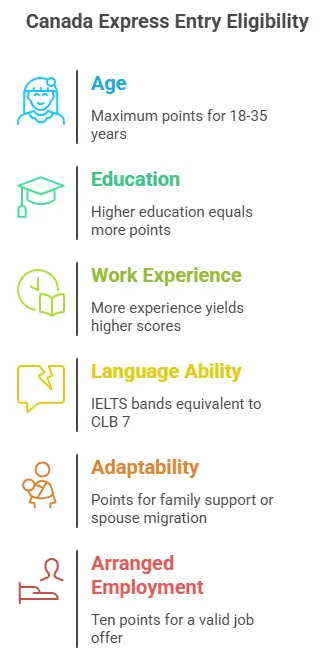
The eligibility requirement for the Express Entry is 67 points out of 100. You will need to score at least 67 points under various eligibility criteria to apply for your PR visa.
The Express Entry eligibility points calculator is based on the following criteria:
- Age: You can score the maximum points if you are between 18-35 years. Those above this age will gain lesser points.
- Education: Your minimum educational qualification must be equal to the higher secondary education level in Canada. A higher level of educational qualification means more points.
- Work experience: To score the minimum points you should have at least one year of work experience. If you have more years of work experience, you will gain more points.
- Language ability: You must have at least 6 bands in your IELTS equivalent to CLB 7 to be eligible to apply and score the minimum points. Higher scores mean more points.
- Adaptability: You can score ten points on the adaptability factor if your family members or close relatives are living in Canada and will be able to support you when you move in there. You can also gain points if your spouse or legal partner is ready to migrate with you to Canada.
- Arranged employment: A valid job offer from a Canadian employer entitles you to ten points.
Canada Express Entry Requirements
- 1-year work experience in skilled occupation, in the last 10 years.
- Minimum CLB score – 7 (in English or French).
- Education Credential Assessment (ECA).
PTE Core
PTE Core is a computer-based English test that evaluates general reading, speaking, writing, and listening skills in a single test.
Key Details
- 35 test centers are there across India
- Bookings are open and the dates for tests are available
- Fee for test: CAD $275 (Including taxes)
- Risk of Bias is decreased by combination of human expertise and AI scoring
- The test is to be attempted at a test center, and is completely computer based test
- Test results are announced in 2 days
- Validity period: Test scores are valid for 2 years from the date of test result. They must still be valid on the day the application for permanent residency is submitted
- The Canadian Language Benchmarks (CLB) will be used to determine the language proficiency level
- The test results will be used to determine the CLB level for each ability
How to create Express Entry Profile?
Step 1: Get Your Educational Credential Assessment (ECA)
If your education is from outside Canada, you must complete an Educational Credential Assessment (ECA). It confirms that your qualification is equal to Canadian education standards.
Step 2: Take Language Tests
You must take an approved English or French language test.
- Minimum requirement: CLB 7 (IELTS 6.0 in each skill or equivalent)
- Test results must be less than 2 years old
- French language skills can help you earn extra CRS points
Step 3: Create Your Express Entry Profile
Create your online Express Entry profile by entering details such as age, education, work experience, and language scores.
Based on this, you will receive a CRS score, and your profile will be added to the Express Entry pool if eligible.
Step 4: Check Your CRS Score
Candidates in the pool are ranked using the Comprehensive Ranking System (CRS).
You must score at least 67 points under the Federal Skilled Worker eligibility criteria to stay eligible.
Step 5: Receive ITA and Apply for PR
If your CRS score meets the draw cut-off, you will receive an Invitation to Apply (ITA).
After receiving ITA, you have 60 days to submit your Canada PR application.
Express Entry Programs Comparison
| Eligibility Factor | Federal Skilled Worker Program (FSWP) | Canadian Experience Class (CEC) | Federal Skilled Trades Program (FSTP) |
|---|---|---|---|
| Language Skills | CLB 7 | CLB 7 (TEER 0/1) CLB 5 (TEER 2/3) |
CLB 5 (Speaking & Listening) CLB 4 (Reading & Writing) |
| Work Experience | 1 year continuous in the last 10 years | 1 year in Canada in the last 3 years | 2 years in a skilled trade in the last 5 years |
| Type of Work | TEER 0, 1, 2, 3 | TEER 0, 1, 2, 3 (Canada) | Skilled trades |
| Job Offer | Not mandatory | Not required | Mandatory (1 year full-time) |
| Education | Minimum high school | Not required | Not required |
| Extra Points | For higher education | — | — |
IRCC Processing Timelines
- ECA processing: 8 to 20 weeks (depends on authority)
- Express Entry profile validity: 12 months
- Time to submit PR application after ITA: 60 days
- PR application processing: Around 6 months
- PR card validity: 5 years
ITA Canada
IRCC holds Express Entry draws at regular intervals. Every draw has a different cut-off score. The applicants with a CRS score equal to or above the cutoff score will receive an ITA. Candidates with a long presence in the Express
What should I do after receiving ITA
Once you receive an ITA, you will have to submit a complete and correct application for which you will be given 60 days. If you fail to do so within 60 days, then your invitation will become null and void. So, you should make the best use of this time to submit an accurate application.
Submit your Canada PR application
After receiving the ITA, candidates need to know under which Express Entry program (FSWP, FSTP, PNP, or CEC) they have been selected to apply for the Canada PR visa. Candidates will receive the checklist of requirements specific to the program they have applied for. A general checklist of requirements is given below:
- English language test results
- Civil status such as your birth certificate
- Proof of your education achievements
- Proof of your work experience
- Medical Certificate
- Police Clearance Certificate
- Proof of Funds
- Photos
Note: Canadian Experience Class (CEC) applicants and candidates with a valid job offer (LMIA-backed or LMIA-exempt) are exempt from the Proof of Funds requirement. This requirement applies specifically to Federal Skilled Worker and Federal Skilled Trades applicants who don't have a qualifying job offer.
Express Entry fees
Express Entry fees include both government charges and third-party costs that applicants must pay at different stages of the Canada PR process. While creating an Express Entry profile is free, fees apply for language tests, credential assessments, biometrics, and PR application processing after receiving an Invitation to Apply (ITA).
| Fee Type | Approximate Cost (CAD) |
|---|---|
| Language tests (IELTS / CELPIP / TEF) | 300–450 |
| ECA (Educational Credential Assessment) | 200–300 |
| Biometrics | 85 per person (170 for family) |
| Permanent Residence fees (Processing + RPRF) | 1,590 per adult (CAD 990 processing + CAD 600 RPRF, effective April 30, 2026) |
| Dependent child | 260 per child |
| Medical exam | 275–450 per person |
| Police certificate | 100+ per country |
Note: Fees increased across all PR categories effective April 30, 2026. Verify current amounts at canada.ca before budgeting.
Proof of Funds for Express Entry
Proof of Funds shows that you have enough money to support yourself and your family when you arrive in Canada. This requirement applies to most Express Entry applicants under the Federal Skilled Worker and Federal Skilled Trades programs (unless you already have a valid job offer or Canadian experience). The amounts below are set by Immigration, Refugees and Citizenship Canada (IRCC) and are updated yearly.
| Number of Family Members | Minimum Funds Required (CAD) |
|---|---|
| 1 | $15,263 |
| 2 | $19,001 |
| 3 | $23,360 |
| 4 | $28,362 |
| 5 | $32,168 |
| 6 | $36,280 |
| 7 | $40,392 |
| Each additional family member (more than 7) | $4,112 |
How Can Y-Axis Help You with Canada Express Entry?
Y-Axis, the world’s leading overseas immigration consultancy, offers end-to-end support for Canada Express Entry based on your profile and career goals. Our expert consultants guide you at every stage of your Canada PR journey.
Our Canada Express Entry services include:
- Free Express Entry eligibility check using the Canada Immigration Points Calculator
- Personalized guidance for Canada Express Entry and PR pathways
- Language coaching for IELTS, CELPIP, and PTE Core
- Free career counseling to plan your move to Canada
- Complete Canada PR visa assistance, from profile creation to visa filing
- Job search support to help you find suitable jobs in Canada
Y-Axis snapshot
1M
Successful applicants
1500+
Experienced counselors
25Y+
Expertise
50+
Offices
Don't know what to do ?
Get Free Counseling
Check your eligibility instantly
Answer few quiestion and get to know your immigration points


Looking for inspiration
Explore what Global Indians have to say about Y-Axis in shaping their future