

Migrate to Canada
Sign up for a free expert consultation!

Don't know what to do?
Get Free Counseling
Eligibility criteria for Canadian immigration
While each program to migrate to Canada has different criteria, a few things are in common. Canadian immigration officials will typically assess migration applications based on:
Educational Profile
Professional Profile
IELTS score
French language skills if migrating to Quebec
References & legal documentation
Canadian employment documentation


Last Updated 09 September 2026
Canada Immigration from India: PR Visa, Express Entry, PNP & All Pathways
Canada Immigration on a PR visa is the best option for candidates willing to settle in the country permanently. Canada PR visa allows you to permanently live, work, and study anywhere in Canada for five years. An applicant can migrate to Canada on a PR Visa through many pathways, such as Express Entry, PNP, Family Sponsorship, Start-up visa, Quebec Immigration Program, and Caregiver Visa.
Canada offers 100+ immigration pathways for Indian applicants. The main routes are Express Entry (FSWP, FSTP, CEC), the Provincial Nominee Program (PNP), and family sponsorship. The 2026 annual PR target is 380,000 under Canada's 2026-2028 Immigration Levels Plan. Most Indian applicants qualify through Express Entry with 67+ FSWP eligibility points and CLB 7 language proficiency.
Jump to: Express Entry | PNP | Quebec | Eligibility | Fees | Processing Times | FAQs |
Why Canada?
- Welcoming 380,000 permanent residents in 2026 — part of Canada's 2026-2028 Immigration Levels Plan
- Approximately 500,000 job vacancies nationwide (Statistics Canada, Q1 2025)
- Easy immigration policies
- Earn 5-8 times more than your current salary
- High standard of living
Canada Immigration Policy, 2026-2028
Canada, the Maple Leaf country, has become the most popular among people willing to settle abroad. Everyone loves to settle in Canada because of its warm, welcoming nature, great quality of life, multicultural spirit, millions of job opportunities, career growth, 100’s immigration pathways, easy citizenship policies, and many more.
Canada plans to welcome 2 million newcomers by 2028.
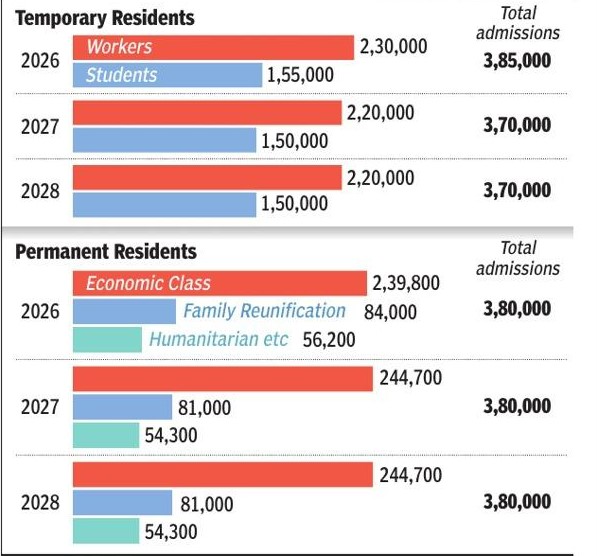
Canada Immigration from India
Canada has the world’s most streamlined immigration programs. There are multiple pathways for Indians to immigrate to Canada.
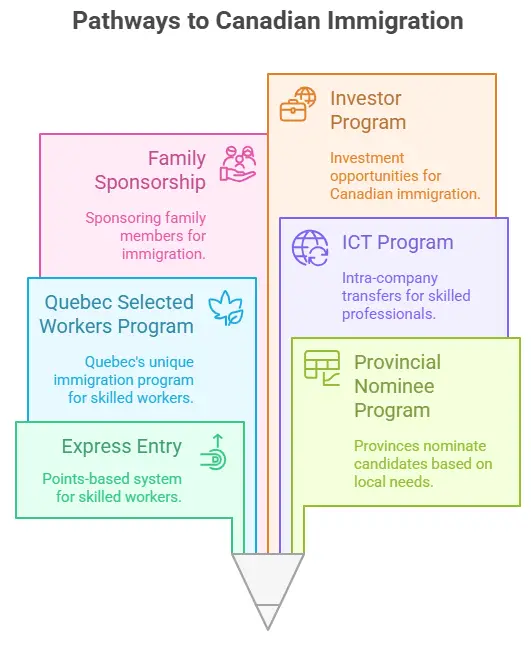
Popular pathways for Canada Immigration include:
- Express Entry
- Provincial Nominee Program
- Quebec Selected Workers Program
- ICT Program
- FSTP
- FSWP
- Canadian Experience Class (CEC)
- Family Sponsorship
- Investor Program
- Start-up visa
- Study Permit
- Atlantic Immigration Program (AIP)
Read more...
What are the PR pathways in Canada?
Canada Immigration – Express Entry
Express Entry is the most sought-after immigration program in the world. Launched in 2015, it is the first Canadian immigration program to use a points-based system.
- Federal Skilled Worker (FSW) Program
- Federal Skilled Trades Program (FSTP)
- Canadian Experience Class (CEC)
*Check your eligibility to Canada through the Y-Axis Canada CRS Score Calculator.
Update for 2026: Significant Shifts Ahead for Express Entry
Canada may be making some significant alterations to the Express Entry program.
What's changing: Right now there are three separate programs Federal Skilled Worker (FSW), Federal Skilled Trades (FSTP), and Canadian Experience Class (CEC). IRCC is exploring merging all three into one single program, with the same basic rules for everyone: high school-level education, CLB 6 language proficiency in all four skills, and at least 1 year of skilled work experience (TEER 0-3), gained in Canada or abroad.
What else might change: Your CRS score could also be recalculated. IRCC's own research found some current points - for having a spouse, a sibling in Canada, having studied in Canada, or French proficiency are weaker predictors of long-term success, so these may be reduced. Job offer points, removed in March 2025, may return but only for high-wage jobs, worth more the higher the wage tier.
Is this final? No. The Immigration, Refugees and Citizenship Canada (IRCC) has undertaken a consultation process starting from April 23 until May 24, 2026, that has been completed. Nothing has been finalized yet as everything still needs to be officially approved by the government. It should be mentioned that if you are going to submit an application via Express Entry system, it will affect you greatly.
Immigration to Canada – PNP
The Provincial Nominee Program (PNP) is the next best option for Canada Immigration. Candidates not qualified in Express Entry can opt for this pathway. A PNP nomination adds 600 points to the candidate’s profile.
The Provincial Nomination Program has two categories:
- Enhanced PNPs – Use Express Entry System
- Base PNPs – Operate independently
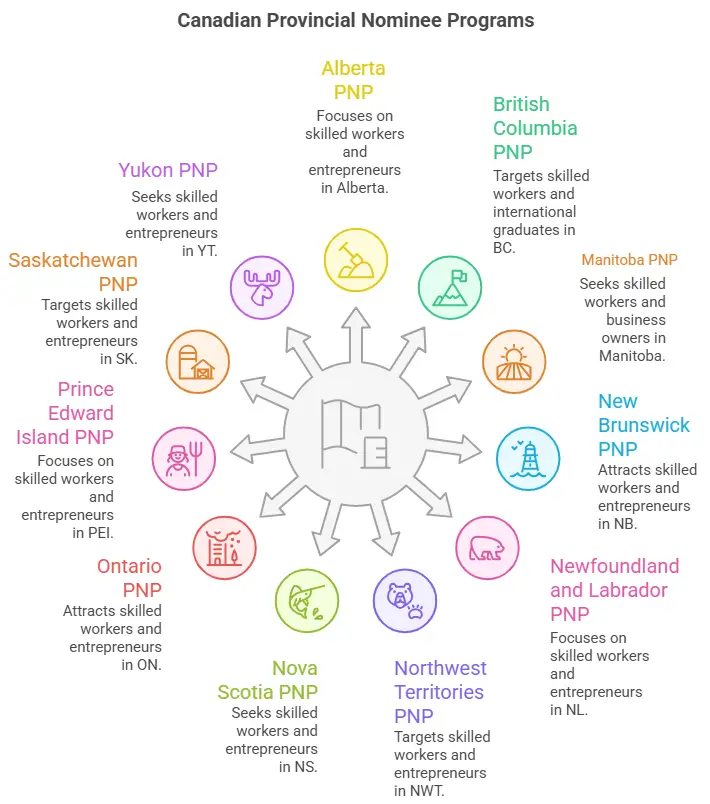
Under Base PNPs, below is the list of programs:
- Alberta PNP
- British Columbia PNP
- Manitoba PNP
- New Brunswick PNP
- Newfoundland and Labrador PNP
- Northwest Territories
- Nova Scotia PNP
- Ontario PNP
- Prince Edward Island PNP
- Saskatchewan PNP
- Yukon PNP
Migrate to Canada – QSWP
Quebec Immigration via Arrima
Quebec operates its own immigration selection system, separate from the federal PNP and Express Entry, for those intending to settle in Quebec.
Arrima is the Quebec Expression of Interest portal used for invitation rounds. Selected candidates apply for the Quebec Selection Certificate (CSQ).
The former Quebec Skilled Worker Program (QSWP) has been replaced by current programmes: Programme des travailleurs qualifiés du Québec (PTQQ) for skilled workers abroad, and Programme de l'expérience québécoise (PEQ) for workers and students already in Quebec. Quebec nominees still require final IRCC approval for permanent residence.
*Check eligibility through the Quebec Immigration Points Calculator
Immigration and Citizenship Canada;
Immigration, Refugees and Citizenship Canada is the official department of the Canadian government responsible for immigration to Canada, refugees, and Canadian citizenship. You can apply to study, work, visit, or immigrate to Canada.
Express Entry + PNP Draws table:
| 173,209 Invitations Issued in 2026 | ||||||||||
|---|---|---|---|---|---|---|---|---|---|---|
| Express Entry / Province Draw | Jan | Feb | Mar | Apr | May | June | July | August | September | Total |
| Express Entry | 15,255 | 19,593 | 20,982 | 15,797 | 8,214 | 9,226 | 15,549 | 15,811 | 5,729 | 126,156 |
| Manitoba | 102 | 101 | 60 | 340 | 1,002 | 228 | 2,989 | 794 | NA | 5,616 |
| British Columbia | 7 | 907 | 12 | 498 | 783 | 920 | 639 | 1,123 | NA | 4,889 |
| Ontario | NA | 3,229 | 2,355 | 7,730 | NA | NA | NA | 0 | NA | 13,314 |
| Alberta | 254 | 2,305 | 1,725 | 974 | 1,051 | 1,829 | 1,259 | 1,134 | NA | 10,531 |
| Prince Edward Island | 26 | 109 | 101 | 127 | 114 | 182 | 195 | 181 | NA | 1,035 |
| Newfoundland and Labrador | NA | NA | 690 | 210 | 479 | 108 | 502 | 470 | 97 | 2,556 |
| New Brunswick | 379 | 526 | 647 | 241 | 250 | 699 | 750 | 68 | NA | 3,560 |
| Northwest Territories | NA | NA | 65 | NA | NA | NA | NA | 0 | NA | 65 |
| Quebec | 1094 | 907 | 893 | 983 | 250 | 1094 | 179 | 87 | NA | 5,487 |
| Total | 17,117 | 27,677 | 27,530 | 26,900 | 12,143 | 14,286 | 22,062 | 19,668 | 5,826 | 173,209 |
What Are Express Entry Category-Based Draws?
Since 2023, IRCC has run targeted "category-based" invitation rounds alongside general draws. For 2026, IRCC has officially confirmed these categories: healthcare and social services, French-language proficiency, trade occupations, STEM occupations, education occupations, foreign medical doctors with Canadian work experience, researchers with Canadian work experience, senior managers with Canadian work experience, transport occupations, and skilled military recruits.
Most relevant for Indian applicants: healthcare and social services (given the large pool of Indian nursing and medical professionals) and trade occupations (electricians, welders, and similar skilled trades). Category-based draws often have lower CRS cutoffs than general draws, though the exact cutoff varies by round - check IRCC's official rounds-of-invitations page for current cutoffs before assuming a specific number.
Canada Immigration Eligibility
- Educational Credential Assessment
- Work experience
- IELTS / PTE / CELPIP score
- French language skills (if migrating to Quebec)
- Job offer (not mandatory)
FREE Canada Immigration Assessment Form;
The Canada Immigration Assessment Form helps skilled professionals and skilled workers check their eligibility for permanent residency in Canada. With the help of the online Canada Immigration Assessment Form, skilled workers can assess their eligibility for programs like Express Entry [Federal Skilled Workers Program (FSWP), Federal Skilled Trades Program (FSTP), and Canadian Experience Class (CEC)], along with the Provincial Nominee Program (PNP).
The Canadian Immigration Assessment will help you evaluate your eligibility in factors like age, language proficiency, education, work experience, dependents (if any), Canadian connections (family members or relatives in Canada), proof of funds, and admissibility to Canada.
Here’s how you can check your eligibility for Canada immigration to get an instant score within seconds:
Y-Axis Canada CRS Score Calculator
Canadian Immigration Requirements
- 67/100 in Canada points grid
- Educational Credential Assessment
- IELTS/PTE/CELPIP score
- Proof of funds
- Valid job offer (not mandatory)
Canada Immigration Points
An applicant needs to score 67 points through the Canada PR points calculator.
| Factors that affect | Score Points |
|---|---|
| Age | Maximum 12 points |
| Education | Maximum 25 points |
| Language Proficiency | Maximum 28 points |
| Work Experience | Maximum 15 points |
| Adaptability | Maximum 10 points |
| Arranged Employment | Additional 10 points |
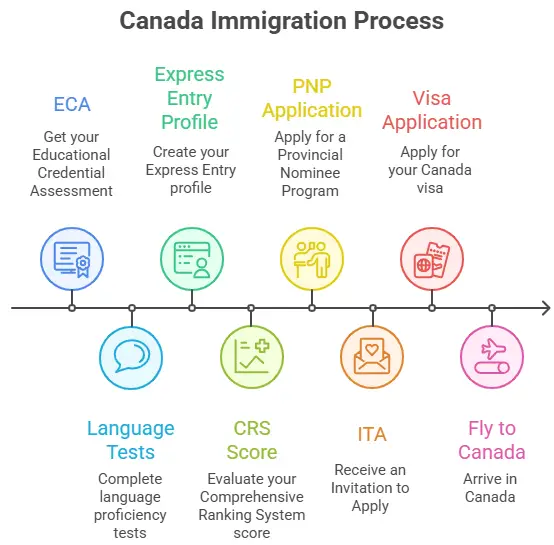
Canada Immigration Process
- Step 1: Get your ECA
- Step 2: Complete language tests
- Step 3: Create Express Entry profile
- Step 4: Evaluate CRS scoreStep 5: Apply for PNP
- Step 6: Receive ITA
- Step 7: Apply for Canada Visa
- Step 8: Fly to Canada
List of Canada Visas for Immigration
The list of Canada Visa for Indians includes:
- Canada Visit Visa
- Canada Student Visa
- Canada Digital Nomad Visa
- Canada Business Visa
- Canada Work Permit
- Caregiver Visa
- Spouse Open Work Permit (SOWP)
- Open Work Permit for US H-1B holders
- Canada Invest Visa
- Canada Dependant Visa
- Canada Parents and Grandparents Visa
- Canada Permanent Resident Visa
Canada Visa Processing Time
The Canada visa processing times are based on IRCC timelines.
| Type of Canada Visa | Processing Time of Canada Visa |
|---|---|
| Express Entry | On average, most Express Entry applications are processed within 6–27 months |
| FSWP via Express Entry: approximately 6–12 months (service standard 6 months) | |
| FSTP via Express Entry: 6–7 months | |
| CEC via Express Entry: up to 19 months | |
| PNPs via Express Entry (online): up to 14 months | |
| Canada PR Visa | At least 107 days |
| Canada PR Visa Renewal | Around 90 days |
| Canada Work Visa | At least 14 weeks |
| Labor Market Impact Assessment (LMIA) | 8–29 business days |
| Student Visa | Around 12 weeks |
| Canadian Citizenship | At least 24 months |
| Canada Visitor Visa | Minimum 164 days |
| Canada Spousal Sponsorship | Up to 20 months |
| Super Visa | Around 31 months |
| Post Graduate Work Permit (PGWP) | 2–6 months |
| Start-Up Visa | 31 months |
Canada Visa Fees for Indians
| Type of Canada Visa | Canada Visa Fee (CAD) |
|---|---|
| Express Entry Application | 1,590 (main applicant) + 1,590 (spouse) + 230 (per dependent child). Fees increased on April 30, 2026; figures reflect current post-increase rates. |
| Canada Work Visa | 155 - 200 |
| Study Visa | 150 |
| Canada Visitor Visa | 100 |
| Family Visa | 1,080 - 1,500 |
| Business Visa | 1,625 |
In-Demand White-Collar Occupations in Canada
The table below highlights the average annual salary ranges for some of the country's most in-demand white-collar jobs.
| Occupation | Annual Salary Range (CAD) | Approx. Annual Salary Range (INR) |
|---|---|---|
| AI / Machine Learning Engineer | $110,000 – $160,000 | ₹69.3 lakh – ₹1.01 crore |
| AI Product Manager | $120,000 – $170,000 | ₹75.6 lakh – ₹1.07 crore |
| Cloud Architect | $120,000 – $170,000 | ₹75.6 lakh – ₹1.07 crore |
| Cybersecurity Analyst | $85,000 – $125,000 | ₹53.6 lakh – ₹78.8 lakh |
| Data Scientist | $98,000 – $130,000 | ₹61.7 lakh – ₹81.9 lakh |
| Software Engineer | $100,000 – $140,000 | ₹63.0 lakh – ₹88.2 lakh |
| Physician / Medical Specialist | $275,000 – $340,000 | ₹1.73 crore – ₹2.14 crore |
| Nurse Practitioner | $90,000 – $120,000 | ₹56.7 lakh – ₹75.6 lakh |
| Pharmacist | $85,000 – $127,000 | ₹53.6 lakh – ₹80.0 lakh |
| Finance Manager / Controller | $90,000 – $140,000 | ₹56.7 lakh – ₹88.2 lakh |
| Marketing Manager | $62,000 – $125,000 | ₹39.1 lakh – ₹78.8 lakh |
| Sales Manager | $80,000 – $130,000 | ₹50.4 lakh – ₹81.9 lakh |
| HR Business Partner | $75,000 – $110,000 | ₹47.3 lakh – ₹69.3 lakh |
Canada Visa, Immigration, Permanent Residence, and Canadian Citizenship
Canada is currently one of the top countries for refugees and immigrants. You can migrate to Canada through Canadian PR programs, such as Express Entry, Canada PNP, and family sponsorship, among others. You can easily immigrate to Canada by meeting the Canada immigration requirements and passing the language test for Canada immigration.
Life in Canada for Indian Immigrants
The life of an Indian immigrant in Canada comes with a better lifestyle and top-quality education for children.
Indians prefer Canada due to its welcoming nature, eased immigration policies, high living standards, job prospects, career growth, free healthcare, and better retirement plans.
Read more....
All you need to know about an immigrant's life in Canada
Canadian Immigration and Visa Services for Indians
Y-Axis helps applicants choose the most ideally suited Canada immigration program. As one of India's most trusted Canada immigration consultants, Y-Axis has the experience and credibility to guide your migration journey.
Read more...
Canada Immigration and Visa Services
Canada Immigration News
The Y-Axis Canada immigration news page offers the latest and up-to-date Canadian immigration news. You can get the latest Canada immigration news developments, covering topics such as Express Entry, work permits, student visas, the Provincial Nominee Program, family sponsorship, and Canada PR Draws.
Read more...
Canada immigration news - Latest Canada Visa Updates
How can Y-Axis help you with Canada Immigration?
- Free eligibility check through the Canada Immigration Points Calculator
- Expert counseling for Canada Immigration
- Coaching services: CELPIP, IELTS
- Free career counseling
- Complete guidance for Canada PR visa
- Resume Marketing services for Canada
Y-Axis snapshot
1M
Successful applicants
1500+
Experienced counselors
25Y+
Expertise
50+
Offices
Looking For Inspiration
Explore what Global Indians have to say about Y-Axis in shaping their future