


Migrate to Denmark
Sign up for a free expert consultation

Don't know what to do?
Get Free Counseling
Last Updated 05 August 2026
Denmark Immigration from India — Pay Limit, Certified Employer Scheme, Positive List, PR & Complete Migration Guide
- Home to approximately 530,000 foreign-born residents (about 9% of the population)
- Get quality education free of cost
- Earn 5 x more than your current salary
- Avail Denmark's top healthcare services
- High standard of living
Jump to: Denmark Work Permits | Certified Employer (India) | Fast-Track | 2026 Updates | PR | Fees | FAQs | Why Denmark
Largest Cities in Denmark
The top five largest cities in Denmark are as follows:
- Copenhagen
- Arhus
- Odense
- Aalborg
- Frederiksberg
Denmark immigration from India
Important: The Denmark Green Card Scheme no longer exists. It was abolished in June 2016 (BS to confirm exact date) and has not been available to any applicant since. If you're researching Denmark immigration and have come across "Denmark Green Card" information elsewhere, that content is outdated.
Denmark currently offers five work permit pathways for Indian professionals: the Pay Limit Scheme, the Supplementary Pay Limit Scheme, the Certified Employer Scheme (which explicitly names India as an eligible country), the Positive List for Higher Education, and the Positive List for Skilled Work. Denmark does not participate in the EU Blue Card programme — Danish employers use these five routes instead.
If a residence permit is obtained under Denmark’s green card scheme, it is not required to apply for a work permit again. This is because a green card holder is allowed to work in Denmark.
To work in Denmark, you will need to apply for a permit to reside and work in Denmark.
Denmark Immigration Updates 2026:
- The Green Card Scheme no longer exists (abolished 2016)
- Pay Limit Scheme threshold: DKK 552,000/year
- Certified Employer Scheme: DKK 300,000/year for Indian nationals — India is one of 16 eligible countries
- Medical professionals: new permits for non-EU doctors and nurses are NOT being issued in 2026 (quota set to zero)
- Application fees increased to DKK 6,810 (main applicant) from January 1, 2026
Denmark Work Permits
Denmark has five main work permit pathways for non-EU professionals, including Indians (Source: SIRI):
- Pay Limit Scheme — minimum salary DKK 552,000/year (2026)
- Supplementary Pay Limit Scheme — minimum salary DKK 446,000/year (2026)
- Certified Employer Scheme — DKK 300,000/year for nationals of 16 countries including India (launched June 2025; requires a SIRI-certified Danish employer)
- Positive List for Higher Education — 180 shortage occupation titles (as of January 2026), no salary threshold required
- Positive List for Skilled Work — 54 shortage occupation titles (as of January 2026), no salary threshold required
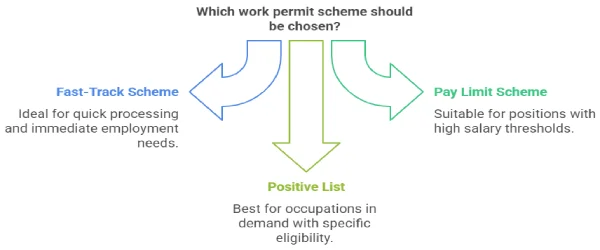
Fast-Track processing (approximately 1 month) is available across these schemes when the employer is SIRI-certified, compared to up to 3 months for standard processing.
Which route suits you depends on your role and salary. If your job is on a shortage-occupation list, the Positive List route requires no minimum salary. If your salary meets DKK 552,000, the Pay Limit Scheme applies regardless of occupation. If your Danish employer is SIRI-certified, you may qualify for the Certified Employer Scheme at the reduced DKK 300,000 threshold.
To check whether your job title is currently on the Denmark Positive List, visit SIRI.dk. SIRI updates both lists on January 1 and July 1 each year — ensure your job title closely matches the listed title, as misclassification is the most common rejection reason.
Important note for Indian doctors and nurses: New temporary residence permits for non-EU medical professionals are NOT being issued in 2026 — SIRI has set the quota to zero. If you're an Indian doctor or nurse planning to migrate to Denmark, new applications will not be accepted until 2027 at the earliest. Existing permit holders can still apply for renewals.
Note: Denmark does not participate in the EU Blue Card programme, unlike Germany, Sweden, and most other EU countries — a result of Denmark's opt-outs under the 1992 Maastricht Treaty. In 2024, EU countries issued approximately 78,100 Blue Cards; Denmark issued zero. An EU Blue Card obtained in another EU country cannot be used to work in Denmark — a separate Danish work permit is required.
Note for Indian IT companies posting employees to Denmark: From January 1, 2026, foreign companies temporarily posting employees to Denmark (relevant for firms like Infosys, TCS, Wipro, HCL, and Cognizant) must provide additional RUT registration documentation, including a copy of the service agreement between the foreign and Danish companies. Non-compliance fines range from DKK 10,000–50,000.
Denmark Work Permit Fees (2026)
- Main applicant: DKK 6,810 (up from DKK 6,055 in 2025)
- Accompanying family member: DKK 3,080 per person
Fees are non-refundable and apply to both new and extension applications. Budget additionally for certified translations (DKK 500–1,000 per document), private health insurance (~DKK 2,000/year initially), and a police clearance certificate from India. Employers sometimes cover the main application fee — confirm with your employer before applying.
Just three reasons why you would want to migrate to Denmark
- A well-balanced family and work-life
- Excellent business climate and
- An efficient welfare state
Certified Employer Scheme — India-Specific Pathway
India is one of 16 non-EU countries specifically named as eligible for Denmark's Certified Employer Scheme, launched June 2025. This scheme allows Indian nationals to obtain a Denmark work permit at a reduced threshold of DKK 300,000/year (approximately INR 24 lakh/year) — 46% below the standard Pay Limit threshold — provided the employer is SIRI-certified.
The other 15 eligible countries: USA, UK, Singapore, China, Japan, Australia, Canada, Brazil, Malaysia, Montenegro, Serbia, North Macedonia, Albania, Ukraine, and Moldova.
Requirements:
- The Danish employer must hold valid SIRI certification (valid 3 years, renewable for 4)
- The job offer must be for at least 30 hours/week with salary paid to a Danish bank account
- The role must fall under an approved high-demand occupation category
Sectors benefiting most: healthcare support, hospitality, construction, logistics, and mid-skill IT.
Eligibility Requirements
- You must be at least 18 years old.
- You are still in compliance with the conditions of your current residence permit.
- You’ve been a resident of Denmark for the past eight years.
- Criminal Clearance certificate
- You passed the second Danish language test 2.
- In the four years preceding your application for permanent residence, you have worked for at least three years and six months.
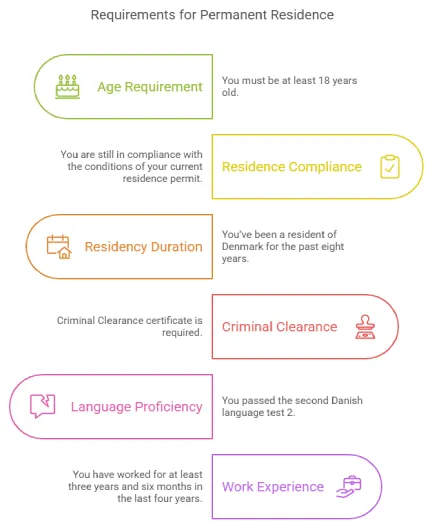
If you meet all of the basic conditions and two of the four additional requirements, you can apply for permanent residency after only four years in the nation.
- You have passed the Danish language test number three.
- You’ve been at your current job for at least four years.
- You passed the active citizen exam or demonstrated active citizenship in some way.
- You earned more than 286,525 DKK every year on average (approximately INR 22.9 lakh/year — BS to verify current figure and exchange rate).
The processing time for a Danish permanent residence application could take up to eight months.
Denmark Permanent Residency
Denmark permanent residency requires 8 years of continuous legal residence under the standard route, or 4 years if you meet the basic conditions plus at least two of four additional criteria (Danish Language Test 3, 4 years with the same employer, active citizenship evidence, or an average income above DKK 286,525/year — BS to verify current figure)..
At any time, you can seek for permanent residency. You do not have to wait until your current residency permit expires to apply. However, your application must be submitted before your current resident permit expires.
Why choose Denmark?
The Kingdom of Denmark commonly known as Denmark, is a country in the Scandinavian region of northern Europe, The mainland is bordered by Germany, Sweden and Norway. Denmark borders both the Baltic and the North Sea. Denmark is a constitutional monarchy with a parliamentary system of government.
Denmark is a member state of the European Union. The Global Peace Index survey ranks Denmark among the most peaceful countries in the world. Denmark has also consistently ranked among the least corrupt countries globally (Transparency International — BS to confirm latest year).
Copenhagen has been ranked among the world's most livable cities by Monocle magazine (BS to confirm latest ranking year). Approximately 9% of Denmark's population holds foreign citizenship.
Copenhagen was ranked as the most livable city in the world by Monocle magazine, about 9% of the population has foreign citizenship. A large portion of foreign citizens are of Scandinavian ancestry, while the rest are of a variety of Nationalities.
Denmark's population is approximately 5.96 million (2025). Danish is the official language and is spoken throughout the country. English and German are the most widely spoken foreign languages.
Denmark has a GDP per capita income higher than that of most European countries and 15-20% higher than that of the United States.
Denmark vs Germany vs Sweden for Indian Professionals (2026)
| Criteria | Denmark | Germany | Sweden |
|---|---|---|---|
| Key Work Visa Route | Pay Limit Scheme / Certified Employer Scheme | EU Blue Card | EU Blue Card |
| Minimum Salary Threshold | DKK 552,000/year (Pay Limit); DKK 300,000/year under Certified Employer Scheme | EUR 50,700/year | SEK 52,000+/month |
| EU Blue Card Available | No | Yes | Yes |
| India-Specific Provision | Certified Employer Scheme explicitly names India | None specified | None specified |
| Path to Permanent Residency | Not specified | ~21 months (with B1 German) | ~21 months (with B1 Swedish) |
| Path to Citizenship | Not specified | 5 years | 8 years (from June 2026) |
| Wage Level | Highest in Scandinavia | Not specified | Not specified |
| Work–Life Balance | Strong | Not specified | Not specified |
| Workplace Language | English widely used | German (B1 required for PR) | Swedish (B1 required for PR) |
| Existing Indian Community | Not specified | Large | Not specified |
| Key Differentiator | Explicit India inclusion in the Certified Employer Scheme, Europe's highest wages, and strong work–life balance | Established Indian diaspora and relatively fast PR/citizenship timeline | Long-standing Blue Card route, though the citizenship timeline is lengthening in 2026 |
How can Y-Axis help you?
Y-Axis, the world’s best immigration company, provides unbiased immigration services for every client based on their interests and requirements. The impeccable services of Y-Axis include:
- Expert guidance to migrate to Denmark.
- Resume marketing services to find related jobs in Denmark.
- Expert free career counseling, book you slot today!
Y-Axis snapshot
1M
Successful applicants
1500+
Experienced counselors
25Y+
Expertise
50+
Offices
Looking For Inspiration
Explore what Global Indians have to say about Y-Axis in shaping their future