
Ireland Tourist Visa
Down Arrow
Down Arrow
Down Arrow

I accept the Terms & Conditions

Free Counseling
Don't know what to do?

Get Free Counselling

Why Apply for an Ireland Tourist Visa?

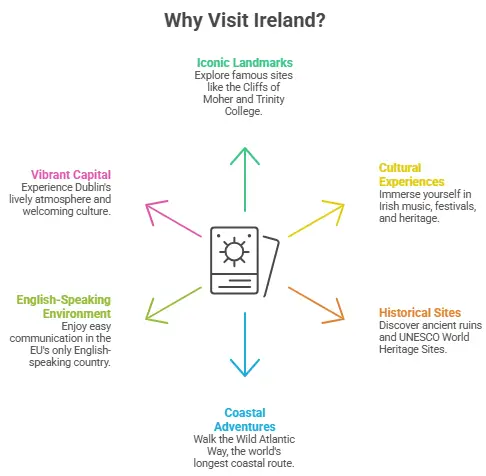
  • Home to iconic landmarks like the Cliffs of Moher, Ring of Kerry, and Trinity College Dublin.
  • Experience world-famous Irish music, festivals, and centuries of rich cultural heritage.
  • Explore over 30,000 castles, ancient ruins, and UNESCO World Heritage Sites.
  • Walk the Wild Atlantic Way — the longest coastal touring route in the world at 2,500 km.
  • Ireland is the only English-speaking country in the European Union.
  • Visit Dublin, one of Europe's most vibrant and welcoming capital cities.
Ireland tourist visa

Ireland Visa for Indians

Ireland is one of Europe's most sought-after travel destinations, and Indian nationals require a visa to visit. The most commonly applied for is the Ireland Tourist Visa, also known as the Short Stay 'C' Visit Visa, allows Indian travellers to visit Ireland for up to 90 days for tourism, family visits, or short-term purposes. As the only English-speaking country in the EU, Ireland is an increasingly popular short-stay destination for Indians, with a growing diaspora, strong economic ties, and world-renowned attractions. Whether you are planning a leisure trip, visiting family, or attending a short course, applying for an Ireland visit visa from India can be a smooth process with proper preparation and assistance from Y-Axis.

*Want to apply for an Ireland tourist visa? Sign up with Y-Axis to help you with the process. 

Types of Ireland Tourist Visa

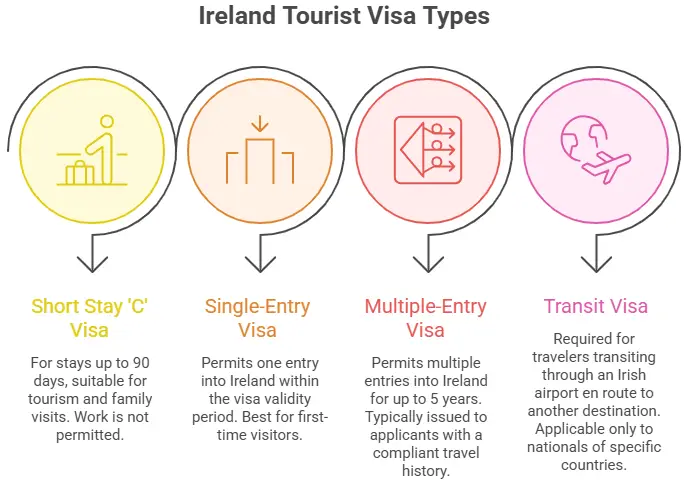
  • Short Stay 'C' Visa: The standard Ireland tourist visa for stays of up to 90 days. Suitable for tourism, family visits, short-term study, marriage, and medical treatment. Work of any kind, paid or unpaid, is not permitted on this visa.
  • Single-Entry Visa: Permits one entry into Ireland within the visa validity period. Best suited for first-time visitors or those planning a one-time trip.
  • Multiple-Entry Visa: Permits multiple entries into Ireland for up to 5 years. Typically issued to applicants with a compliant travel history of at least two previous Irish visas.
  • Transit Visa: Required for travelers transiting through an Irish airport en route to another destination. Applicable only to nationals of specific countries as determined by Immigration Service Delivery (ISD).
Ireland tourist visa types

Benefits of an Ireland Visit Visa

  • Tourism & Family Access: Ideal for travellers visiting family, attending events, or exploring Ireland’s scenic and cultural attractions.
  • English-speaking countries: Easy communication for Indian travellers with no language barrier.
  • Ease of Exploration: Ireland's compact size and well-connected transport links make it easy for visitors to explore multiple destinations, from Dublin to the Wild Atlantic Way, within a short stay.
  • Safe & Welcoming Environment: Ireland ranks among Europe’s safest and most tourist-friendly nations.
  • Strong Indian Diaspora: A large Indian community offers familiarity and comfort to visiting families.

Top 5 Best Places to Visit in Ireland

Ireland is one of the most enchanting destinations in Europe, known for its lush green landscapes, ancient castles, and warm, welcoming culture. Ireland is one of the best tourist destinations for those seeking a blend of history, natural beauty, and authentic local experiences.

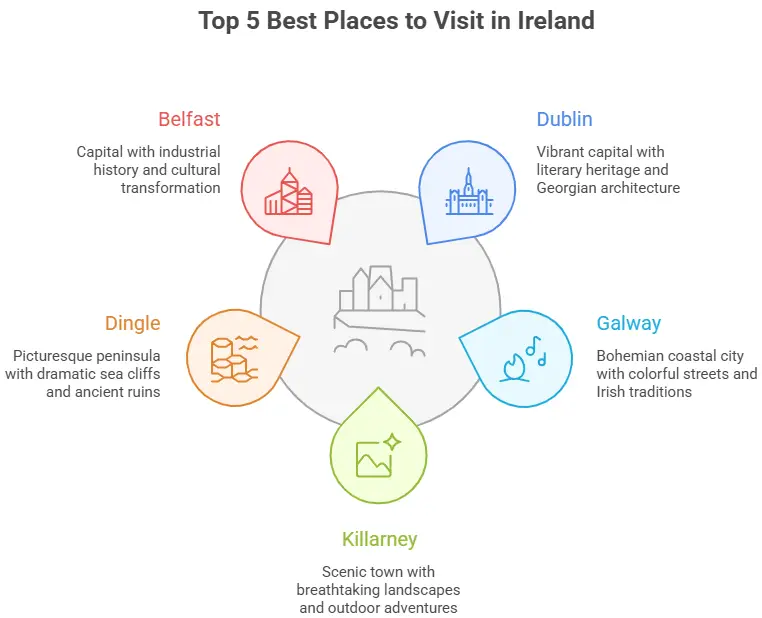
Here are the top 5 places to visit in Ireland:

  • Dublin: This vibrant city is the capital of Ireland and is widely known for its literary heritage, Georgian architecture, and lively pub culture. Dublin is home to landmarks such as Dublin Castle, Trinity College (where you can see the famous Book of Kells), and St. Patrick's Cathedral. You can visit the National Museum of Ireland and the Guinness Storehouse if you are a history or culture enthusiast. Dublin is famous for its traditional Irish pubs, where live music and storytelling reflect the city's rich cultural soul.
  • Galway: This charming coastal city is famous for its bohemian atmosphere, colourful streets, and strong connection to the Irish language and tradition. Some of the must-visit spots in Galway include Eyre Square, the Latin Quarter, and the nearby Cliffs of Moher, one of Ireland's most iconic natural landmarks. You can also experience the city's vibrant arts and festival culture year-round.
  • Killarney: This scenic town is situated on the shores of Lough Leane, surrounded by the magnificent Killarney National Park. Killarney is known for its breathtaking landscapes, including the famous Ring of Kerry driving route, Muckross House, and Torc Waterfall. The town is a gateway to some of Ireland's most stunning countryside and outdoor adventures.
  • Dingle: This picturesque peninsula on Ireland's rugged southwest coast is one of the country's most beloved places. Located along the Wild Atlantic Way, it offers dramatic sea cliffs, golden beaches, and ancient ruins, including beehive huts dating back thousands of years. Dingle is renowned for its traditional Irish music scene, fresh seafood, and the friendly locals who still speak Irish as their first language.
  • Belfast: Northern Ireland's capital city is famous for its fascinating industrial history, impressive Victorian architecture, and remarkable transformation into a thriving cultural destination. You can explore the Titanic Belfast museum, the Cathedral Quarter, and the historic Crumlin Road Gaol. The city is known for its vibrant food scene, street art, and the iconic Black Taxi tours that bring its complex history to life.
Places to Visit in Ireland

Ireland Visit Visa: Key Travel Statistics and Trends

  • Iconic Tourist Destination: Ireland is home to world-renowned attractions, including the Cliffs of Moher, the Ring of Kerry, the Guinness Storehouse, and Trinity College Dublin, which draw millions of international visitors year-round for its landscapes, heritage, and culture.
  • Rich Cultural & Heritage Appeal: Ireland boasts over 30,000 castles, numerous UNESCO World Heritage Sites, and the world's longest coastal touring route — the Wild Atlantic Way, stretching 2,500 km — making it one of Europe's most diverse sightseeing destinations.
  • Strong Indian Community: Indians rank among the top non-EU nationalities residing in Ireland, with one of the fastest-growing diaspora communities in Europe — making Ireland a natural and familiar destination for Indian visitors.
  • Only English-Speaking EU Country: As the sole English-speaking nation within the EU, Ireland offers Indian travellers seamless communication, cultural ease, and a welcoming environment throughout their stay.
  • Safe & Visitor-Friendly Nation: Ireland consistently ranks among Europe's safest countries, with a well-developed tourism infrastructure, reliable public transport, and a globally recognised hospitality culture.
  • Year-Round Travel Appeal: Ireland attracts visitors year-round, from its lively St. Patrick's Day festivals to summer coastal tourism.

Eligibility Criteria for an Ireland Visit Visa (Type C)

To qualify for an Ireland Visit Visa, applicants must meet the following mandatory eligibility requirements:

  • Valid Passport: Must be valid for at least 6 months beyond your intended departure date from Ireland, with copies of all previous visas (if applicable).
  • Genuine Temporary Intent: Must clearly demonstrate intent to visit Ireland temporarily and return to the home country after the visit.
  • Financial Stability: Must show proof of sufficient funds to cover all expenses during the trip (bank statements for at least 6 months, income proof, or sponsorship documents).
  • Proof of Accommodation: Provide confirmed hotel bookings, rental agreements, or an invitation letter from a host residing in Ireland.
  • Ties to Home Country: Must provide proof of strong economic or social ties such as employment, business ownership, family responsibilities, or property ownership.
  • Clean Immigration Record: Must not have previous visa overstays, deportations, or violations in Ireland or any other country.
  • Purpose of Visit: Must submit documents supporting the declared purpose — tourism, family visit, short-term study, marriage, or medical treatment.
  • Health & Character: Must be in good health and possess a clear criminal record. Police clearance may be required for certain applicants.
  • Travel & Medical Insurance: Must have valid travel insurance in place before travelling to Ireland, covering medical emergencies and repatriation.
  • Biometrics: Indian residents must provide fingerprints at a VFS Visa Application Centre at the time of submission.
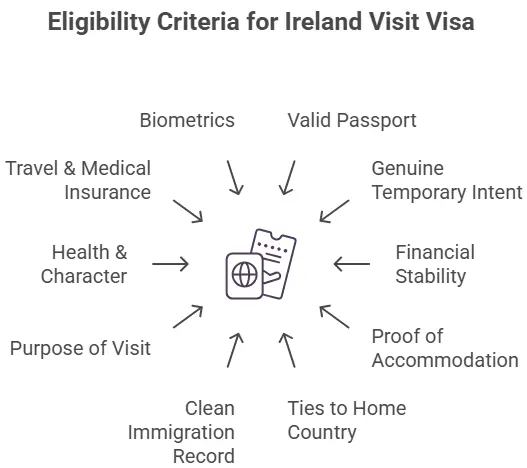
Ireland visit visa eligibility

Requirements for an Ireland Tourist Visa

The Ireland Tourist Visa requirements for Indians are as follows:

  • AVATS Application Form (printed, signed, and dated)
  • VFS Payment Receipt
  • Two Passport-Size Photographs (as per ISD photo standards)
  • Current Passport (valid for at least 6 months after planned departure from Ireland)
  • Copies of previous passports (biographic pages and all stamps/visas)
  • Application Letter (purpose of visit and planned itinerary)
  • Proof of Accommodation or Invitation Letter from the host in Ireland
  • Proof of Employment, Studies, or Ties to Home Country
  • 6-Month Bank Statement (personal or sponsor's)
  • Travel & Medical Insurance (required before travelling to Ireland)
  • Previous Visa Refusal Letters (if applicable)
  • Parental Consent Documents (for applicants under 18)
  • Biometrics at VFS (mandatory for all Indian residents)

*Want to apply for a visit visa? Let Y-Axis guide you with the steps. 

Steps to Apply for an Ireland Tourist Visa from India

Step 1: Determine the type of Irish tourist visa you need based on your purpose of visit and the duration of your stay.

Step 2: Complete your online visa application form on the AVATS portal, print the summary sheet, and sign it.

Step 3: Pay the visa fee online through the AVATS portal at the time of application submission.

Step 4: Book an appointment at your nearest VFS Global Visa Application Center (VAC) in India.

Step 5: Gather all required documents as per the official checklist.

Step 6: Attend your VFS appointment and submit your documents along with your passport. Biometrics (fingerprints) will be collected at this stage.

Step 7: Your application is forwarded to the Embassy of Ireland in New Delhi for processing.

Step 8: Once a decision is made, your passport is returned to you via VFS with the visa stamped if approved.

Ireland Tourist Visa Processing Time

The standard processing time for an Ireland tourist visa from India is typically 20–25 working days from the date the documents are received at the Embassy. Processing times may vary depending on application volume, completeness of documents, and the time of year. It is recommended to apply at least 3 months before your intended travel date.

Ireland Visit Visa Fees

Type Fee
Single-Entry Visa € 60
Multiple-Entry Visa € 100
Transit Visa € 25

How Can Y-Axis Help You?

Y-Axis is one of the world’s leading visa and immigration consultancies. Our experience and expertise in the visit visa process makes us your partner of choice for your visa application. Our teams will help you with:

  • Immigration documents checklist
  • Complete application processing
  • Forms, documentation & application filing
  • Assistance with booking appointments for Interviews 
  • Preparing the client to face the Interview at the Consulate
  • Updates & Follow-up
Sign up for a free consultation
Down Arrow
Down Arrow
Down Arrow

I accept the Terms & Conditions

Free Counseling
Don't know what to do?

Get Free Counselling

Looking For Inspiration

Explore What Global Indians have to say about Y-axis

Frequently Asked Questions

Do Indians need a visa to visit Ireland?
plus

Yes, Indian passport holders are required to obtain a visa before travelling to Ireland. Ireland is not part of the Schengen Area, which means a Schengen visa does not grant entry into Ireland. Indian nationals must apply for a separate Ireland Short-Stay Visa (Type C) through the Irish Naturalisation and Immigration Service (INIS). The only exceptions are holders of valid UK visas or UK Biometric Residence Permits, who may be eligible to travel to Ireland without a separate Irish visa under certain conditions.

What type of visa do I need to visit Ireland for tourism?
plus

For tourism purposes, Indian nationals need to apply for a Short-Stay Visa (Type C). This visa is designed for short visits including tourism, sightseeing, visiting family or friends, attending events, or short-term business activities. The visa allows a stay of up to 90 days. Depending on your travel needs, you can apply for a single-entry or multiple-entry visa. The application is submitted online via the AVATS (Automated Visa Application Tracking System) portal managed by INIS.

How long can I stay in Ireland on a tourist visa?
plus

On an Ireland tourist visa (Type C), you are permitted to stay for a maximum of 90 days. However, the actual duration of stay permitted is decided by the Immigration Officer at the port of entry, not solely by your visa. It is important to carry all your supporting documents — including your return ticket, proof of accommodation, and financial evidence — when you arrive, as these will be reviewed at the border before entry permission is granted.

How much does an Ireland tourist visa cost for Indians?
plus

The Ireland tourist visa fee is €60 for a single-entry visa and €100 for a multiple-entry visa. In addition to the visa fee, you will also need to pay the VFS Global service fee of approximately INR 1,800–2,000, depending on the city of application. Payments are made online via the AVATS portal or at the VFS Global centre using a credit/debit card or bank draft. Note that visa fees are non-refundable, even if your application is rejected.

How long does it take to process an Ireland tourist visa?
plus

Standard processing time for an Ireland tourist visa is typically 4 to 8 weeks from the date of document submission. During peak travel season (April to September), processing can extend up to 10 weeks due to high application volumes. It is strongly recommended to apply at least 8–10 weeks before your intended travel date to avoid delays. Early applications are encouraged, and you can apply up to 3 months in advance of your planned travel date.

What documents do I need to apply for an Ireland tourist visa?
plus

The key documents required include a valid passport (with at least 6 months' validity and two blank pages), completed AVATS application form, recent passport-sized photographs, a cover letter explaining your purpose of visit, confirmed flight itinerary, proof of accommodation (hotel booking or invitation letter), 6 months of bank statements, salary slips or income tax returns, travel insurance, employment letter with leave approval, and proof of strong ties to India such as property documents or family responsibilities. All documents must be accurate and genuine to avoid rejection.

Do I need travel insurance to apply for an Ireland tourist visa?
plus

Yes, valid travel and medical insurance is mandatory for an Ireland tourist visa application. Your insurance policy must cover the entire duration of your planned stay in Ireland and must include coverage for medical emergencies and repatriation. While there is no fixed minimum coverage amount specified (unlike Schengen visas), it is advisable to have comprehensive coverage. Ensure your insurance certificate clearly mentions the dates of coverage, the country covered, and the policyholder's name matching your passport.

Can I apply for an Ireland tourist visa if I have a valid Schengen visa?
plus

Ireland is not part of the Schengen Area, so a Schengen visa alone does not grant entry into Ireland. You must apply for a separate Irish visa. However, if you hold a valid UK visa or a valid UK Biometric Residence Permit (BRP), you may be eligible to travel to Ireland without a separate Irish visa under the British-Irish Visa Scheme (BIVS). It is advisable to verify your eligibility on the official INIS website before making any travel plans.

Where do I submit my Ireland tourist visa application from India?
plus

You need to submit your Ireland tourist visa application online via the AVATS portal (avats.inis.gov.ie). After completing the online form, you must print the summary sheet, sign it, and submit it along with all supporting documents to the VFS Global centre in India, the Irish Embassy in New Delhi, or the Consulate in Mumbai, depending on your location. First-time applicants are generally required to appear in person for document submission and biometric data collection.

What is the AVATS portal and how do I use it?
plus

AVATS (Automated Visa Application Tracking System) is the official online portal used by the Irish Naturalisation and Immigration Service (INIS) to process all short-stay visa applications. To use it, visit the AVATS website, create an account, complete the visa application form with accurate personal, travel, and financial information, upload required documents, and pay the visa fee online. After submission, print and sign the summary sheet and submit it along with your physical documents to the designated visa application centre.

How much money do I need to show in my bank account for an Ireland tourist visa?
plus

While there is no officially fixed minimum bank balance requirement, you must demonstrate sufficient funds to cover your entire stay in Ireland, including accommodation, food, transport, and other expenses. As a general guideline, having a minimum balance equivalent to €50–€100 per day of stay is recommended. You must submit 6 months of bank statements showing a stable financial history. A sudden large deposit just before applying may raise concerns with the visa officer, so maintain a consistent account balance over time.

Can I visit Ireland on a tourist visa for business purposes?
plus

Yes, an Ireland Short-Stay Visa (Type C) also permits short-term business activities such as attending conferences, trade fairs, business meetings, seminars, and exhibitions. However, the visa does not allow you to take up employment or engage in paid work in Ireland. For business visits, you will need to submit additional documents such as an invitation letter from the Irish company or event organiser, details of the business relationship, and proof of your company registration or employment in India.

Can I extend my Ireland tourist visa once I am in the country?
plus

In general, extending a short-stay tourist visa from within Ireland is not straightforward and is only considered in exceptional circumstances such as a medical emergency or other unavoidable situations. You cannot extend your visa simply because you wish to stay longer. Overstaying your permitted time can have serious consequences, including being banned from future entry into Ireland and other countries. If you anticipate needing more time, consider applying for a multiple-entry visa or planning your trip within the 90-day limit.

Is it possible to get a multiple-entry Ireland tourist visa?
plus

Yes, you can apply for a multiple-entry Ireland tourist visa, which costs €100. This visa allows you to enter and exit Ireland multiple times within its validity period without reapplying each time. It is particularly useful for frequent travellers, those visiting family regularly, or business visitors who travel to Ireland more than once a year. In your cover letter, clearly state the reason for requiring a multiple-entry visa. The granting of a multiple-entry visa is at the discretion of the visa officer.

What happens if my Ireland tourist visa application is rejected?
plus

If your Ireland tourist visa is rejected, you will receive a written explanation outlining the reasons for refusal. You have the right to appeal the decision within two months of receiving the refusal. The appeal must be submitted in writing to the Irish Visa Appeals Office with additional supporting documents addressing the reasons for rejection. Common reasons for rejection include insufficient financial proof, weak ties to the home country, incomplete documentation, or doubts about genuine temporary intent. Addressing these issues thoroughly in your appeal improves your chances of approval.

Do I need to book confirmed flight tickets before applying for the Ireland visa?
plus

Confirmed flight tickets are not mandatory at the time of application. You only need to provide a tentative travel itinerary with planned entry and exit dates and the cities you intend to visit. This makes the application process more flexible, as you do not need to purchase tickets before visa approval. However, once your visa is approved, you must book flights and travel within the visa's validity period. It is advisable to apply well in advance so you have enough time to plan and book accordingly.

Can I bring my family along on an Ireland tourist visa?
plus

Yes, each family member intending to visit Ireland must apply for an individual Ireland tourist visa. There are no joint or family visas available. Each applicant must submit their own complete set of documents. For children travelling with parents, additional documents such as birth certificates and parental consent letters may be required. If a child is travelling with only one parent, a notarised letter of consent from the other parent is typically needed. Ensure all family members apply well in advance of the planned travel date.

Will I be interviewed when applying for an Ireland tourist visa?
plus

A formal visa interview is not typically required for standard Ireland tourist visa applications. However, the visa officer may contact you for additional documents or clarifications during the processing period. First-time applicants are usually required to appear in person at the VFS Global centre for document submission and biometric data collection. It is important to ensure all documents are accurate and complete to avoid unnecessary delays. If you have a complex application history or previous visa refusals, additional scrutiny may apply.

What are the most common reasons for Ireland tourist visa rejection?
plus

The most common reasons for rejection include insufficient financial proof, inability to demonstrate strong ties to the home country (such as employment, property, or family), incomplete or inconsistent documentation, previous visa overstays or immigration violations, unclear or unconvincing purpose of visit, and a history of visa refusals in other countries. To minimise the risk of rejection, ensure your cover letter is clear and compelling, your bank statements reflect genuine financial stability, and all supporting documents are consistent, complete, and truthful.

Can I travel to the UK from Ireland on my Ireland tourist visa?
plus

Your Ireland tourist visa does not automatically grant you entry into the United Kingdom. The UK and Ireland are separate visa jurisdictions, and each requires its own visa for Indian nationals. If you plan to visit both countries, you must apply for both an Ireland visa and a UK Standard Visitor Visa separately. However, if you already hold a valid UK visa, you may be eligible to enter Ireland without a separate Irish visa under the British-Irish Visa Scheme (BIVS). Always verify the latest entry requirements on official government websites before travelling.