


Don't know what to do?
Get Free Counselling
Last Updated 21 September 2026
Spain Visit Visa from India: Requirements, Documents, Fees & How to Apply
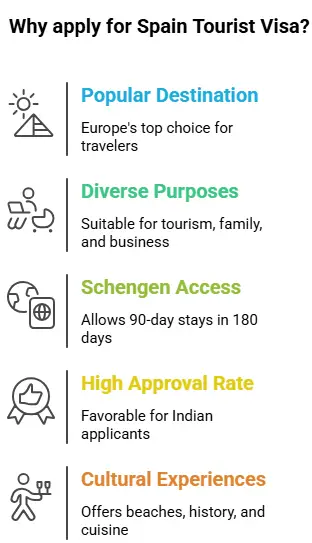
- Spain is one of Europe's most popular and vibrant travel destinations
- You can visit for tourism, family visits, or short business trips
- Schengen visa allows stays up to 90 days in a 180-day period
- Good visa approval rate for Indians
- Explore beaches, historic cities, flamenco culture, and world-famous cuisine
A Spain Visit Visa is a short-term visa that allows travellers to visit Spain for tourism, meeting family or friends, or attending short business meetings and events. It is suitable for people who plan to stay for a short time and return to their home country after the visit.
Spain is becoming one of the top travel destinations for Indian travellers. In 2024, more than 226,000 Indians visited Spain. Interest is still growing, about 98% of Indian travellers planning a Europe trip want to visit Spain, and 57% plan to spend most of their time there. Spain is also one of the most visited countries in the world. In 2025, it welcomed 93.8 million international tourists, which is 10.2% higher than the previous year.
Spain is a member of the European Union and the Schengen Area. As of January 2025, following the full accession of Romania and Bulgaria, the Schengen Area comprises 29 member countries. The Spain Schengen Visa (Type C) gives its holder the right to travel freely across all 29 Schengen member countries for up to 90 days within any 180-day period. This visa can be issued as a single-entry or multiple-entry visa, depending on your travel purpose.
Types of Spain Visit Visa
Single Entry Schengen Visa (Type C): This visa allows you to enter Spain only once. You can stay for up to 90 days within a 180-day period. It is best for a single trip, such as tourism, visiting family, or attending an event. Once you leave the Schengen Area, the visa cannot be used again.
Multiple Entry Schengen Visa (Type C): This visa lets you enter and exit Spain and other Schengen countries multiple times during its validity. Validity can be up to 5 years for multiple-entry visas, making it useful for frequent travellers to Europe.
Short Stay Business Visa (Type C): This visa is issued to business travellers who need to travel within the Schengen Area for business purposes such as meetings, trade fairs, or conferences. It does not allow you to work or earn money in Spain.
Family Visit Visa (Type C): This visa is for visiting family members or close friends living in Spain. If you are staying with friends or family in Spain, you will need a carta de invitación, which your host must apply for in person at their local police station.
Airport Transit Visa (Type A): This visa is for travellers who need to transit through the Schengen area. It consists of two types: the Airport Transit Visa (ATV) and the Seamen Transit Visa (STV). It is required only for certain nationalities.
National Long-Stay Visa (Type D): This visa is for people who want to stay in Spain for more than 90 days, up to one year. It is used for work, study, or joining family, not for tourism.
Top 10 Places to Visit in Spain
Spain is a diverse country in southwestern Europe. It has beaches, mountains, historic cities, and stunning architecture.
Here are 10 places you should visit:
- Barcelona: Barcelona is one of the most famous cities in Spain. It is known for the Sagrada Família, Park Güell, and the lively Las Ramblas boulevard. The city blends art, architecture, and beach life perfectly.
- Madrid: Madrid is the capital of Spain. It has world-class museums like the Prado, a grand royal palace, and a buzzing food and nightlife scene. It is a city full of culture and energy.
- Seville: Seville is the heart of flamenco and Andalusian culture. It is home to the iconic Alcázar palace, a stunning cathedral, and the charming Barrio Santa Cruz neighbourhood.
- Granada: Granada is famous for the Alhambra, a breathtaking Moorish palace and fortress set against the Sierra Nevada mountains. It is one of the most visited historic sites in all of Europe.
- Valencia: Valencia is known for its futuristic City of Arts and Sciences, beautiful beaches, and as the birthplace of paella. It is a modern city with a rich cultural heritage.
- Córdoba: Córdoba is home to the Mezquita, a stunning mosque-cathedral that reflects Spain's Islamic and Christian history. The old city is a UNESCO World Heritage Site.
- San Sebastián: San Sebastián is a coastal city in the Basque Country, famous for its pintxos food culture, beautiful beaches, and one of the highest concentrations of Michelin-starred restaurants in the world.
- Toledo: Toledo is a medieval city perched on a hilltop above the Tagus River. It is known as the "City of Three Cultures" for its blend of Christian, Muslim, and Jewish heritage.
- Bilbao: Bilbao is a modern city in northern Spain, transformed by the iconic Guggenheim Museum. It combines contemporary architecture with a vibrant food scene and scenic riverside setting.
- Mallorca: Mallorca is the largest of the Balearic Islands. It offers stunning beaches, crystal-clear waters, dramatic cliffs, and charming hilltop villages, making it ideal for relaxation and sightseeing.
*Want to visit abroad? Talk to Y-Axis for complete guidance.
Eligibility for Spain Tourist Visa
Indian passport holders can apply for a Spain Schengen tourist visa (Type C) at BLS International if they have a valid Indian passport with at least 3 months' validity beyond their intended return date, travel insurance covering a minimum of €30,000, a confirmed return ticket, proof of accommodation, and proof of sufficient funds.
To apply for a Spain Tourist Visa, you must meet these requirements:
- A valid passport issued in the last 10 years, with at least 2 blank pages, and valid for at least 3 months after you leave the Schengen area
- A clear reason for travel, such as tourism, visiting family, or business meetings
- Proof of sufficient funds — minimum €113.40 per person per day of stay
- Confirmed return flight tickets
- Proof of accommodation in Spain
- Travel insurance with at least €30,000 coverage for medical emergencies
- No criminal record or past visa or immigration issues
Spain Visit Visa Requirements
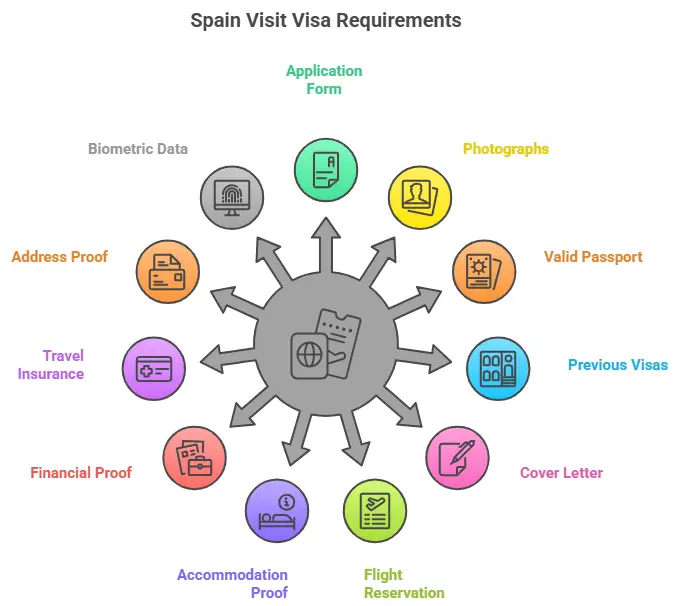
When applying for a Spain Tourist Visa, you need to submit the following documents:
- Completed and signed Schengen visa application form and signed declaration
- Recent passport-size photographs as per Schengen photo specifications
- Valid passport issued within the last 10 years
- Copies of previous Schengen or Spanish visas, if any
- Cover letter explaining the purpose of visit and travel plans
- Confirmed flight reservation
- Proof of accommodation (hotel booking or host invitation letter)
- Proof of sufficient financial means such as bank statements or employment contract
- Travel medical insurance with minimum €30,000 coverage valid across the Schengen Area
- Address proof in home country
- Biometric data submitted in person at the visa centre
Step-by-Step Spain Tourist Visa Application
Step 1: Choose the correct visa type (Single Entry or Multiple Entry, Type C Schengen) based on your travel purpose and plans.
Step 2: Complete the Spain Schengen visa application form accurately via the official Spanish embassy portal or BLS International website.
Step 3: Gather all required documents including passport copy, photographs, travel insurance, flight tickets, and accommodation proof.
Step 4: Book an appointment at the nearest BLS International centre in your city (available in Delhi, Mumbai, Bengaluru, Chennai, Hyderabad, and Kolkata).
Step 5: Attend your appointment in person and submit your application along with biometric data.
Step 6: Pay the applicable Spain visa fee at the centre.
Step 7: Wait for visa processing and receive the decision by email or SMS.
Step 8: Collect your passport with the visa from the centre, then travel to Spain and present your visa and supporting documents at immigration.
*Want to apply for a Schengen visa? Let Y-Axis help you with the process.
Spain Tourist Visa Processing Time
Spain Schengen visa processing takes a minimum of 15 calendar days from receipt of a complete application, under Schengen Visa Code Article 23 (Regulation (EC) No 810/2009). In practice, the Spanish Consulate or BLS International typically takes 15–30 calendar days depending on application volume and documentation completeness. In exceptional cases requiring additional document verification, processing may take up to 60 calendar days. Apply at least 4 weeks before your travel date to allow a comfortable buffer.
Spain Tourist Visa Fee
The cost of a Spain Visit Visa depends on the applicant's type and age. The visa fee is non-refundable in case of refusal, and the service fee is non-refundable once the appointment is confirmed.
| Type | Approximate Cost |
|---|---|
| Schengen Visa – Adult (18+) | €90 (approx. ₹8,200–₹8,920) |
| Schengen Visa – Child (6–12 years) | €45 (approx. ₹4,100–₹4,600) |
| Schengen Visa – Child (under 6 years) | Free |
| BLS International Service Charge | ₹1,675 (per application) |
| National Visa (Type D) | €116–€135 (approx. ₹10,800–₹12,400) |
EU Entry/Exit System (EES) at Schengen Borders
The EU Entry/Exit System (EES) has been fully operational at all 29 Schengen external borders — including all Spanish airports and land crossings — since April 10, 2026; it replaces passport stamps with digital biometric registration and automatically tracks the 90/180-day stay limit. Source: eu-lisa.europa.eu.
Key facts for Indian visitors to Spain:
1. Passport stamps are replaced with digital biometric registration: On your first Schengen entry, your fingerprints (4 fingers) and facial image are registered in the EES database — this takes approximately 5–10 minutes at the border. On subsequent entries, your biometrics are verified.
2. Allow extra time at the airport: Especially for first-time EES registrations, expect longer queues at passport control than in previous years. Allow at least 30 additional minutes when connecting.
3. The 90/180-day rule is now digitally tracked: Your permitted days across all 29 Schengen countries are automatically counted by the EES — overstays are automatically detected.
4. Your visa requirement is unchanged: You still need a valid Schengen visa (Type C) to enter Spain. EES is a border control system — it does not replace the visa requirement.
5. ETIAS does NOT apply to Indian passport holders: ETIAS (European Travel Information and Authorisation System), expected late 2026, is a pre-travel registration for visa-exempt nationalities. Indian passport holders require a full Schengen visa and are NOT affected by ETIAS.
Multi-Year Multiple-Entry Schengen Visas for Experienced Travellers
Under the EU visa cascade regime (Article 24(2) of the Schengen Visa Code, effective April 2024), Indian nationals who have legally used 2 or more Schengen visas within the previous 3 years may be eligible for progressively longer multiple-entry visas: 1-year multiple entry → 2-year multiple entry → 5-year multiple entry → 10-year multiple entry. Spain must issue these longer visas to qualifying applicants without requiring proof of each individual trip. This is a significant benefit for frequent travellers — discuss your travel history with Y-Axis to understand your eligibility for a multi-year visa.
How Can Y-Axis Help You?
The Y-Axis team provides complete support to make your Spain visit visa process simple and smooth.
Our services include:
- Guidance on the correct visa type for your travel purpose
- Support with financial requirements and document preparation
- Application form assistance through the official embassy portal or BLS International
- Document review and submission support
- Appointment booking assistance at BLS International centres across India
- Regular updates on visa status and follow-up support until approval
Y-Axis snapshot
1M
Successful applicants
1500+
Experienced counselors
25Y+
Expertise
50+
Offices
Don't know what to do?
Get Free Counselling
Looking For Inspiration
Explore What Global Indians have to say about Y-axis