

Study in Dubai

Don't know what to do?
Get Free Counseling
Last Updated: 21 October 2026
Study in Dubai: Top Universities, Fees, Scholarships and Visa
Dubai is becoming a popular place for international students who want to study abroad. It offers courses in business, engineering, information technology, finance, healthcare, media and hospitality. Students can choose from undergraduate, postgraduate and doctoral programmes at local universities and international university campuses. Tuition fees depend on the university and the course. Many universities offer scholarships to help students pay for their studies. International students usually need a student visa to study in Dubai. Some universities help students get their visas. Students may also be allowed to work part-time or take up internships if they meet the required visa and work-permit rules.
Dubai's higher education sector is growing. According to Dubai's Knowledge and Human Development Authority (KHDA), 42,026 students studied at 41 private higher education institutions in the 2024–25 academic year. The number of students increased by 20%, and international students made up 35% of the total. Dubai can be a good choice for students who want an international education and experience living in a major business city. Before applying, students should compare university fees, living costs, scholarships and visa rules. Learning about job opportunities can also help them plan for their future after graduation.
*Need help to study abroad? Contact Y-Axis for guidance with your study plans.
Why Study in Dubai?
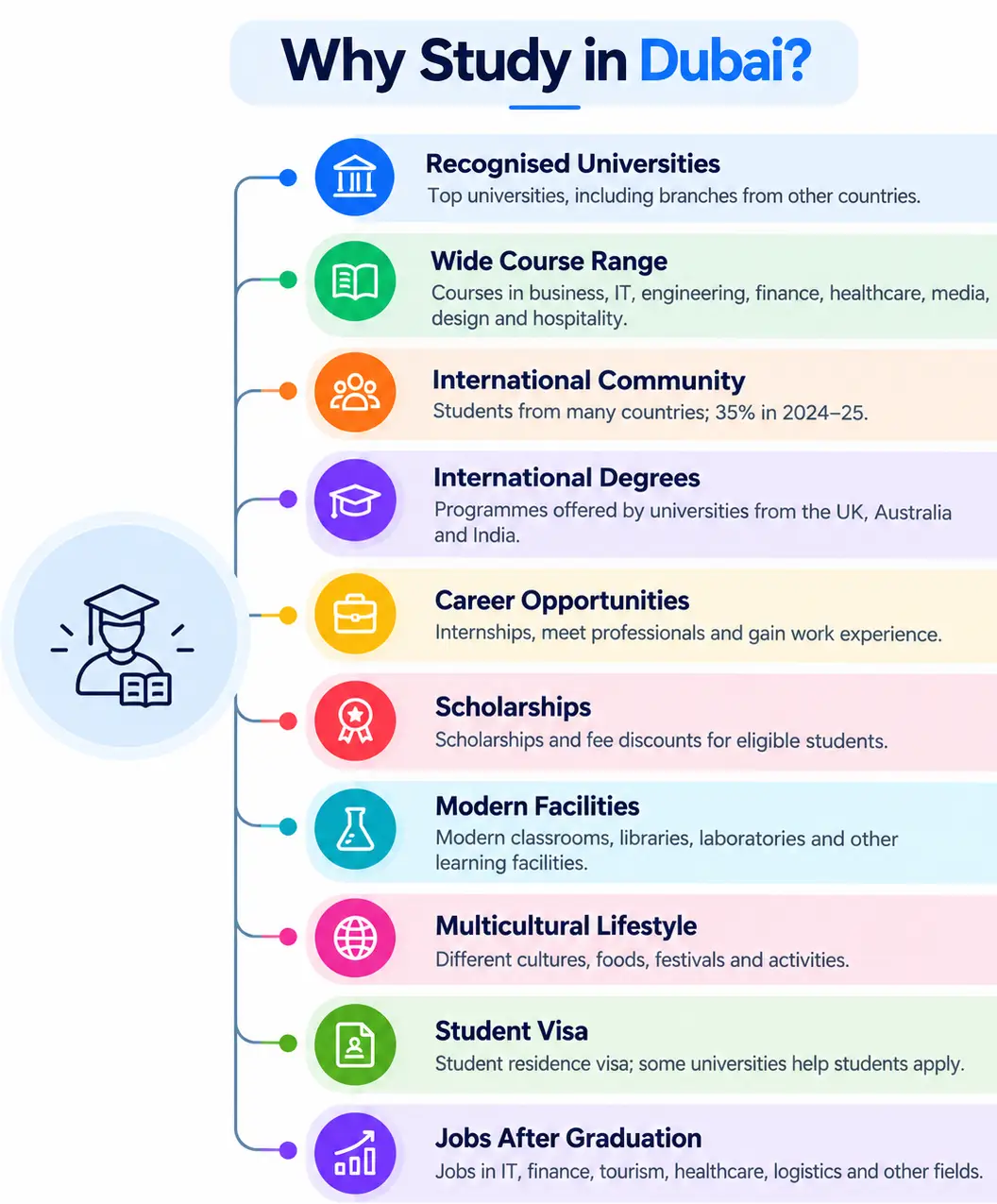
- Recognised Universities: Dubai has top universities, including branches of universities from other countries.
- Wide Range of Courses: Students can choose courses in business, IT, engineering, finance, healthcare, media, design and hospitality.
- International Student Community: Students from many countries study in Dubai. In 2024–25, international students made up 35% of students at private higher education institutions in Dubai.
- International Degrees: Students can study programmes offered by universities from countries such as the UK, Australia and India.
- Career Opportunities: Dubai has businesses in many fields, giving students chances to explore internships, meet professionals and gain work experience.
- Scholarships: Many universities offer scholarships and fee discounts to eligible students based on their marks and other requirements.
- Modern Facilities: Students can use modern classrooms, libraries, laboratories and other learning facilities.
- Multicultural Lifestyle: Students can enjoy different cultures, foods, festivals and activities while living in Dubai.
- Student Visa: International students usually need a student residence visa to study in Dubai. Some universities help students apply for it.
- Job Opportunities After Graduation: Graduates can look for jobs in IT, finance, tourism, healthcare, logistics and other fields, depending on their skills and work permission.
Top Universities in Dubai for Indian Students
| University | Popular Courses |
|---|---|
| University of Dubai | Business, Law, Information Technology, Engineering |
| Heriot-Watt University Dubai | Engineering, Business, Accounting, Finance, Logistics |
| University of Birmingham Dubai | Business, Engineering, Computer Science |
| American University in Dubai | Business, Architecture, Arts, Communication, Engineering |
| University of Wollongong in Dubai | Business, Engineering, Information Technology |
| Middlesex University Dubai | Business, Law, Psychology, Media, Information Technology |
| Canadian University Dubai | Business, Communication, Engineering, Architecture, Technology |
| Rochester Institute of Technology Dubai | Computing, Engineering, Business, Technology |
| Murdoch University Dubai | Business, Information Technology, Media, Psychology |
| The British University in Dubai | Business, Education, Engineering, Postgraduate Research |
Popular Courses to Study in Dubai
Dubai offers undergraduate and postgraduate programmes in many fields. Course availability and duration depend on the university and programme.
| Course | Typical Duration |
|---|---|
| Computer Science and Information Technology | 3–4 years |
| Business Administration and Management | 3–4 years |
| Engineering | 3–4 years |
| Accounting and Finance | 3–4 years |
| Healthcare and Health Sciences | 3–5 years or more |
| Data Science and Artificial Intelligence | 3–4 years |
| Natural Sciences | 3–4 years |
| Media and Communication | 3–4 years |
| Architecture and Design | 3–5 years or more |
| Hospitality and Tourism Management | 3–4 years |
| Master's Degree | Usually 1–2 years |
| MBA | Usually 1–2 years |
Cost of Studying in Dubai
Tuition fees depend on the university, course, degree level, and number of credits. The following figures are general planning estimates, not official average fees.
Estimated Annual Tuition Fees
| Course or Degree | Estimated Annual Fees |
|---|---|
| Undergraduate programmes | AED 35,000–100,000 |
| Business programmes | AED 40,000–100,000 |
| Engineering and Technology | AED 45,000–110,000 |
| Postgraduate programmes | AED 40,000–120,000 |
| MBA programmes | AED 60,000–150,000 or more |
Some specialised programmes may cost more. For example, certain bachelor's degree programmes at SAE Dubai list total programme fees of AED 167,280, excluding VAT, for September 2026 entry. Students should check the official fee page of their chosen university before applying. They should also check for application fees, registration fees, health insurance, accommodation deposits, and other additional costs.
Cost of Living in Dubai for Students
Living costs depend on where students live, their accommodation type, travel needs, and spending habits. Sharing accommodation and cooking at home can help reduce expenses.
Estimated Monthly Living Expenses
| Expense | Estimated Monthly Cost |
|---|---|
| Accommodation | AED 2,000–5,000 |
| Food and groceries | AED 800–1,500 |
| Public transport | AED 150–350 |
| Utilities and mobile phone | AED 300–700 |
| Books and personal expenses | AED 300–800 |
| Estimated total | AED 3,500–8,000 |
These figures are approximate budgets, not official averages. Actual expenses may be higher, especially for private accommodation or a lifestyle with frequent dining out. Students should plan for tuition fees, living costs, visa-related expenses, health insurance, and emergency funds before moving to Dubai.
Scholarships in Dubai for Indian Students
Many universities in Dubai offer scholarships or tuition discounts to eligible students. The amount and eligibility requirements vary by institution, course, academic performance, and intake.
| Scholarship Type | Who May Qualify? |
|---|---|
| Merit-based scholarships | Students with strong academic results |
| Academic excellence awards | Students who meet specific academic standards |
| Need-based financial assistance | Students who meet the university's financial support criteria |
| Early application discounts | Students who apply or pay fees within the stated deadline |
| Sports and talent scholarships | Students with recognised sporting or other achievements |
| Postgraduate research funding | Eligible students undertaking research degrees |
Dubai Student Visa for Indians
Indian students who want to study in Dubai generally need a student residence visa or the appropriate immigration permission for their course and length of stay. Most international students enrolled in full-time degree programmes apply through their university, which may sponsor them for a student residence visa if it is authorised to do so. Students usually need an admission offer from an eligible university or educational institution before starting the visa process. The university or relevant UAE immigration authority will explain the documents, fees, medical checks, and other requirements. The visa process in Dubai is different from South Korea. The UAE does not use the South Korean D-2 and D-4 visa categories. Instead, students generally follow the UAE student residence visa process, with the exact arrangements depending on the institution and the student's circumstances.
Types of Student Visa and Study Options in Dubai
International students may study in Dubai through different educational routes. The appropriate visa or permission depends on the course, its duration, and the institution.
- University Student Residence Visa: For eligible international students enrolled in degree programmes at authorised universities or higher education institutions. The university may sponsor the student.
- Undergraduate Study: For students pursuing bachelor's degrees in fields such as business, engineering, information technology, finance, and media.
- Postgraduate Study: For eligible students enrolled in master's degrees, MBA programmes, or other postgraduate courses.
- Doctoral and Research Study: For students accepted into eligible doctoral or research programmes. Visa arrangements depend on the institution and programme.
- Foundation or Preparatory Courses: Students taking preparatory courses should confirm whether their institution and course qualify for student residence sponsorship.
- Short-Term Study: Short courses, workshops, and programmes lasting a limited period may have different entry or visa requirements. Students should confirm the correct arrangement before travelling.
- Parent-Sponsored Residence: In some circumstances, a student may be eligible to reside in the UAE under a parent's sponsorship instead of university sponsorship, subject to the applicable rules.
The university-sponsored student residence visa is a common route for international students attending university in Dubai. Admission alone does not automatically provide a visa, so students should confirm the sponsorship process with their institution.
Dubai Student Visa Requirements for Indians
Indian students may need to provide the following documents when applying for a student residence visa in Dubai:
- A valid passport, usually with at least six months of validity.
- A recent passport-size photograph with a white background.
- An admission letter or study certificate from the university.
- A certificate confirming the duration of the course.
- A completed visa application form.
- A copy of the university's required registration or sponsorship documents, if requested.
- Academic certificates and transcripts, if required by the university or visa authority.
- Proof of tuition fee payment, if requested.
- Proof of sufficient funds to cover tuition fees and living expenses, if required.
- Financial sponsor documents if parents or another person are paying for the studies.
- A valid health insurance policy or insurance documents accepted by the relevant authority.
- A medical fitness certificate after completing the required medical examination.
- An Emirates ID application receipt or related documents, as applicable.
- A scholarship letter, if the student has received a scholarship.
- Education loan documents, if applicable.
- Any additional documents requested by the university or immigration authority.
Important: Not every student needs to submit every document listed above. Requirements may differ depending on the university, visa sponsor, and the student's circumstances. Ask your university for its latest visa checklist before applying.
Proof of Funds to Study in Dubai
Indian students should prepare a financial plan to cover tuition fees, accommodation, food, transport, and other living expenses. The exact financial documents required can depend on the university and visa arrangements. Unlike some study destinations, there is no single proof-of-funds amount that can safely be assumed to apply to every student applying for a Dubai student residence visa.
- Living expenses: Prepare a budget for accommodation, food, transport, utilities, and personal expenses.
- Tuition fees: Check the total course fees and any required advance payments.
- Bank statements: Keep recent bank statements available if the university or relevant authority requests them.
- Financial sponsor: If your parents or another person will fund your studies, prepare their financial documents if required.
- Income documents: A sponsor may need to provide salary certificates, employment details, or other proof of income.
- Education loan: Keep the approved loan letter or other loan documents if you are using an education loan.
- Scholarship: A scholarship confirmation letter can help demonstrate that part or all of your education costs are covered.
- Family relationship documents: These may be needed if you use a parent's financial documents.
- Tuition payment receipts: Keep receipts for any tuition fees or deposits already paid.
Students should calculate their expected expenses before applying and confirm whether their university or visa sponsor requires particular financial documents.
Steps to Apply for a Dubai Student Visa
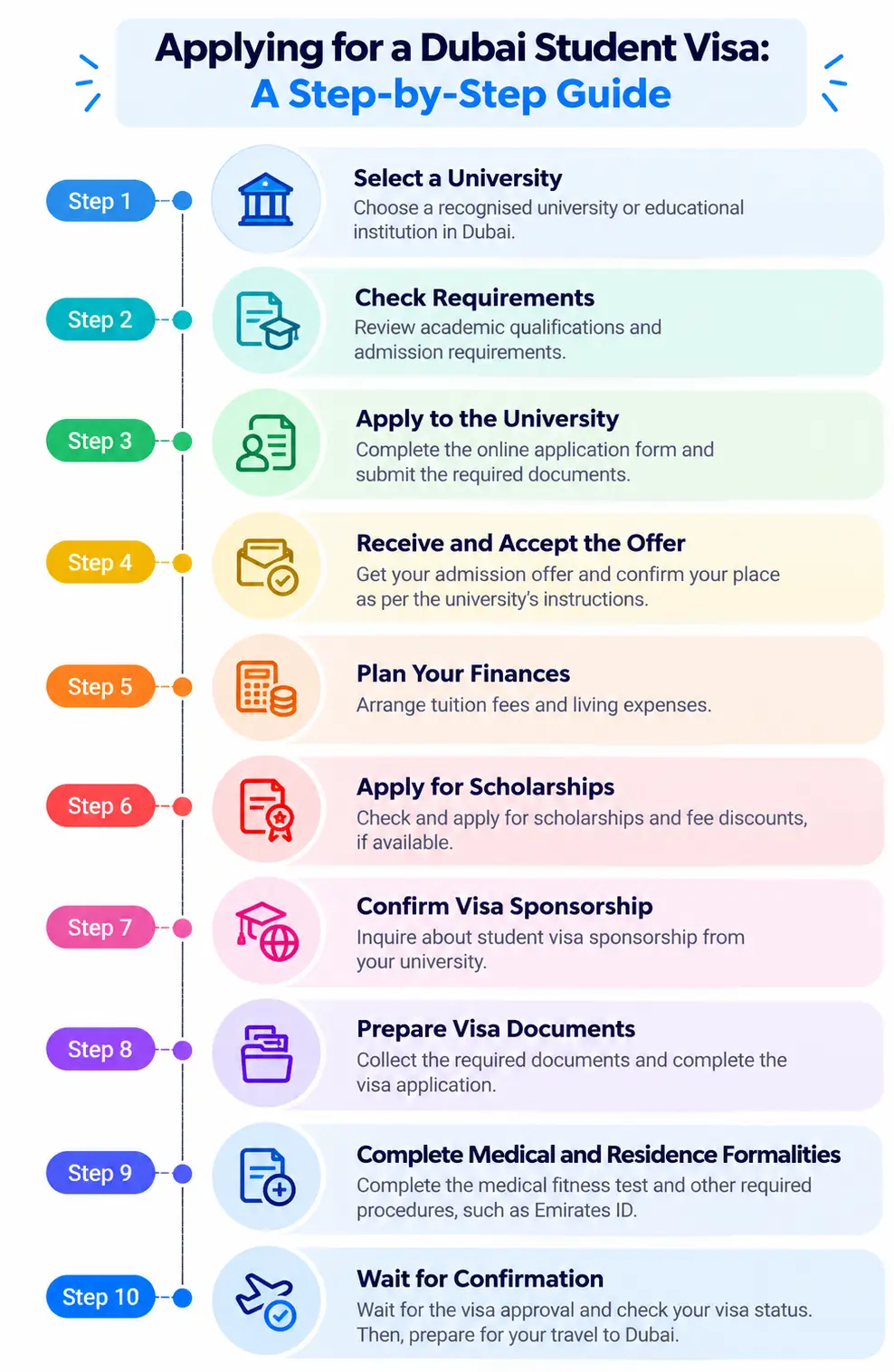
Step 1: Select a recognised university or educational institution in Dubai. Compare course options, tuition fees, entry requirements, scholarships, and career opportunities.
Step 2: Review the academic qualifications, English language requirements, application deadlines, course duration, and documents needed for admission.
Step 3: Complete the online application form and submit your academic certificates, transcripts, passport details, and any other required documents.
Step 4: If your application is successful, the university will issue an admission offer. Read the conditions carefully and follow the instructions for accepting your place.
Step 5: Plan for tuition fees, accommodation, food, transport, health insurance, and other expenses. Prepare bank statements, sponsor documents, scholarship letters, or loan documents if requested.
Step 6: Check whether your university offers merit-based scholarships, academic awards, or tuition discounts. Submit a separate scholarship application if required.
Step 7: Ask the university's international admissions or student affairs team whether it will sponsor your student residence visa and which documents you need to provide.
Step 8: Collect your passport, photograph, admission or study certificate, and other documents on the university's checklist. Follow the instructions for completing the application and paying the applicable fees.
Step 9: After the relevant approval, complete the medical fitness examination, health insurance requirements, Emirates ID application, and any other required residence formalities.
Step 10: The university or relevant immigration authority may request additional information or documents. Wait for confirmation and check the status through the appropriate channel.
Step 11: Once your admission and visa arrangements are confirmed, plan your accommodation, travel, transport, and arrival expenses. Check the university's guidance for international students.
Step 12: Arrive in Dubai and complete university registration
Dubai Student Visa Fee
The student visa cost in Dubai depends on the university and the services included. Students may need to pay for visa processing, Emirates ID, medical tests, and health insurance.
| Expense | Estimated Cost (AED) |
|---|---|
| Visa and entry permit | 1,000–2,500 |
| Emirates ID | 200–400 |
| Medical test | 250–700 |
| Health insurance | 500–1,500 |
| Other charges | 100–500 |
| Estimated Total | 2,050–5,600 |
These are approximate costs and may vary by university and visa type. Confirm the final fees with your university.
Dubai Student Visa Processing Time
The student visa process usually takes around 2–4 weeks, depending on the application and required checks.
| Process | Estimated Time |
|---|---|
| Initial visa approval | 3–10 working days |
| Medical test | 1–3 working days |
| Emirates ID and residence procedures | 3–7 working days |
| Overall estimated time | 2–4 weeks |
Tips to avoid delays:
- Submit all documents correctly.
- Keep your passport valid.
- Complete medical tests promptly.
- Follow your university's instructions.
Simple tip: Budget around AED 2,050–5,600 and apply at least a few weeks before your course starts. These figures are estimates, not guaranteed fees or timelines.
Dubai Study Intakes
Universities in Dubai commonly offer admissions in September and January, although some institutions offer additional intakes during the year. The exact dates depend on the university, programme, and level of study. Students should check the application deadlines, scholarship dates, and visa arrangements for their chosen course before applying.
September Intake
The September intake is a common option for students beginning university in Dubai.
- Research universities, courses, tuition fees, and scholarships.
- Check admission requirements and application deadlines.
- Prepare for English language tests, if required.
- Collect academic certificates, transcripts, and other documents.
- Submit university applications according to each institution's schedule.
- Complete entrance tests, interviews, or portfolio requirements, if applicable.
- Receive an admission offer and confirm your place.
- Arrange tuition payments and prepare financial documents.
- Contact the university about student visa sponsorship.
- Complete the visa process and prepare for travel after the required approvals.
January Intake
The January intake gives students another opportunity to begin their studies.
- Check which universities offer January admission for your chosen course.
- Review application deadlines and English language requirements.
- Prepare academic documents, recommendation letters, and a statement of purpose, if required.
- Complete language tests, interviews, or entrance assessments, if needed.
- Submit your application within the university's deadline.
- Review scholarship options and apply before the closing date.
- Receive your admission decision and accept the offer.
- Arrange tuition payments and prepare any required financial documents.
- Complete the student residence visa process with your university.
- Arrange accommodation and travel after your arrangements are confirmed.
Note: Not every university or programme offers both September and January intakes. Always check the dates published by your chosen institution.
Month-by-Month Plan for Studying in Dubai
The following schedule is a planning guide for students targeting a September intake. Application and visa dates vary by university, so adjust the schedule to match your chosen course.
- January–March: Research universities, courses, tuition fees, scholarships, and admission requirements.
- March–May: Shortlist universities, prepare for English language tests, and check document requirements.
- April–June: Prepare academic certificates, transcripts, recommendation letters, and a statement of purpose, if required.
- May–July: Submit applications according to each university's deadlines.
- June–July: Complete interviews, entrance assessments, or other admission requirements.
- June–August: Review scholarship decisions, accept your admission offer, and arrange tuition payments.
- July–August: Prepare your passport, financial documents if required, health insurance, and other visa documents.
- August: Complete the student visa process according to your university's instructions.
- August–September: Arrange accommodation, travel, and other pre-departure needs.
- September: Travel to Dubai after the necessary approvals and complete university registration.
For the January intake, students should generally begin researching courses several months in advance and submit their applications according to the university's published deadlines. The UAE has an approved academic calendar for higher education institutions, but international branch campuses may follow their parent university's calendar. Always check the dates for your specific course.
Final tip: Start early and confirm every deadline with your university. This gives you enough time to organise admission, scholarships, finances, accommodation, and your student visa.
Part-Time Jobs in Dubai for Indian Students
International students may be able to work part-time while studying in Dubai, but they must meet the applicable employment and immigration requirements. Having a student residence visa does not automatically give permission to work in every job. Depending on the circumstances, students may need an appropriate work permit or authorisation, and the employer may need to complete the relevant procedures.
Common part-time job options may include:
- Restaurant and café work.
- Retail and shop assistance.
- Administrative or office support.
- Customer service.
- Sales assistance.
- Internships related to a student's course.
- Other permitted roles that fit the student's qualifications and work authorisation.
Part-time work can help students gain practical experience and cover some daily expenses. However, students should not depend on part-time earnings to pay all their tuition fees and living costs. Before accepting a job, students should confirm the applicable work permit requirements, permitted working arrangements, and any university rules. Working without the required authorisation may result in penalties.
Post-Study Work in Dubai
Dubai offers employment opportunities in industries such as information technology, finance, engineering, healthcare, logistics, tourism, hospitality, and business services. Unlike South Korea, the UAE does not have a direct equivalent of the South Korean D-10 visa that automatically applies to international graduates. Graduates generally need to qualify for an appropriate UAE residence and work arrangement.
- Look for suitable jobs: Graduates can search for opportunities related to their qualifications and experience.
- Prepare before graduation: Build a CV, develop relevant skills, and connect with employers while studying.
- Understand employer sponsorship: Many graduates take up employment through an employer that arranges the necessary work permit and residence procedures.
- Explore a jobseeker visit visa: Eligible graduates may be able to apply for a UAE jobseeker visit visa for 60, 90, or 120 days, subject to the applicable eligibility and financial requirements.
- Check the requirements carefully: A jobseeker visit visa does not automatically grant permission to work.
- Change to the appropriate status: Before beginning employment, graduates must have the required work authorisation and residence arrangements.
- Build professional experience: Internships, projects, and relevant work experience can help graduates prepare for the job market.
- Develop communication skills: Strong English communication skills can be useful in many workplaces, while Arabic or other languages may be valuable for certain roles.
*Want to work in Dubai? Contact Y-axis for complete guidance
Path to Long-Term Residency in Dubai
Studying in Dubai does not automatically lead to permanent residency or citizenship. After graduation, eligible students may obtain employment and apply for an appropriate residence status. The UAE also offers long-term residence options, including the Golden Visa, for people who meet specific eligibility criteria. These options are not automatically available to every international student or graduate.
Depending on the category, eligibility may involve:
- Holding a recognised academic qualification.
- Meeting specific academic performance or GPA requirements.
- Graduating from an eligible or suitably ranked university.
- Obtaining the required degree attestation or recognition.
- Meeting the conditions for a particular professional, talent, or other residence category.
- Providing the documents requested by the relevant authority.
Outstanding graduates may qualify for a Golden Visa if they meet the requirements for the relevant category. For example, certain graduates of UAE universities must meet university classification, GPA, and graduation-date conditions.
Important: A standard student residence visa does not automatically qualify its holder for long-term residency. The UAE does not have a single general permanent-residency route that applies to all international graduates. Check the latest rules for the specific residence category before making long-term plans.
How Can Y-Axis Help You?
Y-Axis can guide students planning to study in Dubai and help them understand the steps involved in their study plans.
- Free Counselling: Get guidance on university and course selection.
- Campus Ready Program: Explore support to prepare for studying abroad and your future career.
- Course Recommendation: Explore suitable study options based on your academic background and career goals.
- Y-Path: Get help understanding your study and career options.
- Coaching: Explore test preparation if it is needed for your chosen course.
- Dubai Study Guidance: Contact Y-Axis to discuss university choices, admission requirements, and student visa procedures.
Contact Y-Axis to discuss your study plans and understand the application process for Dubai.
Looking for inspiration
Explore what Global Indians have to say about Y-Axis in shaping their future