

Migrate to USA
Sign up for a free expert consultation

Don't know what to do?
Get Free Counseling
Last Updated 30 July 2026
US Immigration from India — H-1B ($100K Fee), Weighted Lottery, Green Card Backlog, EB-5 ($800K TEA), Gold Card, Family and Complete Migration Guide
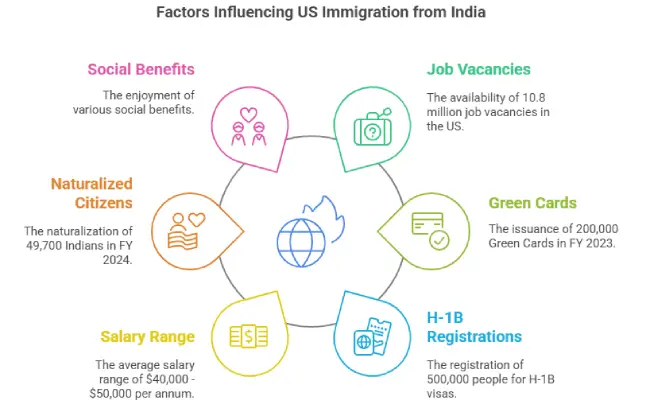
- Approximately 7.6 million job openings
- 1.32 million Green Cards issued in FY 2025
- 336,153 eligible H-1B beneficiaries registered for FY 2026
- Earn an average salary of $40,000 - $50,000/annum
- Approximately 818,500 persons naturalized in FY 2024
- Over 1 million Indians currently in the employment-based Green Card backlog
Enjoy Social benefits
Jump to: H-1B 2026 Updates | Green Card Pathways | EB-2 NIW | EB-1A | Indian Green Card Backlog | Investor: EB-5 and Gold Card | Family Immigration | US Immigration News | FAQs
US Immigration in 2026 — What Indian Applicants Must Know
$100,000 H-1B Employer Fee: Effective September 21, 2025 (upheld by federal court December 23, 2025), all new H-1B petitions require a $100,000 employer-paid fee. Same-employer extensions and renewals are exempt. This applies through September 20, 2026 unless extended. Over 70% of H-1B holders are Indian, and India's Ministry of External Affairs has raised concerns about the fee's impact. Alternatives not subject to this fee include O-1A, L-1, EB-1A, and EB-2 NIW.
Weighted H-1B Lottery: Effective February 27, 2026, USCIS replaced the random H-1B lottery with a weighted selection system. Petitions offering higher wage levels (OEWS Level III and IV) receive more lottery entries and better selection odds than lower wage levels (Level I and II). The FY2027 lottery was the first to use this system — negotiating a higher salary now directly improves your selection chances.
Social Media Screening: Since December 2025, H-1B and H-4 applicants must disclose all social media handles and keep accounts public throughout the visa review process.
H-4 EAD Validity Reduced: Effective December 4, 2025, USCIS reduced the maximum EAD validity to 18 months, affecting H-4 EAD holders and adjustment-of-status applicants. File renewals at least 6 months before expiry to avoid a work authorization gap.
Travel Ban Update: Proclamation 10998 (effective January 1, 2026) expanded travel restrictions to 39 countries. India is not currently on this list.
Gold Card Program: Launched December 2025 — see the Investor Route section below.
Migrate to the USA
The United States offers unmatched opportunity and an unparalleled quality of life for families and individuals. Its powerful economy, excellent educational system, and liberal way of life make it a bastion of progress and growth. At Y-Axis, we have extensive experience with the US immigration processes. Our teams have the knowledge and experience to help you get started with your American Dream.
About the USA
USA is the fourth largest country in the world and is the most preferred destination for immigration. The country is backed with a strong economy and numerous opportunities for aspirants from around the world.
Prominent states in the USA
- New York
- Las Vegas
- Orlando, Florida
- Atlanta
- Miami
- Washington
- Washington, D.C.
- San Francisco
- Denver
- Louisville, Kentucky
- Houston
*Looking to settle in the USA? Start here! Go through the H-1B Visa Flipbook.
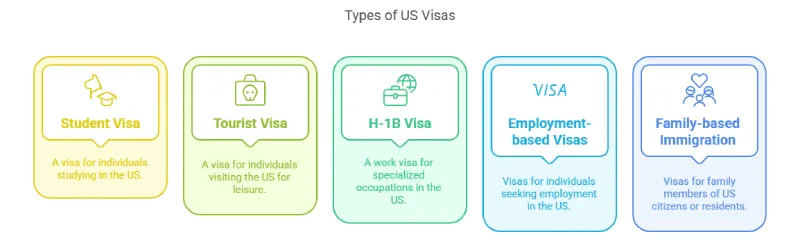
Types of US Visas
Some of the most common types of US visas are listed below:
- Student visa
- Tourist visa
- H-1B visa
- Employment-based visas
- Family-based Immigration
US Visa categories
The US visa is divided into two categories:
Immigrant visa
- Immigrant visas are issued to foreign candidates who plan on living and working in the USA on a permanent basis. The employer or the relatives of the primary applicant usually sponsor the individual in most cases.
Non-immigrant visa
- Immigrant visas are issued to foreign candidates who plan on living and working in the USA on a temporary basis. Non-immigrant visas are mostly for individuals who seek to enter the country temporarily for medical treatment, tourism, business or other similar purposes.
US Green card
Green card, commonly known as a permanent residence card authorizes a Non-U.S. candidate to gain permanent residency in the country. The Green card holder can live and seek employment in any part of the country and will also qualify to apply for US citizenship after three-five years.
*Did you know? Over 1 million Green cards are issued every year by the US government.
Green Card Eligibility
The eligibility criteria to apply for US Green card are as follows -
Apply for a Green card via employment as an immigrant worker:
First preference Immigrant worker
- Must possess extraordinary skills in athletics, business, education or arts etc.
- Must have renowned experience as a researcher/professor.
- Must be a multinational level executive or manager who fulfills a list of given criteria.
Second preference immigrant worker
- Must be a professional with an advanced degree.
- Must have exceptional skills in arts, business or sciences.
- Must be someone who is looking for a waiver at the national interest.
Third preference immigrant worker
- Must be a skilled worker with a minimum of two years of job experience or training.
- Must be a professional who is currently employed with at least a Bachelor’s degree in the U.S or outside U.S with an equivalent degree.
- Must be an expert who is currently employed and has a Master’s degree in the U.S
EB-1A (Extraordinary Ability Self-Petition): No employer sponsorship or PERM labor certification required. Priority dates are currently current or near-current for India. Demonstrated through publications, awards, patents, professional memberships, press coverage, high salary relative to peers, and original contributions to your field. Popular among Indian IT researchers, academics, and senior executives. [Y-Axis EB-1A eligibility assessment — free]
EB-2 NIW (National Interest Waiver): A self-petition option requiring an advanced degree or exceptional ability, plus work of substantial merit and national importance to the US. No employer or PERM required. Popular among AI/ML researchers, biomedical scientists, renewable energy engineers, healthcare professionals, and educators. EB-2 NIW priority dates for India are typically faster than employer-sponsored EB-2. [Y-Axis EB-2 NIW assessment — free]
Apply for a Green card via Family
- Unmarried children of US citizens under the age of 21.
- Spouse of US citizens
- Parents of US citizens who are at least 21 years of age.
Indian Green Card Backlog — What You Need to Know
Indian professionals face the longest employment-based Green Card wait of any country. Over 1 million Indians are currently in the backlog. Estimated wait times by category (2026):
- EB-1 (Extraordinary Ability, Outstanding Professor, Multinational Manager): priority dates current or near-current for India — the fastest employment-based pathway
- EB-2 NIW (National Interest Waiver, self-petition): typically shorter than employer-sponsored EB-2
- EB-2 (employer-sponsored): approximately 10-15 years for India
- EB-3 (Skilled Worker): India priority dates currently in the early 2010s — an estimated 30-50+ year wait at current processing rates
- EB-5 set-aside categories (rural, high-unemployment, infrastructure): no per-country cap — faster processing for investors
Check current India priority dates on the [USCIS Visa Bulletin].
If you're facing a long EB-3 wait, consider these alternatives:
- EB-1A (Extraordinary Ability self-petition) — no employer required, current priority dates for India
- EB-2 NIW (National Interest Waiver) — no employer, no PERM, shorter wait
- Gold Card — $1 million donation for direct EB-1/EB-2 classification
- Alternative destinations — [Canada Express Entry] (6 months to 2 years), [Australia PR] (2-4 years), [Germany Opportunity Card/Blue Card]
Benefits of US Migration
- Provides high quality of education
- Earn in dollars with flexible salary packages
- High standard of life
- Has some of the top educational universities in the world
- The country assures a high level of financial security to its citizens
- Offers a diverse range of educational prospects
- Provides easy citizenship opportunities upon eligibility
US Immigration Eligibility
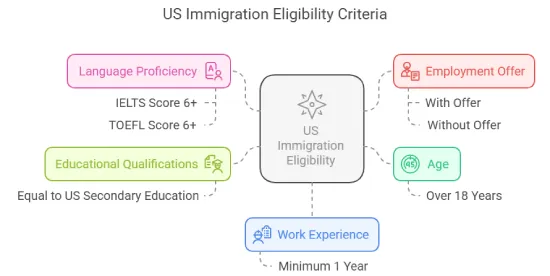
The eligibility criteria to migrate to the US differ based on the type of permit. However, the general eligibility requirements for US immigration are as follows:
Age: Must be over 18 years of age.
Educational qualifications: Must meet the minimum educational qualification that is equal to higher than the secondary education in the USA.
Language proficiency: For employment-based visas (H-1B, EB-1, EB-2, EB-3, EB-5) — no separate English language test is required. Your educational qualifications and professional credentials demonstrate language ability. For student visas (F-1) — university-specific IELTS or TOEFL requirements apply (typically 6.5+ IELTS or 80+ TOEFL iBT).
Requirements vary by institution and program.
Work experience: Must have at least 1 year of professional work experience in the field of your choice.
Employment offer: You can migrate to the US with or without an employment offer.
(Contact Y-Axis to know more)
How to migrate to US?
There are many ways to migrate to the USA; some of the most common ways to migrate to US are listed below:
Migrate to the US as an employee
Temporary work visas allow candidates to enter the United States for the purpose of working for a sponsoring employer. The visa is valid for a set amount of time after which the applicant must return to his home country. Work Permit visas can be granted to applicants if their potential employer submits a petition with the USCIS on their behalf.
Migrate to the US through the investor route
The EB 5 investment visa for United States immigration permits affluent persons to get a green card providing permanent residence status as soon as they enter the country, without having to wait significant periods of time. To qualify for this visa, you must invest a minimum of $800,000 for a Targeted Employment Area (TEA) investment — rural areas or areas with high unemployment, which most Regional Center projects qualify for — or $1,050,000 for a standard urban, non-TEA investment. These amounts were updated under the EB-5 Reform and Integrity Act 2022, replacing the previous $500,000 and $1,000,000 minimums. The investment must create at least 10 full-time jobs for qualifying US workers.
Migrate with your family to the US
Permanent residency in the United States is also available to family members of US citizens or Green Card holders. There are two types of family-based immigration, depending on the degree of affinity.
The following groups of people are granted the ability to live permanently in the United States:
- (Future) spouses
- Unmarried children under the age of 21
- Parents of US citizens or Green Card holders.
They will be given their permanent residence permit immediately.
Siblings and children of US citizens or Green Card holders over the age of 21 are included in the second group. Only a small number of Green Cards are available to them. Furthermore, they are frequently subjected to lengthier wait times.
Trump Gold Card (launched December 2025): A separate investor pathway requiring a $1,000,000 donation to the US Department of Commerce ($2,000,000 for corporate-sponsored applicants) plus a $15,000 non-refundable processing fee. In return, you receive Green Card–equivalent lawful permanent residence under EB-1 or EB-2 classification — with no job creation requirement and no expectation of financial return, unlike EB-5.
| Criteria | EB-5 | Gold Card |
|---|---|---|
| Investment | $800,000 (TEA) / $1,050,000 (Standard) | $1,000,000 donation |
| Job Creation | 10 full-time jobs required | Not required |
| Return Expectation | At-risk investment with potential returns | Pure donation with no financial return |
| Green Card Classification | EB-5 | EB-1 or EB-2 |
For Indian investors with current EB-1 priority dates, the Gold Card may be the faster pathway, bypassing EB-5's multi-year Regional Center processing. Source: Executive Order 14351.
US Immigration Process
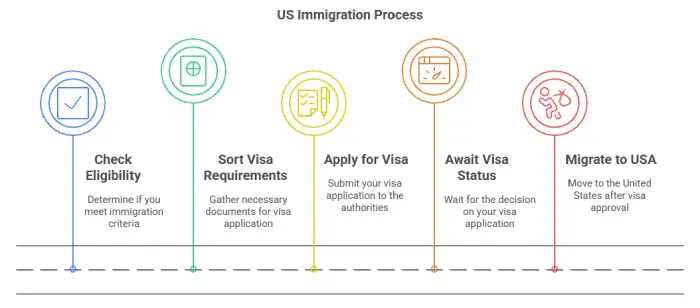
You can follow the simple steps given below to apply for US Immigration:
Step 1: Check your eligibility.
Step 2: Sort out the requirements of the visa.
Step 3: Apply for the visa.
Step 4: Await the status of your visa
Step 5: Migrate to USA.
Y-Axis: US Immigration Consultants
Y-Axis, the world’s best immigration company, provides unbiased immigration services for every client based on their interests and requirements. The impeccable services of Y-Axis include:
- Expert guidance/counseling for US Immigration
- Avail Y-Axis coaching services for IELTS Coaching, GRE Coaching, PTE coaching and more.
- Get Y-Axis resume marketing services to help find the right job for your career.
- Avail free career counseling from industry experts.
Y-Axis snapshot
1M
Successful applicants
1500+
Experienced counselors
25Y+
Expertise
50+
Offices
Looking For Inspiration
Explore what Global Indians have to say about Y-Axis in shaping their future