

Study in Denmark

Don't know what to do?
Get Free Counseling
Last Updated: 09-09-2026
Study in Denmark: Top Universities, Fees, Scholarships & Visa Process
Denmark is one of the top study destinations in Europe, known for its high-quality education, innovative teaching methods, and globally recognised universities. The country offers hundreds of English-taught programmes, strong research opportunities, and excellent career prospects for international students. Denmark is one of the most popular countries in Europe for higher education. It is known for its top universities, modern teaching methods, and high quality of life. Every year, thousands of international students choose Denmark because of its excellent education system, research opportunities, and good career prospects. Whether you want to pursue a bachelor's, master's, or PhD, Denmark provides a safe, inclusive, and student-friendly environment with a high standard of living. Indian students planning to study in Denmark for more than 90 days must obtain a Denmark student residence permit before travelling.
Why Study in Denmark?
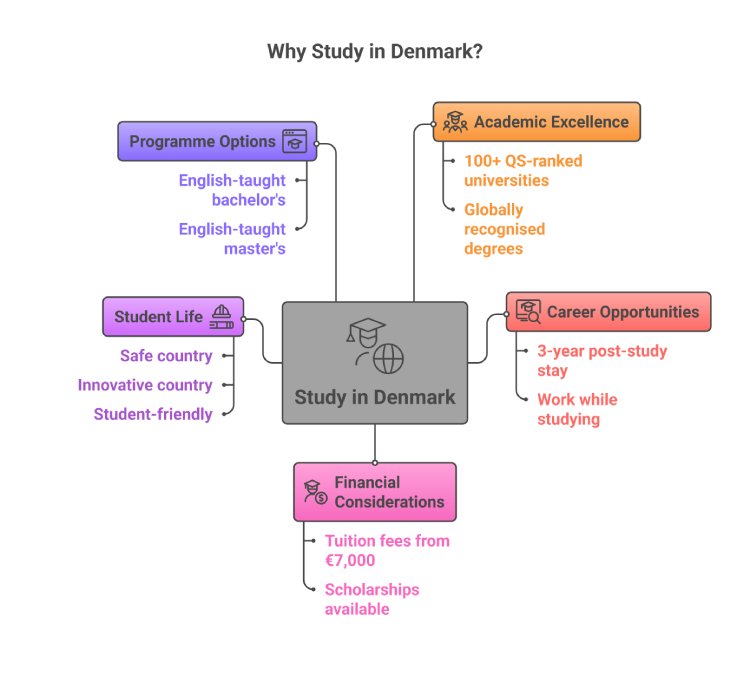
- 100+ QS-ranked universities
- Up to 3-year post-study job-seeking stay for eligible state-approved programmes
- Tuition fees starting from around €7,000 per year
- Scholarships available for international students
- High-quality education with globally recognised degrees
- Safe, innovative and student-friendly country
- English-taught bachelor's and master's programmes
- Opportunity to work while studying
Top Universities in Denmark
Denmark has several internationally recognised universities known for academic excellence, research, and innovation. More than 35,000 international students study in Denmark every year.
Some of the country's leading institutions include:
- University of Copenhagen
- Technical University of Denmark (DTU)
- Aarhus University
- Aalborg University
- University of Southern Denmark
- Copenhagen Business School
- Roskilde University
These universities offer hundreds of English-taught bachelor's, master's, and PhD programmes across engineering, business, healthcare, science, IT, social sciences, and humanities.
QS Ranking Universities in Denmark
| University | QS World University Rankings |
|---|---|
| University of Copenhagen | 100+ |
| Technical University of Denmark (DTU) | 100+ |
| Aarhus University | 200+ |
| Aalborg University | 300+ |
| University of Southern Denmark | 300+ |
| Copenhagen Business School | 100+ (Business Subject Rankings) |
| Roskilde University | 200+ |
Popular Courses to Study in Denmark
Denmark is a strong study destination for international students, particularly in engineering, IT, business, life sciences, sustainability, and design. Danish institutions offer a wide range of English-taught programmes, and the official Study in Denmark portal currently lists more than 400 programmes. Below are the best courses to study in Denmark.
| Course / Study Area | Popular Specialisations | Suitable For |
|---|---|---|
| Engineering | Mechanical, Civil, Electrical, Chemical, Environmental Engineering | Students with a technical background |
| Computer Science & IT | Computer Science, Software Development, Data Science, AI, Cybersecurity | IT and technology students |
| Business & Management | International Business, Business Administration, Finance, Management | Commerce and business graduates |
| Data Science & Artificial Intelligence | Data Analytics, Machine Learning, AI, Business Analytics | Students interested in data and technology |
| Renewable Energy & Sustainability | Wind Energy, Sustainable Energy, Environmental Technology | Students interested in green technology |
| Life Sciences & Biotechnology | Biotechnology, Molecular Biology, Pharmaceutical Sciences | Science and biology graduates |
| Architecture & Design | Architecture, Industrial Design, Digital Design, Product Design | Creative and design-oriented students |
| Healthcare & Nursing | Nursing, Health Sciences, Public Health, Nutrition | Healthcare-focused students |
| Food Science & Technology | Food Technology, Food Science, Biotechnology | Students interested in food and life sciences |
| Business Analytics | Business Intelligence, Analytics, Digital Business | Business and IT graduates |
| Digital Design | UX/UI Design, Interactive Design, Digital Media | Students interested in design and technology |
| Environmental Science | Climate Science, Environmental Management, Sustainability | Students interested in environmental issues |
| Robotics & Automation | Robotics, Automation, Control Systems | Engineering and technology students |
| Maritime Studies | Maritime Engineering, Shipping, Marine Technology | Students interested in the maritime sector |
| Tourism & Hospitality | Hospitality Management, Tourism Management, Service Management | Students interested in tourism and hospitality |
Eligibility to Study in Denmark
To study in Denmark, Indian students generally need to meet the following requirements:
- Admission letter from a recognised Danish university or higher education institution.
- Proof that you can financially support yourself during your studies.
- Proof of English or Danish language proficiency, depending on your programme.
- Valid passport.
- Health or travel insurance if applicable.
- Proof of accommodation in Denmark.
- Payment receipt for the SIRI application fee.
- Required academic qualifications and transcripts.
*Need assistance to Study Abroad? Y-Axis is here to assist you in all the ways.
Benefits of Studying in Denmark
Denmark offers students an excellent academic environment combined with a high standard of living. The country's universities focus on practical learning, research, innovation, and close collaboration with industries.
Some of the major benefits include:
- Internationally recognised degrees.
- Modern teaching methods with practical learning.
- English-taught programmes across various disciplines.
- Safe and welcoming environment for international students.
- Opportunities to work while studying for eligible state-approved programmes.
- Excellent research facilities.
- High graduate employability.
- Scholarships offered by universities and the Danish Government.
- Strong work-life balance and high quality of life.
Denmark Intakes
Most Danish universities offer two major intakes every year.
| Intake | Programmes | Admission Period |
|---|---|---|
| Summer Intake | Undergraduate & Postgraduate | January – Mid-March |
| Winter Intake | Undergraduate & Postgraduate | July – September |
Students are encouraged to apply several months before the deadline, as obtaining a student residence permit can take around 2 months.
Cost of Studying in Denmark
The overall cost of studying in Denmark depends on your nationality, university, course, and lifestyle. For international students from outside the EU/EEA and Switzerland, tuition fees generally apply. Denmark can be an expensive study destination, but students can manage costs by choosing affordable accommodation, cooking at home, and using bicycles or public transport.
Tuition Fees in Denmark
Tuition fees in Denmark depend on the university and programme. Generally, international students from outside the EU/EEA can expect tuition fees ranging between €7,000–€20,000 per year Professional programmes such as engineering, business, medicine, and technology may have higher tuition fees.
Many universities also offer:
- Tuition fee waivers
- Merit-based scholarships
- Danish Government scholarships
- Erasmus+ funding opportunities
EU/EEA and Swiss citizens generally do not pay tuition fees at public universities.
Cost of Living for Students in Denmark
A student's monthly living expenses can vary significantly depending on the city and lifestyle. Based on the official student budget estimates, accommodation is usually one of the largest expenses, followed by food and personal costs.
| Monthly Expense | Approximate Cost |
|---|---|
| Accommodation | DKK 3,000–6,500 |
| Food | DKK 2,000–3,500 |
| Transport | Around DKK 300 |
| Books & supplies | DKK 400–650 |
| Mobile phone | Around DKK 250 |
| Insurance | Around DKK 300 |
| Personal expenses | Around DKK 2,000 |
Estimated Total Cost
For a non-EU international student, a practical estimate would be:
| Cost Category | Estimated Annual Cost |
|---|---|
| Tuition fees | DKK 45,000–120,000 |
| Living expenses | Approximately DKK 99,000–156,000 |
| Total estimated cost | Around DKK 144,000–276,000 per year |
Scholarships to Study in Denmark
Several scholarships are available to help international students reduce the cost of studying in Denmark.
| Scholarship | Approximate Value |
|---|---|
| Erasmus Mundus Scholarships | €12,000 |
| Nordplus Scholarship | €24,000 |
| Danish Government Scholarship (Ministry of Higher Education and Science) | €9,800 |
| CBS International PhD in Economics | €51,985 |
| Danish State Tuition Fee Waivers and Scholarships (Roskilde University) | €93,600 |
| Lendwise Scholarship* | Varies |
Denmark Student Visa
Indian students who plan to study in Denmark for more than 90 days must apply for a Denmark Student Residence Permit through the Danish Agency for International Recruitment and Integration (SIRI). Before applying, you must have an admission letter from a recognised Danish university or institution. You can apply for the permit up to 3 months before your planned travel date.
To get a Denmark student visa in 2026, you must show DKK 7,426 per month about ₹1,08,900 as proof of funds and pay the DKK 3,060 application fee. Most applications are processed in about 2 months, but it may take up to 3 months if SIRI asks for additional documents.
Important Update (Effective 2 May 2025)
Students from outside the EU/EEA, including Indians, who apply for a non-state-approved higher education programme on or after 2 May 2025 cannot work while studying, cannot stay in Denmark after graduation under the job-seeking scheme, and cannot bring family members. Always check that your programme is state-approved before accepting admission.
Why Apply for a Denmark Student Visa?
A Denmark student visa allows international students to study at globally recognised universities while enjoying excellent career opportunities and a high quality of life.
Benefits include:
- Study at internationally recognised Danish universities.
- Access to innovative and research-based education.
- Scholarships offered by universities and the Danish Government.
- Opportunity to work while studying (eligible programmes only).
- Excellent career opportunities after graduation.
- Safe and student-friendly environment.
- Opportunity to stay in Denmark after graduation subject to programme eligibility.
Denmark Study Visa Requirements
To apply for a Denmark student residence permit, you generally need the following documents:
- Completed ST1 application form.
- Letter of admission from a recognised Danish university.
- Valid passport.
- Recent passport-size photographs.
- Proof of financial support.
- Academic transcripts and certificates.
- Receipt for payment of the SIRI application fee.
- Proof of accommodation
- Travel or health insurance if applicable.
English Language Requirements
| Test | Typical Score Required | Notes |
|---|---|---|
| IELTS Academic | 6.5–7.0 overall (some universities accept 6.0) | Most widely accepted |
| TOEFL iBT | 94–101 | The only TOEFL format currently available |
| PTE Academic | 59–65 | Accepted by many universities |
| Duolingo English Test | 115–125 | Accepted by selected universities only |
Types of Denmark Student Visas
| Applicant | Requirement |
|---|---|
| Non-EU/EEA and Swiss citizens | Apply for a Denmark Student Residence Permit before travelling to Denmark. |
| EU/EEA and Swiss citizens | Register with Danish authorities after arrival. A residence permit is generally not required. |
Residence Permit for Long-Term Study
If your course lasts more than three months, you must apply for a student residence permit before travelling to Denmark. The residence permit is normally issued for the duration of your programme. If your course is extended, you may apply to extend your residence permit. Students should ideally begin the application process at least three months before their planned travel date.
Denmark Student Visa Cost
The SIRI case-processing fee for a Denmark student residence permit is DKK 3,060 (approximately ₹44,900). You must pay this fee before submitting your application. The fee is non-refundable, even if your application is refused or withdrawn, and it must be paid separately for each applicant.
SIRI Fee Table
| SIRI Case Area | Fee (DKK) | Approx. INR |
|---|---|---|
| Student Residence Permit | DKK 3,060 | ₹44,900 |
| Job-Seeking Residence Permit | DKK 3,060 | ₹44,900 |
| Accompanying Family | DKK 3,080 | ₹45,200 |
| Au Pair and Internship Cases | DKK 4,305 | ₹63,200 |
| Work Permit Cases | DKK 6,810 | ₹99,900 |
Denmark Student Visa Processing Time
SIRI generally processes Denmark student residence permit applications in about 2 months. If additional documents or information are required, processing may take up to 3 months. Students should apply well in advance to avoid delays before their course begins.
Proof of funds for Denmark Student Visa
To receive a Denmark student residence permit, you must show that you can financially support yourself while studying. The required amount is DKK 7,426 per month (approximately ₹1,08,900) for the duration of your studies, up to a maximum of 12 months.
Required Funds
| Study Duration | Months Counted | Funds Required (DKK) | Approx. INR |
|---|---|---|---|
| One Semester | 6 | DKK 44,556 | ₹6.54 lakh |
| Academic Year | 10 | DKK 74,260 | ₹10.9 lakh |
| One Year or More | 12 (maximum) | DKK 89,112 | ₹13.1 lakh |
The bank statement:
- Must be in your own name.
- Should be issued within 30 days before submitting your application.
- Must clearly show the currency.
If you have already paid your first semester tuition fees, you can submit the payment receipt instead of showing the full maintenance amount. Scholarship award letters are also accepted as proof of financial support.
How to Apply for a Denmark Student Visa
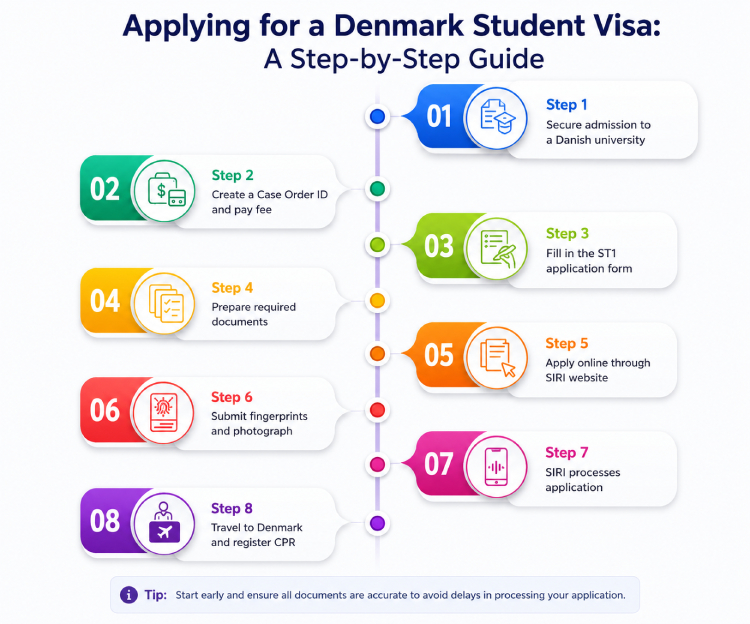
Step 1: Secure admission to a recognised Danish university or higher education institution.
Step 2: Create a Case Order ID on the SIRI portal and pay the application fee.
Step 3: Fill in the ST1 application form. Some sections are completed by your educational institution, while others must be completed by you.
Step 4: Prepare all the required documents, including your passport, admission letter, proof of funds, academic certificates, and language test results.
Step 5: Apply online through the SIRI website and upload all required documents.
Step 6: Visit a Danish Visa Application Centre or Danish diplomatic mission to submit your fingerprints and photograph within 14 days of submitting your online application.
Step 7: SIRI generally processes applications in about 2 months. If additional documents are required, processing may take up to 3 months.
Step 8: After your residence permit is approved, travel to Denmark and complete your CPR registration after arrival.
Part-Time Jobs in Denmark for International Students
International students in Denmark can work part-time alongside their studies. Student jobs can help cover some living expenses while also giving students valuable Danish work experience and improving their CV. However, students should not depend entirely on part-time income to fund their studies.
| Part-Time Job | Approx. Hourly Pay |
|---|---|
| Restaurant / Café Staff | DKK 120–160 |
| Retail Assistant | DKK 120–160 |
| Warehouse Worker | DKK 125–170 |
| Delivery Worker | DKK 120–170 |
| Cleaning Staff | DKK 120–160 |
| Customer Service | DKK 130–180 |
| Teaching / Tutoring | DKK 150–250 |
| Research Assistant | DKK 150–220 |
| IT / Software Assistant | DKK 160–250 |
| Student Assistant | DKK 140–220 |
| Hotel Staff | DKK 120–160 |
| Childcare / Babysitting | DKK 120–180 |
Post-Study Work Opportunities in Denmark
Denmark offers international graduates the opportunity to stay after completing an eligible higher education programme and look for a job.
| Category | Details |
|---|---|
| Post-Study Job-Seeking Period | Up to 3 years for eligible graduates |
| Eligible Graduates | Professional Bachelor's, Bachelor's, Master's and PhD graduates |
| Work During Job Search | Up to 90 hours per month from September to May |
| Summer Work | Full-time work in June, July and August |
| Full-Time Work After Job Offer | Graduates can apply for an appropriate work and residence permit |
| Popular Job Sectors | IT, Engineering, Healthcare, Life Sciences, Business, Finance and Renewable Energy |
| Language Advantage | Danish language skills can improve job opportunities |
| Long-Term Opportunity | Graduates can build work experience and explore longer-term residence options |
Key point: The post-study period allows eligible international graduates to remain in Denmark for up to 3 years to search for employment. However, this does not automatically give unrestricted full-time work rights during the entire period.
How Y-Axis Help You to Study in Denmark
Y-Axis can assist by giving more vital support to aspirants who wish to study in Denmark. The support process includes,
- Free Counseling: Free Counseling on university and course selection.
- Campus Ready Program: Fly to Denmark with the best and ideal course.
- Course Recommendation: Y-Path gives the best suitable ideas about your study and career options.
- Coaching: Y-Axis offers IELTS live classes to help students clear with high scores.
- Denmark Student Visa: Our expert team helps you to get a Denmark student Visa.
Looking for inspiration
Explore what Global Indians have to say about Y-Axis in shaping their future