

Study in Sweden

Don't know what to do?
Get Free Counseling
Last Updated: 07-09-2026
Study in Sweden: Universities, Fee, Visa and Scholarships
Sweden is one of the leading study destinations for international students, with several highly ranked universities. Nine Swedish universities are listed in the QS World University Rankings 2027, with Lund University ranked 71st, KTH Royal Institute of Technology 82nd, and Uppsala University 87th. Karolinska Institutet is also ranked 53rd in the THE World University Rankings 2026. Sweden offers around 1,000 degree programmes taught in English, while tuition fees for non-EU/EEA students usually range from SEK 90,000–200,000 per year (around ₹8–18 lakh). Sweden also offers good opportunities for international students during and after their studies. Around 75% of student residence permit applications are decided within two months, and students at most Swedish universities can receive a residence permit covering up to two years at a time. After completing their studies, eligible graduates can apply for a residence permit for up to 12 months to look for a job in Sweden.
International students must also follow the new rules introduced in 2026. Since 11 June 2026, bachelor's and master's students can work up to 15 hours per week during semesters. Students must complete at least 37.5 credits in the first year and 45 credits per year from the second year onwards. They must also report their Swedish address to Migrationsverket within 30 days. For applications made in 2026, students need to show at least SEK 10,656 per month to cover their living expenses. The university application fee is SEK 900, while the residence permit fee is SEK 1,500. The main autumn admission round closes on 15 January. Students who later want to move to a work permit must meet the required conditions, including a salary of at least SEK 34,470 per month based on the June 2026 threshold.
Highlights: Study in Sweden
| Factor | Details |
|---|---|
| English-taught programmes | Around 1,000 |
| Tuition fees | Typically SEK 90,000–200,000 per year for non-EU/EEA students |
| Funds requirement | SEK 10,656 per month for 2026 applications |
| Residence permit fee | SEK 1,500 for adults |
| University application fee | SEK 900 |
| Processing time | 75% of recently decided student permit cases were decided within 2 months |
| Work while studying | Maximum 15 hours/week during semesters for bachelor's and master's students |
| Summer work | No 15-hour cap during June, July and August |
| Post-study permit | Up to 12 months after bachelor's/master's; 12–18 months after doctoral studies |
| Top universities | 9 Swedish institutions appear in the QS World University Rankings 2027 main global table |
*Willing to study in Sweden? Sign-up to Y-Axis for complete guidance
Why Study in Sweden?
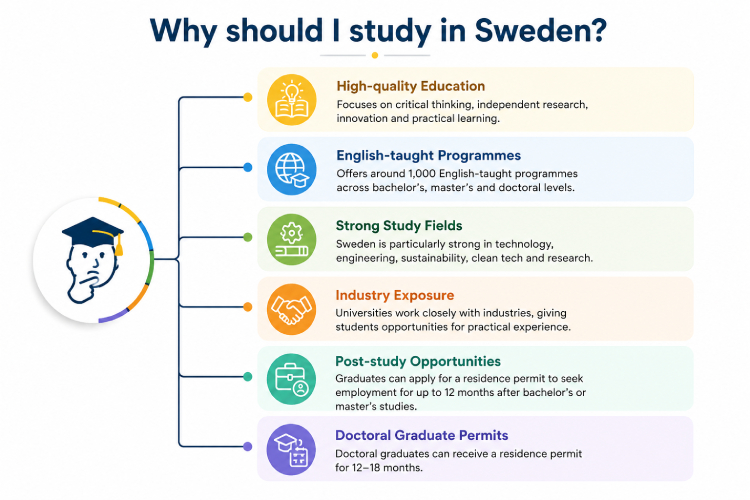
- High-quality education: Sweden focuses on critical thinking, independent research, innovation, and practical learning.
- English-taught programmes: International students can choose from around 1,000 programmes at bachelor's, master's, and doctoral levels.
- Strong study fields: Sweden is known for technology, engineering, sustainability, clean tech, and research.
- Industry exposure: Swedish universities work closely with industries, helping students gain practical experience during their studies.
- Post-study opportunities: Bachelor's and master's graduates can apply for a residence permit to seek employment for up to 12 months after completing their studies.
- Opportunities for doctoral graduates: Doctoral graduates can receive a post-study permit for 12–18 months.
Top Universities in Sweden for International Students
Sweden has several globally recognised universities offering programmes across engineering, technology, medicine, business, sustainability, social sciences and other fields.
Swedish Universities: QS 2027 Rankings and Indicative Tuition
| Factor | Details |
|---|---|
| English-taught programmes | Around 1,000 |
| Tuition fees | Typically SEK 90,000–200,000 per year for non-EU/EEA students |
| Funds requirement | SEK 10,656 per month for 2026 applications |
| Residence permit fee | SEK 1,500 for adults |
| University application fee | SEK 900 |
| Processing time | 75% of recently decided student permit cases were decided within 2 months |
| Work while studying | Maximum 15 hours/week during semesters for bachelor's and master's students |
| Summer work | No 15-hour cap during June, July and August |
| Post-study permit | Up to 12 months after bachelor's/master's; 12–18 months after doctoral studies |
| Top universities | 9 Swedish institutions appear in the QS World University Rankings 2027 main global table |
Tuition in Sweden is generally determined by programme, not simply by university. Students should therefore check the exact tuition fee on the official programme page before applying.
Popular Courses to Study in Sweden
Swedish universities offer English-taught programmes across technology, business, sustainability, sciences, design and other fields.
Popular study areas include:
- Computer Science
- Artificial Intelligence and Machine Learning
- Data Science
- Engineering
- Wireless Communications
- Economics
- Business and Management
- Supply Chain and Logistics
- Environmental Science
- Sustainable Energy
- International Marketing
- Law
- Psychology
- Architecture and Design
Indicative Tuition by Programme
| Programme | Duration | Indicative Annual Tuition |
|---|---|---|
| BSc Information and Communication Technology | 3 years | SEK 110,000–145,000 |
| BSc Mathematics | 3 years | SEK 100,000–135,000 |
| MSc Computer Science | 2 years | SEK 140,000–190,000 |
| MSc Data Science / Machine Learning | 2 years | SEK 145,000–190,000 |
| MSc Economics | 2 years | SEK 100,000–150,000 |
| MSc/MA Management | 1–2 years | SEK 110,000–180,000 |
| MSc Logistics & Supply Chain Management | 2 years | SEK 110,000–160,000 |
| MSc International Marketing & Brand Management | 1 year | SEK 130,000–150,000 |
| LLM | 1 year | SEK 90,000–135,000 |
| MSc Psychology | 2 years | SEK 100,000–145,000 |
| PhD / Doctoral studies | Usually 4 years | No tuition; doctoral students are normally salaried employees |
These are indicative ranges. Students should confirm the exact fee for their chosen programme.
Cost of Living in Sweden for Students
The cost of living in Sweden depends on the city, accommodation and lifestyle of the student. Students should plan their monthly budget carefully, as larger cities such as Stockholm and Gothenburg are generally more expensive.
Smaller student cities can be more affordable.
| Expense | Typical Monthly Cost |
|---|---|
| Student accommodation | SEK 3,500–6,500 |
| Food and groceries | SEK 2,500–3,500 |
| Local transport | SEK 500–700 |
| Phone and internet | SEK 300–450 |
| Course materials | SEK 500–800 |
| Social and miscellaneous expenses | SEK 1,000–2,000 |
| Indicative total | SEK 8,500–13,500 |
Students living in shared accommodation can reduce their monthly expenses. Cooking at home, using student discounts and choosing public transport can also help save money. Stockholm and Gothenburg usually have higher accommodation and daily expenses. Cities such as Linköping, Umeå and Lund can offer comparatively affordable options for students, although costs still depend on the type of accommodation and lifestyle. Students should also keep some extra money aside for healthcare, travel, clothing and unexpected expenses.
Scholarships to Study in Sweden
International students can explore scholarships offered by the Swedish Institute, individual universities and external programmes.
Swedish Institute Scholarships for Global Professionals
The Swedish Institute Scholarship for Global Professionals is a major master's scholarship programme. Depending on the applicable intake and eligibility rules, support can include tuition fees, living expenses, insurance and other benefits.
Eligibility countries and conditions can change between intakes, so students should check the applicable scholarship cycle before applying.
University Scholarships
Major scholarship options include:
- Lund University Global Scholarship
- Uppsala University scholarships
- KTH Scholarship
- Chalmers scholarships
- Stockholm University scholarships
- Linköping University scholarships
- Karolinska Institutet scholarships
- Stockholm School of Economics scholarships
Students can also explore Erasmus Mundus Joint Master's opportunities involving Swedish universities. Scholarship deadlines and award values differ considerably, so applicants should check the specific scholarship before each intake.
Admission Requirements to Study in Sweden
- Bachelor's Degree: Applicants generally need an upper-secondary qualification equivalent to the Swedish upper-secondary standard and must meet programme-specific subject requirements. For Indian applicants, a recognised Class XII qualification with the required subjects is generally the starting point.
- Master's Degree: Applicants normally require a bachelor's degree equivalent to at least 180 ECTS credits, usually in a relevant subject.
- Doctoral Studies: Applicants generally require appropriate master's-level qualifications. Doctoral opportunities are often advertised as positions because doctoral students are normally employed by the university.
English Language Requirements to Study in Sweden
Many English-taught programmes require proficiency equivalent to Swedish English 6.
Common accepted scores include:
| Test | Typical Requirement |
|---|---|
| IELTS Academic | 6.5 overall, no section below 5.5 |
| TOEFL iBT | 90 overall, writing at least 20 |
| PTE Academic | 62 overall, writing 61 |
| Cambridge C1/C2 | 180 or above |
Exact requirements can vary by programme. Some applicants may satisfy English requirements through previous education, subject to the official admissions criteria.
Study Intakes in Sweden
Sweden has two main study intakes for international students:
| Intake | Classes Start | Programme Availability |
|---|---|---|
| Autumn Intake | August/September | Most programmes available |
| Spring Intake | January | Limited programmes available |
Which Intake Is Best?
The Autumn Intake is the most popular choice for international students because more bachelor's and master's programmes are available. The Spring Intake has fewer options, so students should check whether their preferred programme is offered before applying. For international students, the Autumn Intake is generally the better option.
Sweden Residence Permit for International Students
International students from outside the EU/EEA who want to study in Sweden for more than 90 days generally need a residence permit for studies. Students should apply for the permit after receiving admission and meeting the required conditions. The permit allows students to live in Sweden during their studies and, subject to the applicable rules, work alongside their studies.
Types of Sweden Student Visa and Residence Permit
The document you need depends mainly on the duration of your studies.
| Factor | Schengen Visa – Type C | Residence Permit for Studies |
|---|---|---|
| Course duration | Up to 90 days | More than 3 months |
| Suitable for | Short courses, summer schools, vocational modules, research visits and conferences | Bachelor's, master's, doctoral, exchange and other qualifying long-term studies |
| Maximum stay | 90 days within a 180-day period | Generally issued according to the study period, subject to permit rules |
| Fee | €90 for age 12+; €45 for ages 6–11; free for ages 0–5 | SEK 1,500 for adults; SEK 750 for children under 18 |
| Application | Through the applicable Sweden visa process | Online through Migrationsverket |
| Work rights | No | Subject to applicable student work conditions |
| Insurance | Travel medical insurance of at least €30,000 | Comprehensive health insurance for qualifying stays under one year; longer stays may qualify for population registration |
Indian students pursuing a bachelor's, master's or other programme lasting more than three months will generally need a residence permit for studies rather than a short-stay Schengen visa.
*Want to apply for Sweden residence permit? Contact Y-axis for complete guidance
Sweden Student Residence Permit Eligibility Requirements
To qualify for a residence permit for higher education studies, applicants must meet the applicable requirements set by the Swedish Migration Agency.
- Valid Passport: You need a valid passport. Your residence permit cannot be issued beyond the validity of your passport.
- Final Admission to Full-Time Studies: You must have final admission to qualifying full-time, on-campus studies. At a university or university college, full-time study normally corresponds to 30 credits per semester. Distance-only education does not qualify for the higher-education residence permit.
- Tuition Fee Payment: Students who are required to pay tuition must generally pay the required first instalment before applying for their residence permit.
- Health Insurance: Students studying for less than one year may need comprehensive health insurance covering medical care during their stay. Students staying for at least one year can generally register in Sweden's population register after arrival, subject to eligibility.
- Proof of Funds: For applications made in 2026, students must demonstrate financial resources of at least SEK 10,656 per month. The amount must cover the entire period for which the residence permit is requested.
Documents Required for a Sweden Student Residence Permit
Students should prepare:
- Valid passport and required passport-page copies
- Final admission decision from the Swedish educational institution
- Proof of payment of tuition fees, where applicable
- Proof of funds for the full permit period
- Health insurance documents, where required
- Academic documents requested for admission or permit assessment
- Certified English or Swedish translations where documents are issued in another language
- Family documents if a spouse, partner or children are accompanying the student
Important: Sweden does not use a Confirmation of Acceptance for Studies (CAS). CAS is a UK-specific term. Swedish applicants use their final admission decision and related university documentation.
*Looking for assistance with Sweden Immigration? Talk to Y-Axis, the world’s no. 1 overseas immigration consultancy for end-to-end support.
How to Apply for a Sweden Student Residence Permit?
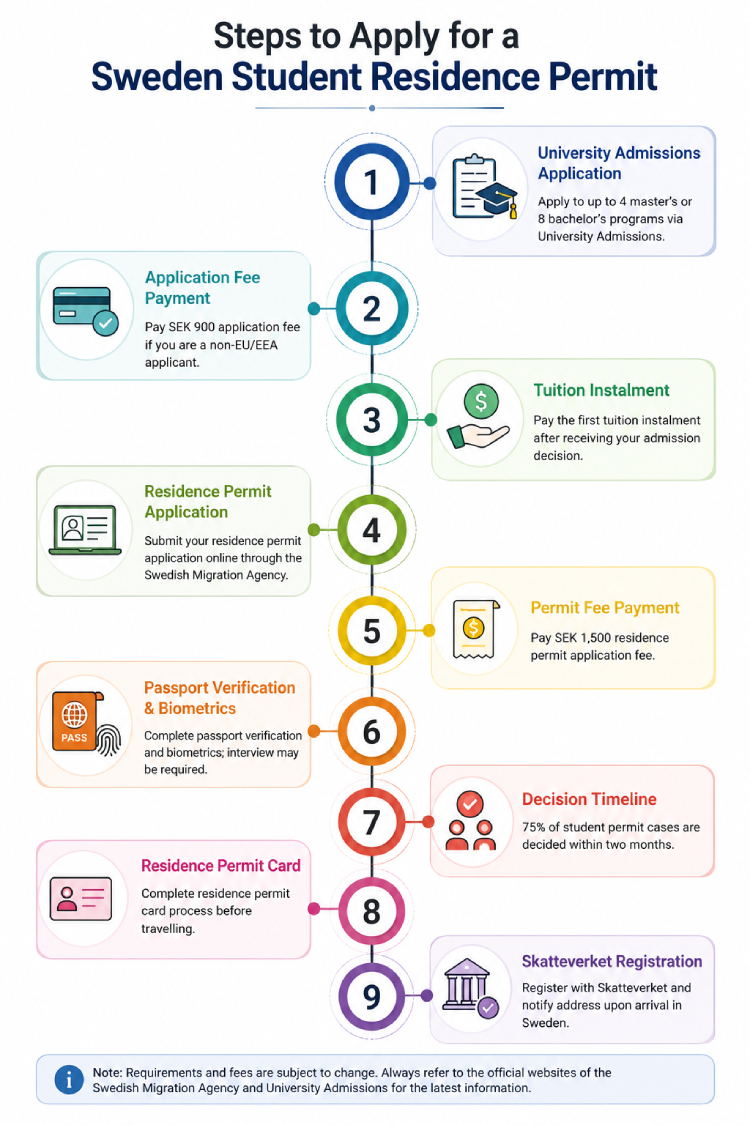
Step 1: Apply through University Admissions, Sweden's centralised higher-education admissions portal.
Students can apply for up to 4 master's programmes or 8 bachelor's courses/programmes, subject to the applicable admissions rules.
Step 2: Non-EU/EEA applicants generally pay an application fee of SEK 900.
Step 3: After receiving your final admission decision, pay the required first tuition instalment where tuition applies.
Step 4: Submit your residence permit application online through the Swedish Migration Agency's e-service with the required documents.
Step 5: The adult residence permit application fee is SEK 1,500.
Step 6: Complete the required passport verification and biometrics process. Some applicants may also be called for an interview.
Step 7: Migrationsverket reports that 75% of recently decided student permit cases were decided within two months.
Step 8: Students who require a residence permit card should complete the card process before travelling as applicable.
Step 9: After reaching Sweden, eligible students should register with Skatteverket and comply with applicable address-notification requirements.
Sweden Student Visa Cost
The cost of studying in Sweden includes the student residence permit fee, university application fee and tuition fees. The exact tuition cost depends on the university and programme you choose.
| Fee | Amount |
|---|---|
| Residence permit – Adult | SEK 1,500 |
| Residence permit – Child under 18 | SEK 750 |
| University application fee | SEK 900 |
| Tuition fee | Programme-specific |
| Study permit extension – Adult | SEK 1,500 |
| Post-study job-search permit – Adult | SEK 1,500 |
Sweden Student Visa Processing Time
The Sweden student visa processing time can vary depending on your application, documents and individual circumstances. It is recommended to apply early so you have enough time to receive your decision and make travel arrangements before your course starts.
| Application Type | Estimated Processing Time |
|---|---|
| Student residence permit | 1–3 months |
| Study permit extension | 1–4 months |
| Post-study job-search permit | 1–3 months |
Top Cities to Study in Sweden
- Stockholm offers access to KTH, Stockholm University, Karolinska Institutet and other institutions, along with Sweden's largest employment market.
- Lund is one of Sweden's best-known student cities and offers a strong university-focused environment.
- Uppsala combines Sweden's oldest university with a compact student city.
- Gothenburg is home to Chalmers and the University of Gothenburg and has strong links with automotive, technology and clean-tech industries.
- Linköping is particularly strong in engineering and innovation, while Umeå can offer comparatively lower living costs.
Part-Time Jobs for International Students in Sweden
International students can work part-time while studying in Sweden. There is no fixed legal limit on the number of hours that students with a valid residence permit for higher education can work. However, students should make sure that part-time work does not affect their studies.
| Part-Time Job | Typical Pay |
|---|---|
| Café or Restaurant Staff | SEK 120–160/hour |
| Retail Assistant | SEK 120–160/hour |
| Delivery Worker | SEK 120–170/hour |
| Customer Service | SEK 130–180/hour |
| University Assistant | SEK 130–180/hour |
| IT/Technical Support | SEK 150–220/hour |
Tips for Finding Part-Time Jobs in Sweden
- Learn basic Swedish, as it can increase your job opportunities.
- Check jobs through university career services and online job portals.
- Choose work hours that fit around your classes and assignments.
- Keep your CV updated and highlight relevant skills and experience.
Note: Pay depends on the job, location, experience and employer. The amounts above are general estimates rather than guaranteed wages.
Post-Study Work in Sweden
After completing qualifying studies, international graduates may apply for the residence permit to seek employment after studies.
| Requirement | Details |
|---|---|
| Permit length | Up to 12 months after bachelor's/master's; 12–18 months after doctoral studies |
| Application deadline | Before the current study permit expires |
| Purpose | Look for employment or explore starting a business |
| Study requirement | Completion of the qualifying programme under applicable conditions |
| Funds | SEK 10,656 per month for the permit period |
| Adult fee | SEK 1,500 |
| Renewable | No |
There is no two-month grace period after the study permit expires. Students must submit the post-study permit application before their existing permit expires.
Jobs After Studying in Sweden
International graduates can find opportunities across sectors including:
- Technology and IT
- Engineering and manufacturing
- Data and Artificial Intelligence
- Life sciences
- Healthcare
- Clean technology
- Renewable energy
- Research and innovation
Sweden's technology, engineering and sustainability sectors can be particularly relevant for international STEM graduates.
Path to Permanent Residence in Sweden
Studying in Sweden does not automatically lead to permanent residence. For many international graduates, the longer-term route involves moving from study status to qualifying employment and then meeting the residence requirements applicable to work permit holders.
Work permit holders can generally become eligible to apply for permanent residence after meeting the required work-permit history and other conditions. Because Swedish permanent residence and citizenship policies can change, students planning long-term settlement should check the rules applicable when they become eligible.
How Can Y-Axis Help You Study in Sweden?
Y-Axis supports students planning to study in Sweden through:
- Free counselling for university and course selection
- Y-Path for personalised course and career recommendations
- Y-Axis Coaching services and enroll in IELTS for live sessions with industry experts.
- Campus Ready Programme to prepare students before moving abroad.
- Sweden residence permit support for documentation, financial evidence and application preparation.
Looking for inspiration
Explore what Global Indians have to say about Y-Axis in shaping their future