

Study in Spain

Don't know what to do?
Get Free Counseling
Last Updated: 31 August 2026
Study in Spain for Indians: Top Universities, Fees, Visa & Scholarships
Spain is one of the most popular countries in Europe for studying. It is also ranked among the top study destinations in the world for international students. In recent years, more Indian students are choosing Spain, and the number is increasing every year. Spain is a good choice because it offers globally recognized degrees, quality education, and a great student life. The country has a strong education system and a friendly, multicultural environment. Universities in Spain focus not only on theory but also on practical learning. Students get to study in modern classrooms, work on real projects, and gain experience through internships. This helps them prepare for jobs anywhere in the world. Spain has more than 87 universities ranked in QS rankings and offers thousands of courses. There are also more than 1,800 programs available in English.
Spanish universities are well known for courses in business, engineering, architecture, medicine, and humanities. Many universities work with international companies, which helps students understand real industry requirements. Spain is also strong in research and development. Students can work on advanced research projects and use modern facilities. The education system also helps students improve skills like critical thinking, problem-solving, and independent learning. For Indian students, Spain offers a good mix of quality education, practical experience, and global career opportunities.
Why Study in Spain?
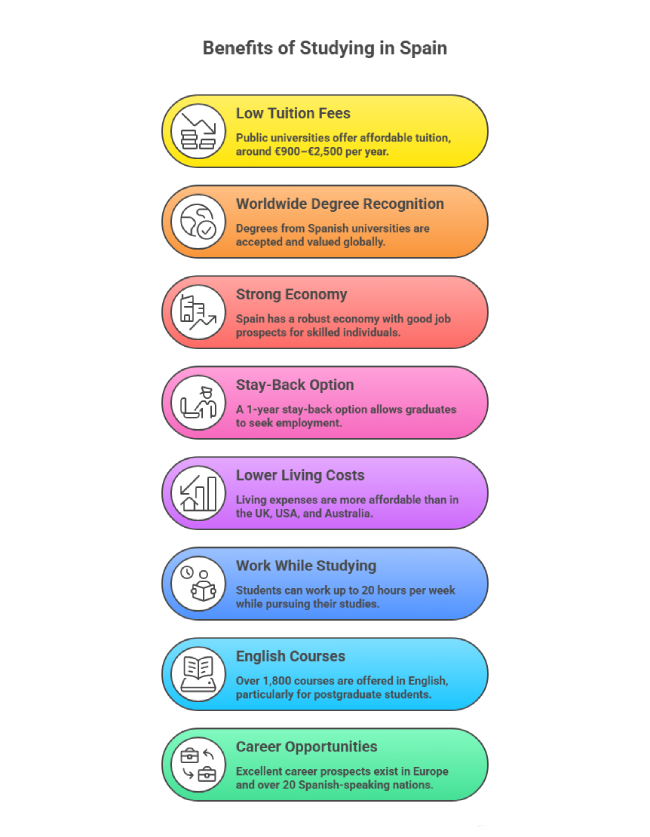
- Low tuition fees at public universities (around €900–€2,500 per year)
- Degrees are accepted and valued worldwide
- 9 Spanish universities in the QS World University Rankings top 450
- Work up to 30 hours per week while studying
- Strong economy with good job opportunities for skilled workers
- 1-year stay-back option to look for a job after graduation
- Living costs are lower compared to the UK, USA, and Australia
- More than 1,800 courses are available in English, especially for postgraduate students
- Good career opportunities in Europe and in over 20 Spanish-speaking countries
*Want to study abroad? Sign-up with Y-Axis for expert guidance
Top Universities in Spain for Indian Students
Choosing the right university is important for students who want to study in Spain. The country has more than 87 universities ranked in QS rankings, located in different cities. These include public, private, and polytechnic universities. Many Indian students are now choosing Spain, and the number is increasing every year.
Most universities in Spain are public and funded by the government. They offer most of the courses in the country and are known for good education, research, and global rankings. Private universities are fewer but usually offer specialized courses, especially in business, management, and technology.
Top 10 QS Ranking Universities in Spain
Spain is home to some of the world's well-ranked universities known for academic excellence, strong research output, and global reputation. Many of these institutions consistently appear in the QS World University Rankings 2025. These universities are especially popular among Indian students for business, engineering, medicine, technology, and science programs. Below is the updated list of top-ranked universities in Spain along with their approximate annual tuition fees for international students:
| Name of the University | QS World Ranking 2025 | Annual Tuition Fee (Approx.) |
|---|---|---|
| University of Barcelona | 160 | €1,500–€3,000 |
| Universitat Autònoma de Barcelona (UAB) | 201–210 | €1,400–€2,500 |
| Universidad Complutense de Madrid (UCM) | 251–300 | €1,000–€2,500 |
| Universidad Autónoma de Madrid (UAM) | 206 | €1,200–€2,800 |
| University of Navarra | 262 | €10,000–€15,400 |
| Universitat Pompeu Fabra (UPF) | 265 | €2,000–€5,000 |
| Universidad Carlos III de Madrid (UC3M) | 301 | €1,500–€3,000 |
| Universitat Politècnica de Madrid | 334 | €1,500–€3,500 |
| Universitat Politècnica de Catalunya Barcelona Tech | 392 | €3,800–€9,300 |
| University Politecnica de Valencia | 422 | €1,153–€2,218 |
Popular Courses to Study in Spain
Spain offers many courses for international students. Public universities have lower fees, while private universities and courses like MBA may cost more.
| Programme | Duration | Popular Courses / Specializations |
|---|---|---|
| Business / MBA | 1–2 years (MBA), 4 years (Bachelor's) | International Business, Finance, Marketing, HR, Supply Chain, MBA |
| Engineering & Technology | 4 years (Bachelor's), 1–2 years (Master's) | Civil, Electrical, Industrial, Computer, Mechatronics |
| Computer Science & IT | 4 years (Bachelor's), 2 years (Master's) | Computer Science, AI, Data Science, Cybersecurity, Software, Cloud |
| Architecture & Design | 5–6 years, 2 years (Master's) | Architecture, Urban Planning, Interior, Industrial, Graphic Design |
| Tourism & Hospitality | 3–4 years, 1 year (Master's) | Hotel Management, Tourism Marketing, Events, Sustainable Tourism |
| Social Sciences | 3–4 years, 1–2 years (Master's) | Political Science, Sociology, International Relations, Psychology |
| Law | 4 years, 1–2 years (LLM) | International Law, EU Law, Business Law, Human Rights |
| Natural Sciences | 4 years, 2 years (Master's) | Environmental Science, Biology, Chemistry, Biotechnology |
| Medicine | 6 years | Medicine, Dentistry, Pharmacy, Nursing, Physiotherapy |
| Arts & Media | 3–4 years | Journalism, Film, Fine Arts, Communication, Digital Media |
Spain Study Intakes: September/February
Spain has two main intakes every year. It is important to plan early because admission, visa, and document processes take time.
September / Autumn Intake (Main Intake)
- University Application Deadline: Most universities close between February and June (some may close earlier).
- Offer Letter: Usually received within a few weeks after applying.
- Financial Preparation: Arrange funds and documents by May–June.
- Visa Application: Apply by June–July (processing takes around 4–8 weeks).
- Travel to Spain: Plan to travel by August–September.
February / Spring Intake (Secondary Intake)
- University Application Deadline: Most universities close between October and December.
- Note: Fewer courses are available compared to the main intake.
- Financial Preparation: Complete by November.
- Visa Application: Apply by December – January.
- Travel to Spain: Plan to travel by January–February.
Month-by-Month Plan
- January – February: Research universities and courses
- March – April: Prepare documents and take IELTS/TOEFL if needed
- April – June: Apply to universities
- June – July: Receive admission letter and apply for visa
- July – August: Arrange accommodation and travel plans
- September: Travel to Spain and complete enrollment
Cost of Studying in Spain
Spain is more affordable than countries like the USA and the UK, which is why many Indian students choose it. Students can get good quality education at a lower cost.
Tuition Fees
There is a clear difference between public and private universities in Spain. Public universities are cheaper because the government controls the fees. Bachelor’s programs usually cost €900–€2,500 per year, and master’s programs cost €1,500–€5,000 per year. Private universities are more expensive, with fees ranging from €6,000–€20,000 per year. Courses like MBA can cost even more, especially in top business schools.
| University Type | Tuition Fee Range | Notes |
|---|---|---|
| Public Universities | €900–€2,500/year (UG); €1,500–€5,000/year (PG) | Fees depend on the region. Cities like Madrid and Barcelona are slightly more expensive. |
| Private Universities | €6,000–€20,000/year | Higher fees, but smaller classes and more English courses |
| MBA Programs | Up to €60,000 (total) | Top business schools charge higher fees |
Cost of Living in Spain
Living costs depend on the city. Big cities like Madrid and Barcelona are more expensive than smaller cities.
Average Monthly Expenses:
- Accommodation: ₹36,000 – ₹72,000 (€400–€800)
- Food: ₹18,000 – ₹32,000 (€200–€350)
- Health Insurance: ₹4,500 – ₹9,000 (€50–€100)
- Transport: ₹3,500 – ₹7,000 (€40–€80)
- Utilities & Internet: ₹4,500 – ₹7,000 (€50–€80)
- Personal expenses: ₹9,000 – ₹18,000 (€100–€200)
Total Monthly Cost: ₹79,500 – ₹1,50,000 (€870–€1,670)
Total Yearly Cost: ₹9.5 lakh – ₹18 lakh
Students must also show proof of money when applying for a Spain student visa. You need to show around €700–€850 per month to cover your living expenses.
Read more...
Scholarships for Indian Students to Study in Spain
Spain offers many scholarship opportunities for international students, including Indians. These scholarships are provided by the Spanish government, private foundations, European institutions, and individual universities. Most scholarships help students cover tuition fees, living expenses, or both. Some scholarships are available for Bachelor's and Master's students, while many are specially designed for PhD and research scholars. Below table shows the main scholarships, the amount they provide, and who can apply.
| Scholarship Name | Scholarship Amount | Eligibility |
|---|---|---|
| MAEC-AECID Scholarship (Spanish Government) | Approx. €1,000/month + tuition coverage | Open to international students from developing countries for master's and doctoral programs. Strong academic record required. |
| Erasmus+ Scholarship | Covers tuition, travel, and living expenses (amount varies by program) | Open to students enrolled in Erasmus+ partner programs. Selection based on academic merit. |
| La Caixa Foundation Scholarship | Up to €16,000 per year | Open to international students for master's and PhD programs at top Spanish universities. Highly competitive. |
| IE University Merit Scholarships | Up to 80% tuition waiver depending on merit | Open to international students applying to IE University programs. Based on academic merit and profile. |
| BBVA Foundation Scholarships | €10,000–€20,000 per year | Open to students in STEM and social science fields with excellent academic records. |
| Banco Santander Scholarships | €3,000–€6,000 (one-time support) | Open to international students at Santander partner universities. Focus on business, banking, and finance. |
| Marie Skłodowska-Curie Actions (MSCA) | €3,000 per month + €600 travel allowance | Open to researchers from all nationalities for PhD and postdoctoral research at EU institutions including Spain. |
| Universidad Complutense de Madrid Scholarships | Partial tuition fee waiver | Available for new international students with outstanding academic performance. |
*Want to apply for scholarships to study in Spain? Contact Y-Axis for end-to-end guidance
Eligibility Criteria to Study in Spain
Before applying to study in Spain, students should check whether they meet the basic requirements for their chosen course and university.
- Educational qualification: For bachelor's programs, Indian students generally need a valid Class 12 certificate. Some students may need to get their qualifications approved or recognised in Spain.
- Language requirements: Students must meet the language requirements of their chosen course. Spanish-taught courses may require DELE B2 or C1, while English-taught courses may require IELTS or TOEFL scores.
- Financial proof: Students applying for a student visa need to show that they have enough money to support themselves during their stay. Financial proof may include bank statements or other accepted documents.
- Health insurance: International students need suitable health insurance for their stay in Spain. Insurance is also required as part of the student visa process.
- Student visa: Most non-EU students, including Indians, need a long-stay student visa (Type D) to study in Spain.
- Admission requirements: Requirements can differ between universities and courses. Students should check the specific academic, language, and document requirements before applying.
Steps to Study in Spain
Step 1: Choose a course and university that match your interests and career goals. Check the course subjects, specialization, university reputation, location, tuition fees, cost of living, teaching language, and scholarship options.
Step 2: Check whether your educational qualifications meet the requirements of the chosen university. Also check the required English or Spanish language test scores and any additional documents needed for admission.
Step 3: Prepare proof that you have enough money to pay for your tuition fees and living expenses in Spain. Bank statements and other financial documents may be required during the student visa process.
Step 4: Submit your application through the university's official website or application system. Spain generally has September and February intakes, although the available courses and deadlines can vary between universities.
Step 5: Arrange suitable health insurance before applying for your student visa. Make sure the insurance meets the requirements for international students in Spain.
Step 6: After receiving your admission letter, apply for the appropriate Spain student visa. Submit your required documents and complete the visa application process.
Step 7: Look for accommodation before travelling to Spain. Students can choose from student hostels, shared apartments, or private accommodation. Rent can be higher in cities such as Madrid and Barcelona.
Step 8: After reaching Spain, complete the final enrollment process with your university. You can then attend classes, access university facilities, and receive your student ID card.
Step 9: Complete Post-Arrival Formalities. After arriving in Spain, complete the required formalitiesExploring part-time work opportunities
Step 10: Once your admission and post-arrival requirements are complete, you can start your studies and settle into student life in Spain.
Spain Student Visa
A Spain Student Visa is a long-stay visa (Type D) for non-EU students who want to study in Spain for more than 90 days. It allows you to enter the country and stay legally for your course duration at a recognized university or institution.
This visa is an important step for international students, as it gives permission to live and study in Spain and also allows limited part-time work during studies. After arriving, students must complete local registration to continue their stay legally.
Requirements for Spain Student Visa
A complete application needs these documents:
- Valid passport with at least 1 year of validity beyond the intended stay, with at least two empty pages
- Completed and signed visa application form with declaration
- Two recent passport-size photographs (white background, 35x45mm, not older than 6 months)
- Letter of admission or enrollment from a recognized Spanish university
- Proof of financial means (bank statements showing €700–€850 per month, or a scholarship letter)
- Private health insurance covering Spain (minimum €30,000 coverage for the full stay)
- Academic certificates and transcripts (with certified Spanish or English translation)
- Language proficiency certificates (IELTS/TOEFL for English; DELE B2/C1 for Spanish-taught programs)
- Statement of Purpose (SOP) and updated CV/resume
- Criminal background check certificate (issued in India)
- Medical certificate confirming no contagious diseases
- Proof of accommodation in Spain (rental contract or student residence booking confirmation)
Proof of Funds to Study in Spain
International students applying for a Spain student visa need to show that they have enough money to live in Spain and pay for their return journey. The required amount is based on Spain's financial requirement called IPREM.
For 2026, a student needs to show at least €600 per month, which is €7,200 for one year. If family members are travelling with the student, they need to show additional funds:
| Person | Minimum Funds per Month |
|---|---|
| Student | €600 |
| First family member | €450 |
| Each additional family member | €300 |
If the student has already paid for accommodation for the full stay, the amount needed for accommodation may be reduced from the required financial proof.
Documents That Can Be Used as Proof of Funds
Students may show their financial ability through:
- Bank statements
- Sponsorship letter from a parent or guardian
- Sponsor's bank statements
- Scholarship or financial aid letter
- Proof of paid accommodation
- Other financial documents accepted by the Spanish authorities
How to Apply for a Spain Student Visa from India?
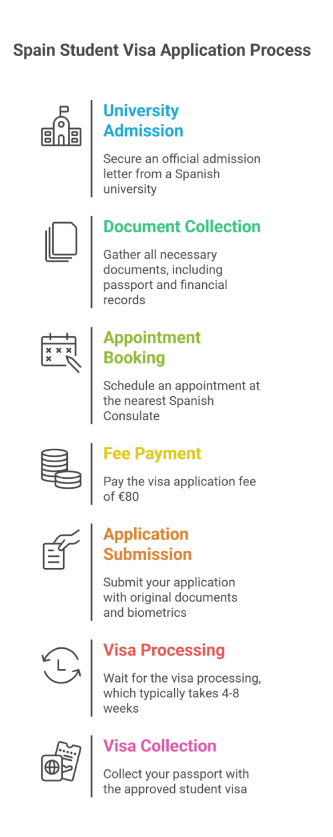
Step 1: Apply to a recognised university in Spain and receive your official admission letter. It is best to apply 6–8 months before your chosen intake. The September intake is the main intake, while January is the secondary intake.
Step 2: Once you receive your admission letter, book your student visa appointment through BLS International, the official visa application partner for Spain in India. You can visit a BLS centre in New Delhi, Mumbai, Bengaluru, Chennai, Kolkata, or other available cities.
Step 3: Collect all the required documents, including your passport, admission letter, proof of funds, health insurance, accommodation proof, police clearance certificate, and medical certificate. Get your police and medical certificates apostilled and arrange sworn Spanish translations if required.
Step 4: Visit the BLS centre on your appointment date, submit your documents, provide your biometric details, and pay the €80 student visa fee along with the applicable BLS service charge.
Step 5: After submitting your application, you can track its status online. Most student visa applications are processed in 3–6 weeks, although it may take longer during busy periods. Some students may also be asked to attend a short interview.
Step 6: After receiving your visa, travel to Spain and apply for your TIE (Foreigner Identity Card) within 30 days of arrival. The TIE is your residence permit and allows you to stay in Spain for the duration of your studies.
Spain Student Visa Fee and Processing Time
The Spain student visa has a fixed fee and takes some time to process. Students must pay the visa fee when they submit their application at the Spanish Embassy or Consulate in India.
- The visa fee is €80 (around ₹7,200–₹7,500).
- In India, you can apply through Spanish Consulates in Mumbai, Delhi, Chennai, and Kolkata.
The processing time is usually 4 to 8 weeks. Sometimes, it may take longer depending on the number of applications and document checks. Students should apply for the visa as soon as they receive their admission letter to avoid delays and reach Spain on time.
Part-Time Jobs in Spain for Indian Students
Part-time jobs help students manage their expenses and gain work experience. International students in Spain can work up to 20 hours per week during their studies. During holidays, they may work more hours depending on visa rules.
Students can find jobs through university job portals, career centres, and websites like LinkedIn and Indeed, or by visiting local shops, restaurants, and businesses. Some universities also offer part-time jobs on campus. Knowing basic Spanish can help you get more job opportunities, especially for customer-facing roles. Students must follow visa rules and have a proper work contract.
Types of Part-Time Jobs in Spain
The minimum wage in Spain is about €8.45 per hour. Most part-time jobs pay around this rate or higher, depending on the job and experience.
| Job Type | Average Salary (Approx.) |
|---|---|
| Restaurant / Café Staff | €8–€10 per hour |
| Supermarket / Retail Assistant | €8–€10 per hour |
| Delivery Jobs | €9–€12 per hour |
| Hotel / Hospitality Staff | €9–€12 per hour |
| Private English Tutor | €15–€30 per hour |
| University Assistant | €9–€14 per hour |
| IT / Technical Support | €12–€18 per hour |
| English Teaching | €15–€30 per hour |
Post-Study Work and Placement Opportunities
Spain offers good career opportunities for international students, including Indians. The country has a stable economy and needs skilled workers in areas like technology, renewable energy, tourism, engineering, healthcare, and finance. This makes Spain a good place to start and grow your career after your studies. After graduation, students can stay in Spain to search for jobs and build their career. Many industries are actively hiring skilled professionals.
Top Job Roles and Salaries in Spain
| Job Role | Average Annual Salary | Required Degree / Background | Key Skills |
|---|---|---|---|
| Software Developer | €35,000–€55,000 | Computer Science, Software Engineering | Python, Java, SQL, JavaScript |
| Data Scientist / Analyst | €35,000–€55,000 | CS, Mathematics, Statistics | Python, R, SQL, Power BI |
| AI / ML Engineer | €55,000–€75,000 | CS, AI, Engineering | TensorFlow, PyTorch, Python |
| Cybersecurity Specialist | €40,000–€65,000 | IT, Computer Science | CISSP, CEH, Security skills |
| Cloud / DevOps Engineer | €40,000–€65,000 | IT, Engineering | AWS, Azure, Docker |
| Renewable Energy Engineer | €35,000–€55,000 | Civil, Electrical, Environmental | Solar, wind, project skills |
| Civil / Structural Engineer | €30,000–€50,000 | Civil Engineering | CAD, project management |
| Biomedical Engineer | €30,000–€50,000 | Biomedical Engineering | Lab work, research |
| Doctor (GP) | €45,000–€70,000 | Medicine | Clinical + Spanish |
| Registered Nurse | €24,000–€35,000 | Nursing | Patient care, Spanish |
| Financial Analyst | €30,000–€50,000 | Finance, Economics | Excel, modeling |
| Management Consultant | €35,000–€55,000 | Business, MBA | Strategy, communication |
| HR Specialist | €28,000–€45,000 | HR, Psychology | Recruitment, HR tools |
| Supply Chain Analyst | €28,000–€42,000 | Business, Engineering | SAP, planning tools |
| Tourism / Hotel Manager | €25,000–€40,000 | Hospitality | Customer service, languages |
Post-Study Work Visa in Spain
After completing a master's or any recognized degree in Spain, students can apply for a 1-year job search or entrepreneurship permit (Autorización de Búsqueda de Empleo o para Emprender). This permit allows graduates to stay in Spain and search for a full-time job related to their field of study. During this period, students can work in any job to support themselves while looking for a permanent position. In some cases, this permit can be extended by another year. Once they find a job related to their qualification, they can switch to a regular work permit or EU Blue Card. This post-study period gives Indian students enough time to explore job opportunities, attend interviews, and start their professional career in Spain.
Path to Permanent Residency (PR)
Students who work legally in Spain after their studies can apply for permanent residency after living in Spain for 5 continuous years. This is a good option for Indian students who want to stay long-term and build their career.
To apply for PR, you need to meet these conditions:
- Live in Spain legally for 5 continuous years
- Have a stable job and regular income
- Know basic Spanish (at least A2 level; B1 is better)
- Have no serious criminal record
- Pass the CCSE test (in some cases)
If you meet these requirements, you can stay in Spain permanently and continue your career.
Build Your Future in Spain
Spain is a great option for Indian students who want good education without spending too much. It offers a strong learning experience along with good job opportunities in Europe and even in Spanish-speaking countries. Compared to the USA or the UK, studying in Spain is more affordable, but the quality of education is still high. With proper planning, choosing the right course, managing expenses, applying for scholarships, and preparing your visa, you can make your study journey smooth and successful. Spain is more than just a study destination. It gives you the chance to grow, build your career, and create a better future.
How can Y-Axis help you?
Y-Axis offers complete support for students planning to study in Spain, with transparent and personalized guidance.
Our services include:
- Free Counseling: Free Counseling on university and course selection.
- Campus Ready Program: Fly to Spain with the best and ideal course.
- Course Recommendation: Y-Path gives the best suitable ideas about your study and career options.
- Coaching: Y-Axis offers IELTS live classes to help students clear with high scores.
- Spain Student Visa: Our expert team helps you to get a Spain student Visa.
- Scholarship identification and application support
- Pre-departure guidance and post-arrival assistance
Looking for inspiration
Explore what Global Indians have to say about Y-Axis in shaping their future