


Don't know what to do ?
Get Free Counseling
Last Updated: 14 July 2026
Study in Spain for Free: Top Universities, Application and Eligibility
Spain is a one of the best and affordable country for international students. Many students choose Spain because public universities have lower tuition fees compared to countries like the USA, UK, and Australia. Although studying in Spain is not fully free, scholarships and financial support can help students study at a very low cost. In 2026, EU students usually pay around €500 to €1,500 per year at public universities. Non-EU students, including Indians, generally pay between €1,000 and €3,500 per year depending on the university and course.
Many universities and government programs offer scholarships that help cover tuition fees and living expenses. More than 80,000 international students choose Spain every year for higher education. Students should also plan for accommodation, food, transport, and health insurance. However, the cost of living in Spain is still affordable compared to many other European countries. With proper planning and scholarships, studying in Spain can be a budget-friendly option for international students.
Study in Spain: Quick Facts for Indian Students
| Topic | Details |
|---|---|
| Is studying in Spain free? | No. Spain is one of Europe's most affordable study destinations. Non-EU students typically pay €1,000–€3,500 per year at public universities. |
| EU student tuition fees | €500–€1,500 per year (for EU/EEA nationals only). |
| Public universities | Around 50 government-funded public universities. The lowest tuition fees are generally found in Andalusia, Extremadura, and Castile-La Mancha. |
| Top-ranked university | University of Barcelona – QS World University Rankings 2026: #160. |
| Cost of living | Approximately €520–€1,160 per month (around ₹46,000–₹1,02,000). |
| Scholarships | MAEC-AECID, Erasmus+ / Erasmus Mundus, La Caixa Foundation, and various regional and university scholarships can significantly reduce or fully cover study costs. |
| English-taught programs | More than 900 bachelor's and master's programs are available in English. |
| Part-time work | International students can work up to 30 hours per week while studying. |
| Post-study options | Graduates can apply for a 12-month job seeker visa. Permanent residence may be possible after 5 years of legal residence, subject to eligibility. |
| Main intakes | October (primary intake) and February (limited programs). International students typically apply for a Type D Student Visa and must show proof of financial means of approximately €700 per month. |
*Are you looking to study in Spain? Y-Axis is here to guide you through the entire process!
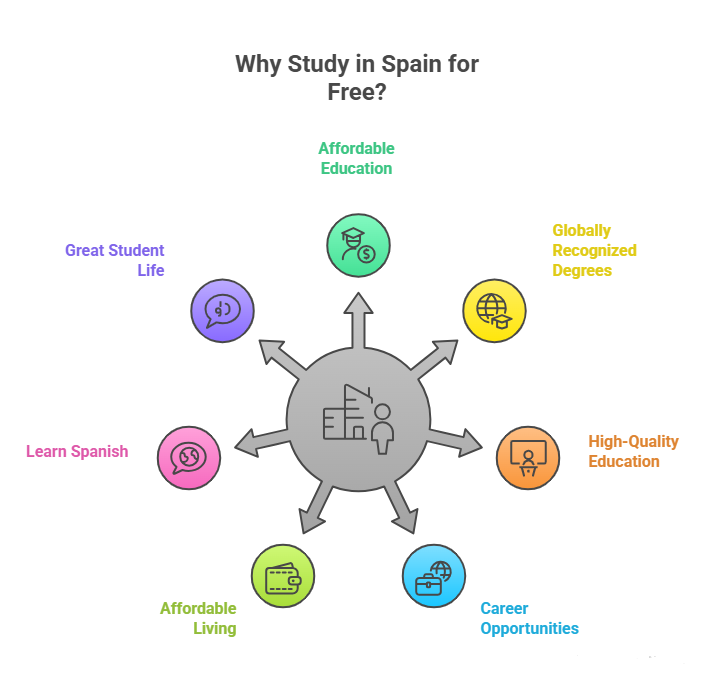
Why Study in Spain for Free?
- Affordable Public Universities: Spain offers low-cost education at public universities, making it possible for international students to study at a very low cost or almost free with scholarships.
- Scholarship Opportunities: Many Spanish universities, government programs, and European scholarships help students reduce or fully cover tuition and living expenses.
- Globally Recognized Degrees: Degrees from Spanish universities are accepted and valued in many countries around the world.
- High-Quality Education: Spain has well-known universities with modern campuses, experienced professors, and strong academic programs.
- Career Opportunities in Europe: Students can explore job opportunities in Spain and other European countries after graduation. Spain also offers post-study work options for international students.
- Affordable Cost of Living: Compared to countries like the UK, France, and Germany, Spain has lower living expenses, especially in smaller cities.
- Opportunity to Learn Spanish: Spanish is one of the most widely spoken languages in the world and can improve international career opportunities.
- Great Student Life: Spain offers a friendly culture, pleasant weather, good lifestyle, and enjoyable student experience for international students.
Top Public Universities in Spain for International Students
Spain has around 50 public universities spread across its regions. These universities are funded by regional and national governments. While they are not fully tuition-free for non-EU students, their fees are very affordable compared to global standards. Below are some of the top public universities in Spain where you can study at low cost:
|
University |
Location |
QS World Ranking 2026 |
Approx. Annual Tuition (Non-EU) |
|
University of Barcelona (UB) |
Barcelona |
177 |
€2,000–€3,000 |
|
Autonomous University of Madrid (UAM) |
Madrid |
257 |
€1,500–€2,500 |
|
University of Madrid (UCM – Complutense) |
Madrid |
218 |
€1,500–€2,500 |
|
University of Valencia (UV) |
Valencia |
401–450 |
€1,500–€2,500 |
|
University of Granada (UGR) |
Granada |
401–450 |
€1,000–€2,000 |
|
Autonomous University of Barcelona (UAB) |
Barcelona |
196 |
€1,500–€2,500 |
|
University of Seville |
Seville |
501–550 |
€1,000–€2,000 |
|
Polytechnic University of Valencia (UPV) |
Valencia |
501–550 |
€1,500–€2,500 |
|
University of Salamanca |
Salamanca |
601–650 |
€1,000–€2,000 |
|
University of Zaragoza |
Zaragoza |
601–650 |
€1,000–€2,000 |
*Want to apply for masters in Spain? Contact Y-Axis for end-to-end support
How to Study in Spain for Free or at Low Cost for Indian Students
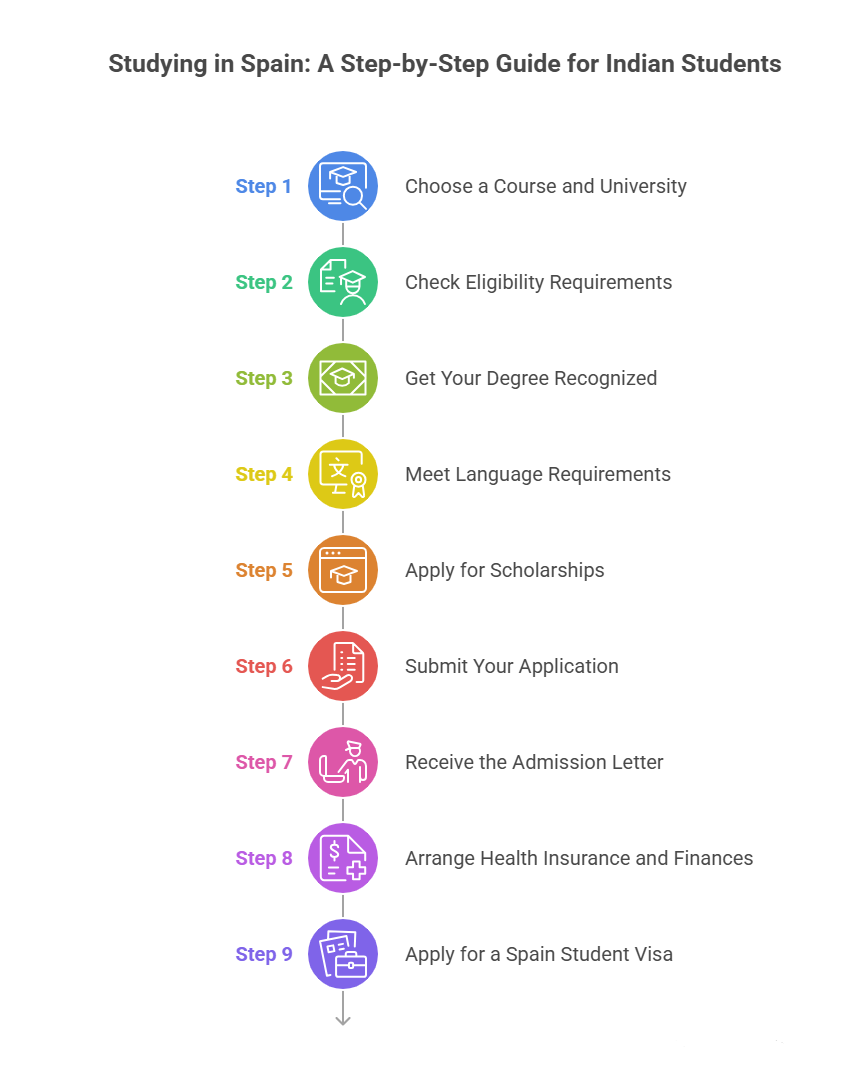
Indian students can study in Spain at a low cost by choosing affordable universities and applying for scholarships. Follow these simple steps for studying in Spain in 2026.
Step 1: Choose a Course and University
Search for public universities in Spain that offer your preferred course. Compare tuition fees, courses, and English-taught programs. Public universities usually have lower fees.
Step 2: Check Eligibility Requirements
For bachelor’s programs, students must complete Class 12 with good marks. For master’s programs, a recognized bachelor’s degree is required. Some courses may also ask for entrance exams, interviews, or portfolios.
Step 3: Get Your Degree Recognized
Indian students may need to get their previous education approved by the Spanish Ministry of Education. This process is called homologation. It confirms that your qualification matches Spanish education standards.
Step 4: Meet Language Requirements
For Spanish-taught courses, students need Spanish language certificates like DELE or SIELE. For English-taught courses, IELTS or TOEFL scores are usually required.
Step 5: Apply for Scholarships
Before paying tuition fees, apply for scholarships and grants offered by the Spanish government, universities, and Erasmus+ programs. These scholarships can help cover tuition fees and living costs.
Step 6: Submit Your Application
Prepare all required documents such as academic transcripts, passport, SOP, LORs, language test scores, CV, and portfolio if needed. Submit your application through the university’s official website before the deadline.
Step 7: Receive the Admission Letter
If your application is successful, the university will send you an official admission letter. This document is required for your student visa application.
Step 8: Arrange Health Insurance and Finances
Students must have health insurance for Spain. You also need to show proof that you have enough money to cover living expenses during your studies.
Step 9: Apply for a Spain Student Visa
Apply for a Spain Student Visa (Type D) at the Spanish Embassy or Consulate in India. You will need documents such as your admission letter, passport, proof of funds, health insurance, and academic certificates.
*Want to apply for Spain student visa? Contact Y-Axis for complete guidance
Homologation of Indian Degrees in Spain: How It Works
Homologation is the official process through which Spain's Ministry of Science, Innovation and Universities recognizes an Indian qualification as equivalent to a Spanish qualification. The official government application fee is €166.50, and the process typically takes 6–18 months, so students are advised to begin well before applying to a Spanish university.
Who needs homologation?
| Applicant | Requirement |
|---|---|
| Bachelor's applicants | Class 12 qualification must be recognized through UNEDasiss, which issues the accreditation required by Spanish public universities. |
| Master's and PhD applicants (regulated professions) | Full homologation is generally required for professions such as medicine, engineering, law, teaching, architecture, and other regulated fields under Royal Decree 889/2022. |
| Master's and PhD applicants (non-regulated fields) | For programs such as business, marketing, management, IT, and similar fields, an equivalencia (equivalence declaration) or the university's own academic evaluation is usually sufficient. |
Steps to apply for homologation
Step 1: Apostille your documents – Get your Indian degree certificate and academic transcripts apostilled by the Ministry of External Affairs (MEA), India.
Step 2: Obtain sworn Spanish translations – Have all required documents translated by an authorized sworn translator.
Step 3: Pay the government fee – Submit Modelo 790-107 and pay the official application fee of €166.50.
Step 4: Submit your application – Apply through the Ministry's online portal with your degree certificate, transcripts, course syllabus, identity documents, and any additional supporting documents.
Step 5: Track your application – The Ministry may request further information, such as detailed course syllabi or credit-hour documentation before issuing a decision.
Processing time
Although the legal processing period is up to 6 months, actual processing commonly takes 6–18 months due to application volumes. It is recommended to start the process at least 12 months before your intended intake to avoid delays in university admission or scholarship applications.
Estimated cost
| Expense | Approximate Cost |
|---|---|
| Official homologation fee | €166.50 |
| Sworn Spanish translations | €30–€60 per page |
| Apostille charges (India) | Varies depending on service provider |
| Estimated total budget | €300–€500 |
Admission Requirements to Study in Spain for Free
Indian students who want to study in Spain for free or at a low cost through scholarships must meet the following requirements:
- Valid Passport: A passport that is valid for the entire study period in Spain.
- Academic Qualifications: Students applying for bachelor’s programs must complete Class 12. For master’s programs, a recognized bachelor’s degree is required. Good academic scores improve scholarship chances.
- Degree Recognition (Homologation): Indian educational qualifications may need approval from the Spanish Ministry of Education.
- Language Proficiency:
- For Spanish-taught courses: DELE or SIELE language certificate is usually required.
- For English-taught courses: IELTS or TOEFL scores may be required.
- Scholarship Eligibility: Students must meet the academic and language requirements for scholarships offered by universities or the Spanish government.
- Statement of Purpose (SOP): A written document explaining your education background, career goals, and reasons for choosing the course and university.
- Letters of Recommendation (LORs): Usually 1 or 2 recommendation letters from teachers, professors, or employers.
- Updated CV/Resume: A resume showing academic achievements, internships, projects, and work experience.
- Portfolio (If Required): Needed for creative courses like architecture, fine arts, or graphic design.
- Proof of Financial Support: Students must show bank statements, sponsorship documents, or scholarship letters to prove they can manage living expenses in Spain.
- Health Insurance: Valid medical insurance approved in Spain is required for visa and admission purposes.
Cost of Living in Spain for Students
Spain offers a relatively affordable cost of living compared to other Western European countries. While public universities charge low tuition fees, students must also budget for daily expenses. The cost of living depends on the city, Madrid and Barcelona are more expensive, while cities like Granada, Seville, or Salamanca are much more budget-friendly.
On average, students need around €520 to €1,160 per month to cover their expenses in Spain. Below is a general breakdown of monthly costs:
|
Expense Category |
Monthly Cost (EUR) |
INR Equivalent (approx.) |
|
Accommodation (Rent) |
€250 – €600 per month |
₹22,000 – ₹53,000 |
|
Food & Groceries |
€150 – €250 per month |
₹13,000 – ₹22,000 |
|
Health Insurance |
€40 – €100 per month |
₹3,500 – ₹8,800 |
|
Transportation |
€30 – €60 per month |
₹2,600 – ₹5,300 |
|
Personal & Miscellaneous |
€50 – €150 per month |
₹4,400 – ₹13,200 |
|
Total (Approx.) |
€520 – €1,160 per month |
₹46,000 – ₹1,02,000 |
For visa purposes, Spain typically requires proof of funds of approximately €600–€700 per month. Students are advised to budget carefully and look for affordable student housing options such as university residences, shared apartments, or student hostels to reduce costs.
Tuition Fee Structure for International Students in Spain
Spain does not have a fully tuition-free system like Germany. However, public university tuition fees are regulated by regional governments and are kept affordable for international students. Here is a summary of the fee structure:
|
Fee Component |
Amount |
|
Tuition fee per year (Non-EU) |
€1,000 – €3,500 at most public universities |
|
Private University tuition per year |
€5,000 – €20,000 per year |
|
Administrative/enrollment fee |
€200 – €500 per year |
|
Available Scholarships to offset fees |
MAEC-AECID, Erasmus+, Regional grants, University grants |
Fees vary by region (comunidad autónoma). Public universities in Andalusia, Castile-La Mancha, and Extremadura tend to have the lowest fees. Universities in Catalonia (Barcelona) and Madrid may charge slightly more due to higher demand. Private universities charge significantly higher fees (€5,000–€20,000 per year) but often offer more scholarship options.
Scholarships to Study in Spain for Free
There are many scholarships that help international students, including Indian students, study in Spain for free or at a low cost. These scholarships are offered by the Spanish government, universities, and European organizations.
MAEC-AECID Scholarships
These scholarships are offered by the Spanish government for postgraduate studies, research, and training programs. Selected students may receive monthly financial support, health insurance, and sometimes tuition fee coverage. Students can apply through the official AECID website.
Erasmus+ Scholarships
Erasmus+ is a European Union scholarship program for international students. If your Indian university has a partnership with a university in Spain, you may receive support for travel, accommodation, and living expenses.
Spanish Government Scholarships
The Spanish Ministry of Education offers scholarships for international students studying in Spanish universities. These scholarships are mainly given to students with strong academic performance.
Regional Government Scholarships
Some regions in Spain offer their own scholarships for international students. These scholarships may help cover tuition fees, accommodation, or monthly living expenses.
University Scholarships
Many public universities in Spain provide scholarships for international students. These scholarships are usually based on academic merit and can reduce tuition fees or provide financial support.
La Caixa Foundation Scholarships
The La Caixa Foundation offers fully funded scholarships for postgraduate students in Spain. These scholarships can cover tuition fees, living expenses, travel costs, and health insurance. They are highly competitive and mainly awarded to excellent students.
* Read more.... Top Scholarships in Spain for Indian students
Application Timeline for Indian Students — Main Intake & February Intake
Spain has two main intakes:
- October Intake (Main Intake): Most courses and programs start in October — this is the primary intake with the most availability.
- February Intake: Some universities offer a second intake in February with limited program availability.
October Intake (Main Intake)
- Nov – Jan: Start researching universities, courses, and scholarship options
- Jan – Mar: Take IELTS/TOEFL or DELE Spanish language test
- Jan – Apr: Apply for degree homologation (if not done)
- Feb – May: Prepare SOP, LOR, CV, and all required documents
- Mar – Jun: Apply for scholarships (AECID, Erasmus+, university grants)
- Apr – Jul: Submit university applications
- Jul – Aug: Receive admission letter from university
- Aug – Sep: Apply for Spanish student visa and arrange health insurance
- Sep – Oct: Travel to Spain and complete university enrollment
- October: Classes begin
February Intake
- Jul – Aug: Start research (limited programs available)
- Aug – Oct: Take language tests if needed
- Sep – Nov: Prepare and submit applications
- Nov – Dec: Receive admission letters
- Dec – Jan: Apply for student visa
- February: Classes begin
English-Taught Programs in Spain
Many Indian students are concerned about language barriers when considering Spain. While Spanish is the main language of instruction, the number of English-taught programs at Spanish universities has grown significantly in recent years.
- Spain offers over 900 bachelor's and master's programs taught fully or partially in English.
- Top universities like UAM, UAB, University of Barcelona, and IE University offer popular English-medium courses in Business, Engineering, Data Science, International Relations, and more.
- About 85,000+ international students studied in Spain in 2024–25, including a growing number from India.
- Learning basic Spanish is highly recommended to help with daily life, finding accommodation, and part-time jobs.
- Spanish proficiency (DELE B2/C1) opens up far more program choices at lower tuition rates.
Post-Study Work and Career Opportunities in Spain
After completing your studies in Spain, you have several options to stay and build your career in Europe.
- Job Search Visa (Autorización para Búsqueda de Empleo): After graduating, international students can apply for a 1-year job search authorization to stay in Spain and look for employment. This can be extended if needed.
- Working During Studies: Non-EU students in Spain can work part-time for up to 20 hours per week while studying. This helps manage living expenses.
- EU Blue Card: After finding skilled employment in Spain, graduates can apply for the EU Blue Card, which leads to long-term residency.
- Startup Visa: Spain launched a Startup Visa program to attract international entrepreneurs. Graduates with innovative business ideas can apply for this to stay in Spain.
- Growing Economy: Spain has a strong economy with demand for professionals in technology, tourism, renewable energy, and healthcare sectors.
Cost of Studying in Spain Compared to USA, UK, Canada, and Germany
Here is how studying in Spain compares with other popular study destinations. All figures are approximate annual totals including tuition and living costs.
|
Factor |
Spain |
USA |
UK |
Canada |
Germany |
|
Annual Tuition |
€1,000–€3,500 (public) |
$30,000–$55,000 |
£15,000–£35,000 |
CAD 20,000–40,000 |
€0 (mostly free) |
|
Tuition in INR |
₹88,000–₹3 lakhs |
₹25–₹46 lakhs |
₹16–₹37 lakhs |
₹12–₹25 lakhs |
₹0–₹2.6 lakhs |
|
Living Cost/Year INR |
₹6–₹12 lakhs |
₹14–₹22 lakhs |
₹11–₹18 lakhs |
₹10–₹16 lakhs |
₹7–₹14 lakhs |
|
Total Annual INR |
₹7–₹15 lakhs |
₹39–₹68 lakhs |
₹27–₹55 lakhs |
₹22–₹41 lakhs |
₹7–₹16 lakhs |
|
Post-Study Work |
1-year job search visa |
OPT 1–3 years |
2-year Graduate Route |
3-year PGWP |
18-month job seeker visa |
|
IELTS Requirement |
6.0–6.5 |
6.5–7.0 |
6.0–7.0 |
6.5–7.0 |
6.0–6.5 |
|
PR Pathway |
5 years (Long-term Residence) |
5+ years |
5 years (ILR) |
1–3 years |
21–33 months (EU Blue Card) |
Begin Your Journey to Affordable Education in Spain
Studying in Spain offers a brilliant combination of affordable quality education, rich cultural experience, and strong career growth opportunities for Indian students. While Spain does not offer fully free university education like Germany, its public universities charge very low tuition fees, and with the right scholarships, many students can effectively study for free or at minimal cost.
With globally respected universities, more than 900 English-taught programs, affordable living costs, and a welcoming international environment, Spain continues to be one of the most attractive study destinations in Europe for 2026. Whether you dream of studying in the heart of Barcelona, the historic streets of Salamanca, or the sunny campuses of Granada, Spain has something to offer every student.
Start your preparations early — research universities, apply for scholarships, complete the degree homologation process, and plan your visa application well in advance. With the right planning and support, studying in Spain can open doors to international exposure, European career opportunities, and long-term personal and professional success.
How Can Y-Axis Help You Study in Spain for Free?
Y-Axis Overseas Careers provides complete support for students who want to study in Spain at affordable public universities and apply for scholarships. We guide students through every step, from choosing the right university to getting a Spain student visa.
If you want to study in Spain for free or at a low cost, selecting the right university and scholarship is very important. Our experts help you find suitable public universities and programs based on your academic profile and career goals.
At Y-Axis, we offer:
- Y-Path Guidance to help you choose the right university and course in Spain based on your education and career plans
- Y-Axis Coaching Services to improve your IELTS, TOEFL, or Spanish language test scores such as DELE or SIELE
- Complete support for university applications and document preparation
- Help in preparing SOPs, LORs, resumes, and other academic documents
- Scholarship guidance to help you apply for government and university scholarships in Spain
Step-by-step assistance for the Spain student visa process, including financial documents and health insurance support
Don't know what to do ?
Get Free Counseling
Looking for Inspiration
Explore what Global Indians have to say about Y-Axis in shaping their future