


Don't know what to do ?
Get Free Counseling
Last Updated: 08-Jul-2026
Masters in Spain 2026: Top Universities, Courses, Fees & Application
Spain has become one of the most popular countries in Europe for students who want to study a master’s degree. The country has 38 universities ranked in the QS World Rankings 2026 and offers more than 200 master’s programs taught in English. Spain provides good-quality education at an affordable price. The tuition fees at most public universities usually range between €1,000 and €9,000 per year, making Spain one of the cheaper study destinations in Western Europe.
Students planning to study an MS in Spain should carefully check the admission requirements because they are different for each university and course. After completing a master’s degree, international students can apply for a 12-month job search visa to look for work in Spain. Spain’s economy is also growing well, with a GDP growth of 3.2% in 2024, which has increased the demand for skilled workers in areas like STEM, business, and healthcare.
Spain is part of the European Union, so graduates can also explore job opportunities in other EU countries. According to OECD data, around 63% of university graduates in Spain get a job within three years, which is higher than the OECD average of 58%. People with a master’s degree in Spain also earn about 27% more than those with only a bachelor’s degree, making it a good choice for building a strong career.
*Are you looking to study in Spain? Y-Axis is here to guide you through the entire process!
Why Pursue a Masters in Spain?
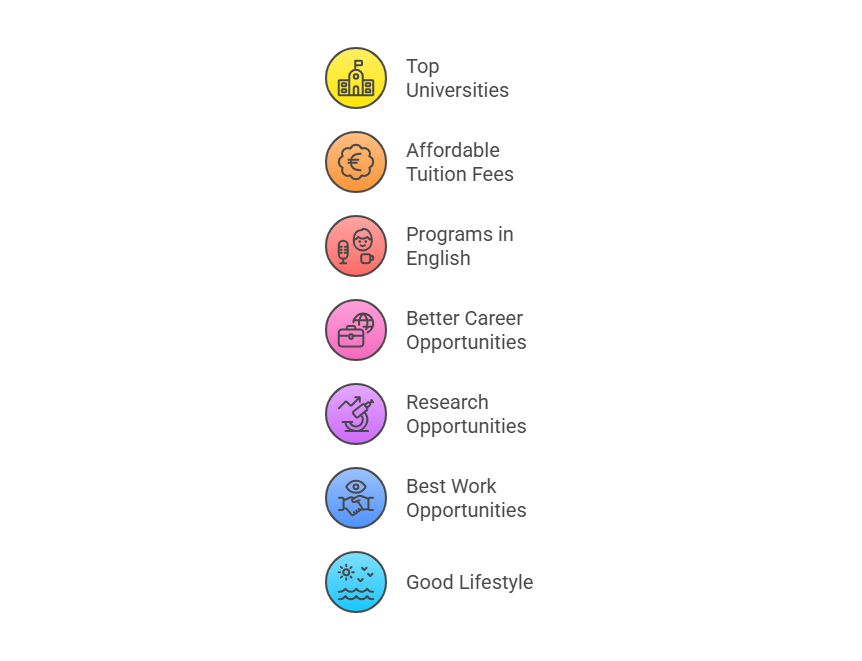
- Top Universities: Spain has 38 universities featured in the QS World Rankings 2026. Universities and business schools like IE Business School, ESADE, and IESE Business School are known as some of the best in Europe.
- Affordable Tuition Fees: Master’s programs at public universities usually cost between €1,000 and €9,000 per year. This is cheaper than studying in countries like the UK or USA, making Spain a budget-friendly option for international students.
- Programs in English: Spain offers more than 200 master’s programs taught in English. This helps Indian and international students study easily without needing to learn Spanish before joining.
- Career Opportunities in Latin America: A master’s degree from Spain can help students find job opportunities in Latin American countries, where Spanish is widely spoken by more than 500 million people. Many international companies value graduates from Spain.
- Good Research Opportunities: Spain spends around €15.1 billion on research and development, which supports strong research facilities and advanced learning at universities.
- Work Opportunities After Graduation: International students can apply for a 12-month job search permit after completing their studies. Once they find a job, they may apply for a work permit or an EU Blue Card.
- Good Lifestyle: Spain is known for its pleasant weather, rich culture, tasty food, and lower living costs compared to many other Western European countries.
Top Universities in Spain for Masters Programs
Spain has many well-known universities that offer good-quality master’s programs. These universities are popular for courses in business, engineering, technology, science, arts, and humanities. Many Spanish universities are ranked among the top universities in the world in the QS World Rankings 2026. Public universities in Spain usually have affordable tuition fees, while private business schools like IE University, ESADE, and IESE Business School offer premium programs with strong career opportunities after graduation.
Below is a list of some of the top universities in Spain for master’s programs, along with their QS rankings and average yearly tuition fees.
|
Top Universities for Masters Program |
QS World Rankings 2026 |
Average Fee per Year (In Euro) |
|
University of Barcelona |
165 |
€5,000 – €7,800 |
|
Complutense University of Madrid |
187 |
€6,600 – €8,300 |
|
Autonomous University of Madrid |
206 |
€3,900 – €6,700 |
|
Autonomous University of Barcelona |
198 |
€3,900 – €5,500 |
|
Pompeu Fabra University |
228 |
€4,000 – €7,000 |
|
University of Granada |
401–450 |
€2,000 – €4,500 |
|
Polytechnic University of Catalonia |
351–400 |
€3,500 – €6,500 |
|
Polytechnic University of Valencia |
461–470 |
€3,000 – €5,500 |
|
Universidad Carlos III de Madrid |
351–400 |
€5,000 – €9,000 |
|
IE University |
346 |
€25,000 – €38,000 |
Top 10 Universities for Engineering and Technology in Spain
Spain has many good universities for students who want to study engineering and technology. These universities offer modern research facilities, practical learning, and strong career opportunities for international students. Below are some of the top universities for engineering and technology master’s programs in Spain, along with their QS World Rankings 2026 and average yearly tuition fees.
|
Universities in Spain |
QS World Rankings 2026 |
Average Fee per Year (In Euro) |
|
Polytechnic University of Catalonia |
351–400 |
€3,500 – €6,500 |
|
Polytechnic University of Madrid |
431–440 |
€4,000 – €7,000 |
|
Polytechnic University of Valencia |
461–470 |
€3,000 – €5,500 |
|
University of Barcelona |
165 |
€5,000 – €7,800 |
|
Autonomous University of Barcelona |
198 |
€3,900 – €5,500 |
|
University of Seville |
501–510 |
€2,500 – €4,500 |
|
Universidad Carlos III de Madrid |
351–400 |
€5,000 – €9,000 |
|
University of Granada |
401–450 |
€2,000 – €4,500 |
|
University of Navarra |
461–470 |
€10,000 – €15,000 |
|
Complutense University of Madrid |
187 |
€6,600 – €8,300 |
Top 10 Universities for Business and Management in Spain
Spain is also one of the best places in Europe to study business and management courses. The country has many top-ranked business schools that are known for MBA and management programs, international exposure, and strong job placement opportunities. Below are some of the best universities and business schools in Spain for master’s programs in business and management.
|
Universities in Spain |
QS World Rankings 2026 |
Average Fee per Year (In Euro) |
|
IE University / IE Business School |
346 |
€25,000 – €38,000 |
|
ESADE Business School |
NA |
€25,000 – €35,000 |
|
IESE Business School |
NA |
€50,000 – €70,000 |
|
University of Barcelona |
165 |
€5,000 – €7,800 |
|
Pompeu Fabra University |
228 |
€4,000 – €7,000 |
|
Complutense University of Madrid |
187 |
€6,600 – €8,300 |
|
Autonomous University of Madrid |
206 |
€3,900 – €6,700 |
|
Universidad Carlos III de Madrid |
351–400 |
€5,000 – €9,000 |
|
University of Navarra |
461–470 |
€10,000 – €15,000 |
|
University of Deusto |
NA |
€8,000 – €14,000 |
Top 10 Universities for Medicine in Spain
Spain is one of the best countries in Europe for studying medicine and healthcare-related master’s programs. Spanish universities are known for advanced medical research, modern hospitals, and practical clinical training. Many universities also work closely with healthcare institutions, giving students hands-on experience during their studies. International students choose Spain because of its affordable tuition fees, good quality education, and strong career opportunities in healthcare and life sciences.
Below are some of the top universities in Spain for medicine and healthcare master’s programs, along with their QS World Rankings 2026 and average yearly tuition fees.
|
Universities in Spain |
QS World Rankings 2026 |
Average Fee per Year (In Euro) |
|
University of Barcelona |
165 |
€5,000 – €7,800 |
|
Autonomous University of Barcelona |
198 |
€3,900 – €5,500 |
|
Complutense University of Madrid |
187 |
€6,600 – €8,300 |
|
Autonomous University of Madrid |
206 |
€3,900 – €6,700 |
|
University of Navarra |
461–470 |
€10,000 – €15,000 |
|
University of Valencia |
451–460 |
€3,000 – €5,500 |
|
University of Granada |
401–450 |
€2,000 – €4,500 |
|
University of Salamanca |
539 |
€2,500 – €4,000 |
|
Pompeu Fabra University |
228 |
€4,000 – €7,000 |
|
University of Seville |
501–510 |
€2,500 – €4,500 |
Top 10 Universities for Arts and Humanities in Spain
Spain is also a popular destination for students interested in arts, literature, history, languages, philosophy, and humanities programs. The country has a rich cultural background, famous museums, historical architecture, and strong academic traditions, making it an excellent place for arts and humanities studies. Many Spanish universities offer international master’s programs in English and provide students with research opportunities, cultural exposure, and affordable education.
Below are some of the top universities in Spain for arts and humanities master’s programs, along with their QS World Rankings 2026 and average yearly tuition fees.
|
Universities in Spain |
QS World Rankings 2026 |
Average Fee per Year (In Euro) |
|
University of Barcelona |
165 |
€5,000 – €7,800 |
|
Complutense University of Madrid |
187 |
€6,600 – €8,300 |
|
Autonomous University of Madrid |
206 |
€3,900 – €6,700 |
|
Autonomous University of Barcelona |
198 |
€3,900 – €5,500 |
|
Pompeu Fabra University |
228 |
€4,000 – €7,000 |
|
University of Granada |
401–450 |
€2,000 – €4,500 |
|
University of Salamanca |
539 |
€2,500 – €4,000 |
|
University of Valencia |
451–460 |
€3,000 – €5,500 |
|
University of Seville |
501–510 |
€2,500 – €4,500 |
|
University of Deusto |
NA |
€8,000 – €14,000 |
Top MS Specializations in Spain
Spain is well known for its strong business education, technology programs, and research-based degrees. Many students choose Spain for their MS because the country offers industry-focused programs, practical training, and excellent career opportunities. Master's programs in Spain typically last 1 to 2 years (60–120 ECTS credits). Fields like Artificial Intelligence, Data Science, Renewable Energy, International Business, and Biotechnology are highly in demand.
Below is a list of the top in-demand MS specializations in Spain, along with popular universities, course duration, and approximate tuition fees.
|
MS Specialization |
Universities Offering the Course |
Duration |
Tuition Fee (EUR per year) |
|
Artificial Intelligence & Machine Learning |
University of Granada, UPC, UAB, UC3M |
1–2 years |
€2,000 – €15,000 |
|
Data Science & Big Data Analytics |
University of Barcelona, UPM, Pompeu Fabra |
1–2 years |
€4,000 – €12,000 |
|
Computer Science |
UPC, UAB, UC3M, University of Seville |
1–2 years |
€3,500 – €14,000 |
|
Mechanical Engineering |
UPC, UPM, University of Seville, UPV |
1–2 years |
€3,000 – €7,000 |
|
Business Administration & Management |
IE Business School, ESADE, IESE, UB |
1–2 years |
€5,000 – €70,000 |
|
Renewable Energy & Sustainability |
UPV, UPC, UPM, University of Seville |
1–2 years |
€3,000 – €8,000 |
|
International Relations & Political Science |
UCM, UAM, Pompeu Fabra, IE University |
1–2 years |
€4,000 – €20,000 |
|
Architecture & Urban Planning |
UPC, UPM, ETSAB Barcelona |
1–2 years |
€3,500 – €8,000 |
|
Biomedical Sciences & Biotechnology |
University of Barcelona, UAB, UCM |
1–2 years |
€4,000 – €10,000 |
|
Tourism & Hospitality Management |
University of Granada, UAB, ESIC |
1–2 years |
€3,000 – €12,000 |
Confused about which course to pursue? Avail Y-Axis course recommendation services to choose the best.
Cost of Studying in Spain for MS
Spain is one of the most affordable countries in Western Europe to study a master's degree. Public university tuition fees range from €1,000 to €9,000 per year. Private universities and top business schools charge higher fees, ranging from €25,000 to €70,000 per year. The overall cost depends on the type of university, the city you live in, and your lifestyle.
Tuition Fees for International Students
Public universities charge between €1,000 and €9,000 per year for master's programs, depending on the program and region. Private universities charge between €10,000 and €38,000 per year for most programs. Top business schools like IE Business School and ESADE charge between €25,000 and €70,000 per year for MBA and specialized master's programs. Many public universities also offer merit-based tuition waivers and partial scholarships for international students.
Living Costs in Major Cities in Spain
The cost of living in Spain varies by city. Barcelona and Madrid are the most expensive cities, while Valencia and Seville are more affordable. Below is a comparison of monthly living costs across major student cities:
|
Expense |
Barcelona |
Madrid |
Valencia |
Seville |
|
Monthly Rent |
€600–€900 |
€600–€850 |
€400–€650 |
€350–€550 |
|
Food (monthly) |
€250–€350 |
€250–€350 |
€180–€280 |
€180–€280 |
|
Transport (monthly) |
€60–€80 |
€60–€80 |
€40–€60 |
€40–€60 |
|
Health Insurance |
€50–€100 |
€50–€100 |
€50–€100 |
€50–€100 |
|
Est. Monthly Total |
€1,000–€1,500 |
€1,000–€1,400 |
€700–€1,100 |
€650–€1,000 |
Estimated Yearly Cost for a Master's in Spain
It is important to understand the full cost before planning to study in Spain. Even though public universities charge low tuition, students must budget for living expenses, accommodation, health insurance, and other academic costs.
- Tuition Fees (Public): €1,000 – €9,000 per year (₹9 lakh – ₹82 lakh)
- Tuition Fees (Private/Business Schools): €10,000 – €70,000 per year
- Living Expenses: €8,400 – €18,000 per year (₹7.5 lakh – ₹16.2 lakh)
- Health Insurance: €600 – €1,200 per year (₹54,000 – ₹1.08 lakh)
For Indian students, the overall yearly cost of studying a master's in Spain generally falls within:
- €10,000 – €18,000 per year (₹9 lakh – ₹16.2 lakh) at public universities
- €35,000 – €55,000 per year (₹31.5 lakh – ₹49.5 lakh) at IE/ESADE and top private business schools
*Want to study in Spain for free? Contact Y-Axis for step-by-step guide
Scholarships for Studying Masters in Spain Universities
The main scholarships for a Master's in Spain include Erasmus Mundus, which covers full tuition fees and provides €1,400 per month for living expenses. The Spanish Government's MAEC-AECID Scholarship also supports international students. The La Caixa Foundation Scholarship offers €1,000–€3,000 per month, while universities such as IE University, ESADE, and IESE Business School provide merit-based scholarships that can cover up to 50% of tuition fees.
- Erasmus Mundus Joint Masters (EMJM): This EU-funded scholarship offers full funding including tuition, a monthly living allowance of €1,400, travel costs, and health insurance for students in Erasmus Mundus partner programs across European universities including Spain.
- MAEC-AECID Scholarships: The Spanish government's official scholarship program for international students. It provides financial support for postgraduate studies, covering tuition and living costs.
- La Caixa Foundation Scholarships: Spain's largest education foundation offers monthly grants of €1,000–€3,000 for master's and doctoral students based on merit and financial need.
- IE University Scholarships: IE University offers merit-based scholarships of €5,000–€15,000 per year, covering 25–50% of tuition fees for high-achieving international students.
- ESADE & IESE Scholarships: Both schools offer need and merit-based scholarships covering up to 50% of tuition for master's and MBA programs for outstanding applicants.
- Barcelona School of Economics (BSE) Scholarships: BSE offers fully funded scholarships for master's students in economics, including tuition and living stipends.
- Becas MEC Scholarships: The Spanish Ministry of Education offers scholarships under the Becas MEC program for international students pursuing postgraduate studies in Spain.
* Read more.... Top Scholarships in Spain for Indian students
Can You Study a Master's in Spain Without IELTS?
Yes, you can study a Master's in Spain without IELTS. Many public universities accept other proof of English instead of IELTS. However, some private universities and business schools, such as IE University, ESADE, and IESE Business School, usually require an IELTS or TOEFL score.
Some common alternatives to IELTS are:
- Medium of Instruction (MOI) Certificate: Many public universities accept an MOI letter from your Indian university confirming that your bachelor's degree was taught in English.
- University Interview: Some universities check your English through a short online interview or their own language test.
- Previous English-Medium Education: Some universities accept proof that you studied in English at school or college.
- Spanish-Taught Programs: If you have a DELE B2 certificate, you can apply for Spanish-taught Master's programs without taking an English language test.
Important: Each university has its own language requirements, so always check the program's admission rules before applying. Also, the Spanish Consulate may ask for proof of language ability when you apply for a student visa. For competitive programs and business schools, an IELTS score of 6.0–6.5 is still the safest option.
Indian CGPA to Spanish Grade Conversion
Spanish universities evaluate Indian academic transcripts using their own grading system. Spain uses a 0–10 grading scale, where 5 is the minimum passing grade. Below is a conversion guide to help you understand how your Indian grades compare to the Spanish system.
|
Indian CGPA (10-pt scale) |
Equivalent GPA (4-pt scale) |
Spanish Classification |
Equivalent |
|
9.0 – 10.0 |
3.7 – 4.0 |
Sobresaliente (Excellent) |
Distinction |
|
7.5 – 8.9 |
3.0 – 3.6 |
Notable (Very Good) |
First Class |
|
6.0 – 7.4 |
2.5 – 2.9 |
Bien (Good) |
Second Class |
|
5.0 – 5.9 |
2.0 – 2.4 |
Aprobado (Pass) |
Pass |
|
Below 5.0 |
Below 2.0 |
Suspenso (Fail) |
Fail |
Note: Most public universities in Spain require a minimum CGPA of 6.0–7.5 (on the 10-point Indian scale) for master's admissions. Competitive programs at institutions like IE, ESADE, and UB may require 7.5+ CGPA. Always check individual university requirements before applying.
Eligibility Criteria for Indian Students to Apply for Master's in Spain
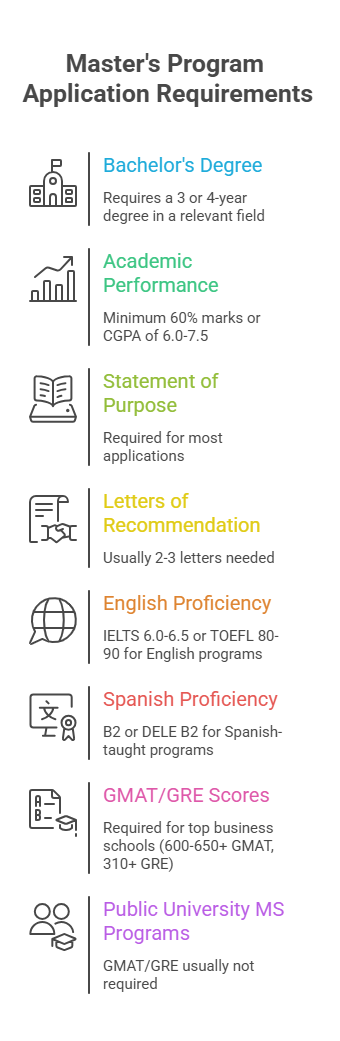
- A 3-year or 4-year Bachelor's degree in a relevant field is required to apply for a master's program.
- Students must have a minimum of 60% marks or a CGPA of 6.0–7.5 out of 10 in their bachelor's degree.
- A Statement of Purpose (SOP) is required for most master's applications.
- Letters of Recommendation (LOR) are required by most universities – usually 2 to 3 letters.
- English proficiency proof is required for English-taught programs – minimum IELTS 6.0–6.5 or TOEFL 80–90.
- If the course is taught in Spanish, students must have a minimum B2 or DELE B2 level Spanish language certificate.
- For top business schools like IE and ESADE, GMAT scores of 600–650+ or GRE scores of 310+ are usually required.
- For most public university MS programs, GRE or GMAT is not required.
Documents Required to Study a Master's in Spain
Indian students must prepare the following documents while applying for a master's program in Spain:
- Valid passport (valid for at least 1 year beyond the end of your program)
- Completed university application form
- 10th and 12th mark sheets and certificates (officially translated to English or Spanish)
- Bachelor's degree certificate and official transcripts (notarized and translated)
- Statement of Purpose (SOP)
- Letters of Recommendation (LOR) – minimum 2
- IELTS or TOEFL scorecard for English-taught programs
- DELE B2 or higher certificate if the course is in Spanish
- GMAT/GRE scorecard (for business school programs)
- Updated CV/Resume
- Proof of financial resources (bank statements showing minimum €600–€800 per month)
- Health insurance proof valid in Spain
- Passport-size photographs
Steps to Apply for Masters in Spain
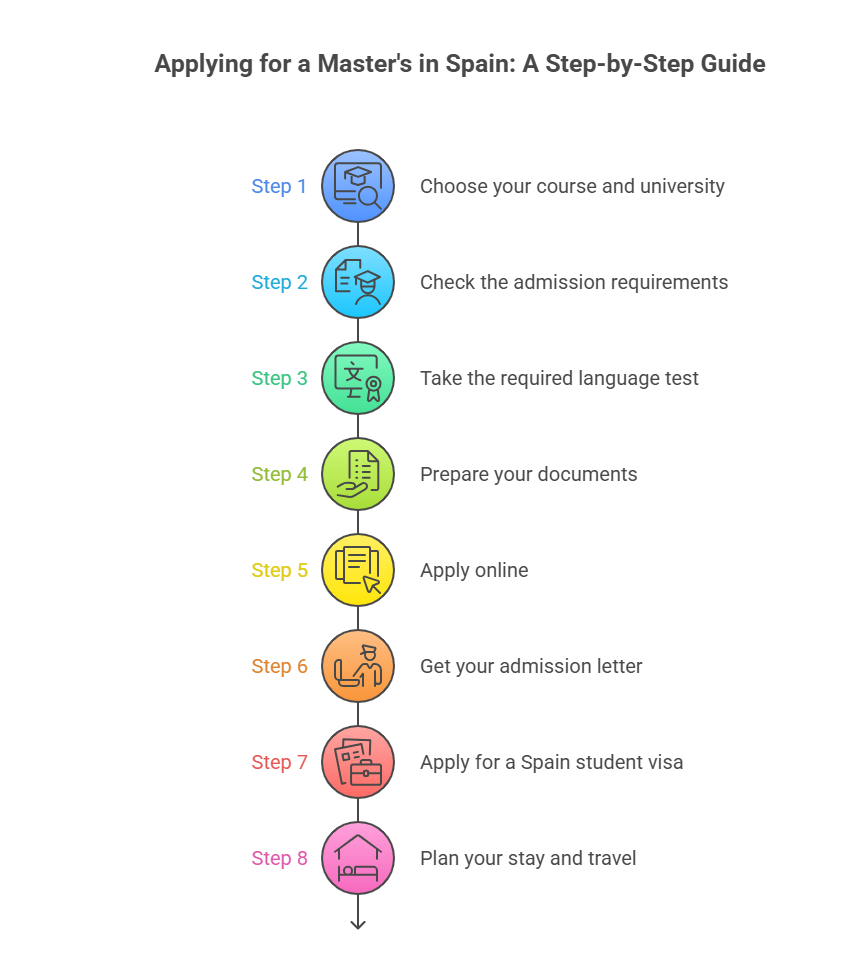
Step 1: Choose your course and university
Select a master’s program and university that match your education background, career plans, and budget.
Step 2: Check the admission requirements
Check the university requirements carefully, such as minimum marks, language test scores, and whether GMAT or GRE is needed for the course.
Step 3: Take the required language test
Complete exams like IELTS, TOEFL, DELE, GMAT, or GRE early so that your scores are ready before applying.
Step 4: Prepare your documents
Collect all the important documents such as academic transcripts, degree certificates, Statement of Purpose (SOP), Letters of Recommendation (LORs), resume/CV, and passport copy. If needed, get your documents officially translated.
Step 5: Apply online
Most universities in Spain allow students to apply through their online application portal. Upload all required documents and pay the application fee if needed.
Step 6: Get your admission letter
After applying, wait for the university’s decision. Most universities usually take around 4 to 8 weeks to process applications.
Step 7: Apply for a Spain student visa
Once you receive the admission letter, apply for a Spain Type D Long-Stay Student Visa through the Spanish Embassy or Consulate in India.
Step 8: Plan your stay and travel
Book your accommodation, arrange your finances, and plan your travel to Spain before your classes begin.
Student Visa Requirements for Masters in Spain
Indian students who receive admission to a Spanish university must apply for a Spain student visa (Type D Long-stay Visa) before travelling. The student visa allows you to stay in Spain legally for the duration of your master's program. After completing your degree, you can apply for a 12-month job search authorization to find employment in Spain and the EU.
Below are the main requirements for a Spain student visa for Indian students:
- Valid biometric passport with at least 12 months validity beyond your course end date
- Original admission letter from a recognized Spanish university
- Proof of sufficient financial resources (minimum €600–€800 per month)
- Proof of accommodation in Spain
- Educational qualification documents with official translations
- Proof of language proficiency (IELTS/TOEFL or DELE certificate)
- Medical certificate issued within 3 months by a registered physician
- Criminal background check certificate from India (issued within 3 months)
- Completed national visa application form
- Health insurance with coverage in Spain
*Want to apply for a Spain student visa? Contact Y-Axis for end-to-end guidance
PR and Immigration Pathways After Masters in Spain
Spain offers a clear pathway for international students who want to stay and build a career after completing their master's degree. Understanding the full immigration pathway from student visa to permanent residency (PR) is important for planning your long-term future in Spain and the EU.
|
Stage / Permit |
Details |
|
Stage 1: Student Visa (Type D) |
Valid for the full duration of your master's program. Student years count as 0.5× toward PR calculation. |
|
Stage 2: Job Search Authorization |
12-month permit applied after graduation to search for work. Apply within 60 days before or 90 days after your student NIE expires. |
|
Stage 3: Work Permit / EU Blue Card |
Once employed, apply for a work and residence permit or EU Blue Card (minimum salary €39,249/year in 2026). Work permit processing time: 20 days. |
|
Stage 4: Permanent Residency (PR) |
Apply after 5 continuous years of legal residence in Spain. Student visa years count as half (e.g., 2-year master's = 1 year toward PR). |
|
EU Blue Card Fast-Track to PR |
With an EU Blue Card: PR eligibility after 33 months. Reduced to 21 months if you have B1 Spanish language certificate. |
|
PR Benefits |
Right to live and work in Spain indefinitely. Same rights as Spanish citizens for work, healthcare, education. Family members can join. |
|
Spanish Citizenship |
Available after 10 years of legal residence (reduced to 2 years for citizens of Latin American countries). |
EU Blue Card – Fast-Track Work Permit for Graduates
The EU Blue Card is a special work and residence permit for highly qualified non-EU professionals. It is one of the best options for master's graduates who find a high-paying job in Spain. Key facts for 2026:
- Minimum salary required: €39,249 gross per year (2026 threshold).
- Eligibility: Master's degree or equivalent qualification + a job offer from a Spanish employer for at least 1 year.
- Processing time: 20 days (fast-track processing through the Large Companies Unit).
- PR eligibility with EU Blue Card: After 33 months, reduced to 21 months with a B1 Spanish language certificate.
- EU mobility: After 18 months with an EU Blue Card in Spain, you can move to work in another EU country.
NIE Certificate for Indian Students
The NIE (Numero de Identidad de Extranjero – Foreigner Identity Number) is a mandatory identification number for all non-EU citizens living in Spain for more than 3 months. It is the Spanish equivalent of Germany's APS Certificate in terms of being a required official process. Without a valid NIE, you cannot open a bank account, sign a rental contract, register with Social Security, or work legally in Spain.
What is the NIE?
The NIE is a unique personal identification number issued by the Spanish government to all foreign nationals. Once you arrive in Spain with your student visa, you must register at the local Foreigners Office (Oficina de Extranjeria) or Police Station to obtain your NIE and your TIE card (Tarjeta de Identidad de Extranjero – Foreigner's Identity Card). The TIE card contains your photo, NIE number, and visa status.
Who Needs a NIE?
- All Indian nationals coming to Spain on a student visa for a master's or any higher education program.
- Students planning to work part-time during studies (NIE is required to receive salary and pay taxes).
- Students who want to open a Spanish bank account (IBAN required for salary payments and tuition fee payments).
- Students planning to sign a rental contract for accommodation in Spain.
Step-by-Step Process to Apply for NIE in Spain
Step 1: Arrive in Spain and complete your university registration process.
Step 2: Book an appointment (called cita previa) at the local Foreign Office (Oficina de Extranjería) or police station.
Step 3: Prepare all required documents, including your valid passport, student visa, university enrollment proof, two passport-size photos, completed EX-15 form, and proof of address.
Step 4: Attend your appointment, submit all documents, and pay the NIE application fee, which is usually around €10–€15.
Step 5: Collect your NIE card, also called the TIE (Tarjeta de Identidad de Extranjero), which is generally issued within 30–45 days.
Step 6: Use your NIE number to open a bank account in Spain, register for Social Security, sign a rental agreement, and legally start working in Spain.
Processing Time & Cost: NIE appointment booking typically takes 2–4 weeks. The NIE card (TIE) is usually ready within 30–45 days of your appointment. The fee is approximately €10–€15. Your university's International Student Office can guide you through the entire process.
Masters in Spain vs UK, USA & Canada
Choosing the right country for your master's is an important decision. Here is a simple comparison based on the most important factors for Indian students:
|
Factor |
Spain |
UK |
USA |
Canada |
|
Tuition Fees (Public) |
€1,000–€9,000/year |
£15,000–25,000/year |
$25,000–50,000/year |
CA$15,000–25,000/year |
|
Course Duration |
1–2 years |
1 year |
1.5–2 years |
1.5–2 years |
|
GRE/GMAT |
Not required for most MS |
Rarely required |
Often required |
Rarely required |
|
Post-Study Work |
12-month job-search visa |
2 years |
12–36 months (OPT) |
Up to 3 years (PGWP) |
|
PR Pathway |
5 years legal residence → PR |
Work visa → PR in 5 years |
H-1B → Green Card (long wait) |
Express Entry (faster PR) |
|
Language |
IELTS 6.0–6.5 / Spanish |
IELTS 6.5–7.5 |
IELTS/TOEFL higher scores |
IELTS 6.5–7.0 |
|
Spanish Advantage |
Huge – opens LATAM market |
Not applicable |
Not applicable |
Not applicable |
Spain is one of the most affordable study destinations in Europe, with low public university tuition and a much lower cost of living than the UK or USA. Most public university MS programs do not require GMAT or GRE, making the application process simpler. With a 12-month post-study job search visa and a clear pathway to permanent residency after 5 years of legal residence, Spain offers excellent long-term opportunities for Indian graduates.
Spain Application Deadline Calendar 2026–2027
Spain mainly offers two intakes for master’s programs. The main intake starts in September or October (Fall intake), while some universities also offer a smaller intake in February (Spring intake). Students should start preparing early to avoid missing deadlines.
|
Intake |
Semester Start |
Application Deadline |
Best Time to Start Preparation |
|
Fall 2026 (Main Intake) |
September / October 2026 |
April – June 2026 |
October 2025 |
|
Spring 2027 (Limited Intake) |
February 2027 |
October – November 2026 |
May 2026 |
Backward Planning Timeline – Fall Semester 2026
- October – December 2025: Shortlist universities and check course eligibility requirements.
- January – February 2026: Book and complete exams like IELTS, TOEFL, GMAT, or GRE.
- February – March 2026: Prepare your SOP, LORs, academic transcripts, translated documents, and other required papers.
- March – May 2026: Submit online applications to universities in Spain.
- April – June 2026: Most Spanish universities close applications during this period.
- June – July 2026: Receive admission offers and apply for a Spain student visa.
- July – September 2026: Arrange accommodation, finances, and travel plans before moving to Spain.
Backward Planning Timeline – Spring Semester 2027
- April – June 2026: Finalize your university list and prepare language test scores.
- July – August 2026: Collect transcripts and prepare your SOP and LORs.
- September – October 2026: Submit university applications online.
- October – November 2026: Most universities close applications during this time.
- December 2026 – January 2027: Receive admission letters and apply for your student visa.
Post-Study Work Options After a Master's in Spain
After completing a Masters in Spain, you can stay in the country for up to 12 months with a job seeker visa to find a job. Once you get a job offer, you can apply for a work permit or an EU Blue Card (minimum salary €39,249 per year in 2026). After meeting the residency requirements, you can apply for permanent residency (PR).
| Stage | Permit | Duration / Requirement | Key Details |
|---|---|---|---|
| 1 | Job Seeker Visa | Up to 12 months | Apply before or shortly after your student permit expires. You can stay in Spain and look for a job. |
| 2 | Work and Residence Permit | 1–4 years, renewable | Once you receive a job offer, your employer applies for your work permit. |
| 3 | EU Blue Card | Minimum salary €39,249 per year (2026) | Available for Master's graduates with a job offer of at least one year. It also allows easier movement to other EU countries after 18 months. |
| 4 | Permanent Residency (PR) | After 5 years of legal residence | You can apply for PR after living legally in Spain for five years. EU Blue Card holders may qualify earlier under certain conditions. |
Spain offers a clear pathway from studying to working and eventually settling in the country, making it a popular destination for international students.
Job Opportunities after Masters in Spain
Spain's economy is growing steadily, with strong demand for skilled professionals in technology, finance, renewable energy, and healthcare. Key hiring sectors include technology, banking, consulting, healthcare, engineering, and renewable energy. Master's degree holders earn 27% more than bachelor's graduates in Spain. After securing employment in Spain for 5 years, you may become eligible for permanent residency.
The table below lists high-paying jobs in Spain along with the average annual salary range:
|
Occupation |
Average Annual Salary (Euro) |
|
IT & Software Development |
€28,000 – €70,000 |
|
Healthcare & Pharmaceuticals |
€32,000 – €78,000 |
|
Engineering (Mechanical, Civil, Electrical) |
€30,000 – €55,000 |
|
Business & Management (MBA/MSc graduates) |
€35,000 – €80,000 |
|
Data Science & Artificial Intelligence |
€35,000 – €65,000 |
|
Finance & Banking |
€30,000 – €65,000 |
|
Architecture & Urban Planning |
€28,000 – €50,000 |
|
Tourism & Hospitality Management |
€22,000 – €45,000 |
|
International Relations & Law |
€30,000 – €60,000 |
|
Renewable Energy & Environment |
€32,000 – €55,000 |
*Also, read… Spain Job Market in 2026-30
How Can Y-Axis Help You Study in Spain?
Y-Axis provides complete support for students who want to pursue their Master's in Spain. We guide you at every step of the process to make your study abroad journey smooth and successful.
At Y-Axis, we provide:
- Y-Path: A smart tool to help you choose the right course and university based on your profile, goals, and budget.
- Spain University Shortlisting: Personalized guidance on choosing the right university and program based on your academic profile, budget, and career goals.
- SOP Writing: Expert Statement of Purpose writing tailored for Spanish universities, highlighting your academic background and career goals.
- Document Preparation & Translation: Full support in preparing, notarizing, and officially translating your academic documents for Spanish university applications.
- IELTS, TOEFL, GMAT, and GRE Coaching: Improve your scores with help from Y-Axis Coaching Centre to meet the requirements of top Spanish universities.
- Spain Student Visa Process: Complete guidance for the Spain Type D Long-stay Student Visa, from documentation to Spanish Embassy appointment.
- Scholarship Assistance: Expert help in identifying and applying for Erasmus+, MAEC-AECID, La Caixa, and university-specific scholarships.
- SOP and LOR Writing: Expert support in writing strong Statements of Purpose and Letters of Recommendation for Spanish university standards.
Don't know what to do ?
Get Free Counseling
Looking for Inspiration
Explore what Global Indians have to say about Y-Axis in shaping their future