


Don't know what to do ?
Get Free Counseling
Last Updated 23 September 2026
In-demand Job Opportunities in Spain
Spain is one of Europe’s most dynamic job markets, offering excellent opportunities for skilled professionals. With a GDP of over USD 1.6 trillion, strong tourism, a growing tech ecosystem, and expanding healthcare and engineering sectors, Spain attracts thousands of foreign workers every year. Spain’s workforce also depends heavily on international talent, especially in shortage sectors such as IT, engineering, hospitality, healthcare, and education.
As Spain accelerates digital transformation, renewable energy projects, and tourism expansion, the demand for skilled workers continues to rise. With modern cities, high quality of life, and employer benefits, Spain remains a top career destination for global professionals.
Highest Paying Jobs in Spain
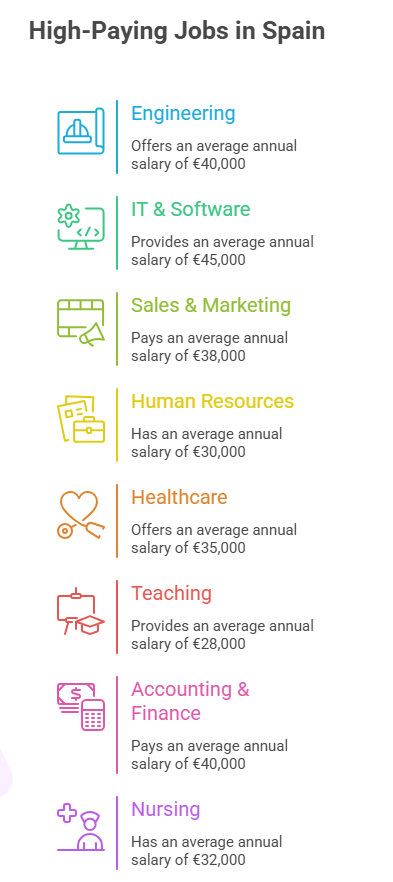
Spain offers good earning opportunities for skilled professionals, especially those working in IT, engineering, healthcare, and finance. Many companies need qualified foreign workers because of skill shortages in these sectors. On average, professionals in Spain earn between €25,000 and €60,000 per year, depending on their job role, experience, and industry. Highly skilled roles such as software developers, engineers, doctors, and financial analysts usually fall on the higher end of the salary range. Foreign workers who have strong technical skills, international experience, or language abilities often receive better salaries and faster career growth in Spain.
Some of the highest paying Jobs in Spain are listed below:
|
Occupation |
Average Annual Salary (€) |
|
Engineering |
40,000 |
|
IT & Software |
45,000 |
|
Sales & Marketing |
38,000 |
|
Human Resources |
30,000 |
|
Healthcare |
35,000 |
|
Teaching |
28,000 |
|
Accounting & Finance |
40,000 |
|
Nursing |
32,000 |
Job Vacancy in Spain
Spain has a large number of job openings driven by digitalization, tourism growth, and renewable energy projects. More than 30% of new jobs are expected to be filled by foreign workers due to skill shortages. Sectors such as IT, engineering, construction, healthcare, hospitality, and education are expanding rapidly. With Spain focusing on green energy, digital jobs, and international tourism, job vacancies will continue to rise through 2030.
Estimated number of Job Openings in Spain by 2030
|
Occupation / Sector |
Estimated Job Openings |
|
IT & Software |
50,000 |
|
Engineering & Renewable Energy |
60,000 |
|
Healthcare & Nursing |
45,000 |
|
Education & Training |
20,000 |
|
Construction & Infrastructure |
40,000 |
|
Finance & Business Services |
25,000 |
Top Careers in Spain
Information Technology (IT)
Spain’s IT industry is growing very quickly because companies are adopting digital systems, modern technologies, and online services. Businesses, government departments, and multinational companies across major cities need skilled professionals who can support digital transformation, improve cybersecurity, manage cloud platforms, and handle technical operations. Tech hubs like Barcelona, Madrid, and Valencia hire a large number of foreign professionals every year, making Spain one of the fastest-growing IT destinations in Europe.
Engineering & Renewable Energy
Spain is one of Europe’s leading countries in renewable energy, especially solar and wind power. The country is investing heavily in new infrastructure and energy projects. This creates strong demand for experienced professionals who can support construction, energy systems, production facilities, and large-scale technical projects. Because renewable energy and infrastructure are national priorities, engineering roles offer stable employment and long-term growth.
Healthcare
Spain’s healthcare sector is expanding due to an ageing population and the need for better medical services. Hospitals, clinics, and care centers require qualified medical professionals to maintain high-quality patient care. Spain faces staff shortages in several areas, which opens opportunities for skilled foreign workers. With good salaries, strong employee benefits, and long-term contracts, Spain remains a popular choice for international healthcare professionals.
Finance & Banking
Spain has a strong financial industry supported by both local and international banks. As businesses grow, the demand for professionals who can manage financial operations, handle investments, perform audits, and ensure regulatory compliance continues to rise. Global companies often prefer foreign workers with international experience, and Spain’s finance sector offers excellent career development opportunities.
Construction & Infrastructure
Spain is witnessing steady growth in infrastructure and construction due to new housing projects, transportation upgrades, and large commercial developments. This results in continuous demand for professionals who can manage, design, plan, and supervise construction work. The sector provides stable jobs because multiple development projects are planned across Spain over the next decade.
Education
Spain’s education sector is growing, particularly in international schools and training centers that use English as the medium of instruction. There is a strong need for qualified teachers and academic professionals as more schools open and student numbers increase. This makes education one of the most reliable sectors for foreigners seeking stable careers.
Tourism, Retail & Hospitality
Spain is one of the world’s most popular tourist destinations, attracting millions of visitors every year. This creates a constant demand for trained professionals in hotels, travel services, restaurants, and retail businesses. The sector offers steady job opportunities throughout the year and is especially favourable for foreign workers with customer service or hospitality experience.
Step-by-Step Guide for Jobs Search in Spain
Step 1: Search for jobs on LinkedIn, Info Jobs, Indeed, EURES, and company websites.
Step 2: Shortlist employers that hire foreign workers and offer visa sponsorship.
Step 3: Prepare an EU standard professional CV and cover letter.
Step 4: Apply directly or through licensed recruitment agencies.
Step 5: Attend interviews and showcase your skills and experience.
Step 6: Once selected, employer applies for work authorization.
Step 7: After approval, submit documents at the Spain Embassy/VFS and travel to Spain.
Why Apply for Jobs in Spain?
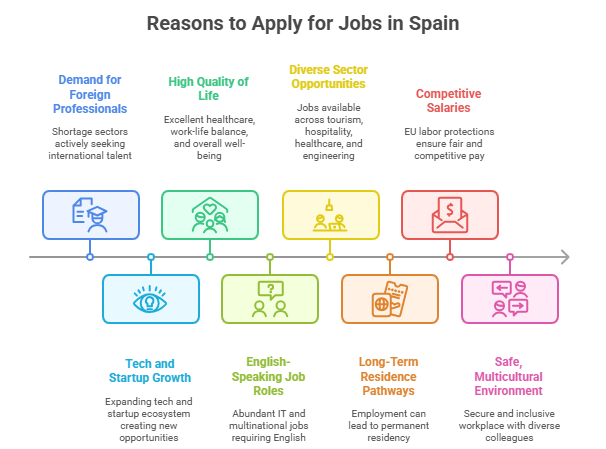
- Strong demand for foreign professionals in shortage sectors
- Growing tech and startup ecosystem
- High quality of life, healthcare, and work life balance
- Large English-speaking job roles in IT and multinational companies
- Opportunities across tourism, hospitality, healthcare, and engineering
- Pathways to long-term residence after employment
- Competitive salaries with EU labour protections
- Safe, multicultural work environment
Migrate to Spain via a Work Visa
To work legally in Spain, foreign professionals must obtain a Spain Work Visa. This visa is issued only after a Spanish employer provides a confirmed job offer and agrees to sponsor the applicant. The work visa process must be completed before entering Spain, as tourist visas cannot be converted into work visas. This system ensures that all foreign workers arrive with proper approval and are eligible for legal employment in the country.
Types of Spain Work Visas
- EU Blue Card (for highly skilled professionals)
- General Work Visa
- Seasonal Work Visa
- Self-Employment Visa
- Entrepreneur/Startup Visa
- Intra-company Transfer Visa
- Family/Dependent Visa
*Looking for expert guidance for your Spain Work Visa? Y-Axis can help you get started.
Requirements for Spain Work Visa
- Valid passport
- Signed employment contract
- Passport-size photos
- Visa application form
- Educational certificates
- Experience letters
- Police clearance certificate
- Medical certificate
- Employer sponsorship documents
- Work authorization approval
List of Shortage Occupations in Spain
- Software developers
- Cybersecurity professionals
- Civil, mechanical & electrical engineers
- Renewable energy technicians
- Doctors & nurses
- Caregivers
- Accountants
- Teachers
- Hospitality staff
- Sales & logistics coordinators
Steps to Apply for a Spain Work Visa
Step 1: Get a job offer from a Spain employer
Step 2: Employer applies for work authorization
Step 3: Complete medical tests and PCC
Step 4: Submit documents to the embassy or VFS
Step 5: Pay visa fees and provide biometrics
Step 6: Receive visa approval and travel to Spain
Step 7: Register for residency permit after arrival
Spain Beckham Law — Special Tax Regime for New Residents
One of the most significant financial benefits for professionals relocating to Spain is the Beckham Law (Régimen Especial de Impatriados), a special tax regime that allows qualifying new residents to pay a flat 24% income tax rate on Spanish employment income — instead of the standard progressive rates, which can reach 47%. The flat rate applies to earnings up to €600,000 per year; income above that threshold is taxed at 47%.
The regime is available for the year of arrival plus the following five tax years, giving eligible workers up to six years of reduced taxation.
To qualify: you must not have been a Spanish tax resident in the five years before relocating; you must move due to an employment contract with a Spanish company; and you must apply (Form 149) within six months of registering with Spanish Social Security.
Spain Digital Nomad Visa
Remote workers and freelancers who work for companies or clients based outside Spain may be eligible for the Spain Digital Nomad Visa (Visa para Nómadas Digitales), introduced under Spain's Startup Act in 2023. This is a separate pathway from the standard employer-sponsored work visa and is designed specifically for those who can work location-independently.
Key details:
- You must work remotely for a company or clients established outside Spain for at least 3 months before applying.
- No more than 20% of your total income can come from Spanish sources.
- Minimum income requirement: approximately 200% of Spain's minimum wage (around €2,646/month).
- Initial visa validity: 1 year (if applying from outside Spain) or 3-year residence permit (if applying from within Spain), renewable for up to 5 years.
- Holders can opt into the Beckham Law flat 24% tax rate (see above).
The Digital Nomad Visa is ideal for IT professionals, consultants, designers, and other remote-capable roles — many of which overlap with Spain's most in-demand occupations.
How Can Y-Axis Help You?
With 25+ years of experience, Y-Axis supports your Spain migration journey with:
- Job search and resume marketing services
- Visa eligibility checks
- Complete documentation guidance
- Spain Work Visa processing
- Interview preparation
- Expert migration advice and updates
Y-Axis snapshot
1M
Successful applicants
1500+
Experienced counselors
25Y+
Expertise
50+
Offices
Don't know what to do ?
Get Free Counseling
Looking for Inspiration
Explore what Global Indians have to say about Y-Axis in shaping their future