

Study in Norway

Don't know what to do?
Get Free Counseling
Last Updated: 11 September 2026
Study in Norway – Top Universities Cost, Visa & Scholarships
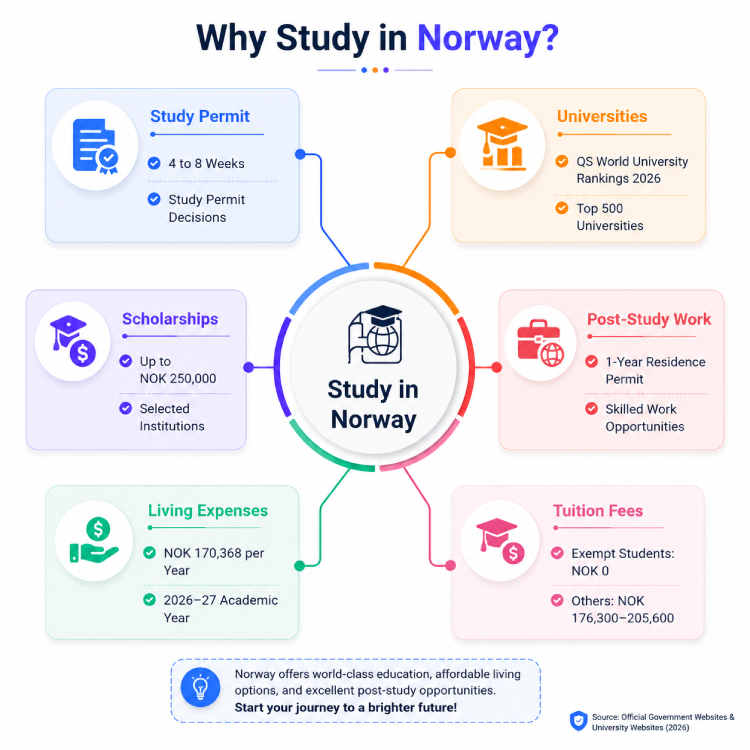
Norway is a well-known study destination for international students because of its high-quality education, safe environment, modern universities, and good career opportunities. Norwegian universities offer several programmes in English, making it easier for international students to study without knowing Norwegian. Norway has 8 universities ranked in the QS World University Rankings 2026, showing the strong quality of higher education in the country. The University of Oslo ranks among the top universities globally. Students can choose courses in areas such as engineering, technology, business, science, medicine, and social sciences.
From August 2026, many international students may need to pay tuition fees, depending on their nationality and university. The estimated living funds required for students in 2026–27 are NOK 170,368 per year. Students with a valid study permit can also work up to 20 hours per week during their studies. Norway also offers different scholarships and funding opportunities at selected universities and institutions. After completing their studies, eligible graduates may apply for a residence permit to look for skilled work for up to one year.
Why Study in Norway?
Norway is a good choice for international students because it offers quality education, a safe environment, and good career opportunities. Some of the main reasons to study in Norway are:
- High-quality education: Norwegian universities provide good education with modern teaching methods and strong research opportunities.
- English-taught courses: Students can find 350+ study programmes taught in English, especially at the master's level.
- Globally recognised universities: Norway has several universities with a good international reputation in subjects such as technology, engineering, science, business, and research.
- Practical learning: Many courses focus on practical skills, independent thinking, problem-solving, and research.
- Part-time work: International students with a valid study permit can generally work up to 20 hours per week during their studies.
- Post-study work option: Eligible students may apply for a residence permit to look for skilled work for up to one year after completing their studies.
- Safe environment: Norway is known for its safe, peaceful, and well-organised society, making it a comfortable place for students.
- Good quality of life: Students can enjoy clean cities, good public services, beautiful nature, and a healthy study-life balance.
- Career opportunities: Norway has job opportunities in areas such as technology, engineering, energy, healthcare, research, and other skilled fields.
- International exposure: Students can meet people from different countries, experience Norwegian culture, and gain valuable international study and work experience.
*Need assistance to Study Abroad? Y-Axis is here to assist you in all the ways.
Best Universities in Norway: QS World University Rankings
Norway has several well-known universities that offer quality education, modern facilities, and strong research opportunities. Students can choose from courses in areas such as engineering, technology, business, science, medicine, and environmental studies. The following table shows some of the leading universities in Norway according to the QS World University Rankings:
| What Applies | Details |
|---|---|
| Maximum duration | Up to 1 year. Two years applies only to certain former PhD candidates who held a skilled worker permit. |
| When to apply | Before your study permit expires. UDI advises applying at least one month before expiry. |
| Purpose | You must be looking for skilled employment that matches your qualifications. |
| Funds required | NOK 28,448 per month, or NOK 341,373 for a full year, generally held in your own name in a Norwegian bank account. |
| Funds for eligible former PhD candidates | NOK 85,344 |
| Application fee | NOK 6,300 |
| Work rights | You can work full-time or part-time while looking for skilled work, including jobs that do not require skilled-worker qualifications. |
| Restrictions | You cannot be self-employed or run your own business. |
| Counts towards PR? | No. Time on this permit does not count towards permanent residence. |
Education in Norway
Norwegian universities offer many course options in various fields. The universities here follow the Bologna system like other European nations. The duration of the various levels of study in the country are:
- Bachelor’s degree: 3 years
- Master’s degree: 2 or 5 years
- Doctorate: 3-year research-oriented education, which may include 1 additional year for teaching
Popular Courses to Study in Norway
Norway offers English-taught programmes across technology, engineering, business, energy, science, and other fields. The official study portal currently lists 360 English-taught programmes across Norwegian institutions.
| Course | Universities Where the Course Is Popular | In-Demand Jobs After the Course |
|---|---|---|
| Computer Science & IT | NTNU, University of Oslo, University of Stavanger, UiT The Arctic University of Norway | Software Developer, IT Consultant, Systems Analyst, IT Specialist |
| Data Science & Artificial Intelligence | University of Stavanger, NTNU, University of Oslo | Data Scientist, AI Engineer, Machine Learning Engineer, Data Analyst |
| Engineering | NTNU, University of Stavanger, UiT, University of South-Eastern Norway | Mechanical Engineer, Electrical Engineer, Civil Engineer, Project Engineer |
| Renewable Energy | University of Oslo, University of Agder, NTNU, Western Norway University of Applied Sciences | Renewable Energy Engineer, Energy Analyst, Sustainability Specialist, Energy Consultant |
| Electrical & Electronics Engineering | NTNU, UiT, University of South-Eastern Norway | Electrical Engineer, Electronics Engineer, Automation Engineer, Control Systems Engineer |
| Mechanical Engineering | NTNU, University of Stavanger, UiT | Mechanical Engineer, Design Engineer, Production Engineer, Maintenance Engineer |
| Energy Engineering | NTNU, University of Stavanger, University of South-Eastern Norway | Energy Engineer, Energy Consultant, Energy Analyst, Project Engineer |
| Petroleum & Energy | University of Stavanger, NTNU | Petroleum Engineer, Reservoir Engineer, Drilling Engineer, Energy Consultant |
| Business & Management | BI Norwegian Business School, NHH Norwegian School of Economics, University of Stavanger | Business Analyst, Management Consultant, Project Manager, Business Development Manager |
| Economics & Finance | NHH Norwegian School of Economics, University of Oslo, University of Stavanger | Economist, Financial Analyst, Investment Analyst, Business Analyst |
| Maritime & Marine Technology | NTNU, University of South-Eastern Norway, University of Stavanger | Marine Engineer, Naval Engineer, Maritime Consultant, Ship Operations Manager |
| Environmental Science & Sustainability | University of Oslo, Norwegian University of Life Sciences, NTNU | Environmental Consultant, Sustainability Specialist, Environmental Analyst, Climate Advisor |
| Natural Sciences | University of Oslo, NTNU, UiT | Research Scientist, Laboratory Scientist, Research Assistant, Science Consultant |
| Architecture & Sustainable Design | NTNU, Oslo School of Architecture and Design | Architect, Urban Planner, Sustainable Design Consultant, BIM Specialist |
| Health & Life Sciences | University of Oslo, University of Bergen, NTNU | Research Scientist, Health Consultant, Laboratory Specialist, Public Health Specialist |
*Confused to choose which course to pursue? Avail Y-Axis course recommendation services to choose the best.
Benefits of Studying in Norway
Norway is a popular study destination for international students, offering quality education, career opportunities, and a safe environment. Some of the main benefits of studying in Norway include:
- Flexible tuition fees: Since 1 August 2026, Norwegian universities can set their own tuition fees for students from outside the EU/EEA. Some universities have reduced their fees sharply, while some programmes may charge little or no tuition. This means students may even find tuition-free options at some of Norway’s top-500 public universities.
- High-quality education with strong academic and research opportunities
- Safe and welcoming environment for international students
- Beautiful natural landscapes and a high quality of life
- Good job opportunities for skilled graduates
- Rich cultural experiences and opportunities to meet people from different backgrounds
Cost of Studying in Norway for Indian Students
The cost of studying in Norway depends on the university and programme you choose. From August 2026, Norwegian universities can set their own tuition fees for students from outside the EU/EEA. Students must also plan for living expenses, student welfare fees, and the study permit fee.
| Cost | Per year (NOK) | Approx. INR |
|---|---|---|
| Tuition – Humanities, Business & Social Sciences (NTNU rate) | NOK 176,300 | ₹17.8 lakh |
| Tuition – Engineering, Science & Health (NTNU rate) | NOK 205,600 | ₹20.7 lakh |
| Tuition – EU/EEA students, PhD candidates, exchange & scholarship-scheme students | NOK 0 | Nil |
| Living costs – UDI minimum funds requirement | NOK 170,368 | ₹17.2 lakh |
| Student welfare (Samskipnad) fee | Approx. NOK 2,000 | ₹20,000 |
| UDI study permit fee | NOK 5,400 | ₹54,000 |
Note: Tuition can vary greatly by programme. For example, NTNU charges NOK 26,445 per year for Childhood Studies and Global Relations & Sustainable Development, while programmes such as Medicine and Dentistry can cost NOK 528,650 per year.
Scholarships to Study in Norway
The Norwegian government does not offer a general scholarship for all international students. Scholarships are mainly offered by individual universities and through a limited number of specific programmes. Students usually need to apply through the university or relevant programme rather than a central scholarship system.
| Scholarship | Where | Value | Key Conditions |
|---|---|---|---|
| A. Wilhelmsen Foundation Scholarship Programme | BI Norwegian Business School – MSc programmes | NOK 250,000 per year | 2 awards for Autumn 2026. Available to non-EU/EEA/Swiss citizens living outside Norway. Submit a one-page scholarship letter with the admission application by 1 March. Available for the first master's degree only. |
| NORPART Partnership Scholarships | HK-dir, through partner universities | Tuition exemption + mobility funding | Available only through an existing NORPART partnership between your Indian institution and a Norwegian institution. |
| NORHED Programme | HK-dir / Norad | Tuition exemption + support | Mainly available through development-focused research and capacity-building projects. |
| Erasmus+ Mobility Grant | EU programme, through your home university | Monthly amount varies | Available for eligible exchange and mobility periods, not for full-degree studies. |
| Institution-Specific Master's Scholarships | NMBU, University of Stavanger, Nord University and others | Varies; some may cover full tuition | Availability depends on the university and programme. Check the latest scholarship details before applying. |
Note: Scholarship availability can vary between universities and academic years, especially following the August 2026 tuition fee changes. Some universities, including NTNU, state that they do not offer scholarships that cover tuition fees. Students who depend on scholarships should check funding options carefully when choosing universities.
Eligibility to Study in Norway
International students planning to study in Norway must meet the admission and study permit requirements. The main requirements include:
- An acceptance letter from a recognised university or institution in Norway
- Admission to a full-time study programme
- Proof of English language skills for English-taught programmes
- Proof that you have enough money to cover your living expenses
- Proof that you can pay the tuition fee, if your university or programme charges one
- Required academic documents from your previous studies
- Health or medical insurance, where required
Norway Student Visa
The Norway Student Visa, also known as a study permit, allows international students to live and study in Norway for the duration of their approved course. It is an important step for students planning to pursue higher education in Norway. The permit also allows eligible students to work part-time while studying and provides options to stay in Norway after graduation to look for skilled work.
Norway Student Visa Requirements
Students from outside the EU/EEA generally need a Norway study permit for studies lasting more than three months. The main requirements include:
- Completed study permit application
- Valid passport
- Acceptance letter from a Norwegian university or institution
- Previous academic certificates and documents
- Proof of funds to cover living expenses
- Proof of tuition fee payment, if applicable
- Health or medical insurance, where required
- Proof of accommodation, where required
Financial Requirements for Norway Study Permit
You must have enough money to cover your living expenses and, where applicable, your tuition fees. For the 2026–27 academic year, UDI requires students to show at least NOK 15,488 per month, or NOK 170,368 for the full academic year (around ₹17.2 lakh).
For students coming to Norway for only one semester, the required amount is:
| Study Period | Funds Required |
|---|---|
| Autumn semester | NOK 77,440 |
| Spring semester | NOK 92,928 |
| Full academic year | NOK 170,368 |
The money must be kept in a Norwegian bank account or the educational institution's deposit account. The funds can come from your savings, an Indian education loan, a grant, a scholarship, or a combination of these. Income from a confirmed part-time job in Norway may also count towards the required amount. Students should also budget around NOK 1,000 per semester for the compulsory student welfare organisation (Samskipnad) fee.
Important: UDI updates the required living funds regularly. Students should check the latest amount for their academic year before transferring funds.
English Language Requirements for Norwegian Universities
Norwegian universities set their English language requirements based on the programme and level of study. Indian students may need to provide scores from IELTS, TOEFL, PTE Academic, Cambridge English, or another accepted test.
| Level | IELTS Academic | TOEFL iBT | Also Accepted |
|---|---|---|---|
| Bachelor's degree | 5.0 overall | 60 | PTE Academic 51; Cambridge FCE, CAE or CPE |
| Master's degree | 6.5 overall, with 6.5 in every band | 90 (Reading 19, Listening 20, Speaking 20, Writing 24) | Check with the individual programme |
The master's scores above reflect published requirements at the University of Oslo and NTNU. Some business, engineering, health, and other competitive programmes may require higher scores. Students should always check the requirements of their chosen programme before taking an English test.
*Get expert coaching services from Y-Axis professionals to ace your scores.
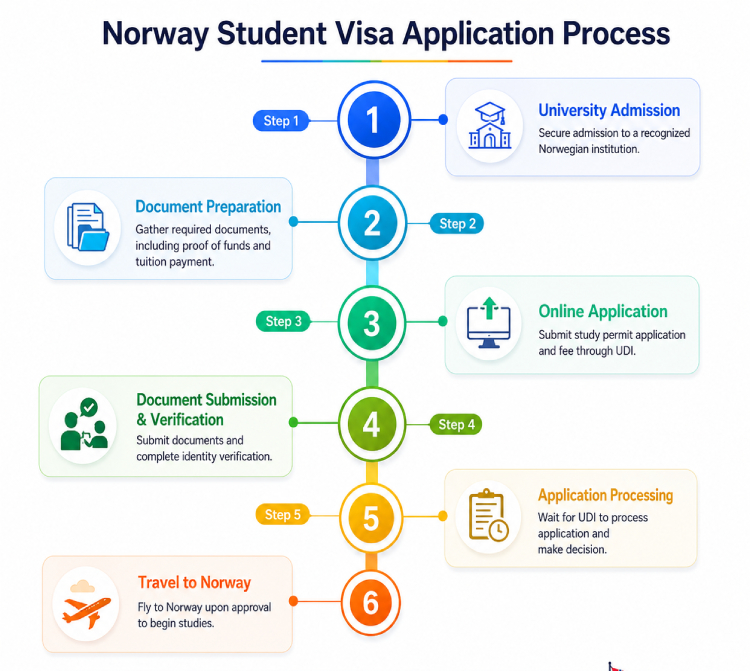
How to Apply for a Norway Student Visa?
Step 1: Get admission to a recognised university or educational institution in Norway.
Step 2: Check the Norway study permit requirements and prepare all the required documents, including proof of funds and tuition payment, if applicable.
Step 3: Complete and submit your Norway study permit application online through UDI and pay the required application fee.
Step 4: Submit your documents and complete any required appointment or identity verification process.
Step 5: Wait for UDI to process your application and receive the decision.
Step 6: Once your study permit is approved, make your travel arrangements and fly to Norway to begin your studies.
Norway Student Visa Fee
UDI charges a fixed fee for a Norway study permit. The fee depends on the applicant's age and is the same for a first application and a renewal.
| Application | Fee (NOK) | Approx. INR |
|---|---|---|
| Study permit – applicant aged 18 or above (first application or renewal) | NOK 5,400 | ₹54,400 |
| Study permit – applicant under 18 (first application or renewal) | NOK 2,700 | ₹27,200 |
| Residence permit as a job seeker after graduation | NOK 6,300 | ₹63,400 |
Applicants can pay the fee online using Visa, Mastercard, Apple Pay, or Google Pay as the final step of the UDI application. Make sure your card is enabled for international online payments.
Note: The application fee is not refundable once you have submitted your application in person.
Norway Student Visa Processing Time
Eligible students can generally receive a Norway study permit decision in around 4 to 8 weeks. Processing times may vary depending on the application and documents submitted. Providing complete and correct documents can help avoid unnecessary delays.
Norway Student-Dependent Visa
Your spouse or cohabiting partner and children can normally apply to live with you in Norway through family immigration. UDI currently does not have the capacity to process a family member's application at the same time as the student's application. This means the student and family members may receive their decisions at different times, so families should plan their travel accordingly. The first-time family immigration application fee is NOK 11,900 per adult and NOK 5,950 per child under 18.
Part-Time Jobs in Norway for Students
International students can take up part-time work in Norway to gain work experience and support their daily expenses. Students from outside the EU/EEA/Switzerland with a valid study permit can generally work up to 20 hours per week during the semester and full-time during holidays.
| Part-Time Job | Approx. Hourly Pay |
|---|---|
| Retail Assistant | NOK 180–230 |
| Restaurant Staff | NOK 180–230 |
| Café Worker | NOK 180–230 |
| Delivery Worker | NOK 180–250 |
| Warehouse Assistant | NOK 190–250 |
| Cleaning Staff | NOK 190–240 |
| Customer Service Assistant | NOK 190–260 |
| Teaching/Tutoring Assistant | NOK 200–300 |
| University Assistant | NOK 200–300 |
| IT Support Assistant | NOK 220–320 |
Norway Job-Seeker Permit After Graduation
Norway does not have a “post-study work visa.” After completing your education in Norway, eligible graduates can apply for a residence permit as a job seeker under Norway's work immigration rules. This permit allows you to stay in Norway while looking for skilled work.
| What Applies | Details |
|---|---|
| Maximum duration | Up to 1 year. Two years applies only to certain former PhD candidates who held a skilled worker permit. |
| When to apply | Before your study permit expires. UDI advises applying at least one month before expiry. |
| Purpose | You must be looking for skilled employment that matches your qualifications. |
| Funds required | NOK 28,448 per month, or NOK 341,373 for a full year, generally held in your own name in a Norwegian bank account. |
| Funds for eligible former PhD candidates | NOK 85,344 |
| Application fee | NOK 6,300 |
| Work rights | You can work full-time or part-time while looking for skilled work, including jobs that do not require skilled-worker qualifications. |
| Restrictions | You cannot be self-employed or run your own business. |
| Counts towards PR? | No. Time on this permit does not count towards permanent residence. |
If you receive a skilled job offer while your job-seeker application is still being processed, you can change it to a skilled worker application through UDI without paying another application fee, while keeping your place in the processing queue. Once you receive a qualifying skilled worker permit, your residence period towards permanent residence can begin.
Can You Get PR in Norway After Studying?
Yes, international graduates can qualify for permanent residence (PR) in Norway, but studying in Norway does not directly lead to PR. Time spent on a study permit or graduate job-seeker permit does noat count towards PR. For most graduates, the qualifying period starts after receiving a skilled worker permit.
A typical PR pathway for an Indian graduate includes:
Step 1: Complete your studies in Norway on a study permit.
Step 2: Apply for a job-seeker permit for up to one year after graduation.
Step 3: Find a skilled job and get a skilled worker permit.
Step 4: Complete three years of qualifying residence on the skilled worker permit.
Step 5: Apply for permanent residence in Norway after meeting all PR requirements.
For a student completing a two-year master’s programme, it could take around six years from arriving in Norway to becoming eligible for PR, assuming they find skilled work within the one-year job-seeker period. Applicants must also meet the required Norwegian language, social studies, income, and immigration conditions. From 1 September 2025, these requirements must be met when UDI makes its decision on the PR application. Norwegian citizenship is a separate process with its own requirements.
How can Y-Axis help you?
Y-Axis can assist by giving more vital support to aspirants who wish to study in Norway. The support process includes,
- Free Counseling: Free Counseling on university and course selection.
- Campus Ready Program: Fly to Norway with the best and ideal course.
- Course Recommendation: Y-Path gives the best suitable ideas about your study and career options.
- Coaching: Y-Axis offers IELTS live classes to help students clear with high scores.
- Norway Student Visa: Our expert team helps you get a Norway student visa.
Looking for inspiration
Explore what Global Indians have to say about Y-Axis in shaping their future