

Posted on August 18 2026
Top 10 Countries to Work Abroad as a Molecular Scientist

By , Editor & Director
Updated October 01 2026
A persistent global talent gap, rapid growth in cell and gene therapy, and rising investment in genomics and biotech R&D continue to drive demand for molecular scientists abroad. Professionals with skills in molecular biology, genomics, protein engineering, and bioinformatics are in high demand across countries like the USA, Germany, Canada, the UK, and Ireland, among others.
This blog is for you if you are a molecular scientist with:
- A recognised degree (BSc, MSc, or PhD) in molecular biology, biochemistry, genetics, or a related life sciences field from India or another country.
- Experience in molecular biology, genomics, protein engineering, or bioinformatics.
- Interested in relocating to a country with a strong biotech, pharma, or academic research sector.
- Mid-career or postdoctoral experience seeking better salaries and faster PR pathways.
- Profile of a research scientist, biochemist, genomics scientist, or laboratory scientist.
|
Quick Facts |
Details |
|
Global life sciences workforce gap |
The US life sciences industry alone needs to add roughly 85,000-100,000 workers a year through 2032 to meet projected demand |
|
Job openings globally |
Strong demand across molecular biology, genomics, cell and gene therapy, protein engineering, and bioinformatics |
|
Fastest PR country |
Ireland — Critical Skills Employment Permit leads to Stamp 4 residency in as little as 21 months, with Biologist and Biomedical Scientist named on the Critical Skills Occupations List |
|
Highest salary |
USA — USD 90,000-160,000 per year |
|
Best PR + salary balance |
Canada — CAD 70,000-110,000 per year, with Express Entry's new Researchers category (2026) |
|
Top English-speaking markets |
USA, UK, Canada, Australia, New Zealand, Ireland |
|
Country with EU Blue Card |
Germany, Netherlands |
|
Fastest shortage-list entry |
Denmark — Biologist is named directly on the Positive List for Higher Education |
|
Salary threshold exemption route |
Sweden — shortage occupations may qualify for exemptions from the standard median-salary work permit rule |
|
Most in-demand skills |
Molecular and cell biology techniques, genomics, gene editing (CRISPR), protein/antibody engineering, and bioinformatics |
*Want to find molecular scientist jobs abroad? Sign up with Y-Axis for end-to-end assistance.
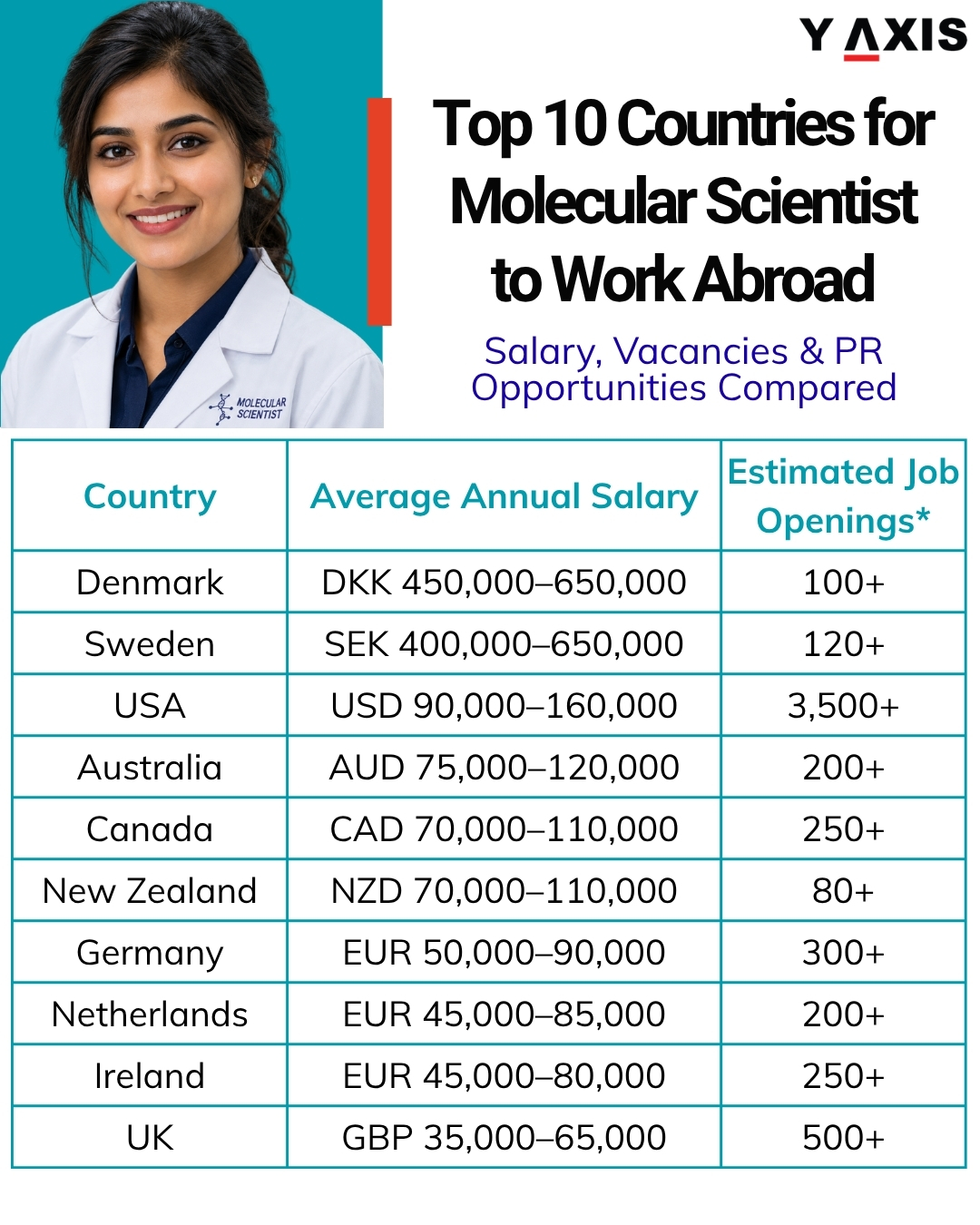
Top 10 Countries for Molecular Scientists: Quick Comparison
Molecular Scientists are in high demand due to a persistent global life sciences talent gap, rapid growth in cell and gene therapy, and expanding biotech and pharma R&D investment. The top countries offer strong salaries, clear visa routes, and established research ecosystems.
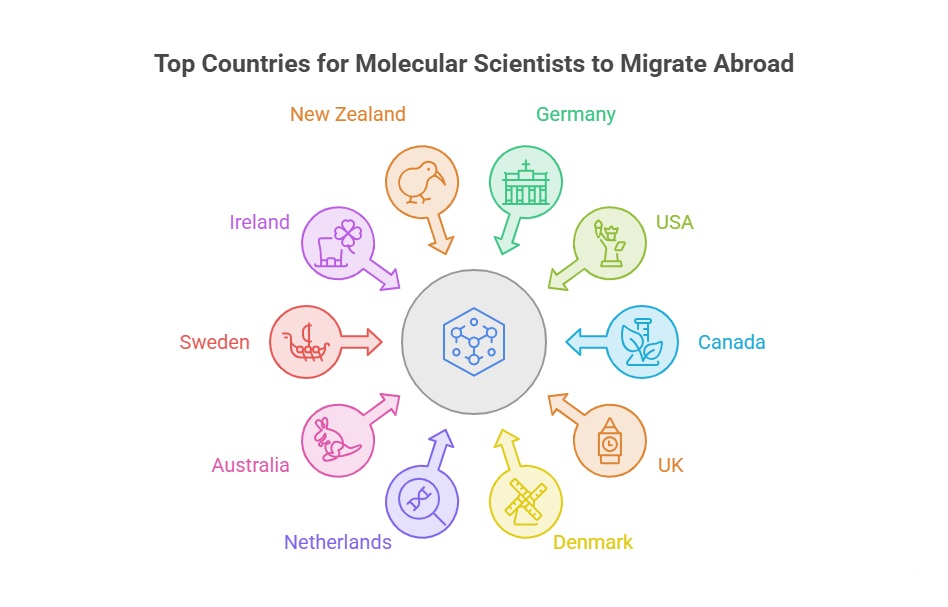
Top 10 countries to migrate abroad as a Molecular Scientist are as follows:
|
Country |
Average Annual Salary |
Work visa/Route |
PR Pathways |
Estimated Job Openings |
| Germany | EUR 50,000-90,000 | EU Blue Card / Skilled Worker Visa | PR after 21 months (Blue Card) or 4 years | 300+ |
| USA | $90,000-$160,000 | H-1B, O-1 (exceptional researchers) | Green Card (EB-2/EB-3/EB-1A) | 3,500+ |
| Canada | CAD 70,000-110,000 | Employer-Sponsored Work Permit, PNP | Express Entry (Researchers category) / PNP | 250+ |
| UK | £35,000-£65,000 | Skilled Worker Visa / Global Talent Visa | ILR after 5 years | 500+ |
| Denmark | DKK 450,000-650,000 | Positive List / Pay Limit Scheme | PR after 8 years (or 4 with conditions) | 100+ |
| Netherlands | EUR 45,000-85,000 | Highly Skilled Migrant (HSM) Visa | PR after 5 years | 200+ |
| Australia | AUD 75,000-120,000 | Skills in Demand Visa (Subclass 482) | Subclass 186 / Points-Tested Pathway | 200+ |
| Sweden | SEK 400,000-650,000 | Sweden Work Permit | PR after 4 years | 120+ |
| Ireland | EUR 45,000-80,000 | Critical Skills Employment Permit | Stamp 4 after 21 months | 250+ |
| New Zealand | NZD 70,000-110,000 | Skilled Migrant Category (points-based) | Residence via SMC points pathway | 80+ |
*Estimated using current job board listings and industry reports; actual openings vary by year and role.
Which Country Is Best for You? Molecular Scientists' Decision Table
The best country for molecular scientists depends on factors like career goals, salary expectations, and available immigration pathways.
|
Highest Salary |
USA |
Molecular Scientists commonly earn USD 90,000-160,000/year, backed by the world's largest biotech and pharma R&D market. |
|
Fastest PR |
Ireland |
The Critical Skills Employment Permit leads to Stamp 4 residency in as little as 21 months, with Biologist and Biomedical Scientist named on the Critical Skills Occupations List. |
|
Best Work-Life Balance |
Sweden |
Generous parental and annual leave, plus continued government investment in life sciences research. |
|
Largest Job Market |
UK |
Europe's biggest biotech and pharma cluster, anchored by the Cambridge-Oxford-London “Golden Triangle.” |
|
Best PR and Immigration Access |
Canada |
Express Entry's new Researchers category (2026) and NOC 21110 selects biologists and molecular scientists, with PR possible without a Canadian job offer via the federal pathway. |
|
Fastest EU Blue Card PR |
Germany |
Life science research roles can qualify for a reduced Blue Card threshold where the role sits on Germany's shortage occupation list, unlocking PR in 21 months. |
|
Easiest Shortage-List Entry |
Denmark |
Biologist is explicitly named on the Positive List for Higher Education, supporting a more direct work permit route. |
|
Most Direct Points-Tested Pathway |
Australia |
Biochemist and Life Scientist are Skill Level 1 occupations, giving access to the points-tested Subclass 189/190 visas without employer sponsorship. |
*Want to work abroad? Let Y-Axis guide you with the process.
1. Germany: Europe's Fast-Track Blue Card Destination for Molecular Scientists
Germany's world-class biotech and pharma sector, anchored by companies like BioNTech, Bayer, and Boehringer Ingelheim, drives steady demand for molecular scientists. High-paying jobs in Germany are concentrated in Berlin, Munich, and Heidelberg. The Germany job market is served by the EU Blue Card, one of Europe's fastest routes to permanent residence, with a reduced threshold where the role sits on Germany's shortage occupation list.
|
Average Salary |
EUR 50,000-90,000 per year. |
|
Top Cities |
Berlin, Munich, Heidelberg, Frankfurt, and Martinsried. |
|
In-Demand Roles |
Molecular Biologist, Biochemist, Genomics Scientist, Cell & Gene Therapy Scientist, and Bioinformatician. |
|
Work Visa |
EU Blue Card (reduced shortage threshold EUR 45,934.20, where applicable) or Skilled Worker Visa. |
|
PR Pathway |
Niederlassungserlaubnis in 21 months (Blue Card, with B2 German) or 4 years (Skilled Worker route). |
|
Why Choose Germany |
A world-class biotech and pharma R&D base, plus fast Blue Card PR for research-intensive roles. |
*Want to apply for a Germany work visa? Let Y-Axis guide you with the process.
2. USA: The World's Largest Biotech and Pharma R&D Market
The United States runs the world's largest biotech and pharma R&D market, with major hubs in Boston/Cambridge, the San Francisco Bay Area, and San Diego. High-paying jobs in the USA are concentrated in these clusters. The USA job market is served by the H-1B visa, while exceptionally accomplished researchers can pursue the O-1 visa.
|
Average Salary |
$90,000-$160,000 per year. |
|
Top Cities |
Boston, San Francisco, San Diego, Cambridge (MA), and Research Triangle Park (NC). |
|
In-Demand Roles |
Molecular Biologist, Research Scientist, Genomics Scientist, Bioinformatician, and Cell & Gene Therapy Scientist. |
|
Work Visa |
H-1B (employer-sponsored, lottery-based) or O-1 for researchers with an outstanding publication and citation record. |
|
PR Pathway |
EB-2 or EB-3 Green Card through employer sponsorship, or EB-1A for researchers of extraordinary ability. |
|
Why Choose USA |
Home to the world's largest biotech and pharma R&D spending and the deepest concentration of research institutions and venture-backed biotech. |
*Want to apply for a USA work visa? Let Y-Axis guide you with the process.
3. Canada: Healthcare-Priority Express Entry for Molecular Scientists
Canada's expanding biotech and genomics sector has created steady demand for molecular scientists. High-paying jobs in Canada are concentrated in Toronto, Montreal, and Vancouver. The Canada job market is served by Express Entry, with molecular scientists classified under NOC 21110 (Biologists and related scientists) and eligible for the newly introduced Researchers category for 2026.
|
Average Salary |
CAD 70,000-110,000 per year. |
|
Top Cities |
Toronto, Montreal, Vancouver, Ottawa, and Calgary. |
|
In-Demand Roles |
Molecular Biologist, Cell and Molecular Biologist, Geneticist, Bioinformatician, and Research Scientist. |
|
Work Visa |
Employer-sponsored Work Permit or Provincial Nominee Programs (PNP). |
|
PR Pathway |
Express Entry (NOC 21110, Researchers category) or Provincial Nominee Program; PR is possible without a Canadian job offer under the federal pathway. |
|
Why Choose Canada |
A new Express Entry Researchers category for 2026, a strong PR pathway, and growing genomics and biotech investment. |
*Want to apply for a Canada work visa? Let Y-Axis guide you with the process.
4. UK: Europe's Biotech and Pharma Golden Triangle
The UK has strong demand for molecular scientists across its pharma, biotech, and academic research sectors. High-paying jobs in the UK are concentrated in the Cambridge-Oxford-London “Golden Triangle.” The UK job market is served by the Skilled Worker Visa under SOC codes 2111-2119, with tradeable points available for a relevant STEM PhD.
|
Average Salary |
£35,000-£65,000 per year. |
|
Top Cities |
Cambridge, Oxford, London, Manchester, and Edinburgh. |
|
In-Demand Roles |
Molecular Biologist, Biochemist, Research Scientist, Genomics Scientist, and Bioinformatician. |
|
Work Visa |
Skilled Worker Visa (SOC 2111-2119, employer-sponsored; a relevant STEM PhD can lower the required salary) or the Global Talent Visa for exceptional researchers. |
|
PR Pathway |
Indefinite Leave to Remain (ILR) after 5 years. |
|
Why Choose UK |
Europe's largest biotech and pharma research cluster, with PhD tradeable points that ease entry for early-career researchers. |
*Want to apply for a UK work visa? Let Y-Axis guide you with the process.
5. Denmark: Direct Entry via the Positive List
Denmark names biologist directly on its Positive List for Higher Education, supporting a more direct work permit route for internationally trained molecular scientists. Denmark job market roles are concentrated in Copenhagen, home to a thriving pharma and biotech cluster including Novo Nordisk. The nation runs its own national work permit routes alongside the EU Blue Card allowing foreign workers to access some of the most in-demand jobs in Denmark.
|
Average Salary |
DKK 450,000-650,000 per year. |
|
Top Cities |
Copenhagen, Aarhus, Odense, and Lyngby. |
|
In-Demand Roles |
Molecular Biologist, Biochemist, Genomics Scientist, Research Scientist, and Laboratory Scientist. |
|
Work Visa |
Positive List for Higher Education (Biologist named directly) or Pay Limit Scheme (DKK 552,000/year). |
|
PR Pathway |
Permanent residence after 8 years (or 4 years if additional conditions are met). |
|
Why Choose Denmark |
Biologist is explicitly named on the shortage list, supporting a more predictable route into Denmark's life sciences sector. |
*Want to apply for a Denmark work visa? Let Y-Axis guide you with the process.
6. Netherlands: Strong Biotech Ecosystem and Structured HSM Route
The Netherlands' developed life sciences ecosystem, anchored by Leiden Bio Science Park and Amsterdam, creates strong demand for molecular scientists. The Netherlands job market is flourishing across cities like Leiden, Amsterdam, and Utrecht. The Highly Skilled Migrant (HSM) visa offers a straightforward, age-banded salary threshold route without a labour market test to skilled workers to leverage in-demand occupations in Netherlands.
|
Average Salary |
EUR 45,000-85,000 per year. |
|
Top Cities |
Leiden, Amsterdam, Utrecht, Rotterdam, and Nijmegen. |
|
In-Demand Roles |
Molecular Biologist, Biochemist, Genomics Scientist, Research Scientist, and Bioinformatician. |
|
Work Visa |
Highly Skilled Migrant (HSM) Visa or EU Blue Card. |
|
PR Pathway |
Permanent residence after 5 years of continuous legal residence. |
|
Why Choose Netherlands |
One of Europe's densest life sciences clusters, a straightforward HSM salary-threshold route, and an English-friendly research workforce. |
*Want to apply for a Netherlands work visa? Let Y-Axis guide you with the process.
7. Australia: Growing Biotech and Genomics Demand
Australia's expanding biotech, genomics, and agritech sectors have created strong demand for molecular scientists. High-paying jobs in Australia are concentrated in Melbourne, Sydney, and Brisbane. The Australia job market assesses molecular scientists under ANZSCO 234513 (Biochemist) or 234511 (Life Scientist), both Skill Level 1 occupations on the skilled occupation list.
|
Average Salary |
AUD 75,000-120,000 per year. |
|
Top Cities |
Melbourne, Sydney, Brisbane, Adelaide, and Perth. |
|
In-Demand Roles |
Biochemist, Molecular Biologist, Geneticist, Microbiologist, and Life Scientist. |
|
Work Visa |
Skills in Demand Visa (Subclass 482), after skills assessment via VETASSESS. |
|
PR Pathway |
Subclass 186 (Employer Nomination) or points-tested Subclass 189/Subclass 190. |
|
Why Choose Australia |
Skill Level 1 occupations with multiple visa pathways, strong biotech and genomics investment, and a clear points-tested PR route. |
*Want to apply for a Australia work visa? Let Y-Axis guide you with the process.
8. Sweden: A Research-Friendly Route with Strong Work-Life Balance
Sweden's life sciences sector, anchored by AstraZeneca in Gothenburg and the Karolinska Institute in Stockholm, offers steady demand for molecular scientists. Sweden job market roles are concentrated in Stockholm, Gothenburg, and Uppsala. In-demand roles in Sweden in severe shortage occupations may qualify for exemptions from Sweden's standard median-salary work permit rule.
|
Average Salary |
SEK 400,000-650,000 per year. |
|
Top Cities |
Stockholm, Gothenburg, Uppsala, and Lund. |
|
In-Demand Roles |
Molecular Biologist, Biochemist, Genomics Scientist, Research Scientist, and Bioinformatician. |
|
Work Visa |
Sweden Work Permit; minimum salary of SEK 33,390/month from June 2026, with possible exemptions for severe shortage occupations. |
|
PR Pathway |
Permanent residence after 4 years of continuous work permit employment. |
|
Why Choose Sweden |
A strong work-life balance, competitive research salaries, and continued government investment in life sciences. |
*Want to apply for a Sweden work visa? Let Y-Axis assist you with the process.
9. Ireland: Europe's Fastest English-Speaking PR Pathway
Ireland's large multinational pharma and biotech manufacturing base has created strong demand for molecular scientists, supported by continued IDA Ireland investment. Ireland job market is booming across Dublin, Cork, and Galway. Biologist and Biomedical Scientist are both named on the Critical Skills Occupations List, relevant to the in-demand job sectors in Ireland.
|
Average Salary |
EUR 45,000-80,000 per year. |
|
Top Cities |
Dublin, Cork, Galway, and Limerick. |
|
In-Demand Roles |
Biologist, Biomedical Scientist, Molecular Biologist, Genomics Scientist, and Quality Assurance Analyst (Pharmaceutical). |
|
Work Visa |
Critical Skills Employment Permit, minimum EUR 40,904/year (from March 2026), or General Employment Permit. |
|
PR Pathway |
Stamp 4 residency after 21 months — one of Europe's fastest PR routes. |
|
Why Choose Ireland |
Biologist and Biomedical Scientist are named directly on the Critical Skills Occupations List, plus a large multinational pharma manufacturing base. |
*Want to apply for an Ireland work visa? Let Y-Axis guide you with the process.
10. New Zealand: A Points-Tested Route for Skilled Scientists
Jobs in New Zealand are centred around growing biotech and agritech research sectors. The in-demand job roles in New Zealand are mainly concentrated around Auckland and Wellington. Most molecular scientists pursue residence through the points-based Skilled Migrant Category (SMC).
|
Average Salary |
NZD 70,000-110,000 per year. |
|
Top Cities |
Auckland, Wellington, Christchurch, and Palmerston North. |
|
In-Demand Roles |
Molecular Biologist, Biochemist, Research Scientist, and Laboratory Scientist. |
|
Work Visa |
Work to Residence Visa (Accredited Employer Work Visa), minimum wage threshold around NZD 35/hour. |
|
PR Pathway |
Residence via the Skilled Migrant Category (SMC), a points-tested pathway requiring a minimum of 6 points, with a job offer significantly boosting the score. |
|
Why Choose New Zealand |
A growing biotech and agritech research base and a clear points-tested route to residence for skilled scientists. |
*Want to apply for a New Zealand work visa? Let Y-Axis assist you with the steps.
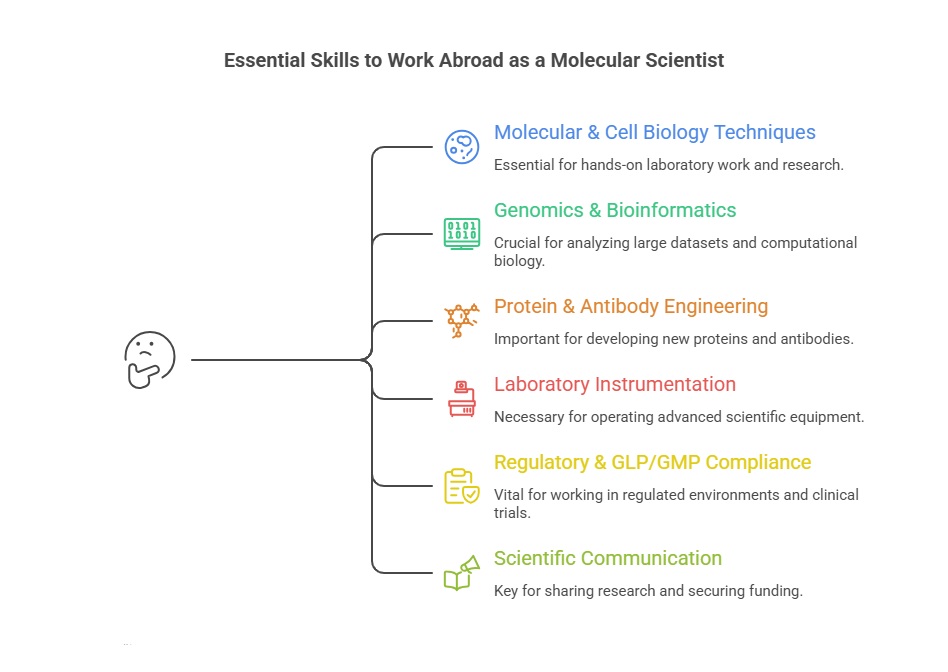
What Skills Do Molecular Scientists Need to Work Abroad?
Employers across the top countries consistently look for the following skills while recruiting molecular scientists:
- Molecular & Cell Biology Techniques: PCR, gene cloning, CRISPR/gene editing, and cell culture
- Genomics & Bioinformatics: next-generation sequencing data analysis and computational biology tools
- Protein & Antibody Engineering: protein expression, purification, and structural analysis
- Laboratory Instrumentation: mass spectrometry, flow cytometry, and chromatography
- Regulatory & GLP/GMP Compliance: documentation, quality standards, and clinical trial protocols
- Scientific Communication: publishing research, grant writing, and presenting findings
*Want to get your Molecular Scientist profile assessed? Try Y-Axis Free Eligibility Assessment to evaluate your profile.
How to Migrate Abroad as a Molecular Scientist?
The steps to apply for Molecular Scientist jobs abroad are as follows:
Step 1: Check your country-wise eligibility based on qualifications, research experience, and English proficiency.
Step 2: Get your degree recognised or assessed, and complete any country-specific skills assessment where required.
Step 3: Draft a resume or academic CV meeting international standards, highlighting your research output and technical skills.
Step 4: Apply for overseas roles across LinkedIn, Nature Careers, ScienceCareers, and country-specific biotech job portals.
Step 5: Secure a job offer after clearing interview and technical or research presentation rounds.
Step 6: Upon visa approval, relocate, complete any final registration formalities, and begin working legally abroad.
Common Mistakes Molecular Scientists Make When Applying for Jobs Abroad
- Using an academic CV format that doesn't translate well into an industry-style resume or ATS systems.
- Applying to countries where their research area doesn't align with local biotech clusters or funding priorities.
- Underestimating the time needed for degree recognition or country-specific skills assessments.
- Applying for work visas without first securing a confirmed job offer or research position.
- Accepting postdoc-level salaries that fall below skilled-worker visa eligibility thresholds.
- Not researching country-specific salary thresholds and PhD-linked visa discounts early enough.
*Are you looking for step-by-step assistance with overseas immigration? Contact Y-Axis, the world's No. 1 overseas immigration consultancy, for end-to-end assistance!
FAQs
Which are the top 10 countries for Molecular Scientists to work abroad?
The top 10 countries are Germany, the USA, Canada, the UK, Denmark, the Netherlands, Australia, Sweden, Ireland, and New Zealand. Ireland offers one of the fastest PR routes through its Critical Skills Employment Permit, while Denmark names Biologist directly on its Positive List. Germany and Canada balance strong salaries with fast PR pathways.
Which country offers the fastest PR for Molecular Scientists?
Ireland offers one of the fastest pathways. Biologist and Biomedical Scientist are both named on the Critical Skills Occupations List, and the Critical Skills Employment Permit leads to Stamp 4 residency in as little as 21 months — one of the fastest routes in Europe.
What is the average salary for a Molecular Scientist in the USA?
Molecular Scientists in the USA typically earn between $90,000 and $160,000 per year, with higher salaries in Boston, San Francisco, and San Diego. The USA has the world's largest biotech and pharma R&D market, and exceptionally accomplished researchers can also pursue the O-1 visa.
Is Ireland's Critical Skills Occupations List open to Molecular Scientists?
Yes. Ireland's Critical Skills Occupations List explicitly names Biologist and Biomedical Scientist — among the most direct routes available to a life sciences professional on this list, provided you have a job offer meeting the minimum salary threshold.
What is the EU Blue Card, and does it help Molecular Scientists?
Yes, where applicable. Germany's EU Blue Card allows applicants in roles on Germany's shortage occupation list to qualify at a reduced salary threshold of EUR 45,934.20/year. Blue Card holders can apply for German permanent residence in as little as 21 months.
Which occupation code do Molecular Scientists use for Canada's Express Entry?
Molecular Scientists are classified under NOC 21110 (Biologists and related scientists), which explicitly covers cell and molecular biologists. Canada's 2026 Express Entry update also introduced a new Researchers category, giving molecular scientists an additional route to an invitation to apply.
Can Molecular Scientists get direct PR in Australia?
Yes. Biochemist (ANZSCO 234513) and Life Scientist (ANZSCO 234511) are Skill Level 1 occupations, giving access to the points-tested Subclass 189/190 visas as well as employer-sponsored Subclass 186 — a genuinely direct pathway to permanent residence after a VETASSESS skills assessment.
Is Denmark a good destination for Molecular Scientists?
Yes. Biologist is named directly on Denmark's Positive List for Higher Education, supporting a more predictable work permit route. Copenhagen is also home to a large pharma and biotech cluster, including Novo Nordisk, creating steady demand for life sciences researchers.
What is Sweden's work permit process for Molecular Scientists?
Sweden requires a minimum monthly salary of SEK 33,390 for work permits from June 2026, though roles in severe shortage occupations may qualify for exemptions. Permanent residence is possible after 4 years of continuous work permit employment.
Do Molecular Scientists need professional registration to work abroad?
Unlike clinical professions, most countries don't require a formal licensing exam for molecular scientists. Instead, expect country-specific degree recognition, skills assessments (such as VETASSESS in Australia), and visa-specific salary or qualification thresholds. Confirm the exact requirements with your target country's immigration authority.
How much does a Molecular Scientist earn in Germany?
Molecular Scientists in Germany typically earn between EUR 50,000 and EUR 90,000 per year, with higher salaries in Berlin, Munich, and Heidelberg. Where the role sits on Germany's shortage occupation list, the EU Blue Card offers a fast track to permanent residence in as little as 21 months.
Which visa should Molecular Scientists apply for in the UK?
Most Molecular Scientists apply for the Skilled Worker Visa under SOC codes 2111-2119, where a relevant STEM PhD can earn tradeable points that lower the required salary. Exceptionally accomplished researchers can instead apply through the Global Talent Visa.
What documents are required for a Molecular Scientist's work visa abroad?
Typical requirements include:
- A valid passport
- A recognised degree (BSc, MSc, or PhD)
- An employment contract or job offer
- An updated resume or academic CV
- Proof of research output or publications
- Police clearance
- Language test results, where required
- Skills assessment, where required
Requirements vary by country, so confirm the exact checklist with your target country's immigration authority.
Which country offers the best work-life balance for Molecular Scientists?
Sweden is often considered the best choice for work-life balance among life sciences career destinations. It offers generous parental and annual leave, competitive salaries between SEK 400,000 and SEK 650,000 per year, and continued government investment in life sciences research.
Can Molecular Scientists bring their family when moving abroad?
In most countries on this list — Germany, the USA, Canada, the UK, Australia, the Netherlands, Ireland, and New Zealand — sponsored work visas allow you to include your spouse and dependent children, often with spousal work rights. Family inclusion for Denmark and Sweden depends on meeting the relevant salary or work permit conditions.
Do Molecular Scientists need a job offer before applying for a visa?
For most routes, yes — including the H-1B, EU Blue Card, Skilled Worker Visa, and Critical Skills Employment Permit. Canada's Express Entry, including the new Researchers category, is one of the few routes that can lead to PR without a confirmed job offer.
Tags:
Molecular Scientist jobs abroad
Molecular Scientist work visa
Molecular Scientist PR pathway
migrate as a Molecular Scientist
Molecular Scientist salary abroad
molecular biology jobs abroad
Molecular Scientist immigration India
Share
Y - Axis services

Get it on your mobile

Get News Alerts

Contact Y-Axis
Latest Article
Popular Post
Trending Article
Posted On October 01 2026
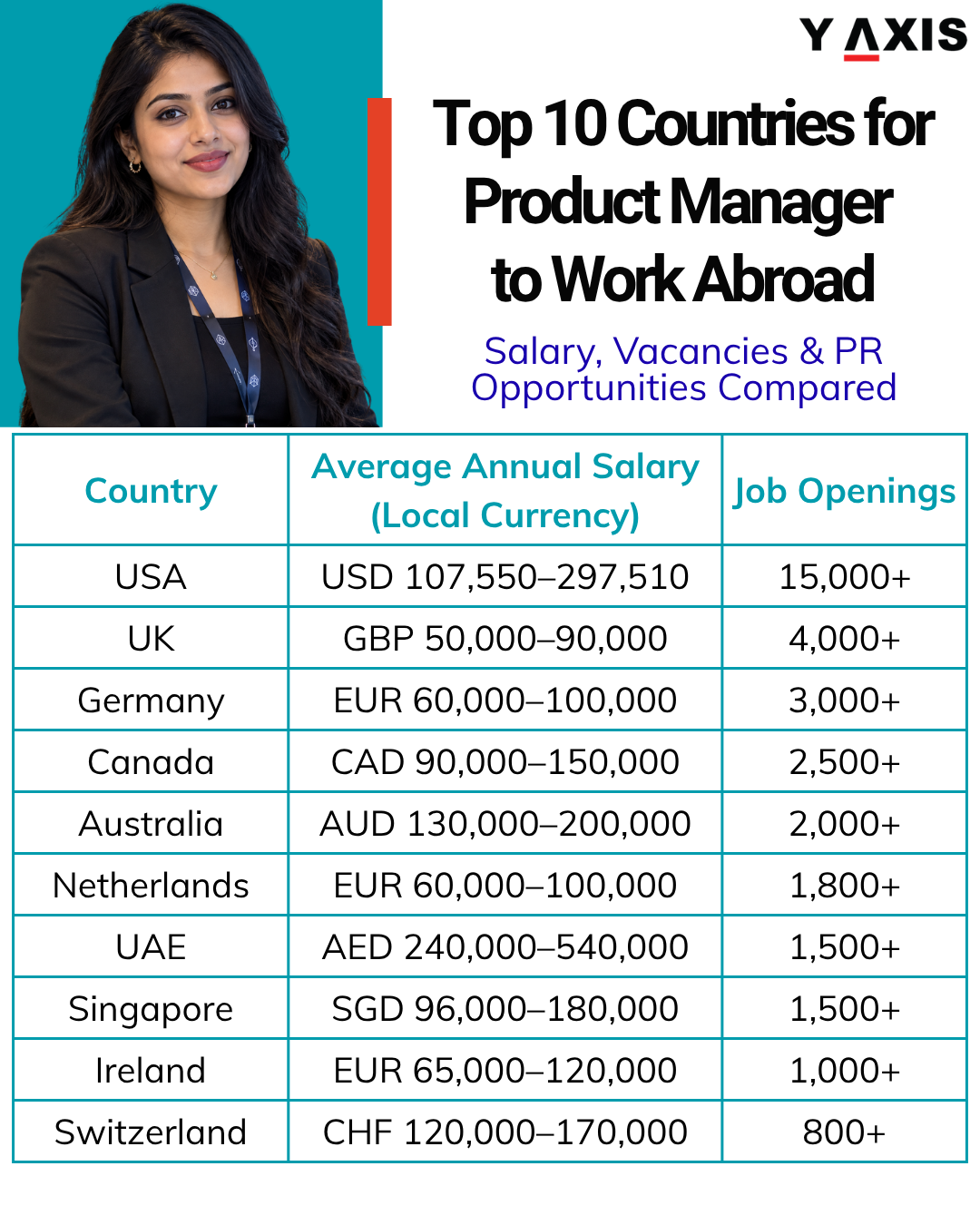
Top 10 Countries to Work Abroad as a Product Manager