


Editors Pick
Latest Article
How Can I Get Permanent Residency in Denmark?
How Can I Get Permanent Residency in Denmark?
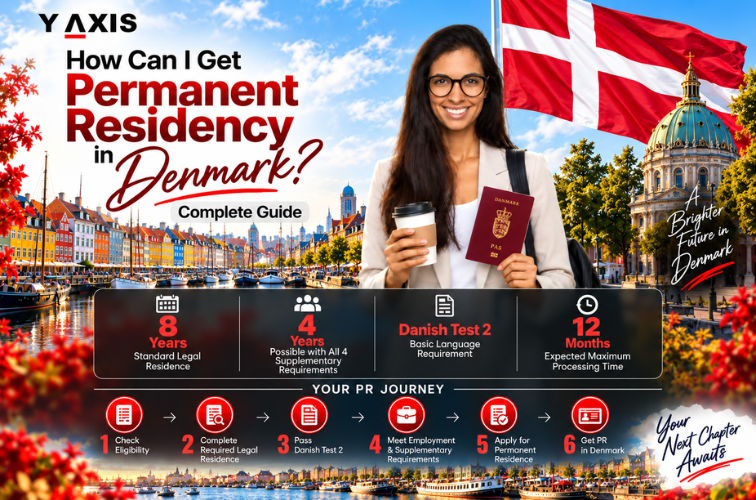
Denmark offers several ways for non-EU citizens to live and work in the country for a long time. Common options include work, highly skilled jobs, study, family reunification and starting a business. The right option depends on your education, work experience, job offer, salary, business plans and family situation. For skilled professionals, work-based residence permits can provide a pathway to permanent residence. Popular work routes include the Pay Limit Scheme, Positive List and Fast-Track Scheme. In general, you can apply for permanent residence after 8 years of legal residence in Denmark. In some cases, you may qualify after 4 years if you meet additional requirements.
*Want to migrate to Denmark? Contact Y-Axis for complete guidance and support.
What Are the Main Ways to Get Permanent Residency in Denmark?
|
PR / Residence Pathway |
Who It May Suit |
|
Employment Residence Visa |
Foreign workers with a valid job offer or employment contract in Denmark. |
|
Pay Limit Scheme |
Professionals with a Danish job that meets the required minimum salary. |
|
Positive List |
Skilled workers whose occupation is on Denmark's shortage occupation list. |
|
Fast-Track Scheme |
Skilled workers employed by companies approved under Denmark's Fast-Track system. |
|
Highly Qualified Work / Researcher |
Highly skilled professionals and researchers with eligible jobs in Denmark. |
|
Study Residence Permit |
International students accepted into an eligible Danish education programme. |
|
Start-up Denmark |
Entrepreneurs with an approved business idea who want to run a business in Denmark. |
|
Family Reunification |
Eligible spouses, partners, children and other qualifying family members of people living in Denmark. |
|
Permanent Residence |
Non-EU citizens who meet the required residence period and other permanent-residence conditions. |
Note: Denmark does not have a general investment or passive-income residence programme. People working remotely usually need to qualify through another suitable residence or work route.
*Do you want to work in Denmark? Contact Y-Axis, the No. 1 Overseas Immigration Consultant.
Steps to Apply for Permanent Residence in Denmark
Step 1: Choose the Danish residence pathway that matches your profile, such as work, study, family reunification or business.
Step 2: Check your eligibility based on your education, work experience, job offer, salary, income or family relationship.
Step 3: If applying through work, get a suitable job offer from a Danish employer.
Step 4: Complete any required qualification recognition or professional registration.
Step 5: Apply for the appropriate Danish residence and work permit.
Step 6: Prepare documents such as your passport, employment contract, education certificates, proof of income and other required documents.
Step 7: Move to Denmark and maintain your legal residence.
Step 8: Meet the required language and integration conditions, where applicable.
Step 9: Complete the required residence period. The normal requirement is 8 years of legal residence. Some applicants may qualify after 4 years if they meet all the additional requirements.
Step 10: Apply for permanent residence after meeting the required conditions and submit the necessary documents and application fee.
Note: Permanent residence requirements can include language skills, employment, financial independence, integration and other conditions. Requirements and fees may change, so applicants should check the latest rules before applying.
Denmark PR Requirements
- You usually need to live legally in Denmark for at least 8 years before applying for permanent residence.
- In some cases, you may qualify after 4 years of legal residence if you meet all the additional requirements.
- You must have a valid residence permit and meet the conditions for permanent residence.
- You generally need to show that you are financially self-supporting and have not received certain types of public benefits.
- You must meet the required Danish-language conditions, depending on the permanent residence route.
- You may need to meet requirements related to employment or work history in Denmark.
- You must meet applicable integration and active citizenship requirements, where required.
- You must comply with Denmark's tax and legal requirements.
- You must meet the applicable criminal-record and conduct requirements.
- You need to provide documents such as your passport, residence documents, employment records, language certificates and other supporting documents, depending on your situation.
- After meeting the requirements, you can apply for permanent residence in Denmark through the Danish immigration authorities.
*Read about...
Denmark PR Cost and Processing Time
The cost of permanent residence in Denmark depends on your application category. The application fee for permanent residence based on work or study is DKK 7,570. Different fees may apply to other categories. The processing time can vary depending on the application and the workload of the Danish immigration authorities. The stated processing time for permanent residence applications can be up to 12 months, although some applications may be processed faster. Permanent residence requirements, fees and processing times can change, so applicants should check the latest requirements before submitting an application.
*Looking for assistance with overseas immigration? Contact Y-Axis, the world's number one immigration consultancy, for guidance and visa assistance.
FAQs
How long do I need to live in Denmark before applying for permanent residence?
Most applicants need to live legally in Denmark for 8 years before applying for permanent residence. In some cases, the period can be reduced to 4 years if all additional requirements are met. You must continue to meet the conditions of your residence permit and follow Denmark’s rules on work, language, public benefits and integration during your period of residence.
Can I get Denmark permanent residence after 4 years?
Yes, some applicants may qualify after 4 years of legal residence. However, they must meet all the required basic conditions and additional requirements. These may include stronger Danish language skills, longer full-time employment, a certain income level and active participation in Danish society. The 4-year option has stricter conditions, so applicants should carefully check whether they meet every requirement before applying.
What are the basic requirements for Denmark permanent residence?
To apply for permanent residence, you generally need to be 18 or older and have lived legally in Denmark for the required period. You must also meet conditions related to employment, language, criminal record, public benefits, financial obligations and integration. Your current residence permit must remain valid and you must continue to follow its conditions when your permanent residence application is processed.
Do I need to know Danish to get permanent residence?
Yes, Danish language skills are an important part of the permanent residence process. Applicants generally need to pass a required Danish language test or meet an accepted equivalent condition. A higher level of Danish may help satisfy additional requirements. Learning Danish can also help with everyday communication, work and integration into Danish society while building your long-term life in the country.
Do I need to work in Denmark to get permanent residence?
Yes, employment is an important requirement for many permanent residence applicants. You generally need to meet specific work conditions and have a qualifying employment history. Full-time work for a required period may also help you meet additional requirements. Your employment record, unemployment periods and current job can affect your application, so maintaining stable employment can be important when preparing for permanent residence.
Can students apply for permanent residence in Denmark?
Students can later apply for permanent residence if they meet the required conditions, but studying in Denmark alone does not automatically provide permanent residence. After completing their studies, many students move into qualifying employment and build their residence history. They must meet the required rules for legal residence, employment, Danish language skills, financial independence and integration before becoming eligible to apply for permanent residence.
Can I get permanent residence through family reunification in Denmark?
Yes, people living in Denmark through family reunification may later qualify for permanent residence. However, they still need to meet the relevant permanent residence requirements. These can include legal residence, employment, Danish language skills, financial conditions, criminal record requirements and integration rules. Family reunification gives you a residence pathway, but it does not automatically change into permanent residence without meeting the required conditions.
How much does it cost to apply for permanent residence in Denmark?
For 2026, the application fee for permanent residence based on work or study is DKK 7,570. Different fees can apply to applications based on family reunification or other categories. The fee may change in future years, so applicants should check the latest amount before submitting their application. Other expenses, such as document translation, certificates or travel, may also need to be considered.
How long does Denmark permanent residence processing take?
The processing time for a Denmark permanent residence application can be up to 12 months. Some applications may be completed sooner, depending on the case and whether all required information is provided correctly. Missing documents or requests for additional information can cause delays. Applicants should submit a complete application and respond quickly if the immigration authorities ask for more documents or clarification.
Where can I apply for permanent residence in Denmark?
You can apply for permanent residence through the Danish immigration authorities using the required application process. You need to complete the application, pay the correct fee and provide supporting documents. Depending on your application, you may also need to provide biometric information such as fingerprints and a photograph. Make sure your current residence status remains valid while your permanent residence application is being processed.
Posted on September 30 2026
Canada vs. Australia for Marketing & Sales Professionals: Which Country Should You Choose?
Canada vs. Australia for Marketing & Sales Professionals: Which Country Should You Choose?
If you are a marketing or sales professional planning to work and settle abroad, Canada and Australia both offer good career opportunities. Your choice depends on your experience, qualifications, English skills, salary expectations, family plans and immigration options. Canada offers opportunities in digital marketing, advertising, sales, business development, e-commerce and corporate marketing. Australia also has opportunities in marketing, advertising, sales, public relations and business development, along with skilled and employer-sponsored visa options.
*Want to migrate abroad? Contact Y-Axis for complete guidance and assistance.
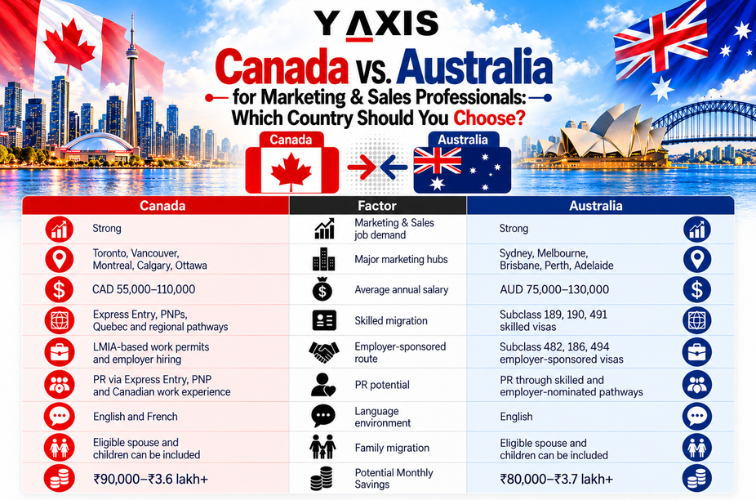
Canada vs. Australia for Marketing & Sales Professionals: Quick Comparison
|
Factor |
Canada |
Australia |
|
Marketing & sales job opportunities |
Jobs in digital marketing, advertising, sales, e-commerce, business development and corporate marketing |
Jobs in marketing, advertising, sales, public relations and business development |
|
Major job cities |
Toronto, Vancouver, Montreal, Calgary, Ottawa, Edmonton |
Sydney, Melbourne, Brisbane, Perth, Adelaide, Canberra |
|
Popular marketing roles |
Marketing Manager, Digital Marketing Specialist, Brand Manager, Marketing Specialist, Advertising Manager, PR Professional |
Marketing Manager, Digital Marketing Professional, Brand Manager, Advertising Manager, PR Professional |
|
Popular sales roles |
Sales Manager, Business Development Manager, Account Manager, Sales Representative |
Sales Manager, Business Development Manager, Account Manager, Sales Representative |
|
Skilled migration |
Express Entry, Provincial Nominee Programs (PNPs) and other eligible pathways |
Skilled Independent (189), Skilled Nominated (190), Skilled Work Regional (491) and other eligible pathways |
|
Professional assessment |
Depends on the job and immigration pathway. Education and work experience may need to be assessed |
A skills assessment may be required for some skilled migration occupations |
|
Professional qualifications |
No single compulsory qualification for most marketing and sales jobs. Professional certifications can help |
No single compulsory qualification for most marketing and sales jobs. Relevant qualifications and experience can help |
|
Employer sponsorship |
Employers may support eligible workers through employer-specific work permits |
Employers can sponsor eligible workers through visas such as 482 and 186 |
|
PR options |
Express Entry, PNPs and other eligible permanent residence programs |
Skilled and employer-sponsored permanent residence pathways |
|
Family migration |
Available through eligible immigration programs |
Available through eligible visa pathways |
|
Work environment |
Strong opportunities in technology, finance, retail, consulting and e-commerce |
Strong opportunities in technology, finance, retail, professional services and corporate businesses |
|
Best suited for |
Professionals looking for North American career opportunities and multiple immigration pathways |
Professionals looking for Australian career opportunities, skilled migration and a different lifestyle |
*Check your eligibility to Canada through the Y-Axis Canada CRS Score Calculator.
Canada vs. Australia: Which Country Offers Better Opportunities for Indian Marketing & Sales Professionals?
Both countries offer opportunities for Indian marketing and sales professionals. The right choice depends on your job profile, experience, qualifications, English skills, immigration eligibility and career goals.
Canada may be suitable if you:
- Have a good profile for Express Entry.
- Have relevant marketing, sales or business experience.
- Have strong English or French language skills.
- Qualify for a Provincial Nominee Program (PNP).
- Work in digital marketing, advertising, sales, branding or business development.
- Want to work in Canada's technology, finance, retail or e-commerce sectors.
- Prefer access to the wider North American job market.
- Want to explore permanent residence through Express Entry or a PNP.
Want to migrate to Canada? Get in touch with experts at Y-Axis to guide you with the process.
Australia may be suitable if you:
- Work in an occupation eligible for an Australian migration pathway.
- Have relevant marketing, sales or business-development experience.
- Have strong English-language skills.
- Meet the requirements for an applicable skilled visa.
- Have an Australian employer willing to sponsor you, where applicable.
- Work in digital marketing, advertising, sales, branding or public relations.
- Want to work in Australia's technology, retail, finance or professional-services sectors.
- Want to explore skilled visas such as 189, 190 or 491, if eligible.
- Have an employer-sponsored opportunity through pathways such as 482 or 186.
- Prefer Australia's lifestyle and work environment.
*Want to migrate to Australia? Get in touch with experts at Y-Axis to guide you with the process.
Canada vs. Australia: Salary, Living Costs & Savings for Marketing & Sales Professionals
For marketing and sales professionals, the financial benefit of working abroad depends on more than salary. Taxes, rent, groceries, transportation and other daily expenses can affect monthly savings. The table below gives an approximate comparison of salaries, take-home pay, living costs and potential savings in Canada and Australia. Actual figures vary by job role, experience, location, tax rate and lifestyle.
|
Factor |
Canada |
Australia |
|
Median Marketing & Sales Salary |
₹45 lakh–₹85 lakh/year |
₹48 lakh–₹90 lakh/year |
|
Monthly Gross Salary |
₹3.75–₹7.10 lakh |
₹4.00–₹7.50 lakh |
|
Estimated Monthly Take-Home Salary |
₹2.90–₹5.50 lakh |
₹3.10–₹5.90 lakh |
|
1-Bedroom City-Centre Rent |
₹1.36–₹1.91 lakh/month |
₹1.70–₹2.42 lakh/month |
|
Monthly Grocery Expenses |
₹27,000–₹41,000 |
₹20,400–₹34,000 |
|
Public Transport Expenses |
₹6,800–₹10,600/month |
₹10,200–₹14,800/month |
|
Utilities + Internet + Mobile |
₹12,300–₹20,900/month |
₹13,600–₹29,200/month |
|
Estimated Monthly Living Costs |
₹1.84–₹2.66 lakh |
₹2.24–₹3.26 lakh |
|
Potential Monthly Savings |
₹90,000–₹3.6 lakh+ |
₹80,000–₹3.7 lakh+ |
|
Lower-Cost Marketing & Sales Cities |
Calgary, Edmonton, Winnipeg, Montreal |
Brisbane, Adelaide, Perth |
|
Major Expensive Cities |
Toronto, Vancouver |
Sydney, Melbourne |
Note: Salary and cost-of-living figures are approximate ranges for comparison. Actual earnings and expenses can differ significantly based on whether you work in digital marketing, sales management, business development, advertising, brand management or another specialised role.
*Looking for assistance with overseas immigration? Contact Y-Axis , world’s number one immigration cosultancy for guidance and visa assistance.
FAQs
Is Canada or Australia better for marketing and sales professionals?
Canada and Australia both offer career opportunities for marketing and sales professionals. Canada has a large business market with opportunities in technology, finance, retail, advertising and e-commerce. Australia also has strong demand across marketing, sales, public relations and business development. The better option depends on your experience, qualifications, salary expectations, immigration eligibility, preferred city and lifestyle goals.
Are marketing jobs in demand in Canada?
Canada offers marketing opportunities in areas such as digital marketing, advertising, brand management, market research, e-commerce and public relations. Major cities such as Toronto, Vancouver, Calgary and Montreal have many businesses and industries that hire marketing professionals. Candidates with digital skills, sales experience, business knowledge and strong communication skills may find opportunities across different sectors and company sizes.
Are sales jobs in demand in Australia?
Australia offers sales opportunities across industries such as technology, retail, financial services, professional services and business-to-business companies. Common roles include sales managers, business development managers, account managers and sales representatives. Professionals with strong communication, negotiation and customer relationship skills can explore different career options. Job opportunities can vary depending on industry, location, experience and the specific sales role.
Which country offers higher salaries for marketing professionals?
Marketing salaries in Canada and Australia vary according to experience, job title, industry and location. Senior marketing managers and specialists with strong digital, analytics or management skills can earn higher salaries in both countries. Australia can offer competitive salaries, while Canada provides access to a large North American employment market. Comparing salary with taxes, rent and daily expenses is important before deciding.
Which country has better immigration options for marketing professionals?
Both Canada and Australia have immigration pathways for eligible skilled professionals. Canada offers options such as Express Entry and Provincial Nominee Programs. Australia has skilled and employer-sponsored pathways, depending on the applicant's occupation and eligibility. Marketing and sales professionals should check their exact occupation, qualifications, experience, English-language ability and other requirements before selecting an immigration pathway.
Can marketing and sales professionals get permanent residence in Canada?
Yes, eligible marketing and sales professionals may explore Canadian permanent residence programs. Options can include Express Entry and Provincial Nominee Programs, depending on the applicant's occupation, work experience, education, language skills and other factors. Having Canadian work experience, a provincial nomination or a suitable skilled profile may support an application, but eligibility depends on the specific immigration program and current requirements.
Can marketing and sales professionals get permanent residence in Australia?
Eligible marketing and sales professionals may be able to apply through Australia's skilled or employer-sponsored migration pathways. The available option depends on the applicant's occupation, skills assessment, qualifications, work experience, English ability, points and other requirements. Some professionals may also explore employer sponsorship. Since different marketing and sales occupations have different rules, applicants should check their exact occupation before applying.
Which cities are best for marketing and sales jobs?
In Canada, major employment centres include Toronto, Vancouver, Calgary, Montreal and Ottawa. In Australia, Sydney, Melbourne, Brisbane, Perth and Adelaide have large business and employment markets. The choice of city depends on your industry, job opportunities, salary and living costs. Professionals should also consider housing, transportation, lifestyle and the presence of companies in their particular marketing or sales field.
Which country has a lower cost of living for marketing and sales professionals?
Living costs vary considerably between cities in both countries. Toronto and Vancouver can have high housing costs, while some Canadian cities may be more affordable. Sydney and Melbourne are also known for higher housing expenses, while Brisbane, Adelaide and Perth may offer different cost levels. Rent, groceries, transport, taxes and lifestyle choices should all be considered when comparing potential savings.
Should I choose Canada or Australia for my marketing or sales career?
There is no single choice that suits every marketing or sales professional. Canada may appeal to people interested in the North American market and Canadian immigration pathways. Australia may appeal to professionals interested in its business, marketing and sales sectors and skilled migration options. Compare your occupation, qualifications, experience, salary expectations, immigration eligibility, living costs and long-term career plans before making a decision.
Posted on September 30 2026
What Are the Different Types of Austria Visas to Migrate?
What Are the Different Types of Austria Visas to Migrate?
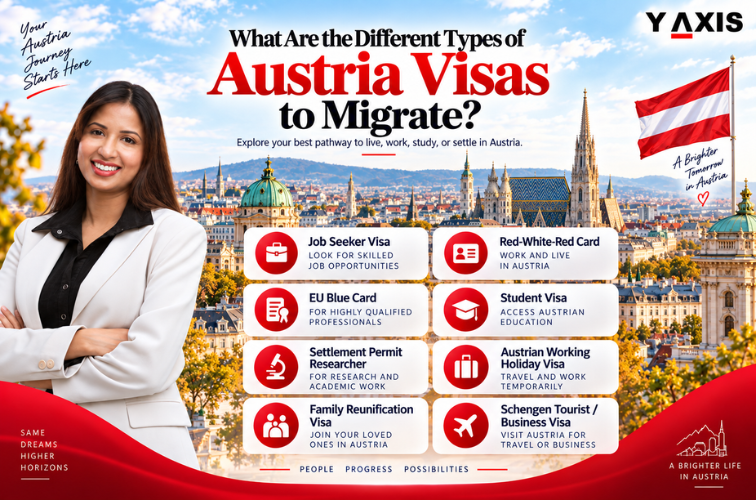
Austria is one of the top destination for skilled professionals, students, workers and families looking to live and work in Europe. Depending on your purpose and length of stay, you may need a Schengen Visa, National Visa, work visa, student residence permit or family residence permit. Skilled professionals can explore pathways such as the Red-White-Red Card, EU Blue Card and other residence permits for employment. Austria also offers residence options for students, family members and certain self-employed or financially independent applicants.
*Willing to migrate to Austria? Contact Y-Axis for complete guidance.
Different Types of Austria Visas
|
Austria Visa Type |
Who Is It For? |
Main Purpose |
|
Eligible non-EU nationals who have fulfilled Austria's residence and integration requirements |
To live and work permanently in Austria |
|
|
Skilled workers and professionals with an eligible employment opportunity |
To work in Austria temporarily or on a long-term basis |
|
|
Qualified third-country nationals who meet the requirements of an eligible category |
To live and work in Austria with an eligible employer |
|
|
Highly qualified non-EU professionals with a qualifying job offer and salary |
To work and reside in Austria as a highly qualified professional |
|
|
Highly qualified workers who meet the eligibility criteria |
To enter Austria and look for qualifying employment |
|
|
Student Visa / Residence Permit |
International students admitted to eligible Austrian educational institutions |
To study in Austria |
|
Family Reunification Visa / Residence Permit |
Eligible spouses, registered partners, children and other qualifying family members |
To join eligible family members living in Austria |
|
Tourists, business visitors and people visiting family or friends |
To visit Austria temporarily for up to 90 days within a 180-day period |
|
|
Researcher Residence Permit |
Eligible researchers and academic professionals |
To conduct research at an approved Austrian institution |
|
Self-Employed / Business Residence Permit |
Eligible entrepreneurs, investors and self-employed individuals, depending on the residence category |
To establish or operate a business in Austria |
What Are the Austria Visa Requirements for Indian Citizens?
The exact requirements depend on the visa or residence permit you choose. Common documents and requirements may include:
- Valid Indian passport with sufficient validity
- Completed visa or residence-permit application form
- Recent passport-size photographs, where required
- Proof of accommodation in Austria, where required
- Proof of sufficient financial means
- Valid health insurance coverage
- Educational certificates and professional qualifications
- Employment contract or qualifying job offer, where required
- Employment reference letters and work-experience documents
- German or English language test results, where required
- Skills or qualification documentation for applicable work routes
- Proof of admission from an Austrian educational institution for student applications
- Proof of relationship for family-reunification applications
- Police clearance certificate, where required
- Health or medical documentation, where required
- Proof of travel purpose and itinerary for visitor applications
- Employer documents and evidence of sponsorship, where applicable
- Other documents specified for the selected visa or residence permit
*Also, read...
What Are the Most In-Demand Jobs in Austria for the Next 10 Years?
Austria Visa Application Process
The general application process depends on the visa or residence permit category, but commonly involves:
Step 1: Choose the appropriate Austria visa or residence permit based on your purpose, such as work, study, family reunification or tourism.
Step 2: Check your eligibility and the specific requirements for the selected visa or residence permit.
Step 3: If applying for a work-based route, check whether you qualify for the Red-White-Red Card, EU Blue Card or another employment residence permit.
Step 4: Complete a German- or English-language test, if required for your selected immigration pathway.
Step 5: Prepare the required documents, such as passport, photographs, education certificates, employment documents, proof of accommodation, health insurance and proof of sufficient funds.
Step 6: Obtain a job offer or employment contract from an Austrian employer, where required.
Step 7: Submit your application to the appropriate Austrian authority. Depending on the visa category and circumstances, the application may be submitted through an Austrian embassy/consulate or by the prospective employer or sponsor in Austria.
Step 8: Provide biometric information and attend an interview, if required.
Step 9: Complete any required health, police or other background checks and provide additional documents if requested.
Step 10: Wait for the decision. Once approved, complete any required visa issuance or residence-permit collection formalities and travel to Austria.
*Planning to work in Austria? Y-Axis can guide your job search and visa process.
Austria Visa Fees for Indians
Austria visa and residence-permit fees are generally charged in euros (EUR). Fees can change, and additional costs such as VFS service charges, document translation, legalisation and insurance may apply.
|
Application Type |
Visa / Residence Permit |
Government Fee (EUR) |
|
PR Visa |
Long-Term Resident – EU |
€275 |
|
Work Visa |
Red-White-Red Card |
€218 |
|
Student Visa |
Residence Permit – Student |
€218 |
|
EU Blue Card |
EU Blue Card |
€218 |
|
Job Seeker Visa |
Job Seeker Visa |
€195 |
|
Family Visa |
Family Residence Permit |
€218 |
|
Visit Visa |
Schengen Visa – Type C |
€90 |
|
National Visa |
Visa D, where applicable |
€195 |
The €275 fee applies to the Austrian Daueraufenthalt–EU long-term residence permit, while the standard application fee for several temporary residence permits, including the Red-White-Red Card, Student residence permit and EU Blue Card, is €218.
Austria Visa Processing Time
Processing times depend on the visa or residence-permit category, the completeness of the application, document verification and the responsible Austrian authority. Therefore, these should be presented as indicative/maximum statutory periods rather than guaranteed processing times.
|
Austria Visa / Immigration Type |
Typical / Maximum Processing Time |
|
PR Visa – Long-Term Resident EU |
Varies by authority and individual case |
|
Work Visa – Red-White-Red Card |
Approximately 8 weeks |
|
Student Visa – Student Residence Permit |
Up to 90 days |
|
EU Blue Card |
Approximately 8 weeks |
|
Job Seeker Visa |
Up to 8 weeks |
|
Family Visa – Family Residence Permit |
Up to 90 days for applicable settlement permits; varies by category |
|
Visit Visa – Schengen Visa |
15 calendar days; up to 45 days if additional checks are required |
*Looking for help with overseas immigration? Contact Y-Axis, worlds’s number one immigration consultancy for guidance and visa assistance.
FAQs
What are the different types of visas to migrate to Austria?
Austria offers several visa and residence pathways depending on the purpose of migration. Common options include the Red-White-Red Card, EU Blue Card, Job Seeker Visa, Student Residence Permit, Family Reunification Residence Permit, Long-Term Resident–EU status and Schengen Visitor Visa.
Which Austria visa is suitable for skilled workers?
Skilled professionals may be eligible for the Red-White-Red Card or EU Blue Card, depending on their qualifications, occupation, employment offer, salary and other eligibility requirements.
What is the Red-White-Red Card in Austria?
The Red-White-Red Card is a residence and work permit for qualified third-country nationals. It covers several categories, including highly qualified workers, shortage occupation workers and other eligible skilled professionals.
Can Indians apply for an Austria EU Blue Card?
Yes. Indian citizens can apply for an EU Blue Card if they meet Austria's requirements, which generally include appropriate higher education or qualifying professional skills, a suitable employment offer and the required salary threshold.
Is there an Austria visa for people looking for a job?
Yes. Austria has a Job Seeker Visa for certain highly qualified workers who meet the applicable eligibility and points requirements. It allows eligible applicants to enter Austria to seek qualifying employment for a limited period.
Which Austria visa is available for international students?
International students generally apply for a Residence Permit – Student when their studies require a longer stay in Austria. Applicants need admission to an eligible Austrian educational institution and must meet requirements relating to funds, accommodation and health insurance.
Can family members join someone living in Austria?
Yes. Eligible family members may apply for family reunification or an appropriate family residence permit, depending on the residence status of the person already living in Austria and the relationship between the applicants.
Does Austria offer a permanent residence option?
Yes. Eligible third-country nationals can apply for Long-Term Resident – EU (Daueraufenthalt – EU) after meeting the applicable residence, integration and other requirements. This provides a long-term residence status in Austria.
What visa do Indians need to visit Austria?
For a short tourist, business or family visit, Indian citizens generally need a Schengen Visa (Type C). It normally allows short stays of up to 90 days in any 180-day period, subject to the visa conditions.
What are the basic requirements for an Austria migration visa?
Requirements vary by visa category but may include a valid passport, application forms, photographs, proof of qualifications, employment documents or admission letter, proof of sufficient funds, accommodation, health insurance, language evidence and police clearance documents, where applicable.
Posted on September 30 2026
What Is the Average Salary in France?
What Is the Average Salary in France?
The average salary in France is about €43,200 (roughly ₹47.5 lakh) per year for full-time employees in the private sector. It comes to about €3,602 (₹3.96 lakh approx.) gross per month, or €2,733 net per month after social contributions. These figures come from INSEE, the French national statistics institute. Skilled professionals in medicine, law, finance, and IT often earn €60,000 to €150,000 or more per year. Salaries in France for foreign skilled workers also vary by region, city, and sector. Paris and the wider Île-de-France region pay the most, while Lyon, Toulouse, and Nice also offer competitive salaries.
*Want to work in France? Let Y-Axis guide you through the process.
Top 10 Highest-Paying Occupations in France
France job market mainly comprises sectors such as finance, IT, healthcare, aerospace, and engineering. Salaries for professionals in France vary widely by sector and region. Many high-demand roles in France is currently facing significant skill shortages. This keeps pay competitive, especially in healthcare, IT, and engineering sectors among others.
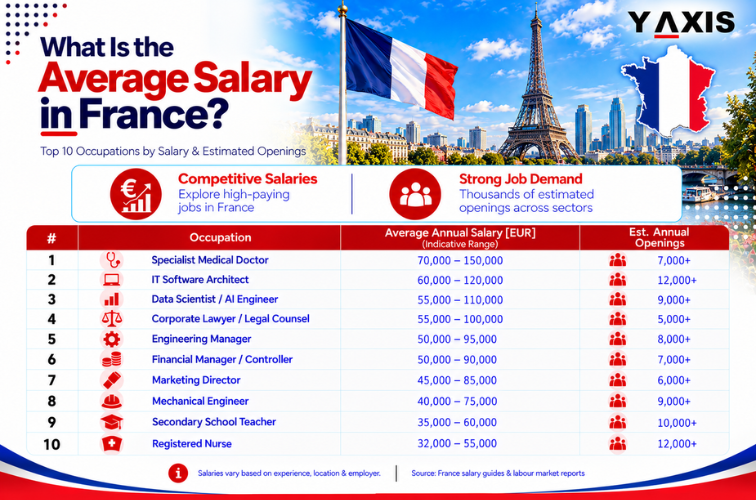
The table below highlights 10 occupations with strong salaries and steady hiring demand in France:
|
Occupation |
Average Annual Salary (EUR) |
Est. Annual Salary (INR) |
Demand Outlook |
|
Specialist Doctor |
€70,000-150,000+ |
₹77 lakh-1.65 crore+ |
Doctor shortages persist in many regions, especially outside large cities |
|
Corporate Lawyer |
€55,000-150,000 |
₹60.5 lakh-1.65 crore+ |
Top Paris law firms pay lawyers well above the national average |
|
Investment Banker / Finance Manager |
€60,000-150,000 |
₹66 lakh-1.65 crore+ |
Paris and La Défense sustain steady hiring in banking, insurance, and asset management |
|
AI / Machine Learning Engineer |
€50,000-95,000 |
₹55 lakh-1.05 crore |
Strong demand across technology, finance, and industry; AI skills command a premium |
|
Cybersecurity Engineer |
€45,000-80,000 |
₹49.5-88 lakh |
Rising demand as businesses and public bodies strengthen digital security |
|
Data Scientist |
€42,000-75,000 |
₹46.2-82.5 lakh |
Steady hiring in finance, retail, energy, and technology companies |
|
Senior Software Engineer |
€45,000-75,000 |
₹49.5-82.5 lakh |
Cloud, backend, and DevOps skills drive hiring in Paris, Lyon, and Toulouse |
|
Aerospace / Electrical Engineer |
€40,000-70,000 |
₹44-77 lakh |
Aerospace, energy transition, and rail projects keep demand high |
|
Pharmacist |
€40,000-60,000 |
₹44-66 lakh |
Steady demand across community pharmacies, hospitals, and the pharma industry |
|
Registered Nurse |
€28,000-40,000 |
₹30.8-44 lakh |
Hospitals and care homes continue to report nursing shortages |
Also, read...
Highest Paying Job Opportunities in France
Average Lifestyle Expenses in France
France offers strong salaries, but living costs vary widely by city. Housing is the largest expense, followed by groceries, utilities, and transport. Knowing these costs in advance helps you judge whether a salary offer in France is truly competitive.
- Rent (1-bed apartment, city centre, Paris): €1,200-1,800 per month
- Rent (1-bed apartment, other major cities, e.g. Lyon, Toulouse): €700-1,000 per month
- Groceries (single person): €250-350 per month
- Utilities (electricity, heating, and water, 1-2 bed flat): €100-180 per month
- Home insurance (required for tenants): €10-25 per month
- Public transport (Paris monthly Navigo pass, all zones): €90.80 per month, with 50% reimbursed by the employer
- Mobile and broadband plan: €25-50 per month combined
- Complementary health insurance (mutuelle), employee share: €20-60 per month
- Dining out (mid-range meal for two): €50-80
- Overall monthly budget, single person, excluding rent: €800-1,200
- Overall monthly budget, single person, including rent (comfortable baseline, Paris): €2,200-3,000
Note: Many professionals reduce costs by living in suburbs outside central Paris. Cities such as Lyon, Toulouse, Nantes, and Lille also offer competitive salaries with much lower rent and daily costs.
Also, read..
France Eases EU Blue Card Rules for Skilled Workers. Check Your Eligibility!
Salary Structure and Take-Home Pay in France
Employee social contributions are deducted first. They usually come to about 22% to 25% of gross pay and fund health insurance, pensions, and unemployment benefits. Income tax is then collected monthly at source by the employer. This is called prélèvement à la source. For one tax share, income up to €11,600 a year is tax-free. The rate of 11% applies from €11,601 to €29,579. The rate of 30% applies from €29,580 to €84,577. The rate of 41% applies from €84,578 to €181,917. The top rate of 45% applies above €181,917. A standard 10% deduction for work expenses is applied before tax. Married couples and families with children pay less, as income is shared across more tax shares under the family quotient system.
The table below shows illustrative gross monthly salary and approximate take-home pay for a single private-sector employee with one tax share. Figures are indicative only; actual take-home pay depends on your job status, collective agreement, family situation, and other income:
|
Gross Monthly Salary |
Mandatory Deductions (Social Contributions + Income Tax) |
Approx. Take-Home Pay |
|
€2,500 (~€30,000/year) |
~€611 (~24%) |
~€1,889 (~76%) |
|
€3,602 (~€43,224/year, France average) |
~€1,059 (~29%) |
~€2,543 (~71%) |
|
€4,500 (~€54,000/year) |
~€1,463 (~33%) |
~€3,037 (~67%) |
|
€6,000 (~€72,000/year) |
~€2,143 (~36%) |
~€3,857 (~64%) |
|
€8,333 (~€100,000/year) |
~€3,199 (~38%) |
~€5,134 (~62%) |
Also, read...
What are the Eligibility Requirements for a France Work Visa?
How France's Average Salary Compares to Other Countries
France pays more than many southern European countries. Its average full-time salary is about €43,200 gross a year. This is close to the UK's median full-time salary of about £39,000 (roughly €45,000). It is lower than Germany's median full-time salary of about €54,000. Switzerland, Ireland, the Netherlands, and Denmark also generally pay more. Spain, Italy, and Portugal generally pay less for similar roles. When comparing job offers, look at net income after social contributions, tax, rent, and living costs. This gives a more realistic view of how far your income will sustain your lifestyle in France.
France is especially attractive for professionals in IT, engineering, aerospace, healthcare, and finance. Paris is one of Europe's leading business and technology hubs. Employees also benefit from a 35-hour legal working week, at least five weeks of paid leave, and strong public healthcare. Salaries can vary significantly by region, city, experience, qualifications, and industry.
*Are you looking for step-by-step assistance with France immigration? Contact Y-Axis, the world's No. 1 overseas immigration consultancy, for end-to-end assistance!
FAQs
What is the average salary in France?
The average gross salary for full-time employees in the French private sector is about €3,602 per month, or €43,224 per year. After social contributions, this comes to about €2,733 net per month. These figures come from INSEE, the French national statistics institute. They are shown in full-time equivalent terms, so part-time pay is converted to a full-time basis for comparison.
What is the difference between average and median salary in France?
The average salary adds up all earnings and divides the total by the number of workers. A small group of very high earners pulls this figure upward. The median is the middle value, so half of all workers earn more and half earn less. In France, the median net salary is €2,190 per month, about 20% lower than the average net salary of €2,733.
Which jobs pay the highest salaries in France?
The highest-paying roles in France include specialist doctors, corporate lawyers, investment bankers, and finance managers. These professionals often earn €60,000 to €150,000 or more per year. AI engineers, cybersecurity engineers, and data scientists also earn well above the national average. Pay is highest in Paris and the Île-de-France region, which host major finance, legal, and technology employers.
Is there a minimum wage in France?
Yes. France has a statutory minimum wage called the SMIC. It is currently €12.31 gross per hour for workers aged 18 and over. For a full-time 35-hour week, this equals €1,867.02 gross per month, or about €1,478 net. The SMIC is reviewed every January. It also rises automatically during the year if inflation passes a set level.
How much tax do I pay on my salary in France?
France first deducts employee social contributions, which are usually about 22% to 25% of gross pay. Income tax is then collected monthly at source. For one tax share, income up to €11,600 a year is tax-free. Rates then rise from 11% to 30% and 41%, and a top rate of 45% applies above €181,917. Couples and families usually pay less under the family quotient system.
Is the average salary in France enough to live comfortably?
Yes, for most single people outside Paris. The average salary leaves about €2,543 per month after social contributions and income tax. This covers rent, bills, groceries, transport, and some savings in cities such as Lyon, Toulouse, or Nantes. In Paris, rent takes a much larger share of income. Shared housing or living in the suburbs helps an average salary go further.
Do foreign workers earn the same as local workers in France?
Yes. French law requires equal pay for equal work, regardless of nationality. Foreign workers must also receive at least the minimum wage and the minimum pay set by their collective agreement. For the Talent Passport – Qualified Employee, the gross salary must be at least €39,582 a year. This means many skilled foreign professionals earn above the national median.
What is a good salary in France for a single person?
A good salary for a single person in Paris is about €45,000 or more gross per year. This covers rent, living costs, and regular savings. In other cities, such as Lyon, Toulouse, or Lille, €35,000 or more per year is a realistic threshold, as rent and daily costs are lower. A gross salary above €60,000 per year places you well above the national average.
How does France's average salary compare to other countries?
France pays more than many southern European countries. Its average full-time salary of about €43,200 gross a year is close to the UK's median of about €45,000. It is lower than Germany's median of about €54,000. Switzerland, Ireland, and the Netherlands also generally pay more. Spain, Italy, and Portugal generally pay less. Comparing net income after tax and rent gives the most accurate picture.
What salary do I need for a France work visa?
It depends on the visa route. The Talent Passport – Qualified Employee needs a gross salary of at least €39,582 a year. The Talent Passport – EU Blue Card needs at least €59,373 a year. Other salaried work visas need at least the French minimum wage (SMIC). Salary thresholds are updated from time to time, so always check the official French government websites.
What is the standard working week in France?
The legal working week in France is 35 hours. Hours worked beyond this are usually paid as overtime, at a higher rate of 25% or 50%, unless a company agreement sets different rates. Maximum working time is generally 48 hours in a week. Full-time employees are entitled to five weeks of paid leave a year, plus public holidays.
Do French employers pay a 13th month salary or bonus?
A 13th month salary is common in France, but it is not required by law. It is usually set by the collective agreement, the employment contract, or company policy. Many employers also pay performance bonuses and profit-sharing. Always check whether a quoted annual salary is spread over 12 or 13 months, and whether it includes bonuses.
Why do salaries vary so much between French regions?
Salaries vary by region mainly due to industry concentration and cost of living. Paris and the Île-de-France region offer the highest pay. This region hosts most major finance, legal, technology, and consulting employers. Many rural regions report lower wages. Rent and living costs in these regions are also lower, so the gap in spending power is smaller.
Is healthcare included in my French salary?
Yes, in part. Your social contributions fund the public health insurance system, Assurance Maladie, which covers a large share of medical costs. Private-sector employers must also offer complementary health insurance, called a mutuelle, and pay at least 50% of its cost. The employee share is deducted from your salary. Check your job offer for the level of cover provided.
What work visas can Indian professionals use to work in France?
Indian professionals can work in France through several routes. The Talent Passport – Qualified Employee suits skilled workers with a master's degree. The Talent Passport – EU Blue Card suits highly qualified professionals with higher salaries. The salaried employee visa covers other jobs with a French employer. The India-France Young Professionals Scheme lets eligible Indians aged 18 to 35 work in France for up to 24 months.
How much does a software engineer earn in France?
A software engineer in France typically earns €38,000 to €55,000 gross per year. Senior software engineers often earn €55,000 to €75,000 or more. Pay depends on experience, technical skills, employer size, and city. Paris offers the highest salaries, while Lyon, Toulouse, Nantes, and Grenoble also have strong demand for software engineers.
What are the mandatory deductions from a French salary?
French employees see two main types of deductions on their payslip. Social contributions cover health insurance, pensions, and unemployment insurance, along with the CSG and CRDS social taxes. Income tax is then withheld at source by the employer. Together, these usually reduce gross pay by about 24% to 38%, depending on salary and family situation.
Which French city offers the best salary-to-cost-of-living ratio?
Toulouse, Lyon, Nantes, and Lille offer a strong balance of salary and living costs. These cities have growing job markets in aerospace, technology, healthcare, and industry. Rent is much lower than in Paris, often by 30% to 50%. This means professionals can often save more each month, even if their gross salary is slightly lower.
Do salaries in France increase with experience?
Yes. Salaries in France rise steadily with experience, especially in technical and management roles. Employees with managerial or professional status, known as cadres, earn an average of about €4,630 net per month. Moving into senior, specialist, or leadership roles usually brings the largest pay rises. Many collective agreements also set pay scales that rise with seniority.
What should I check before negotiating a French job offer?
Before negotiating a French job offer, research salary data for your role and city. Check whether the salary is quoted gross or net, and whether it is paid over 12 or 13 months. Review bonuses, meal vouchers, transport reimbursement, and the mutuelle health cover. Also check your working hours, extra days off (RTT), and the collective agreement that applies to your job.
Posted on September 30 2026

How to Apply for a France Work Visa From India
How to Apply for a France Work Visa From India
To apply for a France work visa from India, you first need a job offer from an employer in France. Most skilled Indian professionals apply under the Talent Passport, which does not need a separate work permit. For other salaried jobs, your employer must first get a work authorisation online through the ANEF portal. You can then apply for a long-stay visa on the France-Visas website. Folowing that, you submit your documents and biometrics at a VFS Global France visa application centre in India. The Talent Passport – Qualified Employee route needs a master's degree and a gross salary of at least €39,582 a year. The EU Blue Card needs a gross salary of at least €59,373 a year. The long-stay visa fee is €99. After you arrive, you must validate your long-stay visa online within three months and pay the validation tax.
*Want to apply for a France work visa? Let Y-Axis guide you through the process.
How to Apply for a France Work Visa From India?
Most France work visa routes need a signed employment contract before you apply.
The steps to apply for a France work visa for Indians are as follows:
Step 1: Choose the most suitable immigration pathway to France aligned with your job , such as the Talent Passport, the EU Blue Card, the salaried employee visa, or the temporary worker visa.
Step 2: Secure a job offer and a signed employment contract from an employer established in France.
Step 3: If you apply as a salaried or temporary worker, your employer applies for your work authorisation on the ANEF portal. Talent Passport applicants do not need this step.
Step 4: Prepare your documents, including your passport, employment contract, degree certificates, photographs, and proof of accommodation in France.
Step 5: Complete the long-stay visa application on the France-Visas website and pay the visa fee of €99.
Step 6: Book an appointment at a VFS Global France visa application centre in India to give your biometrics and submit your documents.
Step 7: Receive the decision and collect your passport with the long-stay visa that acts as a residence permit (VLS-TS).
Step 8: Travel to France and validate your VLS-TS online within three months of arrival by paying the validation tax.
Also, read...
Requirements for the France Work Visa
France's requirements depend on your visa route, job, salary, and qualifications. The Talent Passport, the EU Blue Card, and the salaried employee visa share most of the same documents. The list below brings together the eligibility conditions and documents you will need.
The eligibility criteria for a France work visa are as follows:
- A job offer and a signed employment contract from an employer established in France.
- An approved work authorisation, if you apply as a salaried or temporary worker.
- For the Talent Passport – Qualified Employee, a master's degree or equivalent and a gross salary of at least €39,582 a year.
- For the EU Blue Card, a three-year degree or five years of relevant experience, and a gross salary of at least €59,373 a year.
- For other salaried jobs, a salary of at least the French minimum wage (SMIC). Your employer may need to show that no suitable local candidate was found, unless the job is on the shortage occupation list.
- A completed long-stay visa application form from the France-Visas website.
- A valid passport issued within the last 10 years, with at least two blank pages.
- Recent passport-size photographs that meet the visa photo standards.
- Degree certificates and experience letters, with translations where needed.
- Proof of accommodation in France and proof of the relationship for any dependants, such as a marriage or birth certificate.
Also, read...
High-demand occupations in France
Cost of Applying for a France Work Visa From India
The total cost of a France work visa depends on your visa route and the fees paid after arrival. Costs below are shown in euros and their approximate Indian Rupee equivalent, at a rate of roughly ₹110 to the euro.
|
Cost Item |
Fee |
Notes |
|
Long-Stay Visa Fee |
€99 (approx. INR 10,900) |
Paid by the applicant when applying through France-Visas; not refunded if the visa is refused |
|
VFS Global Service Charge |
Varies by centre |
Paid at the VFS Global France visa application centre in India, in addition to the visa fee |
|
VLS-TS Validation Tax |
€300 (approx. INR 33,000) |
Paid online in France within three months of arrival to validate your long-stay visa |
|
Work Authorisation |
No fee for the applicant |
Applied for by the employer on the ANEF portal; not needed for the Talent Passport |
|
OFII Employer Tax |
Varies by salary |
Paid by the employer when hiring a foreign worker; it cannot be passed on to the employee |
|
Residence Permit Renewal |
Varies by permit |
Paid through a fiscal stamp when you move from the VLS-TS to a multi-year residence permit |
|
Translations and Attestations |
Varies by provider |
Needed for documents such as degree certificates, marriage certificates, and birth certificates |
|
Premium and Courier Services |
Optional extra fee |
Available at some VFS Global centres for added convenience |
*Are you looking for step-by-step assistance with France immigration? Contact Y-Axis, the world's No. 1 overseas immigration consultancy, for end-to-end assistance!
FAQs
Can I apply for a France work visa without a job offer?
Most France work visas need a job offer and a signed employment contract. However, a few Talent Passport categories do not need an employer. These include business creators, founders of innovative projects, and investors. Indian graduates of a master's programme in France can also get a temporary residence permit. It lets them look for work or start a business after their studies.
What is the processing time for a France work visa from India?
The long-stay visa decision usually takes a few weeks after you submit your documents at VFS Global. If you need a work authorisation, your employer must get it first, and this can take several weeks. Missing documents can cause delays. You should start the process at least three months before your job start date.
What is the France Talent Passport?
The Talent Passport is a multi-year residence permit for skilled professionals, researchers, founders, and investors. It can be valid for up to four years. Holders do not need a separate work authorisation. Their spouse and children can receive a Talent Passport – Family permit, which also allows the spouse to work in France.
Is there a minimum salary requirement for a France work visa?
Yes. The Talent Passport – Qualified Employee route needs a gross salary of at least €39,582 a year. The EU Blue Card needs a gross salary of at least €59,373 a year. Other salaried jobs must pay at least the French minimum wage (SMIC). Always check the current thresholds on the official French government websites before you apply.
Do I need to speak French for a France work visa?
French is not required for most work visa applications. Many roles in IT, engineering, research, and multinational companies use English at work. However, French helps with daily life, job options, and integration. Language conditions may also apply later when you apply for long-term residence permits or permanent residency.
Can my spouse and children join me in France?
Yes. Talent Passport and EU Blue Card holders can bring their spouse and children at the same time. Your spouse can work in France without a separate work authorisation. Holders of a salaried employee permit can usually bring their family later through family reunification, after a minimum period of legal residence.
What is the VLS-TS and why must I validate it?
The VLS-TS is a long-stay visa that acts as a residence permit for your first year in France. You must validate it online within three months of arrival and pay the validation tax. If you do not validate it on time, you will lose your right to stay in France. Keep your proof of validation safe.
Can I change employers while on a France work visa?
It depends on your permit. Talent Passport and EU Blue Card holders can usually change jobs if the new job still meets the salary and eligibility conditions. Salaried employees must usually get a new work authorisation before they change employers in their first year. You should inform the prefecture of any change that affects your permit.
What happens if my France work visa application is refused?
If your application is refused, you will receive a written decision. Common reasons include missing documents, an unclear employment contract, or a salary below the required threshold. You can appeal to the Commission de Recours contre les Décisions de Refus de Visa within the deadline stated in the decision. You can also reapply once you have fixed the issue. The visa fee is not refunded.
Does a France work visa lead to permanent residency?
Yes. After five years of continuous legal residence in France, you can usually apply for a 10-year resident card. You must show stable income, integration into French society, and the required level of French. EU Blue Card holders may count time spent in other EU countries in some cases. Check the latest rules on the official French government websites before you apply.
Posted on September 30 2026
Trending Article
Posted On September 30 2026
How Can I Get Permanent Residency in Denmark?