

Posted on November 17 2026
What Are the Different Types of France Visas to Immigrate?

By , Editor & Director
Updated November 18 2026
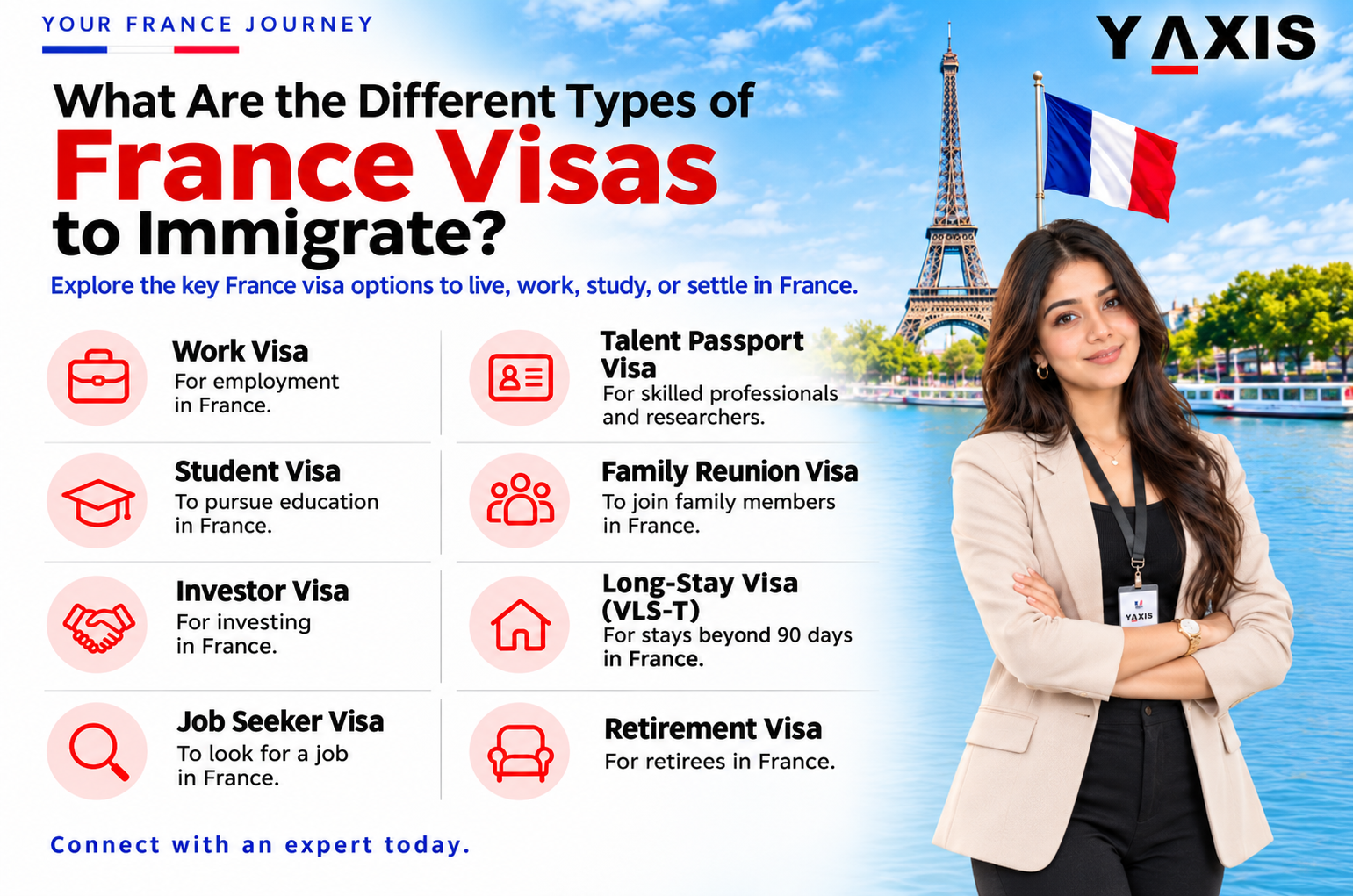
France offers several visa and residence permit options for Indian citizens who want to visit, work, study or settle in the country. For short visits of up to 90 days, you need a Schengen Visa. For stays longer than 90 days, you need a French long-stay visa (Type D). Many long-stay visas also work as a residence permit for the first year, called the VLS-TS. The main long-stay options are the Talent Permit, EU Blue Card, salaried employee visa, student visa and family reunification visa. Indian master's graduates from French institutions can also stay up to two years to look for work or start a business.
The right option depends on your purpose, qualifications and personal situation. Qualified employees need a salary of at least €39,582 per year for the Talent Permit. Highly qualified professionals can apply for an EU Blue Card with a salary of at least €59,373 per year. Students need admission to a recognised French institution. Most residents can apply for a 10-year resident card after five years of legal stay in France.
*Planning to work in France? Contact Y-Axis for complete guidance.
Types of France Visas and Residence Permits for Indian Citizens
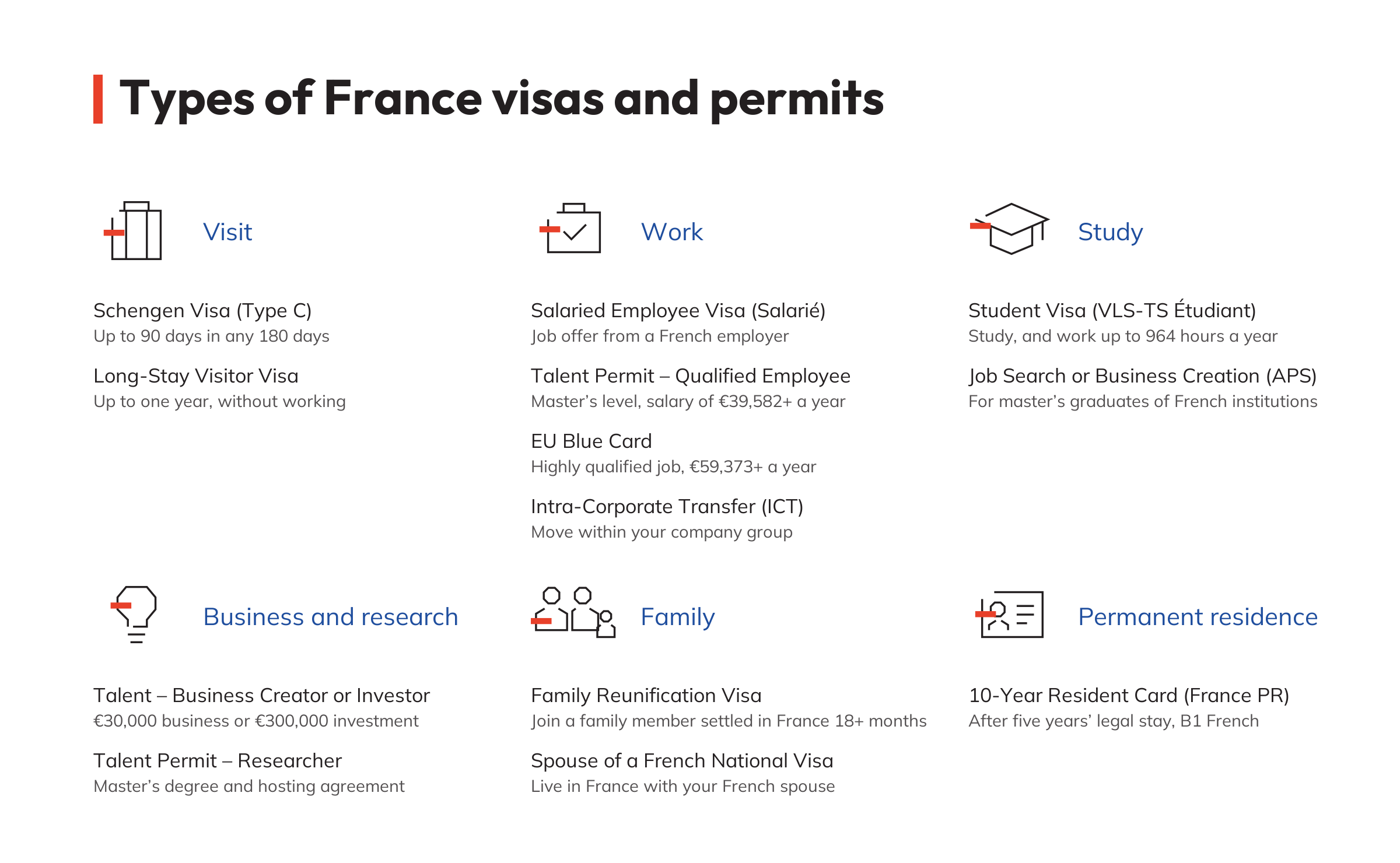
The table below lists the main France visas and residence permits, who they are for and their main purpose.
|
France Visa or Permit Type |
Who Is It For? |
Main Purpose |
|
Schengen Visa (Type C) |
Tourists, business visitors and people visiting family or friends |
To visit France and other Schengen countries for up to 90 days in any 180-day period |
|
Long-Stay Visitor Visa |
People who want to stay longer than 90 days without working |
To live in France for up to one year using their own funds |
|
Salaried Employee Visa (Salarié) |
Non-EU workers with a job offer from a French employer |
To live and work in France after the employer gets work authorisation |
|
Talent Permit – Qualified Employee |
Graduates with at least a master's-level degree and a salary of at least €39,582 per year |
To work in France on a multi-year permit of up to four years |
|
EU Blue Card (Talent – EU Blue Card) |
Highly qualified professionals with three years of higher education or five years of relevant experience |
To work in a highly qualified job with a salary of at least €59,373 per year |
|
Intra-Corporate Transfer (ICT) Permit |
Managers, specialists and trainees moving within the same company group |
To work temporarily at a French branch of their employer |
|
Student Visa (VLS-TS Étudiant) |
Students admitted to a recognised French institution |
To study in France, with the right to work up to 964 hours a year |
|
Job Search or Business Creation Permit (APS) |
Indian graduates with a master's degree from a French institution |
To look for work or start a business in France for up to two years |
|
Talent Permit – Business Creator or Investor |
Entrepreneurs with a viable project or investors |
To start a business with at least €30,000 or invest at least €300,000 in France |
|
Talent Permit – Researcher |
Researchers with a master's degree and a hosting agreement from an approved organisation |
To carry out research or teach at university level in France |
|
Family Reunification Visa |
Spouses and children under 18 of non-EU residents who have lived legally in France for at least 18 months |
To join a family member who lives in France |
|
Spouse of a French National Visa |
Married spouses of French citizens |
To live in France with their French spouse |
|
10-Year Resident Card (France PR) |
Non-EU residents with at least five years of legal stay in France |
To live in France long term, with B1 level French |
*Get your profile on Europe’s top 10 job portals for just ₹2,500 (save ₹2,500).
View package: https://www.y-axis.com/lp/europe-work-indians/
France Visa Requirements and Documents for Indian Applicants
The documents you need depend on your visa or permit type. Common requirements to apply for a France visa from India include:
- Valid Indian passport with at least two blank pages that covers your planned stay
- Completed online application on the official France-Visas portal
- Recent passport-size photographs that meet the required specifications
- Signed employment contract and work authorisation approval for salaried work applications
- Proof of qualifications, such as master's degree certificates, for Talent Permit and EU Blue Card applications
- Proof of work experience, such as experience letters
- Letter of admission from a French institution and Campus France clearance for student applications
- Business plan and proof of investment for business creator and investor applications
- Hosting agreement from an approved research organisation for researcher applications
- Proof of relationship, such as a marriage or birth certificate, for family applications
- Proof that your family member in France has stable income and suitable housing
- Proof of sufficient funds, such as recent bank statements
- Proof of accommodation in France and a travel itinerary for short visits
- Travel medical insurance with cover of at least €30,000 for Schengen Visa applications
- Health insurance for long-stay visas, where required
- Translations of documents that are not in English or French, where requested
- Any additional documents requested by the French Embassy or visa application centre
Also, read…
How to get permanent residency in France?
How to Apply for a France Visa from India?
The application process depends on your visa type. All applications start on the official France-Visas portal. You then submit your documents at the visa application centre in India. For salaried work, your French employer must first get work authorisation. The general steps are:
Step 1: Choose the right visa or permit based on your purpose of moving to France.
Step 2: Check the eligibility requirements for that visa or permit.
Step 3: Secure a job offer, university admission or family sponsor, depending on your route.
Step 4: For salaried work, your French employer applies for work authorisation online. For studies, complete the Campus France process.
Step 5: Fill in the online application on the France-Visas portal and print the receipt.
Step 6: Book an appointment at the visa application centre in India and pay the visa fee.
Step 7: Submit your documents and give your fingerprints and photograph.
Step 8: Wait for the French Embassy or consulate to decide on your application.
Step 9: Collect your passport with the visa and travel to France.
Step 10: Validate your VLS-TS online within three months of arrival and pay the validation tax.
Also, read…
Visa Sponsorship Jobs in France
France Visa Fees for Indian Applicants
France visa fees depend on the type of visa or permit you apply for. A short-stay Schengen Visa costs €90 for adults and €45 for children aged 6 to 12. A long-stay visa costs €99, and students pay a reduced fee of €50. After arrival, most VLS-TS holders pay a validation tax online. You may also need to pay a service fee at the visa application centre. Fees can change, so check the latest amounts before you apply.
|
Visa/ Fee Type |
Fee |
|
Schengen Visa (adults) |
€90 |
|
Schengen Visa (children aged 6 to 12) |
€45 |
|
Schengen Visa (children under 6) |
Free |
|
Long-stay visa (Type D) |
€99 |
|
Long-stay visa for students |
€50 |
|
Long-stay visa for spouses of French nationals |
Free |
|
VLS-TS validation tax after arrival (standard rate) |
€300 |
|
First multi-year residence card (standard rate) |
€350 |
|
Visa application centre service fee |
Charged in addition to the visa fee |
Also, read…
France Job Market: Trends and Opportunities
France Visa Processing Time for Indian Applicants
Processing time depends on the type of visa and your personal circumstances. Schengen Visa applications are usually decided within 15 days, but this can extend in some cases. Long-stay visas can take longer, especially when your employer must first get work authorisation. Apply well in advance and keep your documents complete to avoid delays.
|
Visa or Permit Type |
Usual Processing Time |
|
Schengen Visa |
Within 15 days (can extend up to 45 days) |
|
Salaried Employee Visa |
Several weeks, plus time for work authorisation |
|
Talent Permit |
Several weeks |
|
EU Blue Card |
Several weeks to three months |
|
Student Visa |
Several weeks, after the Campus France process |
|
Family Reunification Visa |
Several months |
|
10-Year Resident Card |
Several months |
*Want guidance with overseas immigration? Connect to Y-Axis, the world’s No. 1 overseas immigration consultancy, for end-to-end support with the process.
FAQs
What is the best France visa for Indian professionals?
The best option depends on your qualifications and salary. Graduates with a master's-level degree and a salary of at least €39,582 per year can apply for the Talent Permit – Qualified Employee. Professionals earning at least €59,373 per year can apply for the EU Blue Card. Others with a French job offer can use the salaried employee visa. All three routes allow you to live and work legally in France.
What is the difference between a Schengen Visa and a long-stay visa for France?
A Schengen Visa (Type C) is for short visits of up to 90 days in any 180-day period. It covers tourism, business trips and family visits, but it does not allow you to work. A long-stay visa (Type D) is for stays longer than 90 days. It is used for work, study, family and settlement. Many long-stay visas are VLS-TS visas, which also act as your residence permit for the first year.
What is the France Talent Permit?
The Talent Permit, formerly called the Talent Passport, is a multi-year residence permit for skilled people. It is valid for up to four years and can be renewed. It covers several categories, including qualified employees, EU Blue Card holders, researchers, business creators, investors and artists. Your spouse and children can join you on a Talent – Family permit. You first apply for a Talent long-stay visa from India.
What salary do I need for the France EU Blue Card in 2026?
For 2026, the France EU Blue Card needs a gross annual salary of at least €59,373. This is 1.5 times the French reference salary. You also need a job contract of at least six months. You must have three years of higher education or five years of relevant experience. The card is valid for up to four years. After 12 months, holders can move to another EU country for work.
Can Indian students work in France?
Yes. Students on a French student visa (VLS-TS Étudiant) can work up to 964 hours a year. This equals about 60% of full-time working hours. Students do not need a separate work permit for this part-time work. However, they must first validate their visa online after arrival. Part-time work can help with living costs, but students should not rely on it to meet visa fund requirements.
How long can Indian graduates stay in France after their studies?
Indian students who complete a master's degree in France can apply for a job search or business creation permit (APS). Under the India-France mobility agreement, it is valid for one year and can be renewed once. This gives up to two years to find a job or start a business. Indian alumni with a master's degree who studied at least one semester in France can also get a five-year short-stay Schengen Visa.
How much does a France visa cost from India?
A short-stay Schengen Visa costs €90 for adults and €45 for children aged 6 to 12. Children under six pay no visa fee. A long-stay visa costs €99, while students pay €50. After arriving in France, most VLS-TS holders pay a €300 validation tax online. The visa application centre also charges a service fee. Fees are paid in Indian rupees, so check the latest amounts before you apply.
Can I take my family to France on a work visa?
Yes, in many cases. Spouses and children of Talent Permit and EU Blue Card holders can join them on a Talent – Family permit, and spouses can work in France. Holders of other work permits usually apply through family reunification. This needs at least 18 months of legal stay in France, stable income and suitable housing. Children must be under 18 to join through family reunification.
How can I get permanent residency in France?
Most non-EU residents can apply for a 10-year resident card after five years of legal stay in France. From January 2026, you need B1 level French and must pass a civic exam. You also need stable income. EU Blue Card holders may qualify for EU long-term residence with five years in the EU, including two years in France. The 10-year card can be renewed, and it gives wide rights to live and work in France.
Do I need to speak French to get a France visa?
Most work and study visas do not need French at the application stage. Many French universities also offer courses taught in English. However, language rules apply later in your stay. From January 2026, a first multi-year residence card generally needs A2 level French. A first 10-year resident card needs B1, and French citizenship needs B2. Some permit types have exemptions, so check the rules for your route.
Tags:
Types of France Visas
Work in France
Share
Options for you by Y-Axis

Get it on your mobile

Get News alerts

Contact Y-Axis
Latest Article
Popular Post
Trending Article

Posted On November 18 2026
UK Records 349,900 Study Visa Applications and 41,800 Seasonal Worker Applications: What the Latest Data Reveals