

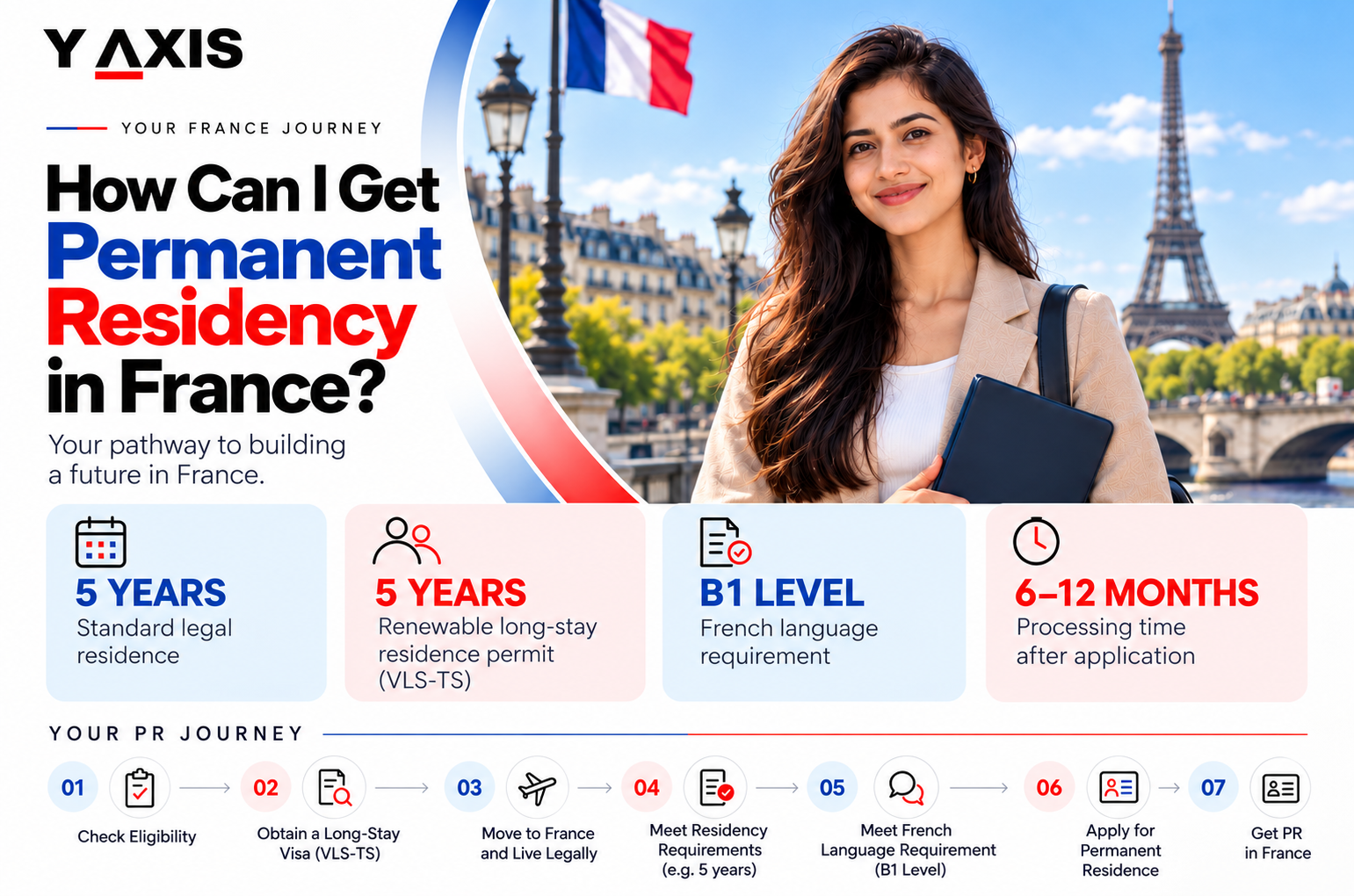
Posted on October 30 2026
How Can I Get Permanent Residency in France?

By , Editor & Director
Updated October 31 2026
France offers several ways for foreign nationals to live and work in the country, including skilled employment, the Talent Passport, business creation and family ties. The right route depends on your qualifications, job offer, income and family situation.
Permanent residency in France usually means holding a 10-year resident card (carte de résident). Most non-EU nationals qualify for the long-term resident – EU card after five years of continuous legal residence in France. You must also have stable income at least equal to the French minimum wage (SMIC) and health insurance. In addition, you need French at B1 level and a pass in the civic exam. The card can be renewed, and some family routes allow you to apply after three years.
*Want to work in France? Contact Y-Axis for guidance on suitable immigration and work permit options.
What Are the Main Ways to Get Permanent Residency in France?
|
PR / Residence Pathway |
Who It May Suit |
|
Long-Term Resident – EU Card |
Non-EU nationals who have lived in France legally and continuously for at least five years and meet the income, language and integration conditions. |
|
Talent Passport |
Skilled professionals, researchers, investors and founders who hold a multi-year Talent Passport and later meet the five-year residence condition. |
|
EU Blue Card |
Highly qualified professionals in France on an EU Blue Card. Time spent in another EU country on a Blue Card may count under certain conditions. |
|
Employee Work Permit to Resident Card |
Non-EU workers on a salaried or temporary worker permit who complete five years of legal residence and meet the other requirements. |
|
Spouse of a French Citizen |
Foreign spouses who have been married for at least three years and meet the residence, language and civic exam conditions. |
|
Parent of a French Child |
Parents of a French child who have lived in France for at least three years and contribute to the child's care and upbringing. |
|
Family Reunification |
Spouses and children who joined a family member in France and meet the applicable residence conditions. |
|
Entrepreneur or Self-Employed Route |
Business owners and independent professionals who run a viable activity and meet the five-year residence condition. |
|
Intra-Corporate Transfer (ICT) |
Employees temporarily transferred to a French branch of their company. This permit alone does not lead directly to permanent residency. |
|
Student Residence Permit |
International students in France. Study alone does not lead to permanent residency, but graduates can switch to a work permit. |
Also, read...
How to Apply for a France Work Visa?
How to Apply for Permanent Residency in France?
The steps to apply for France permanent residence (PR) are as follows:
Step 1: Choose the right residence route, such as employment, the Talent Passport or family ties.
Step 2: Check the eligibility rules for your current or planned residence permit.
Step 3: If you are applying through work, secure a qualifying job offer from a French employer.
Step 4: Obtain your long-stay visa or residence permit and complete the formalities on arrival.
Step 5: Renew your residence permits on time so that your legal stay in France has no gaps.
Step 6: Complete the qualifying residence period, which is five years for most applicants.
Step 7: Reach B1 level in French and get it certified through an approved test or diploma.
Step 8: Pass the civic exam for the resident card, which tests knowledge of French values and institutions.
Step 9: Prepare documents such as your passport, residence permits, income records, tax notices and health insurance proof.
Step 10: Submit your application online through the ANEF portal and wait for a decision from the prefecture.
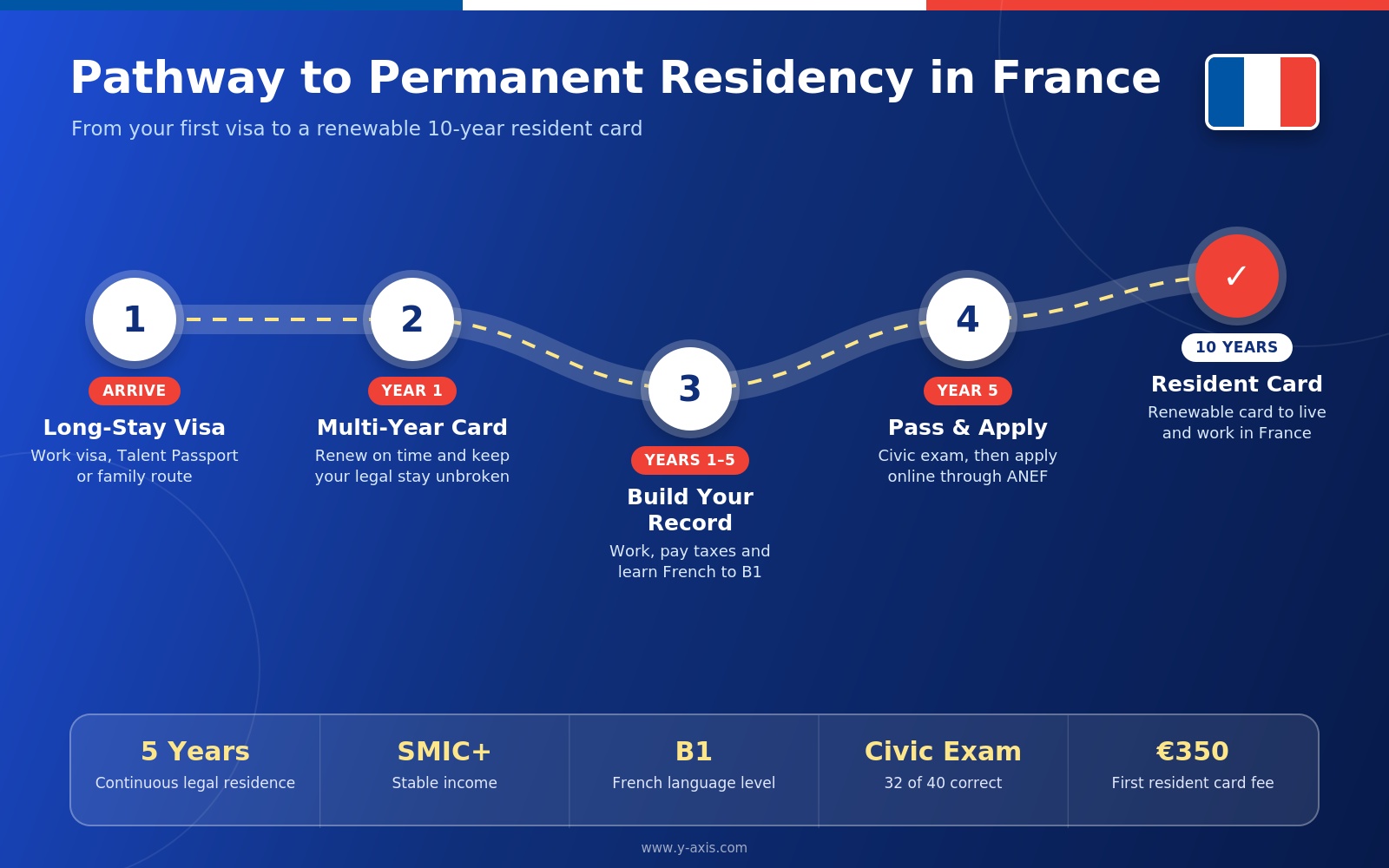
France PR Requirements
- You must complete the qualifying residence period, which is usually five years of continuous legal residence.
- Some family routes, such as spouses of French citizens, may apply after three years.
- You must hold a valid passport and a valid French residence permit.
- You must show stable and sufficient income, at least equal to the French minimum wage (SMIC).
- You must have health insurance coverage in France.
- You must prove French language skills at B1 level.
- You must pass the civic exam for the resident card.
- You must sign a commitment to respect the principles of the French Republic.
- You must have suitable accommodation and must not pose a threat to public order.
- Once approved, you receive a 10-year resident card that can be renewed.
Also, read...
Most In-Demand Occupations in France
France PR Cost and Processing Time
The main cost of a first 10-year resident card is €350, paid as a €50 stamp duty and a €300 tax, through an electronic tax stamp. Renewals cost less. You should also budget for the French B1 test, the civic exam where a fee applies, translations and document copies. Applications are submitted online through the ANEF portal, and decisions are made by the prefecture. Processing times vary by prefecture, the completeness of your file and the details of your case. Many applicants wait several months for a decision. While the application is under review, you usually receive a receipt that lets you stay in France legally. Check the official French government website for current fees and requirements before applying.
*Looking for assistance with overseas immigration? Contact Y-Axis for guidance on French immigration, work permits and residence applications.
FAQs
How long does it take to get permanent residency in France?
Most non-EU nationals can apply for the 10-year long-term resident – EU card after five years of continuous legal residence in France. Some family routes are shorter. For example, spouses of French citizens may apply after three years of marriage. Processing then takes several months, depending on the prefecture.
What is the carte de résident in France?
The carte de résident is a 10-year residence card for non-EU nationals. It lets you live and work in France without a fixed job or employer. It is the closest French equivalent to permanent residency. The card can be renewed as long as you continue to meet the conditions.
What level of French do I need for permanent residency in France?
You need French at B1 level for a first resident card. B1 means you can handle everyday conversations and understand the main points of clear, standard language. You can prove your level with an approved test, such as the TCF, or with a recognised French diploma.
What is the civic exam for the French resident card?
The civic exam is a multiple-choice test on French values, institutions, history and daily life in France. First-time applicants for a resident card must pass it. The test has 40 questions, and you need at least 32 correct answers to pass.
How much income do I need for France PR?
You must show stable and sufficient income, generally at least equal to the French minimum wage (SMIC). Income from work, a business or other regular sources can count. The prefecture checks your income over the period before your application, so keep your payslips and tax notices.
How much does the France resident card cost?
A first 10-year resident card costs €350, made up of a €50 stamp duty and a €300 tax. You pay through an electronic tax stamp. You should also budget for the French language test, document translations and other related costs.
Can Talent Passport holders get permanent residency in France?
Yes. Talent Passport holders can apply for a 10-year resident card once they meet the residence condition, which is usually five years. They must also meet the income, health insurance, B1 French and civic exam requirements. Some EU Blue Card holders can count time spent in other EU countries.
Does time as a student count towards France PR?
Study in France does not lead directly to permanent residency. Some periods of study may count in part towards the residence requirement, depending on the rules that apply. Most graduates first switch to a work permit or Talent Passport and then build up the required residence.
Can I lose my permanent residency in France?
Yes. A long-term resident – EU card can be withdrawn if you live outside the EU for more than three years in a row, or outside France for more than six years. It can also be withdrawn if you were granted it through fraud or if you pose a serious threat to public order.
What is the difference between France PR and French citizenship?
Permanent residency lets you live and work in France on a renewable 10-year card while keeping your nationality. Citizenship gives you a French passport and the right to vote. Naturalisation has stricter conditions, including a higher level of French. India does not allow dual citizenship.
Tags:
permanent residency in France
France PR
France resident card
carte de résident
long-term resident EU France
Talent Passport France
France PR requirements
migrate to France
Share
Options for you by Y-Axis

Get it on your mobile

Get News alerts

Contact Y-Axis
Latest Article
Popular Post
Trending Article

Posted On October 30 2026
Canada Invests C$1.7 Billion and UK Expands Research Visas: Where Can International AI Researchers Find Opportunities?