


Don't know what to do ?
Get Free Counseling
Last Updated 31 August 2026
Saudi Arabia Job Market: Trends and Opportunities
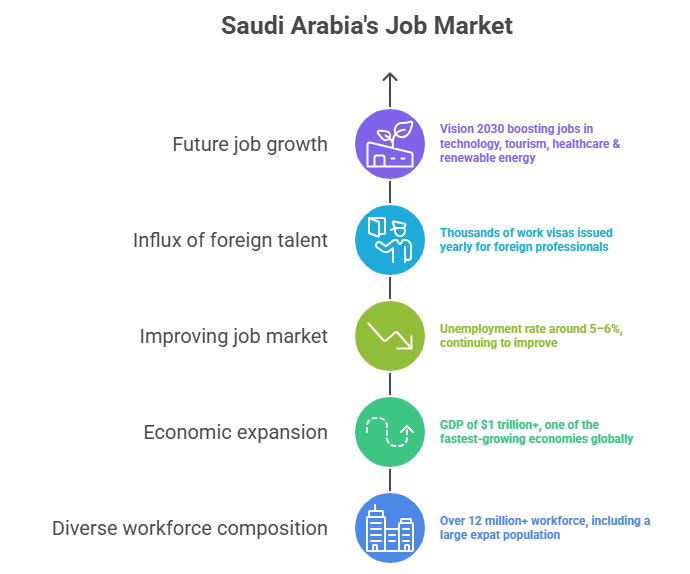
- Labour force of over 16.9 million including a large expatriate population, with the labour force participation rate reaching 67.4% in Q4 2025
- Saudi Arabia's nominal GDP reached $1.275 trillion in 2025 (GASTAT), the largest economy in the Arab world. GDP growth is projected at 3.1% by the IMF for 2026, while the Saudi Ministry of Finance projects 4.6% growth for 2026, driven by non-oil sector expansion under Vision 2030
- Unemployment rate around 5–6%, continuing to improve
- Thousands of work visas issued yearly for foreign professionals
- Vision 2030 boosting jobs in technology, tourism, healthcare & renewable energy
*Planning to work abroad? Y-Axis will guide you step-by-step.
Job Outlook in Saudi Arabia
Understanding the job outlook for job seekers and employers
Saudi Arabia's nominal GDP reached $1.275 trillion in 2025 (GASTAT), the largest economy in the Arab world, with GDP growth projected at 3.1%–4.6% for 2026 depending on oil output and Vision 2030 non-oil sector performance. With strong government investment, global partnerships, and technology adoption, the country is now attracting skilled foreign professionals. Saudi Arabia offers competitive salaries, tax-free income, modern infrastructure, and excellent employee benefits, encouraging global talent to build long-term careers.
General employment trends for the year
The job market is growing across technology, renewable energy, healthcare, engineering, logistics, hospitality, and construction. The non-oil sector reached a record 56% of GDP in 2025, reflecting the success of Vision 2030 diversification. Non-oil activities are estimated to grow 5.0% in 2026, supported by increased domestic demand and improved employment rates. Saudi Arabia is targeting a nominal GDP of $1.5–1.8 trillion by 2030 under Vision 2030. New government initiatives under Vision 2030 are creating thousands of skilled jobs. E-commerce, finance, cybersecurity, and digital transformation are developing quickly, while international companies continue to expand operations in Riyadh, Jeddah, and NEOM.
Factors influencing job creation or reduction
Economic diversification, foreign investments, privatization, mega-construction projects, tourism growth, and digital transformation boost job creation. Policy reforms, Saudization requirements, automation, and global market changes may affect certain roles. However, demand for highly skilled foreign professionals remains strong across advanced and technical sectors.
Saudization (Nitaqat) and What It Means for Foreign Professionals in Saudi Arabia
Saudi Arabia's Nitaqat programme is the government's mandatory workforce nationalisation system. Every private-sector employer must meet specific quotas for Saudi national employees, and these quotas directly determine how many foreign worker visas a company can issue.
What changed in 2025–2026:
- Between November 2025 and April 2026, the Ministry of Human Resources and Social Development (MHRSD) launched a new three-year Nitaqat cycle, raised sector quotas across healthcare, engineering, accounting, procurement, marketing and sales, and eliminated the Yellow tier entirely.
- Starting in 2026, MHRSD will implement a three-year plan to localise more than 340,000 additional private-sector jobs, with profession-specific requirements now superseding reliance on overall workforce percentages alone.
- Since February 2025, electronic contract documentation through the Qiwa platform is mandatory. Paper contracts are no longer accepted.
Key Saudization thresholds for 2025–2026:
| Profession | Saudization Requirement |
|---|---|
| Administrative / Secretarial / Data Entry | 100% Saudi nationals |
| Engineering (companies with 5+ engineers) | Minimum 30% Saudi nationals |
| Accounting (companies with 5+ accountants) | 40% rising to 70% over 5 years (from October 2025) |
| Procurement (companies with 3+ procurement staff) | 70% Saudi nationals |
| General Nitaqat (varies by sector and size) | Set per company size and industry tier |
What this means for Indian professionals: Companies in the Platinum and High Green Nitaqat tier have easier access to foreign worker visas and can process work permits faster. Roles in IT, data science, oil and gas engineering, healthcare, and specialist technical fields remain open to foreign professionals where Saudi talent is insufficient. Always verify with your prospective employer that they are in a Green or Platinum Nitaqat tier before accepting an offer — Red-tier companies cannot sponsor new foreign worker visas.
Work Permit and Visa Requirements for Foreign Professionals in Saudi Arabia
Foreign nationals must obtain a work permit and a residence permit (Iqama) to work legally in Saudi Arabia. The process is employer-led.
| Permit/Visa Type | Who It Is For | Key Requirements |
|---|---|---|
| Work Visa (Employment Visa) | Foreign nationals with a confirmed job offer from a Saudi employer | Employer sponsorship; Nitaqat-compliant employer; issued before travel |
| Iqama (Residence Permit) | All foreign workers living in Saudi Arabia | Issued after arrival; tied to employer; renewed annually |
| Premium Residency (Green Card equivalent) | High-net-worth investors and skilled professionals | SAR 800,000 investment or qualifying profession; no employer tie |
| Saudi Arabia Talent Visa | Globally recognised experts and researchers | Issued for exceptional talent in technology, healthcare, and research |
Key requirements for the standard work visa:
- Confirmed employment contract from a Saudi employer registered with MHRSD
- Employer must be Nitaqat-compliant (Green or Platinum tier)
- Bachelor's degree or relevant professional qualification
- Police Clearance Certificate (PCC) from India attested by MEA and Saudi Embassy
- Medical fitness certificate from a Saudi-approved centre
- Passport with at least 6 months remaining validity
- GAMCA medical test (Gulf Approved Medical Centre Association) — mandatory for Indian applicants
Note for Indian professionals: Saudi Arabia and India have a bilateral labour agreement. Indian workers in construction, domestic services, and semi-skilled roles go through separate MHRSD-approved recruitment channels. Skilled professionals (IT, engineering, healthcare, finance) apply through direct employer recruitment. Always verify your employer's MHRSD registration and Nitaqat status before committing to relocation.
Challenges for Foreign Professionals in the Saudi Arabia Job Market
While Saudi Arabia offers strong opportunities, foreign professionals should be aware of the following:
- Saudization pressure: The 2026 Nitaqat cycle covers 269 professions with specific localisation targets. Roles in administration, secretarial work, accounting, and procurement face 40–100% Saudization requirements, making these categories difficult for foreign professionals to access.
- Yellow tier elimination: The Yellow Nitaqat tier was eliminated in 2025–2026, meaning previously borderline-compliant employers were automatically downgraded to Red, reducing the number of companies eligible to sponsor new foreign work visas.
- Qiwa compliance (February 2025): Electronic contract documentation through the Qiwa platform is now mandatory. Employers who haven't migrated existing employees to Qiwa may face Nitaqat credit issues.
- Cultural and language adaptation: Arabic remains the primary working language in government-linked roles and client-facing positions outside major multinationals. English-only professionals are primarily viable in international companies, tech firms, and healthcare.
- Iqama dependency: The standard work permit ties you to your employer (sponsor). Changing jobs requires either a transfer of sponsorship or an exit-reentry process, though reforms since 2021 have made transfers somewhat easier.
- Industrial sector slowdown: The industrial production index decreased by 14.1% in March 2026 compared to the same month last year. Professionals in manufacturing-adjacent roles should verify current project demand with employers.
In-Demand Jobs in Saudi Arabia
Saudi Arabia continues to create opportunities for skilled professionals across multiple sectors. Strong infrastructure, digital innovation, and national development programs contribute to long-term job growth. The table below shows some of the in-demand jobs and their average salaries:
| Occupation | Average Annual Salary (SAR) |
|---|---|
| IT & Software | 90,000 – 264,000 |
| Engineering | 96,000 – 360,000 |
| Accounting & Finance | 84,000 – 240,000 |
| Healthcare | 66,000 – 180,000 |
| Human Resources | 108,000 – 300,000 |
| Manufacturing & Industry | 72,000 – 180,000 |
| Sales & Marketing | 114,000 – 420,000 |
| Data Science / Analytics | 96,000 – 300,000 |
| Teaching & Education | 72,000 – 240,000 |
Job Vacancy in Saudi Arabia
Saudi Arabia is seeing a fast increase in job openings because of rapid development and many new projects. Industries like construction, IT, engineering, logistics, education, and healthcare are hiring throughout the year. Government projects such as NEOM, The Line, and Red Sea Global are creating thousands of jobs.
The Vision 2030 plan aims to create approximately 3 million new jobs by 2030 (source: Saudi Vision 2030, Government of Saudi Arabia). The non-oil sector accounted for a record 56% of GDP in 2025, confirming the programme's structural impact. The below table shows the estimated number of job openings in Saudi arabia by 2030:
| Occupation | Estimated Number of Jobs by 2030 |
|---|---|
| Healthcare | 120,000 |
| Engineering | 95,000 |
| Nursing | 85,000 |
| Hospitality | 70,000 |
| Accounting & Finance | 55,000 |
| IT & Software | 52,000 |
| Teaching | 48,000 |
| Marketing & Sales | 38,000 |
| Human Resources & Management | 34,000 |
| Logistics & Supply Chain | 60,000 |
| Construction & Infrastructure | 150,000 |
| Energy (Oil, Gas, Renewable) | 80,000 |
| Manufacturing | 65,000 |
Employment trends in Saudi Arabia
Examination of the job market in Saudi Arabia
Saudi Arabia offers strong job opportunities for skilled workers in cities like Riyadh, Jeddah, Dammam, Mecca, and Medina. Major industries include oil and gas, IT, healthcare, logistics, finance, construction, retail, tourism, and renewable energy. Global companies, government-backed projects, and business-friendly reforms attract international professionals.
Best Cities in Saudi Arabia for Career Growth
Riyadh, Jeddah, Dammam, NEOM, and Al Khobar offer high-paying job opportunities, modern workplaces, and better career growth across tech, engineering, business, hospitality, healthcare, and management. Vision 2030 initiatives continue expanding job openings for foreign talent.
Impact of Technology and Engineering on Saudi Arabia’s Job Market
How technology and engineering are shaping employment
Saudi Arabia is investing heavily in digital transformation, IT infrastructure, smart cities, renewable energy, and advanced engineering projects under Vision 2030. Technologies like AI, cloud computing, robotics, cybersecurity, automation, and digital banking are creating thousands of new roles in IT, telecom, energy, and finance. At the same time, large engineering projects in transportation, construction, oil & gas, and utilities continue to generate strong demand for skilled professionals.
Opportunities and challenges
Technology and engineering-driven industries offer high salaries, long-term career stability, and global exposure. Skilled professionals with experience in software development, data analytics, mechanical/electrical engineering, civil engineering, cybersecurity, and project management are highly preferred. However, rapid innovation means workers must continuously upgrade their technical, digital, and problem-solving skills. Saudization policies may increase competition, but foreign experts with specialized expertise remain in strong demand.
*Looking for jobs in Saudi Arabia? Talk to Y-Axis for expert guidance.
Skills In-Demand in Saudi Arabia
Saudi Arabia’s fast-growing economy and modernization goals have increased the need for professionals with strong technical, digital, and workplace skills. Employers look for candidates who can adapt, communicate effectively, and contribute to business growth. The most in-demand skills include:
- Digital and IT skills
- Communication & English fluency
- Leadership & management
- Problem-solving & analytical thinking
- Engineering & technical expertise
- Adaptability & teamwork
- Project and time management
- Customer service skills
- Healthcare and medical knowledge
- Sales, negotiation, and marketing skills
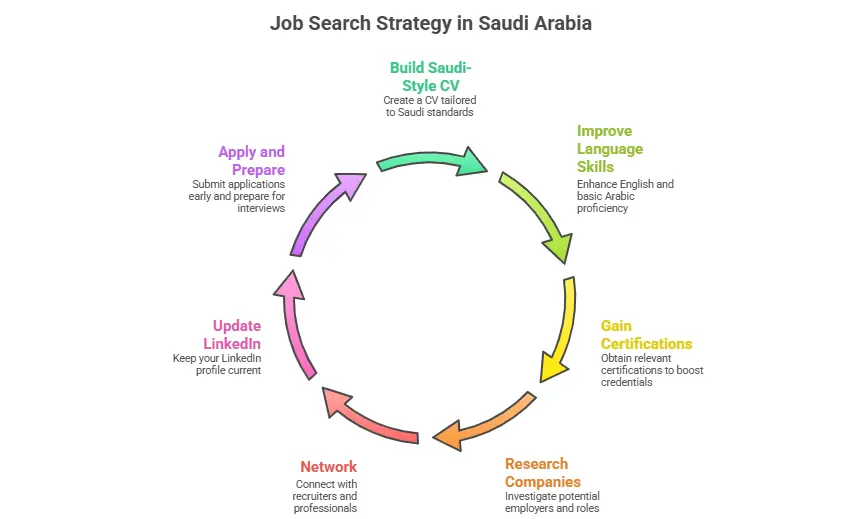
Tips to Help You Find the Right Job Opportunities in Saudi Arabia
- Build a strong Saudi-style CV
- Improve English and basic Arabic
- Gain relevant certifications
- Research companies and job roles
- Network with recruiters and professionals
- Maintain an updated LinkedIn profile
- Apply early and prepare for interviews
Summary of Saudi Arabia Job Outlook
Saudi Arabia offers excellent career opportunities for skilled professionals across IT, engineering, oil & gas, healthcare, education, finance, construction, logistics, and hospitality. With a $1.275 trillion economy (GASTAT, 2025), 3.1–4.6% GDP growth forecast for 2026, tax-free salaries, modern infrastructure, and increasing global investments, the country is becoming a top destination for Indians seeking international careers. Vision 2030 reforms continue expanding job openings, making Saudi Arabia a promising choice for long-term growth and stability.
*Looking to work in Saudi Arabia? Connect with Y-Axis, the world’s no. 1 overseas career consultant, for expert guidance on job search, work visas, resume building, and employer connections.
Y-Axis snapshot
1M
Successful applicants
1500+
Experienced counselors
25Y+
Expertise
50+
Offices
Don't know what to do ?
Get Free Counseling
Looking for Inspiration
Explore what Global Indians have to say about Y-Axis in shaping their future