

Posted on July 07 2026
What are the Eligibility Requirements for a Bahrain Work Visa?

By , Editor & Director
Updated July 12 2026
To apply for a Bahrain work visa from India, you need a confirmed job offer from a Bahraini employer registered with the Labour Market Regulatory Authority (LMRA) and a work permit issued through the LMRA's online Expat Management System (EMS). The process is fully employer-led as your Bahraini employer submits the application on your behalf through the EMS portal. Bahrain does not require a separate labour clearance stage as the work permit and residence permit are both managed through the LMRA. After you arrive in Bahrain, your employer completes your CPR (Central Population Register) card registration with the General Directorate of Nationality, Passports and Residence (NPRA), which is your legal proof of identity and residency in Bahrain.
Interested to work in Bahrain? Let Y-Axis assist you with the process.
Eligibility Criteria to Apply for a Bahrain Work Visa from India
Applying for a Bahrain work visa from India requires employer sponsorship under Bahrain Labour Law for the Private Sector (Law No. 36 of 2012). The employer applies for the work permit through the LMRA's Expat Management System (EMS) portal which is an entirely online process. Processing time is typically 21 working days for applicants outside Bahrain (5–10 business days for applicants already in Bahrain). Before submitting the work permit application, the employer must advertise the position on Bahrain's national employment portal for at least 7 days to confirm that the role cannot be filled by a Bahraini candidate.
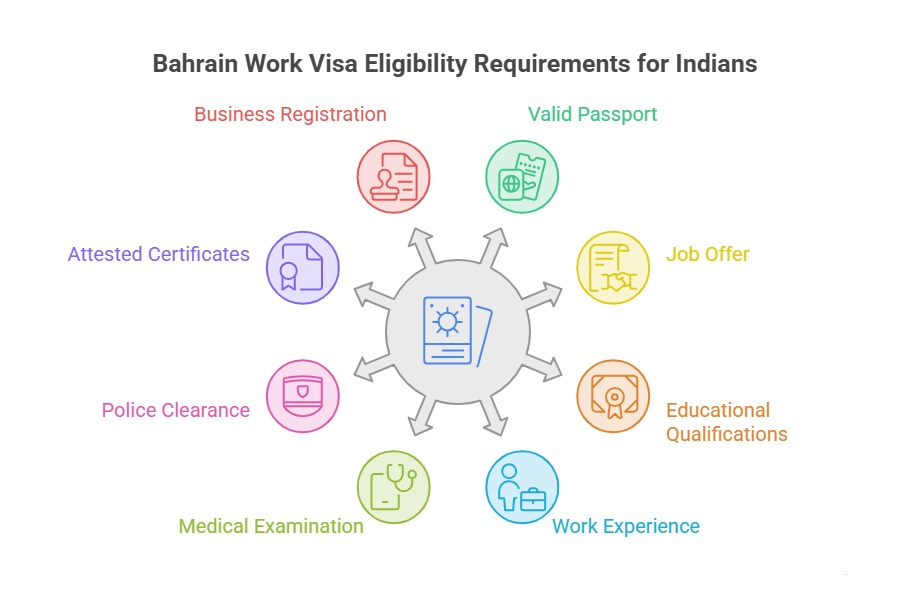
The general eligibility criteria for a Bahrain work visa are as follows:
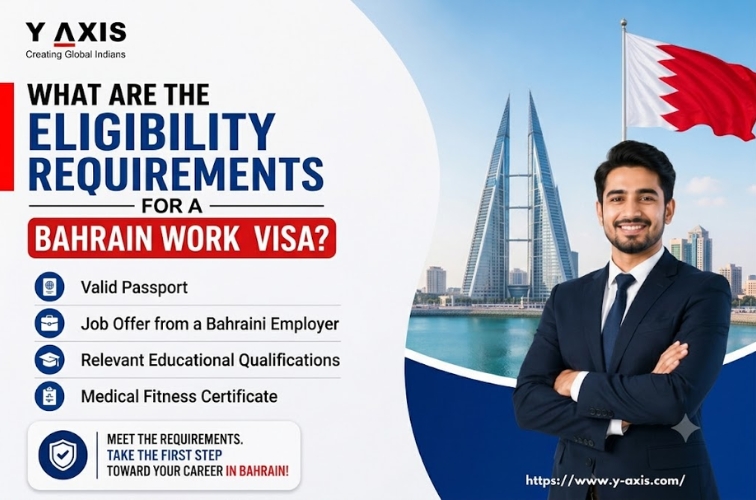
- Valid Indian passport
- Confirmed job offer and signed employment contract from an LMRA-registered Bahraini employer, specifying job title, salary, contract duration, and benefit components
- Bachelor's degree, vocational diploma, or professional certification relevant to the applied role
- Relevant work experience in the applied field
- Pass a medical examination at an approved health centre recognised by Bahrain's Ministry of Health
- Police Clearance Certificate (PCC) from India
- Educational and professional certificates attested by the HRD Ministry India
- Valid Commercial Registration (CR), active LMRA account, and proof of good standing with the Social Insurance Organisation (SIO)
Interested to apply for a Bahrain work visa? Sign up with Y-Axis for end-to-end assistance.
Eligibility Requirements by Visa and Permit Type
Bahrain's work authorisation system involves two stages: the LMRA work permit approved before or shortly after arrival, and the CPR card registration completed after arrival with the NPRA. The table below outlines the main visa and permit types available to Indian professionals.
| Visa / Permit Type | Who Can Apply | Fee | Validity | Key Benefit |
|---|---|---|---|---|
| Standard Employment Visa (Work Permit) | Foreign nationals with a confirmed job offer from an LMRA-registered Bahraini employer. Employer must apply via the LMRA Expat Management System (EMS) portal. | BHD 195/year (~₹43,000) or BHD 390 for 2 years (~₹85,900); Admin fee BHD 5; Job advertisement fee BHD 30 (for applicants outside Bahrain) — all employer-paid. Fees updated under Edict (79)/2025. | 1 year or 2 years; renewable | Most common route; employer manages the entire LMRA process online via EMS. |
| Flexi Permit | Non-EEA workers already in Bahrain on a cancelled or terminated work permit; allows freelance or multi-employer work arrangement. | BHD 5 admin fee + applicable permit fee; issued through Labour Registration Centres. | 1 year; renewable | Allows work across multiple employers without being tied to a single sponsor. |
| Vocational Work Permit | Foreign workers in skilled and semi-skilled trades — construction, manufacturing, service industries. | Standard LMRA work permit fees apply; same structure as employment visa. | 1–2 years; renewable | Specifically designed for blue-collar and technical trade roles. |
| Investor Visa | Foreign nationals who invest in or establish a Bahraini company; proof of capital investment and commercial registration required. | Separate investor visa fees; business registration with Ministry of Industry and Commerce (MOIC) required. | Tied to business registration validity; renewable | Permits business ownership and employment as owner-operator in Bahrain. |
| CPR Card (Central Population Register) | All employment visa holders after arrival in Bahrain; mandatory registration with NPRA (General Directorate of Nationality, Passports and Residence). | BHD 10 (~₹2,200) — processed by employer after arrival; employer registers via LMRA EMS or national portal. | Tied to work permit validity; renewed by employer | Legal identity proof in Bahrain; required for banking, government services, healthcare, and to work legally. |
Also, read...
Bahrain Job Market Trends and Opportunities
What are the Employer Requirements for Sponsoring Indian Professionals in Bahrain?
Bahrain employers sponsoring a work permit must hold a valid Commercial Registration (CR), an active LMRA account registered through the Expat Management System (EMS), and proof of good standing with both the Social Insurance Organisation (SIO) and the tax authorities. Without an active and compliant LMRA account, employers cannot submit new work permit applications or renew existing ones.
Under the enhanced Wages Protection System (WPS) effective February 2026, employers must also register a Wage Responsible Person, submit monthly salary files to the LMRA EMS portal for pre-validation, and ensure all salaries are paid through licensed banks by the 15th of each month. Employers who fail to meet these requirements face permit suspension. All government work permit fees under Bahraini Labour Law must be borne by the employer — any employment contract that shifts these costs to the Indian employee is in breach of Bahraini labour law.
Bahrainization Quota Compliance
Bahrain's Bahrainization policy requires private sector employers to maintain sector-specific minimum percentages of Bahraini nationals in their workforce. Non-compliance directly affects an employer's ability to obtain new or renewed work permits for expatriate employees.
- Bahrainization quotas range from 5% to 60% depending on the industry sector — banking and financial services have reached over 80% Bahraini participation nationally, while construction and domestic services have the lowest requirements (under 15%)
- Employers who fail to meet their applicable Bahrainization quota may apply for expatriate work permits by paying an additional levy of BHD 300 per foreign worker during the application process — on top of standard permit fees
- Criminal penalties for serious Bahrainization non-compliance: imprisonment of no less than 3 months and no more than 1 year, and fines ranging from BHD 1,000 to BHD 2,000. Repeat violations carry imprisonment of 6 months to 2 years and fines of BHD 2,000 to BHD 4,000
- Bahrain's National Plan for Labour Market Regulation 2023–2026 targets employment of 20,000 Bahrainis and training of 10,000 job seekers annually. New draft legislation in Bahrain specifically targets healthcare, medical, legal, accounting, education, banking, and aviation for priority nationalisation within two years
- Tamkeen, Bahrain's national labour fund, subsidises Bahraini employee salaries at up to 70% of salary costs in the first year — creating a built-in cost advantage for employers who hire Bahrainis over expatriates
Wage Protection and Salary Standards
Bahrain operates a Wages Protection System (WPS) mandating electronic salary payment through licensed banks or LMRA-approved financial institutions. Under the enhanced WPS effective February 2026, employers must complete salary payments by the 15th of each month. Non-compliance results in immediate LMRA permit restrictions.
- Bahrain has no statutory minimum wage for private sector workers — including Indian expatriates. All salaries are market-driven and determined by employment contract
- Public sector minimum wage for Bahraini nationals: BHD 300/month (~₹66,000) for those with a high school diploma; BHD 450/month for university graduates — these do not apply to private sector expatriates
- Average salary benchmarks for Indian expatriates: skilled and semi-skilled roles BHD 200–400/month; engineering, IT, and finance professionals BHD 600–2,000+/month; senior specialists and managers BHD 2,000–4,000+/month. Average monthly salary across Bahrain's workforce: approximately USD 2,100–2,300 (2026 estimate)
- Most Bahraini employers provide additional benefits: housing allowance BHD 80–200/month, transport allowance, annual return flight ticket for expatriate employees, and private health insurance
- Bahrain has zero personal income tax — Indian professionals retain 100% of their gross salary minus applicable Social Insurance Organisation (SIO) deductions for certain categories
- Standard working hours in Bahrain: 48 hours per week; reduced to 36 hours per week for Muslim employees during Ramadan. Overtime is paid at 125% for daytime and 150% for night and weekend overtime
Also, read...
Top In-Demand Jobs in Bahrain for Indians
Job Mobility — Changing Employers on a Bahrain Work Permit
Bahrain's labour law provides a structured mechanism for workers to transfer employers. Unlike older Gulf labour systems, Bahrain no longer operates a full No-Objection Certificate (NOC) restriction for transfers after the qualifying period.
- After completing one year of continuous employment with the current employer, Indian workers can change their employer by informing both the LMRA and the current employer within the notice period specified in the employment contract
- Employer transfer request is submitted through the LMRA Expat Management System (EMS) portal by the new employer — not the employee
- Spouse of an Indian expatriate worker: dependent spouses are permitted to work in Bahrain after obtaining a Work Approval for Dependents permit. Spouses do not need to change their visa status to work — a separate permit is applied for by the dependent employer
- Family sponsorship: Indian workers can sponsor dependents (spouse and children up to age 24) if their monthly net income is above BHD 400 (~₹88,000). The employer applies for family residence permits through the LMRA EMS on behalf of the employee
- Flexi Permit: Indian professionals already in Bahrain on a cancelled or terminated work permit can apply for a Flexi Permit, which allows work for multiple employers without being tied to a single sponsor — a unique feature distinguishing Bahrain from most other GCC countries
What Sector-Specific Requirements Apply for Bahrain Work Visas?
Certain professions in Bahrain require additional regulatory approvals before a work permit can be issued. New draft legislation is advancing to expand Bahrainization requirements in healthcare, legal, accounting, education, banking, and aviation. The table below outlines sector-specific requirements for Indian professionals.
| Sector | Additional Requirements |
|---|---|
| Healthcare and Medical | Doctors, nurses, and allied health professionals must obtain a licence from the Ministry of Health Bahrain and register with the relevant Bahraini health authority before practising. Indian medical credentials require attestation by the Medical Council of India and the Bahraini Embassy in India. Foreign-trained healthcare professionals must pass Bahrain's licensing examinations for clinical roles. Nursing professionals require registration with the Bahrain Nursing Council. The sector is subject to an active Bahrainization drive under new draft legislation targeting healthcare, medical, and legal professions for priority nationalisation. |
| Engineering and Construction | Civil, structural, mechanical, and electrical engineers working on major Bahrain infrastructure contracts or government projects typically require registration with the relevant Bahraini professional authority. Construction roles carry some of the lowest Bahrainization quotas (under 15% Bahraini nationals), making this sector one of the most accessible for Indian expatriates. Employers must advertise positions locally for 7 days before applying for an expatriate work permit, demonstrating the role cannot be filled by a Bahraini candidate. |
| Information Technology and FinTech | Bahrain has the lowest IT Bahrainization quota at approximately 35%, making it one of the most accessible tech markets in the GCC for Indian professionals. Bahrain FinTech Bay hosts more than 100 regulated FinTech firms operating under the Central Bank of Bahrain's regulatory sandbox—the first of its kind in the Middle East. Indian IT professionals in cloud computing, cybersecurity, AI, and banking technology are in particularly high demand. No separate technology licensing body exists; professional qualifications and experience are assessed directly by the employer. |
| Finance, Banking and Accounting | Banking is one of the highest Bahrainization sectors, with the private banking industry having over 80% Bahraini national participation. Expatriate finance and accounting professionals working with licensed entities must comply with the Central Bank of Bahrain (CBB) and Bahrain Bourse regulatory requirements for their specific role. ACCA, CFA, and CA qualifications are widely recognised. Non-compliance with Bahrainization requirements in banking may result in restrictions on new expatriate work permits, fines of BHD 1,000–4,000, or imprisonment. |
| Education and Teaching | Teachers in Bahrain's public schools must meet the qualification standards of the Ministry of Education. Degrees must be attested by the HRD Ministry India, MEA India, and the Bahraini Embassy in India. Private school and university teachers require accreditation from the relevant educational licensing authority. New draft legislation targets the education sector for priority Bahrainisation, requiring employers to prioritise Bahraini nationals. Arabic language proficiency may be required for certain public-sector teaching roles. |
| Oil, Gas and Energy | Bahrain's oil and gas sector is led by Bapco Energies (formerly Bahrain Petroleum Company) and Alba (Aluminium Bahrain). Positions in Bapco operations typically require pre-approval through the company's HR system before the LMRA work permit is issued. Both organisations have their own recruitment, qualification, security clearance, and nationalisation requirements aligned with Bahrain Vision 2030. |
How to Apply for a Bahrain Work Visa from India?
The Bahrain work visa process is fully employer-led and conducted through the LMRA's online Expat Management System (EMS). The employer secures the work permit approval and entry visa before the employee travels to Bahrain, then completes the CPR card registration post-arrival.
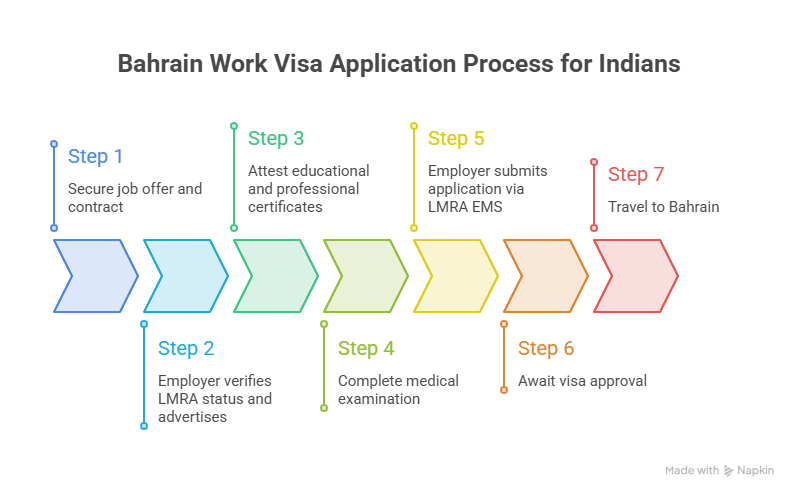
The steps to apply for a Bahrain work visa for Indians are as follows:
Step 1: Secure a confirmed job offer and signed employment contract from an LMRA-registered Bahraini employer.
Step 2: The employer verifies their LMRA account status, checks their Bahrainization quota compliance, and advertises the position on Bahrain's national employment portal for at least 7 days, confirming the role cannot be filled by a Bahraini candidate.
Step 3: Get your educational and professional certificates attested by the HRD Ministry India, MEA India, and the Bahraini Embassy in New Delhi.
Step 4: Complete a medical examination at an accredited health centre recognised by Bahrain's Ministry of Health.
Step 5: Your employer logs into the LMRA Expat Management System (EMS) and submits the New Expatriate Permit application under the 'New Work Permit' folder, specifying visa type, contract duration, and uploading all required documents.
Step 6: Await visa approval to fly to Bahrain to legally start working.
Step 7: Travel to Bahrain once the work visa is approved.
Are you looking for step-by-step assistance with overseas immigration? Contact Y-Axis, the world's No. 1 overseas immigration consultancy!
FAQs
What is the Bahrain work visa for Indians?
The Bahrain work visa is an employer-sponsored work permit issued by the Labour Market Regulatory Authority (LMRA), allowing Indian nationals to live and work legally in Bahrain. The process is managed entirely through the LMRA's Expat Management System (EMS) portal. Bahrain hosts a large Indian expatriate community — Indians form one of the largest foreign national groups in Bahrain's private sector workforce, which is approximately 80% expatriate. Bahrain offers zero personal income tax, allowing Indian professionals to retain their full gross salary. Employers cover all government work permit fees under Bahraini Labour Law.
Can Indian nationals apply for a Bahrain work visa?
Yes. Indian nationals are among the most widely employed foreign professionals in Bahrain, particularly across IT, engineering, healthcare, construction, hospitality, and financial services. The process is employer-initiated — your Bahraini employer applies for the work permit through the LMRA Expat Management System (EMS) portal. You cannot self-apply. Educational certificates from India must be attested by the HRD Ministry India, MEA India, and the Bahraini Embassy in New Delhi. The standard processing time for applicants outside Bahrain is 21 working days from the date of complete application submission.
What are the documents required for a Bahrain work visa from India?
Documents required for a Bahrain work visa include: a valid Indian passport with at least 6 months' remaining validity; signed employment contract specifying salary in Bahraini Dinars, job title, and contract duration; educational and professional certificates attested by HRD Ministry India, MEA India, and the Bahraini Embassy; Police Clearance Certificate (PCC) from India; medical examination report from an accredited health centre recognised by Bahrain's Ministry of Health (not older than 3 months); recent passport-sized photographs; and the employer's valid Commercial Registration, LMRA account details, and SIO compliance proof. All documents must be accurate — incorrect documents result in visa rejection.
What is the Bahrain work permit fee for Indian applicants?
The standard LMRA work permit fees, updated under Edict (79)/2025, are: BHD 195 for a 1-year permit (~₹43,000) or BHD 390 for a 2-year permit (~₹85,900). Additional fees include: admin fee BHD 5, job advertisement fee BHD 30 (for applicants outside Bahrain), and CPR card registration BHD 10 after arrival. Employers who fail to meet Bahrainization quotas pay an additional levy of BHD 300 per expatriate work permit. All fees are legally required to be paid by the employer. Dependant residence permits cost BHD 90 each. A 2-year permit is more cost-effective for long-term positions.
How long does the Bahrain work visa process take?
The LMRA processes new work permit applications within 21 working days for applicants outside Bahrain, and 5–10 business days for applicants already in Bahrain. Processing time begins from the date of complete application submission, including payment of admin and advertisement fees. Applications with missing documents, failed medical tests, or Bahrainization compliance issues may take longer. After approval and arrival in Bahrain, CPR card registration with the NPRA is completed by the employer. Y-Axis can help you ensure all documents are complete and correct before submission to avoid delays.
Can I change jobs on a Bahrain work visa?
Yes, after completing one year of continuous employment with your current Bahraini employer, you can transfer to a new employer. The transfer request is submitted through the LMRA Expat Management System (EMS) by the new employer. You must inform both the LMRA and your current employer within the notice period stated in your employment contract. Indian professionals in Bahrain on a cancelled or terminated work permit can also apply for a Flexi Permit, which allows work across multiple employers without being tied to a single sponsor — a unique feature not available in most other GCC countries. Y-Axis can advise on your specific transfer situation.
Can my family come with me on a Bahrain work visa?
Yes. Indian workers in Bahrain can sponsor dependants — spouse and children up to the age of 24 — provided their monthly net income is above BHD 400 (~₹88,000). Dependant residence permits cost BHD 90 each and are applied for by the employer on behalf of the employee through the LMRA EMS portal. Spouse of a Bahraini work permit holder can also work in Bahrain by obtaining a Work Approval for Dependants permit without changing their visa status. Children of permit holders can access education in Bahrain's schools. Healthcare access is available once the CPR card and social insurance are in place.
What is the Bahrainization requirement and how does it affect Indian workers?
Bahrainization is Bahrain's national workforce localisation policy requiring private sector employers to hire a minimum percentage of Bahraini nationals, ranging from 5% to 60% depending on the industry sector. Banking has the highest compliance (over 80% Bahraini), while construction has the lowest requirement (under 15%). Employers who do not meet their quota pay an additional BHD 300 per expatriate work permit. Serious non-compliance carries fines of BHD 1,000–4,000 and potential imprisonment. For Indian professionals, Bahrainization means employers must demonstrate the role cannot be filled by a Bahraini before hiring you — a 7-day local advertisement period applies.
What sectors are actively hiring Indian professionals in Bahrain?
Bahrain actively hires Indian professionals in IT and FinTech (Bahrain FinTech Bay hosts 100+ firms; cloud engineers and AI specialists had 78% and 64% year-on-year job title growth respectively in 2026 per LinkedIn MENA data), engineering and construction (some of the lowest Bahrainization quotas in the GCC), healthcare and nursing (high demand with ongoing regulatory professionalisation), finance and accounting (ACCA, CFA, and CA qualifications recognised), hospitality and tourism, logistics and supply chain, and manufacturing. Bahrain's cybersecurity workforce gap is estimated at 4,500 unfilled roles by 2027, making IT security specialists particularly sought-after.
Can a Bahrain work visa lead to permanent residency?
Bahrain does not offer a conventional permanent residency pathway for most expatriate workers in the way that Canada, Australia, or European countries do. Long-term legal residence in Bahrain is maintained through continuous renewal of the employer-sponsored work permit and CPR card. Bahrain introduced a Golden Residency programme for investors, retirees with high income, and highly skilled professionals under specific criteria — but this is not a standard pathway for most Indian workers. Most Indian professionals in Bahrain maintain their residency through continuous employment and work permit renewal. Y-Axis can provide current information on any available long-term residency pathways.
Tags:
Work in Bahrain
Bahrain work visa
migrate to Bahrain
Bahrain immigration
eligibility requirements for Bahrain work visa
Bahrain work permit for Indians
Bahrain CPR card
Bahrain work visa from India
Bahrainization
Bahrain Vision 2030
Share
Options for you by Y-Axis

Get it on your mobile

Get News alerts

Contact Y-Axis
Latest Article
Popular Post
Trending Article

Posted On October 07 2026
Germany Opportunity Card for Indians: 5 Checks Before You Apply