

Don't know what to do ?
Get Free Counseling
Last Updated 15 September 2026
Bahrain Job Market 2026-30
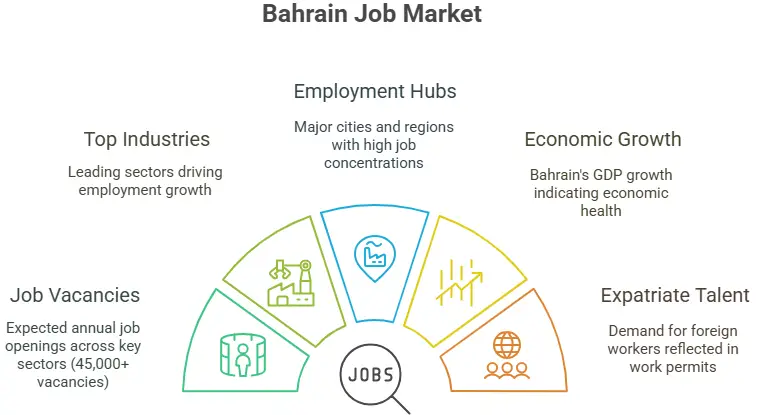
- Around 35,000–45,000 job vacancies expected annually across key sectors.
- IT, healthcare, engineering, finance, logistics, and education remain top hiring industries.
- Manama, Muharraq, Sitra, and Hidd are major employment hubs.
- Bahrain's economy recorded real GDP growth of 2.6% in 2024, with the non-hydrocarbon sector expanding by 3.7%. The IMF projects growth rising to 2.9% in 2025 and 3.3% in 2026, driven by refinery expansion, financial services, tourism, and logistics..
- LMRA had 631,763 active foreign worker permits as of Q2 2024, a 3.8% annual increase. Work permit fees increased by 5% from January 2026 and will rise gradually to 25% by 2029. Employers requesting permits for overseas workers must now wait 21 working days and advertise locally first.
Bahrain Job Market: Key Statistics at a Glance (2026)
| Indicator | Figure |
|---|---|
| Total Population | ~1.67 million |
| Expatriate Share of Workforce | ~80% |
| Active Foreign Worker Permits (Q2 2024) | 6,31,763 |
| Unemployment Rate (Bahrainis, projected 2026) | ~5.8% |
| Registered Bahraini Jobseekers (2025) | 15,433 |
| National Plan: Annual Bahraini Employment Target | 20,000 |
| GDP Growth (2024 actual) | 2.60% |
| GDP Growth (2026 IMF forecast) | 3.30% |
| Non-Hydrocarbon Sector Share by 2030 | ~90% |
| Average Monthly Salary (All Workers) | ~892 BHD (~USD 2,370) |
Job Outlook in Bahrain
Understanding Bahrain’s job outlook is essential for both employers and job seekers planning to work in the Gulf region. Bahrain continues to create strong employment opportunities across IT, healthcare, engineering, finance, logistics, hospitality, and education. Each year, the country records approximately 35,000–45,000 job openings across key private-sector industries.
Major employment hubs include Manama, Muharraq, Sitra, Hidd, and Isa Town, with growing opportunities in financial services, technology parks, industrial zones, and logistics centres.
Bahrain consistently attracts expatriate professionals due to its tax-free income, stable job market, modern infrastructure, and high quality of life. With an economy supported by digital transformation and non-oil sector growth, Bahrain has become a strong choice for skilled workers seeking international career opportunities in the Middle East.
General Employment Trends for the year
Employment opportunities in Bahrain are closely linked to the country’s evolving economic needs and demand for specialized skills. Staying informed about the skills valued by employers, particularly in IT, finance, engineering, healthcare, and logistics—is essential for job seekers. Bahrain’s shift toward a diversified, non-oil economy continues to shape hiring patterns across various sectors.
Bahrain's real GDP grew by 2.6% in 2024, supported by a 3.7% expansion in the non-hydrocarbon sector. The IMF forecasts growth of 2.9% in 2025 and 3.3% in 2026, driven by refinery upgrades and robust financial services, tourism, and logistics activity. Over the medium term, the non-hydrocarbon sector is projected to account for nearly 90% of Bahrain's economy by 2030. Government-led initiatives under Bahrain Economic Vision 2030 are boosting job creation in technology, FinTech, manufacturing, tourism, and healthcare. With a growing reliance on skilled expatriates, Bahrain remains an attractive destination for foreign professionals seeking long-term career opportunities.
*Looking to work in Bahrain? Get in touch with experts at Y-Axis to guide you with the process.
Factors Influencing Job Creation or Reduction in Bahrain
There are several factors that affect job creation and reduction in Bahrain, including overall economic performance, availability of skilled talent, technological advancements, development of new industries, and changes in government employment regulations. The country’s labour market is also shaped by global market conditions, regional economic integration, population trends, and shifts in international trade.
As Bahrain continues to modernize its economy and attract foreign investment, employers across many sectors actively seek skilled professionals from abroad. With competitive salaries, tax-free income, and expanding job opportunities, Bahrain offers promising prospects for qualified individuals looking to build a career in the Gulf.
In-Demand Industries and Occupations in Bahrain
Some of the most in demand occupations in Bahrain along with their salaries are given in the table below:
| Occupation | Average Annual Salary (BHD) | Salary Range (BHD/Year) |
|---|---|---|
| Engineering | 16,000 – 22,000 | Up to 28,000 (senior-level roles) |
| Information Technology (IT) | 18,000 – 24,000 | Up to 29,000 (experienced professionals) |
| Healthcare (Doctors/Specialists) | 42,000 – 96,000 | Allied health professionals can earn up to 36,000 |
| Banking & Finance | 15,000 – 20,000 | Up to 26,000 (senior-level positions) |
| Marketing & Sales | 12,000 – 16,000 | Up to 22,000 |
| Nursing | 10,000 – 14,000 | Up to 21,000 |
| Education / Teaching | 10,000 – 14,000 | Up to 22,000 |
| Hospitality | 8,000 – 12,000 | Up to 20,000 |
| Skilled Trades | 10,000 – 16,000 | Up to 23,000 |
| HR & Management | 12,000 – 16,000 | Up to 21,000 |
*Salaries vary based on experience, employer type, nationality, and sector. Average monthly salary across all workers in Bahrain is approximately 892 BHD (~USD 2,370).
Read more…
Highest Paying Jobs in Bahrain for Indians
Workforce Demands in Different Regions of Bahrain
Details of the workforce demands and opportunities across major regions and economic zones in Bahrain are given below:
Examination of Job Market Differences across Bahrain’s Key Regions
Bahrain continues to attract skilled professionals due to its growing private sector, tax-free salaries, and strong demand across core industries such as IT, healthcare, engineering, finance, logistics, and education. The country’s job market is one of the most competitive in the GCC, offering stable, well-paying roles with excellent career growth opportunities.
Different regions in Bahrain offer unique workforce needs:
- Manama: The financial hub with strong demand in IT, banking, FinTech, consulting, HR, and corporate roles.
- Muharraq: Growing opportunities across aviation services, hospitality, logistics, and retail
- Hidd Industrial Area: High demand for engineering, manufacturing, logistics, and technical jobs.
- Sitra Industrial Zone: Opportunities in oil & gas support services, manufacturing, and mechanical/electrical engineering.
- Isa Town & Riffa: Strong demand for teachers, healthcare staff, administration, and service-sector roles.
Bahrain’s expanding economy and continuous investment in digital transformation, infrastructure, and non-oil industries make it an attractive destination for skilled foreign workers seeking long-term employment in the Middle East.
Areas with Notable Job Opportunities in Bahrain
Bahrain offers strong job opportunities across its key regions and economic zones, supported by growing demand in IT, finance, engineering, logistics, healthcare, and education.
Below is the breakdown of major areas in Bahrain with notable employment opportunities:
| Region / Economic Zone | Key Job Vacancies (Approx.) | Average Monthly Salary (BHD) |
|---|---|---|
| Manama (Capital & Financial District) | 8,000+ | 800 – 1,800 BHD |
| Muharraq (Airport & Hospitality Zone) | 4,000+ | 600 – 1,400 BHD |
| Hidd Industrial Area | 5,000+ | 700 – 1,600 BHD |
| Sitra Industrial Zone | 3,500+ | 650 – 1,500 BHD |
| Riffa (Education & Healthcare Hub) | 2,500+ | 500 – 1,200 BHD |
| Isa Town (Education & Public Services) | 1,800+ | 450 – 1,000 BHD |
| Salman Industrial City (Logistics & Manufacturing) | 3,000+ | 600 – 1,400 BHD |
| Seef District (Corporate & Retail Sector) | 2,200+ | 700 – 1,500 BHD |
Also, read…
What are the most in-demand jobs in Bahrain for the next 10 years?
Impact of Technology and Automation in Bahrain
Bahrain’s job market has seen rapid advancements in technology, automation, and digital transformation, driving strong demand for skilled professionals across key sectors.
Technological Advancements and Automation Shaping the Job Market
Bahrain is undergoing a significant digital transformation, supported by national strategies such as Bahrain Economic Vision 2030 and major investments in FinTech, cloud computing, cybersecurity, AI, and automation. These developments are reshaping the employment landscape and increasing the need for specialized skills.
As automation and digital tools continue to evolve, Bahrain is witnessing rising demand for skilled talent in IT, software development, digital payments, cybersecurity, data analytics, and cloud engineering. The shift toward a technology-driven economy highlights the importance of continuous learning, digital literacy, and upskilling for professionals seeking long-term career growth.
Potential Opportunities and Challenges for Workers in the Evolving Landscape
Bahrain’s evolving economic environment presents both significant opportunities and challenges. Technology-driven industries are expanding rapidly, creating strong demand for highly skilled workers across IT, finance, engineering, logistics, healthcare, education, HR, marketing, and professional services.
However, the pace of technological change also requires professionals to consistently upgrade their skills to stay competitive in the job market. Fields such as cybersecurity, digital marketing, AI, data science, cloud technologies, FinTech, and automation offer promising career prospects, while traditional roles may require new skill sets to remain relevant.
Overall, Bahrain’s move toward a digitally advanced economy continues to open up diverse opportunities for skilled expatriates prepared to adapt, reskill, and grow along with industry demands.
*Want to apply for jobs abroad? Avail Y-Axis Resume Marketing services to find the right one.
Skills in-demand in Bahrain
Bahraini employers seek candidates with specific technical and professional skills that align with the country’s expanding industries. The most sought-after skills include:
Key Skills Sought by Employers in Bahrain
- STEM (Science, Technology, Engineering, Mathematics)
- Technical and IT skills
- Cybersecurity & cloud computing
- Data analysis and digital transformation skills
- Management and leadership abilities
- Communication and interpersonal skills
- Problem-solving and critical thinking
- Creativity and innovation
- Project management
- Marketing and digital marketing skills
- Sales and business development
- Financial analysis, accounting, and risk management
- Customer service and client relationship management
- Digital literacy and tech proficiency
- Adaptability and flexibility
- Collaboration and teamwork
- Multilingual proficiency (English + Arabic preferred)
- Time management and organizational skills
- Emotional intelligence and cultural awareness
These skills are highly valued across Bahrain’s top hiring sectors, including IT, finance, healthcare, engineering, logistics, hospitality, and education.
Importance of Upskilling or Reskilling for Job Seekers in Bahrain
Upskilling and reskilling are essential for professionals aiming to stay competitive in Bahrain’s rapidly evolving job market. As the country continues to diversify its economy and embrace digital transformation, the need for adaptable and future-ready skills has become increasingly important.
Reskilling allows employees to update their abilities and remain effective within changing industries, especially in sectors like IT, finance, healthcare, logistics, and engineering. Upskilling, on the other hand, helps professionals go beyond current job requirements by acquiring advanced skills that enhance efficiency, productivity, and career growth.
Investing in continuous learning enables individuals to contribute more meaningfully to their organizations while preparing for emerging opportunities in Bahrain’s expanding sectors. This strategic approach not only strengthens individual career paths but also fosters a culture of innovation, adaptability, and resilience within the workplace, qualities that are highly valued in Bahrain’s modern economy.
Remote Work and Flexible Arrangements in Bahrain
Remote and flexible work arrangements are gradually becoming more common in Bahrain as companies adopt modern work models and digital solutions to enhance productivity and support employee well-being.
Remote Work Trends in Bahrain
Several companies in Bahrain now offer hybrid or flexible work options, allowing employees to balance their professional and personal lives more effectively. The shift is driven by digital transformation across industries, growth in cloud-based systems, and increasing adoption of remote collaboration tools.
Sectors such as IT, digital marketing, finance, consulting, education, and customer service are seeing the greatest rise in remote or hybrid work setups. Flexible work arrangements are helping organizations remain competitive, attract top talent, and enhance workplace satisfaction.
Exploration of the Continuing Trend of Remote Work
Bahrain’s businesses are increasingly adopting hybrid work structures, especially in tech-driven and service-based industries. Flexible working arrangements support:
- Improved work-life balance
- Increased employee productivity
- Greater creativity and collaboration
- Reduced commute time and work-related stress
Remote work also enables companies to access a broader talent pool, hiring skilled professionals from anywhere in the world and integrating cross-border teams seamlessly.
As digital infrastructure in Bahrain continues to strengthen, more jobs, especially knowledge-based roles, are becoming suitable for remote or hybrid arrangements.
Implications for Both Employers and Employees in Bahrain
For Employers
- Ability to hire and retain top global talent
- Enhanced operational efficiency and reduced office overheads
- Stronger diversity and inclusion in the workforce
- Greater adaptability in competitive industries
For Employees
- Better control over work schedules
- Improved work-life balance and reduced stress
- Higher job satisfaction and flexibility
- Access to job opportunities beyond geographic limitations
- Increased productivity in comfortable, personalized work environments
Government Policies and Initiatives in Bahrain
The Government of Bahrain continues to implement policies and initiatives aimed at supporting economic growth, enhancing workforce development, and attracting skilled foreign professionals to meet labour market needs.
Overview of Government Programs or Policies Influencing Employment
Bahrain actively works to strengthen its labour market by creating favourable conditions for both employers and skilled expatriates. Through the Economic Vision 2030 strategy, Bahrain is focused on diversifying its economy beyond oil and investing heavily in sectors such as technology, financial services, logistics, healthcare, manufacturing, and tourism—all of which generate strong employment demand.
The Labour Market Regulatory Authority (LMRA) plays a central role in regulating employment, issuing work permits, and ensuring smooth hiring processes for foreign workers. As of February 2026, all private-sector employers must process salary payments through the Enhanced Wage Protection System (WPS), ensuring timely, verifiable payment to all registered workers.
Work permit fees for foreign workers increased by 5% from January 2026 and will rise gradually to 25% by 2029, as part of a broader strategy to reduce cost gaps between hiring Bahrainis versus expatriates. Employers requesting foreign worker permits from abroad must advertise the role locally and wait 21 working days before approval.
Companies that fail to meet Bahrainisation quotas are now charged BHD 500 per foreign work permit (up from BHD 300 previously) and are barred from participating in government tenders. LMRA monitors compliance electronically across all sectors.
Each year, Bahrain welcomes a large number of expatriate professionals who fill critical workforce gaps across IT, engineering, finance, hospitality, healthcare, HR, and other skilled domains. As the country continues to advance technologically and expand industrial zones, the demand for skilled workers is expected to remain strong.
Key Labour Market Regulations to Know in 2026
Bahrain's employment framework has seen significant regulatory changes in 2025–2026 that directly affect foreign professionals:
Wage Protection System (WPS) — Mandatory from February 2026
All private-sector employers must now process salary payments through the Enhanced WPS via LMRA's Expatriate Management System (EMS). This protects workers by providing a verifiable payment trail and is tied to work permit eligibility.
Work Permit Fee Increases
Foreign work permit issuance and renewal fees increased by 5% from January 2026, with a further phased increase to 25% planned by 2029. This is part of Bahrain's strategy to encourage hiring of local nationals.
Bahrainisation Quotas — Stricter Enforcement
All sectors are now bound by Bahrainisation quotas, monitored electronically by LMRA. Employers failing to meet quotas are charged BHD 500 per foreign work permit and are blocked from government tenders. In some sectors, quotas can reach 50% Bahraini workforce. National Plan targets employment of 20,000 Bahrainis and training of 10,000 job seekers annually through 2026.
21-Day Advertising Rule
Employers seeking to recruit from outside Bahrain must first advertise the position locally and wait 21 working days before a foreign work permit is approved.
Social Insurance Contributions (Updated January 2026)
Employer SIO contributions have increased: Bahraini employees incur a 26% total contribution (18% employer, 8% employee); expatriate employees face 3% work injury + 4.2–8.4% EOSB + 1% unemployment insurance by the employer.
Challenges and Opportunities for Job Seekers in Bahrain
Certain challenges exist for job seekers navigating Bahrain’s competitive job market. Below are the key challenges as well as tips and strategies to help professionals successfully secure employment in Bahrain.
Challenges Faced by Job Seekers
Job seekers in Bahrain may face several challenges, including:
- Strong competition for roles, especially in high-demand sectors
- Skill gaps in areas such as IT, digital transformation, finance, and engineering
- Limited opportunities for candidates with entry-level or no GCC experience
- Language and cultural differences, particularly in roles requiring Arabic proficiency
- Difficulty building professional networks without local industry connections
- Employers often preferring candidates familiar with Gulf workplace standards
- Tightening Bahrainisation quotas and rising work permit fees (increasing to 25% by 2029) mean fewer expatriate positions may be available in sectors with high Bahraini interest, making competition for available roles more intense.
Despite these challenges, Bahrain remains one of the most accessible Gulf countries for skilled foreign professionals, offering tax-free salaries and growing opportunities across multiple sectors.
Tips and Strategies for Navigating the Bahrain Job Market Successfully
- Stay updated and develop new skills through courses, certifications, and workshops aligned with Bahrain’s in-demand sectors (IT, finance, engineering, digital marketing, HR, healthcare).
- Build strong professional networks through LinkedIn, industry events, job fairs, and Bahrain-based community groups.
- Tailor your CV to GCC standards, highlighting relevant skills, international experience, and accomplishments.
- Use online job portals such as LinkedIn, Indeed, and GulfTalent, along with Bahrain-specific sites and company career pages.
- Gain practical experience through internships, project work, or volunteer roles—especially useful for fresh graduates.
- Attend workshops, webinars, and industry conferences to stay updated on hiring trends in Bahrain.
- Utilize career services from recruitment agencies, training institutes, and professional organizations that support job seekers.
- Reach out to industry professionals for informational discussions to gain insights into Bahrain’s work culture and expectations.
- Optimize your LinkedIn profile to highlight your skills, certifications, achievements, and Gulf readiness.
Bahrain Job Market: Things to Know Before You Apply (2026)
- No Minimum Wage for Private Sector: Bahrain does not impose a minimum wage in the private sector. However, the public sector minimum wage is BHD 300/month, and the government sets supported entry salary benchmarks for Bahraini nationals through Tamkeen. Expatriate minimum pay varies significantly by nationality and role.
- Gender Pay Gap: On average, men in Bahrain earn approximately 15.9% more than women across sectors. Awareness of this gap is growing and Bahrain's EDB has been taking steps to encourage equal employment practices.
- Preferred Hiring Profile: Employers requesting overseas talent must first demonstrate that no qualified Bahraini candidate is available. Roles requiring Arabic language proficiency, GCC experience, or Bahrain-specific licensing give candidates a significant hiring advantage.
- LMRA Talent Portal: Expatriates residing in Bahrain can search and apply for jobs via the official LMRA Talent Portal, which connects job seekers directly with private-sector employers. Those outside Bahrain can apply via dedicated platforms, accredited international labour offices, or company career pages.
Summary of Bahrain Job Outlook
Bahrain’s job outlook is strong and continues to grow across multiple sectors. Key areas of expansion include technology, finance, healthcare, engineering, logistics, and education. The IT and digital sectors are rapidly developing, creating rising demand for cybersecurity professionals, software developers, and data specialists. Similarly, Bahrain’s position as the GCC’s leading FinTech hub drives consistent hiring in finance and accounting roles.
Engineering, healthcare, HR, and business management roles also remain in steady demand as the country expands its infrastructure and services. Overall, Bahrain is viewed as an attractive destination for skilled job seekers due to its tax-free income, stable economy, modern work environment, and growing opportunities across diverse industries.
*Want to work abroad? Get in touch with experts at Y-Axis to guide you with the process.
Y-Axis snapshot
1M
Successful applicants
1500+
Experienced counselors
25Y+
Expertise
50+
Offices
Don't know what to do ?
Get Free Counseling
Looking for Inspiration
Explore what Global Indians have to say about Y-Axis in shaping their future