

Don't know what to do ?
Get Free Counseling
Last Updated 20 July 2026
Saudi Arabia Work Visa for Indian Professionals — Complete Guide Including Kafala Abolition, Iqama, WPS, Salary and Vision 2030
Saudi Arabia is one of the fastest-growing economies in the Middle East, offering high salaries, tax-free income, and excellent career opportunities for skilled professionals. The country’s Vision 2030 initiative is driving massive growth across IT, construction, oil & gas, healthcare, and finance sectors, creating strong demand for foreign workers—especially from India.
Saudi Arabia offers modern infrastructure, world-class cities, safe communities, and a multicultural workforce. The cost of living is affordable, and employers often provide benefits such as accommodation, transport, and health insurance.
Capital: Riyadh | Population: 36 million | Language: Arabic (English widely used in workplaces)
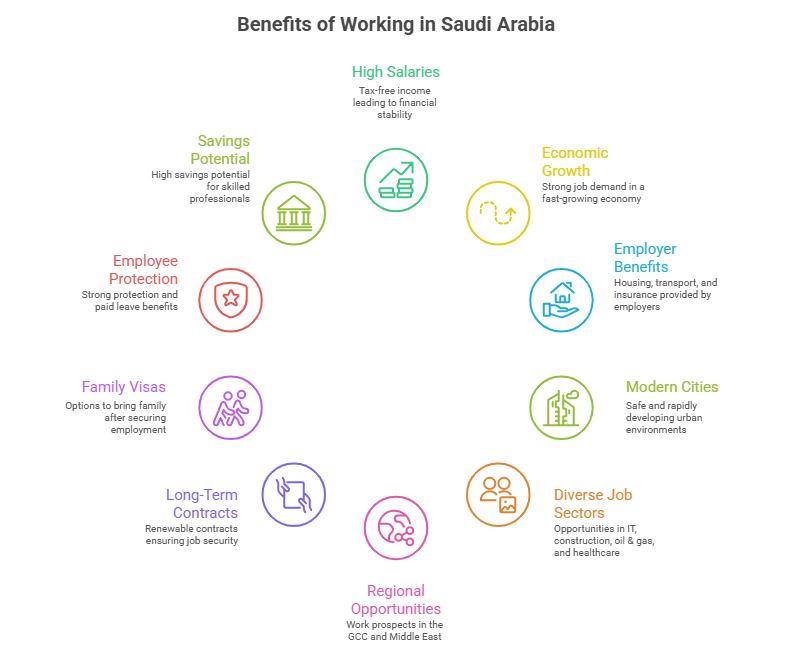
Benefits of Working in Saudi Arabia
- High, tax-free salaries
- Fast-growing economy with strong job demand
- Employer-sponsored benefits such as housing, transport & insurance
- Modern, safe, and rapidly developing cities
- Strong demand in IT, construction, oil & gas, and healthcare
- Opportunity to work in the GCC and Middle East region
- Long-term work opportunities with renewable contracts
- Family visa options after securing employment
- Strong employee protection and paid leave benefits
- High savings potential for skilled professionals
Saudi Arabia Work Visa
A Saudi Arabia Work Visa lets foreign professionals live and work legally in the country under the sponsorship of a Saudi employer. This means your employer is responsible for your visa, documents, and job-related formalities. Indian professionals are in great demand, and most companies help with the entire visa process, making it easier for applicants.
The work visa is issued under your employer's sponsorship, and Iqama renewal is handled by your employer each year. Important: Since June 2025, Saudi Arabia abolished the Kafala system. You are no longer permanently tied to one employer — see the Labour Reform section below for how job mobility now works. After working in Saudi Arabia for a few years, you may become eligible for long-term residency options such as the Premium Residency Program (Saudi Green Card), which gives more freedom to live and work in the Kingdom.
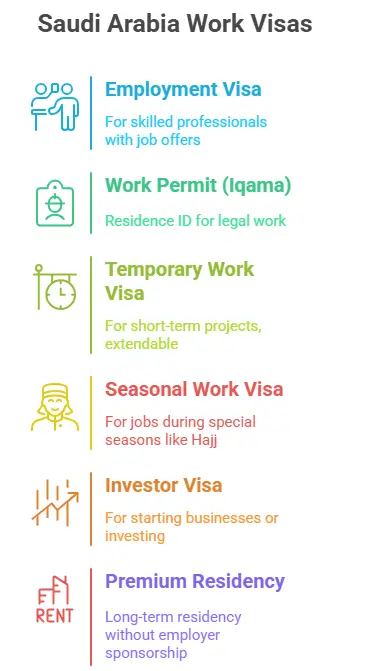
Types of Saudi Work Visas
- Employment Visa: For skilled professionals who receive a job offer from a Saudi employer and want to work full-time in the country.
- Work Permit (Iqama): This is your residence ID card issued after you arrive in Saudi Arabia. It allows you to live and work legally under your employer’s sponsorship.
- Temporary Work Visa: For short-term work projects, usually up to 90 days. It can be extended if the employer needs you for a longer time.
- Seasonal Work Visa: For jobs during special seasons such as Hajj, when many extra workers are needed for support and services.
- Investor Visa: For people who want to start a business, invest money, or manage their own company in Saudi Arabia.
- Premium Residency (Saudi Green Card): A long-term residency option for eligible applicants that provides more freedom, including the ability to live and work without needing an employer sponsor.
Saudi Arabia Labour Reform 2025–2026 — What Changed for Indian Workers
In June 2025, Saudi Arabia abolished the decades-old Kafala sponsorship system for its 13 million-strong foreign workforce, including 2.6 million Indians. Key changes:
- Job mobility without NOC: Change employers after serving your notice period (30–60 days, per contract) via the Qiwa platform — no employer permission required.
- Exit visa via Absher: Apply for exit and re-entry visas directly through the Absher digital platform. Your employer cannot legally prevent your travel.
- Formal contracts via Qiwa: All employment is governed by digital contracts registered on Qiwa.
- Passport protection: Employers are legally prohibited from holding your passport.
- Labour court access via Qiwa: File complaints against employers without fear of deportation.
- Transfer fees: SAR 2,000 (first transfer), SAR 4,000 (second), SAR 6,000 (third and beyond).
Q1 2026 Iqama and Work Permit Reforms
- New 5-year Iqama: Saudi Arabia introduced a 5-year physical Iqama (Resident ID) card in Q1 2026, replacing the previous 1-year card, significantly reducing the annual renewal burden.
- Skills-based classification: Since July 2025 (fully operational in 2026), work permits are issued under three tiers — high-skilled, skilled, and basic — assessed against five criteria: educational background, work experience, professional skills, wage level, and age.
- Profession alignment enforcement: Your Iqama's Mehna (profession) field must accurately match your actual job. Check via Qiwa or Absher, and ask your employer to correct any mismatch before your next renewal.
- Dependent work permits (new in 2026): Qualified spouses and adult children on family-sponsored Iqamas can now obtain their own work permits from MHRSD — previously prohibited regardless of qualifications. This is directly relevant for Indian professional families: a spouse on a family visa can now legally work in Saudi Arabia for the first time.
Wage Protection System (WPS) and Salary Expectations
All private sector salaries in Saudi Arabia must be paid through the Wage Protection System (WPS) via the Mudad platform (mudad.com.sa). Employers must pay salaries electronically through authorised Saudi banks in SAR and upload payroll data to Mudad at least monthly. Non-compliant employers risk suspension of their ability to process or renew work visas. Y-Axis can verify your prospective employer's WPS compliance before you accept an offer.
Important: SAR 4,000/month is the Nitaqat (Saudization) threshold used for counting Saudi nationals in the private sector — it is not a minimum wage for expatriates. There is no statutory minimum wage for expatriate workers in Saudi Arabia. Expat pay is entirely contract-based, so Indian professionals should negotiate their own salary floor before accepting an offer.
End-of-Service Gratuity
All private sector employees in Saudi Arabia, including Indian expatriates, are entitled to end-of-service gratuity when leaving an employer:
- First 5 years of service: 0.5 months' basic salary per year
- After 5 years: 1 full month's basic salary per additional year
- Calculated on last-drawn basic salary only (excluding housing, transport, and other allowances)
Saudi Arabia Labour Law Key Facts
| Provision | Details |
|---|---|
| Working Hours | 8 hours/day; 48 hours/week (6 hours/day; 36 hours/week during Ramadan) |
| Overtime | 1.5× the regular hourly rate |
| Annual Leave | 21 paid days/year after 1 year; 30 paid days/year after 5 years; approximately 11 public holidays |
| Probation Period | Maximum 180 days |
| Notice Period | 60 days (employer to employee); 30 days (employee to employer) |
| Paternity Leave | 3 days of paid leave (Article 113, effective February 2025) |
| Minimum Wage | SAR 4,000/month for Saudi nationals only (for Nitaqat purposes); no statutory minimum wage for expatriates |
| Gratuity | Half a month's basic salary per year for the first 5 years; one full month's basic salary per year thereafter |
| Job Transfer | No NOC required; transfer through Qiwa after the notice period; fees of SAR 2,000, SAR 4,000, or SAR 6,000 (depending on transfer conditions) |
| Wage Payment | Salaries must be paid electronically every month through the Mudad Wage Protection System (WPS) |
Top In-demand Jobs in Saudi Arabia
Saudi Arabia offers many high-paying job opportunities in different sectors. Skilled professionals are in high demand, especially in technology, energy, healthcare, and management roles. Below is a list of in-demand jobs in Saudi Arabia along with their average yearly salaries.
| Occupation | Average Salary per Year (SAR) |
|---|---|
| AI / Machine Learning Specialists | SAR 300,000–400,000 |
| Renewable Energy Engineers (Solar/Wind) | SAR 220,000–400,000 |
| FinTech & Digital Banking Professionals | SAR 200,000–360,000 |
| Oil & Gas Engineers | SAR 180,000–360,000 |
| Cloud Solutions Architects | SAR 180,000–300,000 |
| Cybersecurity Experts | SAR 180,000–276,000 |
| Doctors & Medical Specialists | SAR 180,000–300,000 |
| Supply Chain & Logistics Managers | SAR 150,000–276,000 |
| Tourism & Hospitality Managers | SAR 120,000–240,000 |
| HR Managers (Saudization Specialists) | SAR 180,000–350,000 |
*Read more...
Highest paying Jobs in Saudi Arabia
Top Job Roles in Saudi Arabia for Indians
Saudi Arabia offers thousands of job opportunities for Indian professionals across different industries. The country is growing fast, and companies are hiring skilled professionals in IT, construction, oil & gas, healthcare, logistics, hospitality, and finance. Most jobs come with good salaries, tax-free income, and employer-provided benefits like accommodation and transport.
Below is a simple and clear list of the top industries and the types of job roles available for foreign professionals in Saudi Arabia:
| Industry | Job Roles |
|---|---|
| IT & Software | Developers, Cloud Engineers, IT Support, Cybersecurity |
| Construction | Civil Engineers, Site Supervisors, Technicians |
| Oil & Gas | Petroleum Engineers, Drilling Staff, Safety Officers |
| Healthcare | Doctors, Nurses, Lab Technicians, Pharmacists |
| Hospitality | Chefs, Hotel Staff, Front Office, Housekeeping |
| Manufacturing | Machine Operators, Technicians, Production Staff |
| Logistics | Drivers, Warehouse Staff, Supply Chain Assistants |
| Finance & Business Services | Accountants, HR Executives, Admin Staff |
*Also read....
What are the Most In-Demand Jobs in Saudi Arabia for the Next 10 Years?
Average Salary Levels in Saudi Arabia
Salaries in Saudi Arabia depend on your experience, job role, and industry. Entry-level workers earn lower salaries, while mid-level and senior professionals earn higher pay with more experience and skills. Jobs in sectors like IT, healthcare, engineering, construction, and oil & gas usually offer good salaries. Highly skilled roles such as AI experts, cybersecurity specialists, and senior professionals can earn even more.
| Experience Level | Average Salary |
|---|---|
| Entry Level | SAR 51,000–96,000 per year (₹11–21 LPA) |
| Mid Level | SAR 120,000–216,000 per year (₹26–48 LPA) |
| Senior Level | SAR 300,000–600,000+ per year (₹66–132 LPA) |
Top Companies in Saudi Arabia Hiring Indian Professionals
Below is the list of companies hiring Indian professionals:
| Company | Industry | Why It's Good for International Talent |
|---|---|---|
| Saudi Aramco | Oil & Gas / Energy | Offers tax-free salary, housing, healthcare, and relocation support. |
| NEOM | Smart City / Tech / Sustainability | Large-scale project hiring global talent with competitive salaries and modern facilities. |
| SABIC | Chemicals / Manufacturing / R&D | Provides attractive salaries, housing, and opportunities in engineering and research. |
| ACWA Power | Renewable Energy / Water | Offers jobs in clean energy and water projects with competitive pay and benefits. |
| STC (Saudi Telecom) | Telecom / Technology | Ideal for IT and telecom professionals with modern work culture and career growth. |
| Red Sea Global | Tourism / Hospitality | Recruits international talent for luxury tourism and sustainable development projects. |
| IBM Saudi Arabia | IT / Cloud / AI | Offers global career opportunities in cloud computing, AI, and enterprise technology. |
| Oracle Saudi Arabia | Cloud / Enterprise Technology | Provides roles in cloud solutions, software, and digital transformation projects. |
| Wipro Saudi Arabia | IT Services / Consulting | Popular among Indian professionals for technology and consulting careers. |
| Almarai | Food & Agriculture / FMCG | Offers stable employment, training programs, and career advancement opportunities. |
| PIF (Public Investment Fund) | Finance / Investment | High-paying positions supporting Saudi Arabia's Vision 2030 mega projects. |
| Diriyah Company | Cultural Tourism | Employs global talent in heritage conservation, tourism, and urban development. |
| McKinsey & Company KSA | Management Consulting | Offers excellent career progression, global exposure, and consulting opportunities. |
| Accenture Saudi Arabia | Consulting / IT | Recruits professionals for digital transformation, AI, cloud, and cybersecurity projects. |
| KAUST | Research / Education | Provides world-class research facilities, international work environment, and attractive benefits. |
| Siemens Saudi Arabia | Engineering / Infrastructure / Energy | Offers opportunities in smart infrastructure, automation, healthcare, and energy projects. |
| Saudi Electricity Company (SEC) | Utilities / Power & Energy | Hires engineers and technical professionals for power generation and grid modernization projects. |
| King Faisal Specialist Hospital & Research Centre | Healthcare / Medical Research | Employs international doctors, nurses, researchers, and healthcare specialists with competitive benefits. |
| Red Sea Global – AMAALA | Luxury Tourism / Hospitality | Offers careers in luxury tourism, wellness, sustainability, and hospitality development projects. |
| Riyad Bank | Banking / Financial Services | Provides opportunities in banking, fintech, risk management, digital banking, and corporate finance. |
Market Background & Trends in Saudi Arabia
- Large Foreign Workforce: Saudi Arabia has a large number of foreign workers. Around 18.1 million people are working, and about 77% are expats. This means most workers are from other countries.
- Skill-Based Work Permits: Saudi Arabia has introduced a new system for foreign workers. Jobs are divided into three levels: high-skilled, skilled, and basic. Skilled professionals like engineers, doctors, and IT experts can get better visa options.
- India–Saudi Partnership: More than 2.7 million Indians live and work in Saudi Arabia. Both countries are working together to improve skills and job opportunities. Indian workers also send a large amount of money back to India every year.
- In-Demand Sectors: There is high demand for jobs in AI, cybersecurity, renewable energy, healthcare, and manufacturing. Many companies are looking for skilled workers in these areas.
- Vision 2030 Job Growth: Saudi Arabia is creating jobs at unprecedented scale through projects like NEOM and the Red Sea Project. Indicative demand: 200,000+ construction and engineering professionals for NEOM alone; 50,000+ healthcare professionals for regional expansion; 30,000+ cybersecurity specialists; 25,000+ clean energy roles; 20,000+ AI and data engineers. Indian professionals in these sectors are among the highest-priority recruiting targets.
- Women in Workforce: More women are now working in Saudi Arabia. Female participation has increased a lot, creating more job opportunities for women.
- Lower Unemployment: Unemployment has reduced to around 7%. This shows that more people are getting jobs and the job market is growing.
- Saudization Policy (Nitaqat): Companies must hire a certain number of Saudi citizens. This rule now applies to many sectors, including IT and finance.
- Premium Residency Option: Saudi Arabia offers a special residency program that allows expats to live, work, and own property without needing a local sponsor.
- Growing Non-Oil Economy: Saudi Arabia is focusing on other sectors beyond oil. This is creating more jobs in areas like technology, tourism, finance, and entertainment.
*Read more...
Saudi Arabia Work Visa Requirements
- Valid passport
- Signed job offer or employment contract
- Educational certificates (attested)
- Experience letters
- Passport-size photos
- Medical test certificate (GAMCA medical)
- Police clearance certificate
- Employer-issued work permit approval
- Proof of accommodation (provided by employer)
Also, read…
*Saudi Arabia's updates employment regulations with new digital system. Check if you qualify!
Steps to Apply for a Work Visa in Saudi Arabia
Step 1: A confirmed job offer or employment contract must be secured from a company in Saudi Arabia.
Step 2: The employer submits the applicant’s details to Saudi authorities to obtain work visa authorization.
Step 3: A GAMCA medical test must be completed, and all required documents—passport, certificates, photos, and police clearance—should be collected.
Step 4: Once employer approval is received, the work visa application and documents are submitted at the nearest Saudi Embassy or VFS center.
Step 5: The embassy reviews and processes the application, which may take a few weeks depending on the case.
Step 6: After the visa is approved, travel arrangements can be made to enter Saudi Arabia and begin employment.
Step 7: Upon arrival, the employer completes the procedures for issuing the Iqama, which serves as the official residence and work ID card.
Processing Time for Saudi Work Visa
The processing time for a Saudi work visa is usually 2 to 6 weeks. The exact time can vary based on several factors. It mainly depends on how quickly the employer gets approval, how busy the embassy is, and whether the medical test results and documents are complete and correct.
In many cases, employers try to speed up the process, especially skilled professionals. However, delays can happen during busy hiring seasons or if any documents need extra checking or verification. Applying early helps avoid unnecessary delays.
Saudi Arabia Work Visa Cost
The total cost for a Saudi work visa varies based on employer sponsorship and location.
On average, the cost ranges from SAR 2,000 to SAR 5,000, depending on:
- Medical test fees
- Attestation charges
- Embassy visa fees
- Insurance and processing charges
Many employers cover all major visa costs, including Iqama, flights, and accommodation.
Pathway from Work Permit to Long-Term Residency in Saudi Arabia
Working in Saudi Arabia on a valid Iqama allows you to build eligibility for long-term residency. Some of the long term options are:
- Long-term employment contracts with renewable Iqama
- Premium Residency (Saudi Green Card) for eligible professionals and investors
- Family sponsorship after securing a stable job and income.
Having long-term residency allows you to live freely, bring your family, and enjoy greater job security. Note: as of June 2025, changing employers no longer requires an NOC — you can transfer to a new employer after serving your contractual notice period via the Qiwa platform. Transfer fees apply: SAR 2,000 (first transfer), SAR 4,000 (second), SAR 6,000 (third and beyond).
Digital Platforms Every Indian Worker in Saudi Arabia Should Know
- Qiwa (qiwa.sa): The primary employment platform. View your employment contract, initiate job transfers without employer permission, file complaints against employers, and check your employer's Nitaqat status.
- Absher (absher.sa): The Saudi government's digital identity platform. Apply for exit and re-entry visas without employer approval, renew your residence permit, and access government services.
- Mudad (mudad.com.sa): The Wage Protection System platform where employers submit payroll data. Use it to verify your salary was processed through WPS.
- Muqeem (muqeem.sa): Used by employers for Iqama renewals and extensions.
Saudi Arabia vs Qatar vs UAE for Indian Professionals
- Saudi Arabia: Kafala abolished June 2025; exit via Absher; WPS wage protection; no statutory minimum wage for expats; gratuity 0.5 months/year (first 5 years); Vision 2030 scale (NEOM alone is a $500B project); largest Indian diaspora in any GCC country (2.7 million); no income tax.
- Qatar: Kafala reformed 2020; NOC and exit permit abolished; QAR 1,800/month minimum wage (applies to all nationalities); gratuity 3 weeks/year; family sponsorship threshold QAR 10,000/month.
- UAE: Golden Visa long-term residency option; no kafala reform comparable to Saudi Arabia or Qatar.
How Y-Axis Can Help You
As India’s No. 1 overseas career consultant, Y-Axis provides end-to-end support for working in Saudi Arabia:
- Resume marketing services to help you find right job in Saudi Arabia
- Complete Work Visa Assistance
- Document verification and support
- Medical and PCC guidance
- End-to-end application processing
Y-Axis snapshot
1M
Successful applicants
1500+
Experienced counselors
25Y+
Expertise
50+
Offices
Don't know what to do ?
Get Free Counseling
Looking for Inspiration
Explore what Global Indians have to say about Y-Axis in shaping their future