

Don't know what to do ?
Get Free Counseling
Last Updated 15 July 2026
Greece Work Visa for Indians: EU Blue Card, Article 5C 50% Tax Exemption & Work Permit Guide
Greece, a southeastern European country, is one of the most popular and highly visited countries in the world. Greece not only boasts a high tourism rate but is now emerging as a top destination for foreign nationals looking to work abroad. The high quality of life, affordable living costs, and plenty of job opportunities across high-demand sectors make it a great choice for skilled foreign professionals. Greece has a GDP of $267.35 billion, and consistently ranks in the European Skills Index for Skills Development and Skills Activation. The Greek job market is expanding, with over 85,000 job vacancies available for foreign workers.
Greece is currently facing a major labour shortage due to an aging population, economic recovery after the pandemic, and growth in tourism, construction, and digital industries. The country needs more than 300,000 workers across sectors such as tourism, agriculture, construction, and manufacturing. However, only about 90,000 foreign workers are expected to fill jobs in 2026, which covers only a small part of the total demand.
Greece is also making agreements with other countries to hire professionals. India and Greece are in active negotiations on a bilateral labor agreement that, if signed, is expected to allow up to 50,000 Indian workers annually. As of July 2026, the formal agreement has not yet been signed — monitor official announcements from India's Ministry of External Affairs for confirmation.
Skilled foreign workers can apply for a Greek work visa to work and settle abroad in one of the most vibrant, secure, and fast-growing economies. Some of the key sectors in Greece are IT, tourism, maritime industries, and healthcare.
Capital: Athens | Population: ~ 10.4 million| Language: Greek| Currency: euro (€) ≈ ₹89
Why Work in Greece?
- High demand for professionals in IT, Healthcare, tourism, and digital services
- A growing job market with plenty of job opportunities in the tourism, shipping, and healthcare sectors
- Requires over 300,000 skilled foreign workers to fill labour shortages
- Streamlined pathways for obtaining long-term residence in Greece
- Full-time workers can earn up to €50,000 to €75,000
*Want to apply for a work visa in Greece? Sign up with Y-Axis to help you with the process.
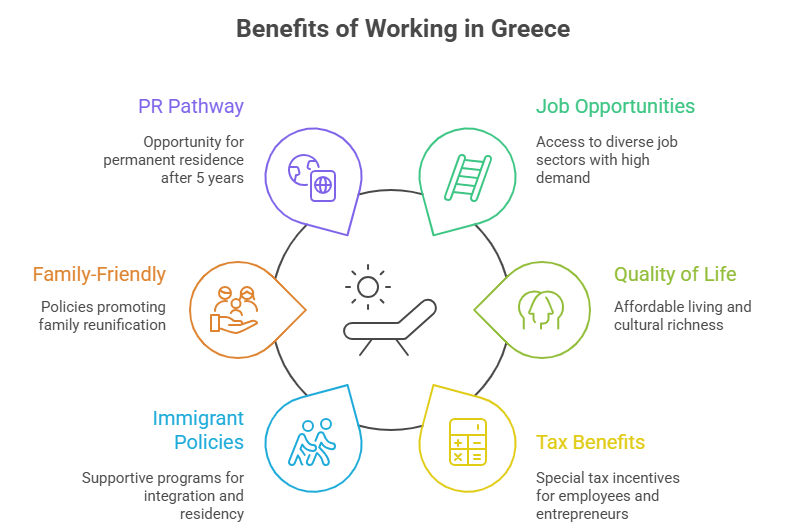
Benefits of Working in Greece
- Growing Job for skilled professionals: The country needs 300,000+ skilled workers across in-demand sectors
- High quality of life: Offers affordable living costs, work-life balance, and a vibrant culture
- More job opportunities: Access job opportunities across top sectors like IT, healthcare, shipping, etc.
- Tax benefits: Get special tax benefits from the Regime for Employees and Entrepreneurs ("Brain Regain" Regime, Article 5C)
- Immigrant-friendly government policies: Offers integration programs, pubic services, and residency assistance
- Family-friendly: Promotes family reunification; can bring spouse and dependent children
- PR pathway: Qualify for permanent residence in Greece after 5 years of living in the countryHas the India-Greece bilateral labor agreement been signed?
Types of Greece Work Visas
Greece offers different types of work visas depending on how long you plan to stay and the purpose of your visit. The two main categories are the Short Stay (Type C) Visa and the Long-Stay (Type D) Visa. A Type C visa is mainly used for short-term visits such as business meetings, conferences, or training programs and allows stays of up to 90 days within a 180-day period. In contrast, a Type D visa is intended for individuals who plan to stay in Greece for more than 90 days for long-term employment, education, or family reunification.
The table below highlights the key differences between the two types of Greece visas, including their purpose, eligibility requirements, and visa fees.
|
Particulars |
Short Stay (C Type) Visa |
Long-Stay (Type D) Visa |
|
Purpose |
For short stays of up to 90 days to attend business conferences, meetings, short-term training, and tourism. |
For extended stays of more than 90 days with the purpose of long-term employment, family reunification, and education. |
|
Education |
No fixed requirements, but must have work experience and qualifications relevant to the job role. |
There is no fixed requirement; it varies depending on the type of job for which you have applied. Generally, a high school diploma or a vocational qualification is required. |
|
Greek Language |
Not required |
Not required, with exceptions for certain job roles. |
|
Eligibility |
Must have a signed employment contract from an employer in Greece and fulfil other requirements. |
Must have a valid job offer from a Greek employer and meet the other visa requirements. |
|
Typical Professions |
Seasonal or project-based job roles in the healthcare, agriculture, and tourism sectors. |
Job roles in hospitality and tourism, IT, healthcare, and construction sectors. |
|
Visa Fees (Embassy) |
€90 |
€180 |
Some of the other types of Greece work Permit options are as follows:
- EU Blue Card: For highly-skilled non-EU nationals with eligible salaries.
- Digital Nomad visa: For individuals who work remotely for companies/organizations outside Greece.
- Seasonal work visa: For contract-based, temporary work with a duration of up to 9 months a year.
- Intra-company Transfer Visa: For individuals who are transferred from a non-EU company to a Greek branch.
- Greece Tech Visa (2026): For employees of licensed tech startups in Greece. Provides immediate work authorisation without requiring a standard work permit process. Launched February 6, 2026.
- Greece Talent Visa (2026): A 12-month job search visa for non-EU nationals holding a Master's degree or higher. Permits the holder to enter Greece and search for employment without a prior job offer. Launched February 6, 2026.
- Specialized Technical Personnel Visa (2026): For foreign specialists transferred from a third-country company to a Greek company for major projects exceeding €10 million in value. Valid for up to 12 months and convertible to an EU Blue Card if eligibility criteria are met. Launched February 6, 2026 under Law 5275/2026.
- Seasonal Work Visa: For contract-based, temporary work in tourism, agriculture, manufacturing and construction — up to 9 months per year. Under Law 5275/2026 (February 2026), Greece formalized an annual quota of 94,240 seasonal worker slots and introduced a digital application process. The employer must submit a digital invitation on behalf of the worker before the visa application can be initiated.
Greece Tech Visa & Talent Visa (2026)
Greece quietly introduced two new visa options on February 6, 2026, and they are worth paying attention to — especially if you are an Indian IT professional or a postgraduate looking to build a career in Europe.
| Feature | Tech Visa | Talent Visa |
|---|---|---|
| Launched | February 6, 2026 | February 6, 2026 |
| Who It's For | Employees of licensed Greek tech startups | Non-EU Master's degree holders |
| Key Benefit | Work authorisation without the standard permit process | Enter Greece first and find a job within 12 months |
| Best Suited for Indians | Software engineers, IT professionals, and startup employees | Postgraduates seeking a European career entry point |
| Next Step | Confirm your employer holds a Greek tech startup licence | Convert to a work visa after securing employment |
Specialized Technical Personnel Visa (2026)
Launched alongside the Talent and Tech Visas on February 6, 2026, the Specialized Technical Personnel Visa fills a specific gap for multinational companies (MNC) bringing expert teams into Greece for large-scale projects. If the standard Intra-Company Transfer route is for routine company transfers, then this visa is for the big ones.
| Feature | Detail |
|---|---|
| Who It's For | Foreign technical specialists transferred from a third-country company to a Greek company. |
| Project Threshold | Project must exceed €10 million in market value. |
| Duration | Up to 12 months. |
| EU Blue Card Conversion | Yes — can be converted if the applicable salary and qualification requirements are met. |
| Launched | February 6, 2026, under Law 5275/2026. |
| Most Relevant for Indians | IT, infrastructure, pharmaceutical, and industrial project specialists working on multinational transfers. |
Note: This visa is worth flagging specifically for Indian professionals working at large Indian IT firms — Wipro, Infosys, TCS, HCL — that are progressively winning contracts on Greek infrastructure and digital modernisation projects under the India-Greece bilateral framework. If your project meets the €10 million threshold, this route may be quicker and more appropriate than the standard ICT visa, with the added advantage of an EU Blue Card conversion pathway at the end.
Greece Seasonal Work Visa — Key Updates Under Law 5275/2026
Greece has always offered a seasonal work visa for temporary roles in high-demand sectors. What changed in February 2026 is that Law 5275/2026 gave it structure — a defined annual quota, a digital application system, and a formally codified maximum stay. For Indian workers exploring short-term Europe opportunities, this is now a more accessible and better-defined route than it was before.
| Feature | Detail |
|---|---|
| Annual Quota | 94,240 seasonal worker slots per year. |
| Maximum Stay | Up to 9 months per year. |
| Application Process | Digital process where the employer submits the invitation on behalf of the worker. |
| Eligible Sectors | Agriculture, tourism, construction, and manufacturing. |
| Launched / Updated | February 6, 2026, under Law 5275/2026. |
| Can It Lead to Long-Term Stay? | No — the seasonal work visa cannot be converted into a long-term residence permit. |
Note: The 94,240 quota is allocated annually by the Greek government across sectors. Indian workers interested in seasonal roles should confirm with their prospective employer that a quota slot is available before initiating the visa process, as slots fill up and availability varies by sector and region.
EU Blue Card Greece 2026 — One of the Most Accessible in Europe
Greece EU Blue Card 2026: minimum annual gross salary approximately €31,919 (1.6 times the average annual wage) — one of the lowest thresholds in the EU. In INR: approximately ₹28.4 lakh/year at April 2026 rates. Requires a recognised university degree or 5 or more years of equivalent professional experience and a minimum 6-month employment contract with a Greek employer.
EU Blue Card Minimum Salary Comparison:
|
Country |
EU Blue Card Minimum Salary (2026) |
Approx. INR per Year (₹89/€) |
|
Greece |
Approximately €31,919 |
Approximately ₹28.4 lakh/year |
|
Spain |
Approximately €40,000–€41,000 |
Approximately ₹35.6–₹36.5 lakh/year |
|
Germany |
Approximately €50,700 |
Approximately ₹45.1 lakh/year |
|
France |
€59,373 |
Approximately ₹52.8 lakh/year |
|
Denmark |
Approximately €74,000 |
Approximately ₹65.9 lakh/year |
Greece is 40–60% more accessible than France or Denmark for Indian IT professionals. An Indian software engineer earning ₹28–35 lakh/year who does not qualify for France's Talent Passport or Denmark's EU Blue Card may qualify for Greece's EU Blue Card.
EU Blue Card Benefits
- After 12 months of holding an EU Blue Card in Greece, holders may transfer to another EU member state.
- From February 6, 2026 (Law 5275/2026), the EU Blue Card validity has been extended from 2 years to 3 years, renewable for a further 3 years. The grace period for late renewals has also been extended from 1 month to 3 months post-expiry.
- The transfer period was reduced from 18 months under the Greece New Immigration Code, Law 5038/2023, effective January 1, 2024.
- EU Blue Card holders can bring family members through family reunification provisions.
- The EU Blue Card provides a direct pathway toward Long-Term Resident (EU) status after 5 years.
Greece Golden Visa (for Investors)
The Greece Golden Visa requires a minimum investment of €500,000 in qualifying assets, including real estate, and provides a Greek residence permit. This pathway is relevant for high-net-worth Indian investors who are not on the work visa route but wish to obtain Greek residency through investment.
Article 5C Brain Regain Regime — 50% Income Tax Exemption for 7 Years
Greece Article 5C Brain Regain: 50% income tax exemption for 7 consecutive years for new tax residents.
Updated July 2025 (Law 5222/2025): The 'new job position' requirement has been removed, meaning the regime now applies to any qualifying employment in Greece.
For an Indian professional earning €50,000/year in Greece, the annual tax saving is approximately €8,750 (approximately ₹7.8 lakh). Total tax saving over 7 years: approximately €61,250 (approximately ₹54.5 lakh).
What is the Article 5C Benefit?
50% exemption from income tax and solidarity contribution on Greek employment income for 7 consecutive tax years.
Who is Eligible?
- You must not have been a tax resident of Greece in 5 of the 6 years immediately before relocating to Greece.
- You must transfer your tax residence to Greece.
- You must be employed by a Greek legal entity or a permanent establishment of a foreign company in Greece.
- Following the July 2025 update under Law 5222/2025, applicants no longer need to be starting a new job position.
- Any qualifying employment in Greece now makes you eligible for the scheme.
Tax Saving Example for Indian Professionals
|
Category |
Amount (€) |
Approx. INR |
|
Annual Salary in Greece |
€50,000 |
Approximately ₹44.5 lakh |
|
Without Article 5C |
Income tax applies to the full €50,000 |
— |
|
With Article 5C |
Income tax applies to only €25,000 |
— |
|
Estimated Annual Tax Saving |
Approximately €8,750 |
Approximately ₹7.8 lakh |
|
Total Saving Over 7 Years |
Approximately €61,250 |
Approximately ₹54.5 lakh |
Major In-Demand Sectors in Greece
Greece currently needs workers in several industries. The demand for skilled workers is increasing because of an aging population, growth in tourism, and the rapid use of digital technology. The country is also investing in digital development and infrastructure projects with support from the European Union.
Every year, Greece has more than 100,000 job vacancies. Many companies are looking for skilled workers in sectors such as tourism, information technology, engineering, logistics, shipping, construction, agriculture, and healthcare.
The table below shows some of the most in-demand jobs in Greece and their average yearly salaries.
|
Occupation |
Average Salary per Year (€) |
Approx. INR per Year (₹89/€) |
|
Software Developers & IT Engineers |
€50,000–€60,000 |
≈ ₹44.5–₹53.4 LPA |
|
AI / Machine Learning Engineers |
€48,000 |
₹42.7 lakh/year |
|
Cybersecurity Specialists |
€35,000 |
₹31.2 lakh/year |
|
Nurses & Nursing Care Workers |
€15,600–€19,200 |
₹13.9–₹17.1 lakh/year |
|
Civil & Mechanical Engineers |
€22,000–€30,000 |
₹19.6–₹26.7 lakh/year |
|
Construction Workers & Supervisors |
€18,000–€24,000 |
₹16.0–₹21.4 lakh/year |
|
Manufacturing / Automation Engineers |
€20,000–€28,000 |
₹17.8–₹24.9 lakh/year |
|
Data Analysts |
€24,000–€42,000 |
₹21.4–₹37.4 lakh/year |
|
English Language Teachers |
€10,800–€18,000 |
₹9.6–₹16.0 lakh/year |
|
Hospitality & Food Service Managers |
€18,000–€26,000 |
₹16.0–₹23.1 lakh/year |
Note: INR figures calculated at ₹89/€1 (April 2026). Exchange rates fluctuate — verify at xe.com before financial planning.
Note: Entry-level developer roles may start below the EU Blue Card threshold of €31,919/year. Mid-level and senior developers earning €32,000+ are eligible. Confirm your offered salary before assuming EU Blue Card eligibility.
Read more...
Highest Paying Jobs in Greece for Indians
Average Salary Levels in Greece
Salaries in Greece depend on experience, job role, and industry. People who are new to a job usually earn lower salaries, while professionals with more experience and special skills can earn higher pay. These salary ranges are common in sectors such as tourism, IT, healthcare, engineering, construction, agriculture, and manufacturing. Highly skilled roles like AI engineers, cybersecurity experts, and senior IT professionals may earn higher salaries.
|
Experience Level |
Salary per Year (€) |
Approx. INR per Year (₹89/€) |
|
Entry Level |
€14,000–€18,000 per year |
₹12.5–₹16.0 lakh/year |
|
Mid Level |
€20,000–€32,000 per year |
₹17.8–₹28.5 lakh/year |
|
Senior Level |
€38,000–€65,000+ per year |
₹33.8–₹57.9 lakh/year |
Top Companies in Greece Hiring Indian Professionals
|
Company |
Industry |
Why It's Good for International Talent |
|
Accenture Greece |
IT / Consulting / Digital Transformation |
Global consulting giant; hires international tech and consulting talent with strong project mobility. |
|
Deloitte Greece |
Finance / Consulting / Audit |
Major multinational with opportunities in audit, tax, advisory, and tech consulting for skilled foreign professionals. |
|
PwC Greece |
Consulting / Tax / Audit |
Global brand with diverse openings for analysts, IT specialists, accountants, and consultants from abroad. |
|
EY (Ernst & Young) Greece |
Consulting / Risk / Finance |
Known for hiring international professionals in IT, cybersecurity, advisory, and financial roles. |
|
IBM Greece |
IT / Cloud / AI / Enterprise Tech |
Strong demand for foreign tech workers; roles in cloud computing, AI, enterprise systems, and digital transformation. |
|
Microsoft Greece |
Technology / Cloud / Software |
Offers skilled foreign workers opportunities in solutions engineering, sales, digital strategy, and cloud services. |
|
Oracle Greece |
IT / Software / Cloud Solutions |
Multinational tech company recruiting global talent in enterprise software, databases, cloud, and consulting. |
|
Vodafone Greece |
Telecom / IT / Network Engineering |
Actively hires foreign engineers, IT specialists, and digital operations professionals. |
|
Siemens Greece |
Engineering / Energy / Automation |
Attractive to global engineering talent; opportunities in automation, power systems, and industrial solutions. |
|
Aegean Airlines |
Aviation / Engineering / Operations |
Greece’s top airline employs skilled workers in aviation engineering, maintenance, IT, and operations. |
|
Hellenic Petroleum (HELPE) |
Energy / Oil & Gas / Engineering |
One of Greece’s largest energy companies; hires international engineers, safety experts, and project managers. |
|
TITAN Cement Group |
Manufacturing / Construction / Engineering |
Strong employer for civil, mechanical, and industrial engineers with multinational exposure. |
|
National Bank of Greece |
Banking / Finance / IT |
Hires foreign professionals in fintech, cybersecurity, data analytics, and financial services. |
|
Alpha Bank |
Banking / IT / Operations |
Opportunities for international talent in finance, IT infrastructure, digital banking, and risk management. |
|
Sani/Ikos Group |
Hospitality / Tourism / Luxury Resorts |
One of Greece’s biggest hospitality employers; recruits international workers for operations, guest services, and management roles. |
*Want to apply for jobs abroad? Avail the Y-Axis Resume Marketing services to find the right one.
Key Tips for Indian Professionals
- Always check official Greek job portals such as EURES (EU job mobility portal) and OAED/DYPA (Public Employment Service). These websites often list job opportunities that may be open to non-EU professionals.
- Try applying for jobs in high-demand sectors such as IT, engineering, healthcare, hospitality, and shipping. These industries need skilled workers, which can improve your chances of getting hired.
- Many jobs in Greece allow people to work in English, but learning basic Greek can be helpful. It can make communication easier at work, improve your job opportunities, and help you settle in Greece more easily.
- Before accepting a job offer, check whether the Greek employer provides visa sponsorship and help with residence permits. Many international companies in Greece support foreign employees with the visa and relocation process.
Market Background & Trends in Greece
- Growing job opportunities: Greece will have over 1 lakh job opportunities in the next 5 years
- In-demand sectors: Information Technology (IT), healthcare, hospitality, construction, manufacturing
- Increasing demand for skilled foreign workers: Greece currently has a requirement of over 300,000 skilled foreign professionals.
- In-Demand Sectors: Greece currently needs professionals in several industries, including tourism and hospitality, IT and cybersecurity, healthcare and elderly care, construction, agriculture, manufacturing, renewable energy, education, customer service, and shipping and logistics.
- Work visa categories: EU Blue Card, Digital Nomad visa, and Intra-Company Transfer (ICT)
- Work visa policies: Greece plans to streamline the immigration process by digitalizing public services and introducing incentives for skilled professionals.
- Long-term residency options: Individuals can qualify for Long-Term Resident (EU) status if they have legally lived and worked in the country for five consecutive years.
Steps to Apply for a Greece Work Visa
The steps to apply for a Greece work visa are as follows:
Step 1: Secure a job offer from a registered Greek employer willing to provide visa sponsorship and initiate the work permit process on your behalf.
Step 2: Employer applies for work permit on your behalf with necessary documents like job contract, qualifications, among others.
Step 3: The Greek work permit is reviewed and approved by the Greek Ministry of Migration.
Step 4: Apply for Type D Work Visa upon apporval of work permit at the Greek Consulate in India.
Step 5: Submit the necessary documents and biometrics for verification on the scheduled date of visa interview.
Step 6: Once your visa is approved, travel to Greece to work legally.
Greece Work Visa Fees
The Greece work visa fee depends on the type of work visa you apply for. Here are the most common fees:
|
Greece Work Visa Type |
Visa Fee |
|
Long-Stay Work Visa (Type D) |
€180 (approximately ₹16,020) |
|
Seasonal Work Visa |
€75 |
|
Short-Stay Schengen Visa (Type C) |
€90 |
Note: Additional costs may apply, including service charges, biometrics, signature attestation, and courier services.
Greece work visa processing time
The average processing time for a Greece work permit visa is 15-30 days. In some cases, the time taken to process a work visa in Greece may also take around 30-60 days. Below is a breakdown by processing time and visa type:
|
Visa Type |
Processing Time |
|
Short-Stay (Type C) Schengen Work Visa |
About 10–15 working days. It may take up to 30 days if extra checks are needed. |
|
Long-Stay (Type D) Work Visa |
Usually takes 30–60 working days, depending on the documents and application details. |
|
EU Blue Card |
Around 30–90 days, depending on qualifications and the workload of the consulate. |
|
Seasonal Work Visa (Type D) |
About 2–4 weeks after the work permit is approved. |
|
Family Reunion Visa |
Usually takes 3–4 months to process. |
Note: The timeline varies based on documentation completeness and immigration office workload.
Factors Influencing Processing Time:
- Work visa type: Varies depending on the visa type you have applied for (Type C or Type D visa)
- Time of application: May take longer during peak or holiday season
- Workload at the embassy: The processing time differs based on the overall volume of applications at the embassy.
- Accuracy of the documents submitted: Accurate and correct documents are processed faster.
- Nationality: Citizens of some countries would require additional background checks or verification, which may extend the processing time.
Convert your Greece Work Visa to PR
You can convert your work visa in Greece to permanent residency after residing in the country for five continuous years.
To convert your Greek work visa to a PR, you must meet the following criteria:
- Reside in Greece for five continuous years.
- Absences outside Greece during the 5-year qualifying period must NOT exceed 6 consecutive months in any single absence, or a combined total of 10 months across the entire 5-year period. Exceeding these absence limits will interrupt or reset your qualifying period for PR.
- Must demonstrate an A2 level proficiency in the Greek language
- Have a minimum income of €12,320 per annum.
- Have a valid medical insurance
- Provide a valid registration address in Greece.
Greece Minimum Wage: The current minimum wage in Greece is €920 per month gross (€11,040 per year), effective April 2026 — an increase of 4.5% from €880 per month in 2025. The Greek government has set a target of €950 per month by April 2027. This minimum wage figure is the baseline for the income requirement when applying for permanent residence.
Greece Citizenship Pathway: After 7 years of legal residence in Greece, non-EU nationals may apply for Greek naturalisation. Requirements include B2-level proficiency in the Greek language (higher than the A2 level required for PR) and demonstrated knowledge of Greek history and culture. Greek citizenship provides a full EU passport and freedom of movement across all 27 EU member states — a significant long-term benefit for Indian professionals building their career in Europe.
How can Y-Axis help you?
As the world's No. 1 overseas immigration consultancy, Y-Axis has been providing unbiased, personalized services for 25 years. Our team of experts is here to provide comprehensive assistance throughout your immigration journey, ensuring a seamless process. Our impeccable services include:
- Y-Axis Resume Writing Services to help you create a compelling resume
- Expert assistance with the Greece visa.
- Review of your documents and visa application form
- Complete Application processing
- Y-Axis Resume Marketing Services to help you find the best jobs for you
Y-Axis snapshot
1M
Successful applicants
1500+
Experienced counselors
25Y+
Expertise
50+
Offices
Don't know what to do ?
Get Free Counseling
Looking for Inspiration
Explore what Global Indians have to say about Y-Axis in shaping their future