

Posted on May 30 2026
In-Demand Jobs in Saudi Arabia for the Next 10 Years

By , Editor & Director
Updated May 31 2026
What are the Most In-Demand Jobs in Saudi Arabia for the Next 10 Years?
Saudi Arabia is becoming one of the top destinations for skilled professionals as it expands its economy through Vision 2030. The country is creating thousands of new jobs in sectors such as IT, engineering, healthcare, renewable energy, logistics, finance, construction, and tourism. For Indian professionals, Saudi Arabia offers many advantages, including tax-free salaries, housing benefits, career growth opportunities, and a high standard of living. More than 2.4 million Indians already live and work in Saudi Arabia, making it one of the largest Indian expatriate communities in the world.
As businesses continue to grow and new projects are launched, the demand for skilled workers is expected to increase over the next decade. Some of the most in-demand jobs include software developers, AI engineers, doctors, nurses, civil engineers, project managers, logistics specialists, teachers, renewable energy experts, and financial analysts. This guide covers the top jobs in demand in Saudi Arabia, average salaries in INR, work visa requirements, the Iqama process, Saudization rules, and practical tips to help you build a successful career in the Kingdom.
*Planning to work abroad ? Sign-up to Y-Axis will guide you step by step.
Why Work in Saudi Arabia for Indian Professionals
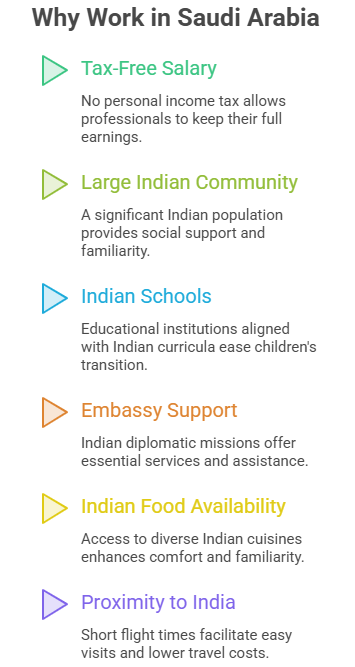
Saudi Arabia is one of the most preferred countries for Indians looking to work abroad. More than 2.4 million Indians live and work in Saudi Arabia, making it the largest expatriate community in the country. This large Indian population helps new workers settle in easily and feel at home.
- Tax-Free Salary: One of the biggest benefits of working in Saudi Arabia is that there is no personal income tax. This means you can keep your full salary. For example, a software engineer earning SAR 12,000 per month can take home around ₹2.7 lakh every month without any tax deductions.
- Large Indian Community: Major cities such as Riyadh, Jeddah, Dammam, and Al Khobar have large Indian communities. You can easily find Indian grocery stores, restaurants, cultural events, and people from different parts of India. This makes it easier to adjust to life in Saudi Arabia.
- Indian Schools for Children: Many major cities have CBSE and ICSE-affiliated Indian schools. This allows children to continue their education without changing to a different school system. Popular Indian schools are available in Riyadh, Jeddah, Dammam, and Al Khobar.
- Support from Indian Embassy and Consulate: India has an Embassy in Riyadh and a Consulate General in Jeddah. They provide services such as passport renewal, document attestation, and emergency assistance to Indian citizens living in Saudi Arabia.
- Easy Access to Indian Food: Indian food is widely available across Saudi Arabia. You can find North Indian, South Indian, Kerala, Mughlai, and many other Indian cuisines in most cities. This helps Indians feel more comfortable while living abroad.
- Close to India: Saudi Arabia is only about 3 to 5 hours away by flight from most major Indian cities. This makes it easy to visit family during holidays, festivals, or emergencies. Travel costs are also generally lower compared to countries in Europe or North America.
List of Top Job Opportunities in Saudi Arabia for the Next 10 Years
Saudi Arabia is becoming a global hub for technology, engineering, logistics, renewable energy, and smart city development. Skilled foreign and local professionals can find high-paying, long-term careers across the following sectors:
| Sector | Job Roles |
|---|---|
| Information Technology (IT) | Software Engineers, Cybersecurity Specialists, Data Scientists, Cloud Engineers, AI Experts |
| Engineering & Construction | Civil Engineers, Mechanical Engineers, Project Managers, Architects, Site Engineers |
| Healthcare | Doctors, Nurses, Pharmacists, Lab Technicians, Medical Specialists |
| Oil, Gas & Petrochemicals | Petroleum Engineers, Safety Officers, Chemical Engineers, Operations Managers |
| Logistics & Supply Chain | Supply Chain Analysts, Warehouse Managers, Freight Coordinators, Logistics Planners |
| Finance & Business Services | Accountants, Financial Analysts, HR Managers, Compliance Officers |
| Tourism & Hospitality | Hotel Managers, Chefs, Guest Relations Officers, Travel Consultants |
| Renewable Energy | Solar Technicians, Wind Energy Engineers, Environmental Analysts |
| Education & Training | Teachers, University Lecturers, Academic Coordinators |
| Retail & Customer Service | Store Managers, Sales Executives, Customer Service Representatives |
*Read more...
Highest paying jobs in Saudi Arabia
Top In-Demand Skills in Saudi Arabia
Employers prefer professionals who can adapt to modernization, digital transformation, and fast workplace changes. Key skills include:
| Category | Skills |
|---|---|
| IT & Digital Skills | Cybersecurity, Data Analytics, Cloud Computing, AI, Software Development |
| Business & Management Skills | Leadership, HR Management, Project Management, Business Strategy |
| Communication Skills | English Fluency, Customer Interaction, Negotiation |
| Technical & Industry Skills | Engineering Design, Safety Management, Machinery Operations |
| Soft Skills | Problem-Solving, Teamwork, Adaptability, Time Management |
Adaptability, professionalism, and time management help candidates succeed. As industries modernise, employers prefer workers who can learn quickly, use technology effectively, and contribute to organisational growth.
Saudi Arabia’s Job Outlook for the Next 10 Years
The country’s employment future looks strong due to Vision 2030 reforms, increased foreign investments, smart city development, and diversification into non-oil sectors. Industries like technology, renewable energy, defense, logistics, tourism, and healthcare will see rapid expansion. Skilled foreign professionals with relevant experience, qualifications, and language proficiency will remain in demand.
Saudi Arabia aims to become a global business and innovation center, offering long-term employment stability and career growth.
Salary Trends in Saudi Arabia Over the Next Decade
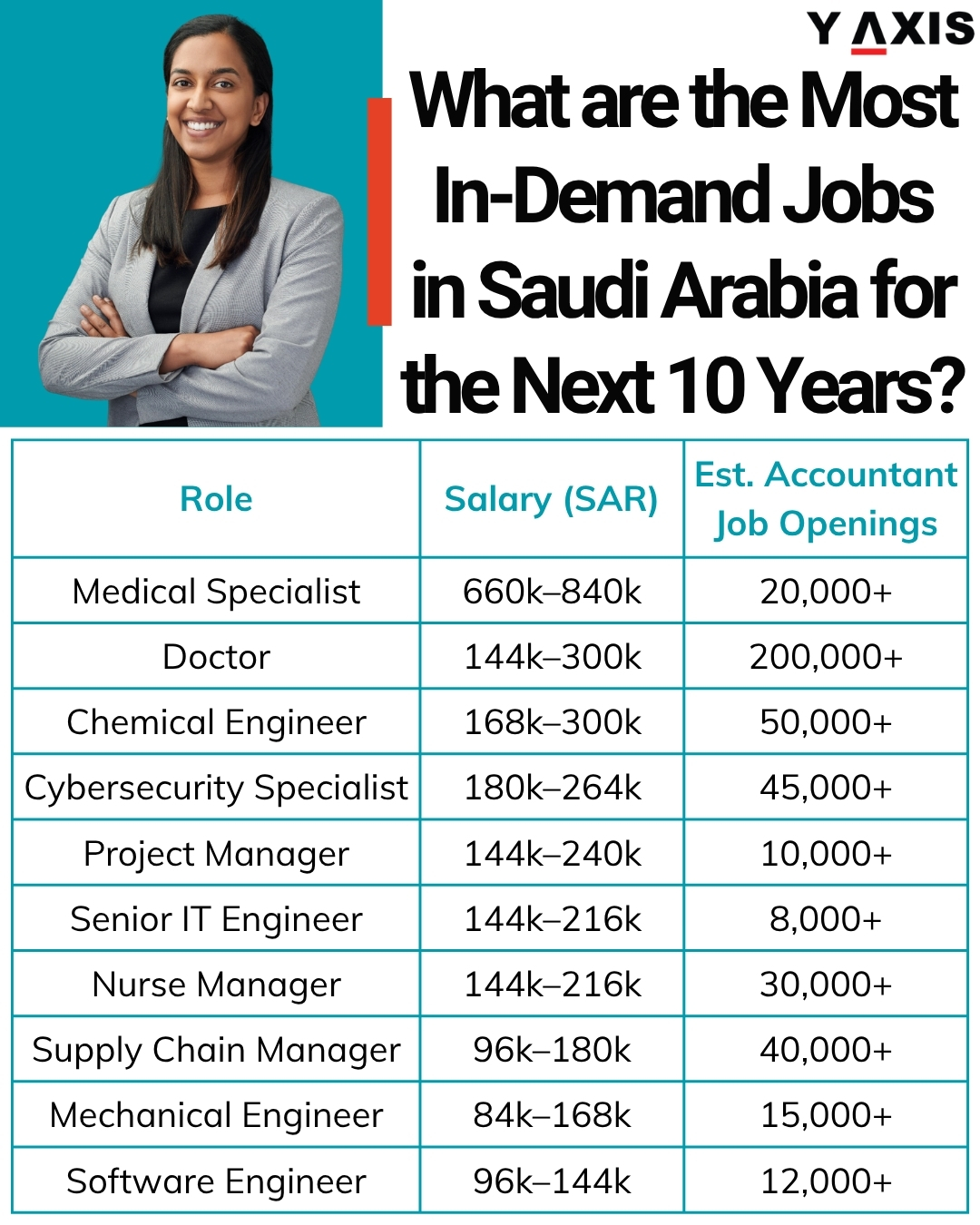
Salaries in Saudi Arabia are expected to increase steadily between 2025 and 2035 as the economy grows and more skilled professionals are needed. The table below shows the average monthly and yearly salaries for some of the most in-demand jobs in Saudi Arabia. Salary figures are shown in Saudi Riyal (SAR) and their approximate value in Indian Rupees (INR), based on an exchange rate of 1 SAR = ₹22.50.
| Job Role | Annual Salary (SAR) | Annual Salary (INR) |
|---|---|---|
| Software Engineer (3–5 Years Experience) | SAR 96,000 – 144,000 | ₹21.6 Lakh – ₹32.4 Lakh |
| Senior IT / Cloud Engineer | SAR 144,000 – 216,000 | ₹32.4 Lakh – ₹48.6 Lakh |
| Cybersecurity Specialist | SAR 180,000 – 264,000 | ₹40.5 Lakh – ₹59.4 Lakh |
| Civil / Mechanical Engineer | SAR 84,000 – 168,000 | ₹18.9 Lakh – ₹37.8 Lakh |
| General Doctor (MBBS) | SAR 144,000 – 300,000 | ₹32.4 Lakh – ₹67.5 Lakh |
| Medical Specialist | SAR 660,000 – 840,000 | ₹1.48 Crore – ₹1.89 Crore |
| Registered Nurse | SAR 60,000 – 108,000 | ₹13.5 Lakh – ₹24.3 Lakh |
| Senior Nurse / Nurse Manager | SAR 144,000 – 216,000 | ₹32.4 Lakh – ₹48.6 Lakh |
| Financial Analyst / Accountant | SAR 84,000 – 144,000 | ₹18.9 Lakh – ₹32.4 Lakh |
| Project Manager | SAR 144,000 – 240,000 | ₹32.4 Lakh – ₹54 Lakh |
| Teacher / Academic Coordinator | SAR 60,000 – 108,000 | ₹13.5 Lakh – ₹24.3 Lakh |
| Logistics / Supply Chain Manager | SAR 96,000 – 180,000 | ₹21.6 Lakh – ₹40.5 Lakh |
| Petroleum / Chemical Engineer | SAR 168,000 – 300,000 | ₹37.8 Lakh – ₹67.5 Lakh |
*Know more...
Cost of Living in Saudi Arabia Compared to India
The cost of living in Saudi Arabia is generally higher than in India. However, salaries are usually much higher and there is no personal income tax. This allows many Indian professionals to save more money while working in Saudi Arabia. Many employers in Saudi Arabia provide benefits such as free or discounted accommodation, transportation allowance, medical insurance, and annual flight tickets. Because of these benefits and tax-free salaries, many professionals are able to save a large part of their income every month.
| Expense Category | Saudi Arabia (Monthly Cost) | India – Major Cities (Monthly Cost) |
|---|---|---|
| Rent (1BHK Apartment in City Centre) | SAR 1,500 – 2,500 (₹33,750 – ₹56,250) | ₹15,000 – ₹35,000 |
| Groceries | SAR 400 – 600 (₹9,000 – ₹13,500) | ₹5,000 – ₹10,000 |
| Eating at Restaurants | SAR 25 – 60 per meal (₹562 – ₹1,350) | ₹150 – ₹500 per meal |
| Transportation | SAR 300 – 500 (₹6,750 – ₹11,250) | ₹3,000 – ₹6,000 |
| Utilities (Electricity, Water, Internet) | SAR 200 – 400 (₹4,500 – ₹9,000) | ₹2,000 – ₹5,000 |
| Total Monthly Cost for Comfortable Living | SAR 3,500 – 5,500 (₹79,000 – ₹1,24,000) | ₹35,000 – ₹80,000 |
Also read.....
Saudi Arabia changes work visa rules for Indian workers from Jan 2025
Companies Hiring Foreign Professionals in Saudi Arabia
Saudi Arabia has many international companies and large local organizations that regularly hire skilled workers from other countries. Opportunities are available in sectors such as oil and gas, technology, healthcare, engineering, finance, logistics, tourism, and renewable energy.
| Industry | Major Employers |
|---|---|
| Oil and Gas | Saudi Aramco, SABIC, Schlumberger |
| IT and Telecommunications | STC, SAP Saudi, Cisco, IBM Saudi |
| Construction and Engineering | Bechtel, Larsen & Toubro, Nesma & Partners |
| Finance and Consulting | Deloitte Saudi, PwC Saudi, KPMG Saudi |
| Logistics and E-commerce | Saudi Post, Aramex, Amazon Saudi |
| Healthcare | Dr. Sulaiman Al Habib Group, Ministry of Health Hospitals |
| Hospitality and Tourism | Hilton, Marriott, Red Sea Global |
| Renewable Energy | ACWA Power, NEOM Green Hydrogen |
| Marketing and Advertising | Publicis Groupe Middle East, WPP Saudi Arabia, Omnicom Media Group, Dentsu Saudi Arabia |
| Nursing and Healthcare Services | Dr. Sulaiman Al Habib Medical Group, King Faisal Specialist Hospital & Research Centre, Saudi German Health, Mouwasat Medical Services |
If you are looking for jobs in Saudi Arabia, many of these companies regularly recruit skilled foreign professionals in areas such as engineering, IT, healthcare, project management, logistics, and finance.
Saudization (Nitaqat) Policy: What Indian Professionals Should Know
If you are planning to work in Saudi Arabia, it is important to understand the Saudization policy, also known as the Nitaqat system. This policy can affect your job opportunities, work permit, and long-term employment in the country.
What is Saudization?
Saudization is a government program that encourages private companies to hire more Saudi citizens. Under the Nitaqat system, companies are ranked based on how many Saudi nationals they employ.
Companies are placed into different categories such as:
- Platinum: Excellent compliance with Saudization rules
- Green: Meets the required targets
- Yellow: Below the required targets
- Red: Does not meet the required targets
What Does Saudization Mean for Indian Professionals?
The category of your employer can affect your work visa and job security.
- Platinum and Green companies can easily hire foreign workers, renew work permits, and sponsor visas. These are generally the safest employers for Indian professionals.
- Yellow and Red companies may face restrictions on hiring foreign workers and renewing work permits. Employees in these companies may face greater job uncertainty.
New Saudization Phase (2026–2028)
Saudi Arabia is increasing Saudization efforts between 2026 and 2028 to create more jobs for Saudi citizens. The government plans to localise more than 340,000 private-sector jobs across different industries.
What Indian Job Seekers Should Keep in Mind
- Check the Nitaqat status of an employer before accepting a job offer.
- Skilled professionals such as doctors, engineers, IT specialists, and healthcare workers are still in high demand.
- Industries such as healthcare, technology, engineering, and construction continue to hire foreign professionals because of skill shortages.
- Entry-level and low-skilled jobs are becoming more focused on hiring Saudi citizens.
- Professionals with specialised skills, certifications, and work experience have better job opportunities and greater job security.
Saudi Arabia Work Visa Types for Indians
To work legally in Saudi Arabia, you need a valid work visa. Most work visas are issued through the Kafala (sponsorship) system, where your employer sponsors your stay and employment in the country.
Main Work Visa Types
| Visa Type | Validity | Main Purpose | Best For |
|---|---|---|---|
| Employment Visa (Leads to Iqama) | 1–2 years (renewable) | Long-term employment and residence | Full-time employees |
| Temporary Work Visa | 90 days (can be extended once) | Short-term projects and assignments | Project-based workers |
| Business Visit Visa | 30–90 days | Business meetings, training, and conferences | Business visitors |
| Freelancer Visa | 1 year (renewable) | Self-employed professionals in approved fields | Freelancers and consultants |
Saudi Arabia Skill Classification System
Saudi Arabia classifies workers into different skill levels. Your education, experience, and salary determine your category.
| Skill Level | Qualification Requirement | Minimum Monthly Salary |
|---|---|---|
| High-Skilled | University degree and at least 5 years of experience | SAR 15,000 or more (about ₹3.37 lakh) |
| Skilled | Secondary education and at least 2 years of experience | SAR 7,000–14,999 (about ₹1.57 lakh–₹3.37 lakh) |
| Basic | Entry-level workers | SAR 3,000–6,999 (about ₹67,500–₹1.57 lakh) |
Your skill category can affect your work visa eligibility, salary expectations, and career opportunities in Saudi Arabia.
Step to Apply for Saudi Arabia Work Visa for Indians
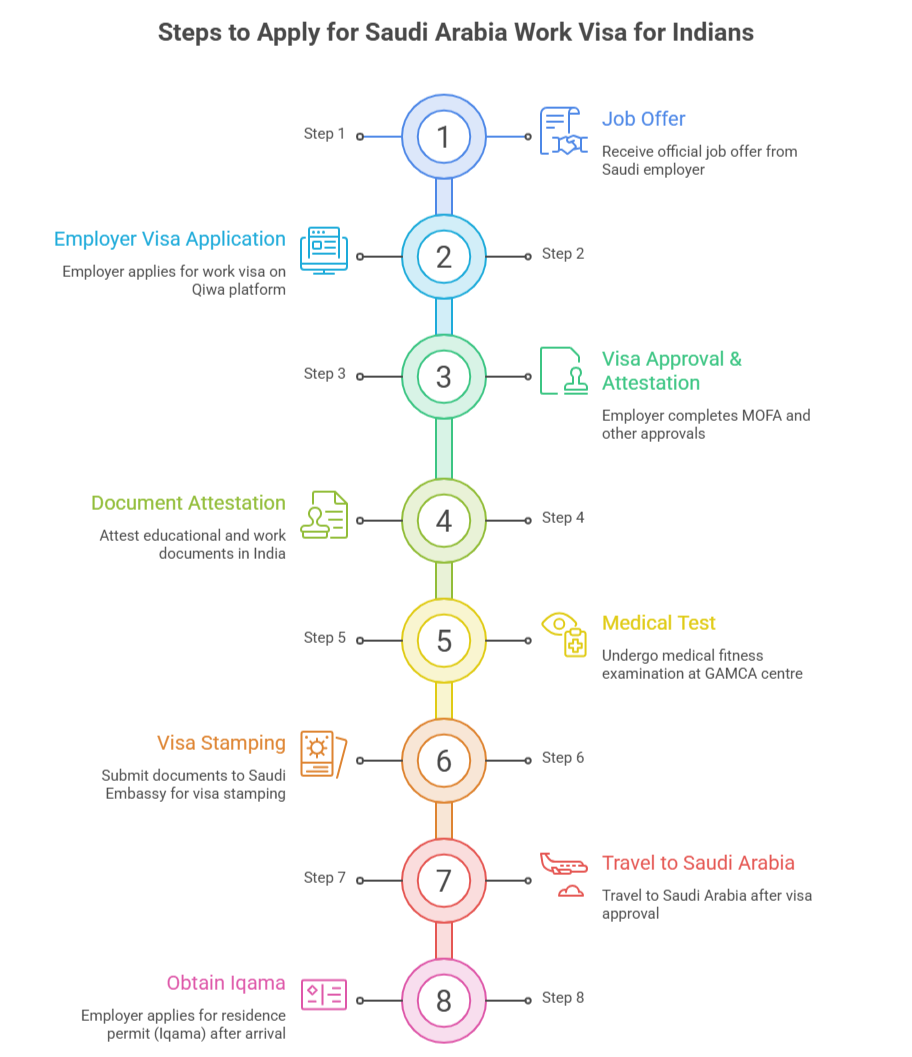
If you want to work in Saudi Arabia, you must first get a valid work visa. Below is the step-by-step process for Indian professionals applying for a Saudi Arabia work visa.
Step 1: Get a Job Offer
The first step is to receive an official job offer from a Saudi employer. The offer letter should clearly mention your job role, salary, and employment terms.
Step 2: Employer Applies for Your Work Visa
After you accept the job offer, your employer applies for a work visa on your behalf through Saudi Arabia's Qiwa online platform. The employer receives a visa number linked to your job position.
Step 3: Visa Approval and Attestation
Your employer completes the required approvals and attestation process through the Saudi Ministry of Foreign Affairs (MOFA) and other relevant authorities.
Step 4: Attest Your Documents in India
Before applying for a Saudi work visa, you must get your educational certificates, degree certificates, and work experience documents attested by the State Government, the Ministry of External Affairs (MEA), and the Saudi Embassy in India.
Step 5: Complete the Medical Test
All Saudi work visa applicants must undergo a medical fitness examination at a GAMCA-approved medical centre in India. A valid medical report is required for visa processing.
Step 6: Submit Documents for Visa Stamping
Submit your passport, attested documents, medical report, visa application, and required fees to the Saudi Embassy or an authorised visa centre. Visa processing usually takes 1 to 3 weeks.
Step 7: Travel to Saudi Arabia
Once your visa is approved, you can travel to Saudi Arabia. Many employers assist new employees with airport pickup and initial accommodation arrangements.
Step 8: Obtain Your Iqama
After arriving in Saudi Arabia, your employer will apply for your Iqama (residence permit). You may need to complete biometric registration and a local medical check-up. The Iqama is usually issued within the first 90 days of arrival.
What Is an Iqama and Why Is It Important?
The Iqama is the official residence permit for foreign workers in Saudi Arabia. It acts as your legal identity document while living and working in the country.
Without an Iqama, you cannot legally:
- Work in Saudi Arabia
- Open a bank account
- Rent a house or apartment
- Sign official contracts
- Access many government and private services
Important Facts About the Iqama
- Your Iqama is linked to your employer under the sponsorship system.
- It is usually renewed every one or two years, depending on your employment contract.
- It contains details such as your job title, employer name, and validity period.
- If you change employers, your Iqama must be transferred to the new employer.
- Your spouse and children can receive dependent Iqamas linked to your permit.
- In most cases, employers pay the Iqama fees, but you should confirm this before signing your employment contract.
Latest Update
Saudi Arabia has introduced stricter rules to ensure that an employee's job title, qualifications, and salary match their approved skill category. Therefore, it is important to make sure that the details on your Iqama match the position you were hired for.
Dataflow Verification: Recognition of Indian Qualifications in Saudi Arabia
Healthcare professionals such as doctors, nurses, pharmacists, dentists, and lab technicians must complete DataFlow verification before obtaining a professional licence in Saudi Arabia. DataFlow is a verification process that checks your educational qualifications, professional licences, and work experience directly with the issuing institutions. To complete the process, you must register on the DataFlow portal, upload the required documents, and wait for verification. The process usually takes 4–8 weeks and costs around SAR 1,200–1,800 (₹27,000–₹40,500). A positive DataFlow report is required before applying for a healthcare licence in Saudi Arabia.
Health Insurance and End-of-Service Benefits
Health Insurance
Health insurance is compulsory for all employees in Saudi Arabia. Employers are legally required to provide medical coverage, which usually includes hospital treatment, doctor consultations, and emergency care. If you are moving with your family, check whether the insurance plan covers your dependants as well.
End-of-Service Benefits (ESB)
Employees who complete at least two years of service are entitled to an end-of-service gratuity under Saudi labour laws. For the first five years, employees receive half a month's salary for each year worked. After five years, they receive one full month's salary for every additional year of service. This benefit can provide a significant financial payout when leaving the company.
Other Common Employee Benefits
- Annual return air tickets to India
- Housing allowance or company accommodation
- Transportation allowance
- Annual performance bonuses
Top Indian Communities in Saudi Arabia
More than 2.4 million Indians live in Saudi Arabia, making them the largest expatriate community in the country. Large Indian communities can be found in Riyadh, Jeddah, Dammam, Al Khobar, Al Jubail, and the developing city of NEOM.
| City | Indian Community Profile |
|---|---|
| Riyadh | Large Indian community working in IT, healthcare, finance, and corporate sectors. |
| Jeddah | Popular among professionals in trade, logistics, and hospitality. |
| Dammam / Al Khobar | Home to many Indians working in oil and gas, engineering, and petrochemicals. |
| Al Jubail | Strong Indian workforce in manufacturing and industrial sectors. |
| NEOM | Emerging destination for engineers, technology professionals, and sustainability experts. |
Top Indian Schools in Saudi Arabia
Indian families can access CBSE schools across major Saudi cities, helping children continue their education without changing curricula.
| City | School Name | Board |
|---|---|---|
| Riyadh | Indian International School Riyadh | CBSE |
| Riyadh | Al Yasmin International School | CBSE |
| Jeddah | International Indian School Jeddah | CBSE |
| Jeddah | Dauha Al-Uloom International School | CBSE |
| Dammam | Indian International School Dammam | CBSE |
| Al Khobar | Indian International School Al Khobar | CBSE |
Indian Embassy and Consulate Services
Indian citizens in Saudi Arabia can access consular support through the Embassy of India in Riyadh and the Consulate General of India in Jeddah. These offices provide services such as passport renewal, document attestation, emergency assistance, and other support for Indian residents.
Building a Successful Career in Saudi Arabia
Saudi Arabia offers rewarding careers for skilled professionals seeking international exposure, higher salaries, and long-term opportunities. To succeed, improve your technical and soft skills, tailor your Saudi-style CV, gain relevant certifications, build a professional network, and research industries aligned with Vision 2030. With the right preparation and expert guidance, you can build a strong and future-proof career in Saudi Arabia.
*Planning to work in Saudi Arabia? Contact Y-Axis, world’s number one immigration consultancy for complete guidance can help you through the entire process
FAQs
What are the most in-demand jobs in Saudi Arabia for the next 10 years?
The most in-demand jobs will be in IT, engineering, healthcare, renewable energy, logistics, construction, finance, and education. Roles like software developers, cybersecurity experts, nurses, doctors, civil engineers, project managers, supply chain analysts, teachers, and financial analysts will continue growing. Vision 2030 projects, smart cities, and digital transformation are creating thousands of long-term career opportunities for skilled professionals, including foreign workers.
Which industries are expected to grow the fastest under Vision 2030?
Industries expected to grow fastest include technology, renewable energy, tourism, healthcare, logistics, real estate, education, finance, and advanced manufacturing. Vision 2030 aims to diversify the economy beyond oil, increase foreign investment, build new cities like NEOM, and expand hospitality and entertainment. These reforms create new businesses, more jobs, and long-term employment opportunities for both Saudi nationals and international professionals.
Do foreign professionals have good job opportunities in Saudi Arabia?
Yes. Foreign professionals continue to have strong job opportunities, especially in IT, engineering, healthcare, construction, logistics, education, energy, and finance. Many companies actively hire skilled expatriates due to talent shortages in specialised fields. Competitive tax-free salaries, modern workplaces, and career growth attract foreign workers. Although Saudization prioritises local hiring, highly skilled and experienced international professionals remain in demand across multiple industries.
What skills are employers in Saudi Arabia looking for?
Employers value digital and IT skills, engineering knowledge, communication, English fluency, leadership, teamwork, customer service, and problem-solving abilities. Project management, data analysis, financial literacy, and industry-specific technical skills are also important. Adaptability, professionalism, and time management help candidates succeed. As industries modernise, employers prefer workers who can learn quickly, use technology effectively, and contribute to organisational growth.
Which cities in Saudi Arabia offer the highest-paying jobs?
Riyadh, Jeddah, NEOM, Dammam, and Al Khobar offer the highest-paying jobs. Riyadh is the business, finance, and technology hub. Jeddah provides strong opportunities in trade, logistics, and tourism. NEOM offers high salaries in engineering, sustainability, innovation, and smart-city development. Dammam and Al Khobar pay well in oil, gas, and manufacturing. These cities attract multinational companies and offer competitive packages with modern living standards.
Are IT and engineering jobs expected to increase in Saudi Arabia?
Yes. IT and engineering jobs are expected to grow rapidly due to digital transformation, smart city projects, renewable energy expansion, and Vision 2030 infrastructure development. Companies need software developers, cybersecurity specialists, data scientists, AI engineers, civil engineers, mechanical engineers, and project managers. Government and private sectors are investing heavily in technology, automation, and construction, creating long-term job growth in these fields.
What salary can Indians expect in Saudi Arabia?
Salaries in Saudi Arabia are expected to grow steadily between 2025 and 2035, especially for skilled professionals. IT engineers can earn SAR 8,000–18,000/month (₹1.8L–₹4L). Specialist doctors can earn SAR 55,000–70,000/month (₹12L–₹15.7L). All salaries are tax-free. Additional benefits like housing allowance, transport, health insurance, and annual flights to India significantly increase total compensation. High-demand roles in tech, healthcare, and energy will see the strongest salary growth.
Which companies hire foreign professionals in Saudi Arabia?
Many global and Saudi companies hire foreign workers, including Saudi Aramco, SABIC, Schlumberger, Bechtel, STC, IBM Saudi, Deloitte, PwC Saudi, KPMG, Amazon Saudi, Aramex, ACWA Power, and major hospital groups. These organisations recruit skilled professionals in IT, engineering, logistics, healthcare, finance, hospitality, and renewable energy.
How can job seekers build a successful career in Saudi Arabia?
Job seekers should develop strong technical and soft skills, create a Saudi-style CV, and gain industry certifications relevant to Vision 2030 sectors. Networking through LinkedIn, recruiters, job portals, and professional events can improve opportunities. Learning basic Arabic and understanding Saudi workplace culture also helps. Connecting with a registered immigration consultant like Y-Axis gives you a clear roadmap to Iqama registration.
Is Saudi Arabia a good destination for long-term career growth?
Yes. Saudi Arabia offers excellent long-term career growth due to a strong economy, large infrastructure projects, global companies, tax-free salaries, and Vision 2030 development plans. Professionals gain international experience, better earnings, and career stability. Expanding industries like technology, renewable energy, logistics, healthcare, education, and tourism create continuous demand for skilled workers. Many Indian expatriates have built highly successful long-term careers in the Kingdom.
What is the Iqama and why is it important for Indians working in Saudi Arabia?
The Iqama is the Saudi Arabia residency permit issued to all foreign workers. It is your legal identity document in the country. Without an Iqama, you cannot open a bank account, rent accommodation, sign contracts, or travel freely within Saudi Arabia. Your employer applies for your Iqama within 90 days of your arrival through the Muqeem system. The Iqama is tied to your employer under the Kafala sponsorship system and must be renewed annually.
What is Saudization and how does it affect Indian job seekers?
Saudization (Nitaqat) is Saudi Arabia's policy requiring private companies to hire a minimum percentage of Saudi nationals. Companies are rated Platinum, Green, Yellow, or Red based on compliance. Working for a Red or Yellow category employer can put your work permit renewal at risk. Highly skilled Indian professionals in IT, healthcare, and engineering are largely protected because Saudi nationals with equivalent skills are still limited. Always verify an employer's Nitaqat category before accepting a job offer.
What documents do Indians need for a Saudi Arabia work visa?
The documents Required for a Saudi Arabia Work Visa for Indians are listed below:
- Valid passport with at least 6 months of validity
- Formal job offer or employment contract from a Saudi employer
- Attested educational certificates
- Degree certificates attested by the State Government and Ministry of External Affairs (MEA)
- Work experience and employment documents (if applicable)
- GAMCA medical fitness certificate
- Recent passport-size photographs
- Completed visa application documents
- DataFlow verification report (for healthcare professionals)
- SCFHS licence (for doctors, nurses, pharmacists, dentists, and other healthcare professionals)
Note: Your employer is responsible for obtaining the visa block and completing the MOFA attestation process in Saudi Arabia. After all documents are submitted, visa processing generally takes 1–3 weeks.
What is Dataflow verification and is it required for all Indians?
Dataflow is a Primary Source Verification process that confirms the authenticity of your educational and professional qualifications by contacting your issuing institutions directly. It is mandatory for all Indian healthcare professionals (doctors, nurses, pharmacists, dentists, lab technicians) seeking to work in Saudi Arabia. It is also required by SCFHS before issuing a medical licence. The process takes 4–8 weeks and costs approximately SAR 1,200–1,800 (₹27,000–₹40,500).
Are there Indian schools in Saudi Arabia for families moving with children?
Yes. CBSE and ICSE-affiliated Indian schools are available in all major Saudi cities, including Riyadh, Jeddah, Dammam, and Al Khobar. Notable schools include the International Indian School Jeddah (founded 1969), the Indian International School Riyadh, and the Indian International School Dammam. Indian families can ensure their children continue the Indian curriculum without disruption, making Saudi Arabia a genuinely family-friendly destination for Indian professionals.
Can Indians get permanent residency in Saudi Arabia?
Saudi Arabia does not offer traditional permanent residency like Canada or Australia. However, eligible foreign nationals can apply for the Premium Residency Program, which allows long-term residence, property ownership rights, and greater flexibility without needing a sponsor. Most Indian professionals work in Saudi Arabia through employer-sponsored work visas and Iqama permits.
Which job sectors offer the highest salaries in Saudi Arabia?
The highest-paying sectors in Saudi Arabia include healthcare, oil and gas, information technology, engineering, finance, and renewable energy. Specialist doctors, petroleum engineers, cybersecurity experts, project managers, and senior IT professionals can earn some of the highest salaries, along with additional benefits such as housing allowances and health insurance.
Is knowledge of Arabic required to work in Saudi Arabia?
Arabic is not mandatory for many professional jobs, especially in IT, engineering, healthcare, finance, and multinational companies where English is widely used. However, learning basic Arabic can improve communication, workplace relationships, and career opportunities, particularly in customer-facing roles.
What are the benefits of working in Saudi Arabia for Indian professionals?
Indian professionals benefit from tax-free salaries, competitive compensation packages, employer-sponsored health insurance, housing and transport allowances, annual air tickets to India, and strong career growth opportunities. The large Indian community in Saudi Arabia also makes it easier for newcomers to settle and adapt.
What qualifications improve job opportunities in Saudi Arabia?
Professional qualifications, industry certifications, and relevant work experience can significantly improve job prospects. Certifications in cloud computing, cybersecurity, project management, healthcare specialisations, finance, and engineering are highly valued by Saudi employers. Candidates with international certifications and specialised skills are often more competitive in the job market.
📞 Call: +91-7670800000
📩 Email: info@y-axis.com
🌐 Visit: https://www.y-axis.com
Tags:
Saudi Arabia jobs
Jobs in Saudi Arabia
careers in Saudi
Work in Saudi Arabia
Saudi job market
Saudi skills in-demand
Career in Saudi Arabia
Companies in Saudi Arabia
Saudi work opportunities
High demand jobs Saudi Arabia
Share
Options for you by Y-Axis

Get it on your mobile

Get News alerts

Contact Y-Axis
Latest Article
Popular Post
Trending Article
Posted On October 09 2026
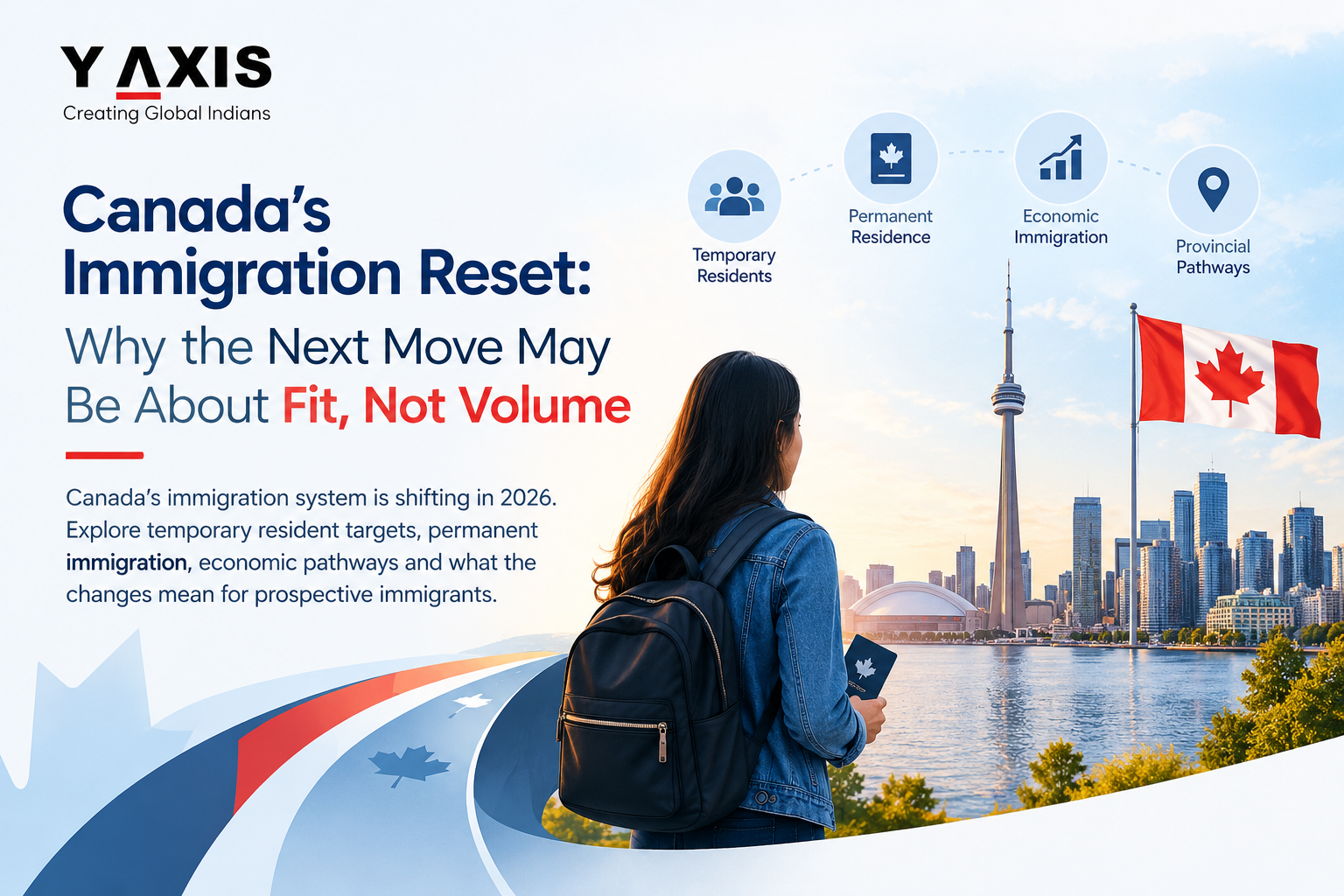
Canada’s Immigration Reset: Why the Next Move May Be About Fit, Not Volume