

Don't know what to do ?
Get Free Counseling
Study MBA in Europe: Top Countries, Universities, Fees & Scholarships
Studying an MBA in Europe has become a popular choice for international students, especially for Indian professionals who want global exposure and strong career opportunities. Europe offers internationally recognized business schools, industry-focused MBA programs, and excellent networking opportunities with global companies.
More than 1.33 million international students study in Europe, and a significant number of them choose business and management programs such as MBA. In 2025 alone, over 50,000 Indian students studied across different European countries, with many enrolling in business schools and management programs.
One of the biggest advantages of pursuing an MBA in Europe is the shorter program duration, usually 12 to 18 months, compared to two-year MBA programs in many other countries. This helps students save both time and tuition costs while gaining the same level of international business education.
Europe is home to some of the world’s best business schools, including institutions in the UK, France, Spain, Germany, and the Netherlands. These schools provide strong industry connections, internships, leadership training, and real-world business exposure.
Students also benefit from multicultural learning environments, strong global alumni networks, and access to international job markets. With proper planning and guidance, studying an MBA in Europe can open doors to leadership roles and global career opportunities.
Why Study MBA in Europe?
Studying an MBA in Europe provides students with strong management skills, international business exposure, and career opportunities across global industries.
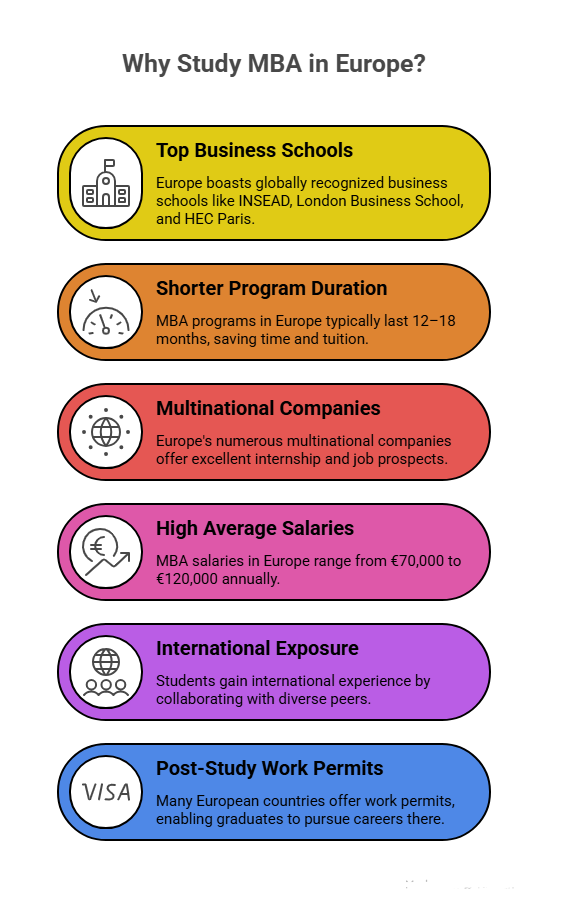
- Europe has many globally ranked business schools, including INSEAD, London Business School, and HEC Paris.
- MBA programs in Europe usually last 12–18 months, helping students save time and tuition costs.
- Europe has many multinational companies, offering strong internship and job opportunities.
- Average MBA salaries in Europe range between €70,000 and €120,000 per year depending on experience and industry.
- Students gain international exposure by studying with peers from different countries.
- Many countries offer post-study work permits, allowing graduates to stay and find jobs after completing their MBA.
Benefits of Studying MBA in Europe for Indian Students
Globally Recognized Business Schools
Europe has several top-ranked MBA institutions that consistently appear in global rankings such as QS and Financial Times. Degrees from these institutions are highly valued worldwide.
Shorter MBA Duration
Most MBA programs in Europe take 12–18 months, which helps students enter the job market faster compared to traditional two-year MBA programs.
Strong Industry Connections
European business schools collaborate with major global companies in sectors such as finance, consulting, technology, and manufacturing.
Diverse International Classroom
MBA programs in Europe attract students from many countries, creating a multicultural environment that improves leadership, networking, and global business understanding.
Career Opportunities
Graduates from European MBA programs often work in industries such as consulting, banking, technology, and international trade.
Experience Different Countries and Cultures
While studying an MBA in Europe, students get the chance to visit and experience many different countries and cultures. European countries are well connected, so traveling between them is easy. This helps students learn about different business styles, meet people from many backgrounds, and gain a global understanding of business and culture.
*Want to study abroad? Contact Y-Axis for end-to-end support
Top Countries to Study MBA in Europe
Europe offers several countries known for excellent business education, modern campuses, and strong career opportunities.
MBA in the UK
The United Kingdom is one of the most popular destinations in Europe for MBA studies. It has many world-class universities and business schools that are recognized globally. Students choose the UK because of its high academic standards, strong industry connections, and excellent career opportunities after graduation.
- Home to top institutions like London Business School and Oxford Saïd Business School
- MBA programs typically last 12–15 months, helping students complete their degree faster
- Strong focus on finance, consulting, entrepreneurship, and global business management
- Opportunities for internships, networking events, and industry exposure
- Post-study work visa available for 2 years after completing the MBA
*Want to study in the UK? Y-Axis is here to provide complete guidance!
MBA in France
France is well known for its prestigious business schools and strong reputation in global business education. Many French business schools regularly rank among the top MBA institutions in the world. France also has a strong corporate environment with global companies in sectors like luxury brands, finance, and technology.
- Home to INSEAD, HEC Paris, and ESSEC Business School
- Strong programs in international business, luxury brand management, marketing, and finance
- Multicultural environment with students from many countries
- Excellent networking opportunities with global companies and industries
- Post-study work opportunities available for graduates
*Want to study in France? Y-Axis is here for end-to-end assistance!
MBA in Germany
Germany is one of the most attractive countries in Europe for MBA students because of its strong economy and excellent education system. The country is known for innovation, technology, and global business leadership. Many universities offer high-quality MBA programs with practical learning and industry connections.
- Known for innovation, engineering, technology, and business leadership programs
- Lower tuition fees compared to many other European MBA destinations
- Strong job market in cities like Berlin, Munich, and Frankfurt
- Opportunities to work with global companies in automotive, engineering, finance, and technology sectors
- Post-study work visa of up to 18 months to find a job after graduation
*Want to study in Germany? Y-Axis is here to provide complete assistance!
MBA in Spain
Spain is one of the popular destinations in Europe for MBA studies. The country is known for its well-known business schools, modern campuses, and lively student lifestyle. Many international students choose Spain because it offers quality education along with a friendly and vibrant environment. Spanish business schools focus on practical learning, leadership skills, and global business understanding.
- Home to well-known institutions like IE Business School and ESADE Business School
- Strong programs in entrepreneurship, international business, marketing, and management
- Affordable living costs compared to many other Western European countries
- Opportunities to connect with international companies and business professionals
- Vibrant cities like Madrid and Barcelona offer great student life and cultural experience
*Want to study in Spain? Y-Axis is here to provide complete assistance!
MBA in Netherlands
The Netherlands is a modern and innovative country that attracts many international students for MBA programs. Dutch universities are known for their practical teaching methods, interactive classrooms, and strong focus on real-world business skills. Many MBA programs are taught entirely in English, which makes it easier for international students to study and communicate.
- Most MBA programs are taught in English, making it easier for international students.
- Strong focus on innovation, technology, sustainability, and international business.
- Universities encourage group discussions, practical projects, and industry collaboration.
- International and welcoming environment with students from different countries.
- Post-study work visa available through the Orientation Year Visa, allowing graduates to look for jobs in the Netherlands.
*Want to study in the Netherlands? Y-Axis is here to provide expert assistance!
MBA in Ireland
Ireland has become a popular destination for MBA studies because of its strong economy and presence of many multinational companies. The country is home to global companies like Google, Apple, Facebook, and Microsoft, which creates good career opportunities for MBA graduates. Irish universities focus on practical learning, leadership skills, and global business knowledge.
- Home to universities like Trinity College Dublin and University College Dublin
- Strong programs in finance, technology management, and international business
- Many global companies have their European headquarters in Ireland
- Friendly and welcoming environment for international students
- Post-study work visa up to 2 years
*Willing to study in Ireland? Y-Axis is here to guide you through the process!
MBA in Switzerland
Switzerland is known for its high-quality education system and strong global business environment. The country has several well-known business schools that offer internationally recognized MBA programs. Switzerland is also famous for industries like banking, finance, hospitality, and luxury management.
- Home to top institutions like IMD Business School and University of St. Gallen
- Strong programs in finance, banking, hospitality, and international business
- Excellent networking opportunities with global companies
- High quality of life and safe environment
- Strong career opportunities in European and global markets
*Want to study in the Switzerland? Y-Axis is here to provide expert assistance!
MBA in Italy
Italy is becoming a popular choice for MBA studies because it offers quality education at affordable costs. Italian business schools provide strong programs in business management, fashion, design, and entrepreneurship. Students also experience a rich culture and vibrant lifestyle while studying.
- Home to institutions like SDA Bocconi School of Management
- Strong programs in business management, fashion, luxury brand management, and entrepreneurship
- Affordable tuition fees compared to some Western European countries
- Opportunities to connect with industries such as fashion, design, and manufacturing
- Cultural cities like Milan and Rome provide great student experiences
*Want to study in Italy? Y-Axis is here to provide expert assistance!
MBA in Sweden
Sweden is known for its modern education system and strong focus on innovation and sustainability. Swedish universities encourage practical learning, teamwork, and problem-solving skills. The country also has strong connections between universities and industries.
- Home to institutions like Stockholm School of Economics and Lund University
- Strong focus on innovation, sustainability, and technology management
- Modern campuses and research facilities
- Friendly and inclusive environment for international students
- Post-study work opportunities available
*Willing to study in Sweden? Y-Axis is here to provide personalized guidance!
MBA in Denmark
Denmark offers high-quality education with a focus on creativity, innovation, and business development. Universities encourage open discussions, teamwork, and real-world business projects. Denmark also provides a safe and well-organized environment for international students.
- Universities like Copenhagen Business School offer globally recognized MBA programs
- Strong programs in business strategy, entrepreneurship, and sustainability
- Modern campuses and student-friendly environment
- Opportunities to connect with growing European industries
- Post-study work options available
*Willing to study in Denmark? Y-Axis is here to provide personalized guidance!
Top 10 MBA Colleges in Europe
Europe is home to many of the world’s top-ranked MBA universities and business schools. These institutions are known for their high teaching standards, strong industry connections, and focus on leadership and business innovation. Many European MBA programs are designed to provide practical learning, global business exposure, and networking opportunities with international companies. Graduating from a well-known MBA university in Europe can improve career opportunities and help students work in global organizations.
Below is a list of some of the top MBA universities in Europe in 2026 based on QS rankings:
|
University |
Country |
QS Rankings |
|
UK |
2 |
|
|
France |
5 |
|
|
London Business School |
UK |
6 |
|
UK |
7 |
|
|
France |
8 |
|
|
IE Business School |
Spain |
11 |
|
UK |
12 |
|
|
Spain |
15 |
|
|
UK |
19 |
|
|
SDA Bocconi |
Italy |
20 |
|
Esade Business School |
Spain |
21 |
|
IMD |
Switzerland |
25 |
|
ESCP Europe |
France |
26 |
*Read more....
Most affordable Universities in Europe
Top MBA Programs in Europe
European universities offer a wide range of MBA specializations that match current global business trends and industry demands. MBA programs in Europe are designed to develop leadership, strategic thinking, and management skills while allowing students to focus on a specific area of business.
Many business schools provide specializations in fields that are currently in high demand in the global job market, such as Business Analytics, International Business, Finance, and Technology Management. These programs combine theoretical knowledge with practical learning through case studies, industry projects, internships, and networking opportunities with global companies. Choosing the right MBA specialization helps students build expertise in a particular industry and improves their chances of finding better career opportunities after graduation.
Below are some of the popular MBA specializations in Europe and the universities where these programs are widely offered:
|
MBA Specialization |
Universities Where the Course is Popular |
|
International Business |
INSEAD (France), London Business School (UK), HEC Paris (France), IE Business School (Spain) |
|
Finance and Banking |
University of Oxford – Saïd Business School (UK), University of Cambridge – Judge Business School (UK), Imperial College Business School (UK), HEC Paris (France) |
|
Marketing Management |
ESSEC Business School (France), ESADE Business School (Spain), IE Business School (Spain), London Business School (UK) |
|
Business Analytics |
Imperial College Business School (UK), Rotterdam School of Management (Netherlands), ESADE Business School (Spain), Warwick Business School (UK) |
|
Entrepreneurship |
IE Business School (Spain), SDA Bocconi School of Management (Italy), HEC Paris (France), Cambridge Judge Business School (UK) |
|
Supply Chain Management |
Rotterdam School of Management (Netherlands), KEDGE Business School (France), Mannheim Business School (Germany) |
|
Human Resource Management |
London Business School (UK), University of Manchester – Alliance Manchester Business School (UK), ESCP Business School (France) |
|
Technology Management |
Imperial College Business School (UK), IE Business School (Spain), Technical University of Munich (Germany), Rotterdam School of Management (Netherlands) |
*Confused to choose which course to pursue? Avail Y-Axis course recommendation services to choose the best.
Eligibility Requirements to Study MBA in Europe
The eligibility requirements for MBA programs in Europe may vary depending on the country, university, and business school. However, most universities follow similar admission criteria for international students. Applicants are generally required to meet certain academic qualifications, provide proof of work experience, demonstrate English language proficiency, and submit important documents during the application process.
Below are the common eligibility requirements to study an MBA in Europe:
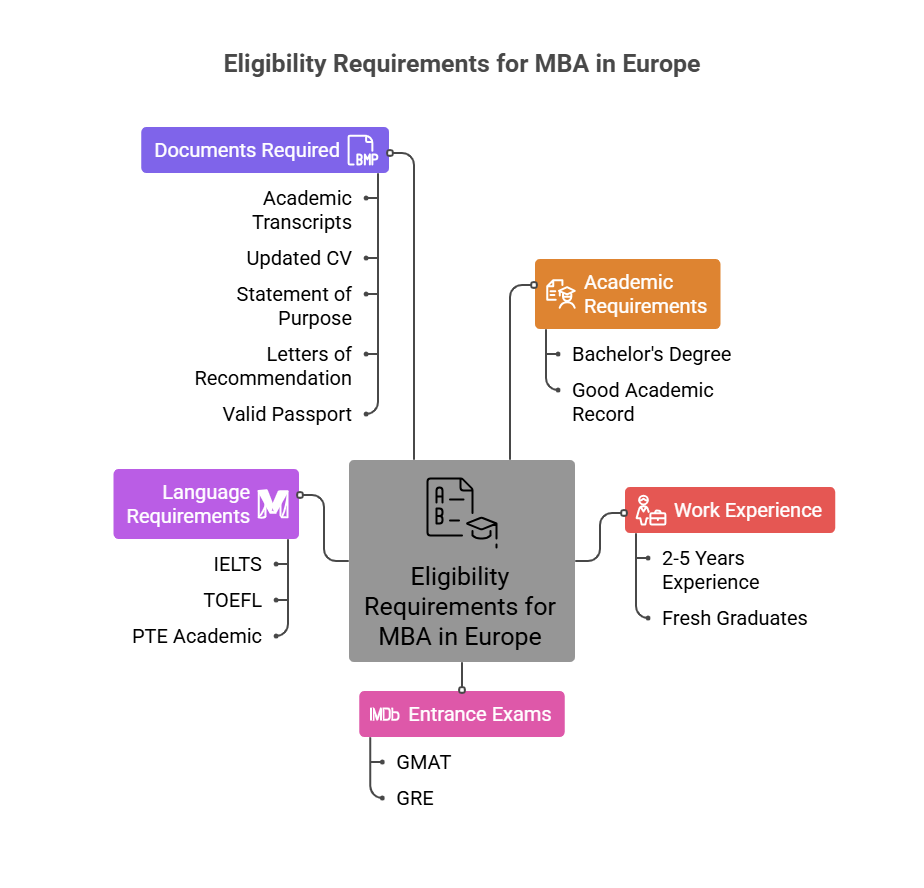
Academic Requirements
Students must have completed a bachelor’s degree from a recognized university or college. The degree can be in any field such as business, engineering, science, or arts. Most universities also expect students to have a good academic record or minimum GPA/percentage, although the exact requirement may vary depending on the university and program.
Work Experience
Many MBA programs in Europe prefer candidates who have professional work experience. This is because MBA programs often focus on real business situations and leadership development. Most universities require 2 to 5 years of work experience, but some programs may accept students with less experience or even fresh graduates.
Entrance Exams
Some universities require entrance exam scores to evaluate a student’s analytical and problem-solving skills. Common entrance exams include GMAT (Graduate Management Admission Test) or GRE (Graduate Record Examination). However, some universities may offer MBA programs without GMAT/GRE, depending on the applicant’s work experience and academic background.
Language Requirements
Since most MBA programs in Europe are taught in English, international students must show proof of their English language ability. Universities usually accept tests such as IELTS, TOEFL, or PTE Academic. The required score depends on the university, but generally students must demonstrate that they can read, write, speak, and understand English well.
Documents Required
Students must submit several important documents when applying for an MBA program. These documents help universities evaluate the student’s academic background, work experience, and career goals.
Common documents required include:
- Academic transcripts and certificates from previous education
- Updated CV or resume showing professional work experience
- Statement of Purpose (SOP) explaining the student’s career goals and reason for choosing the MBA program
- Letters of Recommendation (LOR) from employers or professors
- Valid passport for identification and international travel
Step-by-Step Application Process to Study MBA in Europe
Step 1: Choose the country, university, and MBA specialization.
Step 2: Check eligibility requirements and prepare required exams (GMAT/IELTS).
Step 3: Prepare application documents such as SOP, CV, and recommendation letters.
Step 4: Submit applications through the university website.
Step 5: Receive admission or offer letter from the university.
Step 6: Arrange proof of funds and financial documents.
Step 7: Apply for a student visa for the respective country.
Step 8: Prepare travel and accommodation arrangements.
*Want to study MBA in Europe? Sign-up to Y-Axis for complete guidance.
Cost of Studying MBA in Europe
The cost of studying an MBA in Europe varies depending on the country, university, and type of business school. Europe offers a wide range of MBA programs, from affordable public universities to prestigious international business schools. While top-ranked institutions may charge higher tuition fees, many universities offer competitive programs with strong career opportunities.
MBA Tuition Fees in Europe
MBA tuition fees differ based on the reputation of the business school, program duration, and specialization. On average, the total tuition fee for an MBA program in Europe ranges between €20,000 and €90,000 for the entire course.
|
Study Program |
Average Tuition Fees |
|
MBA Programs |
€20,000 – €90,000 total program cost |
Top business schools in countries like France, Spain, Switzerland, and the UK may charge higher tuition fees due to their global rankings, international faculty, and strong industry connections. However, several universities across Germany, Italy, and Eastern Europe offer more affordable MBA programs.
Many MBA programs in Europe are 1–2 years long, which makes them cost-effective compared to longer MBA programs in other countries.
Living Costs While Studying MBA in Europe
Apart from tuition fees, students must also consider the cost of living. Living expenses vary depending on the country and city. Major cities such as Paris, London, Amsterdam, and Zurich usually have higher living costs, while smaller cities are more affordable for international students.
|
Expense |
Average Cost |
|
Accommodation |
€400 – €1,500 per month |
|
Food |
€200 – €350 per month |
|
Health Insurance |
€200 – €1,000 per year |
|
Other Expenses |
€150 – €600 per month |
Top MBA Scholarships in Europe
Pursuing an MBA in Europe can be a significant investment, but many universities, governments, and international organizations offer scholarships to support talented international students. These scholarships help reduce the financial burden by covering tuition fees, living expenses, travel costs, or providing monthly stipends.
Scholarships are usually awarded based on academic merit, leadership potential, professional experience, and financial need. Some programs are fully funded and cover the entire cost of studying, while others provide partial financial assistance to help with tuition or living expenses.
International students, including applicants from India, can apply for a wide range of government-funded and university-funded scholarships offered by European countries. These scholarships not only provide financial support but also give students access to global networks, career opportunities, and international exposure.
Below are some of the most popular MBA scholarships available in Europe for international students:
|
Scholarship |
Benefits |
|
Erasmus Mundus Scholarship |
Full tuition + living expenses |
|
Chevening Scholarship (UK) |
Full tuition + living costs |
|
DAAD Scholarship (Germany) |
Monthly stipend + travel support |
|
Eiffel Excellence Scholarship (France) |
Monthly stipend |
|
Holland Scholarship |
€5,000 – €15,000 support |
*Read more.....
Top Scholarships for Indian Students to Study in Europe
Post-MBA Career Opportunities in Europe
Europe offers many job opportunities for MBA graduates. The region has a strong economy and many global companies that need skilled professionals in business, management, and leadership roles. After completing an MBA in Europe, graduates can find jobs in different industries such as finance, consulting, technology, and international business.
Many multinational companies have offices across European countries like Germany, France, the Netherlands, Ireland, and Switzerland. This creates strong demand for professionals who have business knowledge, management skills, and international experience. The average salary for MBA graduates in Europe usually ranges from €70,000 to €120,000 per year. The exact salary depends on factors such as the business school, work experience, industry, and the country where the graduate works. Graduates from top European business schools and those with prior professional experience often receive higher salary packages and better career opportunities.
Some of the most popular career sectors for MBA graduates in Europe include:
|
Role / Career Sector |
Average Salary Range in Europe (per year) |
|
Consulting |
€80,000 – €120,000 |
|
Finance and Banking |
€75,000 – €110,000 |
|
Technology and IT |
€70,000 – €115,000 |
|
Marketing and Sales |
€65,000 – €100,000 |
|
International Business |
€70,000 – €105,000 |
|
Supply Chain and Operations |
€65,000 – €95,000 |
Build Your Future with an MBA in Europe
Studying an MBA in Europe is a great opportunity for professionals who want to improve their career and develop strong business and leadership skills. European business schools focus on practical learning, global business knowledge, and leadership training, which helps students prepare for management roles in international companies.
An MBA in Europe also helps students build a strong international network. You will study with classmates from different countries and backgrounds, which allows you to learn new perspectives and create valuable global connections. These connections can help you find job opportunities in different countries after graduation.
Europe is home to many top-ranked business schools known for their high-quality education, experienced faculty, and strong links with global industries. Many MBA programs in Europe are shorter in duration, usually lasting 1 to 2 years, which helps students save both time and tuition costs compared to longer programs in other countries.
Because of the strong economy, global companies, and international business environment, Europe has become one of the most popular destinations for MBA education. Graduates often benefit from better career opportunities, higher salaries, and the chance to work with leading companies around the world.
How Can Y-Axis Help You?
Y-Axis provides complete guidance for students who want to pursue an MBA in Europe.
- Free counselling on MBA universities and specialization selection
- Assistance with MBA admissions and applications
- Y-Path gives the best suitable ideas about your study and career options.
- Coaching services for TOEFL, IELTS, and German language preparation
- Student visa application support
- Pre-departure and accommodation assistance
Don't know what to do ?
Get Free Counseling
Looking for Inspiration
Explore what Global Indians have to say about Y-Axis in shaping their future
Frequently Asked Questions