


Posted on July 10 2026
Top 10 Countries for Biotechnologists to Work Abroad: Salary, Demand & PR Opportunities Compared

By , Editor & Director
Updated August 10 2026
The global demand for skilled Biotechnologists is accelerating across every major life sciences market. With the rise of cell and gene therapy, mRNA technology, precision medicine, and AI-driven drug discovery, countries across Europe, Asia-Pacific, and North America are competing for biotech talent capable to drive R&D, biomanufacturing, and regulatory functions. The global biotechnology market is projected to reach approximately USD 3.88 trillion by 2030 (Grand View Research), with health applications and biopharmaceuticals leading demand. Indian biotechnologists with expertise in bioprocessing, molecular biology, genomics, and quality assurance are increasingly sought after by global pharma majors, biotech startups, and research institutions. For the right qualification pathway, Indian Biotechnologists can access competitive salaries, sponsored work visas, and clear permanent residency routes across ten of the world's strongest biotech markets.
This blog is for you if you are a:
- Qualified Indian biotechnologist (B.Tech/M.Tech/M.Sc Biotechnology or related life sciences) with at least 2–5 years of post-qualification experience in R&D, bioprocessing, or quality assurance
- Life sciences professional with pharma or biotech MNC experience (Biocon, Serum Institute, Dr. Reddy's, Cipla) seeking international roles and higher salaries
- PhD or postdoctoral researcher targeting countries with strong R&D ecosystems and clear PR pathways
- Senior biotech scientist or R&D/manufacturing manager targeting maximum salary and long-term career growth
| Category | Details |
|---|---|
| Global Biotech Market | Expected to reach approximately USD 3.88 trillion by 2030 (Grand View Research), with a CAGR of around 14%, driving demand for professionals in R&D, bioprocessing, genomics, and biomanufacturing. |
| Highest Gross Salary Market | Switzerland – Senior biotechnology scientists can earn approximately CHF 85,000–140,000 per year, particularly in Basel's Roche and Novartis ecosystem. |
| Leading Biomanufacturing Hub | Ireland – Home to major biologics manufacturing facilities operated by Pfizer, Regeneron, MSD, and Bristol Myers Squibb (BMS). Eligible professionals on the Critical Skills Employment Permit can qualify for Stamp 4 after two years. |
| Fastest PR Pathway in Europe | Ireland – The Critical Skills Employment Permit provides a pathway to Stamp 4 permission after two years of eligible employment. |
| Fastest Points-Based PR Globally | Canada – Biotechnology professionals may qualify through Express Entry under eligible science occupations, with permanent residence potentially achievable in approximately 1–3 years, depending on eligibility and CRS score. |
| Best Points-Based PR (Asia-Pacific) | Australia – Life Scientist occupations are listed on the MLTSSL, providing access to Skilled Independent (Subclass 189) and Skilled Nominated (Subclass 190) visas. |
| Top English-Speaking Markets | United Kingdom, Ireland, Singapore, Australia, and Canada. |
| Countries Offering EU Blue Card | Germany and the Netherlands offer EU Blue Card pathways for eligible highly skilled biotechnology professionals who meet salary requirements. |
| Leading Asia-Pacific Biotech Hub | Singapore – Home to the Biopolis and A*STAR research ecosystem, with regional headquarters for many global biopharmaceutical companies. |
| Qualification Note | Indian B.Tech, M.Sc. Biotechnology, and M.Pharm qualifications are generally accepted by international employers. However, regulated positions may require local licensing (such as HPRA registration in Ireland) or credential assessments (such as WES for Canada or VETASSESS for Australia). |
*Want to find Biotechnologist jobs abroad? Sign up with Y-Axis for end-to-end assistance.
Top 10 Countries for Biotechnologists: Quick Comparison
Biotechnologists with expertise in bioprocessing, molecular biology, genomics, cell and gene therapy, and regulatory affairs are in demand across every major biotech and pharma market globally. Global biopharma majors, biomanufacturing companies, research institutes, and government science agencies are actively sponsoring qualified biotechnologists from India. Countries including Ireland, Australia, Canada, and Germany have placed life science occupations on shortage lists, creating fast-track visa routes for qualified international talent.
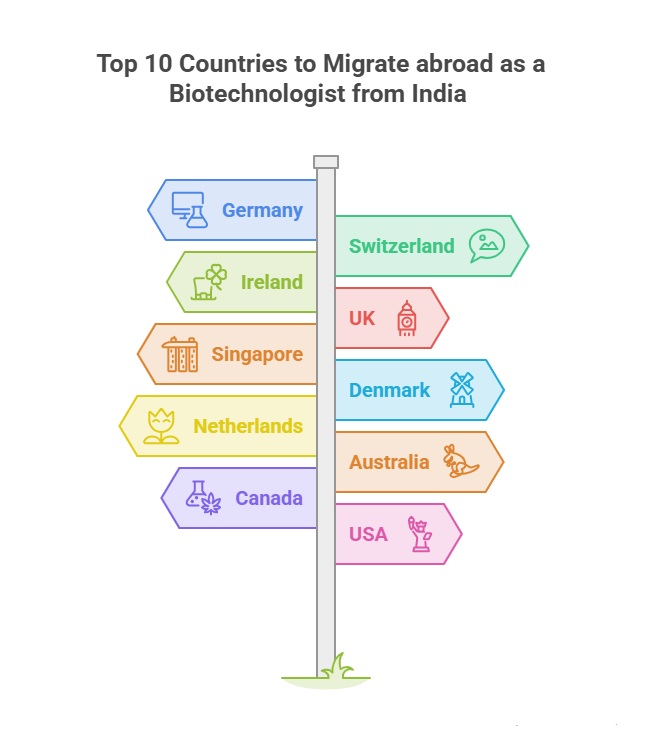
The table below highlights average annual salary and immigration pathways across the top 10 countries for Biotechnologists.
| Country | Average Annual Salary | Work Visa / Route | PR Pathway |
|---|---|---|---|
| Germany | EUR 45,000–90,000 | EU Blue Card / Skilled Worker Visa | Permanent residence in as little as 21 months with an EU Blue Card and B1-level German proficiency. |
| Switzerland | CHF 85,000–140,000 | Employer-sponsored Swiss Work Permit (quota-based) | Eligible for Permit C after 5–10 years, depending on nationality and residence conditions. |
| Ireland | EUR 45,000–85,000 | Critical Skills Employment Permit | Eligible for Stamp 4 permission after 2 years of qualifying employment. |
| United Kingdom | GBP 32,000–75,000 | Skilled Worker Visa | Eligible for Indefinite Leave to Remain (ILR) after 5 years of continuous qualifying residence. |
| Singapore | SGD 55,000–110,000 | Employment Pass (EP) | May apply for Permanent Residence after approximately 2–3 years, subject to ICA approval. |
| Denmark | DKK 450,000–750,000 | Pay Limit Scheme / Positive List for Higher Education | Eligible for permanent residence after meeting Denmark's continuous residence and integration requirements. |
| Netherlands | EUR 45,000–95,000 | Highly Skilled Migrant Visa / EU Blue Card | Eligible for permanent residence after 5 years of continuous legal residence. |
| Australia | AUD 75,000–140,000 | Skills in Demand Visa (Subclass 482) / Skilled Migration Program | Pathways include Subclass 186, 189, and 190 visas for eligible Life Scientist occupations on the MLTSSL. |
| Canada | CAD 65,000–120,000 | LMIA-based Work Permit / Express Entry | Express Entry pathway for eligible science occupations, with permanent residence often achievable within 1–3 years for qualified candidates. |
| United States | USD 70,000–160,000 | H-1B, O-1A, or L-1 Visa | Employment-based Green Card through EB-2 or EB-3 categories, with National Interest Waiver (NIW) available for eligible researchers and scientists. |
Which Country Is Best for You: Biotechnologists' Decision Table
The ideal destination to migrate abroad as a Biotechnologist depends on your specialisation (R&D, bioprocessing, regulatory affairs, or quality), salary expectations, PR timeline, and readiness to pursue additional local qualifications.
The table below helps you assess the best country based on your individual priorities.
| Your Goal | Best Country | Why It Stands Out |
|---|---|---|
| Highest gross salary globally | Switzerland | Offers salaries of CHF 85,000–140,000 per year. Basel is home to global biotech leaders such as Roche and Novartis, creating strong demand for drug discovery, genomics, and personalised medicine professionals. |
| Fastest pathway to long-term residence in Europe | Ireland | The Critical Skills Employment Permit can lead to Stamp 4 permission after two years. Ireland also hosts major biomanufacturing facilities operated by Pfizer, Regeneron, MSD, and Bristol Myers Squibb. |
| Fastest points-based permanent residence | Canada | Qualified biotechnology professionals can apply through Express Entry under eligible science occupations, with permanent residence often achievable within 1–3 years. |
| Best destination for biomanufacturing careers | Ireland | One of the world's leading biopharmaceutical manufacturing hubs, offering strong opportunities in bioprocessing, quality assurance, quality control, and cell therapy manufacturing. |
| EU destination with strong biotech demand | Germany / Netherlands | Both countries offer EU Blue Card pathways and host internationally recognised biotech ecosystems, including Bayer, BioNTech, Merck KGaA, and Leiden Bio Science Park. |
| Leading Asia-Pacific biotech hub | Singapore | Home to the Biopolis and A*STAR research ecosystem, with Employment Pass options and excellent opportunities in pharmaceutical research, biotechnology, and life sciences. |
| Best points-based migration option | Australia | Life Scientist occupations are listed on Australia's skilled migration pathways, providing access to Subclass 189 and 190 permanent residence visas. |
| Highest-paying biomanufacturing hub | Denmark | Features the Medicon Valley life sciences cluster and global employers such as Novo Nordisk, with annual salaries typically ranging from DKK 450,000–750,000. |
| Largest biotech job market and salary potential | United States | Home to world-leading biotech clusters including Boston-Cambridge and the San Francisco Bay Area, offering exceptional career progression and high salary ceilings. |
| English-speaking destination in Europe | Ireland / United Kingdom | Both countries offer English-speaking work environments, established biotechnology and pharmaceutical sectors, and structured skilled worker visa pathways. |
*Want to work abroad as a Biotechnologist? Let Y-Axis guide you with the process.
1. Germany — EU Blue Card Access with a Thriving Biotech and Pharma R&D Ecosystem
Germany is one of Europe's largest biotechnology and pharmaceutical R&D hubs, home to global players such as Bayer, BioNTech, and Merck KGaA. High-paying jobs in Germany for Biotechnologists are available in Munich, Berlin, Leverkusen, Mainz, and Darmstadt, across pharmaceutical R&D, industrial biotechnology, and vaccine development. The Germany job market for biotech professionals is particularly strong in mRNA and vaccine research, bioprocess engineering, and molecular biology.
| Category | Details |
|---|---|
| Average Annual Salary | €45,000–€90,000 per year. Entry-level professionals typically earn €42,000–€55,000, senior scientists and R&D leads earn €65,000–€90,000, while Heads of R&D and Directors can earn €95,000–€140,000 or more annually. |
| Top Cities | Munich, Berlin, Leverkusen (Bayer headquarters), Mainz (BioNTech), and Darmstadt (Merck KGaA). |
| In-Demand Specialisations | mRNA and vaccine research, bioprocess engineering, molecular biology, bioinformatics, regulatory affairs, and industrial biotechnology. |
| Work Visa | EU Blue Card (salary threshold from approximately €45,300 per year for eligible shortage occupations, including natural scientists) or the Skilled Worker (Fachkraft) Visa. |
| Permanent Residence Pathway | EU Blue Card holders may become eligible for permanent settlement after 21 months with B1-level German language proficiency or after 33 months without meeting the language requirement. |
| Qualification Note | Indian biotechnology qualifications such as B.Tech, M.Tech, and M.Sc Biotechnology are generally accepted by German employers. Some regulated roles may require recognition through ZAB (Central Office for Foreign Education). English is widely used in multinational R&D teams, while German language skills improve long-term career prospects and speed up permanent residence eligibility. |
*Want to apply for a Germany work visa? Let Y-Axis guide you with the process.
2. Switzerland — Highest Gross Salary Globally for Biotechnologists in Basel's Pharma Ecosystem
Switzerland offers the highest gross salaries in the world for Biotechnologists, anchored by Basel which is home to the global headquarters of Roche and Novartis. High-paying jobs in Switzerland for Biotechnologists are concentrated in Basel, Zurich, and Geneva, spanning drug discovery, cell and gene therapy, and biostatistics. The Switzerland job market for biotech professionals benefits from some of the world's largest private R&D budgets, though non-EU work permits are subject to strict annual quotas.
| Category | Details |
|---|---|
| Average Annual Salary | CHF 85,000–140,000 per year. Entry-level professionals typically earn CHF 75,000–90,000, senior scientists earn CHF 110,000–140,000, while R&D Directors can earn CHF 150,000–200,000 or more annually. |
| Top Cities | Basel (home to Roche and Novartis global headquarters), Zurich, and Geneva. |
| In-Demand Specialisations | Drug discovery, personalised medicine, cell and gene therapy, regulatory affairs, biostatistics, and bioprocess development. |
| Work Visa | Employer-sponsored Swiss Work Permit (Permit L or Permit B), subject to annual quotas for non-EU/EFTA nationals and a labour market test demonstrating that no suitable local or EU/EFTA candidate is available. |
| Permanent Residence Pathway | Non-EU nationals are generally eligible to apply for a Permit C (settlement permit) after 10 years of continuous residence. Nationals of certain countries with strong integration arrangements may qualify after five years. |
| Qualification Note | Work permits for non-EU professionals are highly competitive because of annual quotas. Direct recruitment by major biotechnology and pharmaceutical employers such as Roche, Novartis, and Lonza provides the strongest opportunity for employer-sponsored specialist positions. |
*Want to apply for a Switzerland work visa? Let Y-Axis guide you with the process.
3. Ireland — Europe's Biomanufacturing Powerhouse with the Fastest PR Track
Ireland has become one of the world's most important biopharmaceutical manufacturing hubs, hosting major production sites for Pfizer, Regeneron, MSD, and Bristol Myers Squibb. High-paying jobs in Ireland for Biotechnologists are available in Dublin, Cork, and Waterford, across biomanufacturing, bioprocessing, and quality assurance. The Ireland job market for biotech professionals is particularly strong in cell therapy manufacturing and regulatory affairs.
| Category | Details |
|---|---|
| Average Annual Salary | €45,000–€85,000 per year. Entry-level professionals typically earn €38,000–€48,000, senior scientists earn €55,000–€75,000, while manufacturing and QA managers can earn €70,000–€95,000 annually. |
| Top Cities | Dublin, Cork (Ireland's leading biopharmaceutical manufacturing hub), and Waterford. |
| In-Demand Specialisations | Biopharmaceutical manufacturing, bioprocessing, quality assurance (QA), quality control (QC), regulatory affairs, and cell and gene therapy manufacturing. |
| Work Visa | Critical Skills Employment Permit, which commonly covers biotechnology, pharmaceutical manufacturing, and other high-demand life sciences occupations. |
| Permanent Residence Pathway | Critical Skills Employment Permit holders can become eligible for Stamp 4 permission after two years of employment, providing one of Europe's fastest pathways to long-term residence. |
| Qualification Note | Ireland's pharmaceutical and biotechnology sector operates primarily in English, and Indian biotechnology and pharmacy qualifications are generally recognised by employers. Professionals working in regulatory affairs may also need to comply with requirements set by the Health Products Regulatory Authority (HPRA). |
*Want to apply for an Ireland work visa? Let Y-Axis guide you with the process.
4. UK — The Cambridge-Oxford Golden Triangle with Shortage Visa Access
The United Kingdom is home to one of the world's most active biotech research clusters, anchored by Cambridge and Oxford. High-paying jobs in the UK for Biotechnologists are available in Cambridge, Oxford, London, and Macclesfield (AstraZeneca), across genomics, cell and gene therapy, and vaccine development. The UK job market for biotech professionals is particularly strong in bioinformatics and biomanufacturing, where biological scientist occupations frequently qualify for the Skilled Worker Visa's shortage occupation route.
| Category | Details |
|---|---|
| Average Annual Salary | £32,000–£75,000 per year. Entry-level professionals typically earn £28,000–£35,000, senior scientists earn £45,000–£60,000, while principal scientists and R&D leads can earn £65,000–£90,000 or more annually. |
| Top Cities | Cambridge and Oxford (the UK's renowned Golden Triangle biotech cluster), London, and Macclesfield (home to AstraZeneca). |
| In-Demand Specialisations | Genomics, cell and gene therapy, bioinformatics, vaccine development, and biomanufacturing. |
| Work Visa | Skilled Worker Visa, commonly used for biotechnology and life sciences professionals, or the Global Talent Visa for internationally recognised researchers and innovators. |
| Permanent Residence Pathway | Indefinite Leave to Remain (ILR) is generally available after five years on the Skilled Worker Visa. Eligible Global Talent Visa holders may qualify for ILR after three years. |
| Qualification Note | UK biotechnology employers generally recognise international life sciences qualifications. Researchers with an outstanding academic profile and strong publication record may qualify for the Global Talent Visa through endorsement by UK Research and Innovation (UKRI), without requiring employer sponsorship. |
*Want to apply for a UK work visa? Let Y-Axis guide you with the process.
5. Singapore — Asia's Biotech Hub with the A*STAR and Biopolis Ecosystem
Singapore is Asia-Pacific's most important biotechnology hub, known for its Biopolis research campus and the Agency for Science, Technology and Research (A*STAR). High-paying jobs in Singapore for Biotechnologists are available across biomanufacturing, cell therapy, and vaccine production, with the Tuas biomanufacturing park hosting several global biopharma production facilities. The Singapore job market for biotech professionals benefits from the country's role as a regional gateway, with A*STAR and multinational biopharma companies actively recruiting international researchers.
| Category | Details |
|---|---|
| Average Annual Salary | SGD 55,000–110,000 per year. Entry-level professionals typically earn SGD 48,000–60,000, senior scientists earn SGD 70,000–95,000, while R&D leads can earn SGD 100,000–140,000 annually. |
| Top Locations | Biopolis and one-north (Singapore's leading biotechnology and biomedical research hub) and the Tuas Biomanufacturing Park. |
| In-Demand Specialisations | Biomanufacturing, cell therapy, bioprocessing, vaccine manufacturing, and genomics. |
| Work Visa | Employment Pass (EP) for qualified professionals meeting the applicable salary criteria. Exceptional researchers and senior professionals may also qualify for the Tech.Pass or Overseas Networks & Expertise (ONE) Pass, subject to eligibility. |
| Permanent Residence Pathway | Employment Pass holders may apply for Singapore Permanent Residence after establishing employment and residence, with many applicants becoming eligible to apply after approximately 2–3 years. Approval is discretionary and assessed by the Immigration & Checkpoints Authority (ICA). |
| Qualification Note | A*STAR is one of Singapore's leading employers and research organisations for biotechnology professionals. Unlike regulated professions, most biotechnology roles are employer-driven and generally do not require registration with a separate professional licensing body. |
*Want to apply for a Singapore work visa? Let Y-Axis guide you with the process.
6. Denmark — Medicon Valley and Novo Nordisk's Global Biomanufacturing Base
Denmark hosts one of Europe's leading biotech clusters, Medicon Valley, and is home to Novo Nordisk, one of the world's largest biopharma employers driving global demand for GLP-1 and diabetes biologics. High-paying jobs in Denmark for Biotechnologists are available in Copenhagen and Kalundborg (Novo Nordisk's major manufacturing site), across bioprocess engineering, quality assurance, and regulatory affairs. The Denmark job market for biotech professionals is particularly strong given the country's outsized pharma export base relative to its population.
| Category | Details |
|---|---|
| Average Annual Salary | DKK 450,000–750,000 per year (approximately €60,000–€100,000), reflecting Denmark's competitive biotechnology and pharmaceutical salaries. |
| Top Cities | Copenhagen (home to the Medicon Valley life sciences cluster) and Kalundborg (Novo Nordisk's major biomanufacturing hub). |
| In-Demand Specialisations | Diabetes and GLP-1 biologics manufacturing, bioprocess engineering, quality assurance (QA), and regulatory affairs. |
| Work Visa | The Pay Limit Scheme for professionals meeting the applicable salary threshold, or the Positive List for Higher Education for occupations experiencing labour shortages. |
| Permanent Residence Pathway | Permanent residence generally requires several years of continuous legal residence in Denmark, together with employment, language, and integration requirements, subject to the applicable immigration rules. |
| Qualification Note | Novo Nordisk is one of the world's largest biotechnology and pharmaceutical employers and regularly recruits international professionals. Most roles within the Medicon Valley ecosystem operate in English, making Danish language proficiency beneficial but not mandatory for many specialist positions. |
*Want to apply for a Denmark work visa? Let Y-Axis guide you with the process.
7. Netherlands — Leiden Bio Science Park and a Competitive Highly Skilled Migrant Route
The Netherlands has built a strong biotechnology and biopharmaceutical ecosystem centred on the Leiden Bio Science Park, one of Europe's largest life sciences campuses. High-paying jobs in the Netherlands for Biotechnologists are available in Leiden, Amsterdam, Utrecht, and Groningen, across biopharmaceuticals, vaccine development, and industrial and agricultural biotechnology. The Netherlands job market for biotech professionals is competitive enough that 2026 industry reports specifically flag biotechnology as a sector where salary increases are needed to remain attractive against rising Highly Skilled Migrant salary thresholds.
| Category | Details |
|---|---|
| Average Annual Salary | €45,000–€95,000 per year. Entry-level professionals typically earn €40,000–€50,000, senior scientists earn €60,000–€80,000, while R&D leads can earn €85,000–€110,000 annually. |
| Top Cities | Leiden (Leiden Bio Science Park), Amsterdam, Utrecht, and Groningen. |
| In-Demand Specialisations | Biopharmaceuticals, vaccine development, agricultural biotechnology, and industrial biotechnology. |
| Work Visa | Highly Skilled Migrant (HSM) Visa for qualified professionals meeting the applicable salary threshold, or the EU Blue Card for eligible highly skilled workers. |
| Permanent Residence Pathway | Eligible applicants can generally apply for Dutch permanent residence after five years of continuous legal residence, subject to immigration and integration requirements. |
| Qualification Note | Biotechnology researchers generally do not require a separate professional licence to work in the Netherlands. Dutch biotechnology clusters actively recruit international talent, although applicants should ensure their employment offer meets the latest salary requirements for the relevant visa category. |
*Want to apply for a Netherlands work visa? Let Y-Axis guide you with the process.
8. Australia — Points-Based PR with MLTSSL Access via CSL Limited's Biotech Ecosystem
Australia has a fast-growing biotechnology sector with strong government investment in life sciences research. High-paying jobs in Australia for Biotechnologists are available in Melbourne (Australia's biotech precinct), Sydney, Brisbane, and Adelaide (BioMed City), across biopharmaceutical manufacturing, genomics, and medical devices. The Australia job market for biotech professionals benefits from Life Scientist occupations being listed on the Medium and Long-term Strategic Skills List (MLTSSL.
| Category | Details |
|---|---|
| Average Annual Salary | AUD 75,000–140,000 per year. Entry-level professionals typically earn AUD 65,000–80,000, senior scientists earn AUD 95,000–120,000, while R&D and biotechnology managers can earn AUD 130,000–160,000 or more annually. |
| Top Cities | Melbourne (home to Australia's largest biotechnology precinct and CSL Limited headquarters), Sydney, Brisbane, and Adelaide. |
| In-Demand Specialisations | Biopharmaceutical manufacturing, genomics, agricultural biotechnology, and medical devices. |
| Work Visa | Skills in Demand Visa (Subclass 482) for employer-sponsored professionals. Eligible Life Scientist occupations are also included on Australia's skilled occupation lists for migration pathways. |
| Permanent Residence Pathway | Eligible applicants can transition to permanent residence through the Employer Nomination Scheme (Subclass 186) or the points-tested Skilled Independent Visa (Subclass 189) and Skilled Nominated Visa (Subclass 190), subject to eligibility requirements. |
| Qualification Note | A VETASSESS skills assessment is generally required for points-tested skilled migration in eligible life science occupations. CSL Limited, one of the world's leading biotechnology companies, is a major employer of international biotechnology professionals in Australia. |
*Want to apply for an Australia work visa? Let Y-Axis guide you with the process.
9. Canada — Fast Express Entry PR with Toronto and Montreal Biotech Clusters
Canada offers Biotechnologists a strong combination of competitive salaries and one of the fastest, employer-independent permanent residency pathways in the world. High-paying jobs in Canada for Biotechnologists are available in Toronto, Montreal (a major biotech and pharma cluster), and Vancouver, at companies including Takeda, Novo Nordisk Canada, Zymeworks, and Deep Genomics. The Canada job market for biotech professionals is particularly strong under the Biologists and related scientists occupational classification, which qualifies for permanent residence.
| Category | Details |
|---|---|
| Average Annual Salary | CAD 65,000–120,000 per year. Entry-level professionals typically earn CAD 55,000–70,000, senior scientists earn CAD 85,000–105,000, while R&D Directors can earn CAD 120,000–150,000 or more annually. |
| Top Cities | Toronto (Ontario), Montreal (Quebec's leading biotechnology and pharmaceutical hub), and Vancouver (British Columbia). |
| In-Demand Specialisations | Biomanufacturing, genomics, bioinformatics, cell and gene therapy, and vaccine research and development. |
| Work Visa | Employer-sponsored LMIA-based Work Permit, the Express Entry system for eligible skilled professionals, or the Global Talent Stream for qualifying biotechnology employers. |
| Permanent Residence Pathway | Eligible biotechnology professionals can apply through Express Entry under appropriate life sciences occupations or through the Federal Skilled Worker Program (FSWP). Professionals working in Quebec may also qualify under the Quebec Skilled Worker Program. Many successful applicants obtain permanent residence within approximately 1–3 years, depending on eligibility and invitation rounds. |
| Qualification Note | A World Education Services (WES) Educational Credential Assessment (ECA) is generally required for Express Entry applicants educated outside Canada. French language proficiency is particularly valuable for opportunities in Quebec and can improve immigration prospects under applicable programs. |
*Want to apply for a Canada work visa? Let Y-Axis guide you with the process.
10. USA — The World's Largest Biotech Market with the Highest Salary Ceiling
The United States is the world's largest biotechnology market and offers the highest salary ceiling for experienced Biotechnologists, anchored by the Boston-Cambridge cluster and the San Francisco Bay Area. High-paying jobs in the USA for Biotechnologists are available in Boston-Cambridge MA (the largest biotech cluster globally), the Bay Area, San Diego, and Raleigh-Durham (Research Triangle), at companies including Amgen, Gilead, Moderna, and Biogen. The USA job market for biotech professionals has shown signs of recovery in late 2025 and 2026 with venture funding and M&A activity both rising sharply.
| Category | Details |
|---|---|
| Average Annual Salary | USD 70,000–160,000 per year. Entry-level professionals typically earn USD 65,000–85,000, senior scientists earn USD 95,000–130,000, while principal scientists and R&D directors can earn USD 140,000–220,000 or more. Positions in the Boston and San Francisco Bay Area biotech hubs often offer salaries 15–25% above the national average. |
| Top Cities | Boston–Cambridge (Massachusetts), San Francisco Bay Area, San Diego, and Raleigh–Durham (Research Triangle). |
| In-Demand Specialisations | Cell and gene therapy, mRNA technology, bioinformatics and computational biology, GLP-1 and metabolic disease research, and AI-driven drug discovery. |
| Work Visa | H-1B Visa for employer-sponsored professionals, O-1A Visa for individuals with extraordinary ability, and the L-1 Visa for eligible intra-company transferees. |
| Permanent Residence Pathway | Eligible professionals may pursue permanent residence through employer-sponsored EB-2 or EB-3 immigrant visa categories. Researchers with significant achievements may also qualify for the National Interest Waiver (NIW). Processing times vary by category and country of birth. |
| Qualification Note | A PhD, advanced research experience, or a strong publication record can strengthen eligibility for research-focused positions and certain immigration pathways. Biotechnology recruitment in the United States remains highly competitive, with strong demand in established life sciences and pharmaceutical hubs. |
*Want to apply for a USA work visa? Let Y-Axis guide you with the process.
Key Qualifications and Skills Biotechnologists Need to Land Jobs Abroad
International employers, immigration authorities, and research institutions consistently look for the following qualifications, skills, and certifications when hiring Biotechnologists from overseas.
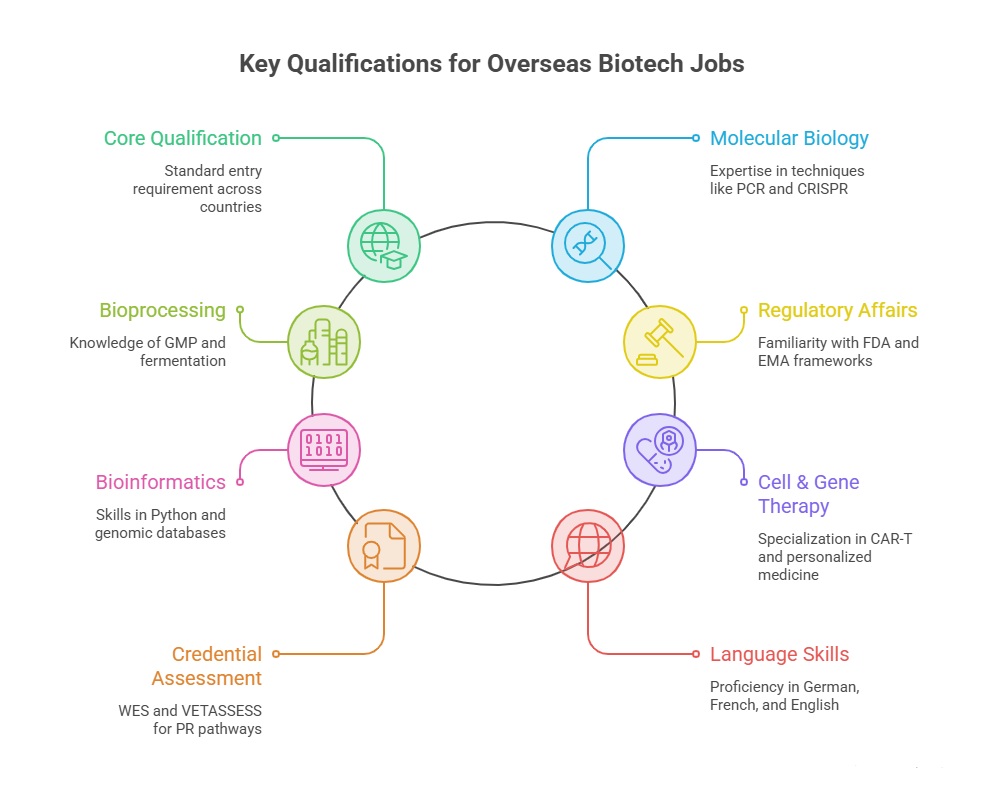
Here are the key qualifications and skills to build before applying for overseas biotech roles:
- Core qualification: A B.Tech/M.Tech/M.Sc in Biotechnology, Microbiology, Biochemistry, or a related life sciences degree is the standard entry requirement across all 10 countries
- Molecular biology and genomics expertise: Proficiency in techniques such as PCR, CRISPR gene editing, next-generation sequencing, and recombinant DNA technology
- Bioprocessing and biomanufacturing: GMP (Good Manufacturing Practice) knowledge, upstream/downstream processing, and fermentation technology are essential for biomanufacturing-heavy markets
- Regulatory affairs knowledge: Familiarity with FDA, EMA, HPRA, or TGA regulatory frameworks is highly valued for roles involving drug approval and compliance
- Bioinformatics and computational skills: Python, R, and familiarity with genomic databases are increasingly expected as AI-driven drug discovery reshapes the industry
- Cell and gene therapy specialisation: Growing demand for expertise in CAR-T therapy, viral vector manufacturing, and personalised medicine
- Credential assessment for PR pathways: WES Educational Credential Assessment (Canada Express Entry, mandatory); VETASSESS skills assessment (Australia points-tested PR
- Language skills: German B1 for the fastest EU Blue Card PR route in Germany; French proficiency valuable for Quebec's biotech cluster in Canada; English proficiency (IELTS Academic 7.0+) for Canada Express Entry and Australia's points test
Which Country Is Right for Your Biotechnologist Career?
The right country to migrate abroad as a Biotechnologist depends on your specialisation, salary expectations, and PR goals.
The table below helps you identify the best country based on your specific priorities:
| Your Priority | Recommended Country |
|---|---|
| Highest Gross Salary | Switzerland – Offers annual salaries of CHF 85,000–140,000 or more, particularly in Basel's globally renowned pharmaceutical and biotechnology ecosystem. |
| Fastest Pathway to Long-Term Residence in Europe | Ireland – The Critical Skills Employment Permit can lead to Stamp 4 permission after two years, with excellent opportunities in the country's leading biopharmaceutical manufacturing sector. |
| Fastest Points-Based Permanent Residence | Canada – Eligible biotechnology professionals can apply through Express Entry, with many successful applicants obtaining permanent residence within approximately 1–3 years. |
| Best Destination for Biomanufacturing Careers | Ireland and Denmark – Both countries host major global pharmaceutical manufacturers and offer strong career opportunities in biologics, bioprocessing, and advanced manufacturing. |
| Best EU Country for Biotechnology Careers | Germany – Provides access through the EU Blue Card and offers excellent opportunities with leading biotechnology and pharmaceutical companies such as Bayer, BioNTech, and Merck KGaA. |
| Best Biotechnology Hub in Asia-Pacific | Singapore – Home to the A*STAR research ecosystem and Biopolis, with strong demand for biotechnology professionals and established Employment Pass pathways. |
| Best Points-Tested Skilled Migration Option | Australia – Life Scientist occupations are included on Australia's skilled occupation lists, providing pathways to permanent residence through Subclass 189 and Subclass 190 visas. |
| Largest Biotechnology Job Market | United States – Boston-Cambridge, the San Francisco Bay Area, and other major life sciences hubs offer the widest range of biotechnology careers and the highest long-term salary potential. |
| Best English-Speaking Destination in Europe | Ireland and the United Kingdom – Both countries offer English-speaking workplaces, globally recognised pharmaceutical industries, and structured skilled worker immigration pathways. |
| Long-Term Career Stability | Netherlands – Home to the Leiden Bio Science Park and a strong biotechnology ecosystem, with long-term opportunities through the Highly Skilled Migrant programme and EU Blue Card pathway. |
Want to get your Biotechnologist profile assessed? Try Y-Axis Free Eligibility Assessment to evaluate your profile. Call +91-7670800000.
Watch: Top Countries Offering Work Permits and PR Pathways in 2026
The global biotech job market is evolving rapidly. Countries are expanding shortage occupation lists, launching new visa fast-tracks, and competing aggressively for experienced Biotechnologists from India.
Watch the Y-Axis Podcast to explore the latest overseas biotech career opportunities, high-demand roles, work visa pathways, salary benchmarks, and permanent residence options in the world's strongest biotech markets.
Watch To Know More: Want to Work, Study, or Settle Abroad? Watch This First!
Discover expert guidance on working, studying, and settling abroad. Learn about visa options, eligibility, and the best pathways to achieve your global career and immigration goals.
How to Migrate Abroad as a Biotechnologist from India?
Migrating abroad as a Biotechnologist from India starts with identifying your target qualification pathway alongside your work visa route and PR strategy. Indian Biotechnologists can target countries via the Employer-Sponsored route (work visa with PR pathway) or the Independent Points-Based route depending on the country selected.
The steps to migrate abroad as a Biotechnologist for Indians are as follows:
Step 1: Identify your target country based on your biotech specialisation, salary expectations, PR timeline, and qualification pathway.
Step 2: Choose and begin your international qualification or credential assessment pathway early.
Step 3: Complete your credential assessment as early as possible.
Step 4: Complete your English proficiency test such as IELTS or equivalent proof of English.
Step 5: Build a strong international profile by updating your resume and LinkedIn to reflect molecular biology, bioprocessing, and regulatory expertise, along with any publications.
Step 6: Apply for biotech roles through LinkedIn, specialist life sciences recruiters, and country-specific platforms.
Step 7: Secure a job offer meeting the visa salary threshold for your target country.
Step 8: Submit your work visa or work permit application with all required documents such as passport, biotech qualification certificates, employment contract, credential assessment (if required), and health insurance.
Step 9: Complete biometrics and any country-specific pre-departure requirements.
Step 10: Upon visa approval, migrate to your preferred country and begin your international biotech career.
Common Mistakes Biotechnologists Make When Applying for Jobs Abroad
Indian Biotechnologists are in demand across Ireland, Germany, Australia, Canada, Singapore, and Denmark. Understanding common mistakes around qualification recognition, credential assessment, salary benchmarking, and visa requirements can significantly improve your chances.
Here are some common mistakes to avoid when applying for overseas biotech roles:
- Don't assume all biotech jobs require licensing – Most R&D, bioprocessing, and quality roles do not.
- Be aware of Switzerland's work permit quotas – Apply directly to major employers with quota allocations.
- Complete your WES assessment early for Canada – It's required for Express Entry and can take time.
- Check the latest Netherlands salary threshold – Ensure your job offer meets the 2026 Highly Skilled Migrant requirement.
- Don't overlook Ireland – It offers strong biomanufacturing opportunities and a fast PR pathway.
- Time your US job search carefully – Apply during periods of stronger biotech hiring and investment.
Are you looking for step-by-step assistance with overseas immigration? Contact Y-Axis, the world's No. 1 overseas immigration consultancy, for end-to-end assistance! Call +91-7670800001.
FAQs
Which are the top 10 countries for Biotechnologists to work abroad?
The top 10 countries for Biotechnologists to work abroad are Germany, Switzerland, Ireland, the UK, Singapore, Denmark, the Netherlands, Australia, Canada, and the USA. Ireland and Canada offer the fastest permanent residency pathways. Switzerland and Denmark provide the highest salaries, driven by Roche, Novartis, and Novo Nordisk. Germany and the Netherlands offer EU Blue Card access with strong biotech and pharma R&D demand. Singapore is Asia-Pacific's leading biotech hub through its A*STAR ecosystem, and the USA remains the world's largest and highest-ceiling biotech job market.
Do Indian Biotechnologists need additional qualifications to work abroad?
In most countries, an Indian B.Tech, M.Tech, or M.Sc in Biotechnology is accepted directly by employers for non-regulated R&D, bioprocessing, and quality roles. However, credential assessments are required for certain PR pathways: WES Educational Credential Assessment is mandatory for Canada's Express Entry, and a VETASSESS skills assessment is required for Australia's points-tested PR routes. Regulated roles — such as clinical or pharmaceutical licensing positions — may require additional local recognition, for example through Ireland's Health Products Regulatory Authority (HPRA). A PhD or strong publication record significantly strengthens applications for research-focused roles, particularly in the UK, Switzerland, and the USA.
Which country offers the fastest PR for Biotechnologists?
Ireland offers the fastest PR pathway in Europe for Biotechnologists — the Critical Skills Employment Permit leads to Stamp 4 (Ireland's permanent residence equivalent) in just two years, supported by the country's dense biopharma manufacturing base including Pfizer, Regeneron, and MSD. Canada offers the fastest points-based PR globally through Express Entry under the Biologists and related scientists classification, with PR achievable in 1 to 3 years. Australia offers a comparable timeline of 2 to 4 years through MLTSSL-listed Life Scientist occupations via Subclass 189, 190, or employer-sponsored Subclass 186 visas.
What is the average salary for Biotechnologists in Switzerland?
Biotechnologists in Switzerland earn among the highest salaries globally, ranging from CHF 85,000 to CHF 140,000 per year depending on experience and specialisation. Entry-level scientists typically earn CHF 75,000 to CHF 90,000, while senior scientists in Basel's Roche and Novartis ecosystem earn CHF 110,000 to CHF 140,000. R&D directors and principal scientists can command CHF 150,000 to CHF 200,000 or more. Switzerland's high salaries reflect both the concentration of global pharma R&D headquarters in Basel and the country's overall high cost of living, alongside comparatively low income tax rates for many cantons.
Is Ireland a good destination for Biotechnologists focused on biomanufacturing?
Yes. Ireland is one of the world's most important biopharmaceutical manufacturing hubs, hosting major production facilities for Pfizer, Regeneron, MSD, and Bristol Myers Squibb, largely concentrated around Dublin and Cork. Biomanufacturing, bioprocessing, and quality assurance roles are in particularly strong demand. The Critical Skills Employment Permit frequently covers biotechnology and pharma manufacturing occupations, and crucially, leads to Stamp 4 permanent residence status in just two years — the fastest such pathway in Europe. Ireland's biopharma sector also operates entirely in English, removing language barriers that exist in many other European destinations.
What is the EU Blue Card and how does it help Biotechnologists in Germany?
The EU Blue Card is Germany's fast-track residence permit for highly qualified non-EU professionals, with a general salary threshold of approximately EUR 45,300 per year, though shortage occupations including natural scientists may qualify at a lower threshold. Germany's biotech sector, anchored by Bayer, BioNTech, and Merck KGaA, actively recruits international Blue Card holders for R&D, bioprocess engineering, and vaccine development roles. Blue Card holders can apply for permanent settlement in just 21 months with B1-level German proficiency, or 33 months without German language skills, making it one of the fastest EU permanent residency routes available to Biotechnologists.
Can Indian Biotechnologists qualify for Australia's MLTSSL and access direct PR?
Yes. Life Scientist occupations, which cover biochemists and molecular biologists relevant to Biotechnologists, are listed on Australia's Medium and Long-term Strategic Skills List (MLTSSL) under the ANZSCO 2342 occupation group. MLTSSL listing provides access to the full range of permanent residency pathways, including Subclass 186 Employer Nomination, Subclass 189 Skilled Independent, and Subclass 190 State Nominated visas. A VETASSESS skills assessment is required for points-tested PR pathways. CSL Limited, headquartered in Melbourne, is one of the world's largest biotech companies and a significant sponsor of skilled visas for international biotech professionals.
What is the Netherlands Highly Skilled Migrant visa for Biotechnologists?
The Netherlands Highly Skilled Migrant (HSM) visa allows Dutch employers to sponsor qualified foreign professionals without a labour market test, provided a minimum salary threshold is met. As of 2026, this threshold is EUR 5,942 per month for applicants aged 30 and above, and EUR 4,357 per month for those under 30. The Netherlands hosts a strong biotech ecosystem centred on the Leiden Bio Science Park. Notably, 2026 industry reports specifically flag biotechnology as a sector where employers may need to raise salaries to remain competitive against these rising thresholds, so applicants should verify current offers carefully before accepting.
What are the top biotech job recruitment platforms for working abroad?
Leading platforms for international biotech and life sciences roles include LinkedIn for direct employer applications globally; Nature Careers and Science Careers for academic and research-focused biotech roles; company career pages for major employers such as Roche, Novartis, Novo Nordisk, Pfizer, and CSL Limited; BioSpace for US-focused biotech listings; Seek for Australian biotech and life sciences roles; and A*STAR's careers portal for Singapore-based research positions. Specialist life sciences recruiters such as SThree and Real Staffing also place candidates across Europe, the UK, and the USA for R&D, bioprocessing, and regulatory affairs roles.
How does Y-Axis help Indian Biotechnologists work abroad?
Y-Axis provides complete overseas immigration support for Indian Biotechnologists at every stage: free eligibility assessment to identify the best country and visa route based on your specialisation (R&D, bioprocessing, regulatory affairs, or quality), salary expectations, and PR goals; credential assessment guidance for WES (Canada) and VETASSESS (Australia); work visa application support for the Critical Skills Employment Permit (Ireland), EU Blue Card (Germany/Netherlands), Skilled Worker Visa (UK), Employment Pass (Singapore), and H-1B (USA); resume marketing to connect your biotech profile with international pharma and biotech employers; and post-visa settlement support. Y-Axis has 25+ years of experience helping Indian life sciences professionals build global careers.
Tags:
biotechnology jobs abroad
biotechnologist jobs overseas
biotech salary abroad
biotech work visa
biotech PR pathway
migrate as a biotechnologist
overseas biotech careers
biotech immigration India
life sciences jobs abroad
pharma biotech careers
Share
Options for you by Y-Axis

Get it on your mobile

Get News alerts

Contact Y-Axis
Latest Article
Popular Post
Trending Article
Posted On October 09 2026
Canada’s Immigration Reset: Why the Next Move May Be About Fit, Not Volume