

Don't know what to do ?
Get Free Counseling
Last Updated 10 September 2026
Highest paying Jobs in Australia
Australia is one of the best countries for skilled professionals who want to work abroad. It offers a strong economy, good salaries, a high quality of life, and many career opportunities. There is a high demand for skilled workers in industries such as healthcare, information technology (IT), engineering, construction, education, and skilled trades.
Australia has around 350,000 job vacancies, creating many opportunities for qualified professionals from other countries. Under the 2025–26 Migration Programme, the Australian Government has allocated 185,000 permanent migration places, with most of them reserved for skilled workers.
For Indian professionals, Australia offers high-paying jobs, employer-sponsored work visas, clear pathways to permanent residency (PR), and excellent career growth opportunities. The table below provides a quick overview of Australia's job market, including the country's average salary, available job opportunities, major hiring industries, and work visa options for skilled professionals.
| Factor | Details |
|---|---|
| Capital | Canberra |
| Currency | Australian Dollar (AUD) |
| Estimated Job Vacancies | Approximately 350,000 |
| Average Full-Time Salary | AUD 90,800 per year |
| Income Tax | Progressive tax system |
| Largest Hiring Industries | Healthcare, IT, Engineering, Construction, Education, Finance, Mining |
| Work Visa Required | Yes |
| Employer Sponsorship Available | Yes |
| Skilled Migration Available | Yes |
*Know more about job salaries in Australia
In-demand Job Opportunities in Australia
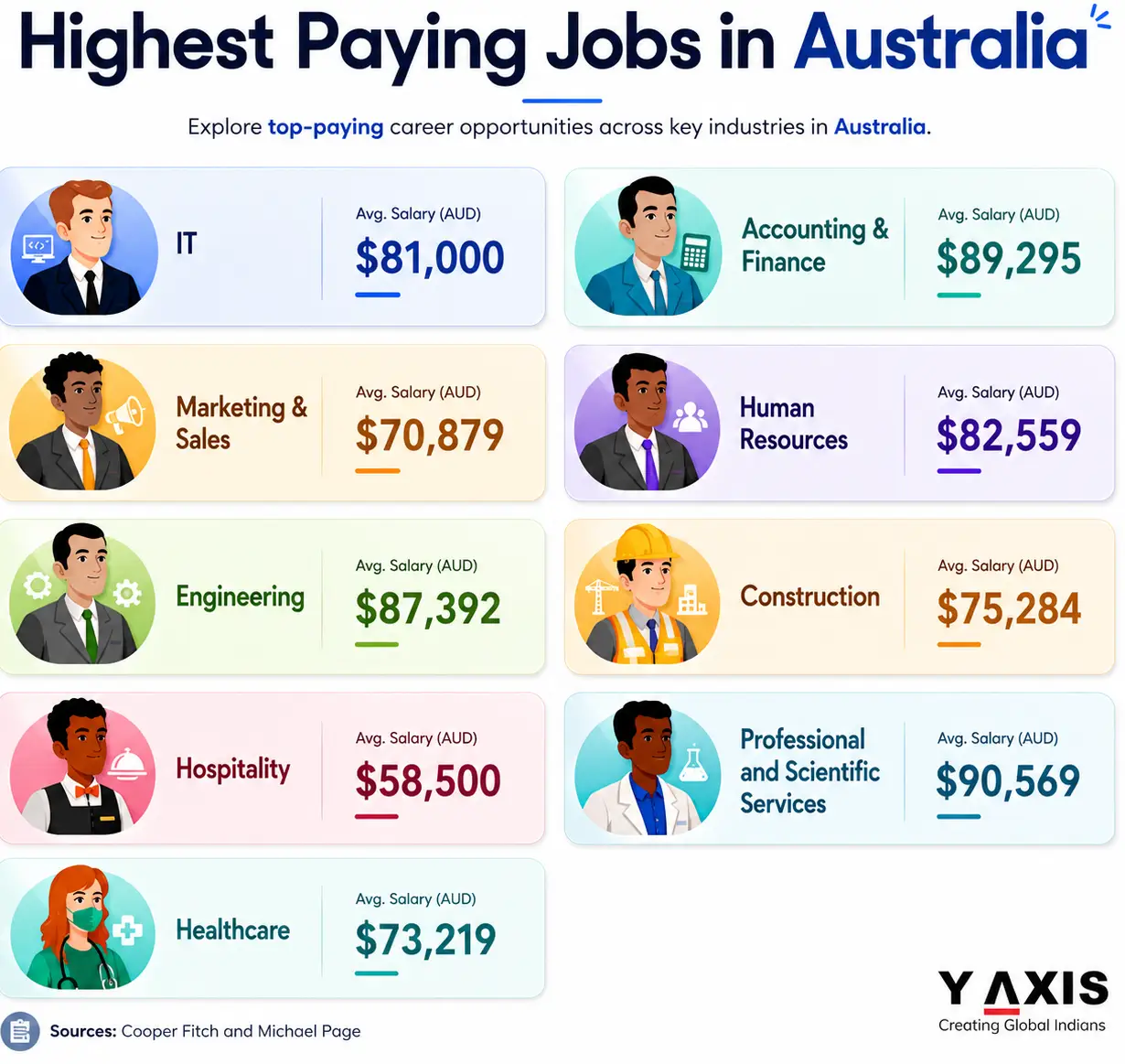
Australia offers competitive salaries across several high-demand industries. The table below provides an overview of the average annual salary ranges.
| Industry | Average Annual Salary (AUD) |
|---|---|
| Information Technology | AUD 81,000 – 149,000 |
| Marketing & Sales | AUD 71,000 – 165,000 |
| Engineering | AUD 87,000 – 180,000 |
| Hospitality | AUD 59,000 – 114,000 |
| Healthcare | AUD 73,000 – 160,000 |
| Accounting & Finance | AUD 89,000 – 163,000 |
| Human Resources | AUD 83,000 – 131,000 |
| Education & Teaching | AUD 75,000 – 160,000 |
| Professional & Scientific Services | AUD 91,000 – 109,000 |
Job Vacancy at Australia
Australia is expected to have strong job growth by 2030 as more skilled workers are needed in different fields. Sectors like healthcare, education, and technology will create the most new jobs in the coming years. Below is the list of job vacancies in Australia by 2030 for some top occupations:
| Occupation | No. of Jobs by 2030 |
|---|---|
| Aged Care Takers | 2,52,000 |
| Nursing & Healthcare | 1,50,000 |
| Teaching | 1,32,000 |
| Software Development | 1,10,000 |
| Digital Marketing | 78,000 |
| Web Development | 69,000 |
| Data Analytics | 59,000 |
| Cybersecurity | 53,000 |
Source: Jobs and Skills Australia (JSA) — Employment Projections 2025, produced by Victoria University for JSA. Full projections available at: jobsandskills.gov.au/data/employment-projections
*Also, read...
What are the most in-demand jobs in Australia for the next 10 years?
Step to find Jobs in Australia from India
Step 1: Search for jobs in Australia on trusted websites like LinkedIn, Indeed, SEEK, Jora, Adzuna, and Glassdoor.
Step 2: Look for Australian companies that hire foreign professionals and offer visa sponsorship, especially in fields like IT, engineering, healthcare, construction, and hospitality.
Step 3: Make a clear and simple CV and cover letter highlighting your education, skills, and work experience. Having good English communication skills increases your chances.
Step 4: Apply for jobs directly on company websites or through recruitment agencies that help international professionals find jobs in Australia.
Step 5: Attend online interviews and clearly explain your experience, qualifications, and why you want to work in Australia.
Step 6: Once you receive a job offer, your employer will guide you with the documents needed for the Australia Work Visa (such as the TSS 482 visa or Skilled Visa).
Step 7: After your work visa is approved, finalize your travel plans, book your flight, and move to Australia to start your new job.
*Also, read...
How to find jobs in Australia from India?
Why Work in Australia?
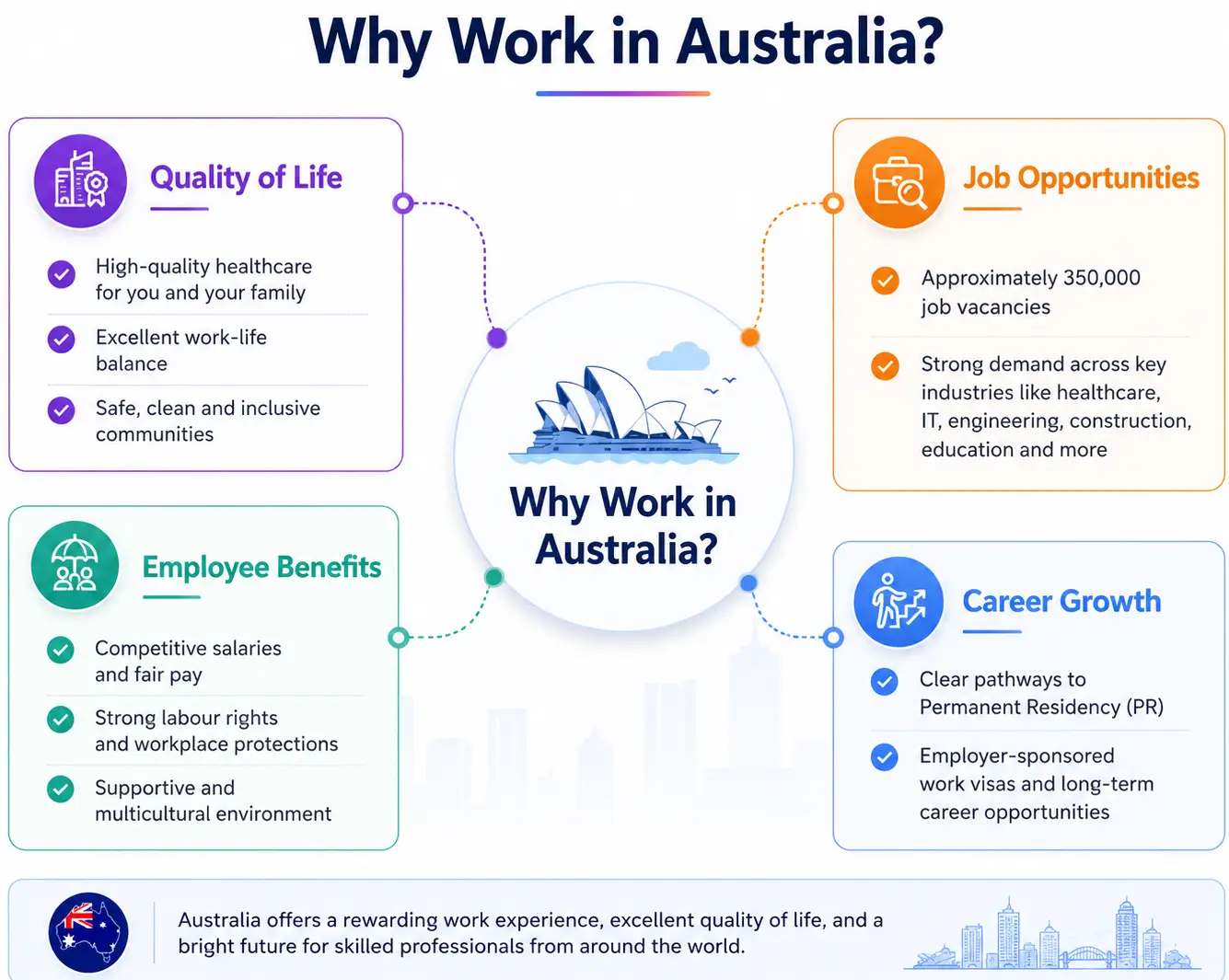
Australia is one of the best countries to work because it offers a good work-life balance, attractive employee benefits, and excellent career growth. The country is creating more jobs as it continues to invest in industries like healthcare, construction, renewable energy, technology, and infrastructure. This has increased the demand for skilled workers in many sectors.
- Competitive salaries across major industries
- Approximately 350,000 job vacancies
- Clear pathways to Permanent Residency (PR)
- Employer-sponsored work visa options
- High quality healthcare and education
- Strong labour rights and workplace protections
- Multicultural working environment
- Excellent work-life balance
- Opportunity to bring eligible family members
- Global career exposure
Australia Migration Programme
Australia continues to prioritise skilled migration to address labour shortages and support long-term economic growth.
- 185,000 permanent migration places
- Around 71% of places allocated to the Skilled Stream
- Continued focus on employer-sponsored migration
- Greater opportunities for skilled professionals in healthcare, engineering, IT, education, and construction
- Multiple pathways to permanent residence through employer-sponsored and points-tested visas
The Migration Programme reflects Australia's ongoing need for skilled overseas professionals to fill workforce shortages across critical sectors.
*Also, read...
1 Million Jobs in Australia Over the Next Decade: Job Outlook and Work Visa Options
Australia Work Permit
Candidates can work in Australia for a temporary period or migrate permanently. After getting a work visa, candidates can live and work in Australia. Candidates should be able to boost the economy of Australia.
Candidates must follow the eligibility criteria and understand the processes to apply for a work visa in Australia. In order to migrate to Australia, candidates must check their eligibility criteria through the points system. Candidates must score a minimum of 65 points to become eligible for a visa.
*Check your eligibility to Australia with the Y-Axis Australia Skilled Immigration points calculator.
Types of Australia Work Visas
Australia offers several visa options for people who want to work in Australia, either temporarily or permanently. Each visa type has its own purpose, eligibility, and benefits depending on your skills, experience, and employment situation. Here are some of the main work in Australia visa categories:
A permanent visa is designed for skilled professionals who are not sponsored by an employer, state, or family member. This visa follows a points-based system, and applicants must have an occupation listed on the Skilled Occupation List.
A state-nominated permanent visa that allows skilled workers to live and work in Australia. Applicants must be nominated by an Australian state or territory and meet the points test requirements.
This visa allows skilled workers to live and work in regional areas of Australia. It can be obtained through a state nomination or a family sponsorship and can lead to permanent residency after meeting certain criteria.
Replacing the former Temporary Skill Shortage (TSS) visa, the SID visa allows employers to sponsor skilled workers for temporary employment in Australia. It’s ideal for filling roles where there is a skill shortage in the local workforce.
This visa is for skilled workers who are sponsored by an employer in regional Australia. It aims to address skill shortages outside major cities and can be a pathway to permanent residency.
A popular visa among international students, this allows graduates to stay and work in Australia temporarily after completing their studies, helping them gain local work experience.
For young people aged 18 to 30 years from eligible countries, this visa allows you to work and travel in Australia for up to 12 months, combining work experience with leisure.
This visa is for individuals taking part in short-term professional or cultural programs, including research, sports, and community events.
A short-term visa for highly skilled professionals who need to visit Australia for specialized or project-based work for up to three months.
For individuals visiting Australia under government agreements or exchange programs, supporting diplomatic and international cooperation activities.
Designated Area Migration Agreement (DAMA)
Under the Designated Area Migration Agreement (DAMA), employers can employ skilled and semi-skilled workers. The employment will be done for positions where employers are not getting skilled workers in Australia. The agreement has been made to deal with the increasing labor shortage. Currently, there are 12 places where DAMA is being applied, and these places include:
- Adelaide City Technology and Innovation Advancement, SA
- East Kimberley, WA
- Far North Queensland, QLD
- Goulburn Valley, VIC
- Great South Coast, VIC
- Northern Territory, NT
- Orana, NSW
- Pilbara, WA
- South Australia Regional, SA
- Southwest, WA
- The Goldfields, WA
- Townsville, QLD
*Read more....
Australia announces the new Designated Area Migration from March 2025 to 2030
Requirements for Australia Work Visa
Australia has many work visas, each with separate requirements. Some of the requirements are based on the points system. Employers will need a visa depending on the type of work they have been invited to and the duration they want to stay in the country. Employees who have applied for an ENS visa must show the skills needed for a particular job through skills assessment.
Other requirements to get a work visa are as follows:
- A valid passport with at least 6 months’ validity.
- A confirmed job offer from an Australian employer.
- Must have skills, qualifications, and work experience in an occupation listed on Australia’s Skilled Occupation List.
- Work experience in your field, or strong skills if you are a fresher.
- English language proficiency (IELTS, PTE, or equivalent).
- Must score a minimum of 65 points on the points-based system based on age, education, experience, and other factors.
- Health insurance covering your stay in Australia.
- Police clearance certificate.
- Must be under 45 years old
- Proof of financial stability to support yourself until you start earning.
- Willingness to work in regional areas if required.
Other criteria
- Candidates need to have at least three years of experience.
- The age of the candidates should be below 45 years.
- Candidates have to read the booklet of Life in Australia
- Candidates have to sign the Australia Values Statement
*Want to migrate to Australia? Let Y-Axis guide you with the steps.
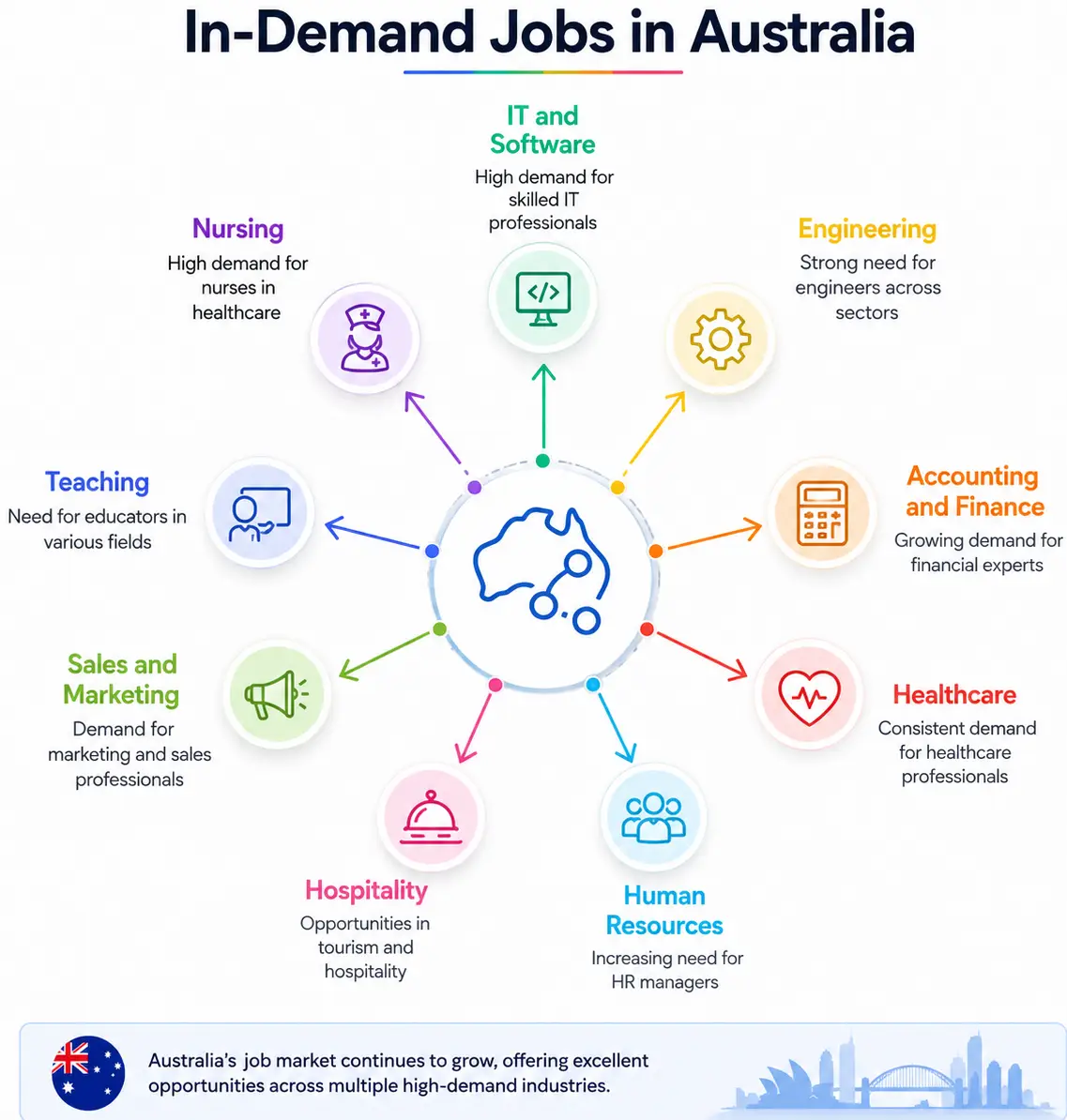
In-demand Job Opportunities in Australia for Indians
IT and Software Jobs in Australia
The jobs in the IT sector are booming everywhere. There is a massive demand for IT professionals, and hence, people who are willing to settle overseas with PR can migrate immediately. Making a move to immigrate to Australia as an IT professional gives you a new lease on life. Many tech companies are providing jobs to freshers and experienced skilled workers in Australia. There are numerous software engineer jobs in Australia and if you want to settle abroad, you can choose Australia to settle along with your family. Some of the highest paying IT jobs are listed below:
| Job Role | Average Annual Salary (AUD) | Average Annual Salary (INR) |
|---|---|---|
| IT Security Architect | AUD 140,000 – 250,000 | ₹84 lakh – ₹1.5 crore |
| IT Manager | AUD 140,000 – 180,000 | ₹84 lakh – ₹1.08 crore |
| Cloud Solutions Architect | AUD 130,000 – 200,000 | ₹78 lakh – ₹1.2 crore |
| Enterprise Architect | AUD 150,000 – 220,000 | ₹90 lakh – ₹1.32 crore |
| DevOps Engineer | AUD 120,000 – 160,000 | ₹72 lakh – ₹96 lakh |
| Data Scientist | AUD 120,000 – 160,000 | ₹72 lakh – ₹96 lakh |
| AI / Machine Learning Engineer | AUD 120,000 – 160,000 | ₹72 lakh – ₹96 lakh |
| Software Engineer / Developer | AUD 100,000 – 150,000 | ₹60 lakh – ₹90 lakh |
| Network / Systems Engineer | AUD 100,000 – 140,000 | ₹60 lakh – ₹84 lakh |
| Database Administrator | AUD 100,000 – 140,000 | ₹60 lakh – ₹84 lakh |
*Searching for It jobs in Australia? Avail Y-Axis Resume Marketing services for working in Australia.
Engineering Jobs in Australia
Australia’s engineering sector offers a variety of specializations across government, private companies, educational institutions, and independent practices. Skilled engineers in these fields are in high demand, with some roles among the highest-paying jobs in the country.
| Role | Average Annual Salary (AUD) | Average Annual Salary (INR) |
|---|---|---|
| Aerospace Engineer | AUD 83,800 – 115,000 | ₹50.3 lakh – ₹69 lakh |
| Biomedical Engineer | AUD 80,000 – 90,000 | ₹48 lakh – ₹54 lakh |
| Chemical Engineer | AUD 85,000 – 100,000 | ₹51 lakh – ₹60 lakh |
| Civil Engineer | AUD 90,000 – 110,000 | ₹54 lakh – ₹66 lakh |
| Design Engineer | AUD 100,000 – 120,000 | ₹60 lakh – ₹72 lakh |
| Electrical Engineer | AUD 110,000 – 130,000 | ₹66 lakh – ₹78 lakh |
| Environmental Engineer | AUD 85,000 – 95,000 | ₹51 lakh – ₹57 lakh |
| Industrial Engineer | AUD 100,000 – 135,000 | ₹60 lakh – ₹81 lakh |
| Mechanical Engineer | AUD 113,659 | ₹68 lakh |
| Mining Engineer | AUD 145,000 | ₹87 lakh |
| Project Engineer | AUD 125,000 | ₹75 lakh |
| Software Engineer | AUD 122,640 | ₹73.6 lakh |
Source: Talent site
*Searching for Engineering jobs in Australia? Avail Y-Axis job search services for working in Australia.
Accounting and Finance Jobs in Australia
Australia’s finance sector offers strong opportunities for professional growth and career development. It is in high demand, with many roles in accounting, investment, and insurance. Surveys show that finance professionals in Australia are highly satisfied with their jobs, not just because of good salaries, but also due to career progression and skill development. Over time, many professionals were promoted to senior financial management positions.
| Role | Average Annual Salary (AUD) | Average Annual Salary (INR) |
|---|---|---|
| Accountant | AUD 79,453 | ₹46.3 lakh |
| Accounting Manager | AUD 130,000 | ₹75.8 lakh |
| Accounts Payable Specialist | AUD 95,796 | ₹55.9 lakh |
| Accounts Receivable Specialist | AUD 72,164 | ₹42.1 lakh |
| Auditor | AUD 85,176 | ₹49.7 lakh |
| Controller | AUD 105,700 | ₹61.6 lakh |
| Payroll Specialist | AUD 105,714 | ₹61.6 lakh |
| Tax Accountant | AUD 80,612 | ₹47.0 lakh |
| Administrative Assistant | AUD 68,367 | ₹39.8 lakh |
| Data Entry Clerk | AUD 63,375 | ₹36.9 lakh |
| Office Manager | AUD 88,824 | ₹51.8 lakh |
| Project Manager | AUD 125,000 | ₹72.9 lakh |
| Health and Safety Officer | AUD 86,492 | ₹50.5 lakh |
| Human Resources Officer | AUD 78,735 | ₹45.9 lakh |
| Recruiter | AUD 85,000 | ₹49.6 lakh |
Source: Talent site
*Searching for Accountant jobs in Australia? Avail Y-Axis job search services for working in Australia.
Healthcare Jobs in Australia
The healthcare sector in Australia has a high demand for workers because the country values good health and well-being. Jobs in nursing and aged care are especially needed, making nursing one of the most in-demand professions in Australia. Some of the highest paying job roles in healthcare are listed below:
| Role | Average Annual Salary (AUD) | Average Annual Salary (INR) |
|---|---|---|
| General Practitioner (GP) | AUD 100,000 – 150,000 | ₹58.3 – ₹87.5 lakh |
| Psychiatrist | AUD 236,055 | ₹137.6 lakh |
| Registered Nurse | AUD 85,000 – 95,000 | ₹49.5 – ₹55.4 lakh |
| Nurse Practitioner | AUD 140,000 – 155,000 | ₹81.6 – ₹90.3 lakh |
| Occupational Therapist | AUD 85,000 – 100,000 | ₹49.5 – ₹58.3 lakh |
| Physiotherapist | AUD 85,000 – 100,000 | ₹49.5 – ₹58.3 lakh |
| Psychologist | AUD 95,000 – 110,000 | ₹55.4 – ₹64.3 lakh |
| Sonographer | AUD 143,392 | ₹83.6 lakh |
| Aged Care Worker | AUD 54,000 – 66,000 | ₹31.5 – ₹38.5 lakh |
| Medical Specialist | AUD 200,000 – 600,000 | ₹116.5 lakh – ₹349.5 lakh |
*Searching for Healthcare jobs in Australia? Avail Y-Axis job search services to find the right one.
Human Resources Management Jobs in Australia
A career in human resource management will allow individuals to be at the forefront of an organization. These individuals can work across many departments and that is the reason it is an in-demand career. The Department of Employment in Australia expects around 65,900 job openings by 2024. The average salary of an HR manager in Australia is $128,128 per annum.
*Searching for Human Resource Management jobs in Australia? Avail Y-Axis job search services for working in Australia.
Hospitality Jobs in Australia
The hospitality industry in Australia generates a GDP of around 10.4 percent and has employed around 320 million people. As the industry grows at a fast pace, thousands of workers are needed every year. Australia is facing a shortage of skilled workers at senior and management levels in all areas of the hospitality industry.
*Searching for Hospitality jobs in Australia? Avail Y-Axis job search services to find the right one.
Sales & Marketing Jobs in Australia
The sales and marketing sector has a wide scope in Australia. The country is in dire need of managers, representatives, and many other job roles. The average salary of a sales and marketing manager is AUD 74,272 per annum. The salary of the entry-level positions is AUD 65,000 per annum, and experienced workers get a salary of AUD 110,930.
*Searching for Sales and Marketing jobs in Australia? Avail Y-Axis job search services to find the right one.
Teaching Jobs in Australia
Australia has many private and public educational institutions, and every state and territory has its own education system. Candidates must check the requirements to work as a teacher in a particular state. The salary for a new teacher in Australia is between $65,608 and $69,000, depending on the state where the job is being done.
*Searching for Teaching jobs in Australia? Avail Y-Axis job search services to find the right one.
Nursing Jobs in Australia
The nursing career is in high demand in Australia. Overseas candidates need to complete an initial registration and then choose a nursing career from a wide range of occupations listed below:
- Enrolled Nurse
- Nurse Educator
- Nurse Manager
- Nurse Practitioner
- Nurse Researcher
- Registered Nurse (Aged Care)
- Registered Nurse (Child and Family Health)
- Registered Nurse (Community Health)
- Registered Nurse (Critical care and Emergency)
- Registered Nurse (Developmental Disability)
- Registered Nurse (Disability and Rehabilitation)
- Registered Nurse (Medical Practice)
- Registered Nurse (Medical)
- Registered Nurse (Mental Health)
- Registered Nurse (Paediatrics)
- Registered Nurse (Perioperative)
- Registered Nurse (Surgical)
- Veterinary Nurse
*Searching for Nursing jobs in Australia? Discover the right opportunity with Y-Axis job search services and kickstart your career in Australia.
Core Skills Occupation List (CSOL)
The Core Skills Occupation List (CSOL) is Australia's main occupation list for the Skills in Demand (SID) Visa. It identifies occupations experiencing skill shortages and helps employers sponsor overseas professionals for eligible positions.
The CSOL currently includes 456 occupations across a wide range of industries, such as:
- Healthcare
- Information Technology (IT)
- Engineering
- Construction
- Skilled Trades
- Education
- Finance
- Agriculture
If your occupation is on the CSOL and you meet the eligibility requirements, you may qualify for an employer-sponsored work visa in Australia.
Australia Occupation Shortage List
Australia's Occupation Shortage List (OSL), prepared by Jobs and Skills Australia (JSA), highlights occupations where employers are facing ongoing skill shortages. The list helps the Australian Government understand labour market needs and supports skilled migration planning. The latest OSL identifies 293 occupations experiencing shortages, with 139 occupations remaining in shortage since 2021.
Occupations with High Demand
- Registered Nurses
- Software Engineers
- Civil Engineers
- Electricians
- Secondary School Teachers (STEM)
- Early Childhood Teachers
- Construction Managers
- Heavy Vehicle Mechanics
- Cybersecurity Specialists
Healthcare, engineering, education, skilled trades, and technology continue to report the highest demand for skilled workers.
What is an ANZSCO Code?
The Australian and New Zealand Standard Classification of Occupations (ANZSCO) is the official system used to classify occupations for skilled migration and employment in Australia. Each skilled occupation is assigned a unique 6-digit ANZSCO code, which helps determine visa eligibility and the appropriate skills assessment authority.
ANZSCO codes are used to identify:
- Eligible skilled occupations
- Skills assessment authority
- Skill level of the occupation
- Visa eligibility requirements
- Occupation list classification
For example:
| Occupation | ANZSCO Code |
|---|---|
| Software Engineer | 261313 |
| Civil Engineer | 233211 |
| Accountant (General) | 221111 |
| Registered Nurse | 254499 |
| Electrician (General) | 341111 |
*Read more..
Australia Replaces ANZSCO with OSCA for Job Classification
Skills Assessment Authorities
Before applying for most Australian skilled visas, applicants may need a skills assessment from the relevant assessing authority.
| Occupation | Assessing Authority |
|---|---|
| Information Technology | Australian Computer Society (ACS) |
| Engineering | Engineers Australia (EA) |
| Nursing | Australian Nursing and Midwifery Accreditation Council (ANMAC) |
| Medical Professionals | Australian Health Practitioner Regulation Agency (AHPRA) |
| Accounting | CPA Australia, Chartered Accountants Australia and New Zealand (CA ANZ), Institute of Public Accountants (IPA) |
| Skilled Trades | Trades Recognition Australia (TRA) or VETASSESS (depending on the occupation) |
| Teaching | Australian Institute for Teaching and School Leadership (AITSL) |
Visa Sponsorship Jobs in Australia for Indians
Australia offers thousands of visa sponsorship jobs every year, creating great opportunities for skilled Indian professionals. The country currently faces a shortage of over 350,000 skilled workers, leading many Australian companies to hire foreigners through sponsored visas such as the Temporary Skill Shortage (Subclass 482) and Employer Nomination Scheme (Subclass 186). Employers actively sponsor qualified candidates from India, especially in fields like IT, engineering, healthcare, construction, and education. Most visa-sponsored roles offer salaries starting from AUD 70,000 to 90,000 per year. Australia is one of the few countries that regularly provides visa sponsorship for foreigners, and Indians are among the most preferred professionals due to their strong technical and language skills. These sponsorships often serve as a pathway to permanent residency in Australia.
Steps to apply for Australian Work Permit
Step 1: Check your eligibility
Step 2: Take an approved english test to prove your language proficiency skills
Step 3: Choose the right Australian work visa for your profile
Step 4: Submit your Expression of Interest (EOI) through the SkillSelect
Step 5: If your EOI is selected, you will receive an Invitation to Apply (ITA) for the work visa based on your points and eligibility.
Step 6: Submit your visa application online with all required documents
Step 7: After your visa is approved, move to Australia to start your job
How can Y-Axis assist you?
Y-Axis, the world's top overseas immigration consultancy, provides unbiased immigration services for every client based on their interests and requirements. Our impeccable services at Y-Axis include the following:
- Resume Marketing Services to help you get Jobs in Australia.
- Expert guidance for working in Australia
- Assistance in applying visa
- Coaching Services: IELTS/TOEFL Proficiency Coaching
- Free career consultation; book your slot today!
Other Work Visas:
Y-Axis snapshot
1M
Successful applicants
1500+
Experienced counselors
25Y+
Expertise
50+
Offices
Don't know what to do ?
Get Free Counseling
Looking for Inspiration
Explore what Global Indians have to say about Y-Axis in shaping their future