


Don't know what to do ?
Get Free Counseling
Last Updated: 15-July-2026
Study Masters in Europe: Top Countries, Universities, Fees & Scholarships
Europe has become the best destination for international students who want to study a Master’s degree, especially for Indian professionals who want global exposure and better career opportunities. Europe offers well-known universities, research-focused Master’s programs, and good networking opportunities with international companies.
More than 1.33 million international students study in Europe. Many of them choose programs in science, technology, engineering, and business at the Master’s level. In 2025, over 50,000 Indian students studied in different European countries, with many enrolling in postgraduate programs such as computer science, engineering, data science, and management.
Masters in Europe quick facts:
- Europe offers 5,000+ English-taught Master's programmes across 40+ countries.
- Germany's public universities charge €0 tuition fees, with only a semester fee of about €350.
- The UK hosts 732,285 international students, the highest in Europe.
- Germany has 400,000+ international students, making it one of Europe's top study destinations.
- Germany, the Netherlands, Sweden, France, and Italy accept MOI certificates as an alternative to IELTS at many universities.
- Post-study work visas are available for 2 years in the UK and Ireland, 18 months in Germany, and 1 year in France and the Netherlands.
- Most Master's programmes in Europe take 1–2 years to complete.
- Erasmus Mundus Scholarships can cover 100% tuition fees and provide a €1,000 monthly stipend.
- Most universities require a Bachelor's degree with 55–60% marks for admission.
- Living costs in Europe range from €600 to €1,800 per month, with an average of €900–€1,100 per month.
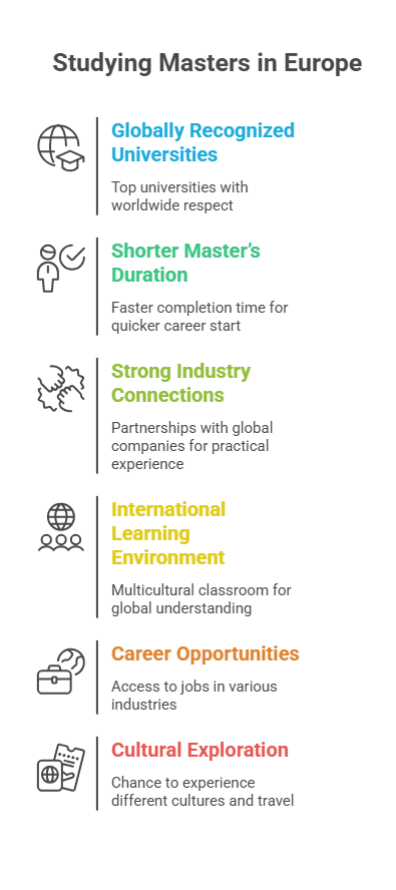
Why Study Masters in Europe?
Studying a Masters in Europe provides students with advanced technical skills, international academic exposure, and career opportunities across global industries.
Globally Recognized Universities
Europe has many top universities that appear in global rankings like QS and Times Higher Education. Degrees from these universities are respected and accepted around the world.
Shorter Master’s Duration
Most Master’s programs in Europe take 1 to 2 years. This allows students to finish their studies faster and start their careers sooner compared to longer programs in some other countries.
Strong Industry Connections
Many European universities work closely with global companies in fields like technology, engineering, finance, consulting, and manufacturing. This helps students gain practical knowledge and job opportunities.
International Learning Environment
Master’s programs in Europe attract students from many different countries. This creates a multicultural classroom, helping students improve their skills, build international networks, and understand global business.
Career Opportunities
Graduates from European Master’s programs often find jobs in industries such as technology, consulting, banking, healthcare, and international trade.
Opportunity to Explore Different Cultures
While studying in Europe, students can visit different countries and experience new cultures. European countries are well connected, making travel easy. This helps students learn about different work styles, meet people from various backgrounds, and gain a global perspective.
*Want to study in Europe? Contact Y-Axis for end-to-end support
Top Countries to Study Masters Degree in Europe
Europe has the best countries that offer high-quality postgraduate education, modern research facilities, and good career opportunities for students.
Masters in the UK
The United Kingdom is one of the most popular countries in Europe for Master's studies. It has many well-known universities that are respected around the world for their education and research. Many students choose the UK because of its high education standards, strong connections with companies, and good job opportunities after graduation. The UK hosted 732,285 international students in the 2024/25 academic year, making it the second most popular destination for international students in the world after the United States. International students make up 51% of all postgraduate students in the UK, which shows how popular the country is for Masters-level education.
- Home to top universities such as the University of Oxford, University of Cambridge, and Imperial College London
- Most Master's programs take only 1 year, so students can finish their degree faster
- Popular fields include research, technology, finance, engineering, and data science
- Students can get internship opportunities, attend networking events, and gain industry experience
- Graduates can stay and work in the UK for 2 years with a post-study work visa
*Want to study in the UK? Y-Axis is here to provide complete guidance!
Masters in Germany
Germany is one of the top countries in Europe for students who want to study a Master's degree. Many international students choose Germany because it has a strong economy, advanced research facilities, and highly respected universities. The country is especially known for its strengths in engineering, technology, innovation, and scientific research. Germany enrolled just over 402,000 international students in the 2024/25 academic year, a 6% increase from the previous year, with India now being the largest sending country with 59,000 students. Germany is projected to reach 500,000 international students by 2028, making it one of the fastest-growing study destinations in the world.
- Most public universities charge no tuition fees for Masters programs, regardless of nationality
- Only a small semester contribution of around €300 is required
- Strong job market in cities like Berlin, Munich, and Frankfurt
- Opportunities to work with global companies in automotive, engineering, finance, and technology sectors
- Post-study work visa of up to 18 months to find a job after graduation
*Want to study in Germany? Y-Axis is here to provide complete assistance!
Masters in France
France is known for its well-respected universities and high-quality education system. Many universities and specialized schools in France are ranked among the top institutions in the world, especially for subjects like engineering, business, and applied sciences. Because of this strong reputation, many international students choose France for their Master’s studies.
France is also one of the most popular study destinations in Europe. About 16% of all international higher-education students in the European Union were studying in France, making it the second largest destination for international students in Europe. The country has a friendly and supportive environment for international students, with many universities offering programs in English and services to help students settle in.
Another important reason students choose France is the affordable cost of education at public universities. Tuition fees are relatively low compared to many other countries, which makes studying in France attractive for students from India and other parts of the world.
- Home to top institutions like Polytechnic School, PSL University, and Paris Institute of Political Studies
- Strong programs in engineering, data science, international business, and sustainability
- Multicultural environment with students from many countries
- Affordable tuition at public universities, with fees starting as low as €170 per year
- Post-study work options available, Indian Master’s graduates can apply for a 1-year APS visa, renewable for another year
*Want to study in France? Y-Axis is here for end-to-end assistance!
Masters in the Netherlands
The Netherlands is a modern and innovative country that attracts many international students for Master’s programs. Universities in the Netherlands are known for their practical teaching style, where students learn through real-life examples, projects, and teamwork. This helps students develop skills that are useful for their future careers.
The country is also a popular study destination for international students. In the 2024/25 academic year, about 131,000 international students were studying in degree programs in the Netherlands, including around 51,800 new students. Many students choose the Netherlands because universities offer a large number of English-taught Master’s programs, especially in fields such as technology, sustainability, and data science.
Students studying in the Netherlands also benefit from a friendly and international environment, modern facilities, and strong connections between universities and companies. These connections help students gain practical experience and better job opportunities after graduation.
- Most Master’s programs are taught in English, making it easier for international students
- Strong focus on innovation, technology, sustainability, and data science
- Universities encourage group discussions, practical projects, and collaboration with industries
- International and welcoming environment with students from different countries
- Post-study work visa available through the Orientation Year Visa for up to 1 year
*Want to study in the Netherlands? Y-Axis is here to provide expert assistance!
Masters in Ireland
Ireland has a strong economy and many international technology and pharmaceutical companies. Many students from Asia choose Ireland for higher education. In fact, students from Asia make up about 40% to 45% of all international students in Ireland, including many from India. Because Ireland has strong connections with global tech companies, it is a good place to study and build a career in technology and business.
- Home to universities like Trinity College Dublin and University College Dublin
- Strong programs in computer science, data analytics, finance, and pharmaceutical sciences
- Many global companies such as Google, Apple, and Meta have their European headquarters in Ireland
- Friendly and welcoming environment for international students
*Willing to study in Ireland? Y-Axis is here to guide you through the process!
Masters in Switzerland
Switzerland is known for its high-quality education system and global research reputation. The country has several world-leading universities offering internationally recognized Masters programs. Switzerland consistently produces some of the highest-ranked universities in the world, particularly in engineering, data science, and life sciences. The country attracts a highly competitive and international student community, with strong career opportunities in banking, finance, and technology after graduation.
- Home to ETH Zurich and EPFL, two of the top-ranked universities in the world
- Strong programs in engineering, data science, finance, and life sciences
- Excellent networking opportunities with global companies
- High quality of life and safe environment
- Strong career opportunities in European and global markets
*Want to study in the Switzerland? Y-Axis is here to provide expert assistance!
Masters in Italy
Italy is becoming a popular choice for Masters studies because it offers quality education at affordable costs. Italian universities provide strong programs in engineering, design, business, and architecture. Italy has 100,000+ international students choosing to study there, with the government actively targeting students from 25 countries for STEM and business Masters programs through its Invest Your Talent initiative, with the government actively targeting students from 25 countries for STEM and business Masters programs through its Invest Your Talent initiative.
- Home to institutions like Politecnico di Milano and Università Bocconi
- Strong programs in engineering, architecture, design, fashion management, and business
- Affordable tuition fees of €0 to €2,000 per year at public universities
- Opportunities to connect with industries such as fashion, design, and manufacturing
- Cultural cities like Milan and Rome provide great student experiences
*Want to study in Italy? Y-Axis is here to provide expert assistance!
Masters in Spain
Spain is a popular destination in Europe for Masters studies. The country is known for its modern universities, affordable living costs, and vibrant student lifestyle. Spain forecasts reaching 200,000 international students by 2030, a 79% increase, driven by low tuition costs and strong demand from Latin America. With affordable public university fees and a welcoming environment, Spain is an increasingly attractive option for Indian students looking for quality education at lower costs.
- Home to institutions like the University of Barcelona and Universitat Autònoma de Barcelona
- Strong programs in engineering, business, international relations, and environmental science
- Affordable tuition fees of €300 to €3,500 per year at public universities
- Opportunities to connect with international companies and business professionals
- Vibrant cities like Madrid and Barcelona offer great student life and cultural experience
*Want to study in Spain? Y-Axis is here to provide complete assistance!
Masters in Sweden
Sweden is known for its modern education system and strong focus on innovation and sustainability. Swedish universities consistently rank among the best in Europe. Sweden is a particularly strong destination for students interested in engineering, sustainable energy, and technology management. The country offers a high quality of life and a welcoming environment for international students from India and across the world.
- Home to institutions like KTH Royal Institute of Technology and Lund University
- Strong focus on innovation, sustainability, engineering, and technology management
- Modern campuses and advanced research facilities
- Friendly and inclusive environment for international students
- Post-study work opportunities available
Willing to study in Sweden? Y-Axis is here to provide personalized guidance!
Masters in Denmark
Denmark offers high-quality education with a focus on creativity, innovation, and research. Universities encourage open discussions, teamwork, and real-world projects. Denmark is especially known for its strengths in sustainable energy, engineering, and data science, and the country consistently ranks among the happiest and safest countries in the world for international students.
- Universities like the Technical University of Denmark (DTU) offer globally recognized Masters programs
- Strong programs in engineering, data science, sustainable energy, and business
- Modern campuses and student-friendly environment
- Opportunities to connect with growing European industries
- Post-study work options available
*Willing to study in Denmark? Y-Axis is here to provide personalized guidance!
IELTS Score Requirements for Masters in Europe
Most European universities require an IELTS score of 6.0 to 6.5 for admission to Master's programmes. Highly ranked universities may ask for 6.5 to 7.0. Many universities in Germany, the Netherlands, Sweden, France, Italy, Finland, and Denmark also accept a Medium of Instruction (MOI) Certificate as an alternative to IELTS.
IELTS Score Requirements for Masters in Europe by Country
| Country | Minimum IELTS Score | Top University Requirement | MOI Accepted | Other Accepted Tests |
|---|---|---|---|---|
| Germany | 6.5 | 7.0 | Yes | PTE 58+, TOEFL 88+ |
| UK | 6.5 | 7.0 | No | PTE 59+, TOEFL 90+ |
| France | 6.0 | 6.5 | Yes | TOEFL 80+ |
| Netherlands | 6.5 | 7.0 | Yes | TOEFL 90+ |
| Sweden | 6.5 | 7.0 | Yes | TOEFL 90+ |
| Ireland | 6.5 | 7.0 | Accepted by some universities | PTE 62+ |
| Italy | 6.0 | 6.5 | Yes | TOEFL 80+ |
| Spain | 6.0 | 6.5 | Accepted by some universities | TOEFL 80+ |
| Finland | 6.0 | 6.5 | Yes | TOEFL 85+ |
| Denmark | 6.5 | 7.0 | Yes | TOEFL 88+ |
Masters in Europe Without IELTS
Indian students can study for a Master's degree in several European countries without submitting IELTS scores. Many universities accept a Medium of Instruction (MOI) Certificate as proof of English language proficiency.
An MOI certificate is an official letter issued by your university confirming that your Bachelor's degree was taught in English. Many European universities accept this certificate instead of IELTS for admission to English-taught Master's programmes.
Masters in Europe Without IELTS – MOI Certificate Acceptance by Country:
| Country | IELTS Waiver Available | Accepted Alternative | Conditions |
|---|---|---|---|
| Germany | Yes | MOI Certificate | Degree must be completed at an English-medium university. Requirements may vary by university. |
| Netherlands | Yes | MOI Certificate | Usually accepted for students who completed an English-taught Bachelor's degree. |
| Sweden | Yes | MOI Certificate | Accepted by many universities for English-medium programmes. |
| France | Yes | MOI Certificate or TCF | Accepted for English-taught programmes. French-taught programmes may require French language proof. |
| Italy | Yes | MOI Certificate | Accepted by many universities offering English-taught Master's programmes. |
| Ireland | Partial | MOI Certificate | Some universities accept MOI, while others may require IELTS or another English test. |
| Finland | Yes | MOI Certificate | Generally accepted for English-taught Master's programmes. |
| Spain | Partial | MOI Certificate | Acceptance depends on the university and programme. |
| United Kingdom | No | IELTS, PTE, or TOEFL | Most universities and visa requirements require an approved English language test. |
| Denmark | Yes | MOI Certificate | Accepted by many universities if the previous degree was taught in English. |
Top Universities in Europe for Masters
Europe is home to many of the world's top-ranked universities. These institutions are known for their high research output, strong industry connections, and focus on innovation and academic excellence. Below is a list of some of the top Masters universities in Europe in 2026 based on QS rankings:
| University | Country | QS World Ranking |
|---|---|---|
| Imperial College London | UK | 2 |
| University of Oxford | UK | 4 |
| University of Cambridge | UK | 6 |
| ETH Zurich | Switzerland | 7 |
| UCL | UK | 9 |
| EPFL | Switzerland | 22 |
| Technical University of Munich | Germany | 22 |
| Université PSL | France | 29 |
| King’s College London | UK | 31 |
| University of Edinburgh | UK | 34 |
| University of Manchester | UK | 35 |
| Institut Polytechnique de Paris | France | 41 |
| Delft University of Technology | Netherlands | 47 |
*Read more....
Most affordable Universities in Europe
Top Masters Programs in Europe
European universities offer a wide range of Masters specializations that match current global industry demands. Masters programs are designed to develop advanced technical knowledge, research skills, and leadership capabilities while allowing students to focus on a specific area.
Many universities provide specializations in fields that are currently in high demand in the global job market, such as Computer Science, Data Science, Artificial Intelligence, Engineering, and Sustainability. These programs combine theoretical knowledge with practical learning through research projects, internships, and industry collaborations.
| Masters Specialization | Universities Where the Course is Popular |
|---|---|
| Computer Science & AI | ETH Zurich (Switzerland), Technical University of Munich (Germany), Imperial College London (UK), University of Edinburgh (UK) |
| Data Science & Analytics | University of Amsterdam (Netherlands), KTH Royal Institute of Technology (Sweden), Politecnico di Milano (Italy), University of Manchester (UK) |
| Electrical & Mechanical Engineering | ETH Zurich (Switzerland), EPFL (Switzerland), TU Delft (Netherlands), KIT (Germany) |
| Business & Management | London Business School (UK), HEC Paris (France), Rotterdam School of Management (Netherlands), IE Business School (Spain) |
| Finance & Banking | University of Oxford – Saïd (UK), University of Cambridge – Judge (UK), Imperial College Business School (UK), Bocconi University (Italy) |
| Sustainable Energy & Environmental Science | DTU (Denmark), Lund University (Sweden), Utrecht University (Netherlands), TU Munich (Germany) |
| Cybersecurity | University of Bristol (UK), TU Delft (Netherlands), KTH Royal Institute of Technology (Sweden), Technical University of Munich (Germany) |
| Biotechnology & Life Sciences | University of Copenhagen (Denmark), ETH Zurich (Switzerland), Heidelberg University (Germany), University of Amsterdam (Netherlands) |
*Confused to choose which course to pursue? Avail Y-Axis course recommendation services to choose the best.
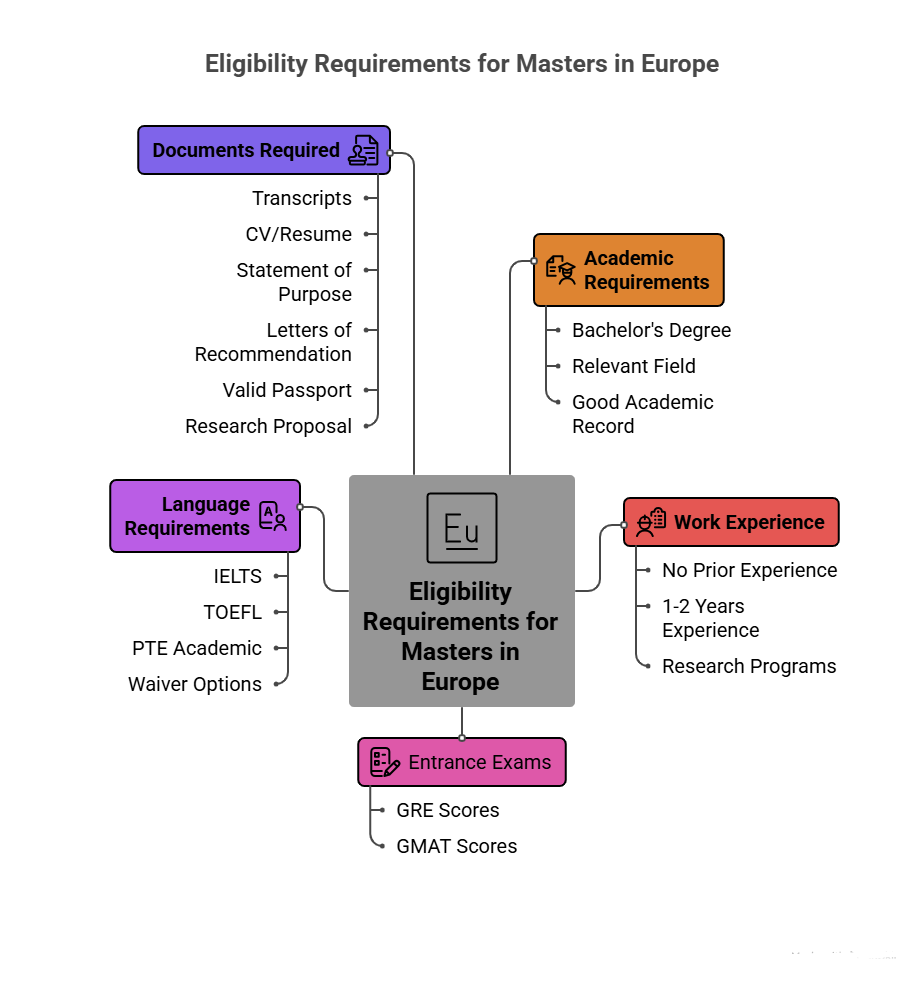
Eligibility Requirements to Study MS in Europe
The eligibility requirements for Masters programs in Europe may vary depending on the country, university, and program. However, most universities follow similar admission criteria for international students.
Academic Requirements
Students must have completed a bachelor's degree from a recognized university or college. The degree should be in a relevant field related to the chosen Masters program. Most universities expect students to have a good academic record or minimum GPA, although the exact requirement may vary depending on the university and program.
Work Experience
Most Masters programs in Europe do not require prior work experience. However, some programs in business, management, and applied sciences may prefer candidates with 1 to 2 years of relevant experience. Research-focused programs generally accept fresh graduates directly.
Entrance Exams
Some universities may require GRE scores for science and engineering programs, or GMAT for business and management programs. However, many European universities do not require these exams and evaluate applicants based on academic performance and motivation letters.
Language Requirements
Since most Masters programs in Europe are taught in English, international students must show proof of their English language ability. Universities usually accept IELTS, TOEFL, or PTE Academic. Some universities in Germany, France, and the Netherlands may waive language test requirements if the applicant completed previous education in English.
Documents Required
- Academic transcripts and certificates from previous education
- Updated CV or resume
- Statement of Purpose (SOP) explaining career goals and reason for choosing the program
- Letters of Recommendation (LOR) from professors or employers
- Valid passport
- Research proposal (for research-based Masters programs)
GPA / Percentage Requirements for Masters in Europe
Most European universities require 55%–60% marks or a CGPA of 5.5–6.0/10 for admission to Master's programmes. Top universities may require 65%–70% or higher. A strong Statement of Purpose (SOP), work experience, research projects, or internships can strengthen an application.
Minimum GPA / Percentage for Masters in Europe by Country
| Country | Minimum Percentage | Minimum CGPA (10-point Scale) | Top University Requirement | Notes |
|---|---|---|---|---|
| Germany | 60% | 6.0/10 | 65–70% | APS certificate required for Indian students |
| UK | 55% | 5.5/10 | 60–70% | Top universities usually require higher grades |
| France | 60% | 6.0/10 | 70% | Some top schools may require GRE scores |
| Netherlands | 60% | 6.0/10 | 65% | Academic records are evaluated individually |
| Sweden | 60% | 6.0/10 | 70% | Competitive programmes may require higher scores |
| Ireland | 55% | 5.5/10 | 65% | Work experience may help for MBA programmes |
| Italy | 55% | 5.5/10 | 60% | Some universities may conduct additional assessments |
| Spain | 55% | 5.5/10 | 65% | GMAT may be required for top MBA programmes |
| Finland | 60% | 6.0/10 | 65% | Motivation letter is important |
| Denmark | 60% | 6.0/10 | 65% | Research-focused programmes may require additional documents |
Process to Study Masters in Europe
Step 1: Choose the country, university, and Masters specialization.
Step 2: Check eligibility requirements and prepare for required exams
Step 3: Prepare application documents such as SOP, CV, and recommendation letters.
Step 4: Submit applications through the university website or application portal.
Step 5: Receive admission or offer letter from the university.
Step 6: Arrange proof of funds and financial documents.
Step 7: Apply for a student visa for the respective country.
Step 8: Prepare travel and accommodation arrangements.
*Want to study Masters in Europe? Sign-up to Y-Axis for complete guidance.
Cost of Studying Masters in Europe
The cost of studying a Master’s in Europe can vary depending on the country, university, and type of program. Europe offers many study options, ranging from tuition-free public universities to well-known private universities with higher fees. In some countries, students pay very little for education, while in others the tuition fees are higher, especially for international students. Students should also plan for living expenses such as accommodation, food, health insurance, and daily costs while studying.
Masters Tuition Fees in Europe
Tuition fees for Master’s programs in Europe can be very affordable compared to countries like the USA or Australia. Some European countries provide free or low-cost education at public universities, while others charge moderate to higher fees depending on the university and program.
| Study Program | Average Tuition Fees |
|---|---|
| Masters Programs | €0 – €25,000 total program cost |
Countries like Germany and Norway offer Master’s programs at public universities with zero tuition fees. France charges low tuition fees, usually between €170 and €3,770 per year, while Italy's public universities charge between €0 and €2,000 per year. Countries such as the Netherlands, Ireland, and the UK generally have higher tuition fees, especially for students from outside the European Union.
Living Costs While Studying Masters in Europe
Besides tuition fees, students also need to plan for monthly living expenses. The cost of living depends on the city, lifestyle, and type of accommodation. Major cities usually have higher costs, while smaller cities are more affordable for students.
| Expense | Average Cost |
|---|---|
| Accommodation | €400 – €1,500 per month |
| Food | €200 – €350 per month |
| Health Insurance | €200 – €1,000 per year |
| Other Expenses | €150 – €600 per month |
Top Scholarships in Europe for Masters
Studying a Master’s in Europe can sometimes be expensive, but many scholarships are available to help international students. These scholarships are offered by European governments, universities, and international organizations to support talented students from different countries.
Scholarships can help cover tuition fees, living expenses, travel costs, and health insurance. Some scholarships provide full funding, while others give partial financial support. These scholarships make it easier for international students, including those from India, to study at top European universities and focus on their education without major financial stress.
| Scholarship | Benefits |
|---|---|
| Erasmus Mundus Scholarship | Full tuition + living expenses |
| Chevening Scholarship (UK) | Full tuition + living costs |
| DAAD Scholarship (Germany) | Monthly stipend + travel support |
| Eiffel Excellence Scholarship (France) | Monthly stipend |
| Holland Scholarship (Netherlands) | €5,000 – €15,000 support |
| Stipendium Hungaricum (Hungary) | Full tuition + accommodation + monthly stipend |
| Swedish Institute Scholarship (Sweden) | Tuition fees + monthly allowance + travel grant |
| Swiss Government Excellence Scholarship (Switzerland) | Monthly stipend + tuition support |
| Ireland Government International Education Scholarship | €10,000 stipend + full tuition waiver |
| Danish Government Scholarship (Denmark) | Partial or full tuition waiver + living allowance |
| Italian Government Scholarship | Monthly stipend + tuition fee support |
*Read more.....
Top Scholarships for Indian Students to Study in Europe
Post-Masters Career Opportunities in Europe
Europe offers many career opportunities for Master’s graduates. Many countries in Europe have strong economies and large international companies that hire skilled professionals. Graduates with a Master’s degree can find jobs in fields such as technology, engineering, research, business, and finance.
European universities also have strong connections with industries, which helps students get internships and job opportunities after graduation. Many graduates start working in multinational companies, research centers, and growing startups across Europe.
The average salary for Master’s graduates in Europe usually ranges between €35,000 and €80,000 per year. However, salaries can be higher depending on the country, industry, job role, work experience, and the university from which the student graduated.
| Role / Career Sector | Average Salary Range in Europe (per year) |
|---|---|
| Technology & Software Engineering | €50,000 – €85,000 |
| Data Science & Artificial Intelligence | €55,000 – €90,000 |
| Engineering (Mechanical / Electrical) | €45,000 – €75,000 |
| Finance & Banking | €45,000 – €75,000 |
| Consulting | €50,000 – €80,000 |
| Research & Academia | €38,000 – €65,000 |
| Cybersecurity | €55,000 – €90,000 |
| Cloud Computing & DevOps | €60,000 – €95,000 |
| Business & Management | €40,000 – €70,000 |
| Marketing & Digital Marketing | €38,000 – €65,000 |
| Healthcare & Biotechnology | €40,000 – €75,000 |
| Supply Chain & Logistics | €40,000 – €70,000 |
*Know more about highest paying jobs in Europe for Indians
Post-Study Work Visa Options in Europe After a Master's Degree
Many European countries allow international graduates to stay after completing their Master's degree to look for jobs or start working. The duration of post-study work visas ranges from 6 months to 2 years, depending on the country. The UK and Ireland offer the longest stay period of 2 years, while Germany provides an 18-month job seeker visa for graduates.
| Country | Visa Name | Duration | Work Rights | Can Lead to PR? |
|---|---|---|---|---|
| UK | Graduate Route Visa | 2 years (3 years for PhD graduates) | Can work for any employer in any role | Yes |
| Germany | Job Seeker Visa | 18 months | Must find a job related to qualifications | Yes |
| Ireland | Third Level Graduate Scheme | 2 years | Full work rights | Yes |
| France | APS Residence Permit | 12 months | Can work while searching for a long-term job | Yes |
| Netherlands | Orientation Year (Zoekjaar) | 12 months | Can work for any employer | Yes |
| Sweden | Post-Study Job Search Permit | 6 months | Can work during the job search period | Yes |
| Finland | Job Search Permit | 12 months | Can work in any role | Yes |
| Denmark | Job Search Permit | 6 months | Full work rights | Yes |
| Italy | Job Search / Self-Employment Visa | 12 months | Can look for jobs or start a business | Yes |
| Spain | Job Search Authorisation | 12 months | Must find a job related to studies | Yes |
Masters in Europe Application Deadlines
Most European universities accept applications for the 2026–27 academic year between January and July 2026, depending on the country and university. Students should apply as early as possible, especially if they need a student visa, scholarship, or accommodation.
| Country | Intake | Application Deadline | Start Date | Status (June 2026) |
|---|---|---|---|---|
| UK | September 2026 | January–June 2026 | September 2026 | Open – Apply Now |
| Germany | Winter 2026–27 | April–July 2026 | October 2026 | Open – Apply Now |
| Germany | Summer 2027 | November 2026 – January 2027 | April 2027 | Opens November 2026 |
| Netherlands | September 2026 | January–April 2026 (most universities) | September 2026 | Check individual university deadlines |
| France | September 2026 | March–June 2026 | September 2026 | Some universities still accepting applications |
| Sweden | September 2026 | January 15, 2026 (most universities) | September 2026 | Deadline closed – Apply for 2027 intake |
| Ireland | September 2026 | Rolling admissions / March–June 2026 | September 2026 | Some universities still accepting applications |
| Italy | October 2026 | April–July 2026 | October 2026 | Open – Apply Now |
| Spain | October 2026 | March–June 2026 | October 2026 | Some universities still accepting applications |
| Finland | September 2026 | January 2026 | September 2026 | Deadline closed – Apply for 2027 intake |
| Denmark | September 2026 | January–March 2026 | September 2026 | Deadline closed – Apply for 2027 intake |
Masters in Europe vs USA vs Canada vs Australia
Europe, especially countries such as Germany and France, offers some of the most affordable Master's programmes in the world. The USA is known for its globally ranked universities and strong career opportunities. Canada and Australia are popular for their post-study work options and easier pathways to permanent residency (PR).
Masters in Europe vs USA vs Canada vs Australia – Key Comparison
| Factor | Europe (Germany) | Europe (UK) | USA | Canada | Australia |
|---|---|---|---|---|---|
| Average Tuition Fees | €0–€3,000 per year | £15,000–£35,000 per year | $25,000–$60,000 per year | CAD 15,000–40,000 per year | AUD 28,000–50,000 per year |
| Course Duration | 1.5–2 years | 1 year | 1.5–2 years | 1–2 years | 1.5–2 years |
| English Language Requirement | IELTS 6.5 or MOI accepted by some universities | IELTS 6.5–7.0 | IELTS 6.5–7.0 | IELTS 6.5–7.0 | IELTS 6.5–7.0 |
| Post-Study Work Permit | Up to 18 months | 2 years | Up to 3 years | Up to 3 years | 2–4 years |
| PR Opportunities | Moderate | Moderate | Limited | Strong | Strong |
| Total Cost (Tuition + Living Expenses) | ₹15–25 lakh | ₹55–80 lakh | ₹80–130 lakh | ₹50–80 lakh | ₹60–90 lakh |
| Part-Time Work During Studies | Up to 120 full days per year (Germany) | 20 hours per week | 20 hours per week (on-campus) | Unlimited hours | Unlimited hours |
| QS Top 100 Universities | 9 (Germany) | 17 | 26 | 6 | 7 |
| Student Visa Approval Rate | 95%+ | 90%+ | 75–85% | 90%+ | 90%+ |
| Language Barrier | Low for English-taught programmes | None | None | None | None |
Build Your Future with a Masters in Europe
Studying a Master’s in Europe is a great option for professionals who want to grow in their careers and gain deeper knowledge in their field. European universities focus on research, practical learning, and innovation, which helps students develop strong skills and prepare for better roles in international companies.
A Master’s program in Europe also helps students build a strong global network. Students study with classmates from many different countries and cultures. This allows them to share ideas, learn new perspectives, and create valuable connections that may help them find job opportunities in different countries after graduation.
Europe is home to many top-ranked universities that offer high-quality education, experienced professors, and strong connections with global industries. Because of its strong economy, presence of international companies, and advanced research environment, Europe has become one of the most popular destinations for postgraduate education. Students who complete their Master’s in Europe often gain better career opportunities, competitive salaries, and the chance to work with leading companies around the world.
How Can Y-Axis Help You?
Y-Axis provides complete guidance for students who want to pursue a Masters in Europe.
- Free counselling on Masters universities and specialization selection
- Assistance with Masters admissions and applications
- Y-Path gives the best suitable ideas about your study and career options
- Coaching services for TOEFL, IELTS, and German language preparation
- Student visa application support
- Pre-departure and accommodation assistance
Don't know what to do ?
Get Free Counseling
Looking for Inspiration
Explore what Global Indians have to say about Y-Axis in shaping their future