

Posted on July 22 2026
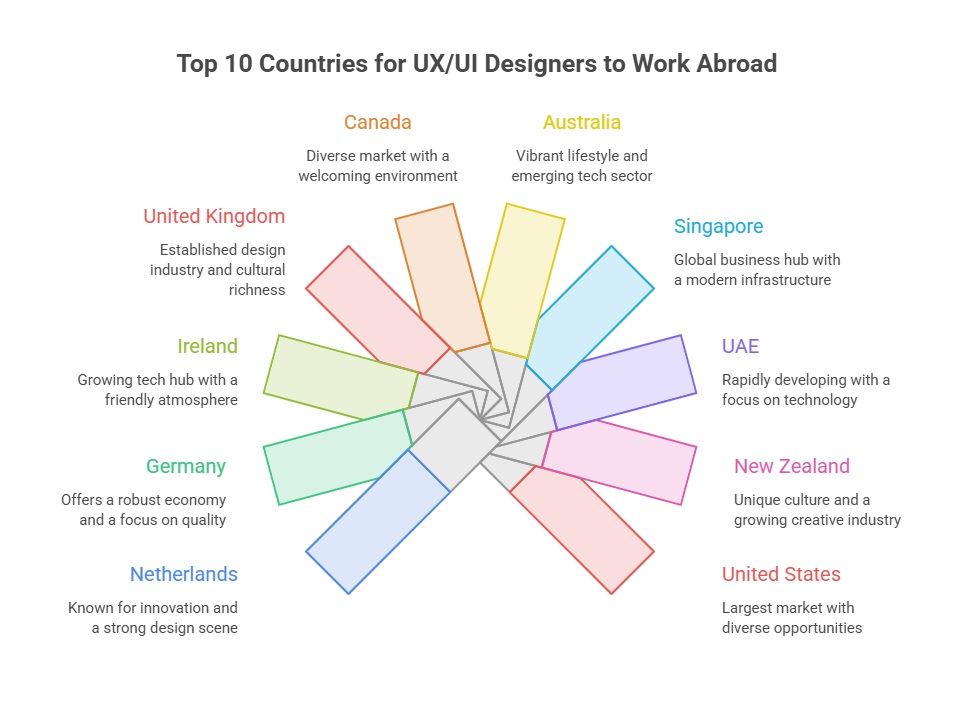
Top 10 Countries for UX/UI Designers to Work Abroad: Salary, Demand & PR Opportunities Compared

By , Editor & Director
Updated August 10 2026
Demand for skilled UX/UI Designers is rising fast as businesses across fintech, e-commerce, SaaS, and consumer technology compete on user experience. Countries across Europe, North America, Asia, and the Gulf are actively recruiting UX/UI Designers to fill product design, design systems, and digital agency roles. The global UX design market is valued at approximately USD 13.06 billion in 2026 and is projected to reach USD 25.69 billion by 2031 (Mordor Intelligence), driven by growing enterprise investment in customer-centred digital products. Indian UX/UI Designers with a strong portfolio are increasingly sought after by product companies, digital agencies, and consultancies abroad. Unlike regulated professions such as healthcare, UX/UI design carries no mandatory licensing requirement in any of these countries — portfolio strength, design-tool fluency, and (for points-based routes) the right occupation code matter far more than a registration exam.
This blog is for you if you are a:
- Qualified Indian UX/UI Designer with at least 1–3 years of professional experience in product design, interaction design, or a digital agency setting
- Designer with specialisation in product design, design systems, e-commerce, or fintech interfaces seeking international roles and higher salaries
- Designer targeting countries with strong employer-sponsored or points-based PR routes rather than short-term freelance contracts alone
- Senior UX/UI Designer or design lead targeting maximum salary, career growth, and long-term settlement abroad
|
Global UX design market |
USD 13.06 billion in 2026, projected to reach USD 25.69 billion by 2031 (Mordor Intelligence) — driven by rising enterprise investment in user-centred digital products |
|
Highest gross salary market |
USA — USD 85,000–150,000+/year, though no shortage-occupation fast track exists and green card timelines are long for Indian applicants |
|
Fastest PR in Europe |
Ireland — Critical Skills Employment Permit leads to Stamp 4 (permanent residence equivalent) in 2 years |
|
Fastest PR pathway overall |
Canada — Express Entry PR achievable in 1–2 years via NOC 21233 (TEER 1), with no separate licensing exam required |
|
Best EU Blue Card route |
Germany — settlement permit achievable in as little as 21 months with German B1 proficiency |
|
Strongest European tech hub |
Netherlands — Highly Skilled Migrant visa skips the labour market test; Amsterdam's dense scale-up ecosystem drives demand |
|
Best tax-free earning market |
UAE — fully tax-free salaries with a genuinely freelance-friendly route through Dubai Design District |
|
Best tax-free earning market |
Singapore — Employment Pass; COMPASS-assessed, with roles concentrated in regional APAC product headquarters |
|
Asia's leading design hub |
Unlike regulated professions, no country on this list requires UX/UI Designers to hold a licence or registration to practise. Portfolio strength, design-tool fluency, and (for points-based routes) the correct occupation code — such as NOC 21233 in Canada or ANZSCO 232414 in Australia — matter most |
|
Key qualification note |
Unlike regulated professions, no country on this list requires UX/UI Designers to hold a licence or registration to practise. Portfolio strength, design-tool fluency, and (for points-based routes) the correct occupation code — such as NOC 21233 in Canada or ANZSCO 232414 in Australia — matter most |
*Want to find UX/UI Designer jobs abroad? Sign up with Y-Axis for end-to-end assistance.
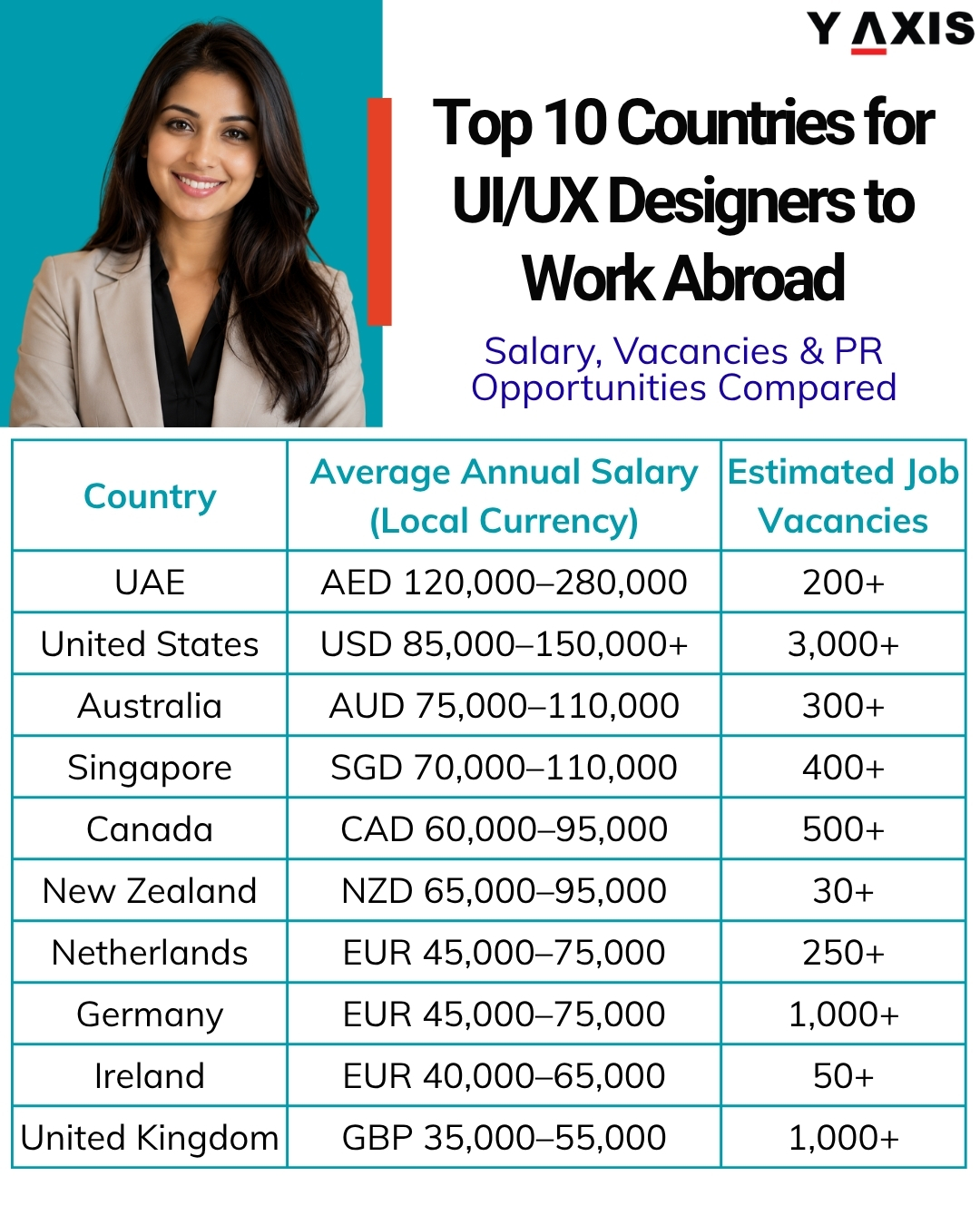
Top 10 Countries for UX/UI Designers: Quick Comparison
UX/UI Designers with experience in product design, design systems, e-commerce, or fintech interfaces are in demand across startups, agencies, and enterprise product teams worldwide. Growing digital transformation across Europe, North America, and Asia, combined with the global shift to subscription-based SaaS platforms, is driving sustained hiring of internationally qualified UX/UI Designers. Countries including the Netherlands, Ireland, Germany, and Canada offer employer-sponsored or points-based pathways that, once secured, open a direct route to permanent residency.
The table below highlights average annual salary and immigration pathways across the top 10 countries for UX/UI Designers.
|
Country |
Average Annual Salary |
Work Visa / Route |
Permanent Residency (PR) Pathway |
Estimated Job Vacancies* |
|
Netherlands |
EUR 45,000–75,000 |
Highly Skilled Migrant Visa |
PR after 5 years |
250+ |
|
EUR 45,000–75,000 |
EU Blue Card |
Settlement Permit in 21–33 months |
1,000+ |
|
|
Ireland |
EUR 40,000–65,000 |
Critical Skills Employment Permit |
Stamp 4 after 2 years (one of Europe's fastest PR pathways) |
50+ |
|
GBP 35,000–55,000 |
Skilled Worker Visa (SOC 2134) |
Indefinite Leave to Remain (ILR) after 5 years |
1,000+ |
|
|
CAD 60,000–95,000 |
LMIA Work Permit / Express Entry |
Express Entry (NOC 21233), typically 1–2 years |
500+ |
|
|
AUD 75,000–110,000 |
Skills in Demand Visa (Subclass 482) |
Subclass 186 or 191 (STSOL-listed occupation) |
300+ |
|
|
SGD 70,000–110,000 |
Employment Pass (EP) |
PR consideration after 2–3 years |
400+ |
|
|
AED 120,000–280,000 (tax-free) |
Employer-Sponsored Visa / Design District Freelance Permit |
Green Visa (freelancers) or Golden Visa (eligible high earners); no standard PR |
200+ |
|
|
New Zealand |
NZD 65,000–95,000 |
Accredited Employer Work Visa (AEWV) |
Skilled Migrant Category |
30+ |
|
USD 85,000–150,000+ |
H-1B Visa / Direct EB-2 or EB-3 |
PERM-based Green Card; longer wait for Indian applicants due to per-country caps |
3,000+ |
Which Country Is Best for You: UX/UI Designers' Decision Table
The ideal destination to migrate abroad as a UX/UI Designer depends on your specialisation, salary expectations, PR timeline, and the occupation classification your target country applies to design roles. The table below helps you assess the best country based on your individual priorities.
|
Your Goal |
Best Country |
Why |
|
Highest gross salary globally |
USA |
USD 85,000–150,000+/year in San Francisco, New York, and Seattle; deepest product design market in the world, though H-1B lottery odds and PERM/green-card timelines apply |
|
Fastest PR in Europe |
Ireland |
Critical Skills Employment Permit leads to Stamp 4 in 2 years; Web Design & Development Professionals sits on the Critical Skills Occupations List and Dublin's tech sector operates entirely in English |
|
Fastest skilled PR pathway overall |
Canada |
Express Entry under NOC 21233 (TEER 1); PR achievable in 1–2 years, especially through tech-focused category draws, with no separate licensing exam required |
|
Best EU Blue Card / product design hub |
Germany |
Berlin and Munich's dense startup and enterprise software scene, combined with a settlement permit achievable in as little as 21 months |
|
Best European tech ecosystem |
Netherlands |
Amsterdam's scale-up density and the Highly Skilled Migrant visa's fast, labour-market-test-free process, plus the 30% tax ruling for qualifying migrants |
|
Deepest UK design agency market |
United Kingdom |
London's concentration of fintech, e-commerce, and design consultancy roles under the Skilled Worker visa (SOC 2134) |
|
Best tax-free earning potential |
UAE |
Fully tax-free salaries with a genuinely freelance-friendly route through Dubai Design District; Green Visa access for freelancers clearing the income threshold |
|
Best Asia-based design career |
Singapore |
Employment Pass; roles concentrated in regional APAC product and fintech headquarters |
|
Best state-nominated/regional route |
Australia |
Skills in Demand visa (Subclass 482) and state-nominated Subclass 190/491, since Web Designer (232414) is STSOL-listed rather than MLTSSL-listed |
|
Steady general skilled route |
New Zealand |
Accredited Employer Work Visa leading to the standard Skilled Migrant Category — a genuine, if not fast-tracked, route for designers |
*Want to work abroad as a UX/UI Designer? Let Y-Axis guide you with the process.
1. Netherlands — Amsterdam's Scale-Up Ecosystem with a Fast Highly Skilled Migrant Route
The Netherlands has become one of Europe's strongest markets for UX/UI Designers, driven by Amsterdam's dense cluster of scale-ups, agencies, and regional tech headquarters. High-paying jobs in the Netherlands for UX/UI Designers are concentrated in Amsterdam, Rotterdam, Utrecht, and Eindhoven, across product design, fintech, and e-commerce platforms. The Netherlands job market for designers is anchored by the Highly Skilled Migrant (HSM) visa, which skips the labour market test entirely and offers one of the fastest employer-sponsored routes in the EU.
|
Avg Annual Salary |
EUR 45,000–75,000/year (entry: €35,000–€45,000; mid-level: €50,000–€70,000; senior: €75,000–€100,000+) |
|
Top Cities |
Amsterdam, Rotterdam, Utrecht, Eindhoven |
|
In-Demand Specialisations |
Product design, fintech and e-commerce UX, design systems, SaaS interface design |
|
Work Visa |
Highly Skilled Migrant (HSM) visa — no labour market test; minimum gross monthly salary of EUR 5,942 (age 30+) or EUR 4,357 (under 30) in 2026 |
|
Netherlands PR Pathway |
Permanent residency after 5 years of continuous legal residence; Dutch citizenship possible after 3–7 years depending on integration and language proficiency |
|
Qualification Note |
No mandatory design licensing body exists in the Netherlands. Employers assess candidates primarily on portfolio strength, Figma/design-system fluency, and relevant degree or bootcamp training. The 30% ruling can make salaries significantly more tax-efficient for qualifying migrants. |
*Want to apply for a Netherlands work visa? Let Y-Axis guide you with the process.
2. Germany — EU Blue Card Access to Europe's Largest Product Design Market
Germany offers UX/UI Designers one of the most direct EU Blue Card routes, backed by Berlin's and Munich's dense concentration of startups, scale-ups, and enterprise software companies. High-paying jobs in Germany for UX/UI Designers are available in Berlin, Munich, Hamburg, Frankfurt, and Cologne, across SaaS, automotive digital, and fintech interface design. The Germany job market for designers is anchored by the EU Blue Card, though non-technical design roles are generally assessed under the standard salary threshold rather than the reduced IT/shortage-occupation rate.
|
Avg Annual Salary |
EUR 45,000–75,000/year (entry: €38,000–€46,000; mid-level: €48,000–€60,000; senior: €65,000–€85,000+) |
|
Top Cities |
Berlin, Munich, Hamburg, Frankfurt, Cologne |
|
In-Demand Specialisations |
SaaS and enterprise software UX, automotive digital interfaces, fintech product design, design systems |
|
Work Visa |
EU Blue Card (§18g Aufenthaltsgesetz) — minimum gross annual salary of EUR 50,700 (standard route) in 2026; a lower EUR 45,934.20 threshold applies only to officially recognised shortage occupations, which does not typically include design roles |
|
Germany PR Pathway |
Settlement permit (Niederlassungserlaubnis) achievable in as little as 21 months with German B1 proficiency, or 33 months with A1, for EU Blue Card holders |
|
Qualification Note |
UX/UI design is not a regulated profession in Germany, so no state licensing body applies. However, patient- and client-facing communication in German B1 is increasingly expected for in-house design roles at German-headquartered companies, even though English is standard in most Berlin startups. |
*Want to apply for a Germany work visa? Let Y-Axis guide you with the process.
3. Ireland — Critical Skills Employment Permit with Europe's Fastest PR Track
Ireland gives UX/UI Designers one of the most accessible routes into the European tech sector, backed by Dublin's concentration of US tech headquarters and a growing homegrown SaaS scene. High-paying jobs in Ireland for UX/UI Designers are available in Dublin, Cork, Galway, and Limerick, across SaaS product design and digital agency work. The Ireland job market for designers benefits from Web Design & Development Professionals sitting on Ireland's Critical Skills Occupations List, and critically, the Critical Skills Employment Permit leads to Stamp 4 (Ireland's permanent residence equivalent) in just two years.
|
Avg Annual Salary |
EUR 40,000–65,000/year (entry: €40,000–€45,000; mid-level: €48,000–€58,000; senior: €60,000–€70,000+) |
|
Top Cities |
Dublin, Cork, Galway, Limerick |
|
In-Demand Specialisations |
SaaS product design, digital agency UX/UI, e-commerce interface design, design systems |
|
Work Visa |
Critical Skills Employment Permit, sponsored by a tech employer or digital agency — Web Design & Development Professionals is a listed Critical Skills Occupations List category; minimum salary threshold of EUR 40,904 as of March 2026 |
|
Ireland PR Pathway |
Stamp 4 after 2 years on the Critical Skills Employment Permit — the fastest permanent residence equivalent pathway in Europe |
|
Qualification Note |
There is no licensing board for UX/UI Designers in Ireland. Ireland's entirely English-speaking tech sector, combined with the dense presence of Google, Meta, Stripe, and LinkedIn's European operations in Dublin, makes it one of the easiest transitions for Indian-trained designers. |
*Want to apply for Ireland work visa? Let Y-Axis guide you with the process.
4. United Kingdom — Skilled Worker Route Across the UK's Deep Design Agency Market
The United Kingdom remains one of the largest employers of UX/UI Designers in Europe, driven by London's dense concentration of design agencies, fintechs, and global tech offices. High-paying jobs in the UK for UX/UI Designers are available in London, Manchester, Edinburgh, Bristol, and Leeds, across fintech, e-commerce, and digital agency work. The UK job market for designers is served through the Skilled Worker visa under SOC 2134, though the going rate for this code sits above the general salary threshold, so employers must clear the higher figure.
|
Avg Annual Salary |
GBP 35,000–55,000/year (entry: £30,000–£38,000; mid-level: £40,000–£50,000; senior: £52,000–£65,000+) |
|
Top Cities |
London, Manchester, Edinburgh, Bristol, Leeds |
|
In-Demand Specialisations |
Fintech and digital banking UX, e-commerce interface design, design agency and consultancy work, design systems |
|
Work Visa |
Skilled Worker Visa (SOC 2134 — Web design and development professionals) — going rate of approximately GBP 49,400/year in 2026, which exceeds the general threshold of GBP 41,700 and is therefore the binding figure for sponsorship |
|
UK PR Pathway |
Indefinite Leave to Remain (ILR) after 5 years of continuous residence on the Skilled Worker visa |
|
Qualification Note |
UX/UI design carries no licensing requirement in the UK. Because the SOC 2134 going rate is higher than many junior and mid-level design salaries, entry-level candidates should expect employers to rely on the new entrant discount (roughly 70% of the going rate) where eligible, or to target mid-to-senior roles that already clear the threshold comfortably. |
*Want to apply for a UK work visa? Let Y-Axis guide you with the process.
5. Canada — Express Entry PR Under NOC 21233 with One of the World's Fastest Timelines
Canada offers UX/UI Designers a strong combination of steady demand and one of the fastest employer-independent permanent residency pathways available. High-paying jobs in Canada for UX/UI Designers are available in Toronto, Vancouver, Montreal, Ottawa, and Calgary, across fintech, e-commerce, and enterprise SaaS design. The Canada job market for designers is classified under NOC 21233 (Web Designers, TEER 1), which qualifies directly for Express Entry without requiring a separate licensing exam.
|
Avg Annual Salary |
CAD 60,000–95,000/year (median approximately CAD 78,000; entry: CAD 50,000–65,000; senior: CAD 90,000–110,000+) |
|
Top Cities |
Toronto (Ontario), Vancouver (BC), Montreal (Quebec), Ottawa (Ontario), Calgary (Alberta) |
|
In-Demand Specialisations |
Fintech and e-commerce UX, enterprise SaaS design, design systems, product design for scale-ups |
|
Work Visa |
LMIA-backed Work Permit or direct Express Entry application under NOC 21233 (TEER 1 — Web Designers), which covers UX/UI design roles |
|
Canada PR Pathway |
Express Entry (Federal Skilled Worker Program or Canadian Experience Class) under NOC 21233; PR achievable in as little as 1–2 years, particularly through tech-focused category draws |
|
Qualification Note |
TEER 1 classification means Canada generally requires a university degree or equivalent relevant experience, but there is no separate competency exam or registration board for UX/UI Designers, unlike regulated healthcare professions. A strong portfolio carries significant weight in both hiring and, indirectly, in building the work experience needed for PR. |
*Want to Canada work visa? Let Y-Axis guide you with the process.
6. Australia — Employer-Sponsored and State-Nominated Routes for Digital Designers
Australia offers UX/UI Designers steady demand across Sydney and Melbourne's agency and product companies, though the occupation's classification means the pathway runs through state nomination and employer sponsorship rather than the fastest independent points-tested visas. High-paying jobs in Australia for UX/UI Designers are available in Sydney, Melbourne, Brisbane, and Perth, across e-commerce, fintech, and digital agency work. The Australia job market for designers is assessed under ANZSCO 232414 (Web Designer), which currently sits on the Short-Term Skilled Occupation List (STSOL) rather than the Medium and Long-term Strategic Skills List (MLTSSL).
|
Avg Annual Salary |
AUD 75,000–110,000/year (entry: AUD 65,000–80,000; mid-level: AUD 85,000–100,000; senior: AUD 105,000–130,000+) |
|
Top Cities |
Sydney, Melbourne, Brisbane, Perth |
|
In-Demand Specialisations |
E-commerce and retail UX, fintech interface design, digital agency and consultancy work, product design |
|
Work Visa |
Skills in Demand Visa (Subclass 482) (employer-sponsored) or state-nominated Subclass 190/491, since ANZSCO 232414 (Web Designer) is STSOL-listed rather than MLTSSL-listed |
|
Australia PR Pathway |
Subclass 186 (Employer Nomination Scheme) after time on a Subclass 482 visa, or Subclass 191 after 3 years on a Subclass 491 regional visa — direct, unsponsored Subclass 189 access is not currently available for this occupation code, unlike MLTSSL-listed roles |
|
Qualification Note |
Because Web Designer (232414) sits on the STSOL, Indian UX/UI Designers should plan around employer sponsorship or state/regional nomination rather than assuming immediate points-tested PR access. A VETASSESS skills assessment is required, and candidates should confirm their target state's current nomination priorities before applying. |
*Want to apply for a Australia work visa? Let Y-Axis guide you with the process.
7. Singapore — Asia's Regional Design Hub with a COMPASS-Assessed Employment Pass
Singapore is Asia-Pacific's leading hub for regional product and design headquarters, anchored by the many multinational tech and fintech companies that base their APAC design teams in the city-state. High-paying jobs in Singapore for UX/UI Designers are concentrated around fintech, e-commerce, and regional SaaS product teams. The Singapore job market for designers runs through the Employment Pass, which since January 2026 requires clearing both a higher salary floor and the COMPASS points framework.
|
Avg Annual Salary |
SGD 70,000–110,000/year (entry: SGD 60,000–75,000; mid-level: SGD 80,000–95,000; senior: SGD 100,000–130,000+) |
|
Top Cities |
Singapore (city-state; roles concentrated around the CBD and one-north tech precinct) |
|
In-Demand Specialisations |
Fintech and regional SaaS UX, e-commerce interface design, APAC product design hub roles |
|
Work Visa |
Employment Pass (EP) — minimum qualifying salary of SGD 6,200/month (2026) for most sectors, plus a minimum score of 40 points under the Complementarity Assessment Framework (COMPASS) |
|
Singapore PR Pathway |
Permanent residency applications are typically considered after 2–3 years of Employment Pass holding, via Singapore's Ministry of Manpower discretionary PR scheme (Professionals/Technical/Skilled route) |
|
Qualification Note |
There is no registration board for UX/UI Designers in Singapore. The COMPASS framework means employers must also demonstrate the role's salary sits competitively against local professionals, so candidates should expect offers materially above the SGD 6,200 floor for a credible application, particularly for experienced hires. |
*Want to apply for a Singapore work visa? Let Y-Axis guide you with the process.
8. UAE — Tax-Free Freelance and Employer Routes Through Dubai's Design District
The UAE offers UX/UI Designers fully tax-free earnings alongside one of the few genuinely freelance-friendly immigration routes on this list, anchored by Dubai's dedicated creative free zones. High-paying jobs in the UAE for UX/UI Designers are available in Dubai, Abu Dhabi, and Sharjah, across fintech, e-commerce, and agency design work. The UAE job market for designers is served by both employer-sponsored work visas and a dedicated freelance permit route through Dubai Design District (d3) and similar free zones — design is one of the officially permitted GoFreelance activity categories.
|
Avg Annual Salary |
AED 120,000–280,000/year (approximately USD 33,000–76,000), fully tax-free |
|
Top Cities |
Dubai, Abu Dhabi, Sharjah |
|
In-Demand Specialisations |
Fintech and e-commerce UX, digital agency and freelance design work, product design for regional startups |
|
Work Visa |
Employer-sponsored UAE work visa, or a freelance permit issued through Dubai Design District (d3), Dubai Media City, or a similar TECOM free zone under the GoFreelance programme — no local sponsor required for the freelance route |
|
PR Pathway |
No standard PR route for most employees. Freelancers earning AED 360,000+ per year over two consecutive years may qualify for the 5-year Green Visa; high earners or exceptional talent may qualify for the 10-year Golden Visa |
|
Qualification Note |
The UAE has no licensing board for UX/UI Designers, unlike regulated healthcare or legal professions. This makes it one of the more accessible markets on this list for freelancers and contractors, though building toward the AED 360,000 Green Visa income threshold typically requires 1–2 years of established freelance income first. |
9. New Zealand — Accredited Employer Route Without Green List Fast-Tracking
New Zealand offers UX/UI Designers a genuine but standard skilled-migration route, without the fast-track residence pathway available to some shortage occupations. High-paying jobs in New Zealand for UX/UI Designers are available in Auckland, Wellington, Christchurch, and Hamilton, across e-commerce, fintech, and government digital services. The New Zealand job market for designers runs through the Accredited Employer Work Visa, since UX/UI Designer does not currently sit on the Green List of fast-tracked shortage occupations.
|
Avg Annual Salary |
NZD 65,000–95,000/year (entry: NZD 60,000–70,000; mid-level: NZD 75,000–85,000; senior: NZD 90,000–110,000+) |
|
Top Cities |
Auckland, Wellington, Christchurch, Hamilton |
|
In-Demand Specialisations |
E-commerce and retail UX, government digital services design, fintech interface design |
|
Work Visa |
Accredited Employer Work Visa (AEWV) — general median wage threshold of approximately NZD 35.00/hour as of March 2026; UX/UI Designer is not a Green List Tier 1 or Tier 2 occupation |
|
New Zealand PR Pathway |
Residence via the standard Skilled Migrant Category (SMC) points-based route after a period of qualifying skilled employment — there is no Work to Residence fast-track for this occupation, unlike Green List-listed roles |
|
Qualification Note |
Because UX/UI Designer sits outside the Green List, Indian applicants should plan realistically around the standard AEWV-to-SMC timeline rather than assuming the accelerated residence pathway available to shortage occupations such as software engineers or registered nurses. |
*Want to apply for a New Zealand work visa? Let Y-Axis guide you with the process.
10. USA — The World's Largest Design Market, Without a Shortage-Occupation Fast Track
The United States is the world's largest and highest-paying market for UX/UI Designers, home to the majority of global product companies, but it offers no equivalent to the Schedule A shortage designation available to some healthcare professions. High-paying jobs in the USA for UX/UI Designers are available in San Francisco, New York, Seattle, Austin, and Los Angeles, across big tech, fintech, and enterprise SaaS product teams. The USA job market for designers is the deepest on this list, though Indian applicants should plan realistically around the H-1B lottery and standard green card backlogs.
|
Avg Annual Salary |
USD 85,000–150,000+/year (entry: USD 65,000–85,000; mid-level: USD 95,000–120,000; senior: USD 130,000–170,000+) |
|
Top Cities |
San Francisco, New York, Seattle, Austin, Los Angeles |
|
In-Demand Specialisations |
Big tech product design, fintech and enterprise SaaS UX, design systems, AI-driven interface design |
|
Work Visa |
H-1B (employer-sponsored, subject to the annual lottery) for temporary work; direct EB-2/EB-3 green card sponsorship is also common for experienced designers |
|
PR Pathway |
UX/UI Designer is not a Department of Labor Schedule A occupation, so employers must complete the standard PERM labour certification process before filing an EB-2 or EB-3 green card petition. Indian applicants face the same per-country visa bulletin backlog as most other employment categories, often extending several years |
|
Qualification Note |
Unlike Physical Therapists, UX/UI Designers have no Schedule A shortage designation and no licensing board in the USA. The H-1B lottery — not a skills shortage list — is the main bottleneck for entry, so candidates should treat multiple lottery cycles and a realistic PERM/green-card timeline as part of their overall planning. |
*Want to apply for a USA work visa? Let Y-Axis guide you with the process.
Key Qualifications and Skills UX/UI Designers Need to Land Jobs Abroad
International employers, product teams, and design agencies consistently look for the following qualifications, tools, and skills when hiring UX/UI Designers from overseas.
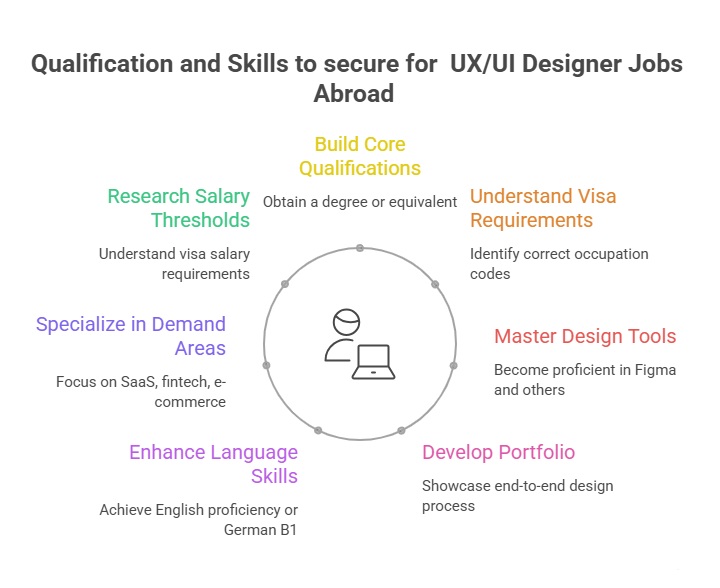
Here are the key qualifications and skills to build before applying for overseas UX/UI design roles:
- Core qualification: A Bachelor's degree in Design, HCI (Human-Computer Interaction), or a related field is the common entry standard, though a strong self-taught portfolio or bootcamp certification (e.g., in Figma, Adobe XD) can substitute for formal education in most markets on this list
- No licensing board required: Unlike physiotherapists, nurses, or engineers, UX/UI Designers do not need to register with any professional body before practising in the UK, Ireland, Germany, the Netherlands, Canada, Australia, Singapore, the UAE, New Zealand, or the USA
- Correct occupation code for points-based routes: NOC 21233 (Web Designers, TEER 1) for Canada and ANZSCO 232414 (Web Designer, STSOL) for Australia determine your visa pathway and PR timeline — get this classification right before applying
- Design tool proficiency: Figma is now the industry-standard tool across all 10 countries; Adobe XD, Sketch, and prototyping tools such as Framer strengthen a portfolio further
- Portfolio depth: A well-documented portfolio showing end-to-end process — user research, wireframes, prototypes, and usability testing outcomes — carries more weight internationally than academic credentials alone
- Language proficiency: English is sufficient for the Netherlands, Ireland, the UK, Canada, Australia, Singapore, New Zealand, and the UAE in most tech and agency settings; German B1 proficiency is increasingly expected for in-house design roles at German-headquartered companies
- Specialisation: Product design for SaaS and fintech platforms is the most universally transferable specialisation, while e-commerce and design systems expertise are increasingly valuable given the scale of global digital retail and platform growth
- Understanding of visa salary thresholds: The UK's SOC 2134 going rate, Germany's EU Blue Card threshold, and Singapore's COMPASS-assessed Employment Pass floor all directly affect which roles qualify for sponsorship — research your target country's current thresholds before negotiating an offer
Which Country Is Right for Your UX/UI Designer Career?
The right country to migrate abroad as a UX/UI Designer depends on your specialisation, salary expectations, and PR goals. The table below helps you identify the best country based on your specific priorities:
|
Your Goal |
Best Country |
Why |
|
Highest gross salary globally |
USA |
USD 85,000–150,000+/year in San Francisco, New York, and Seattle; deepest product design market in the world, though H-1B lottery odds and PERM/green-card timelines apply |
|
Fastest PR in Europe |
Ireland |
Critical Skills Employment Permit leads to Stamp 4 in 2 years; Web Design & Development Professionals sits on the Critical Skills Occupations List and Dublin's tech sector operates entirely in English |
|
Fastest skilled PR pathway overall |
Canada |
Express Entry under NOC 21233 (TEER 1); PR achievable in 1–2 years, especially through tech-focused category draws, with no separate licensing exam required |
|
Best EU Blue Card / product design hub |
Germany |
Berlin and Munich's dense startup and enterprise software scene, combined with a settlement permit achievable in as little as 21 months |
|
Best European tech ecosystem |
Netherlands |
Amsterdam's scale-up density and the Highly Skilled Migrant visa's fast, labour-market-test-free process, plus the 30% tax ruling for qualifying migrants |
|
Deepest UK design agency market |
United Kingdom |
London's concentration of fintech, e-commerce, and design consultancy roles under the Skilled Worker visa (SOC 2134) |
|
Best tax-free earning potential |
UAE |
Fully tax-free salaries with a genuinely freelance-friendly route through Dubai Design District; Green Visa access for freelancers clearing the income threshold |
|
Best Asia-based design career |
Singapore |
Employment Pass; roles concentrated in regional APAC product and fintech headquarters |
|
Best state-nominated/regional route |
Australia |
Skills in Demand visa (Subclass 482) and state-nominated Subclass 190/491, since Web Designer (232414) is STSOL-listed rather than MLTSSL-listed |
|
Steady general skilled route |
New Zealand |
Accredited Employer Work Visa leading to the standard Skilled Migrant Category — a genuine, if not fast-tracked, route for designers |
Want to get your UX/UI Designer profile assessed? Try Y-Axis Free Eligibility Assessment to evaluate your profile. Call +91-7670800001.
Watch: Top Countries Offering Work Permits and PR Pathways in 2026
The global UX/UI design job market is evolving rapidly. Countries are refining occupation classifications, adjusting visa salary thresholds, and competing for experienced designers from India.
Watch the Y-Axis Podcast to explore the latest overseas UX/UI design career opportunities, high-demand roles, work visa pathways, salary benchmarks, and permanent residence options in the world's strongest design job markets.
Watch To Know More: Want to Work, Study, or Settle Abroad? Watch This First!
Discover the best pathways to work, study, or settle abroad with expert guidance from Y-Axis. Learn about visa options, eligibility requirements, top destinations, and the application process to help you achieve your global career and immigration goals.
How to Migrate Abroad as a UX/UI Designer from India?
Migrating abroad as a UX/UI Designer from India starts with identifying your target visa route alongside your PR strategy and occupation classification. Indian UX/UI Designers can target countries via the Employer-Sponsored route (work visa with PR pathway) or the Independent Points-Based route depending on the country selected.
The steps to migrate abroad as a UX/UI Designer from India are as follows:
Step 1: Identify your target country based on your specialisation, salary expectations, PR timeline, and occupation classification using the comparison tables above.
Step 2: Build and refine a strong portfolio showing end-to-end design process — user research, wireframes, prototypes, and usability testing outcomes.
Step 3: Identify the correct occupation code for points-based routes — NOC 21233 for Canada, ANZSCO 232414 for Australia — since this determines your visa pathway and PR timeline.
Step 4: Complete any English proficiency test such as IELTS if required, or German B2/B1 certification if targeting in-house roles in Germany.
Step 5: Update your resume and LinkedIn to reflect your specialisation, product impact, and specific design tools you're proficient in.
Step 6: Apply for UX/UI design roles through LinkedIn, design-specific job boards (Dribbble, Behance job listings), and specialist tech recruiters.
Step 7: Secure a job offer meeting the visa salary threshold for your target country.
Step 8: Submit your work visa or work permit application with all required documents such as passport, degree or portfolio certification, employment contract, and health insurance.
Step 9: Complete biometrics and any country-specific pre-departure requirements, including police clearance certificates.
Step 10: Upon visa approval, migrate to your preferred country and begin your international UX/UI design career.
Common Mistakes UX/UI Designers Make When Applying for Jobs Abroad
Indian UX/UI Designers are in demand across the Netherlands, Germany, Ireland, Canada, and the Gulf. Understanding common mistakes around occupation classification, visa thresholds, and portfolio presentation can significantly improve your chances.
Here are some common mistakes to avoid when applying for overseas UX/UI design roles:
|
Common Mistake |
Practical Solution |
|
Assuming a design degree alone guarantees visa sponsorship |
Employers weight portfolio quality and demonstrated design-tool proficiency far more heavily than academic credentials — invest in a strong, well-documented portfolio before applying, since no licensing exam exists to fall back on |
|
Misclassifying your occupation code for points-based visas |
Canada's NOC 21233 and Australia's ANZSCO 232414 carry different implications for PR speed and sponsorship type — confirm your correct classification with a skills assessor before committing to a country |
|
Assuming Australia offers the same direct PR access as MLTSSL occupations |
Web Designer (232414) sits on the STSOL, not the MLTSSL — plan around employer sponsorship (Subclass 482) or state/regional nomination (Subclass 190/491) rather than assuming unsponsored Subclass 189 access |
|
Overlooking New Zealand's Green List exclusion |
UX/UI Designer is not currently a Green List occupation in New Zealand — this means the standard Skilled Migrant Category route applies, not the accelerated Work to Residence pathway available to shortage occupations |
|
Assuming the USA offers a shortage-occupation fast track |
Unlike Physical Therapists (Schedule A), UX/UI Designers must go through the standard PERM labour certification process for a green card — factor in the full PERM timeline and per-country visa bulletin backlog, not just the H-1B lottery stage |
|
Underestimating Singapore's COMPASS framework |
Clearing the SGD 6,200/month salary floor is not enough on its own — employers must also score at least 40 points under COMPASS, so competitive offers well above the minimum strengthen the case significantly |
Are you looking for step-by-step assistance with overseas immigration? Contact Y-Axis, the world's No. 1 overseas immigration consultancy, for end-to-end assistance! Call +91-7670800001.
FAQs
Which are the top 10 countries for UX/UI Designers to work abroad?
The top 10 countries are the Netherlands, Germany, Ireland, the UK, Canada, Australia, Singapore, the UAE, New Zealand, and the USA. Ireland and Canada offer some of the fastest PR pathways. The USA offers the highest salaries but has no shortage-occupation fast track and a significant employment-based green card backlog for Indian applicants. The UAE provides tax-free income and a freelance-friendly route.
Do UX/UI Designers need a licence or registration to work abroad?
No. Unlike physiotherapists, nurses, or engineers, UX/UI Designers generally do not require a licensing board or professional registration in any of these countries. Employers primarily evaluate candidates based on their portfolio, relevant education or bootcamp training, and proficiency in tools such as Figma, Adobe XD, or Sketch.
Which country offers the fastest PR for UX/UI Designers?
Ireland offers one of Europe's fastest PR pathways, with the Critical Skills Employment Permit leading to Stamp 4 after two years. Canada's Express Entry system can result in PR within one to two years for eligible applicants. Germany's EU Blue Card can lead to permanent settlement in as little as 21 months with German B1 language proficiency.
What is the average salary for UX/UI Designers in the USA?
UX/UI Designers in the USA typically earn between USD 85,000 and USD 150,000+ annually. The highest-paying locations include San Francisco, New York, and Seattle. Since UX/UI Designer is not a Schedule A occupation, employers must complete the standard PERM labour certification process before sponsoring permanent residence.
Is the Netherlands a good destination for UX/UI Designers?
Yes. The Netherlands offers one of Europe's fastest employer-sponsored immigration pathways through the Highly Skilled Migrant (HSM) visa. Amsterdam's thriving startup ecosystem, international companies, and the 30% tax ruling make it an attractive destination for UX/UI professionals.
What is the Highly Skilled Migrant visa and how does it work for designers?
The Highly Skilled Migrant (HSM) visa allows recognised Dutch employers to sponsor skilled professionals, including UX/UI Designers. For 2026, the minimum monthly salary requirement is EUR 5,942 for applicants aged 30 or above and EUR 4,357 for applicants under 30. The visa does not require a labour market test.
Can Indian UX/UI Designers get an EU Blue Card in Germany?
Yes. Applicants with a recognised university degree and a qualifying job offer meeting the salary threshold may apply for an EU Blue Card. For 2026, the standard salary threshold is EUR 50,700 annually. Reduced thresholds apply only to recognised shortage occupations and certain recent graduates.
Is Ireland's Critical Skills list open to UX/UI Designers?
Yes. Ireland's Critical Skills Occupations List includes Web Design & Development Professionals under the ICT category. The 2026 minimum annual salary requirement is EUR 40,904. Successful applicants receive a Critical Skills Employment Permit and become eligible for Stamp 4 after two years.
What is NOC 21233 and why does it matter for Canada?
NOC 21233 (Web Designers) is Canada's occupational classification commonly used for UX/UI Designers under TEER 1. This allows eligible professionals to apply through Express Entry programs such as the Federal Skilled Worker Program and Canadian Experience Class, subject to meeting program requirements.
Can UX/UI Designers get direct PR in Australia?
UX/UI Designers are generally assessed under ANZSCO 232414 (Web Designer), which is currently listed on the Short-Term Skilled Occupation List (STSOL). Most applicants obtain permanent residence through employer sponsorship or state/regional nomination pathways rather than the independent Subclass 189 visa.
What is the Employment Pass salary threshold for designers in Singapore?
As of January 2026, Singapore's Employment Pass generally requires a minimum qualifying salary of SGD 6,200 per month. Applicants must also satisfy the COMPASS framework, where salary, qualifications, employer diversity, and skills contribute toward eligibility.
Can UX/UI Designers freelance legally in the UAE?
Yes. UX/UI Designers can legally freelance through Dubai's GoFreelance programme and selected free zones such as Dubai Design District (d3), Dubai Media City, and Dubai Knowledge Park. Eligible freelancers may later qualify for long-term residence through the Green Visa or Golden Visa, subject to meeting the applicable requirements.
Is UX/UI Designer on New Zealand's Green List?
No. UX/UI Designer is not currently included on New Zealand's Green List. Most designers apply through the Accredited Employer Work Visa (AEWV) and later transition to residence through the Skilled Migrant Category if they meet the required points and eligibility criteria.
What documents are required for a UX/UI Designer visa application abroad?
- Valid passport
- Relevant degree or recognised bootcamp certification
- Professional UX/UI design portfolio
- Employment contract or job offer
- Educational qualification documents
- Police clearance certificate
- English or local language test results (where applicable)
- Medical insurance (if required)
Which country offers tax-free income for UX/UI Designers?
The UAE offers tax-free salaries for UX/UI Designers, typically ranging from AED 120,000 to AED 280,000 per year. Dubai and Abu Dhabi continue to see strong demand across fintech, digital agencies, and e-commerce sectors.
Do UX/UI Designers need to know a local language to work abroad?
It depends on the destination. English is generally sufficient in the Netherlands, Ireland, the UK, Canada, Australia, Singapore, New Zealand, and the UAE. Germany increasingly expects German language proficiency, particularly for long-term employment and settlement.
How important is a portfolio compared to formal qualifications for UX/UI Designers?
A strong portfolio is often more important than formal qualifications. Employers place significant emphasis on real-world case studies, user research, problem-solving ability, and proficiency in tools such as Figma, Adobe XD, and Sketch when selecting candidates for international roles.
Can I bring my family when I move abroad as a UX/UI Designer?
Yes. Most skilled worker visa programmes in the Netherlands, Germany, Ireland, the UK, Canada, Australia, and New Zealand allow applicants to include their spouse and dependent children. Family eligibility in Singapore and the UAE generally depends on meeting specific salary thresholds.
Which specialisation is most in demand for UX/UI Designers abroad?
Product design for SaaS platforms, fintech applications, design systems, mobile app UX, and e-commerce user experience remain the most sought-after specialisations globally. Strong expertise in user research, prototyping, accessibility, and design systems significantly improves employability.
How does Y-Axis help Indian UX/UI Designers work abroad?
Y-Axis offers complete guidance for Indian UX/UI Designers, including eligibility assessment, visa and immigration support, employer-sponsored work visa assistance, Express Entry and PR application guidance, resume and portfolio marketing, and job search support to help professionals secure overseas opportunities.
Tags:
UX UI designer jobs abroad
UX designer jobs overseas
UI designer salary abroad
UX UI designer work visa
UX UI designer PR pathway
migrate as a UX UI designer
overseas UX UI design careers
UX UI designer immigration India
digital design jobs abroad
Share
Options for you by Y-Axis

Get it on your mobile

Get News alerts

Contact Y-Axis
Latest Article
Popular Post
Trending Article
Posted On September 29 2026
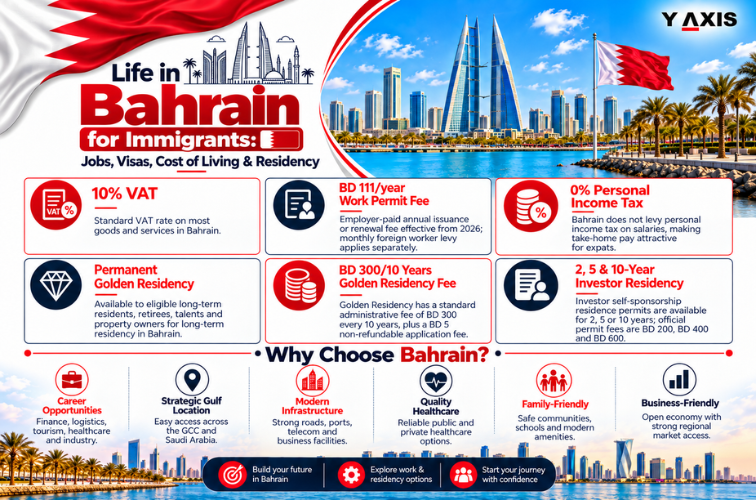
Life in Bahrain for Immigrants: Jobs, Visas, Cost of Living & Residency